Wednesday, October 09, 2013

Lunchbox of the Week: Charlie's Angels (Aladdin)


Collectibles of the Week: The Charlie's Angels Collection (Hasbro; 1977 - 1978)


In 1976, ABC had a surprise hit on its hands with Charlie's Angels, an action/crime drama starring Farrah Fawcett, Jaclyn Smith, and Kate Jackson as a team of beautiful crime-stoppers. The series ran for five seasons (until 1981), spawned two feature film re-imaginations in the early 2000s, and recently a TV re-boot in 2011.  But the original series also spawned a highly successful line of toys from Hasbro.

Specifically, Hasbro produced a line of 8.5 inch action figures of the series' three main characters -- Jill (Fawcett), Sabrina (Jackson) and Kelly (Smith).  And when Fawcett left the show for a movie career, Cheryl Ladd's Kris was added to the line-up.


But the these action figures -- "beautiful girls that live dangerously" -- were only the beginning of the Hasbro merchandise.  There was also an incredible and much-sought-after play set called "The Hideaway House," a multi-level affair described in promotional materials as "the heavenly abode Charlie built for the Angels." 

In addition, Hasbro produced a "sensational wardrobe for the girls who live dangerously by day, glamorously by night."  These costume changes had names like "moonlight flight," "night caper," "black magic" and "gaucho pizzazz."


Some costume change sets also came with accouterments and accessories.  These sets included "The Slalom Caper," "River Race" and "Underwater Intrigue."

A vehicle was also released for the angles, the "adventure van" which came with a director's chair, wrist camera, headset and binoculars.


Below, some commercial for the Charlie's Angels line, by Hasbro:


Model Kit of the Week: Charlie's Angels Van (Revell)


Board Game of the Week: Charlie's Angels (Milton Bradley)


Monday, October 07, 2013

Ask JKM a Question: Surveillance (2008)?


My friend and reader, Trent, writes:


"Could you possibly post a review of a 2008 release of a title called 'Surveillance'? Starring Bill Pullman & Julia Ormond,  directed by Jennifer Lynch,  I am truly curious as to what you think of this film."


Trent, I watched the thriller Surveillance after receiving your e-mail, and found it a strange, strange film, with a quirky sense of humor, and some remarkable visuals.  I have a lot to explore there, so thanks for leading me to Lynch's film. It is indeed...Lynch-ian.

I will post a detailed review this Friday morning, so look for it!

Cult-TV Theme Watch: Brains


The brain is (according to Wikipedia) “the center of the nervous system in all vertebrate and most invertebrate animals.”  The brain “acts on the rest of the body both by generating patterns of muscle activity and by driving the secretion of chemicals called hormones. This centralized control allows rapid and coordinated responses to changes in the environment.”
In cult-television history, however, the humanoid brain has played a different kind of role.  It has survived death (often in jars filled with colored fluid), and it has been the form of life evolved beyond the need of physical, biped bodies. 

In Star Trek (1966 – 1969), the Enterprise encountered three individuals of highly-advanced brain creatures, the Providers, on the distant world of Triskelion.  
In the more notorious episode “Spock’s Brain,” aliens in go-go boots incapacitate the crew and surgically-remove Mr. Spock’s brain so that it can control the faculties of their underground complex on a distant world.


In Space: 1999 (1975 – 1977), Moonbase Alpha traveled through a region of space where a gigantic entity, a space brain, dwelt, in an episode titled, appropriately “Space  Brain.” This brain was capable of defending itself with crushing antibodies and was found to be on a collision course with the errant moon.  A second season story, “Brian the Brain” involved a malevolent robot brain, Brian, who had murdered his human crew.
In the second episode of the short-lived series The Fantastic Journey (1977), a group of travelers on an island in the Bermuda Triangle come across a metropolis where a giant brain controls all the city’s activity – including the capacity to send lost travelers home – in “Atlantium.”
The old trope of the brain in a jar has appeared on Doctor Who, in the serial “Brain of Morbius” and in the Wonder Woman (1976 – 1979) episode “Gault’s Brain.”

 
In the former program, the Fourth Doctor (Tom Baker) and his companion Sarah-Jane Smith (Elizabeth Sladen) land on a world where a mad scientist is seeking to place the brain of a Time-Lord renegade into a Frankenstein-like body. 


In the latter show, Wonder Woman (Lynda Carter) tangles with Gault (John Carradine), a brain with frightening telepathic powers….
The X-Files (1993 – 2002) featured an episode in its seventh season titled “Hungry” in which a genetic mutant boasting qualities of a shark could survive only by feasting on human brain.
"Brain Guy," (Bill Corbett) meanwhile, was a regular character on Mystery Science Theater 3000 in its Sci-Fi Channel years.  A ghost-faced Observer, Brain Guy carried his brain around -- exposed -- in a pan.

The Cult-TV Faces of: Brains

Not Identified: The Outer Limits: "The Brain of Colonel Barnham"

Identified by SGB: Star Trek: "The Gamesters of Triskelion."

Identified by SGB: Star Trek: "Spock's Brain."

Identified by SGB: Space:1999: "Space Brain."

Not Identified: Doctor Who: "The Brain of Morbius."

Identified by SGB: Space:1999: "Brian the Brain."

Not Identified: The Fantastic Journey: "Atlantium"

Not Identified: Wonder Woman: "Gault's Brain"

Identified by SGB: Pinky and the Brain


Identified by SGB: Brain Guy and Friends from Mystery Science Theater 3000.


Identified by Mr. C: "Hungry."

Identified by Lonestarr357: "The Day the Earth Stood Stupid"

Identified by SGB: Ben 10's Brainstorm.

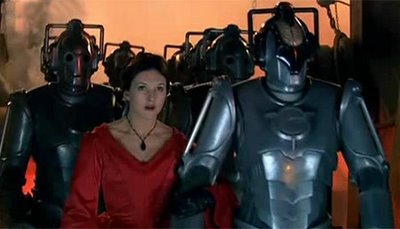
Identified by SGB: Doctor Who: "The Next Doctor."

Television and Cinema Verities #90


“The assumption is that this is a metaphysical story, not a ghost story, meaning that we’re making the adult’s thinking version. So the trick and the brilliance of director Mark Pellington was finding a visual vocabulary that would suggest a presence and give you the kind of chilling feeling that was much deeper and larger than “Don’t open that door.”


-Richard Gere discusses The Mothman Prophecies (2002), at Sci-Fi Online. I’ll be reviewing the film here, tomorrow morning.

Sunday, October 06, 2013

Cult-TV Flashback: The Tomorrow People (1973 - 1979)


From Great Britain -- the home of Dr. Who, UFO, Blake's 7, Space:1999, The Prisoner and Sapphire and Steel -- came this 1970s TV serial about homo superior, a new brand of "evolved" human beings. 

The CW has remade the series, and the new show will be airing beginning this coming Wednesday, October 9.  Today, a look back at the disco-decade original.

In the first five-part serial of The Tomorrow People (1973 - 1979), penned by series creator Roger Price and Brian Finch and directed by Paul Bernard, we join the first three tomorrow people in the middle of a rescue mission, in media res.

In particular, Tomorrow People leader John (Nicholas Young) -- a serious, fast-talker -- and his companions, Carol (Sammie Winmill) and Kenny (Stephen Salmon), have set out with the help of their friendly computer, Tim (a more kindly version of HAL) to bring a young boy named Stephen (Peter Vaughan-Clarke) into the fold.

Stephen is in the delicate process of "breaking out" (an experience analogous to puberty in humans), wherein his mental skills as a "tomorrow person" are coming to the forefront of his psyche. Among these powers are the three "T's" of the tomorrow people: telepathy, teleportation and telekinesis. When Carol visits Stephen in the hospital following a "brainstorm," she informs Stephen of his destiny as an evolved human being, a tomorrow person.

Because they share a mental link, "tomorrow people are never alone." Also, tomorrow people are totally incapable of killing. They can defend themselves, but they cannot commit murder under any circumstances. Fortunately, their advanced minds as well as their technology help them complete their tasks (locating and educating more tomorrow people, and communing with alien races...), and we see examples in this first serial of their tools of the trade.

For instance, The Tomorrow People carry nifty stun guns (which don't kill), and also wear belts that help them "jaunt" back and forth from one location to another through hyperspace. Jaunting, in case you were wondering, is "the instant transmission of bodies from one point in space to another" (like beaming up). The tomorrow people operate from a central headquarters in an abandoned underground station (where a geological fault was detected...), and the base is equipped with view screens, computers, a jaunt pad and more.


Tim (Philip Gilbert) is the best technology of all. "I'm a biological computer," he informs Stephen. "I don't have disks and tapes." The high-tech "machine" is fully capable of original thought, and he also cooks...materializing food instantaneously (sort of like a replicator in latter day Treks). In this first serial, we see Tim make some executive decisions when the young tomorrow people can't. In an especially dangerous situation, he overrides the jaunt pad so that all the tomorrow people can't be put into danger at once.

The Tomorrow People also reveal to Stephen in this episode that Earth is a "closed world;" that aliens are not supposed to visit the planet, though they occasionally do so. And that fact leads into the central intrigue of "The Slave of Jedikiah:" a mysterious bearded man also wants to get his hands on Stephen for some mysterious purpose, and abducts the boy to rural Bentham Hall with the help of a comic (and annoying..) motorcycle gang. The Jedikiah squelches Stephen's telepathic ability with a "silencer band," which soaks up mental transmissions.

The Tomorrow People set out to rescue Stephen and solve the mystery of the Jedikiah (who calls the Tomorrow People "younglings"). They soon discover that there is some truth Homer's Odyssey, particularly in the character of Polyphemus. Seems that Jedikiah is the (robotic, shape-shifting servant of a green alien cyclops aboard a damaged spaceship in Earth orbit. The Cyclops requires the help of telepaths to help him get his ship into hyperspace, because his own telepathic slaves died in an accident. While evading Jedikiah (rendered out-of-control by a stun-gun shot to the head), the Tomorrow People attempt to send the alien Cyclops back to his planet. In the process, they learn that, according to the alien, "Earth has a bad reputation."

"You are always at war," he tells them, and every time an ambassador is sent from other worlds, "he's slain."

"The Slaves of the Jedikiah" ends with Stephen on track to join the Tomorrow People in future assignments, and a friendship forged with the comic motorcycle dudes.

"The Slaves of Jedikiah," The Tomorrow People's introductory serial, is one that grows less and less interesting the longer it lasts. The first portions of the narrative (thru Part III or thereabouts) serve as splendid set-up of Price's interesting and unique universe, but by episodes four and five, we're deep in "runaround" territory (a failing also of early Doctor Who), with Kenny getting kidnapped and rescued, and the robotic Jedikiah roaming endlessly through spaceship corridors. The good will and curiosity forged by the serial's fine beginning is pretty much squandered by the end. You watch episode 5 and you're ready to move onto the next serial already. You like the characters; you like the settings...you just want a better story.

What works so beautifully about The Tomorrow People (termed a children's show at the time) is the central premise (one shared, in various ways by modern franchises such as Heroes, Prey and Mutant X). It's the notion that mankind is evolving into something better, and that people with special abilities walk among us. Because this series was created in 1973, the next step of human evolution depicted here - homo superior - is idealistic, anti-war (this was the age of the Vietnam conflict after all) and intensely pacifist. The Tomorrow People boast the idealism of the Hippie Movement, but the characters have the technology, science and power behind them to exploit their skills in clever, useful and entertaining ways.

Even the central threat in "The Slaves of Jedikiah" arises not from deliberate alien malevolence, but rather from misunderstanding and fear. Carol asks Ranesh (the Cylops) why he didn't just ask for help, rather than trying to force the Tomorrow People to come to his aid, and his answer concerns human nature and human history. Yeah, it's a "message," but it isn't preachy. It's in the fine tradition of The Day The Earth Stood Still or Star Trek.

I also love the idea so prominently placed here that any child in the world can "break out;" can become a tomorrow person. That's an enormously appealing idea; the notion that one day you can make an impact; change your world for the better. And there are no exclusions on your abilities based on Earthly prejudices like sex, race or (presumably) orientation. It's an immensely positive idea to impart to kids (and grown-ups too, perhaps).


If you've watched 1970s British science fiction television before, you know that (excepting UFO and Space:1999) there are often limitations in terms of budget, and therefore in terms of visualizations or production values. The same is true here. The robot Jedikiah turns into is very, very lame (a sort of cardboard box creation). There's a lot of what appears to be chroma key work ...some of it good (the jaunting), some of it not so good (the hyperspace sequence). The "futuristic" space helmets appear to be football helmets, down to wire mesh over the eye slits. Still, I enjoy the look of the Underground HQ (a great set...), and I appreciated the retro-style jaunt control belts.

For a so-called "children's show," The Tomorrow People does absolutely zero talking down to the audience, which is also a really fine quality of British si-fi.  This serial, "The Slaves of The Jedikiah" explains in rapid-fire succession such adult genre concepts as hyperspace, teleportation, shape-shifting, biological computers, telepathy, and even Darwinism. The imagination of the ideas far outstrips the special effects and that's a trade I'm happy to make. 

I will be interested to see how American television of 2013 re-parses The Tomorrow People.  I'm expecting angsty, doom-n'-gloom adolescent super-models, and a more Earth-based story-line. But I'm also keeping my expectations in check, and seeing what the new program has to offer as a variation-on-a-theme. I hope the show is good, and a smashing success...

Cult-TV Blogging: Firefly: "The Train Job" (September 27, 2002)


“The Train Job” is Firefly’s second episode, and the installment directly following the events of “Serenity.” Oddly, however, “The Train Job” was actually the first episode aired by Fox back in 2002.   

Regardless of that scheduling hiccup, “The Train Job” is a stand-out segment that continues to build on the post-Civil War-in-space leitmotif of the overall series at the same time that it develops more fully, the mythos, characters, and story-arc.


In “The Train Job,” Mal Reynolds (Nathan Fillion) and his crew -- still desperate for cold, hard cash -- seek work from a local crime lord, Niska (Michael Fairman), a man known for utterly destroying those who cross him or disappoint him.  Niska tasks Mal and his group with stealing a shipment of Alliance cargo on a hover-train bound for the city of Paradiso.

To Zoe’s (Gina Torres’) chagrin, however, that cargo is guarded by a squad of heavily-armed Alliance soldiers.  Nonetheless, thanks to Mal’s ingenuity the cargo is successfully “liberated” by the group of bandits on Serenity. 

A new problem emerges, however, when Mal discovers that the cargo is medicine desperately needed by the miners of Paradiso, who are suffering from a degenerative illness called Bowden’s disease.

Now Mal must make an unenviable choice.  Should he return the medicine and help the town, only to face Niska’s violent wrath? Or should he take the money and run, with poor families suffering as a direct result of his actions?


“The Train Job” opens on the anniversary of Unification Day some six years after the Battle of Serenity ended the war.  Unification Day is thus a celebration of the fact that the Alliance defeated the Independents, and a remembrance of the very day that Mal’s way of life came to an end.  

As “The Train Job” commences, Mal initiates a saloon fight over the topic of Unification Day, and thus re-establishes the series’ overarching context: an examination of post-Civil War mores and situations…transposed to space, and the future. 

In particular, Mal explicitly attributes the Independent defeat to the fact that the Alliance had “superior numbers.” His explanation mirrors historical reality. General Robert E Lee, in his letter to Confederate troops on April 10, 1865 noted the “overwhelming numbers and resources” of the North as a cause for the Confederacy’s defeat. 

Historian Richard Current has likewise noted that “God was on the side of the heaviest battalions,” meaning the North, or the Union.  In Firefly, viewers are meant to conclude the same thing about the Alliance (our Union surrogate) and the Independents (our Confederacy surrogate).  The Alliance used its overwhelming resources to crush the Independents.   

Intriguingly, Mal’s discussion of the defeat -- blaming it on the superior numbers of the Alliance -- could also be parsed as sour grapes; as an acknowledgment of his belief that the Independents had better fighters and a more just cause than the Alliance, but lost only because of overwhelming force.  Similarly, for some folks I’ve met in the South – and I live happily in the South, by the way -- the Civil War never really ended, and is constantly being re-fought in “what if” scenarios.  It’s a lot easier for those folks to blame the Confederacy’s loss on a gargantuan enemy than on their side’s failed strategy, or overwhelming issues of morality. There’s a little bit of that same quality in Mal’s griping, to be certain.  He’s fighting a war that is long-ended and which, in some context, is irrelevant to his present situation.

And as I mentioned last week, “The Train Job” also features Mal making the argument that “I’m thinking we will rise again,” re-parsing the famous “The South will rise again” battle-cry of many post-Civil War southerners.  What makes the comment so much fun, however, is that Mal’s remark coincides with the literal rising of Serenity over a mountain peak to back him up during the brawl. The joke defuses the politics of the moment as Mal’s ship literally hovers behind his position.


The whole Unification Day angle as explored by “The Train Job” is fascinating because it establishes some points worth debating about the Alliance.  First, The Alliance commemorates its defeat of Independents, thus literally, independence. 

And secondly, one must wonder about the Alliance’s use of Orwellian language.  Is “unification” really something that can be forced on someone, or won through war?   Being “united” suggests a shared purpose, and clearly -- at least in terms of Mal -- that “unity” doesn’t yet exist.  It is more apt to say that the Alliance conquered the Independents, and forced submission.  But that doesn’t have the politically-correct ring of “Unification,” does it?

One amusing aspect of “The Train Job’s opening fight sequence involves a very clichéd visual composition made fresh by the futuristic setting.  In Western movies since time immemorial, combative cowboys have been violently tossed out of saloon windows by their enemies, only to land hard on the street outside. 

Here, the same thing happens to Mal, but he doesn’t crash through glass…he goes through a hologram or  force-field instead.  This moments seems to be a deliberate announcement by the creative team that not only is Firefly recreating the post-Civil War/beginning of the Frontier-Era context in space (or “The black”), but it is doing so with a sense of fun, and a sense of humor to boot. 


The very set-up of “The Train Job” suggests a kind of familiar caper or heist western, wherein either a train or a stage coach is robbed by merry bandits.  The moral problem for Mal is that he learns he isn’t only stealing from the Alliance. In this case, he’s stealing from poor families who won’t thrive without much-needed medicine.  River explicitly reminds the audience in “The Train Job” that Mal’s name means “bad” in Latin, and so the question becomes: is Mal a bad guy?  Is everything (even his anti-Alliance feelings) a hint of his corrupt, quarrelsome nature?

“The Train Job” answers that question quite definitively, since Mal risks jail-time to deliver the needed medicine to Paradiso.  He may play at being a bandit, or not caring about people, but he clearly possesses a moral compass.

What does go uncommented upon in “The Train Job,” however, is the fact that The Alliance -- the real bad guys of the series -- was actually doing a good thing when Mal interfered with them: they were delivering medicine to the sick.  In fact, they even placed armed guards alongside that medicine to assure that it would get to its destination unmolested.

This fact is a reminder that the universe of Firefly is not a black-and-white one, and that sometimes Mal’s assumptions and biases are not correct, even if his heart is in the right place.  In “The Train Job,” he makes a terrible mistake, and then must risk his crew and ship to set it right.  I love how human and complex a character he is, and that Whedon and the other writers allow him to make -- and address -- mistakes.

There’s always a danger when you hate something so vehemently (like Mal hates the Alliance), that you end up allying yourself with a force much, much worse (like Niska).  In a sentence, that’s the situation Mal faces in “The Train Job.”

In terms of other details, “The Train Job” picks-ups on the plot-threads initiated in “Serenity,” namely Shepherd Book’s familiarity with the milieu of the criminal underworld, and the ongoing debate between Inara and Mal over her (controversial) vocation as a Companion.  Is Inara actually a therapist and healer, or merely a prostitute? 

In “The Train Job” Inara notes that she selects her clients, not vice-versa, and that Companions only choose for lovers those who “share the same kind of energy.”  Again, this appears, at least on the surface, to suggest an empowering profession, and we see in “Shindig” how Inara leverages her power against a noble man…and wins.

“The Train Job” is also the first episode to feature River’s nightmarish flashbacks of her time in Alliance custody. Furthermore, the story introduces the two Alliance agents with blue hands, who we will see more of in future installments. 

In addition to this plot thread, Niska’s story line will also continue.   His hard-core way of doing business comes back to haunt Mal in “War Stories.”  Firefly is often compared to Star Wars (1977), and Mal directly to Han Solo.  This Niska subplot, from a certain perspective, is not unlike Solo’s encounter with Jabba the Hutt.  In both cases, working for a crime boss turns out very, very bad when the smuggler/criminal disappoints his employer.


As “The Train Job” confirms, Firefly is already laying down its outline for the season (or half-season as it were), and assiduously constructing its character/story arc.  “The Train Job” is actually one of my favorite episodes of the series because it moves with such speed, grace, and assurance, and also because it features some dynamic, feature-film quality visual effects (of the hover train in motion, and Serenity nearby…). 

Finally, “The Train Job” successfully illuminates Mal’s moral center.  This doesn’t mean the episode should have aired instead of the pilot episode, but it’s a strong episode nonetheless

Next week: “Bushwacked.”

Saturday, October 05, 2013

Saturday Morning Cult-TV Blogging: Return to the Planet of the Apes: "Flames of Doom" (September 6, 1975)


Return to the Planet of the Apes (1975) is a Saturday morning TV program developed for television by David De Patrie and Fritz Freleng.  It assimilates and re-invents characters, plot lines, devices and technology from all previous incarnations of the once-popular franchise, including the Pierre Boulle novel, the 1968 film and sequels (Beneath, in particular), and even the short-lived 1974 live-action TV series.

The result is an invigorating shot in the arm for the franchise. I hadn’t watched these half-hour episodes for something like thirty-five years, but re-discovering them on DVD, I was shocked and pleased at how attentive and committed to details (and to an overall story arc) this animated series remains.

Because frankly the buzz from the old genre press wasn’t good. Going back to Fantastic Television a reference book from 1977 that I've always adored, the author writes in a summary review of the NBC series that it “was a not very exciting animated version of the short-lived CBS live-action series,” and that the artwork and plots were “simplistic.” (page 177).  The comment about the art work is correct, and yet some times "simplistic" can also mean...interesting.  Once you get used to it, the design of the cartoon series is actually pretty terrific, at least in a baroque kind of way.


The premiere episode of Return to the Planet of the Apes, “Flames of Doom,” (by Larry Spiegel), finds a NASA space capsule called the “Venture” traveling on a routine deep space mission on August 6, 1976.

Aboard are three astronauts: Bill Hudson (a white man), Jeff Allen (an African-American man) and Judy Franklin (a woman).

Bill narrates the captain’s log and confirms Dr. Stanton’s theory of “time thrust;” that man can utilize faster-than-light speeds to propel himself into the future. Admirers of the 1968 film will recognize this comment as a reflection of Chuck Heston’s opening narration, and Dr. Hasslein’s theory named there. It’s been simplified for children in this cartoon, but the idea is identical.

No sooner has Hudson informed us about this scientific theory than the ship’s chronometer goes wild and the Venture literally plunges into a time warp. The “Earth Clock” goes crazy, and the Venture arrives battered and bruised in the year 3979, where it crashes on a strange planet, and into a dead lake.


Meanwhile, elsewhere on the surface  – in a city ruled by intelligent apes – General Urko, a gorilla power-monger, addresses the Supreme Council of Ape City and demands genocide against all humans.

Arguing the opposite case is the kindly chimpanzee Cornelius, who pleads for a “different course.” He and his wife, a behavioral scientist named Zira, wish to study humans as the key to “simian origins.” Arbitrating this dispute of national importance is the ruler of the apes, an orangutan named Dr. Zaius.

I must note that the level of attention to detail in this scene is remarkable.  For as Zaius issues his decision on the matter at hand, the edit cuts to a stone relief on the wall behind him which reveals the long history of ape-human relations. There are images of apes hunting humans and even domesticating them.

Humans may be hunted as legitimate sport, Zaius concludes, or brought into the city to perform “menial tasks.” They may even serve as domestic pets, but Zaius will not demand their total destruction.

However, on an ominous note, he warns that Article 18 of the “Book of Simian Prophecy” demands that man must be destroyed at any cost if he develops the power of speech. In other words, this is a temporary victory for Cornelius’s cause, and for the primitive, mute, stone-age humans who populate caves outside the technologically advanced ape-city.


Watching this portion of the episode, a few matters become plain. First and foremost, the franchise has returned to the ape society as depicted in Boulle’s original novel. In other words, the apes dwell in a twentieth century city with television, radio, automobiles and the like.

Their city is not a rock-outcropping like in the popular original movie, but rather a contemporary metropolis with buildings and skyscrapers that resemble those from human history in a wonderful nod to the adage “monkey see, monkey do.” The ape culture of the original film was almost medieval, despite the presence of guns and such medical advances as brain surgery. Not so here.

For instance, the imposing ape council building resembles nothing so much as our own Capitol Building where Congress deliberates when it isn't shutdown. Since this is a re-imagination and updating of Planet of the Apes for the mid-1970s, not only is there the burgeoning nod to gender and racial diversity (this was the era of the equal rights amendment...) in the make-up of the astronauts, but the focus on the Council and its proceedings reveals a more bureaucratic bent to the apes.

Instead of ape culture being essentially of one mind (as in the see-no-evil/hear-no-evil/speak-no-evil triumvirate of the Schaffner film showcases), here Ape society is bedeviled by partisan politics, with chimpanzees representing the pacifist left, gorillas the militant right, and orangutans the sensible center. This is especially important considering the context of Return to the Planet of the Apes: immediately post-Watergate and soon after the Vietnam conflict. Again, this is an example of updating and changing a franchise, but not throwing out the baby with the bath water.

Continuing with the story, Bill, Jeff (voiced by Austin Stoker of Battle for the Planet of the Apes and Assault on Precinct 13), and Judy abandon their sinking spaceship and flee into the Forbidden Zone. Recalling the portions of the original film shot in Death Valley, the series offers an artistic montage here as the three astronauts search for water and food under the glaring sun of what they believe is an alien world.


The animated frames turn a bright scarlet hue to represent the heat of the desert and there are close-ups of human faces caked in sweat. Close-ups of tired feet marching in the sand also appear. This montage doesn’t rely on dialogue, but rather on clever images that express an emotion.

The animation is limited perhaps, even crude but these limitations are marshaled as a strength on the program. Overlapping views, double exposures, intense close-ups, insert shots and first person subjective point-of-view shots all provide a texture to the desperate march through the wasteland.

This march ends, appropriately, with the sighting of an Ape Mount Rushmore. Another new touch, but again one that along with the ape metropolis reveals the ape talent for mimicry (monkey see, monkey do) and is therefore thematically valuable; a subconscious reminder that all of the simian accomplishments are built on “aping” human society.

Later episodes go further with this idea, visiting "The Tomb of the Unknown Ape" or mentioning the famous author, William Apespeare.  One episode, "Invasion of the Underdwellers," even casts eyes on -- at least briefly -- a simian Mona Lisa.


In the desert, Jeff and Bill lose Judy when fires spontaneously erupts in front of them, and an earthquake splits the ground in a series of lovely frames that reveal a high degree of fidelity to images from Beneath the Planet of the Apes (particularly Taylor’s abduction by the underground mutants).

The astronauts have little time to ponder the loss of their companion, however, as Bill and Jeff encounter a tribe of stone age humans, including the beautiful Nova.

Suggesting an interesting mystery, Nova wears the dog tags of another astronaut, someone named Brent (again, a reference to Beneath the Planet of the Apes). His birth date was May 2, 2079, so Jeff and Bill are forced to ponder the notion that an astronaut who was born after them arrived on the planet of the apes before they did. Boggles the mind, no? This is a pretty advanced concept for a kid’s show, and it also provides an underlying mystery for adults to enjoy. Where is Brent? What happened to him?

Before long, the apes arrive, on the hunt,  in tanks, jeeps and with heavy artillery. The gorillas even lob gas grenades at the primitive humans. Here, the series utilizes zooms inside individual frames (not actual motion, but rather camera motion…) to suggest the frenetic pace of the hunt. Jeff and Bill are separated, and Bill is captured and taken to Ape City.

That’s where the first episode ends, but already, the attentive viewer can detect how this canny re-imagination assimilates the critical aspects of the Planet of the Apes mythos with something akin to 20/20 hindsight.

Instead of making up the saga as it goes (a deficit of the otherwise outstanding motion picture series…), Return to the Planet of the Apes accounts for -- from the very beginning -- the mutants in the Forbidden Zone (here termed “The Underdwellers.”) It also employs familiar characters in new ways and in  new situations, and even incorporates movie imagery to vet the story. 


In terms of characters, Urko derives from Mark Lenard’s character on the 1974 TV series. In Beneath, a similar character was known as “Ursus.” He is essentially the same ape here, as are Zira and Cornelius, but Dr. Zaius has changed the most.

Zaius is no longer a hypocritical religious zealot, but rather an equalizing force of moderation in Ape Society…almost heroic, actually.

“The free ape is he who does not fear to go to the end of his thought,” he even states; an ideal that the movie’s “chief defender of the faith” could never get behind.

This is actually a significant structural change as well as a symbolic representation of the left/right divide in our culture. Why? Because with Zaius moderating pacifists and war-mongers, we can more logically believe that humans (particularly the astronauts) can continue to escape and outmaneuver a technologically advanced simian culture. The whole planet isn’t out to kill them; they do have allies.  Dr. Zaius is even referred to by his enemies, the Underdwellers, as being "just...for an ape," and again, this is a sea change in the character's depiction.

From the original Planet of the Apes movie, “Flames of Doom” also incorporates other powerful visuals. We see the ape scarecrows on the border of the Forbidden Zone again, and, on a connected note, hear the same gorilla “hunt” horn on the soundtrack. We see a small, yellow rubber raft and a U.S. flag planted in the Forbidden Zone too, as well as the discovery of a first green plant indicating life on the fringe of the desert.

Again, the approach here seems to be to this: take what worked in the apes movie, book and TV series, and then put them all together in a more coherent, cohesive story, smoothing out the bumps and making everything jibe.

That’s important, because long time Planet of the Apes fans will remember some of the more dramatic gaps fouling continuity in the film series. In Planet of the Apes, for instance, it is the year 3978 when Taylor arrives, but when Brent arrives on his heels in the follow-up, Beneath, it is magically 3955.

Similarly, there are discrepancies between Escape and Conquest in the story of how the apes ascended to superiority in man’s world. Cornelius’s story involves an ape named Aldo (whom we meet in Battle), but does not take into account the true ape revolutionary, Caesar.  Coming at essentially the end of the apes cycle, Return to the Planet of the Apes benefits from knowing everything that came before.


Indeed, this is the only valid reason for the re-imagination of a franchise. Taking what worked in one production and maintaining it; and taking what didn’t work and improving upon it.  It must be done, however, with a degree of love, patience and restraint involving the material. I feel like I see all that here.

Notice that there is not merely change for the sake of change; that characters have not miraculously switched sexes, and whole swaths of mythology have not been removed or altered to suit a developer"s ego, or need to be "creative."

What I’m suggesting is that fundamentally there is a respect in evidence here for the the productions that came before, for the Apes mythos. So yes, a re-imagination can work, and this dedicated animated series is one example, at least in its first chapter, where it did so.

None of this means, however, that Return to the Planet of the Apes doesn't sometimes lapse into childishness and silliness.  The series was made, after all, to air on Saturday mornings in the 1970s.  The intended demographic was young children.  

This factor plays out in some funny ways throughout the series, as we'll see in the weeks ahead. Next weekend: "Escape from Ape City."

Abnormal Fixation Teaser