Showing posts with label Star Trek Week 2018. Show all posts

Friday, September 07, 2018

Star Trek Week 2018: "Spectre of the Gun"


Stardate 4385.3

The U.S.S. Enterprise is sent to the territory of the xenophobic Melkotians to attempt to make peaceful contact with the mysterious race. Captain Kirk (William Shatner) ignores a warning buoy and takes the vessel into Melkotian space.

After beaming down to a Melkotian planet, however, Kirk and his landing party -- which consists of Mr. Spock (Leonard Nimoy), Dr. McCoy (De Forest Kelley), Mr. Scott (James Doohan) and Mr. Chekov (Walter Koenig) -- confront a Melkotian who plans to terminate the intruders using their own primitive thoughts.

In particular, the thoughts of Captain Kirk will be the “pattern” for their deaths.

In a flash, the Enterprise landing party finds itself trapped in a bizarre, half-formed recreation of Tombstone, Arizona, circa October 26, 1881, the day of the gunfight at the OK Corral.  This is a facet of Kirk’s family background and history: The Old West.

Worse, all the denizens of this world see Kirk and his team not as Starfleet officers, but as a criminal gang of the day: the Clantons. And, unfortunately, history records that Wyatt Earp and his brothers killed the Clantons that very day.

This is a fate that seems inescapable. To wit: Kirk attempts negotiation with the Earps, and fails. He attempts to leave the town with his crew, only to be repelled by a force field at the town border. He even attempts to seek the aid of a local lawman, with no positive results.

Soon, one of the Earp brothers murders Chekov in cold blood, and this tragedy gives Spock a valuable clue.  Chekov’s “character,” Billy Claiborne, survived the OK Corral combat, so it is possible that history can be changed.

Using his Vulcan mental abilities, Spock is able to pierce the powerful Melkotian illusion with the power of his mind, so he and his shipmates will be prepared for the gunfight at the OK Corral.


I know my view about this Star Trek episode is not a popular one, but conventional wisdom be damned!  

“Spectre of the Gun” is one of my all-time favorite Star Trek (1966-1969) episodes, from any season. I also consider it one of the absolute best installments of the third season canon.

The episode is widely disliked by some Trek scholars and fans for two reasons, both of which I’ll explain below.

I fully understand both reasons, even if I don’t agree with them.

The first reason involves TV history, and the nature of television in the 1960’s. This was the age of Gunsmoke (1955-1975), Bonanza (1959-1973) and other popular Westerns. In short, Westerns were everywhere, and they were the norm.  You couldn’t turn on the TV to escape them. 

And, in fact, Star Trek was even considered a respite for audiences tired of horse operas.

So fans look at a “Western”-themed episode of Star Trek -- a series that was sold to NBC as “Wagon Train to the Stars” -- and see only a sell-out; a bow to popular taste.

The argument goes like this: Instead of telling a “real” Star Trek story, “Spectre of the Gun” gives audiences a half-baked Western, just like everything else on the tube! What a desperate attempt to be popular!

And this also plays into the rampant Fred Freiberger-blaming. “Oh look, he doesn’t understand Star Trek, and he tries to turn it into a Western!”


What’s the second argument against “Spectre of the Gun?”

Well, it concerns the episode’s unusual choice in visualization.

The production team did not have the money to create a fully-realized Western street to represent Tombstone, and so constructed only scattered pieces of the town, opting for a surreal approach rather than a realistic one.  Some Star Trek fans consider this approach inadequate, and may also recall that Lost in Space in 1966 used a similar expedient in “West of Mars.”  

Basically, this argument is that the episode looks cheap and slapdash.


But today, I wish to offer an alternative point-of-view.

I will argue that this episode is actually one of the most visually-accomplished and stylish ventures in the entire Star Trek catalog.  It is true that the town is represented only by pieces of architecture -- some of which float in mid-air -- but such an abstract or surreal visualization is perfectly in keeping with the episode’s themes. 

The Melkotians are xenophobes and telepaths who are afraid of aliens. When they probe Kirk’s mind, they don’t glean an accurate, complete picture of the Old West, only bits and pieces.  Whether this is because Kirk’s understanding of the era are spotty, or because Melkotian psionic abilities are limited is entirely inconsequential, and immaterial.  The Melkotians create a town out of Kirk’s half-understood or half-complete memories, and that’s what we see.  Thus, the episode’s form absolutely mirrors its content.

And that form gives us an opportunity to understand, visually, the unreality of this version of Tombstone.  It also permits for highly dramatic moments, such as the ticking down of a clock….floating in mid-air.  A “real” set couldn’t highlight the clock, or the deadline to the gunfight, in the same effective manner.


We can see how this visual approach is utilized throughout the episode to give “Spectre of the Gun” a nightmarish quality. Significantly, the Earps and Doc Holiday are visualized not as standard TV cowboys, but rather as soulless automatons or zombies, stuck in a “groove” that will lead them, no matter what, to kill Kirk and company.  They are expressionless beings, shot from low-angles, so as to enhance their menace.

Why is this an effective approach? The Earps are not people. They are not “real” or accurate in an “historical” sense. They are ciphers meant to represent death, created by the Melkotians to murder the Enterprise landing party. They cannot be reasoned with, or bargained with. They are soulless executioners.


As the Earps march, lock-step towards the OK Corral, the episode provides several expressionistic views of these ghouls, lightning flares reflected on their inexpressive faces.  We see craggy tree branches casting shadows on the canvas sky of the sound stage, and again, we’re asked to reckon with a world that is not real, but unreal. It is a half-formed, bizarre, and dangerous terrain.


Another terrific shot immediately follows Chekov’s murder. The other landing party members rush to his side, and they appear tiny in the frame. In the foreground on both sides -- visually surrounding them -- are the Earps. 

The careful positioning of the Earps in the frame reveals their out-sized menace to Kirk and his friends.  Their positioning on both sides of the frame also carefully limits Kirk and company’s available space in said composition. 
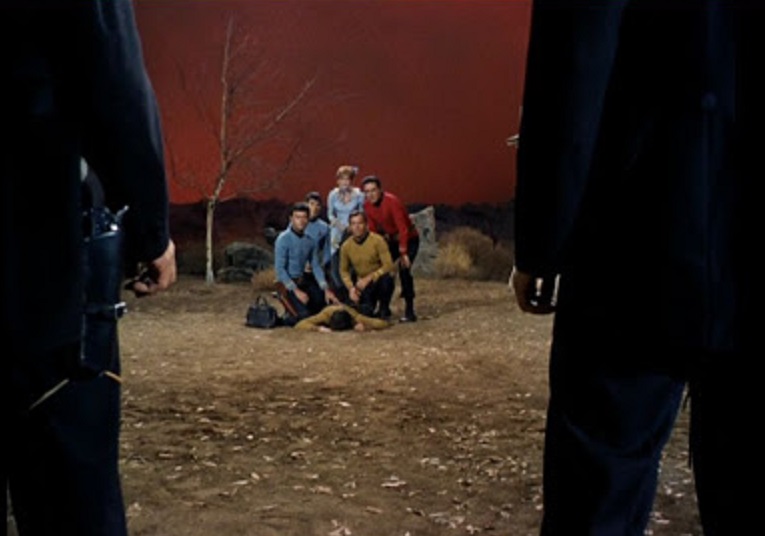

The imagery tells us that our heroes are boxed in.

The expressive nature of the filmmaking here creates an absolutely relentless sense of menace. In Star Trek, well-reasoned plans of escape don’t often fail so dramatically.

Why? Kirk is resourceful, Spock is logical. Scotty can fix anything. And Bones is the voice of human morality. Working in unison, this team can extract itself from virtually any dangerous situation. Here, because the scenario is surreal -- like a dream -- there is no clear path to escape until Spock understands the “unreality” of the situation. Spock’s realization that the Melkotians have bent reality to their liking is the key that allows him to bend reality too.

“Spectre of the Gun’s” overriding theme that the power of the mind ultimately beats out of the power of the gun (or belief in a gun, as the case may be) is a terrific one in terms of Star Trek history and philosophy too. 


The Melkotians “choose” the gunfight at OK Corral as the setting for Kirk’s execution, but this episode’s events, and Spock’s dedication to reason, prove that man has evolved beyond such violent outcomes by the 23rd century.  A positive outcome can be created not through violence (as it was during the gunfight in 19th century America), but through adherence to facts, science, and logic. Kirk successfully wrestles his violent instincts here -- his anger at Chekov’s murder, namely -- and chooses not to kill. He does not live down to the Melkotian’s expectations of a lowly human.

Buttressed by that strong thematic line, and its daring, unnerving, expressive photography, “Spectre of the Gun” is an entertaining and thoughtful addition to the Star Trek canon, and a real highlight of the final season.

I wish it were more appreciated.

Star Trek Week 2018: The Role Playing Game (FASA)


I recently signed up to play Star Trek Online and commenced my training as a Starfleet officer of the 24th Century.  I stopped playing after about an hour (and just as I was about to board a Borg ship too...) because I realized the game was very quickly going to become a black hole of lost time.     

Someday, I plan to return...


But Star Trek Online reminded me of an earlier experience of imaginative interface with Gene Roddenberry's universe: The Star Trek role-playing game by FASA (1980 - 2001).

 I was never really a Dungeons and Dragons kid -- though I played it several times in high school -- because I always leaned more toward hard sci-fi and horror than fantasy.  

But a Star Trek role-playing game?  I was so there.

In particular, during my first year at the University of Richmond, my group of friends and I played this role-playing game.  A lot.  We had no car with which to escape from the campus, we weren't allowed to join fraternities until sophomore year, and we were all strapped for cash.   After a few weeks, we'd spent our respective budgets playing Gauntlet (1985) at the student recreational hub, The Pier.  So we had to do something, besides play endless games of Risk.

And remember, when I was in college -- a long time ago, in a galaxy far, far away -- the newest, hottest technology was the Fax machine, so it wasn't like we could all surf the net, text friends, e-mail, watch YouTube or do anything cool like that.


Accordingly, FASA's Star Trek was just what the doctor ordered in my dorm room at Thomas Hall.

My roommate became our heroic ship's captain (of the U.S.S. Nassau), I served as first officer, and other pals  played a Vulcan security officer, a Caitian science officer, and an Andorian communications officer, respectively.  My wife, Kathryn -- then my girlfriend -- even joined us for an adventure or two as a protocol officer keeping an eye on our "cowboy diplomat" captain.

I loved the game (and my role as executive officer) because my roommate wasn't a Trekkie. But he was an ingenious and resourceful fellow, capable of innovative thinking and strategizing.  I was the one with the encyclopedic knowledge of the Trek universe, so between his ingenuity and my contextual skills, we made a potent command team.

I still own a couple of the modules or "episodes" from the Star Trek game that we played back in the day, including "Where Has All the Glory Gone" and "The Dixie Gambit."  In total, there were twenty or so FASA adventures that Trekkers could enjoy, if I recall, with titles such as "Denial of Destiny," "The Vanished," "A Doomsday Like Any Other," "Return to Axanar" and "The Mines of Selka."   Many of the games were sequels to original series episodes.

The thing that I also enjoyed so much about the game, as I remember, was that many of the stories were set not in the days of the Original Series or The Next Generation, but in the movie era.  As I've said before, the movies, in a very real way, represent "my" Star Trek: the productions I grew up with in the late 1970s and early 1980s.


Paramount suddenly revoked the license to FASA's Star Trek game in 1989, just as The Next Generation was really taking off in syndication.  There are reports that this cancellation occurred because of growing discontinuities between the FASA Trek universe, and the canon universe imagined by Gene Roddenberry.

One such continuity apparently involved the depiction of the Klingons and their Empire in FASA.  Still, it seems a shame that the game was canceled just as Star Trek was taking off on television again...

I must admit, I'm pretty divorced from role-playing games today, as a 42 year old, but my understanding is that, like Star Trek Online, they've all moved to the Internet.

There's nothing wrong with that development, but I'll always remember my days at UR with my friends, sitting around in a circle in our dorm room, eating Dominos Pizza, drinking Mountain Dew, staying up too late,and foiling the plans of the Klingons.

Star Trek Week 2018: Just One Star Trek Episode for the Ages?


What is the one great Star Trek episode for the ages, if you could select only one?  Below is my selection.


But let me walk you through my thought-process in terms of my selection.  If only one episode of Star Trek is to survive for future viewings, I must consider which episode in the canon highlights best the core elements of the series; which best represents everything Star Trek stands (or stood…) for.

Some of my favorite episodes, like “Space Seed,” or “The Trouble with Tribbles”wouldn’t necessarily make the cut.  They are great shows, but I wouldn’t want either to be my representative Trek.

I’d have to drill-down here a little and answer a key question, I suppose: what does Star Trek mean to me?

Well, it’s about friendship. (Kirk, Spock and Bones).

It’s about the idea of man going out into the unknown and taking his humanity with him.

It’s about confronting alien life.

It’s about learning to see others (aliens, etc.) in a new and different light.

It’s about resourcefulness on the frontier, on the edge of civilization, when no one is around to back you up. You have great technology, but that technology is no guarantee of survival, or victory in battle.

I’ve been poring over the episode list and I believe have one episode that hits all those hot spots. 

It’s not my favorite show, though it’s a good one. It’s not even in my top twenty favorite Treks. (Among my favorites: “This Side of Paradise,” “Amok Time,” “Metamorphosis,” “Journey to Babel,” “Charlie X,” “The Doomsday Machine,” and “The Enterprise Incident.”)

But I would choose “The Corbomite Maneuver.” 


This episode from early in the first season finds the Enterprise encountering a giant cube in space (no, not the Borg). 

Captain Kirk reluctantly orders it destroyed when it emits dangerous radiation.  Before long, a much larger alien ship -- the Fesarius -- arrives and threatens the Enterprise.  Its captain is the fearsome and very alien Balok.

Now Kirk must figure out a way to escape from the technologically-superior ship, and the merciless Balok.


I would choose this episode, first, because there’s a clear surrogate for the audience in the narrative.  We meet young Lt. Bailey (Anthony Call), who is anxious and scared, having never encountered anything alien.  He’s nervous and burdened by responsibility.


Dr. McCoy thinks Bailey was promoted (by Kirk) too soon, but Kirk sees something of himself in the green officer. He sees a man who can learn and grow.  This character -- who voices audience fears and concerns -- helps us to understand the nature of the Star Trek universe, and the nature of the choices Kirk must make. 

The episode also features some good back-and-forth in the heroic triumvirate, with McCoy needling Kirk about his weight, and Spock and Kirk discussing poker and chess.


Furthermore, “The Cormobite Maneuver” involves humanity encountering alien life, and not knowing what to expect from it.  In that vacuum, tension rises.

Man brings with him to the encounter both his inexperience (Bailey) and his experience (Kirk), which makes for a nice balance, and a nice complete picture of man as a species.

And the episode’s finale involves a reveal about the true nature of Balok, and the way that “fear” is a universal constant. Kirk, Bailey and McCoy board Balok’s ship only to find that the “alien” is a puppet, and that the real Balok is a child-like alien.  He only presented that other face because he was as fearful as Bailey was about the unknown.


But, optimistically, this means that man and alien are alike.  They feel the same things; they fear the same things. This is a basis for friendship.

Kirk is up against the wall in this episode, matched against a superior ship and superior powers.  But he uses a bluff -- from the game of poker -- to find a path to survival.  He could easily fail, but he doesn’t.  

And when he “wins,” Kirk shows mercy to his enemy, and curiosity about his enemy too.  This act shows that mankind has truly grown-up.  That given the chance, he can choose not to kill, or hurt another life form.

It was tough to make this call, but “The Corbomite Maneuver” is representative of Star Trek’s best ethos, and I think the presence of the rookie, Bailey, makes the episode easier for newbies to identify with.  

Thursday, September 06, 2018

Star Trek Week 2018: "Space Seed"


Stardate 3141.9

The U.S.S. Enterprise encounters a derelict vessel adrift in space: the S.S. Botany Bay.

This primitive Earth ship -- launched in a time of global turmoil, the 1990s – is a sleeper ship carrying 72 men and women from that time period.

The leader of the group -- Khan Noonien Singh (Ricardo Montalban) -- is awakened from suspended animation, and almost immediately plots to take over the Enterprise.

He does this with the help of ship’s historian Marla McGivers (Madlyn Rhue), who possesses a fascination -- even obsession -- with men of the past.

Even as Mr. Spock (Leonard Nimoy) identifies Khan as a brutal tyrant from the Eugenic Wars, Khan makes his power play, awakening his fellow genetically-engineered superman, and proceeding to hijack the Enterprise.

Now Captain Kirk (William Shatner) must regain command of his ship, and find a suitable punishment for the insurrectionists and their leader, a man who does not belong in the 23rd century. 

He settles on banishment, sending Khan and his people to the harsh but tamable world, Ceti Alpha V.

In response to his sentence, Khan quotes Paradise Lost.


There are no two ways about it. “Space Seed” is a virtually perfect episode of Star Trek (1966-1969).

“Space Seed” moves with purpose, energy, and suspense, and is grounded by the charismatic central performance by Ricardo Montalban as Khan. The episode even ends with a note of foreboding or anticipation, which is perfect considering the franchise’s return to this story-line in 1982.  The last moments of the episode find Spock wondering what Khan’s planet, Ceti Alpha V, will give rise to in 100 years.

The franchise would wait just fifteen years, series time, to reveal the answer.  But the final episode of the moment is chilling, and raises questions about Kirk’s decision.  Will Khan build an Empire? A new kind of human race? A city on a Hill, or will he “reign in Hell?”


Given the prominent placement that Khan has been assigned in the modern Star Trek mythos, it might be worthwhile to note here that before the Wrath of Khan, “Space Seed” wasn’t judged by most Star Trek fans to be one of the best or most memorable episodes of the series. 

Many modern fans and writers insist that Khan is to Captain Kirk as Joker is to Batman, and that’s not quite true.  Khan rose to real prominence in the franchise in 1982, after Wrath of Khan proved such a dramatic success at the box office.


Remember, the original Star Trek is structured as a traditional TV series, meaning that there are, essentially, 79 dramatic (or standalone) threats to Kirk and Company, none necessarily graver than the others. Had Harve Bennett decided to sequelize “Charlie X” or “Who Mourns for Adonais” or 
“The Omega Glory,” we would have had the Wrath of Charlie, The Wrath of Apollo or The Wrath of Ron Tracey and those villains would have risen to “Joker’ status in the franchise instead.

But delightfully, Khan is a perfect selection to become the go-to “mythic” villain in the Star Trek universe. This is so because Star Trek in shape and form is a celebration of diversity, of the Vulcan concept of IDIC (Infinite Diversity in Infinite Combinations).  The crew succeeds in its space missions based on the qualities of the team, which includes people of different backgrounds and experiences. We’ve got Kirk, Spock, McCoy, Scotty, Uhura, Chekov, Sulu, Chapel and even Kyle.  

They don’t all look the same or act the same, and they boast different experiences and different expertise too. 

And yet this coalition of diverse personalities works together as a flawless team to confront mysteries and crises.

That team is faced, in “Space Seed,” with a genetically-engineered superman, an autocratic “trait” leader.  Khan, a tyrant, leads because of his artificially-augmented traits. He has been engineered to possess the physical strength of ten men, and the intellect of a genius.  He does not command via consensus or team-building.  He does not value the rights or freedoms of the individual, or different experiences.

And yet, in the end, the superman -- “a prince…with power over millions…” -- is defeated by “regular” people working together in that diverse team.


Thus “Space Seed” is a statement that affirms humanity’s capabilities and potential. Man need not be a superhero to explore the stars, or improve the species.  Instead, he must incorporate all colors, cultures and beliefs, and shepherd those diverse experiences to achieve meaningful goals.

Khan represents a threat to that approach. He represents the idea -- as Spock suggests – of tyranny; of the individual subjugated under the ‘whip’ of one charismatic strongman. 

Just as the Borg represent a significant attack on Star Trek values (the idea of drones, not individuals tending to a society), Khan does so too.  He symbolizes both out-of-control science (creating avaricious supermen) and the idea of those scientific monstrosities lording it over the masses, eliminating the diversity exemplified by McCoy, Kirk, Spock, Uhura, Sulu, Scotty and Chekov in favor of a fascist leader who sees only followers, and worlds to conquer.  All the little people are under his thrall, under that proverbial whip.  Their experiences don’t matter. They’re, well, merely cannon fodder.

By Wrath of Khan, Khan represents a slight variation on this theme. There, he is a leader consumed with revenge, who refuses to listen to his crew.  Kirk, by contrast, does listen to his crew, and gleans the way to defeat Khan from his friendship with and trust in a friend, Spock, who notes the villain’s “two-dimensional thinking.” Kirk’s friendship is reciprocated to the degree that Spock sacrifices himself to preserve his friends, the team.  Khan may be genetically superior, but he leads by dictate and fear. He bullies his team members (like Judson Scott’s Joaquim) into submission. He sees no real value in anything save his own perceived superiority

In terms of Star Trek continuity, “Space Seed,” fills in some crucial gaps.  We learn from this episode that mankind fought a third World War in the 1990s, one in which whole populations were bombed out of existence. It was out of the rubble of this war that the “united” future began to come about.  In our history, of course, none of this occurred in the 1990s, and later editions of Star Trek, like Voyager (“Future’s End”) have backtracked some on the 1990s being a time of devastating war and destruction.

“Space Seed” also cements a rather unfortunate and now dated aspect to the classic series: a female crew-member seduced by a charismatic man to take mutinous action against her own crew. Here, Marla McGivers acquiesces to Khan, who -- let’s face it -- treats her abusively, at least at first, and aids his efforts to take over the ship.


This idea recurs in “Who Mourns for Adonais,” when Lt. Carolyn Palamis (Leslie Parrish) becomes consort to Apollo, who wishes to subjugate the crew and crush the Enterprise hull like an egg shell. To a lesser degree, we also saw this paradigm with Dr. Dehner (Sally Kellerman) and Mitchell in “Where No Man Has Gone Before.”

But the bottom line is that we rarely, if ever, in Star Trek history (original series) meet a male crew-member who gets seduced by a woman and takes adopts her agenda, ignoring his duties, oath, and training for “love” (or lust, anyway).  Instead, it is only female Starfleet officers, apparently, who do so.

I suspect “Space Seed” gets away with this plot line to the degree it does for a few reasons.

First, Madlyn Rhue goes a long way towards suggesting that McGivers marches to the beat of her own drummer.

The character is depicted as an artist, and as a sensitive individual who is genuinely overcome by her passion for history, for the storied past. When she is taken with Khan, we can see her interest in him is a result of her character, not merely a (stereotypical) weakness of the gender.

Similarly, Montalban is extremely charismatic as Khan, not to mention forceful. Since McGivers’ recovers her center in due time, and Khan comes to profess his love for her, one can write off McGiver’s bad behavior as a temporary lapse.  How often, after all, do we meet a man from “the 20th century coming alive?”  That could catch anyone off-guard, right?

Similarly, the scenes in which Scotty and Kirk admit a “grudging” respect for Khan help us realize that this genetically-engineered superman is quite magnetic, and casts a spell on those around him.

Actually, this aspect of the episode speaks to another human truth, about our species’ worship for strong-men, figures who lead -- not always fairly -- but by din of personality, charisma, and promises of greatness, or returning to a time when things were better.

Those who offer the world “order” and link themselves to that order, represent, in some way, a retreat to non-thinking safety and comfort.  We trust in them, instead of facing the hard questions ourselves.

But still, we rarely see men in Star Trek experience such temporary lapses over their proximity to a woman.  Kirk, for example, stays focused on his duties when encountering Mudd’s Women, Odona, an even Elaan of Troyius.  Their charms are not enough to make him forget his responsibilities.

“Space Seed” moves with such momentum and grace that it is easy to overlook these and other little bumps in the road.  For instance, Kirk seems foolish to have let this “guest” have full access to the ship’s library of technical manuals. But this reckoning only comes after watching the episode multiple times.

In terms of the genre, one might note how the premise of a person from the past being revived from suspended animation in the future, became a trope after “Space Seed.” 


We have seen it in episodes of The Starlost (“Lazarus from the Mist”), Logan’s Run (“Crypt”), Ark II (“The Cryogenic Man,”) and even Star Trek: The Next Generation (“The Neutral Zone.”)  Yet, no man (or woman) from the past has quite impacted the direction of a franchise the way Khan ultimately has in Star Trek.

Sometimes I lament the character’s influence. Since Wrath of Khan we have met too many villains who are bent on revenge, or who get their hands on the latest weapon of mass destruction (like Genesis).  I don’t blame Khan or Montablan.

Rather, it’s a testament to the actor’s (and character’s) success that every filmmaker wants to recreate the danger and charisma this villain offers. 

But for “Space Seed,” Khan gives Star Trek one of its most exciting and thought-provoking hours.

It asks: does humanity increase the species' influence in the universe by bringing everyone along as part of the team?  Or by selecting a strong man to lead the way?

Star Trek Week 2018: "Balance of Terror"


Stardate 1709.1

As Captain Kirk (William Shatner) officiates at a wedding of two young officers -- Lt. Robert Tomlinson (Stephen Mines) and Ensign Angela Martine (Barbara Baldavin) -- he also monitors a dangerous situation developing in the neutral zone separating the Federation from the Romulan Star Empire.

Specifically, two Federation outposts monitoring the zone have gone suspiciously quiescent, and a third, Outpost 4, reports coming under heavy attack by an invisible enemy.

The Enterprise arrives too late to save Outpost 4, but catches sight of an enemy vessel nearby; one with the ability to “cloak” and vanish from sight. Its weakness, however, is that it must become visible to fire its deadly plasma weapon.

Although the Earth-Romulan War is a century in the past, old race hatreds persist -- even aboard the Enterprise -- in the form of a bigoted helmsman, Stiles (Paul Comi). When the Enterprise learns that the Romulans are an off-shoot of the Vulcan race, he immediately suspects that Mr. Spock (Leonard Nimoy) is a spy, or a traitor.

Captain Kirk soon recognizes the fact that he must destroy the invisible Romulan starship while it is still traveling on the Federation side of the Neutral Zone, so no question can be raised about who was the aggressor in this conflict.  

Meanwhile aboard the Romulan vessel, a war-weary commander (Mark Lenard) similarly realizes he must defeat the Enterprise if his crew is ever again to see the stars of home.


I must read like a broken record in reporting this assessment, but “Balance of Terror” is another all-time classic Star Trek episode, and likely one of the ten best stories of the entire series. 

“Balance of Terror” overcomes its obvious transplant of tropes from The Enemy Below (1957) -- a movie about a destroyer battling a submarine in World War II -- to forge a powerful statement about the futility of war. 

This Trek episode also brilliantly portrays its dueling commanders; men who are on opposite sides in a conflict, yet -- ironically -- share the same values. They are part of the universal brotherhood of soldiers, one might conclude. 

Again, this depiction fits in well with the strong anti-war theme of Paul Schneider’s teleplay.  In a universe without war, race hatred, territoriality and political gamesmanship, Kirk and the Romulan Commander might be “friends,” since they are clearly two-of-a-kind.  But in this universe, they are separated by their devotion to opposing governments and their martial philosophies.

Beyond these matters, “Balance of Terror” establishes a gigantic chunk of Star Trek continuity. This story introduces us to the Romulans, cloaking devices, the concept of a space neutral zone, and more.  

It creates, in fact, a whole lexicon and approach to battle strategy in space. Virtually every Star Trek episode or movie featuring two starships in tactical opposition owes something to the battle that is (splendidly) depicted here, including the “grudging” respect Kirk and opposite number afford one another in such combat scenarios (think Khan vs. Kirk; Kruge vs. Kirk, or even Chang vs. Kirk).

It is true, however, that the key genetic element of this episode is very clearly The Enemy Below.  In this film from the fifties, a destroyer captain, Murrell (Robert Mitchum) tangles with a German U-Boat commanded by Captain Stolberg (Curt Jurgens). In both cases, the so-called “enemy” commander may be described as war-weary and lacks faith or trust in his command structure back home (Nazis or the Praetor).


Secondly, the closing gambit to the engagement in both cases involves an attempt to draw in an enemy by appearing disabled. In The Enemy Below, Murrell orders fires to be started on the deck of the destroyer, the Haynes, so that the vessel looks hopelessly damaged. In “Balance of Terror” Kirk orders the Enterprise powered down, and lets her drift off-course, to create the convincing illusion that she is dead in space.

Some viewers have also detected elements of Run Silent, Run Deep (1958) in “Balance of Terror,” particularly in the scenes involving Stiles (a prejudiced crew man) and the scene in which the Romulans dump their debris as a ruse. 

If one considers both sources as playing an important role, then “Balance of Terror” could actually be viewed more as a pastiche -- an accumulation of submarine movie tropes -- than as mere imitator. The transfer of the venue to the final frontier, however, makes the story appear original and fresh.

Even while pinpointing its inspirations, one can see how “Balance of Terror” travels well beyond them to offer Star Trekkian philosophy and comment on humanity.

Specifically, the episode features book-end scenes in the Enterprise chapel. 


In the first scene, Angela and Tomlinson are celebrating life, preparing to be married (with Kirk officiating as chaplain).  

In the final scene, Tomlinson is dead, and Angela returns to the chapel in mourning. 

Again, Kirk must act as a chaplain, but this time to comfort Angela, and help her through her grief and mourning.  

Importantly, the episode features a remarkable turn of events in its denouement. In some fashion, Angela actually comforts Kirk, telling him that she will be all right. This flipping of the roles is necessary, because it is clear that Kirk feels terrible guilt over what has occurred; over a battle that he won, but which ultimately cost crew-members their lives. In losing these crew-members, and wondering about the real purpose of the battle, in human terms, Kirk actually takes a step towards becoming more war-weary...just like the foe he just vanquished.


This is very much the anti-war theme that I mentioned above. 

What we see in “Balance of Terror” is that young people, inevitably, are the ones who suffer during the prosecution of a war. 

Tomlinson had hopes and dreams, as did Angela. The future they imagined for themselves are not to be. One may argue all day about the necessity of strength and resolve in a war-situation like the one featured in “Balance of Terror.”  But the simple fact is that the party is paid for with the Enterprise’s dearest “blood,” to paraphrase Kirk in The Search for Spock (1984). 

Consider that, as “Balance of Terror” aired in mid-December of 1966, 184,000+ U.S. servicemen were fighting in the Vietnam War. Just a dozen days after the episode aired for the first time, another 382,000 American men were sent to fight it.  

The reasons for that war, as is the case in “Balance of Terror,” are matters of state and politics. Not letting an enemy sense weakness; not allowing an opposing ideology get a foothold. These are all tactical decisions of a State that wishes to assert dominance and remain pre-eminent.  

Through the Martine/Tomlinson subplot, Star Trek makes plain that victory in war, while preferable to defeat, is not without heavy human costs. And the young --- those with the most to lose -- are the ones that bear that cost the most.  Ironically, they are probably the ones who care least about politics, brinkmanship, and so forth.

A second theme also comes through loud and clear in “Balance of Terror.”  

Hate only leads to more war.  Stiles is quite clearly living in the past, carrying the hatreds of a war he was not even alive to see. Yet his family has passed that intense hate forward, like a family heirloom, so that he is able to contemplate the idea of Romulans only as monsters and villains.


The episode balances Stiles' two-dimensional hatred of the enemy with the three-dimensional portrayal of the Romulan commander. He is not a monster. He is not a cliche.  He is a thoughtful person and an accomplished starship commander.

Mark Lenard is extraordinary in this role, and we sympathize with the character's plight. Like Captain Kirk, the Romulan Commander he is a creature of duty, and a man ensconced in a hierarchy. He has given his career, his life, to this hierarchy. And yet he knows too well the cost of war, and that there is nothing ennobling about the endeavor. 

Where Stiles is hungry to take the fight to Romulans, the Romulan Commander sees war only as an ugly duty, a necessity that he hates.He can game it all out, to the last move, and all he sees in war is death and more death.

Stiles also shows prejudice towards Spock simply because our favorite half-Vulcan resembles the enemy.

In this case, one might assert Spock stands in for a Japanese-American soldier in World War II, one who isn’t trusted by his peers not because of his actions, but because of his appearance. That appearance is enough to make some bigots worry that he sympathizes more with the enemy than he does with his own countrymen. Stereotyping occurs when people fail to see the individual, and see only skin color, or pointed ears. That is how Stiles views Spock.

In “Balance of Terror,” Stiles learns that he is wrong, after Spock saves his life in the phaser control room.  But again, the overall message seems to be that war encourages racism, division, aggression, suspicion and irrational emotions. We're supposed to not just want to defeat those who oppose us, but actually hate them and see them, somehow, as savages or sub-humans.

“Balance of Terror” introduces us to the Romulans, who re-appear in the original series in “The Deadly Years” and “The Enterprise Incident,” and who have been a mainstay of the franchise ever since.  

The neutral zone concept has been exported not just to the Romulans, but the Klingons as well, in productions such as The Wrath of Khan (1982).  The cloaking device, similarly, has been responsible for some of the most provocative Star Trek stories in series history, and it too falls into the hands of the Klingons. 

Even the concept of a spaceship “Bird of Prey” re-appears.

But perhaps the area wherein “Balance of Terror” succeeds most admirably and achieves its longevity is in its depiction of one character: Kirk. 


He is truly, a man alone, making decisions that could cost lives, and plunge the galaxy into a bloody war.  Kirk must carry that tremendous weight on his shoulders, and “Balance of Terror” shows him agonizing over it.  

McCoy’s advice to him is good: don’t destroy the one named Kirk. In other words, Kirk must not allow himself to be overcome by the gravity of the situation, or the hypothetical outcomes of each and every choice. He must function -- and function at his highest ability -- no matter the cost.

Kirk also grows as a character, intriguingly, because of the episode’s three-dimensional depiction of the Romulan. The Commander gets to voice some things that a “hero” can’t, but which Kirk must nonetheless feel as the commanding officer of a starship. This "enemy" gets to showcase the same characteristics (such as devotion to duty), but simultaneously transmits as older, and more war-weary than his counterpart. He may not be a precise mirror for Kirk, but a mirror for what Kirk could very well become in twenty years.

“Balance of Terror” -- an anti-war story -- is tense and suspenseful throughout its run. Although it showcases the cost of war, at the same time it creates a whole “universe” of believable space combat "rules."  

For example, the episode showcases how starship commanders can use the environment of nearby space (like passing comets) to seek strategic advantage, for instance, and is very much a cat-and-mouse kind of hunt. 

Each commander comes up with dynamic resolutions as they try to save their ship and carry the day.  Kirk’s ship plays dead, for example, and the Romulan ship launches debris (with a nuclear device in it) to trap the Enterprise.  This brand of space strategy is a core conceit of all generations of Star Trek.  

CULT TV FLASHBACK: Dead of Night (1994-1997)

This year, Dead of Night: The Complete Series , was released on Blu-Ray by Vinegar Syndrome , and I just had the pleasure of falling into i...