Showing posts with label Space:1999 50th Anniversary. Show all posts

Thursday, September 11, 2025

Space:1999 50th Anniversary: "All that Glisters"


Commander Koenig (Martin Landau) leads a team to a nearby planet when Main Computer reports that the world possesses the rare and vital mineral called Milganite required for Alpha’s life support system. 

On the team to find and mine the Milganite are Dr. Helena Russell (Barbara Bain), Maya (Catherine Schell), Alan Carter (Nick Tate), Chief Security Officer Verdeschi (Tony Anholt) and geologist David Reilly  (Patrick Mower), an Irishman who fancies himself a Texan cowboy.

Once on the planet surface, the Alphans’ Milganite readings lead them to a strange orange rock in a cave. When Reilly cuts off a sample of it, it bleeds and utters a scream of pain.  Upon the deposit of the rock in the Eagle, the rock flares energy, and apparently kills Tony.

Helena determines, however, that Tony still possesses brain function, a fact which becomes apparent when Tony is “revived” to serve as the arms and legs of the rock sample, retrieving another piece of the glowing rock from the cave.

Koenig and the others soon recognize that the rocks on the planet are alive, and desperate. They require water to survive, and have been enduring a seemingly-unending drought.

But, as Maya points out with worry, there is plenty of water in the human body…


“All that Glisters” is a quite disliked episode by many Space: 1999 (1975-1977) fans, and also, actually, by some of those who participated in the making of it.  

Martin Landau’s displeasure with the script is legendary, and if you watch very closely, you can also see Catherine Schell breaking character and succumbing to fits of giggling, in a scene set on the planet exterior, as the rocks take control over the Eagle. She must turn away from the camera, once her composure fails.

Why the dislike? 

Well, there are a number of reasons, for certain. 

The episode, about a silicon-based life-forms, doesn’t treat the main characters, for the most part, in appealing or intelligent fashion. The guest star, Mower’s Reilly, for instance, is an “Irish Cowboy” and attempts a dreadful Texan accent. 

He is an obnoxious character, with little in terms of human qualities to make the audience like, or even care about him. He hits on Maya in the Eagle, to Tony’s dismay, and then constantly acts counter to Commander Koenig’s orders.  He is obsessed with a living rock.  

So, an Englishman plays an Irish cowboy who is obsessed with rocks.  That’s quite a description!

Commander Koenig, a character I love and admire, also fares poorly in the episode.  


Perhaps because of Landau’s displeasure with the story, Koenig is constantly on the verge of catastrophic rage, shouting and yelling at his subordinates like a maniac.  

Worse, his orders sometimes make no sense.  After Tony is injured by the rock, for instance, Koenig orders that no one go near, look at, or in any way interact with any rocks.  

Well, if they do that, how will they save Tony? How will they understand their environs? It’s a dumb order, and Landau should never have been put in the position of having to issue it.

Dr. Russell also comes across poorly here. She has to say the line “I’m a doctor, not a miracle worker,” which, of course, comes straight from the lexicon of Star Trek (1966-1969) and its notoriously cantankerous physician, Leonard McCoy (DeForest Kelley). So Helena is a sort of cut-rate “Bones” here, frustratingly.

So why did I give such a favorable review of “All that Glisters” in my book, Exploring Space: 1999 (1997)? And why do I still appreciate it?

There are two reasons, primarily.  

First, I admire the episode’s photography. Much of the episode takes place in a darkened Eagle laboratory pod, as Helena and the others deal with the strange nemesis in their midst.  These shots are beautifully-crafted, with dim illumination, and lights sometimes cast only on eyes, or faces.  

It’s stylish and smart in visual approach, and reminds me of black-and-white horror photography from Hollywood of the 1940s. The familiar technological setting is rendered almost “supernatural” in its creepy nature, and given that so much time is spent there, the episode also boasts a nice, claustrophobic feel.  There’s a real sense here of an inescapable trap.


Secondly, and perhaps more important than the episode’s stylish photography, I appreciate how “All that Glisters” fits into my “horror myth” thesis about Space: 1999 overall.  

Basically, that thesis states that Space: 1999 is actually a horror series, not a science-fiction one, with all the old universal fears translated to the technological space age. We have the horror of the premature burial, in “Earthbound,” for example.  We have the man with the Midas Touch, instantly freezing other humans on contact, in “Force of Life.”  Other stories are about wicked, evil children (“Alpha Child”) or dragons (“Dragon’s Domain.”)

This conceit continued into Year Two. “The Exiles” was “The Picture of Dorian Gray,” at least after a fashion, and this segment, “All that Glisters” is very clearly a technological, space-age update of the traditional zombie story.  

Today, we primarly associate zombies with George A. Romero and The Walking Dead (2010 - ).  They are dead creatures who feast on human flesh and typically transmit a plague to those bitten.  But if you go back in Hollywood history to films such as White Zombie (1932) or I Walked with a Zombie (1943), you can see the interpretation of that monster that “All that Glisters” adopts and re-processes for the space age.  

Basically, zombies, in those situations are shambling, dead (or mostly dead…) servants of sorcerers or other puppet masters.  The fear was of being made dead, and then a drone or slave to some horrible person and his agenda. 

Here, of course, the rocks destroy Tony’s consciousness and make him, operationally, a zombie: a creature without higher thought, but bound to their control.  

Again, there are some very good, atmospheric shots of Tony blank-faced, walking across the alien planet surface. He is lit from below (by the glow of the rocks), so that his vacant life-less face appears menacing and inhuman.  


My grounds for admiring “All that Glisters” come down to, essentially, the horror touches, and the accumulation of their impact. The dark laboratory is a haunted house setting, and quite claustrophobic, thus generating anxiety. And the rocks make zombies of the living, turning them into trudging, mindless automatons, in keeping with the series’ overall horror qualities.

I can see how the episode’s other factors are less than successful. Certainly, the silicon life form has been featured before, and in better shows, such as Trek’s “The Devil in the Dark,” but in fairness, “All that Glisters” also appears to be the influential basis of the ST:TNG episode “Home Soil.”

Finally, I do think it is nice, after all the horror on display in “All that Glisters,” that the Alphans show their humanity and help the rocks to survive.  

Not so much because I want Space: 1999 to emulate Star Trek’s universe of brotherhood and optimism among alien species, but because it’s a different type ending for the series, and therefore it feels fresh.  If the Alphans can help the rocks, it seems natural that they would do so.

Wednesday, September 10, 2025

Space:1999 50th Anniversary: "The Metamorph"


'In “The Metamorph,” Moonbase Alpha emerges from its second encounter with a space warp, six light years from its previous position. The lunar facility’s life support system needs repair, and requires the ore known as Titanium.

Titanium is pinpointed on the volcanic surface of a nearby planet, but an Eagle reconnaissance flight ends in terror when the ship is abducted by a strange green light.  Soon, Alpha is contacted by an alien from the planet, Mentor (Brian Blessed), who claims that the pilots are safe in his custody.

Mentor and Commander Koenig (Martin Landau) arrange an orbital rendezvous, but the plan is further treachery from Mentor.  He captures Koenig’s eagle and drags it down to the planet, called Psychon.  

There, in a subterranean city, Mentor lives with his daughter, Maya (Catherine Schell) whom he has taught the “priceless art of molecular transformation,” and operates a biological computer called Psyche which he hopes to use to restore the planet surface to its former tranquil self.

To do so, however, he must feed Psyche living minds. 

The Alphans provide him a ready supply, though Koenig refuses to cooperate. Koenig hopes to convince Maya -- who doesn’t know of Psyche’s brain draining power -- that he needs her help.  But to do so, she must turn on her own father.


The first episode of Space: 1999 Year Two is colorful and bold, crisp and exciting. It also introduces a great regular character to the series: Maya of Psychon, played by Catherine Schell.  

I won’t mince words about Maya or her presence on the series.  I love her.  


I believe Maya is a great character, in part because she is allowed to be emotional as well as competent and brilliant. After Mr. Spock, all resident aliens had to be stoic, it seems, but not Maya. She was more like an imp, a good-humored, playful, highly emotional alien.

Like all her people, Maya is incredibly intelligent, with a mind that can run circles around the most high-powered computer. As a Psychon, she is, we are told in "Seed of Destruction," "hyper sensitive to all forms of living matter." Maya is also a pacifist, deploring the violence of the planet Earth when told of it in "Rules of Luton.” 

"You mean, people killed people, just because they were different. That's disgusting!"

But Maya is also one tough cookie. She regularly transforms into frightening outer space creatures to stop the monster of the week in episodes such as "The Beta Cloud" and "The Bringers of Wonder." She stands up to the Commander when she believes he is wrong ("Seed of Destruction" again), and is just as comfortable flying an Eagle or running the science station in Command Center as she is in a party dress (“One Moment of Humanity.”)   

In just one season on Space: 1999, Maya did things that the other females in cult-TV history have regularly been denied the opportunity to do.  She piloted spaceships, engaged in fisticuffs, provided the analytical answer to the scientific challenge of the day, and also served as the mouth-piece for the “social gadfly” commentary about the human race. 

To many, she became a role model.

Consider, by 1991 and Star Trek: The Next Generation’s fourth season (and episodes such as “Q-Pid”) – and long after 1999 was canceled -- women characters were still locked in caretaker roles (Dr. Crusher and Counselor Troi), and still knocking enemies out by smashing crockery over their heads. Unlike Maya, they rarely piloted space craft, or engaged the enemy in hand-to-hand combat. Data got the science talk, and Data and Worf were the outsider commenters, leaving Troi to “sense” danger, and Crusher to mend broken bones.

"I never thought of Maya as a role model," Ms. Schell told me during our 1994 interview, "perhaps because in my life I have never been held back from doing something just because I am a woman. I'm thrilled that she is seen by many as I role model, but I didn't intend it that way. Perhaps because Maya was an alien, she was allowed to do more than 'human' women were at the time." 

Whatever the reasons for Maya’s full integration into the action, I remain grateful for it.I miss Barry Morse’s Victor and Prentis Hancock’s Paul Morrow in Space:1999 Year Two, but Maya’s presence adds so much to the season.

And as all fans of the series realize, there are some big differences visually, character-wise, and conceptually between Year One and Year Two. Year One is awe-inspiring, scary and often wondrous. By comparison, Year Two tends to be colorful, and action-packed, with more humor. Year One is lugubrious and ponderous, in a remarkable way. Year Two is fast-paced and giddy.


I know fans divide on the issue of “which year is better.”  I prefer Year One, but I also enjoy Year Two, and feel that Maya, in particular, is a great addition to the series, in large part because of Catherine Schell’s portrayal. 

And of all the Year Two style episodes - big on action, movement, and color – “The Metamorph” may just be the best. It is big, brash, exciting, and pacey…all good qualities for a season premiere, no doubt.

Writer Johnny Byrne once told me, in an interview, how the change in formats occurred:

“During the interregnum between seasons, I wrote for Gerry Anderson. I kept busy, but people involved with the production of Space: 1999 were very twitchy.  Everybody knew that the new producer, Freddie [Frieberger], was coming. He sent over a tape of comments about the series, and after hearing his remarks, I understood a second season would be a whole new ball game. I had been told I would be the story editor for the second year, but it was just a verbal agreement, and I understood it was no longer going to happen. I would continue to write episodes, but it was a very different situation.”

The shift in formats boils down to, at least in creative terms, the fact the Alphans become much more aggressive and in control over their destiny in Year Two. This shift is apparent in “The Metamorph” from the fact that the base now has laser cannons positioned around its lunar perimeter, the equivalent of phaser banks. 

Similarly, the Alphans have developed “Directive 4,” a coded order which means that a dangerous planet (in this case, Psychon) is to be destroyed. In Year One, Alpha did possess nuclear charges and space mines (which it utilized in stories such as “Space Brain” and “Collision Course”) but the Alphans did not have the potential for Death Star-level destruction.

What does this shift mean, in terms of storytelling? 

Well, in Year Two the Alphans operate not from a place of not-knowing about outer space, but from a position of being able to defend themselves, and hold their own against all comers. One can argue for the dramatic validity of such a change, and indeed, in some senses it is logical.  The Alphans would be more prepared and defensive over time, given the nature of their odyssey. But by the same token, these changes are not explained in “The Metamorph,” or phased in “in universe. Year Two begins, and everything just seems different.  

That jarring change may actually be the reason so many fans have difficulty with Year Two as opposed to Year One. It’s not that the changes are wrong-headed, so much, as they are aren’t accounted for gradually, or in terms of the characters’ actual experiences or history.  

“It comes down to this,” Byrne told me. “The things that people to do prevent disaster are invariably what lead them to disaster. That’s the essence of Greek tragedy. We’ve all heard that man proposes and God disposes. That’s the theme of many Year One stories. That was lost to some extent in Year Two, although I know we both think it was also a valuable season.”

Byrne also pinpointed for me another concern, one much more having to do with a production crunch than any shift in concept. “The problem was that in Year Two our scripts were no longer consecutive, feeding into each other naturally, one after the next. Instead, there was broad commissioning of about twenty at once, and I think that led to a feeling of reduced momentum. But without Freddie, there would not have been an additional season of Space: 1999. I think I need to be clear about that. It was valuable to have those twenty-four additional shows, even if I would have preferred a different direction.”

I agree with Byrne completely on this subject.  I am grateful to have Space:1999 Year Two and feel that many episodes, especially those at the start (“The Metamorph,” “The Exiles,” “Journey to Where”) and at the finish  (“The Séance Spectre,” “The Immunity Syndrome,” and “The Dorcons”) were good shows.  

“The Metamorph” remains tops in the revised format, though, and I remember watching it with Johnny at the Main Mission Convention in New York in 2000. We saw there, much in terms of  both virtue and potential. 

“I wrote the premiere episode, “The Metamorph,” and it introduced the character of Maya, the shape-shifter played by Catherine Schell,” he told me in our interview. “She wasn’t in my original script, which was called “The Biological Soul” and then “The Biological Computer.” But I saw the episode just recently in New York, and it looked absolutely wonderful.  It was fast-paced, smart, interesting and I liked what was left of my main character, Mentor…that idea of flawed genius.


Byrne tallied up so many good points there. Indeed “The Metamorph” moves with such confidence and purpose, that watching it, one feels like the series revamp could have been a remarkable thing.  The same atmosphere carries over to “The Exiles,” in my opinion.  After that, however, the feeling of quality starts to slip, and the production rush takes over, producing some slipshod episodes. It’s not that the writing in particular gets worse in Year Two, it’s that there’s the feeling that corners are being cut, and the series creator are constantly battling not to fall behind, instead of battling to produce great new stories in this format, of which “The Metamorph” is absolutely one.

What makes it so good?  

For one thing, the Alphans reach out in "The Metamorph." 

Despite the fact that they have been betrayed and disappointed by aliens in the past, Koenig reaches out to Maya, and makes a friend in the process.  

And Maya, to her credit, realizes in "The Metamorph" that there are some virtues greater, even, than family.  When she discovers the truth of Mentor's sadism and evil, she doesn't rally loyally (and mindlessly) to her father. Instead, she attempts to redress a wrong he has committed. It's not an easy choice for her, yet Maya does what is right, not what is easy.  This makes her a hero.


The episode's closing scene in the Eagle, with Koenig telling Maya that "we are all aliens, until we get to know each other," is an indicator that the Alphans are still human, still willing to extend a hand of friendship. Koenig and Helena want to help Maya, despite the fact that Mentor has been their enemy.  They don't let her former allegiance color their perception of her, and on the contrary, realize how much she has given up for them.

The episode also works in terms of Koenig's character, showcasing the isolation of his position.  He is forced to make a terrible choice in "The Metamorph:" give up his people on Psychon, or watch Alpha be obliterated.  

He attempts to turn the tables on Mentor, but for a time, his people, including Carter (Nick Tate) believe he is a coward. He silently carries that shame, rather than expose his plan to stop Mentor.

"The Metamorph" is also very exciting, from the sequence with Koenig's eagle experiencing terrible G-forces in flight, to the final confrontation in which Maya goes crazy, transforming from animal to another animal in a desperate bid to save her father from a fire.  

Most importantly, "The Metamorph" sets the stage for Maya's place on Alpha. She begins the episode asking her father, Mentor, if she would make a good Alphan. She ends the story with Koenig and Helena re-assuring her that there's a place for her there.

Although fans will always have their preferences regarding Year One and Year Two, I would nonetheless declare that Maya and Catherine Schell helped to make Space:1999 Year Two exciting and memorable,  "The Metamorph" is an example of a success story in Year Two, and a demonstration of the revised format's potential.

Space:1999 50th Anniversary: "Mission of the Darians"


Late during Space:1999 Year One, author and script-editor Johnny Byrne penned a memorable entry called "Mission of the Darians," the tale of the intrepid Alphans rendering help and assistance to a damaged space ark from the planet Daria.

What Commander Koenig (Martin Landau) and his rescue team discover on the colossal, nearly-destroyed spaceship, however, is a real horror. Because of a nuclear accident on board the Ark generations earlier, the Darians have splintered into two societies, two classes.

Existing on one level of the damaged ship are primitive, mutated Darians, ones who have no technology, and worship a deity called "Neman."

On another level are the technologically-advanced, genetically "pure" Darians. They are led by the likes of aristocratic Kara (Joan Collins) and Captain Neman, who exploit the unknowing primitives of Level 7 as a "resource." 

Specifically, the "pure breed" Darians manipulate the primitives' belief in God to abscond with body parts...for limb replacement surgery...and food.

Simply put, the Darians are cannibals. The upper class feeds on the lower class. 

Literally. 

Commander Koenig, Victor Bergman (Barry Morse), astronaut Alan Carter (Nick Tate) and Dr. Russell (Barbara Bain) learn about the Darian society up-close-and-personal, and Russell is herself almost used as "spare parts" in a Darian operating room.


As Johnny Byrne noted on more than one occasion, the creative impetus for "Mission of the Darians" came from a real life, disco-decade story about human nature...and survival. 

On October 13, 1972, Uruguayan Air Force Flight 571 crashed in the inhospitable Andes mountains on the way to Santiago, Chile. 

Forty-five rugby team players were on board the doomed flight. Twelve people died in the crash, and another five expired from injuries sustained in the accident. With no medical supplies, no food, and no immediate possibility of help, the survivors resorted to cannibalism, to eating the flesh of their dead comrades.

On December 23, 1972, sixteen survivors were rescued from Flight 571, suffering from acute frost-bite, dehydration, malnutrition and altitude sickness. Their harrowing story was related in the best-seller, Alive: The Story of the Andes Survivors (1974; J.B. Lippincott). Johnny Byrne later told TV Zone magazine, in relation to "Mission of the Darians" that "The Andean plane crash had happened, and I was struck by the fact that people had eaten each other to live." (David Richardson. TV Zone, Issue # 54: "Writing 1999: Johnny Byrne." Page 10, 1992.).

Later, Byrne informed me an in interview that his goal in crafting "Mission of the Darians" was not to make villains of the story's cannibals (or by extension, those who had resorted to cannibalism here on Earth.)

"They had suffered a catastrophe and were trying to survive, and so the Darians weren't evil," Byrne explained to me. "Cannibalism happens. Flesh is flesh, whether it is human flesh or animal flesh. When I wrote that episode, it had just happened [in the Andes]..."

This idea of desperate times calling for desperate measures goes back to one of Space: 1999's most important and enduring "memes," what The Los Angeles Times' Dick Adler termed "limited options for survival" in a domain where resources are scarce. 

The same writer also noted that where Star Trek had been "recklessly liberal," Space: 1999 was far more "realistic" in approach.

When I read Byrne this particular quote, he approved of Adler's observation, calling it "astute." "Space:1999 represents a very definite shift from the 1960s to the 1970s," Byrne elaborated. "It wasn't a hippie dream. It was the wake-up after the dream."

In Exploring Space:1999 I note that not one of the alien cultures encountered by the Alphans in Year One are technologically less advanced than the turn-of-the-century Alphans. As "advanced" peoples, these alien cultures thus prove examples (or teachers) for the humans of Alpha to either emulate or reject. 

For instance, In "The Guardian of Piri," Koenig rejects the Pirian manner of "perfection" because it robs humanity of its impetus to achieve.

In "Missing Link," Koenig likewise rejects the Zennite way of life because it values intellect entirely over emotions, and Koenig still believes it is "more important to feel" than to dispassionately reason. 

In Byrne's "Voyager's Return," the Alphans reject a society that has found purpose only in vengeance, the Sidons. 

And in "The Last Enemy," the Alphans encounter two humanoid races that have fallen into a state of everlasting war, and reject that outcome as well.

If, as viewers, we are to believe that the Alphans are, perhaps, being "guided" to a particular destiny (as Byrne's Year One denouement, "The Testament of Arkadia" indicates) then these particular planetary stops (Piri, Delta, Zenno, etc.) along the way are, essentially, object lessons for a species that seeks a second chance in space after the destruction of the Earth's environment/civilization following the premiere episode, "Breakaway."

In "Mission of the Darians," the Alphans receive another object lesson about survival in outer space. In particular, they are confronted with a terrible "what if" scenario that mirrors, in many ways, their own possible future. 

Without resources, and facing a long trip to a destination planet or "home," the humanoid Darians have fed on themselves, on their people, and on their people's hopes. They've even fed on their people's spiritual beliefs to assure continued survival. This "what if" situation is put into explicit perspective for John Koenig by a final question from Alan Carter.

The pilot asks his commander: "If the same thing happened on Alpha, would you have chosen differently?"

Notably, Koenig doesn't answer the question directly. "Remind me to tell you sometime," he quips, deflecting the query.

I asked Byrne specifically about this exchange, and he told me that Koenig's deliberate non-answer is particularly important. Koenig could not have chosen differently, Byrne explained, because ultimately survival is the name of the game for mankind. Even the humane John Koenig, -- if trapped in a desperate situation -- would act...desperately.

What makes "Mission of the Darians" such a powerful and enduring episode of this 1970s series, I submit, is that Byrne offered a very clever space-age parallel for the Andes story, on virtually all fronts. For instance, the survivors of the plane crash who resorted to cannibalism sometimes likened the process of eating the dead to Christianity's sacred "Holy Communion."

Likewise, Byrne's fictional Darian society -- which uses a "God" Neman and angels (men in space suits) to abduct healthy, non-contaminated members of the society as food stuffs and replacement "parts" -- incorporates this spiritual, religious angle in its narrative; though in an entirely futuristic/space-age setting.

Byrne also inventively and imaginatively takes the idea of "cannibalism" to the next level here. In "Mission of the Darians" cannibalism is not just eating the dead but harnessing the dead for personal (and species) immortality; and in a very real sense, feeding on the "hopes" and "dreams" of a people in the process. Cannibalism in "Mission of the Darians" is thus literal and metaphorical.

A very strong example of the long-lived "space ark" sub-genre of science fiction Space:1999's "Mission of the Darians" is also distinguishable as one of the program's most lavishly-designed and executed stories. The episode features impressive miniatures, gorgeous matte-paintings of the S.S. Daria, and several new live-action sets.

Byrne also remembered the episode's production values as "simply astounding," and credited director Ray Austin for his visualization of the narrative.


"Just the way it played out, I was amazed how one three-minute sequence featuring Barbara Bain and the Darian 'vetting' procedure so completely explained the bizarre food-chain of the devastated environment," Byrne reported.

Space:1999 50th Anniversary: "Space Brain"


Yes, this is the (in) famous Space: 1999 (1975 -1977) that sees Moonbase Alpha’s interior overrun with…soap suds. 

Yet despite such a silly-sounding (and appearing…) menace “Space Brain” by Christopher Penfold is still pretty great. This is so because the episode intimates an alien (and ultimately impenetrable…) order to the universe, and more-so, an alien hand influencing Alpha’s journey…and perhaps not for the better.

In fact, I was so taken with the sub-text and “under”-story aspects of “Space Brain” that my first officially licensed Space: 1999 novel, The Forsaken (Powys Media; 2003), might be interpreted as a direct sequel to this episode’s events, one that seeks to address some of the mysteries presented in the televised story.


In “Space Brain” Moonbase Alpha’s routine is unexpectedly disrupted by the sudden transmission on every vid-screen of streaming alien hieroglyphs. Commander Koenig (Martin Landau) sends out an Eagle to investigate the transmission’s point of origin, but quickly loses contact with the craft. 

In short order, a second ship is sent out, but one astronaut, Kelly (Shane Rimmer) returns from a spacewalk as a changed man.  He is now the “programmed” vessel for a vast entity in space, one on a collision course with the Moon. 

Meanwhile, a small but incredibly-heavy meteorite crashes near Alpha.  Concerned about the impending collision with the larger obstacle, Koenig orders an Eagle filled with nuclear charges launched.  It is tagged to detonate at the center of the space-going entity.

As the threat progresses, Dr. Helena Russell (Barbara Bain) and Professor Victor Bergman (Barry Morse) seek to understand the threat better, and Bergman soon realizes that the meteorite is actually the crushed remains of the first eagle craft, destroyed by alien antibodies. 

At roughly the same time, Helena understands that Kelly is acting as an intermediary, relaying messages from Alpha’s Main Computer to the entity in space, attempting to avoid the collision.

After undergoing a dangerous mental symbiosis with Kelly, Koenig accepts that the entity -- the so-called “space brain” -- is a peaceful organism, and one that turns at the “center of a whole galaxy, maybe hundreds of galaxies.” 

But disaster looms when the eagle armed with the nuclear charges can’t be recalled, and the Space Brain begins to emit deadly antibodies so as to crush the Moon in the very way it crushed the first eagle spacecraft…


One of the arguments I universally make in support of Space: 1999 as a highly-visual science fiction initiative is that it functions (like Prometheus [2012], for example) on largely symbolic terrain, and its stories -- often criticized as being somehow confusing -- are crystal clear once the symbols are noted, studied and then thoughtfully interpreted. 

“Space Brain” is no exception, and in terms of both visuals and musical choices, this episode proves rather impressive, despite the onslaught of killer soap suds.

For instance, “Space Brain” opens with various scenes of Moonbase Alpha personnel relaxing off-duty, solving puzzles (and trying to beat a puzzle record).  One of the first such shots depicts Alpha’s commander, Koenig, completing a puzzle in his office. 

The puzzle itself depicts a painting by Jacque Daret (1404 – 1470), created circa 1435.  Called “The Visitation,” this work of art reveals Mary (with Jesus still in utero) visiting another pregnant woman, Elizabeth.  Art critics have interpreted Deret’s work to symbolize Mary’s role as intermediary between God and Man. 

This work of art, then, reveals, in a sense, Kelly’s role in “Space Brain” as the go-between for Alpha and the entity in space.  In both circumstances, there is indeed a “visitation” and a human being is transformed by what she/he carries within.  The shot of the painting also reveals what Koenig only learns later: that the space brain, like Mary’s God, is a benevolent one.  On a much more basic level, all the “puzzle-solving” suggests the modus operandi of the teleplay: Koenig, Bergman, and Helena must each put together a piece of the space entity’s puzzle, from the indecipherable hieroglyphs, to Kelly’s odd physical condition, to the true (and horrific…) nature of the meteor.


Late in the episode, the action is scored to Gustav Holst’s Planets’ suite, namely the movement titled “The Bringer of War.”  In terms of practicality, this music was likely seeded in to lighten the load on composer Barry Gray.  There’s a real world, production reason for its use.

And yet in terms of appropriateness and interpretation, Holst’s composition also fits in well with “Space Brain’s” themes. Specifically, Holst’s work is a seven part suite, and each part describes the “character” of that planet, and that planet’s influence on the psyche of humans.  Consider then that “war” ascends in Koenig’s mind as he prepares a pre-emptive strike with the eagle carrying nuclear charges, and only later realizes the errors of his ways.  The “Mars” composition is also scored to literal war, as Alpha falls under siege, nearly crushed by the killer antibodies of the space brain. 

Put the two artistic visions and ideas held together -- peaceful interaction or Visitation between God and man, and then all-out war --- essentially present the two main perspectives depicted in “Space Brain.” The entity wants peaceful contact. The Alphans prepare for war.  The entity opens with communication and an intermediary. Human-kind faces a puzzle (and a crisis) with plans for destruction.  The book end works of art in “Space Brain” -- Daret’s and Holst’s -- convey much of the narrative’s deeper meaning.  Ignore the imagery and the soundtrack, and you’re not getting the entire picture.

Also, I often laud Space:1999 in terms of another quality for which it is widely disliked: it’s refusal to explain every aspect of its narrative and spoon-feed the audience easy answers. 


“Space Brain” never satisfactorily explains, for instance, why the nuclear-charged Eagle remote-control guidance system should short-out, rendering the collision with the space brain impossible to avoid.  Koenig himself dismisses – in explicit dialogue -- the idea that the space brain is behind the act.  By inference, this could mean, quite simply, that a third, unseen hand, is at work in this episode.  And that hand desires the space brain destroyed for some reason.  Thus it is using Alpha as its vessel for that very purpose. 

Again, we must go back to the painting, and the idea of Visitation.  Is Moonbase Alpha being used or visited by another force, only as a bullet to the brain, for some unknown purpose?

That’s the plot-line of my book, The Forsaken. 

But clearly, Alpha’s destruction of the space brain at the conclusion of this episode must boast terrifying and cosmic ramifications.  The dialogue explains how thousands of worlds depended on the space brain.  Accordingly, I speculate that the entity was a kind of regulating factor, ensuring the stability of stars and other environments.  Thus in its absence, everything becomes unstable, unpredictable…chaotic.  If you’ve read my book, you realize that’s my explanation for the wild, out-of-control, action-oriented events of Space:1999’s second season.  The galaxy has descended into chaos, and all bets are off.

Like I said, that’s my interpretation, but it need not be anyone else’s.  What I love about “Space Brain” is that it leaves open these little intriguing mysteries, and the viewers can fill them in, interpreting the clues in a way that they see fit, and that seems to fit the facts.  I’ve done so, as I note above, but other viewers are also welcome to interpret the symbols in a different fashion.  I much prefer these open-ended, stimulating mysteries to “techno-babble” resolutions we get in latter-day space operas.


The biggest stumbling block, of course, for “Space Brain” is the visual depiction of the alien antibodies.  The foam or soap-suds don’t look like organic antibodies, but rather just like a washing machine has gone dangerously out-of-control. 

I realize that this visualization will be a deal breaker for some viewers, and I accept that fact, but it’s truly a shame because there’s a lot going on in “Space Brain” beneath the bloody foam attack in the last act.  Open-minded s.f. viewers forgive the giant ice-cream cone-shaped planet killer in Star Trek’s “the Doomsday Machine” and the panto-Myrka in Doctor Who’s “Warriors of the Deep, so I would ask (again) that Space:1999 be given the same consideration.

Going back to the possibilities inherent in “Space Brain,” I once pitched to Powys Media a novel titled “Ordination” in which a race of high priests to the Space Brain arrived on Alpha and attempted to induct Maya into their number, for nefarious purposes…the destruction of a rogue space entity like the one seen in this episode...

Space:1999 50th Anniversary: "The Full Circle"


The reconnaissance team on Eagle 6 has not reported back from the forested planet of Retha. 

Commander Koenig (Martin Landau) orders Paul Morrow (Prentis Hancock) to retrieve the craft by remote control.  When the ship is explored at Moonbase Alpha, a primitive cave-man is discovered dead in the passenger module. He is the ship's only occupant.

Koenig orders a full-scale rescue mission to the planet, unaware that a mysterious mist found on the planet surface is actually a time warp of sorts.  

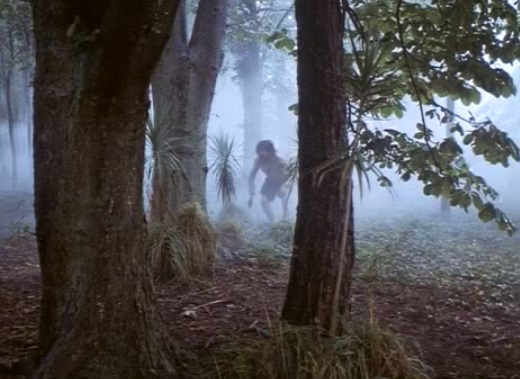
When the Alphans step through the fog, they are re-made as primitive cave-people. As a primitive man, Koenig becomes Cave Chief, while Helena Russell becomes the tribal healer, and the Chief’s consort.

Unaware of what has happened to her fellow Alphans, data analyst Sandra Benes (Zienia Merton) encounters several cave people, who capture her and bring her back to the cave.  There, a primitive hunter (Oliver Cotton) and the Cave Chief battle for ownership of the beautiful and strange female in their midst.

On Alpha, Dr. Mathias (Anton Phillips) solves the alien riddle during an autopsy.  The caveman in the Eagle has caps on his teeth.  

He is one of the Alphans, not an inhabitant of Retha…


“The Full Circle” is likely not one of the better-regarded episodes of Space: 1999’s (1975-1977) Year One.  And yet, it is an episode that I like very much, and for two key reasons.  

First, the episode is set mostly in natural, real environs, and that fact gives the story a remarkable boost in terms of visuals and excitement.  The planet Retha is a combination of Black Park and Pinewood Studios back-lot exterior locations, and the contrast between sterile, technological Moonbase Alpha and such natural, wild locales is remarkable.

You could not recreate the “primordial” look and feel of Retha on an interior sound-stage, using papier mache rocks, nor, truthfully, by using a familiar So Cal location.  

To American eyes, therefore, “The Full Circle” looks genuinely like a journey to the prehistoric era, to a wild, untamed world.  Director Bob Kellett’s camera-work is also remarkable, especially during the pursuit of Sandra by the cave-man Alphans.


Secondly, the episode’s thematic framework works very successfully. Specifically, "The Full Circle" ponders the (unchanging?) nature of humanity. It compares turn-of-the-millennium, space-age Alphans to Stone Age counterparts, and finds few meaningful differences.  

To wit: Sandra Benes (Zienia Merton) nearly bludgeons Commander Koenig (as cave man) to death with a rock.  And Alan Carter (Nick Tate) literally goes “cave-man,” vengeful and hungry for blood when he worries that Sandra has been injured. These are the acts of rational, modern human beings?

As the episode’s coda suggests, the narrative is really about basic human emotions, about human instincts.  Sandra still acts by fight-or-flight dictates, for example, and this means that she is not far removed, in terms of nature, from the Cave Chief who -- in a manner very unlike Commander Koenig -- desires her.

As Koenig notes “it was only us there,” and the point is made. In 40,000 years, according to the episode’s timeline, man has not really evolved beyond savagery, beyond jealousy, rage, and other primitive emotions.  Those things still drive us, sometimes to survival, sometimes to disaster.


One scene suggests the similarities visually.  

At around the half-way point of the episode, we meet Alan, Victor and Kano huddled around a camp-fire, getting ready to turn in for the night. 

In the very next scene, we see the interior of the tribe’s cave, where a camp-fire is also at the center of the population, at the center of civilization.  The costumes have changed -- from Rudi Gernreich 1999 chic to primitive furs -- but man has not.  He still needs fire. He still huddles with his fellow humans in the dark.  And he still doesn’t understand all the mysteries of nature, and the universe.


Where “The Full Circle” vexes some critics and viewers, I suppose, is in the story mechanism that makes the comparison between primitive man and space age man possible.  Here, a swirling mist is a time warp that changes Koenig, Helena and other Alphans from civilized to primitive. Even their clothes change with them.


The time warp mist is a solid device for making the story’s point, but leaves a lot of questions unanswered.  

How do the Alphan’s change costumes in the mist?  How does the time warp achieve that end? Does all the mist on the planet act in this fashion, or only in this one spot?  Is the time warp naturally occurring, a function of “nature” on Retha, or is it something that was designed by unseen inhabitants?

Personally, it doesn’t bother me that Space: 1999 fails to address such questions. I prefer to speculate, and have always felt that the time warp is some device or entity left behind the planet’s inhabitants.  

Perhaps they created it because they foresaw the end of their race, and wanted to go back to the beginning...get a second chance. Or perhaps they left it behind on Retha to preserve the planet’s natural, unspoiled nature.  Any visitors would lose the capacity to alter the planet’s climate or terrain if reverted to primitive form. 

In the end, the details don’t really matter a whole lot, and it is what “The Full Circle” states about human nature that is valuable, and memorable.  When you combine that statement with the beautiful location work, the episode emerges as one that is less disposable, and far more intriguing.  Barry Gray's score is also one of his most unusual contributions, and underlines the action brilliantly.

Also, as is the case in many Year One stories (and “Earthbound’s” coda is an example), “The Full Circle” gains interest and suspense from a twist in the tale.  

It is learned, late in the story, that the cave-man in Eagle 6 is actually an Alphan.  Specifically, he has caps on his teeth.  This information changes the whole nature of the story on the first watch.  Before this reveal, it is a natural assumption that the Alphans have encountered a world of primitive man.  

In fact, as Mathias's discovery suggests, they have encountered only themselves at a different stage of development.  That twist is a surprising one, and like the device of the misty time-warp, makes the final point about humanity’s unchanging nature, all the more powerful.

30 Years Ago: Chris Carter's Millennium (October 25, 1996)

Frank Black (Lance Henriksen), his wife, Catherine (Meghan Gallagher) and their daughter, Jordan (Brittany Tiplady) move into a beautiful ye...