Showing posts with label Tales from the Darkside Binge. Show all posts

Friday, October 23, 2020

Tales from the Darkside Binge: "Answer Me"


My wife has informed me on more than one occasion that I become highly offended when my phone rings during the evening, and she's absolutely right.  

I hate telephone interruptions when I'm screening a movie or TV episode, eating dinner, or writing.  

Now, I don't object to calls from friends and family, mind you, but the ubiquitous calls from political parties, telemarketers, doctors' offices and the like drive me absolutely up the wall.  In fact, I've developed what I can only term a Pavlovian response to the telephone's loud ring. I simultaneously feel a pit of acid in my stomach, and a dawning sense of agitation and anger.

Tales from the Darkside's one-woman show, "Answer Me" recognizes how annoying a persistently ringing telephone can be, and utilizes that sound to punctuate a droll half-hour of escalating terror. The episode exists in a kind of irrational, illogical zone of terror, featuring the scatter shot logic of a dream.  And yet, "Answer Me" boasts some genuine psychic power and gravitas because we all hate technology that we can't control.  Like a damned telephone that rings all hours of the night, undeterred by our desire to silence it.

In "Answer Me," a woman named Joan (Jean Marsh) has sub-let an apartment in New York City from her friend.  But all night, every night, the telephone in the next apartment, 12F rings.  Worse, there is  anoccasional pounding on the wall too, just as she is about to drift off to sleep.

Joan grows increasingly agitated and restless as the days go by, and the damned phone won't stop its plaintive ringing.  She learns, however, that the apartment is vacant and that the woman who once lived next door...died in the apartment.   She apparently committed suicide.  She strangled herself.

As the phone continues to ring, unabated, all day and all night, Joan fiinally breaks into Apartment 12F to have a look...


If you apply logical standards to this episode of Tales from the Darkside, you can see how it collapses under the daylight of rationality.  If Joan is truly vexed by the ringing phone, she has any number of options.  She could go stay at a hotel, for instance.  She could go to Apartment 12F and cut the phone cord.  Or, even, she could purchase ear-plugs.

And yet, undeniably, horror is not always about rationality or logic.

Sometimes the genre works quite effectively on a different level, a surreal nightmare level, and that's the quality "Answer Me" possesses in spades.

There's the possibility Joan's entire experience is a nightmare itself; or that she has found her way into Hell.  For instance, is Joan actually the woman (the English woman...) who died in the apartment netx door, strangled by the phone, but somehow reliving the event?  Her experiences with an uncooperative telephone operator certainly hint at such a possibility.  And  the fact that Joan never sees another human being during the episode's proceedings might even be interpreted not as a sign of the production's low budget, but as an indicator of the fact that the world itself is not right.  That Joan has traveled to some "dark side."

The final moments of "Answer Me" are ridiculous, and yet delightful, even inspired on some level.  The vexing telephone physically assaults Joan, and there's a wonderfully silly p.o.v. shot from the phone's subjective viewpoint during the siege.  

Of course, a telephone as a malevolent evil force is kind of funny.  

And yet again, somehow the idea works in this context, as an avatar for fear.  Not just as a symbol of intrusive technology, but as a representation of the fact that some objects we believe we control and dominate actually seem to take on a life of their own, especially when we're agitated, or thinking irrationally.

"Answer Me" is one of my favorite episodes of Tales from the Darkside.  It's another one that I remember from the series' first run some twenty-seven years ago.  As a teenager, it troubled my slumber and my psyche, although I readily acknowledge it's ridiculous in concept and execution.  

Still, I've never forgotten the imagery of a woman driven mad by the incessant ringing of a telephone, and her final, mortal tussle with "convenient" technology.    

Tales from the Darkside rarely ceases to impress me because it forges a real sense of imaginative terror from the thinnest of premises, and "Answer Me" is a perfect example of this quality.

Thursday, October 22, 2020

Tales from the Darkside binge: "Slippage"


If "Inside the Closet" demonstrated how formalist film techniques might be effectively marshaled to forge a visceral sense of terror on a low-budget, then Tales from the Darkside's "Slippage" reveals another side of the anthology series' creative equation. 

Here, a cerebral, existential terror is broached.  There are no monsters or ghouls to speak of in this half-hour installment, simply the terrifying notion that we do not hold as firm a grasp upon our lives and our identities as we might believe.

As mortal human beings what many of us fear most is oblivion, our absence from existence itself.  Religions have been created, in fact, simply to temper our fear of such oblivion.  Instead of oblivion, we face an eternal and Utopian afterlife in a different, spiritual form, many religions inform us in a dedicated attempt to make the unimaginable and unacceptable palatable. 

But "Slippage" dwells explicitly in that universal fear of "winking out," veritably gazing at the bogeyman of oblivion in the mirror.

In "Slippage," written by Mark Durand and Michael McDowell and directed by Michael Gornick, a commercial artist, Richard Hall (David Patrick Kelly) unexpectedly has a very bad day.  His paycheck has gone missing, and the portfolio he sent to a prospective employer, Commercial Graphics, has also disappeared.

At home, Hall is perturbed when his wife, Elaine (Kerry Armstrong) appears to have registered their car in her name only.

And why wasn't he invited to his high school reunion?

In very short order, Rich worries that "a gremlin is out to rob me of all documentation."  Soon, the fear -- though disturbingly amorphous -- becomes more pronounced: Rich goes to visit his Mother (Harriet Rogers) and she doesn't recognize him.  In fact, she claims not to have a son at all.  Some dark force is systematically wiping out Rich's past...and getting perilously close to his present.

Thus, in the spirit of Twilight Zone stories such as "A World of Difference and "I Shot An Arrow in the Air," "Slippage" suggests that, through some dark supernatural or paranormal auspices, we could be wiped out of existence. That existence itself, seemingly, bears a grudge against us.

Such an idea is frightening enough on its own, but if you peel back the layers of the onion you see that the terror goes even deeper.  If we become lost to oblivion as if we never were at all, the world's memory of us vanishes too.   Since remembrance is the only immortality our species can achieve, the idea of all our loved ones forgetting we ever existed is a potent fear. 

At one point, Elaine asks Richard "you don't want them to forget you, do you?" in regards to his new employers, but her question is actually about a larger, existential issue.  We must accept the fact of physical death, but not one of us wants to accept the idea that we could be forgotten by our loved ones, or that our good deeds on this Earth will disappear into the fog of time.

Simply put, we don't want to be forgotten. We don't want to be invisible.

"Slippage" is consumed with the idea of self/identity, and the episode highlights numerous shots of Richard gazing into the mirror, considering his reflection.  He draws sketches of himself as a baby, as an adult, and as an old man as well.  All such compositions remind the viewer how important we hold our own image, our visage and sense of self.  The message is, simply -- as scrawled out in a Yearbook quote from Rich's classmate -- "Remember thyself to thyself."


As Richard starts to slip through the cracks of time, no more than a "memory that's slipping fast now," he suggests to his friend, who still remembers him, that it is easy in the grind of daily life not to remember thyself, but simply to grind along, unthinking, taking existence itself for granted.

The mechanism of the "Darkside" or "Other World" in this episode causes unfortunate Richard to consider those very things he has neglected.  His favorite movie may be It's a Wonderful Life, but Richard hasn't learned the film's lesson.

Although not as stylistically accomplished as "In the Closet," "Slippage" reveals a how Tales from the Darkside could, even on an egregiously low budget, reckon with human terrors beyond ghouls, witches and devils. 

Wednesday, October 21, 2020

Tales from the Darkside Binge: "Inside the Closet"


Tom Savini directed this episode of Tales from The Darkside (1984 - 1988), which involves a young student, Gail (Roberta Weiss) who rents a room in the home of prickly old professor, Dr. Fenner (Fritz Weaver). 

The officious prig lives alone, he claims. His wife died of cancer, and his daughter is apparently away at graduate school. 

In her rented attic bedroom, however, Gail starts to suspect a different truth when she hears scratching noises emanating from inside the walls.  Worse, a crawlspace door seems to open and close of its own volition. 

On one occasion, Gail finds the crawlspace decorated like a child's room. She sets a trap for rats, only to see the trap mysteriously disappear...and re-appear under her bed.

Gail's final horrifying discovery -- and that discovery's unusual relation to Dr. Fenner -- comprises the final punctuation of this particular installment of Tales from the Darkside, which first aired on November 18, 1984. 

Like many episodes of Tales from the Darkside, it's plain that "Inside the Closet" was cheaply produced. 

At one point, the press reported that the weekly special effects budget for the series was a mere $188.00 dollars. 

Here, the economical aspects of the production are evident in the small cast (just two people) and the number of sets, again just two (an attic bedroom and a downstairs foyer).


Yet despite such apparent limitations, director Tom Savini transforms "Inside the Closet" into a veritable horror masterwork.

With imaginative staging and mise-en-scene, he generates a sustained and disturbing atmosphere of terror until the final, macabre revelation.  There's very little dialogue in "Inside the Closet," and so Savini relies on two creative elements to create the dark atmosphere. 

In the first instance, he deploys expressionistic angles to lift up the terror quotient.  In the second instance, he lets ominous music help sell the story. In fact, the music is almost a character itself in the drama.

This is a spine-tingling and effective combination of techniques and I marveled while watching "Inside the Closet" at how expertly Savini engages the viewer's interest and fear. 

There's a great silhouette shot of Gail at the eight-minute point, for instance -- pushing into the frame -- as she hears a suspicious noise. 

Savini also deploys slow zooms and pull-backs to accent certain important (and portentous) conversations, and even works in a Trilogy of Terror-styled monster-cam./P.O.V. shot.

There are also several featured shots here of slowly turning doorknobs, hinting at the unseen terror behind the door (in a manner reminiscent of Wise's The Haunting). One provocative and carefully crafted composition involves a rack focus: an ominous shift from Gail's foot dangling off the bed in the foreground to the terrifying crawlspace in the background.

The best of these moments involves simple camera motion: a pan down from Gail in bed -- her head resting on the pillow -- to the thing below her bed, eyes red, malevolent and jaundiced. It's a frightfully well-conceived shot, and part of a truly effective stylistic tapestry. 

Too bad then, that, finally, the reveal of the "monster" is largely ineffective. Once you see the beast in the daylight, it no longer scares or is even particularly impressive. 

But of course, given the creature's nature and relationship to Dr. Fenner, this quality may be appropriate too.  The final, sympathetic shots of "Inside the Closet" suggest that even monsters need love too.

There's an authentic simplicity and innocence about "Inside the Closet" that proves really appealing in this day and age of CGI, digital creatures, and high-tech horrors. 

The story doesn't strive for explanations, grasp for far-fetched, gimmicky twists, or wallow in unnecessary narrative complications.  "Inside the Closet"  is about a monster in hiding, and the atmosphere of terror that  this monster creates for one, unlucky woman.

Finally, we get a surprise shift a perspective and are asked to regard the monster differently...as a child.  

And supporting everything here is the universal fear of a closed closet door, and the thing that may or may not lurk inside.

That's plenty of efficacious terrain for a 22-minute story.

Tuesday, October 20, 2020

Tales from the Darkside Binge: "Trick or Treat"


The low budget Laurel horror anthology, Tales from the Darkside, may be a relic from the 1980s, but it's one relic eminently worth excavating, especially around Halloween time.   

Like its brethren, Rod Serling's Night Gallery and The Twilight ZoneTales from the Darkside -- produced by George A. Romero, Richard Rubinstein and Jerry Golod -- remains a highly didactic horror television enterprise, one very concerned with  social commentary. 

As I wrote in Terror Television (1999): "if one looks beneath the veneer of gore and grue, it seems fairly clear that many episodes of this series" are "modern morality plays, cautionary tales about what might happen to an individual who acts selfishly or maliciously."

The Writer's Bible for Tales from the Darkside made this conceit explicit.  "The Other World" or "Darkside" intervention featured in each 30-minute tale was a deliberate mechanism or tool by which the cosmic scales of justice could be balanced.  

And yes indeed, this notion is squarely rooted in the great and noble tradition of EC's Tales from The Crypt or Vault of Horror.

Exhibit A regarding this didactic aesthetic is the series' sterling premiere segment, "Trick or Treat" written by George Romero himself.   Although set in rural America in the 1940s, the program aired in the early Reagan years, and remains just as powerful a parable about greed in 2011 as it was during the time of its original broadcast. 

Directed adroitly and economically by Bob Balaban, "Trick or Treat" involves a nasty old miser, Mr. Hackles (Barnard Hughes) who "collects every penny" that is due him, and gives nothing back to the poor farmers in his community who support his business at a general store.  

And in point of fact, Hackles has even set himself up as a sort of local bank by offering the farmers ample credit when the chips are down.  With nowhere to turn, they accept his "kind" help, only to see him ruthlessly leverage control of their very lives.

Explicitly, the vulture-like Hackles views the people in his town as "backward" primitives, and notes that "people make their own misfortune."  Hackles also derides "the little people and their little lives."   Accordingly, on Halloween night, this "self-made" man doesn't give out candy.  Instead, he dispenses advice.  He tells young Trick or Treaters that "I made my fortune...and so should you."

In today's vernacular, then, old Mr. Hackles is clearly part of the 1 percent.

Each year on Halloween night, Mr. Hackles makes it his business (and pleasure...) to torment the so-called little people of his town.  In particular, he instructs the poor farmers to deliver to his house their children every October 31st.  There, they will be permitted to search the imposing home for his I.O.U.s.  If the children find them, their parents' debt will be completely absolved.  If not, the debt stands.  

Of course, in all the years Hackle has played this sadistic game, no child has ever found the stash of creditor's notes, in part because Hackle's arranges nightmarish "frights" for the children: booby traps and  monster effigies that scare the kids away.

Essentially, Mr. Hackles demands that the good citizens of his town literally turn their children into "debt slaves," becoming his play things for a night in the vain hope that one lucky family might get a reprieve from their bills.  

Again, this idea represents a metaphorical commentary on the nature of the American dream.   Studies have revealed that many low-income Americans don't want the rich to pay their fair share in taxes because they believe they too will one day be rich.  After all, they might just win the lottery, right?  And every Halloween night, Mr. Hackles organizes just such a lottery...but with no real winners.  It's hard to win a game in which one man (or one percent...) leverages all the power and holds all the cards.


In "Trick or Treat's" denouement, Mr. Hackles inevitably gets the tables turned on him.  This Halloween night, it is not children who show up to play his game...it is an array of ghouls, including a terrifying witch.  

One might say that these ghouls occupy his house, even...

In short order, these representatives from "The Other Side" play a little trick on Hackles: they cast his cash (and his prized I.O.U.s) to the four winds.  Hackles attempts in vain to retrieve his "belongings" and ends up chasing the almighty dollar right down the corridors of Hell.  

"You're getting warmer now.  Warmer..." a hideous devil informs Hackles as the miser goes at last to his just reward in the Lake of Fire.  Notably, Hackles feels treated unfairly by those who wield more power than he.

But Mr. Hackles...I thought we all made our own misfortune?  Aren't you a self-made man?

Produced on a budget of just $200,000, "Trick or Treat" dominated the 1983 Halloween weekend Nielsen ratings in major markets such as New York, thereby assuring that Tales from the Darkside would soon become a weekly series; a series that lasted for four years and eighty-nine episodes.  

Episodes such as "Trick or Treat" were generally the norm rather than the exception, and various series installments tackled issues of racism, "hate" radio and other topics from the national discourse of the day.   "Trick or Treat," of course, serves as a pretty explicit and ghoulish reminder (in the early Yuppie era, no less) that "upward mobility" should concern more than the bottom line on a bank account; that our final, eternal "upward mobility" might depend on our accumulation of other currency, namely decency, empathy and compassion.  

In other words, the episode conforms to that line from Matthew: "It is easier for a camel to pass through the eye of a needle, than for a rich man to enter into the kingdom of heaven." 

Trick or Treat...

Monday, October 19, 2020

Tales from the Darkside Binge: Opening Montage


One of the best horror anthologies of the mid-1980s boom was the syndicated, low-budget entry Tales from the Darkside (1984 - 1988). Though it lacked the big budget of Steven Spielberg's Amazing Stories (1985 - 1987) and the re-vamp of Alfred Hitchcock Presents (1985 - 1986), the tales were often authentically frightening, not to mention inventive.  

The introductory montage for Tales from the Darkside reveals the pitifully low-budget (especially compared to Amazing Stories, which featured an introductory montage with a score by John Williams and early computer-generated effects). And yet, the very basic, blunt nature of this intro seems to suggest something important about the series.  

Forget the bells and whistles, Tales from the Darkside is dedicated to scaring the hell out of you. A big budget isn't necessary. This is back-to-basics simplicity.

The montage opens with views of clouds in the sky. This should be a light, happy image, but one view of clouds appears to have been superimposed over another, and so there is a sense of layers here. That's significant symbolically, since the intro's narration establishes that there are actually two worlds: the world of sunlight and the world of darkness.  

The shot of the clouds, slightly overlapping, seems to hint at this duality right out of the gate.


Next, we see a selection of pastoral images.  These are views of our "brightly lit" reality. 

We see the tips of trees as we look up in the sky.  We view a field, a covered bridge, and a babbling brook.

All these images suggest harmony with nature, and a feeling of well-being.  The imagery is positively bucolic.


But now, an interesting shift.  

The next image, on first blush seems bucolic like the others, but there's something askew.  

The tree branches on the left-hand side of the frame seem to be jutting into the picture, spoiling the view of nature. They could be visually "read" as a hand, actually, or worse: A claw. 

And the uneven nature of the split-rail fencing also suggests a world not quite in balance.


As the narrator speaks of an underworld, we move -- tracking -- through a gray woods of extremely tall and narrow trees.  

There is a slightly de-saturated or silver sheen to this imagery, and we get the visual sense of a dangerous place. 

Since the very beginning of human history, the forest or woods have been associated with creatures and spirits, so it is appropriate that this silvery forest becomes the tipping point, as it were, to reaching "the darkside."


Next, with a bargain-basement -- yet wholly effective -- video transition, we flip open a door and fall into the Dark World, a negative image heavy on blacks and grays.


The world we see in the following image is a mirror image of the bucolic images we saw before, perhaps close enough to recognize as being familiar, but with a focus on dark spaces and objects.  

This idea carries importance in terms of the series. The anthology often features (like The Twilight Zone), individuals who unknowingly slip from our daylight world into this...dark side.


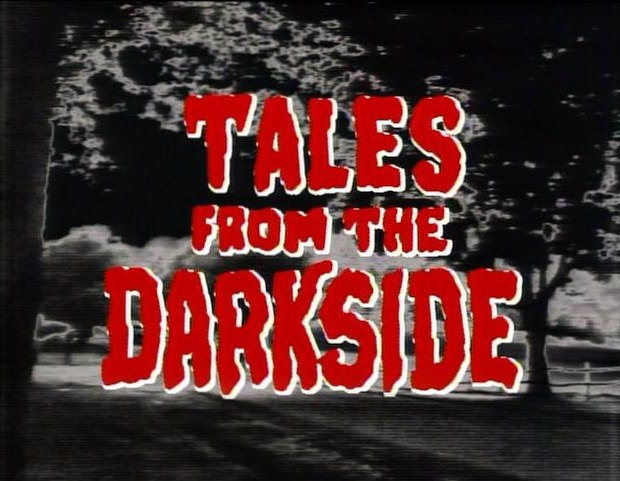
Next, our title card.  We see the series title scrawled in blood-red letters over a black-on-black view of the Darkside world.


So there you have it: this introductory montage is simple, effective and scary, much like the series itself. Great, expensive special effects aren't really necessary, and this introduction fosters an aura of uncertainty and discomfort...on a budget.