Showing posts with label From the Archives. Show all posts

Saturday, June 03, 2017

Saturday Morning Cult-TV Blogging: Ark II: "The Flies (September 11, 1976)


“For millions of years, Earth was fertile and rich. Then pollution and waste began to take their toll. Civilization fell into ruin. This is the world of the 25th Century. Only a handful of scientists remain, men who have vowed to re-build what has been destroyed. This is their achievement: Ark II, a mobile storehouse of scientific knowledge manned by a highly trained crew of young people. Their mission: to bring the hope of a new future to mankind.”

-          Voice-over narration for Ark II (1976)


Since it is summer-time and I am working on a book, I am going to re-post my retrospective of the post-apocalyptic Filmation series Ark II for the next few weeks. I'll blog a fresh series in the fall!

Ark II aired on Saturday mornings beginning September 11, 1976 and ran for fifteen 22-minute episodes. Like many science fiction TV efforts of the time, it was rather determinedly a “civilization of the week” program; meaning that each week, the diverse protagonists traveled (usually by a ground vehicle; sometimes on foot…) to a new and strange civilization.

Basically, it was Star Trek all over again, only without the U.S.S. Enterprise and outer space as useful backdrops.  With some variation, the format was seen in The Starlost (1973), Planet of the Apes (1974), Logan’s Run (1977) The Fantastic Journey (1977) and in the 1980s program Otherworld, to name a few examples. Star Trek creator Gene Roddenberry himself had attempted to take the civilization of the week formula to new heights with Genesis II and Planet Earth, two made-for-tv movie/backdoor series pilots from the early 1970s.


Although it aired during America’s optimistic bicentennial year, Ark II was set in the new Dark Ages of 25th century, and focused on a large, impressive, high-tech tank-like vehicle, the Ark II, which traversed the wasteland in order to aid the survivors of an environmental disaster. 

In a hold-over from the popular youth movement of the late 1960s and early 1970s, Ark II’s crew is described in each week’s opening narration as a “highly trained crew of young people.”

Specifically, the crew of Ark II consisted of the bearded Captain Jonah (Terry Lester), scientist Ruth (Jean Marie Hon), and young scholar Samuel (Jose Flores).  In a weird, unspoken acknowledgment of Planet of the Apes’ continuing popularity, these young humans also traveled with a talking chimpanzee named Adam who could play chess and drive the Ark in a pinch.   

You may have noticed that all the crew names listed above arise from Judaism, and thus carry resonances beyond the obvious.  In the Hebrew Bible, Jonah was a “truth seeker,” which is a term you might use for the stalwart captain of Ark II.  Ruth was the name for a “companion,” in the same text, and Samuel was a man on the cusp of two eras, the last Hebrew judge and the first prophet.  Similarly, on Ark II, the young Samuel is a child of the Dark Age who will also live in the period of the New Enlightenment, or recovery. As for the ape, he is named for Adam, the first human male. 


The name “ark,” of course, calls up imagery of Noah’s Ark, the craft that repopulated the Earth after a disaster, the Great Flood.    

The first episode of Ark II is called “The Flies.” Written by Martin Roth and directed by Ted Post, it finds Captain Jonah recording his log entry numbered 1444. The Ark is patrolling Sector 83, Area 12, investigating a gang called “The Flies” that is responsible for “serious infringements on the rights of the others.” The assignment: bring “discipline” and “reason” into their lives.  The name “The Flies” conjures images of William Golding’s novel Lord of the Flies (1954), which also concerned a society of children.

Unfortunately for Jonah, the Flies -- an interracial gang of youngsters -- are entirely loyal to their leader, a rapscallion named Fagan and a scoundrel played by the one-and-only Jonathan Harris, Lost in Space’s Dr. Smith. Fagan is named after Charles Dickens’ famous Oliver Twist character Fagin, a “receiver of stolen goods” and man who encourages a life of crime in children, turning them into thieves.  In Ark II’s “The Flies,” Fagin and his group of thieves discover ancient poison gas canisters, ones that are still functional.


After capturing Jonah, Fagan takes the poison gas cylinders (and a gas mask to protect himself), and heads to the HQ of a local warlord Brack (Malachi Throne), who lives in the “the Village of the Lords,” actually the Ape City set from the live-action Planet of the Apes TV series and films. Fagan believes he has found “the ultimate weapon,” and attempts to wrest control of the warlords from Brack. Brack beats Fagan at his own game, however, and captures the Flies, forcing Fagan to forfeit his leadership

Ruth, Samuel and Adam save Jonah and free Fagon and the Flies from warlord subjugation.  They also retrieve and dismantle all the dangerous gas canisters without ever resorting to violence. Instead, they neutralize the gas and change it into Nitrous Oxide (laughing gas).


Finally, the episode ends with a moral statement from Jonah: “weapons man creates to use against others can easily be turned against himself.”

Although the series is now over forty years old, the look and production design of Ark II remains admirable.  The main cast, for instance, wears skin-tight and attractive space-age uniforms with computerized belts and cuffs (replete with wrist communicators). 

One can see how this design influenced later Star Trek outings, including The Motion Picture (1979).  Also the exterior, post-apocalyptic set design is kind of interesting: a mix of the Old West, Vikings, and the aforementioned Planet of the Apes. Interestingly, Ark II presages the barbarity and chaos of The Road Warrior (1981) on a TV budget and within TV restrictions.


The Ark II itself, built by the Brubaker Group, remains a remarkable piece of hardware, a life-size, operational vehicle. It looks thoroughly convincing….especially in motion. In the series, this high tech truck is equipped with a protective force field.  The Ark II also billets a smaller exploratory vehicle, the fast-moving roamer.

I find it fascinating that Ted Post directed this premiere episode of Ark II.  A veteran director of The Twilight Zone and Boris Karloff’s Thriller, his movie career had taken off in the early 1970s with Beneath the Planet of the Apes (1970) and the Dirty Harry sequel, Magnum Force (1973).  

Given this impressive CV, it’s odd that, by 1976, Post was helming Saturday morning television. He does a good job handling the actors and action in “The Flies,” and of introducing all of the various tech, from the Ark itself, to the roamer, to Jonah’s rocket pack (which looks identical to one used on Lost in Space years earlier.)

Next week on Ark II: “The Slaves.”

Tuesday, December 23, 2014

The Top Ten Toys of My Childhood


Well, Christmas time is almost here again, and so it's time for an archival post focusing on...toys.

Listed below are my top ten toys from childhood.


10. The Strange Change Machine (Mattel; 1967):  

This "electrical toy" from 1967 is actually just a small oven -- or heating chamber of sorts -- though the box art colorfully describes the mechanism as a "mysterious strange change machine" that "changes time capsules" and offers you -- a mad scientist -- the opportunity to create "16 hidden wonders of the lost world" as they "appear and disappear into capsules over and over again."

What this comes down to, essentially, is that with a pair of blue plastic tongs (included), you would insert small red, yellow and green "capsules" into the heating chamber, and as they heated up, the cubes would unfold (in glorious slow-motion...) into the ships of plastic monsters, dinosaurs and bugs. Then, you could reverse the process, and turn the objects back into cubes.

I played with this toy at my granny Tippie’s house in the 1970s.  It belonged to my beloved Uncle Larry --a mad scientist by disposition (and now a chemistry professor…) – and we had great times creating dinosaurs, mummies, giant insects and other words of “the lost world.”


09. Flash Gordon Rocket (Mattel; 1981)

Straight from "the greatest adventure of all," this whopping rocket ship ("not for use as a flotation device," in case you were wondering...) is over 2.5 feet long (and was made in Taiwan). It's a giant of a toy, with room to hold two action figures from the Flash Gordon Mattel line. The box notes that the toy is over "2.5 feet [81.6 cm] long from nose cannon to tail fin when chamber is filled with air." 

The rocket's cockpit houses two figures and can "detach" to carry Flash or Zarkov (not included) on adventure. Yep, it doubles as a "modular space shuttle" that can be rolled out on "a recon mission." The nose cannon also detaches from the central rocket (and "re-mounts with cloth fastener!"). Also, the box suggests that kids can find "the eyelets and your own string" to hang the ship up.

I remember collecting the Flash Gordon action figures as a kid. I had four of 'em to be precise: Flash, Zarkov, Ming and The Lizard Woman. I bought them at a store called Newberry's in Verona, New Jersey...where they cost a dollar a piece. But I also recall seeing this massive inflatable rocket ship in the pages of a Sears catalog and desperately wanting it.  I never got it, but one of my best friends had one, and I always asked him if we could play with it.  I finally got my hands on one on E-Bay in the 2000s, and I cherish the inflatable rocket to this day.


08. The Six Million Dollar Man Mission Control Center (Kenner; 1976):

I might as well admit it: I've got some kind of weird fetish for 1970s sci-fi control rooms with their big, bulky reel-to-reel computers. I don’t know what it is.  I mean, basically action figures just sit in control rooms…yet I often preferred “the bridge” or “Main Mission” to other type toys (like vehicles). 

One of my favorite such control room s came from the popular Kenner The Six Million Dollar Man toy line. The Bionic "Mission Control Center" was the very place, according to the box legend, "where all the bionic adventures begin!"

This huge, impressive toy included a "giant inflatable dome, 17.5" high and 26" wide." Since the dome was inflatable by air valve (9 for strength and durability...), the toy even came with a repair kit. In case, I guess, Big Foot (Andre the Giant) happened by hoping to puncture it with a pin or something. And inside (or rather beneath...) that huge dome was the HQ for OSI agents Colonel Steve Austin and Jaime Sommers. It was protected, according to the dome specifications, by a "laser force field." Another exterior section of the dome was a computer, a "retrieval storage unit." 

The Six Million Dollar Man Mission Control Center also contains (from the bulleted points on the box): "radar scanner," "TV Monitor," "radio headphones" "bionic check-out panels and cables," "command chair and command console  and "mission control vinyl floor."  And at the "Bionic Check-Out Panel" you could "plug cables into your Six Million Dollar Man's modules" and "pretend you check out his bionics for special missions."  Today, my son Joel also loves this playset.


07. Star Wars Death Star Space Station (Kenner; 1978)

This giant play-set representation of the Star Wars (1977) Death Star -- a literal "pie slice" of the space sphere -- remains one of the greatest and most impressive toys of the late 1970s space craze.

Released by Kenner in 1978, The Death Star Playset recreates the central location of Star Wars, the Imperial battle station, with four different levels of intricacy and detail. The promotion material describes the toy in detail:

"Kenner's exciting play environment simulates the Death Star space station with manual elevator to take the Star Wars figures to any of the action play floors."

"TOP FLOOR: Laser cannon that swivels, emitting "clicking" sounds; it explodes from housing when hit by X-wing fighter.  Also has ledge for Ben Kenobi."

THIRD FLOOR: Manually operated "light bridge" that opens and closes, and an escape rope swing for Luke and Leia.

SECOND FLOOR: Control room for piloting Death Star and escape hatch to trash compactor.

FIRST FLOOR: Trash compactor complete with removable foam garbage; has turn-screw to close end of compactor, which stops in in time for Star Wars hero to escape."

This description doesn't indicate one of the coolest aspects of this great toy, however: the Death Star comes complete with a figure of the Dia Noga -- or trash-compactor monster -- thus allowing us to see its full body shape for the first time.

I received this impressive toy for Christmas as a nine year old, I believe, and I loved it.  I was disappointed that the station was not in the familiar sphere aspect from the movie, but the "pie slice" structure allows for easy access on all sides, and makes playing Star Wars easy.


06. Big Trak (Milton Bradley; 1979)

On the cusp of the futuristic 1980s (!), Milton Bradley's electronic toys seemed truly amazing and forward-looking.  The toy company created the Star Bird , and of course, Big Trak, the "fully programmable electronic" vehicle. As you can see from the box photo above, Big Trak is a land rover-type vehicle, one with a nice futuristic sheen.  The craft is sleek and it looks bad-ass.  On the dorsal side of the tank is a rectangular computer panel, fully programmable.  As the box establishes: "BIG TRAK's computerized Control Center -- with its intricate electronic memory -- can accept complex programs of up to 16 separate commands.  Big Trak can go out of the room and return to you; it can maneuver around furniture.  Detailed instruction booklet (with sample programs) included."

So Big Trak could "respond to your commands" and the box invites kids to "watch Big Trak perform!  Goes forward and reverse, turns, spins, and fires." An accessory (sold separately, naturally) was the Big Trak Transport, which could be attached to Big Trak to "haul light loads for long distances."  You could also deploy the transport as a kind of dump truck, which was very cool. 


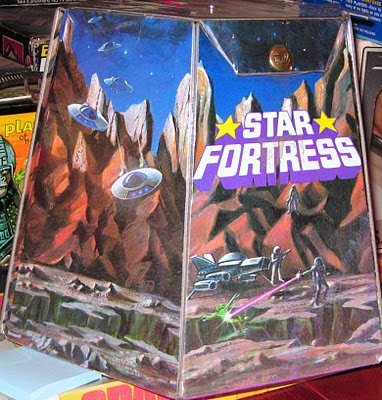
05. Interplanetary Star Fortress (Sears; 1979)

In the years following Star Wars (1977), outer space-related toys flooded the American toy market.  Many of these toys were what collectors today uncharitably term "knock-offs," meaning that the toys don't originate with a license like Star Wars, Star Trek, Battlestar Galactica, or Buck Rogers in the 25th Century...but from an incredible simulation.  In other words, these toys didn't belong to a specific set, but could easily co-exist with the other sets in terms of size and general "look" and vibe.

And -- I have to admit it -- I have a sort of crazy love for these knock-offs or so called "generic" play sets.  I guess it's because as a kid ,the knock-off toys offered me an opportunity to put  my Jedi Knights, Starfleet Officers, or Directorate Agents into "new" adventures; ones that didn't come specifically from any movie or TV episode.

It seems like an alien concept in the era of the Internet, but getting a Sears Catalog near Christmas every year was an incredible experience for kids back then.  I remember eagerly getting my hands on the catalog (after my sister was finished looking at Jordache jeans...) and leafing through the toy section, absolutely agog at the new toys being offered up for sale.  I remember one year, my Mom purchased for me the Star Wars Cantina, complete with Blue Snaggletooth.  The next year (I think...), I got this Interplanetary Star Fortress from the catalog.  And I loved it.


04. Star Hawk/S.T.A.R. Team (Ideal; 1977)

The Star Hawk is another knock-off toy from the Star Wars era.  This is the “Star Team spaceship with motorized hatch and space-like sounds.”  The large red and gray flying saucer-type craft came “complete with Zeroid, moveable landing pods, revolving platform, exit ramp and clear dome.”  And “Zeroid’s spaceship, the Star Hawk transports your Zeroid from one daring adventure to the next.  When you activate the special motor, the hatch slides open, landing pods go into position, exit ramp lowers, and space-like sounds announce the arrival of Zeroid, to help you save the day.”

As for the Zeroid himself, he is a modified version of the popular (and now incredibly expensive...) 1960s Zeroid line.  He’s a “highly detailed action robot with moveable arms. ZEROID rolls on a twin-tread base.  Flip on his special flishing signal lamp and send messages to his friends.”

My grandparents (now both deceased…) bought me the Star Hawk (w/Zeroid) when Star Wars toys were new and at first I was disappointed with the generous gift because I would have preferred the Millennium Falcon, Darth Vader, R2-D2 and C3PO.  But it wasn’t long before I became intrigued by theseStar Wars knock-off toys, and came to see that they allowed me to create my own play universe.  In particular, I remember that the Star Team Knight of Darkness camped out in G.I. Joe’s Adventure Team Headquarters.

Today, I’m really glad I still have these particular toys in my home office.  Even today, Zeroid’s dome lights up, and the Star Hawk hatch still slides open (with a springy rat-a-tat sound).  The decals are coming off now, after all these years, but these toys remain…ideal for the imagination.  


03. U.S.S. Enterprise Bridge, Star Trek: The Motion Picture (Mego; 1979)

It must have been 1980 or 1981, I guess; a bitterly cold winter's day as I recall. I was at the massive (and legendary...) Englishtown flea market in New Jersey with my family, searching out toy treasures. At that time in my life, that would have meant Planet of the Apes, Star Wars, Space:1999 or Star Trek figures, to put a fine point on the matter.

Bundled in a warm winter jacket and sipping hot chocolate out of a Styrofoam cup, my lips shivering, I soon came across a toy that I had never seen before and have only rarely seen since. And which today, I prize.  It's the Star Trek: The Motion Picture "U.S.S. Enterprise Bridge" from Mego Corporation, released 1980. I found it mint in its box at the flea market that day...selling for one dollar. Needless to say, I bought it. And I still had allowance to spare...

I've kept this toy with me ever since - during all my geographical moves from New Jersey to Virginia to North Carolina, though the toy box is long, long gone.  A few years back, I bought a new one (with box...) on E-Bay for significantly more than one dollar. Why? Well, I had always promised myself that if I saw another of these rare toys, and it was under a certain price threshold, I would get it, since I had played mine out and all the decals had basically rubbed off.

To explain further about this toy, it is not the famous "spinning transporter" Bridge playset from Mego; from the original TV series.No, this is the movie Enterprise bridge from Star Trek: The Motion Picture. The box legend says it all, capturing the glory of this toy: "take command of the helm and recreate all the adventure of the crew of the starship Enterprise."

How many of us X'ers, as kids, wanted to do just that?  I know I did, and since the movies were from my era growing up, the 1979 -1991 era, this was the bridge I wanted. The bridge V'Ger's probe attacked. The bridge Kirk returned to after a 2.5 year absence after the five year mission; the bridge from which he faced "KHAN!"


02. The Star Bird Avenger (Milton Bradley; 1980)

The spaceship you are gazing above at is the Milton Bradley Star Bird, or in this case, the second incarnation of the cruiser, the Star Bird Avenger. Featuring "new exciting electronics," this nicely-designed "space transport" features "exciting engine sounds, firing photon beams, battle sounds, and special target!"

The Star Bird (sans the specification "Avenger") was first released by Milton Bradley in 1978, shortly after Star Wars took the world by storm, and my next door neighbor and best friend from West Milford, David, was the first kid in Glen Ridge (and particularly on Clinton Road...) to have one.

The ship was truly state-of-the-art for the time, because if you owned two Star Birds they could electronically duel with one other. Or as the box put it: "Fire your photon beams and hit the alien spaceship. Hear distress signals and sputtering engine sounds!"

In other words, the Star Birds were relatively interactive, at least for the disco decade. In the event you didn't have two ships, the Star Bird also was sold with an "alien target." The box noted: "Attack the special target with the flashing photon beams and Avenger signals your victory!"

The other interesting aspect of the Star Bird was that it was actually several starships housed as one. For instance, mounted on the dorsal rear of the ship was an "escape pod" and cannon, in case of battle damage. Per the box: "Rotating gun turret - rear gun turret doubles as an escape pod. Just release the retainer and go whirling through space."


01 Space 1999 Eagle 1 Spaceship (Mattel; 1976)

The Mattel Eagle 1 Spaceship (1976) remains my all-time favorite toy, hands-down.  ,In part, I favor this 1970s Mattel toy because it comes from my all-time favorite science fiction TV series, Space: 1999 (1975 – 1977). But in part it is also because the toy is downright colossal: over 2.5 feet long, as the box trumpets. 

Beyond these values, the Mattel Eagle also comes apart into a smaller ship, a combination of the command and engine modules. This aspect of the toy seems very realistic to the series (or “show accurate,” to use collecting lingo) and the modular design of the Eagle (from SPFX maestro Brian Johnson).   The separated command module resembles some of the incarnations we saw of the Eagles in episodes such as “Missing Link” and “Dragon’s Domain.”

I was given this really awesome toy shortly before my sixth birthday, in 1976, by my Mom and Dad.  I remember that I was sort of depressed because my older sister didn’t want to play with me on a Saturday and I had nothing to do.  My Mom noticed I was down in the dumps. So she led me into my parents’ bedroom and told me to look underneath the bed.  I did, and there was Eagle 1, ready for action! The surprise gift made my day…and I’ve never forgotten it, or my Mother’s kindness. She was always doing things like that for me (and still does, for my son Joel, to this day.)

Then, as my real birthday approached, my Mom and Dad took me aside and told me that my Uncle Glenn, who recently passed away, had also bought me an Eagle One toy. They asked me if I wanted a second one, or something different.

Well, of course I wanted a second one. The only thing better than having Eagle One was having an Eagle fleet!

Friday, September 19, 2014

Cult-Movie Review: Code 46 (2003)


"If we had enough information, we could predict the consequences of our actions. Would you want to know? If you kissed that girl, if you talked to that man, if you take that job, or marry that woman, or steal that papelle? If we knew what would happen in the end, would we ever be able to take the first step, to make the first move?"

- Code 46 (2003)

If you subtract the  futuristic and dystopian details from Michael Winterbottom's spell-binding Code 46 (2003), what emerges is a relatively simple and straight-forward tale of doomed, irrational love. 

In other words, this sci-fi movie concerns an adage from an old Woody Allen film: the heart wants what the heart wants.  Even if what the heart desires isn't really wise, legal, or necessarily right.

Once you layer on the film's impressive futuristic details however, Code 46  emerges as something of tremendous import and note.  It's a frightening and deeply saddening glimpse of technology run amok and genetic control ruthlessly imposed by a seemingly-invisible but all-powerful State. There are echoes and resonances of Gattaca (1997) here, but Code 46's focus is not on personal achievement and widespread genetic "racism," but rather on a single star-crossed couple who -- inexorably and unintentionally -- flout the prevailing laws. They feel they have no choice. They are in the grip of a force not of their conscious choosing.

Coupled with a mesmerizing, trance-like score and an informal cinema verite shooting-style, Code 46 masterfully conveys a real sense of place and time; even though the film's futuristic venue doesn't exist in the real world.  It's a staggering achievement on Winterbottom's part, and Code 46 thrives not as an action film or even as a thriller, but as an unforgettable mood piece. Even if precise details of the plot are occasionally opaque or baffling, images and feelings from the film nonetheless linger and echo long after a viewing. 

After experiencing Code 46, you will authentically feel as if you've spent ninety-five minutes in another world. Or, as film critic Paul Byrnes insightfully reported in his review of the film: "It's a bleak future, but not a bleak film. Winterbottom has an uncanny ability to create beautiful, hypnotic sequences, using contemporary music. His films have a seductive modernism, but without losing focus on character and idea. Other directors raised on MTV use music to paper the cracks; Winterbottom uses it to get inside the cracks."

Does an empathy virus work long distance?


In the intriguing world of Code 46, genetics are rigorously policed, perhaps as a result of widespread infertility or sterility in the recent past. 

As the film's opening card relates: "due to IV, DI embryo splitting and cloning techniques, it is necessary to prevent any accidental or deliberate genetically incestuous reproduction." 

If genetically incestuous reproduction does occur, it is termed a Code 46 violation. If genetically incestuous reproduction occurs intentionally, it is a criminal violation of Code 46, and duly punished.

The future imagined by Code 46 is also one of huge class differences. Cities are over-populated (except in the "unhealthy" heat of broad daylight), highly affluent, and termed "Inside."  Beyond the borders of the colossal cities -- "Outside" --  denizens live in abject poverty, environmental desolation and technological primitivism. Because of the draconian genetic regulations, freedom of travel is a luxury of the past. 

To make passage from one from city to another, from Inside to Outside and vice-versa, travelers must carry genetic passports termed "cover," or "papelles." These electronic "papers" -- genetic driver's licenses, essentially -- must be presented before any egress. "Cover" is also severely time-limited.  If your cover i.d. expires while you are still in a foreign land, you have no way to get home.


As Code 46 commences, a fraud investigator, William Geld (Tim Robbins) is sent to Shanghai to investigate a problem inside the massive Sphinx Insurance Company. 

Someone inside the company is falsifying cover papelles for undesirable genetic elements, thus permitting them to travel freely in restricted zones. In order to help him ferret out the saboteur, Geld has been injected by his employers with an "empathy virus" that allows him to intuit the traits of those people he interviews, provided they freely share with him one detail of their lives.

After a series of one-on-one interviews, Geld determines that Maria (Samantha Morton) is the source of the falsified or forged papers. However, instead of arresting her, the married Geld makes a leap.  He pursues a romantic and sexual relationship with Maria. The next day, while still "covered," he leaves Shanghai.  

Back home in Seattle with his wife and young son, Geld still seems obsessed with Maria. When he is summoned back to Shanghai on a new development in his investigation (the death of a man with falsified papers...), he attempts to find Maria again. William discovers that she has been taken to a state clinic for a Code 46 violation. Specifically, she was pregnant with Geld's child. Now, the pregnancy has been "terminated" by the State. Also, Maria's memories of the sex act and her lover have been surgically-removed.

Although he knows he is courting danger, Geld remains in Shanghai as his cover papelle expires, and shares with Maria memories of their lost relationship. Geld also goes to a DNA expert and learns that he and Maria indeed share genetic history. Specifically, Maria is fifty-percent genetically related to him, a "biological clone" of his own mother, who was one of a "set of 24 in-vitro fertilized clones." 

Legally, they cannot "liaise"

Despite his knowledge of this fact, Geld still pursues a romantic relationship.  On forged cover, Maria and Geld flee to the "Outside" and to Jebel Ali, in Dubai. There, Geld learns that Maria has been implanted with a virus that reacts negatively to his...sexual presence. Still in love with him, Maria demands William strap her to the bed and make love to her.  He complies. 

But afterwards, still possessed of the virus, Maria reports to local authorities a Code 46 violation. 

The couple attempts to outrun the State in a hastily-purchased car...

You know what they say, "the Sphinx knows best."


In some ways -- and as has been duly noted in other reviews -- Code 46 plays like a high-tech variation and meditation on Sophocles' play, Oedipus Rex (429 BC).  

In both tales a man unknowingly falls in love with his own mother (or a genetic duplicate of his own mother, at least), and personal disaster and destruction ensue The Oedipus Complex is known in psychological circles as a male child's unconscious desire for the (sexual) love of his mother, of course, and Sophocles' famous work also gazes explicitly at the conundrum of fate versus free will. In pursuing his free will, Oedipus meets his unpleasant destiny.

This idea is resurrected, updated and tweaked in Code 46. William Geld is involved in an unacceptable form of love by legal, societal standards (as was the case with the King of Thebes), but in his case, the laws of the state actually seem to compel this behavior, at least to a certain extent. 

Society as depicted in the film creates the very technological conditions under which William can encounter a genetic duplicate, essentially, of his mother. And then society punishes him for his "illegal" response to Maria. Yet, importantly, Geld is in no position to deny his Oedipal feelings, his destiny, either. The "empathy virus" he has been injected with only augments his feelings for others, thereby assuring that he will step outside of bounds of legality with Maria.

As for Maria, she describes early in the film a dream she experiences every year on her birthday. In that dream, she gets closer and closer to finding her "destiny." She first meets William Geld on her birthday, and when she experiences the prophetic dream again, she sees him waiting for her. He is her destiny. Since she believes this, and William is "empathetic" (thanks to the virus), he cannot help but believe it as well.  He is a sense, under her romantic influence.

And Maria? She is a biological clone of William's mother. Does this mean that her subconscious vision of William as her destiny actually symbolizes her genetic desire for an offspring, a child?  The movie never suggests that explicitly, but it certainly seems a possibility. Maria receives one signal, but misinterprets her destiny. William is not supposed to be her lover, perhaps, but her child. A biological clone of another being, her circuits seem crossed.

Even the so-called "riddle of the Sphinx" is adapted in Code 46. In Oedipus the King, Oedipus must solve the riddle of the Sphinx, a query which has perpetually vexed travelers outside Thebes. In Code 46, the mysterious Sphinx -- the monolithic insurance company -- permits and denies travelers egress for reasons all its own. The corporation's decision-making process remains completely hidden from the actual travelers.  As viewers, we don't discern the Sphinx's higher purpose, except control.

In both Oedipus and Code 46, the man who has broken the law -- William or the King -- must pay for their crimes. Oedipus gouges out his own eyes and becomes a wandering wretch. In Code 46, William Geld has his memories of Maria expunged from his mind and lives up to his name, "Geld."  To Geld is to castrate, and here William Geld is emotionally castrated; denied the knowledge of what he once felt (rightly or wrongly) was his destiny.

In substituting a company (Sphinx) for an instrument of the divine (the Sphinx of Greek mythology), Code 46 suggests that in a high-tech future both fate and free will shall be supplanted by the iron will of the State. 

And again, there's a kind of hypocrisy embedded in the State's will. The very world that it creates ultimately is responsible for encouraging and discouraging William and Maria's love. The State is a fickle deity. The couple would never have met without the genetic laws, never have fallen for each other without the "empathy virus" and then never have been torn asunder without the widespread prosecution of Code 46 violations. Maria and William are thus screwed six ways to Sunday, if you'll pardon my French.  Their love and loss is unimportant to the Order of Things as legislated.


William survives the affair well enough, after a fashion. But for Maria, it's quite a different story.  The end of the film features a canny montage of cross-cuts to suggest this. 

In one set of images, we see William returning home to his well-dressed, perfectly-coiffed wife in Seattle. He is greeted by his gorgeous spouse and young son, and then returned to his affluent home.

These images are inter-cut with visions of Maria alone, in Dubai, wandering in solitude and poverty. Her final words, uttered in voice-over -- "I miss you" -- are ones that William will never hear. In fact, he has no awareness or memory of Maria at all.Their love affair is erased, deleted except in her solitary memory.

And lastly, there's one final connection to Oedipus here. In Sophocles' work, Oedipus realized what he had done, and took steps to punish himself.  He rendered himself blind, and then made himself an outcast. In Code 46 -- after a second instance of illegal sexual intercourse with Maria -- William knowingly permits his lover to notify the authorities. He watches her make the telephone call, and does nothing to prevent her or stop her. 

This is by far a more passive response than Oedipus's, but it is William's tacit acknowledgment that he has committed a wrong, and that it must be corrected.  Yet -- in some cowardly way -- the burden of pain falls not on William (as it did on Oedipus) but on Maria instead. William blithely returns to his happy life, never knowing what he has lost while Maria forever bears the scars of their brief but passionate relationship. 

In this fashion, I submit, Code 46 also concerns a globalized society in which the rich make the rules and benefit from those rules, while the poor get shafted. 

William had an illicit dalliance, but was welcomed back into the loving embrace of his wife (and we see them make love after his return). He carries not even the burden of a guilty conscience for his illegal behavior. In this world, love apparently means you don't have to remember to say you're sorry.

Instead, Maria takes it on the chin, alone. Outside, and grief-stricken. She wonders, mournfully about the man she has lost, harking back to her own memory loss.

"Can you miss someone you don't remember? Can one moment or experience ever disappear completely, or does it always exist somewhere, waiting to be discovered?"

We all have problems, William. How we deal with them is a measure of our worth.


As I wrote at the beginning of this review, Code 46 is an eminently powerful mood piece, and all the details add up to a believable future world as backdrop to the haunting, conflicted love story. 

In this case, one of those backdrop details involves the "globalized" society I just noted. Although the world-spanning State (a one world government?) regulates genetics, it has apparently also paved the way for the assimilation of all known languages and cultures, and therefore also the destruction of small, local, individual worlds (at least on the "Inside.") 

Specifically, all the characters in the film speak a hodgepodge of English, French, Spanish, Mandarin and Farsi. There are no borders anymore, as the State (apparently a Corporate State) has smashed all of them. 

To support the idea of this rampant "globalization" and wanton intermingling of cultures, Winterbottom even intermingles our very sense of geography in the film. Outside metropolitan Shanghai, for instance, is a vast, empty desert. And Seattle looks roughly the same as Hong Kong does, or any other over-populated urban center. 

And in every city, gigantic interior structures seem to wind around on themselves, technological behemoths with no end and no beginning.The idea here is that technology and business "globalization" have dwarfed individuality the world around. By shooting in real-life locations all over the world and mixing and matching locales freely, Winterbottom presents a vision of global sameness on an inhuman (and inhumane) scale.

What's so beautiful about Code 46's presentation, however, is that Winterbottom does not approach this inhuman world with sterility or even, actually, cinematic formality. On the contrary, through informal editing and shooting techniques (jump cuts, blurred focus, point-of-view perspective shots, and more), he enhances the sense of a real place, of bustling Shanghai at nightfall, for example. 

Desson Thomson, writing in The Washington Post rightly observed: "The movie's atmospherics -- the grainy-hazy images, a blighted world, the zoned-out luminosity of Morton's face -- give "Code 46" an impact that transcends the actual story. You may soon forget the specifics of the plot, but you'll always remember the world it came from.

The spontaneous-seeming, cinema verite camera-work in Code 46 also successfully contrasts the controlling aesthetic of the Sphinx and the State. It's a top down world of rigorous control in which citizens are constantly under surveillance.  But down on the street level -- and between two lovers like Maria and William -- life can still feel spontaneous, surprising, unpredictable. This couple wander into a pre-ordained genetic meeting with eyes closed; not understanding the pull of destiny, or rather, genetic pre-determination. 

The fact of their genetic incompatibility is revealed in visual clues  by Winterbottom, right down to the casting of Robbins and Morton. Robbins towers a full meter over the diminutive Morton, a virtual giant beside her, and there's something unsettling and wrong about them "together," down to their very physicality. 

Kurt Loder noted this idea in his review of the film: "But in extrapolating from our contemporary unease about human cloning, and of course the ever-ominous powers of government, "Code 46" presents a future society that's hauntingly plausible. Robbins and Morton don't seem to have much in the way of romantic chemistry at first — or do they? In fact, they probably have all the chemistry possible in a world that's been so drained of cheer and trust and human possibility, and so fundamentally disfigured by scientific technology. They have too much chemistry, it turns out, and it dooms them both in different, dreadful ways."

That last point is a critical one. In very deep, thoughtful fashion, Code 46 concerns the way that our feelings seem to dictate our reality; how our emotions become intertwined, irrevocably, with our world view. Maria and William may be courting destiny in their tragic love affair or they may be responding to something deeper: a genetic, Jungian unconscious that must pull them together, regardless of the consequences. 

In small, meaningful ways and in occasional grace notes, Code 46 artfully explores the nuances of the human condition, and the way that the human condition forever remains constant, even in the looming shadow of scientific, technological and business "advances."

The heart wants what the heart wants...

CULT TV FLASHBACK: Dead of Night (1994-1997)

This year, Dead of Night: The Complete Series , was released on Blu-Ray by Vinegar Syndrome , and I just had the pleasure of falling into i...