Showing posts with label The Films of 1969. Show all posts

Friday, June 02, 2017

The Films of 1969: Journey to the Far Side of the Sun


From Kubrick’s 2001: A Space Odyssey until George Lucas’s Star Wars (1977) the space film genre -- in film and on television -- evidenced a deep belief in man’s capacity to tame the solar system, and offered a realistic rather than glamorous portrayal of man himself. 

In other words, man’s technology had improved to the point where (near) space could be conquered, but humanity itself remained as venal, as grasping, as competitive, and as conflicted as ever. 

Another film from the same milieu is Journey to the Far Side of the Sun (British title: Doppelganger).  This science fiction film was a perennial on WABC Channel 7’s 4:30 pm movie in the New York market during the mid-to-late 1970's, and as such, represented an early obsession both for me and my older sister.

To this day, you can likely ask my sister about that strange science fiction movie from the 1970's in which a man removes his eyeball in a red-lit darkroom, or another man pile-drives his wheelchair into a mirror, and get a visceral response from her about the imagery.

Beyond those personal memories, Journey to the Far Side of the Sun arises from the impressive stable of British producers Gerry and Sylvia Anderson, and seems a perfect representation of their brand in its glory days.

And what does that brand entail, precisely?

It's a simple three-part formula, really. 

The gadgetry and miniatures.

First, the typical Anderson production boasts high-tech gadgetry galore, created with an eye towards scientific accuracy, and with elaborate, state-of-the-art costumes, sets, props, and miniatures. 

Near future man on the cusp of space exploration.
Secondly, said production showcases a narrative focus on the near future "space age,” when man is not yet so “evolved” that he is unrecognizable as man.  In the Anderson canon, stories often occur just as turn-of-the-century man is taking his first footsteps into the solar system at large.  The advantage of this setting is its appeal to the young.  I’m a perfect example, I suppose.  I was captivated by Journey to the Far Side of the Sun and Space: 1999 at a young age, and believed that such futures were possible -- nay probable -- in my life time.

The Mystery.
And finally, the perfect Anderson production highlights, a macabre, deeply disturbing "twist" that exposes the nature of the universe as something beyond modern man’s capacity to conceive or conquer.  In space, we are confronted with a realm where there are no easy answers, no pat solutions.

For example, in UFO (1970), we learn that aliens are harvesting our organs. In Space: 1999 (1975 – 1977), the moon is blasted out of Earth’s orbit and sent careening into a universe of monsters and mysticism that 20th century man is psychologically and technologically unprepared to encounter.

Personally, the Anderson creative formula represents one of my favorite types of storytelling, and Journey to the Far Side of the Sun is a potent, crisply-edited declaration of all the ingredients I tallied above.   It is a sharp -- and often unsettling -- mix of 2001: A Space Odyssey (1968), the James Bond films of the Connery era and even a little bit of Planet of the Apes (1968) tossed in for good measure.

The explicit premise of Journey to the Far Side of the Sun is that there exists beyond the sun a “mirror” world.  It is a heretofore-hidden planet and a reverse “copy” of Earth. 

As the movie explains, all the matter here on our Earth has been “duplicated” there on that planet, but in reversed fashion, much like you’d see while gazing into the mirror.  Accordingly, Journey to the Far Side of the Sun supports its theme by featuring a number of compositions involving mirrors or other reflective surface.  I find this visual approach quite intelligent, and the leitmotif of mirrors forecasts a brilliant line of dialogue spoken in Solaris (1972) a few years later: “We don’t need other worlds, we need a mirror.”

In Journey to the Far Side of the Sun, an American astronaut, Glen Ross (Roy Thinnes), and the men and women of a European version of NASA called EUROSEC discover that very mirror, and in the end knowledge of that mirror (and that world) drives at least one man, Jason Webb (Patrick Wymark) insane. 

What remains delightful about this fact is that the movie leaves the exact reasons for Webb’s insanity open to interpretation, as we shall see.

Beyond the creepy idea of a world identical to ours, but in reverse, Journey to The Far Side of the Sun impresses due to a few other key factors. 

First, the film climaxes with an unrelentingly grim final act, and an uncompromising, bleak finale.  You can’t make the claim the movie lacks the courage of its convictions.  There is no ameliorating Hollywood bullshit to make serviceable the possibility of a happy ending (see: Oblivion [2013]) here.

And secondly, the film’s Anderson-esque approach to space travel -- basically that it’s a dangerous and expensive enterprise -- makes the whole film feel incredibly grounded, and therefore incredibly believable.  One of the film’s main protagonists, the aforementioned Webb, is downright Machiavellian in his manner of getting things done.  He’s on the side of the angels, but his methods aren’t exactly…nice.

Journey to the Far Side of the Sun remains a dazzling head-trip from an era (and team) that believed space travel was inevitable, but one that proves --- because of the meticulous nature of the production -- both compelling and scarily believable, even in 2014.


 “You wouldn’t want anyone else to get there first, would you?”

Journey To The Far Side of the Sun dramatizes the story of EUROSEC, a European space agency run by the hard-driving Jason Webb (Wymark), a man determined to launch a space mission to examine a new planet discovered in the solar system, one that we can't observe from Earth.

The recently launched Sun Probe snapped images of the alien world using its "cine camera" and brought back to Earth the "first photographic evidence" of the heretofore undetected planet. This discovery is vetted in a sequence that forecasts today's video-conferencing capability, with Webb making an address and visual presentation to EUROSEC members across the globe.


Because a space flight to the new planet will cost a billion dollars, America and NASA are brought in to share the cost of the journey.  An American astronaut and the first man on Mars, Colonel Glen Ross (Thinnes) will command the mission.  At home, however, Ross is facing more earthbound problems. He has not been able to conceive a child with his sexy but harsh wife -- the daughter of an ambitious American politician -- who tells him his sterility is due to his work in space.

“You went up there a man, but you came back less than a man,” she snipes.

Going along with Glen on the mission is John Kane (Ian Hendry), a British astrophysicist who has never been to space before. Together, these men train for the arduous six week mission and the film follows every detail of the process. From there, the audience is treated to sweeping shots of colossal rockets on launch pads (courtesy of special effects wizard Derek Medding), pans across vast mission control centers, and intense close-ups of space-suited astronauts ready to commence the mission.

When Ross and Kane reach the distant planet, their lander crashes on the surface and Kane suffers devastating life-threatening injuries. But Ross awakes to find himself on Earth…or a duplicate of Earth where everything – including the writing -- is reversed. 

After several interrogations by EUROSEC, Ross is able to convince the alternate version of Jason Webb of the truth: he completed his mission successfully, and now he stands on an alien world.  Just as another Ross – originating from this world -- is now talking to a “mirror image” or doppelganger of Webb on Glen’s Earth.

Webb and Ross devise a plan to get him home, but a miscalculation involving the polarity of electricity scuttles the mission, killing Ross and nearly destroying EUROSEC in the process.

Years or perhaps decades later, later a defeated Webb -- an old, very sick man -- gazes in a mirror at a rest home, and reaches out longingly for the mirror image there…


“How much is it going to cost us this time?”

Journey to the Far Side of the Sun is dominated, oddly enough, by discussions of money. Jason Webb is the head of EUROSEC, and a man who finds himself a beggar, asking for money to further man’s scientific frontiers. 

French, German, and American members of EUROSEC are not impressed by his proposal to land men on the distant, newly discovered planet, and tell him so. 

How much is it going to cost us this time?” asks one character. 

A realistic estimate?” queries another. 

“Such a sum is out of the question!” declares a third council member, when talk of a billion dollars is bandied about.

The point here I suppose is, well, when was the last time the Emperor asked Darth Vader how much it would cost to build another Death Star? 

That’s not a dig at Star Wars so much as an acknowledgment that many popular space or science fiction franchises simply ignore matters of money or the economy because their creators assume that such talks are boring, or out of place in science fiction drama.   

I would argue a different tact: discussions of space travel economics tend to make futuristic productions seem more realistic, and that’s an important task when you consider that -- nestled at the far side of the sun -- there exists a mirror planet housing duplicates of every single one of us. 

It helps us to accept the unbelievable, in other words, if we know the rest of the story is, actually, grounded in recognizable reality.

When he must solicit funding from the Americans for his mission, Webb must also compromise and accept an American commanding officer for the task.  He is willing to make this accommodation because he understands the importance of the space flight. Again, what is being showcased quite explicitly in Journey to the Far Side of the Sun is the horse-trading of politics.   It’s not romantic and it isn’t pretty, but again, it’s true to who we are as a species.

Some of Webb’s compromises are much more distasteful, however, and that’s a realistic touch too. 

For instance, Webb knows there is a security leak at EUROSEC and, at least tacitly, allows information about the new planet to be leaked to Europe’s enemies (presumably The Soviet Union or Red China…) so as to get the Americans on his side for the mission.  He has the spy (Herbert Lom) killed, but not before the leak occurs.

Because now he can taunt the Americans with being second-best. “You wouldn’t want anyone else to get there first, would you?”

Mission accomplished.  The only thing that could get us to Mars tomorrow is the knowledge that Putin is trying to get there today.

This idea of space travel as a political and expensive game also plays out in Space: 1999 episodes such as "Dragon's Domain" and in several UFO episodes, wherein Commander Straker (Ed Bishop) must go before the unimpressed faces of bureaucracy to request more funds for SHADO.

Again, I view such discussion of politics and money as a necessary bow to reality and accuracy, and in Journey to the Far Side of the Sun, Webb is able to afford to build the Phoenix -- the rocket bound for the alien world -- only because he knows how to play the political money game better than anyone else does.

In Moon Zero Two, we saw how big money was “civilizing” the moon and squashing personal freedom.  Here we see how money is a necessary evil if space is to be explored.  It’s the other fuel source that powers our rockets, our moon bases, and so on.

Outside this acknowledgment of reality in a genre that is often given to wild flights of fancy, Journey to the Far Side of the Sun is resolutely creepy because it subtly asks vital questions regarding its unusual “doppelganger” premise.

What if there were two versions of you? What if everyone here on Earth had an exact duplicate there, on the other world?

Would the existence of that duplicate take away from our own senses of individuality and identity?  Would society collapse?

Could we still claim that Earth is the center of the universe (and center of God's universe), if just across the solar system existed a second Earth, exact in every way?

The climax of the film involves an elderly Jason Webb -- wheelchair bound and debilitated by heart disease -- pondering, no doubt, the very questions I ask above. He spies his reflection -- his double -- in a wall-sized mirror and reaches out for it.  His “other self” is just out of reach, and he begins racing for it...an attempt to touch the unknown, to understand the self, to bring together two opposites.

So has Jason gone mad because he can’t truly encounter his other self?

Or is he insane because he now possesses knowledge of that other self’s existence, and information that, therefore, he is no longer the singular creation he believed himself to be?

Or finally, is the reflection in the mirror simply a notation, a deadly reminder, that he lost his greatest game?  He never got back to that planet.  He never succeeded. 

When Jason reaches out so desperately, is he trying to strangle the memory of his greatest failure? Or accomplish by touch that which rockets could not: intimate interface with the other world?


I love that Journey to the Far Side of the Sun literally boasts a smashing ending, but also one open to many interpretations.  

The leitmotif of doubling or reflections builds splendidly to this emotional pay-off.  Throughout the film, we see reflections in ponds, and even the imaginary “other” Ross as he delivers his theory of doppelgangers to Jason. 


In the end, Jason is near death, and he must reckon with the knowledge that the universe is far more bizarre than he could have imagined.  His final act is one of exploration failed.  And that’s a mirror image of the Phoenix’s failure. In the end, the mirror is shattered, and contact with the other planet is not made.

Certainly, there will be those among us who gaze at Journey at the Far Side of the Sun and decry the deliberate, methodical pace (a trait it shares in common with Kubrick's Space Odyssey).

In our day and age, we've become accustomed to shock cutting, myriad close-ups, and the whiz-bang pace of blockbuster films. By contrast, this film is perhaps a relic of an earlier, less adrenaline-addicted age.

To enhance its sense of reality, Journey to the Far Side of the Sun literally wallows in the details and minutiae (but also the beauty...) of space travel. It attempts to methodically and precisely capture the details of the endeavor, from its accurate depiction of weightlessness to the impact of G-forces on the fragile human body. I'm afraid this is the kind of thing that movies today just don't have the time for anymore. CGI monstrosities and vistas have made us forget about the wonders of our own age: rocket launches, weightlessness, or the view of Earth from space.


Even the opening credits of Journey to the Far Side of the Sun seem to boast this love of technology.  We are treated to multitudinous shots of spinning tape reels, the digits on computer punch cards, whirring teletype machines, and other touches that don’t exactly seem “romantic.”  And yet there is a real beauty to them too as they are presented in montage form alongside Barry Gray’s soaring sound-track.  In the early 1970s, Robert Wise adopted a similar approach with the credits of The Andromeda Strain, making them a brand of computerized art-form.  One can sense the same idea at work here: Our technology is our doorway to other worlds, other experiences, and it is, in a way, quite beautiful.

That idea of beauty, of course, is countered, in the film’s finale, when man makes a mistake with his technology, and disaster blossoms.  But still, there are moments in Journey to the Far Side of the Sun that veritably promise a golden age of space travel and space technology. These moments still have the capacity to inspire.

I’ll be writing more about this idea in the weeks ahead, but I’ve always believed it was a bum rap that Anderson programs and films got tagged with the description of “wooden.”  On the contrary, the characters and the presentation of the characters in Journey to the Far Side of the Sun are realistic, and multi-dimensional.  There’s an administrator who is fighting for the side of good, but does bad to get the job done.  There’s an astronaut who gets hosannas from the world, but only raw hatred from his wife at home.  There’s a EUROSEC security chief who is a beautiful female, and yet doesn’t feel the need to be butch or bullying, or even domineering.  Instead, she is gentle and kind.  Every one of these characters shows the inherent contradictions and surprises that humanity is capable of.


There’s a perfect scene here, too, that expresses this notion. 

It occurs right before the Phoenix lifts off.  The scene is set in Mission Control at EUROSEC, and all the sounds of computers and intercoms go silent for a moment, replaced with the solitary pulse of a human heart-beat

This sudden, unexpected, living beat reminds the viewer that we -- the human race -- are at the center of all this technology.  Humanity is what makes space exploration possible.  We may make mistakes, we may miscalculate, but our heart-beat is at the very center of things, making all accomplishments possible. 

In short, this scene is a perfect metaphor for the movie itself.

Tuesday, February 14, 2017

The Films of 1969: The Valley of Gwangi


The Valley of Gwangi (1969) is a fantasy adventure from a bygone epoch of filmmaking, perhaps even one that might, today, be described as prehistoric.

This colorful film mixes Western tropes with “lost worlds of fantasy” tropes, and is punctuated by visual effects from maestro Ray Harryhausen (1920 – 2013). These special effects were considered not merely extraordinary in their day, but state-of-the-art, as well. The film -- a project Harryhausen inherited from his mentor, Willis O’Brien -- is shot via a process termed, grandly, “Dynamation.” 

What that means, basically, is that the film’s dinosaurs (and elephants, at one point) are rendered via stop-motion animation.

Like many of you, at least presumably, I grew up with the wondrous cinematic works of Ray Harryhausen, including The 7th Voyage of Sinbad (1958), Mysterious Island (1961), Jason and the Argonauts (1963), The Golden Voyage of Sinbad (1973), and Clash of the Titans (1981), to name just a handful. 

And when I was young, The Valley of Gwangi was on TV all the time.  Or at least it seemed that way.


I screened the film again for this review, in 2017, and came away with the uncomfortable feeling that in comparison to those other titles, The Valley of Gwangi is a bit lacking.  The story is very derivative and familiar; essentially a retelling of King Kong (1933). 

And the human protagonists are not particularly appealing or likeable characters.  On the contrary, they seemed designed to be cynical and flawed.  This may have been an attempt to make the film play as more adult and realistic, but the result is that there is no central character -- no Sinbad, Captain Nemo, Jason or Perseus for example -- to serve as a focal point of audience identification.

The visual effects, of course, are remarkable for their day and time, and wholly products of their 1969 context.  One can (and should) admire the artistry that went into the creation of the film’s major set-pieces. And yet today, we don’t believe that dinosaurs moved the way they do here.  Today, we see the flaws in the animation; namely that foregrounds are sharp and distinct and the backgrounds appear washed out and less distinct.

These facts established, at least one visual effects shot here is an undisputed masterpiece, and highly influential in terms of its execution.

It’s always difficult to review the films of one’s youth, and assess that time may be starting to pass them by.  Yet The Valley of Gwangi, despite its cult-status, seems a bit plodding and lacking thrills in 2017.


My father used to say it is not good to dig up the past.”

At the turn of the century, in Mexico, a gypsy, Miguel, dies while bringing back a rare treasure from the Forbidden Valley: an eohippus, or miniature horse.  An older gypsy woman (Freda Jackson) warns her son, Carlos (Gustavo Rojo) that the animal must be returned to the valley, lest a curse befall all of them.

Elsewhere, a smooth-talking cowboy, Tuck Kirby (James Franciscus) visits an old flame, T.J. Breckinridge (Gila Golan) who is now starring in a cheap, poorly attended rodeo show in Mexico. They were once lovers, but Tuck has returned not to rekindle old flames, but to negotiate a fair price for T.J.’s show horse.

When Carlos gives T.J. the eohippus, she realizes that she now possesses an attraction that will make her rich.  Meanwhile, however, a paleontologist named Bromley (Laurence Naismith) wants to learn where the eohippus came from. He hires horse rustlers to steal the miniature horse and release it, so it will lead him to its home, to the Forbidden Valley.

A party consisting of Bromley, Carlos, and eventually Tuck and T.J. follows the horse to the secret valley. There, they encounter a pterosaur, a Styracosaurus, and a hungry Allosaurus.  When the Allosaur follows them out of the valley, they resolve to bring “Gwangi” back to civilization, making it an attraction at the wild west show.

That decision, however, has unforeseen and disastrous consequences.


“Until he is returned, a great evil will fall upon us.”

It is not difficult to see how The Valley of Gwangi mimics very closely the basic outline of King Kong (1933).  A group of adventurers (related to show-business) visit a secluded or remote area where prehistoric monsters dwell.  Once there, they discover that one beast dominates the others (either Kong or Gwangi), and tussle with the beast.  After some adventurers, the great beast is subdued (either by gas grenades or lasso), and returned to civilization.

Back at civilization, the caged beast is seen as a moneymaker at first. On opening day, however, it breaks from restraints and goes on a killing spree.  In King Kong, Kong is heralded as the “eighth wonder of the world.” Here, Gwangi is described similarly, as “the living wonder of the prehistoric world.”


The differences between tales are intriguing, however, to consider. Kong is an attraction in New York City, on Broadway, basically. Gwangi is an attraction on the edge or outskirts of show-business, at an under-attended wild-west show.  The result in both cases, however, is the death and destruction of that which was brought back from nature, from the wild. Something unique, in both situations, as a result of human selfishness or avarice.

As I noted in my introduction, it is fair to state that the lead protagonists in most Harryhausen films, and in King Kong as well, are colorful and dynamic. In the case of most Harryhausen films, the central characters are figures of myth, or great literature. We identify and side with them because of the larger-than-life heroism of characters like Sinbad, or Perseus, or Jason.  In Kong, we identify with the love story between Jack and Ann Darrow.  And though Denham is exploitive, we also view him as a hero, as a man on the edge of a great new frontier.

The Valley of Gwangi goes out of its way not to sentimentalize or mythologize the film’s heroes. On one hand, that’s a fascinating idea.  On the other hand, it robs the film of a central point of identification.  Tuck has returned to Mexico not to write a moral wrong (his treatment of T.J.) but to negotiate a transaction with her.  T.J. realize she loves Tuck and wants to live with him on a ranch, when he suggests it…until she realizes she could make a ton of money exploiting the eohippus. 

And Professor Bromley, a man of science, hires people to steal the miniature horse, so it will lead him to the Forbidden Valley. 

In some way, they are all quite cynical, all quite flawed.

Again, one might claim that this is merely a realistic rather than glamorous portrayal of mankind, and I won’t argue the point. However, by the same token, there’s nobody likeable or honorable in the picture, either, which makes it, to some degree, less compelling as a visceral experience. We’re less invested in the characters’ survival, because we don’t care deeply for them, or about them. Even Gwangi is less identifiable and relatable a figure than was Kong. Kong had flashes of emotions and feelings that we all recognize.  Gwangi doesn’t elicit the same feelings.

The Valley of Gwangi’s special effects earn respect and admiration, even though today we recognize them as not being quite photo-real. At least two sequences are still quite extraordinary: the battle with the Styracosaurus, and the scene in which Gwangi is lassoed and brought to the ground by the cowboys. Both scenes still rivet the attention.

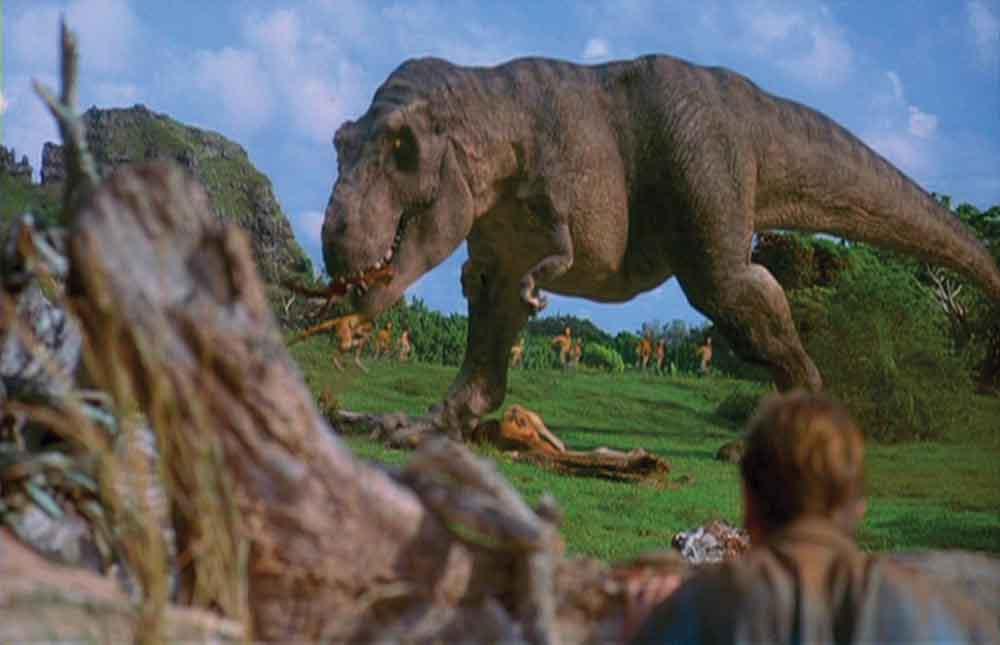
The scene that became a major influence on dinosaur cinema, however, goes by almost unnoticed. It’s so real and so right that it feels almost like an after-thought (though it isn’t).  I refer to the scene in which a fleeing Ornithomimus runs across frame, only to be caught and killed in the jaws of Gwangi. This moment is repeated, almost as a film quote, in a Jurassic Park (1993) scene featuring a T-Rex and a Gallimimus.


Unlike Lope’s father in The Valley of Gwangi, I don’t believe it is “not good to dig up the past.”  There is still value in The Valley of Gwangi, for certain, and yet I don’t now consider it a classic in the same league as many other Harryhausen films.

Friday, August 26, 2016

The Films of 1969: Captain Nemo and the Underwater City


Across the various Jules Verne-inspired films surveyed here on the blog the last few weeks, we've seen the classic literary anti-hero Captain Nemo depicted as self-sacrificing savior and anguished anti-hero (Fleischer's 20,000 Leagues Under The Sea [1954]), and Nemo as older (and perhaps wiser?) benevolent benefactor of mankind (Mysterious Island [1961]). 

1969's Captain Nemo and The Underwater City provides yet another interpretation of the character, and to put it bluntly, it isn't one of my favorites.

Here, as played by diminutive, thin Robert Ryan, Captain Nemo is portrayed as a soft-voiced, beardless, kindly, grandfather-type. In this British-made feature, Nemo commands not merely the advanced submarine Nautilus, but serves happily as friendly ruler of a golden undersea utopia, a domed metropolis called "Temple Myra," if I have it right.

More to the point, however, this 1969 version of Captain Nemo is rather toothless, given to the occasionally 'bout of grumpiness, but overall most determined, apparently, to forge a romantic relationship with a castaway named Helena (Nanette Newman) whom he has rescued from a sinking ship. I suppose there's nothing intrinsically wrong with a film dramatizing the softer side of Nemo, but it's still a bit jarring to see such an edgy character rendered so...harmless.

Captain Nemo and The Underwater City (shot by the always-impressive Alan Hume) depicts the tale of six men and women who are rescued by Nemo when their vessel sinks during a storm on the high seas. These characters include the honorable U.S. Senator Robert Fraser (Chuck Connors), plucky widower Helena Beckett (Newman), her young boy, Phillip, a twitchy claustrophobic named Lomax (Allan Cuthbertson) and two petty crooks -- Barnaby (Bill Fraser) and Swallow (Kenneth Connor) -- who comprise the film's egregiously tiresome comic-relief duo.


Nemo transports these survivors to the bottom of the sea and to his gold-plated commune, a domed city of peace and prosperity. 

In fact, Nemo is even planning a construction expansion there: two additional domes are in the offing

Life in Temple Myra is a paradise, but for the people from the surface, it's also a cage because Nemo won't permit the new arrivals to return home out of fear that they will reveal the existence of his amazing metropolis to the warring nations above. 

Soon, Fraser romances a sexy citizen in the city, Mala (Lucianna Paluzzi), which enrages her current beau, Joab (John Turner). We know Mala and the Senator are hot for each other, because she serenades Fraser with a strangely phallic musical instrument that she strokes romantically (and in soft-focus), while Fraser looks on, entranced.

Meanwhile, Nemo becomes a kindly father-figure to young Phillip, and develops a a close friendship with the obstinate women's libber Helena. When offered the choice to betray Nemo and leave the city, or stay with Nemo and form an ad hoc family (along with Phillip's little kitten...), Helena chooses to remain.

As all this soap opera occurs inside the safety of the city walls, a deranged giant manta ray named "Mobula" threatens the peace outside. Fraser becomes a hero after dispatching the murderous beast while in command of Nautilus.

Despite this act of bravery, Fraser plots escape aboard a brand new Nautilus #2 with the help of the treacherous Joab and the avaricious Barnaby...


I first saw Captain Nemo and The Underwater City with my (patient) parents sometime in the very early 1970s, on a drive-in double-bill, as a I recall. As a child, I loved the movie simply because it featured cool submarines, undersea domes, and the giant Mobula monster. 

And did I mention Lucianna Paluzzi in a bathing suit?

Watching the film as a more discerning adult, however, Captain Nemo and The Underwater City doesn't wear quite as well.

For instance, the production design is rather underwhelming. Specifically, the underwater city is saddled with an unfortunate and hackneyed leitmotif: not only is everything gold Futura, but every architectural detail is ridiculously marine-life-centric. What I mean by that is that Nemo makes his announcements through a microphone that is molded into the shape of a fish. And when a siren sounds, the alarm bell features a vibrating lobster figure


Nemo's diving suits are also somewhat silly in appearance. The suits feature transparent shoulder epaulets in the shape of fish fins. This sort of decoration resembles a bad seafood theme restaurant rather than the Utopian headquarters of the world's greatest genius.

The miniature work is also terrible. I should add, this is not a case of the years being unkind to good special effects, to be certain. If you go back to 20,000 Leagues Under The Sea in 1954 or Mysterious Island in 1961, you can see some amazing and convincing miniature work and optical effects. In both cases, those effect still hold up remarkably well: you believe the Nautilus is a full-sized vehicle ramming actual surface vessels. 


Captain Nemo and The Underwater City's effects never achieve that level of verisimilitude. It puts forward inferior -- and obvious -- model work.

Captain Nemo and the Underwater City also wastes an inordinate amount of its melodramatic narrative concentrating on unfunny comic-relief. Barnaby and Swallow make pests of themselves -- and in one cringe-worthy moment -- Barnaby squirts a stream of alcohol in his face while trying to master an undersea drink dispenser. 

Much more troubling and difficult to accept is the fact that secretive Captain Nemo not only goes out of his way to rescue a few survivors from a passing ship (when in 20,000 Leagues Under The Sea he was willing to let Ned and the others die in the sea...), but that he here turns around and bestows upon them his instant and unquestioning trust. 

Specifically, Nemo permits Joab to give the Lomax and the gold-hungry Barnaby and Swallow full access to the city (except for a carefully labeled "Forbidden Area.") Joab obediently and politely shows these visitors everything: the gold repository room, and the pressure control room...the one room in the city that could be sabotaged, and could destroy the utopia.

Frankly, Nemo's insistence that these visitors remain at the bottom of the sea (10,000 fathoms below the surface...) is also more than a little mystifying. The good captain should have just dropped the survivors off on the nearest island, or given them a small raft so they could find help from a passing vessel. Nemo's stated motive for not permitting Fraser and others to return to the surface is that they would tell the world about his underwater utopia.

Yes, but what could they do about it?

I mean, it's not like any nation in the world at this time in history (roughly the period of the American Civil War) boasted the technology to reach the city, let alone attack and pillage it. 

Nemo is the only human being in the world with the capacity to even reach the bottom of the sea at this juncture in time. Fraser and the others could be sent back freely with their wild story, and even if by chance they were believed by the authorities, there would be nothing that could be done about it

In fact, if you follow my logic, the only way malicious forces (or spies...) from the outside world could reach the domed city would if they were...rescued by Nemo and brought down by him as guests. 

Once inside they could then sabotage the city and escape back to the surface in his submarines. 

And that, in fact, is what happens. 

This is purely and simply a case of a narrative scenario without a whit of logical consistency.

A couple more things: it seems to me that if you wanted to write the story of Captain Nemo falling in love and becoming a father-figure, you would want to highlight his sad past, especially his alienation from the world-at-large. 

You'd want to include much information about the family he lost too. 

Captain Nemo and The Underwater City does none of that, providing instead a lukewarm romance between the elder Nemo and one of his much-younger visitors. It is also baffling that the anti-social Nemo, who exiled himself in the sea to escape his past, would cheerfully become the very visible leader of an undersea commune, presiding over school swimming competitions and the like. I'm not kidding, either. That's actually what Nemo is doing (celebrating All-Seas Day, poolside...) when Fraser steals the Nautilus # 2.

I've been rather tough on Captain Nemo and The Underwater City, but in closing, I would like to write something positive about it. 

And that is this: for all the hoary aspects of the movie (from the miniature design to the pedestrian script by Pip and Jane Baker), the film does boast a unique approach to villainy: Not one character is really a "bad guy" in the traditional movie sense. 

Lomax is a sick man, mentally unbalanced. 

Barnaby is simply greedy. 

And opponents Fraser and Nemo come to respect and admire one another, despite the fact they end up in conflict. Too often, movie villains are evil "just because," when in reality we know that battles are waged over ideologies or differences of opinion. 

As childish as Captain Nemo and The Underwater City sometimes seems, it's at least a little rewarding that the characters are occasionally less two-dimensional than the production design is. The movie has a nice way of focusing on character motivations and decisions instead of assuming that all the visitors to Nemo's world would reflexively want to return home.

"Even Utopia has its hazards," one character states in the film, but Captain Nemo and The Underwater City's best quality is that it realizes our world has hazards too. 

And that choosing a "home" ultimately comes down to more than just returning to the place where you started out.