Showing posts with label Star Trek: The Next Generation. Show all posts

Tuesday, June 12, 2018

Star Trek: The Next Generation 30th Anniversary Blogging: "Conspiracy" (May 9, 1988)


Stardate:  41775.5

A call from Captain Picard’s (Patrick Stewart) old friend, Captain Walker Keel (Jonathan Farwell) of the starship Horatio reroutes the Enterprise from its visit to Pacifica.  Keel asks Picard to rendezvous with him in secret, and meet with two other Starfleet captains too, Captain Tryla Scott, and Captain Rixx. Only reluctantly, Picard agrees to the clandestine meeting.

When the group meets, Captain Picard hears about a conspiracy in Starfleet, mirroring reports he heard from Admiral Quinn (Ward Costello) some months earlier. After the rendezvous, the Horatio is reported destroyed, confirming for Picard his old friend’s story about a dark conspiracy. Data (Brent Spiner) is able to determine odd patterns in Starfleet’s recent actions, as well.

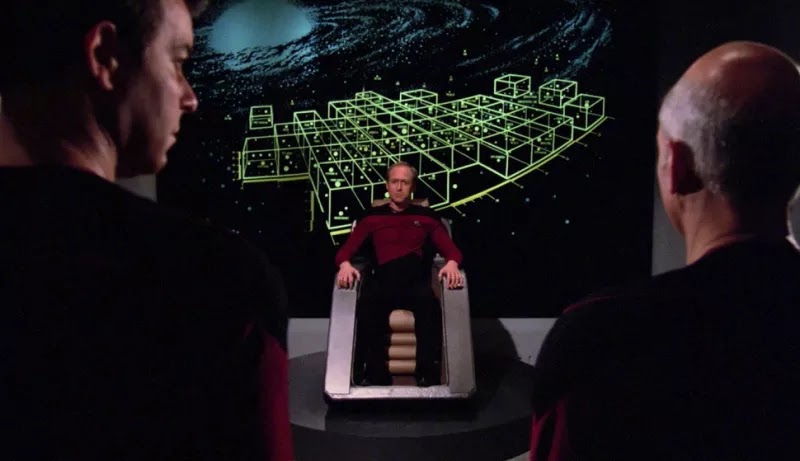
Captain Picard orders the Enterprise back to Earth, where he investigates the presence of a conspiracy in Starfleet Command. What he finds there is almost unbelievable. Alien parasites have taken over the Admiralty, and are subverting the Federation. Admiral Quinn has also been compromised by a parasite, as has his adjutant, Remmick (Robert Schenkkan).

  
Apparently “Conspiracy” is a divisive episode, with some long-time fans loving it, and other fans hating it. My own assessment is that this title is one of the best, and most exciting episodes of Star Trek: The Next Generation’s (1987-1994) first season (and indeed, of the series in its totality).

Why? “Conspiracy” feels downright dangerous. There are moments in the episode that are unpredictable, and filled with real, sinister menace. At one point, it looks like Captain Picard will not escape from the parasites.  Offhand, I can think of only one other episode that is as terrifying and unpredictable as this one: “Q-Who,” which introduces the Borg.

Too often in The Next Generation, menace and danger are undercut, or underplayed. So many stories in the first season don’t feel immediate, or urgent. The characters stand on the command bridge of their perfect starship, with their perfect ideals and philosophies, and get to talk down to planets and people who are not as evolved as they are. The drama in the storytelling lessened via this approach, and the lack of action adds to the feeling of the series as a sustained academic lecture, rather than a scintillating entertainment.


None of those things are true in “Conspiracy,” which takes the Enterprise back to Earth (for the first time in the series), and into the hive of the conspiracy.  The episode is a real life commentary on the Iran-Contra scandal of the day, which saw “patriotic” generals turning against the ideals of the Constitution to pursue their own radical ideological agenda. By my count, “Conspiracy” is the third time the series had taken on the scandal. “Q” appeared, basically, as Ollie North in “Encounter at Farpoint,” mocking the colonel’s brand of self-serving patriotism. Then “Arsenal of Freedom” dealt with the arms-dealing aspect of the scandal. And, finally, “Conspiracy” tackles the “enemy within” nature of American patriots subverting the law for their extremism. It would make an interesting paper, for some academician, to write about Star Trek: The Next Generation’s responses to this scandal of the Reagan Era.

Another strength of “Conspiracy” is the episode’s chilling ending, which has Data announce news that the parasites have sent out a beacon to their distant brethren. This code is one worthy of The Twilight Zone (1959-1964) and feels haunting to this day. The episode ends with the sounds alien messaging still “going out” to the final frontier.

I understand why the episode is controversial, however. In part, that controversy it concerns the hypocrisy of Gene Roddenberry. I remember reading an interview in Starlog Magazine with the Great Bird of the Galaxy after the release of Star Trek II: The Wrath of Khan (1982), in which he complained about Kirk phasering (to death) the Ceti eel that emerged from Chekov’s ear. It was a new and unknown life-form, Roddenberry insisted, and should have been studied and investigated. Instead, it was met with disgust and violence by a Starfleet officer.


So what does Picard do in “Conspiracy” when faced with a similar parasite? He grimaces, just like Kirk, and blows the thing away without a second look.

Picard’s actions are appropriate given the threat level here, but they also reveal that Roddenberry’s complaints about the Wrath of Khan were not valid. It’s amusing how Captain Picard’s log entry in the denouement of “Conspiracy” attempts to paper over the rampant phaser blasting.  He notes how repugnant it was to destroy life, after years of respecting it, but that he had no choice. 

Yeah, like Captain Kirk dealing with the Ceti eel, I guess…

So I suppose some Star Trek fans dislike the episode because Picard acts in a way that might be deemed out-of-character, blasting an alien “mother” creature to kingdom come. But again, in the context of what was at stake, who can blame the guy?!  Not every problem can be solved by mediation or arbitration, even in the 24th century, and “Conspiracy” is a prime example of that fact.  There are some life-forms that may say they desire “peaceful co-existence,” but what they really desire is conquest.

Part of the reason that “Conspiracy” works so well is that some of the elaborate story set-up was delivered in the earlier first season tale “Coming of Age,” and so this episode can actually take the time to develop suspense, and deliver action, without too much exposition (save for in the first act.). It is rewarding that as early as its first season, Star Trek: The Next Generation was beginning to experiment with serialized story-telling, which would become a mainstay of DS9, down the road (and then Discovery, of late).

Basically, “Conspiracy” is just so weird, and unlike any other TNG episode, and that makes it a special hour. We see an old man (possessed by a parasite) beat up Worf, and then get phasered to the ground by Dr. Crusher, in a stunning and dramatic scene. We see Starfleet admirals dining on worms. We see parasites crawl inside a human mouth. We see a human head explode. And we’re left with the ultimate mystery.  What are these things?  And finally, we are also left with the fear that they will return.


As I’ve written before, the first season run from “Heart of Glory” through “The Neutral Zone” was a beautiful time for this fledgling series, in that the program writers were finally starting to get down the right mix of cerebral science fiction and colorful action.  “Conspiracy” is likely the apex of that formula in the first season, an episode that scares, shocks, and delights, even on repeat viewings. I wish there were more episodes like “Conspiracy” in the TNG canon.

In two weeks: “The Neutral Zone.”

Tuesday, June 05, 2018

Star Trek: The Next Generation 30th Anniversary Blogging: "We'll Always Have Paris" (May 2, 1988)


Stardate: 41697.9

The U.S.S. Enterprise encounters a strange time-hiccup, and traces the phenomenon to the work of Dr. Paul Manheim (Rod Loomis), a disgraced scientist, and also the husband of Captain Picard’s (Patrick Stewart) old flame, Jenice (Michelle Phillip).

Years earlier, Picard failed to show up at a rendezvous with Jenice at a café in Paris, fearing that if he saw her again, he would not have the wherewithal to return to Starfleet and continue his career. Now, after all these years, he has the chance to make amends.

The localized time distortion, however, is growing stronger, and is dubbed “The Manheim Effect.” Data determines a way to stop Manheim’s time experiment, which opens a door-way to another, alternate universe.

Fortunately, his attempt is successful, repairing the space-time continuum, saving Manheim’s life, and giving Picard and Jenice the opportunity to have their café meeting, decades later, courtesy of the holodeck.


“We’ll Always Have Paris” is not widely remembered as either a particularly strong or notably weak episode of Star Trek: The Next Generation (1987-1994).  

In general, I agree with the consensus that it is a relatively average show.  In terms of the Next Generation’s positive momentum at the end of the first season, it is actually something of a set-back, however.  “Heart of Glory,” “Arsenal of Freedom,” “Symbiosis,” and “Skin of Evil” are all notable and inventive episodes, for a number of reasons.  After “We’ll Always Have Paris,” two strong episodes follow: “Conspiracy,” and “The Neutral Zone.” In this company, “We’ll Always Have Paris,” is pretty forgettable.

Part of the problem is that Michelle Phillips, a good, charismatic actress, is given an impossible role. Jenice is Picard’s lost love, and apparently feels the same way about him. Yet she also loves her husband, and through the bulk of the episode, he is in sickbay, dying.  Given this fact, it’s natural that her mind is not fully on resolving the Picard subplot. I understand that the intention was to make a romantic episode, but the episode feels anti-romantic. There is no passion between the two characters, or those who play them. 


Picard is obsessed with the relationship (and his behavior ending the relationship), but Jenice is obsessed with reality, and her husband’s well-being. Early drafts of the script reportedly had Picard and Jenice consummating their relationship.  Thank goodness saner heads prevailed. Had Picard and Jenice slept together in the course of these events, Picard would have looked like a cad and an opportunist, and Jenice would have appeared uncaring towards her husband. The structure of the story, with Jenice caught between Paul and Jean-Luc, simply doesn’t permit for a real sense of romance.

Also, just how many men (and Starfleet officers) in the 23rd and 24th century left their partners/lovers behind without saying goodbye, to pursue their ambition of Starfleet Command? In Star Trek: The Motion Picture (1979), Captain Decker (Stephen Collins) left Ilia (Persis Khambatta) without saying goodbye, to follow his Starfleet ambitions.  Then, in “Encounter at Farpoint,” it is established that Riker (Jonathan Frakes) left Troi (Marina Sirtis) on Betazed, without saying goodbye, to pursue his career.  Now, we learn from “We’ll Always Have Paris” that Picard did the same thing, missing his date with Jenice so he could stay in Starfleet and climb the ladder to a captaincy.  So, are all men cowards, or what?


There are some good individual moments in “We’ll Always Have Paris,” though not any that stand-out, across the whole series.  It’s nice to see Picard fencing in his off-time, giving us a sense of what the captain likes to do when not on the bridge. In later episodes (“Pen Pals,” and “Starship Mine”) he rides horses, instead.  Finally, the closing set piece with Data avoiding booby traps in the lab, and sealing the time rift are visually-impressive, and a lot of fun.


“We’ll Always Have Paris,” but the question is, do we want it? The episode is okay, but I can’t imagine picking it to be in either the top fifty, or bottom fifty episodes of the series. It’s just a thoroughly mediocre viewing experience, and a modern re-watch doesn’t reveal any perspectives or ideas.

Next week, one of the early TNG greats: “Conspiracy.”

Tuesday, May 29, 2018

Star Trek: The Next Generation 30th Anniversary Blogging: "Skin of Evil" (April 25, 1988)


"... death is that state in which one only exists in the memory of others; which is why it is not an end..."

- Tasha Yar (Denise Crosby) in "Skin of Evil."

In this post, I remember the controversial first season effort "Skin of Evil" written by Joseph Stefano and directed by Joseph Scanlon.  It's an episode that has been widely termed an "unmitigated disaster."

In fact, "Skin of Evil" is often considered one of the series' worst installments. That's an honor I would more readily reserve for early first season programs such as "Code of Honor," "The Last Outpost," "Haven," Too Short A Season," "Home Soil," or the second season clips show "Shades of Gray." 


The reasons for the generally low-opinion of "Skin of Evil" are clear and definitely understandable.

First, the episode kills off a popular regular character, Tasha Yar (Denise Crosby) and more than that, does so in a purposefully random or "meaningless" fashion.

In short, the beloved Enterprise security chief dies the ignominious death of a red shirt.

Star Trek: The Next Generation itself attempted to rewrite this apparently unworthy demise in the excellent third season episode "Yesterday's Enterprise," by granting the character a more noble and meaningful second send-off.

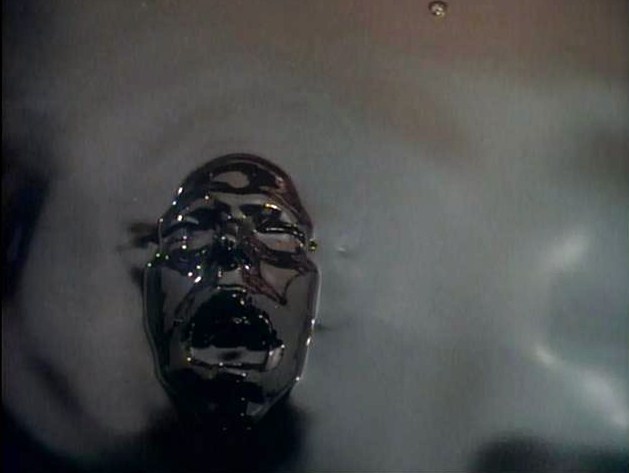
Beyond this character exit, there are certainly other grounds by which to deride "Skin of Evil" too, if that's the game. For example, the episode relies heavily on repeat footage of the central threat, the oil-slick monster, Armus. One shot of him rising from the muck is repeated three times in less than an hour.

Seemingly routine scenes are not staged very well, either. To wit, Deanna Troi is trapped in a shuttle craft for the duration of the episode with an injured pilot named Ben. We never even see Ben until the last act, wherein Picard beams into the shuttle, checks him out, and concludes he is very weak indeed.  Why wasn't Deanna tending to him herself before this moment?  She may be injured, but is she physically paralyzed?  Why don't we see her limp over to the poor guy (he's two feet away, at most, for goodness sake...) and just check for a pulse?

In another scene -- right after Armus takes Commander Riker -- we get a blooper.  We see Geordi's phaser "plop" into the black muck, visible to the naked eye. Again, this moment is indicative of the fact that the episode -- and the physical creation of the alien Armus -- was likely a nightmare to vet.

Also, it's difficult to deny that at least a few lines of dialogue are real groaners. The holographic Tasha's comment during her funeral that Deanna taught her she could be "feminine without losing anything" was horribly antiquated-sounding even back in 1988.

Would that really be a concern of a Starfleet officer in the 24th century? I don't think people even worry about this in 2018, let alone 2363, or whatever.

Finally, an early scene in the episode that features Tasha discussing an upcoming martial arts competition with Worf is so sentimentally scored and so overplayed by the actors that it telegraphs immediately what is bound to happen next: Tasha's untimely death. A little more subtlety would have been nice here, rather than a neon sign which seems to shout out "SHE'S GOING TO DIE!"

Yet -- going out on a limb -- I have always really enjoyed and appreciated "Skin of Evil" for the things it gets right rather than the things it gets wrong. Therefore, I'm going to focus on those positive elements in this review, having already at least paid lip-service to the admittedly-numerous complaints Trekkers might have regarding this segment.

First, a re-cap.

As the Enterprise is en route to rendezvous with shuttle craft 13 and Counselor Troi (Marina Sirtis), something goes terribly wrong.  The shuttle crashes on apparently uninhabited Vagra 2 and both Troi and her pilot, Ben, are injured.  A force field seems to be blocking the Enterprise from beaming up the injured.

When an away team consisting of Commander Riker (Jonathan Frakes), Dr. Crusher (Gates McFadden), Lt. Data (Brent Spiner) and Tasha Yar beams down to attempt a rescue, it is deliberately blocked by a sentient oil slick, a sadistic and hostile creature called "Armus."

When Tasha attempts to circumvent Armus to rescue the wounded, the creature strikes her down in an instant; murdering her. The away team returns to the Enterprise immediately, but there's nothing Dr. Crusher can do to help save the fallen security chief.  Though now in mourning, the crew turns its attention towards rescuing the downed shuttle crew.

Counselor Troi, meanwhile, uses her gifts and talents as an empath and psychologist to learn the truth about Armus and his motives.  She learns that his world was once home to a race of "Titans."  In order to become beautiful, these aliens cast off their darkest, most evil qualities and created Armus...literally a skin (or shroud) of evil.

Once free of him, these aliens abandoned Armus on the desolate planet and headed off to the stars to meet their great destiny.  Alone and miserable, Armus now wishes only to strike out and hurt those who rejected him.  Troi determines he is "empty," and worse, wants to fill that emptiness with acts of pure malevolence and sadism.

Ultimately, Captain Picard (Patrick Stewart) is able to defeat Armus by reminding him that although the creature may boast the capacity to control and hurt the crew, only Picard possesses the ability to command them.  After the final confrontation, the shuttle crew is rescued, Armus is abandoned, and aboard the Enterprise,the bridge crew attends Tasha's funeral, an event meant to "celebrate" her life.

One of the reasons I admire "Skin of Evil" so much is that --  up to this point in Next Generation history, at least -- the series was kind of...well, soft.

Although I love and respect the Star Trek ideal of peacefully broaching contact with alien life forms, the very heart of good drama remains conflict.  In Star Trek: The Next Generation's first season, the Enterprise crew had already met aliens who wanted to debate philosophy (Portal, in "The Last Outpost"), or worked matters out peaceably with other races ("Home Soil," "Encounter at Farpoint.")  Some episodes even featured no overt "alien" conflict at all, but played merely as standard soap operas set in an idealistic future ("Coming of Age.")  The show felt perilously like a space adventure without the adventure.

This "safe" approach changed radically with "Skin of Evil" as the crew encounters an absolutely implacable foe.  Armus can not be reasoned with or negotiated with.  You cannot appease him by "asking" what he wants and then "mediating" a way to give it to him.  On the contrary, he is a creature who exists only to oppose, only to obstruct, only to negate.

If he is not actually pure evil, then certainly Armus is hostility and Id personified.  On a program that so often pitched soft ball alien interaction,  Armus -- the piece's villain -- really plays hard ball. He is dangerous and capricious, and explicitly does not share the Starfleet belief that "all creatures have a right to exist."

Killing Tasha as he does is brutal, nasty and, unmotivated, but the unnecessary and savage act reminds our stalwart crew that not everyone in the galaxy thinks in the same way as they do.  And this fact, I submit, brings out the steel in their spines, and makes the characters actually reconsider and re-evaluate their noble beliefs.

In particular, I love the moment in the episode wherein Armus asks Dr. Crusher if she is "scared" and she admits that she is, but doesn't back down. That's a wonderfully human character touch, and McFadden is magnificent in that moment.

Another great character moment sees Data refusing to help Armus taunt Geordi, and then conclude that Armus should be destroyed. Armus scoffs at this "moral judgment" from a machine, but the matter is of great import.

By killing Tasha and mocking Geordi, Armus has made Data reconsider Starfleet's core belief, that all creatures have the right to exist.  Again, this is a pretty powerful moment for Data and for the show.

A big complaint about Star Trek: The Next Generation is that the characters can afford to be magnanimous and noble because they live in a Utopia, one where they are the most powerful folks on the block.  In this case, however, Data is not insulated by the paradise of the UFP, and must put those morals to the test in practice.

In a flash -- when his friends are hurt -- he abandons noble principle for expression of blood-thirsty vengeance, actually advocating murder. An interesting shade of gray for the child-like android, no?  A very human (and understandable) response too

I also believe Riker is developed well here. Worrying for Deanna's safety,  he allows himself to be absorbed by Armus. Will goes from shouting to Data for help as he is dragged across the dirt to actively forbidding help and facing intense personal danger.  This selfless decision speaks volumes about his character, and how he applies his own sense of morality to conflict.

This is also likely one of Troi's strongest episodes in the first season, and perhaps the series in totality.  Instead of offering up blatantly obvious information about alien commanders such as the tiresome bromide "he's hiding something," she sharpens her psychological skills in "Skin of Evil" and really dissects -- effectively too -- Armus's mental weaknesses.

The series should have permitted the character to do more of that kind of thing; to counsel not just in treacly, touchy-feely terms, but in pointed strategic ones as well. A counselor to a captain on a star ship would need to demonstrate his or her practical value in times of danger, and not merely belabor off-point opinions about how the crew is coping with stress ("they're anxious" or "they're inexperienced.")  Kirk had Spock to (logically) analyze situations and tactics on the bridge, and one can see from "Skin of Evil" how Troi might have served the same useful purpose if the writers had not been so blindly committed to featuring her in the tiresome "caregiver" mold.

Another quality I appreciate in "Skin of Evil" is the absence of techno-babble. Over the years, The Next Generation descended into a mind-numbing morass of meaningless science fiction jargon.  Any alien, any phenomenon -- anything at all -- could be justified, explained, and ultimately defeated by the mealy-mouthed, nonsensical tech-talk.

"Skin of Evil" sidesteps this dramatic plague and writer's crutch, and instead forges a chilling sense of mystery about Armus.

As Data reports, the alien has "no proteins known to us, no circulatory system, no musculature, and no skeletal framework."  And yet...it lives.

Star Trek is supposed to be about encountering alien life forms, and Armus, at the very least, is not the routinely-seen bumpy-headed humanoid.  There's a real sense of alien menace -- and difference -- about this being. In short, the crew really deals with something unknown and horrifying here, and I appreciate that dedicated sense of ambition, that imagination to go beyond the conventional.

And "Skin of Evil" works overtime to terrify. There are some great compositions of Riker's tortured visage, subsumed inside Armus, and terrifying views of the alien rising from the black bile, looming over the crewmen in the screen frame and appearing truly illimitable.  Perhaps we do see some of these shots one too many times, but again, I appreciate the risk-tasking that's on display here, the concerted effort to show us something we had not seen before.

In terms of style, I can also admire how the camera-work goes hand-held once Crusher reaches sickbay with Tasha, and attempts to revive the fallen officer. The immediacy-provoking, jerky camera-work is much different from the program's typically formal approach to visualization, and it lets us know -- viscerally -- what's at stake. The scene's final punctuation, Picard's disbelief that Tasha is "gone," thus proves gut-wrenching.

In fact, Picard gets a pretty good makeover in this episode. He brilliantly outmaneuvers Armus and brings his people home safe, without firing a single phaser shot. But his talking here is not for consensus-building or to convince an enemy of his peaceful ways. Rather, Picard uses words to weaken Armus, to trick and deceive him, and that's a nice twist on the perpetually action-less hero.

I also appreciate the fact that Picard doesn't lecture Data about mortality at episode's conclusion.  Instead, Picard is magnificently terse.  Data asks Picard if by thinking of himself and his own feelings he has missed the point of Yar's memorial. Picard replies, "No Data, you got it," and the episode ends.  It's a sharp comeback that makes the episode's point without explanation or excessive spoon-feeding. 


I suppose there's ample reason to dislike this episode because it dispatches Tasha the way it does. And yet, I suspect that the decision to kill the under-utilized character in such fashion is a brave and worthwhile one.

God knows, we don't all get to end our lives the way we wish, and exploring the stars is exceedingly dangerous business.  On top of that, Tasha selected a dangerous specialty.

Accordingly, Yar's death may be the most realistic character death in Star Trek history.  And that's an important distinction. We're not immortal supermen, even in the 24th century.  We're humans...and we die, sometimes unexpectedly.  Tasha's death reminds the audience of its own mortality, and again, that's a good thing, a bold move in a show that too often played things safe.  I appreciate the moment in the episode when the away team reports Tasha's death, and we see Worf's reaction, just for a few seconds.  He doesn't say a word; he doesn't over-emote.  He just silently gives this look...and it speaks volumes of his emotional state.  Another nice character touch.

I still remember watching "Skin of Evil" for the first time in 1988, and being pretty impressed by it.  The episode is thrilling, dangerous and emotional...and anything but soft. I suppose these qualities render it out of step with other installments, but for me, that's all to the good too.

You see, a problem I discern too often in Star Trek: The Next Generation, even thirty years later, is that the characters are too comfortable. They possess too many resources with which to meet the unknown, and too much discipline in controlling their fear and anxieties. Medicine and technology can bring back the dead and dying  ("Shades of Gray," "Lonely Among Us," "Unnatural Selection").  All life forms can be reasoned with ("Home Soil," "Encounter at Farpoint," "The Neutral Zone" etc.) and unchained technology makes life a virtual paradise, a world of material wealth and plenty.

For all of its flaws in terms of execution, "Skin of Evil" proves a dramatic reminder that there are some dark corners of outer space where reason can't save the day, where logic doesn't hold sway, where medicine can't bring back the lost, and technology can't give Starfleet an easy win.

A later episode "Q Who," gave the series a similar "kick" in its complacency with the introduction of the Borg, but "Skin of Evil" -- regardless of all its bloopers and drawbacks -- aimed the show in that very direction too, and courageously so. 

In my opinion, it's still a pretty worthwhile and imaginative course correction.

Tuesday, April 17, 2018

Star Trek: The Next Generation 30th Anniversary Blogging: "Heart of Glory" (March 21, 1988)


Stardate: 41503.7

The U.S.S. Enterprise patrols near the Neutral Zone with the Klingon border when it receives a distress call from a battered Talarian freighter, the Batris.

The damaged ship’s reactor is near overload status, and an away-team led by Commander Riker (Jonathan Frakes) beams over to search for survivors.  Geordi LaForge (Levar Burton) uses this opportunity to test his Visual Acuity Transmitter, a device which transmits back to the ship what he sees through his visor.

There are survivors aboard the Batris: three Klingon warriors.

Korris (Vaughn Armstrong) Konmel (Charles Hyman) and K’Neva (David Froman) claim that they helped to defend the Batris when it came under attack by Ferengi, but their story has holes in it, and Captain Picard (Patrick Stewart) is suspicious.

Lt. Worf (Michael Dorn) befriends the Klingons, in part to learn the truth about what happened on the Batris. His close connection to his own people, however, does not hide the fact that, since his adoption by humans, he has never been fully at peace with his Klingon heritage.

When the truth is known about the Klingons, Korris and the others launch a surprise attack on the Enterprise.

This violent act requires Worf to step in and defend his friends, against his people.


For my money, “Heart of Glory” is one of the best episodes of Star Trek: The Next Generation’s (1987-1994) first season. The episode embraces a beloved race from the original series (the Klingons), explores Lt. Worf’s history and back-story, and, finally, features some real, honest-to-goodness action.

At one point in TNG’s development, an edict apparently existed that the series would not revisit races seen in the Original Series. Thank goodness, this policy was re-thought, or abandoned. Today, The Next Generation is probably best remembered for two story arcs.

One is the introduction of -- and invasion by -- the Borg (“The Neutral Zone,” “Q-Who,” “Best of Both Worlds,” etc.).


The other involves Klingon politics and culture, and Worf’s difficult interaction with his own people. Had the original creative edict stayed in place, we would not have witnessed great episodes such as “Sins of the Father,” or “Reunion,” or “Redemption,” which are all part of a multi-season mini-arc of sorts.

“Heart of Glory” is undeniably the first chapter of this tale; one that explores Worf’s uneasy relationship with his own people.  This is the episode in which we first see Klingons eat, for example, and thirst for combat, adventure, and most importantly, honor.


“Heart of Glory” is terrific, however, because it makes the Klingons dangerous and unpredictable, while also revealing their now-notorious “death scream” custom/ritual. Korris and the others are formidable foes. Their values are very different than those we see explored in the UFP, or aboard the Enterprise.  Given this, it makes sense that Picard, Riker and others seem to be “on alert” in the presence of the galaxy’s greatest warriors.

More than that, however the story explains to audiences the details of Worf’s past that were heretofore unknown. We learn in “Heart of Glory” that Worf was adopted by humans after Romulans attacked his home on Khitomer, and killed his Klingon family.  Young Worf then lived on Earth (with a human step-brother), but always felt as though it wasn’t truly home. Like Spock in many important ways, Worf has “repressed” his Klingon feelings and longings so he can fit in with humans in Starfleet.

But he is always an outsider. “Heart of Glory” explains that outsider status for the first time.


It’s actually strange to think that the series has gone through so many episodes, already, and that this is the first tale that begins to paint in the details of Worf’s background.

I’ll confess, this episode really hit the mark with me in 1988, when I first watched it. As much as I loved The Next Generation and was hoping for its success, the vast majority of the first season catalog, while interesting and even intellectually stimulating seemed to lack not merely the color of the original series, but the adventure; the danger.

Watching these episodes, it often seems as if the 24th century has evolved past the idea of “danger,” even. One weird thing about all nineties Trek? No matter the crisis, you almost never see any crew people running, or even moving quickly.  Seriously, watch TNG, or even DS9, and this is the case.

Well, “Heart of Glory,” at least, feels dangerous.

From the looming Klingon battle-cruiser on the view-screen, to the mystery surrounding Korris and his team, to Riker’s worried exclamation about “Klingons,” this episode suggests that there are some things in the universe that even Starfleet’s finest people countenance with concern or worry.

And then, the episode goes the extra mile by revealing the cleverness of the Klingons, as they use (hidden) elements of their body armor to create weapons and escape from the Enterprise’s brig.  Following this (beautifully-scored) sequence of battle preparations, there’s a chase through the corridors, and a battle between the Klingons and Tasha’s security forces. 

For once, it feels like Star Trek: The Next Generation considers action important, and something that it should focus on, if the franchise is to continue. Not every problem, even in the future, can be resolved through conferences.

Not every note here is perfect, of course.

As is the norm in the first season, the writers fail to consider how their choices make Picard seem like a poor captain. To wit: in the opening act, Picard sends his away team to a ship on the verge of blowing up. That’s part of the job, of course.

But once Picard’s team is in danger (and the clock is ticking), Picard seems to spend endless minutes satisfying his curiosity about how LaForge’s VISOR works. He seemingly forgets -- until tersely reminded by Riker -- that this is a life-and-death mission. The Absent Minded Professorial Captain.


A good captain should be able to put aside his curiosity at a time like this.

This (poor) moment in an otherwise superb episode characterizes the variable quality of The Next Generation in its first season. The writes craft a tense, compelling character-based story for Worf. 

But then they ham-handedly shoe-horn in some character development for LaForge, so the audience can see what he sees. 

Of course, in seven seasons, the Visual Acuity Transmitter is never seen or mentioned again. 

Next week: Another action story! “The Arsenal of Freedom.”

Tuesday, April 10, 2018

Star Trek :The Next Generation 30th Anniversary Blogging: "Coming of Age" (March 14, 1988)


Stardate: 41461.2

The Enterprise stops at Relva VII, where young Wesley Crusher (Wil Wheaton) plans to take a difficult entrance exam for Starfleet Academy. He is in competition against three other contenders: a Benzite named Mordock (John Putch), a Vulcan named T’Shanik (Tasia Valenza), and a human, Oliana Mirren (Estee Chandler). Wesley has prepared well for the test, but is most concerned about Starfleet’s Psych Test, which is renowned for being accurate…and terrifying.

Meanwhile, the Enterprise is visited by Admiral Quinn (Ward Costello), who -- through his underling Lt. Commander Dexter Remmick (Robert Schenkkan) -- launches an investigation into the Enterprise. Remmick interviews the command crew, and the gist of all his questions involves Captain Picard (Patrick Stewart) and his fitness for command.

While Remmick toils, Captain Picard saves the life of a young man, Jake Kurland (Stephen Gregory) who steals a shuttlecraft. Jake is upset he did not get to test at Relva instead of Wesley, and loses control of his craft in orbit. Picard demonstrates his acumen and knowledge by instructing Kurland how to bounce the malfunctioning shuttle off the planet’s atmosphere and return safely to space. Even this rescue, however, does not impress Remmick.

On the surface, Wesley aces his Psych Test, but is not selected as the candidate for Starfleet. He loses out to Mordock, who will be the first Benzite in Starfleet.

Meanwhile, on the Enterprise, Picard learns why he has been singled out by Remmick and his old friend, Quinn.  The admiral fears some nefarious conspiracy has taken over Starfleet, and wants allies close by. He offers Picard the position of Commandant, Star Fleet Academy, but Picard turns him down to remain captain of the Enterprise.


“Coming of Age” is a weird, though not unpleasant episode of Star Trek: The Next Generation (1987-1994). The episode is weird because it functions as an unofficial first part of a two part episode (the second part being “Conspiracy.”)  

Basically, the episode sets up the premise of a conspiracy subverting the Federation in general, and Starfleet in particular. Admiral Quinn and Remmick both return in “Conspiracy,” one of the final episodes of the first season, co-opted by the alien-run conspiracy. However, “Coming of Age” seems torn between setting up this fascinating premise, and undercutting it. Quinn explains the broad details of a conspiracy here, but then, by episode’s end, dismisses the very idea as being the product of his (aging) mind. So he goes through all this angst -- including recruiting Remmick -- because he is convinced a conspiracy exists. Then, after putting the Enterprise crew through the wringer, he dismisses the possibility himself. 


In this episode, Data is asked to check into the Enterprise and seek anything amiss. He finds nothing. But what if Quinn had asked Data to confirm his suspicions of a conspiracy inside Starfleet itself, instead? We know from “Conspiracy” that Data finds one, after brief research. Had Quinn trusted Picard, and engaged his crew in discovering the conspiracy, his mission would have been better accomplished.

Intriguingly, the episode gives Remmick ample reason to question Picard’s fitness. It brings up his violation of the Prime Directive in “Justice,” and his loss of his mental faculties in “The Battle.”  Remmick might also have asked why, in his first months in command of Starfleet’s flagship, Captain Picard has also twice surrendered the ship (once to “Q” in “Encounter at Farpoint” and once to the Ferengi in “The Last Outpost.”) He might also have asked about Picard’s loss of faculties in “Lonely Among Us,” though of one his questions references “The Naked Now,” another story in which Picard lost command of the Enterprise and also lost control of himself.

Amazingly, given all these circumstances, Remmick finds nothing amiss with Picard’s tenure. Then, astoundingly, he notes the informality among the bridge crew, and says that it is the result of a feeling of family. This is an observation more appropriate to Kirk’s Enterprise, it would seem. Indeed, the final episode of The Next Generation, “All Good Things,” culminates with Picard admitting that he should have been “familiar” with his bridge crew far earlier. The interaction between this bridge crew is pleasant, but I would hardly say it is like a family, especially at this early juncture.

So basically, Remmick is the worst investigator ever. He sees a relationship that isn't there. And then doesn't report Picard's (numerous) failures in command.

It’s weird to write these words, but Wesley’s subplot is superior, actually, to the “investigation” subplot. It is fascinating to learn more about procedures for entering Starfleet Academy, and great to meet an intriguing new alien species: the Benzites.  Furthermore, Wesley’s particular psych test -- worrying about choosing who must live or die -- makes sense for the character, and is reasonably affecting.  Still, in terms of practicality, does Starfleet Command always arrange dramatic “set-ups” for the Psych-Test, enlisting other officers to play out specific scenarios?  Wesley's psych test involves explosions, injuries, steam/gas, etc. That's a pretty elaborate production!


If Starfleet goes to these lengths for every cadet, that’s a little weird and unbelievable.  Still, the psych test scene is well-played by Wheaton, and it’s a great choice on the part of the writers and producers to deal Wesley a reverse.  Throughout the series thus far, Wesley has been seen as superior to all others, including trained Starfleet Officers. By this point, we expect him to succeed. But as The Last Jedi (2017) taught us (with apparently so much controversy), failure can be the greatest teacher.  Picard virtually says as much in the episode coda.


Fans of Buck Rogers in the 25th Century will recognize the matte painting of the Starfleet base on Relva 7. The matte was used in the BR episode “Plot to Kill a City.” It has been modified here, re-painted and given some new (moving) elements so it seems more three-dimensional.  This episode also marks the first appearance of a Starfleet shuttle.


Next week: "Heart of Glory."

Tuesday, March 27, 2018

Star Trek: The Next Generation 30th Anniversary Blogging: "Home Soil" (February 22, 1988)


Stardate: 41463.9

The Enterprise proceeds to Velara III, where a Federation terraforming mission has fallen behind schedule. When contact is established from orbit with Director Mandl (Walter Gotell), Counselor Troi (Marina Sirtis) determines that he is “hiding something,” a fact which necessitates further investigation.

An away team led by Commander Riker (Jonathan Frakes) beams down to look more closely at the terraformers and their laboratory. In short order, one of the scientists, Malencon (Mario Roccuzzo) is murdered by a runaway laser drill. After this death, Picard orders the terrraformers to return to the Enterprise.  Riker learns more about the group’s interactions from the optimistic but emotional Kim (Elizabeth Lindsay), while Geordi (Levar Burton) and Data (Brent Spiner) find evidence of a unique life-form, composed of crystal, on the planet.

The crystal is beamed up to the Enterprise, and Dr. Crusher (Gates McFadden) works to determine if it is indeed, alive. Further investigation reveals that the crystal exists in the planet’s water table, and uses the saline in the water to conduct its thoughts to other crystals, creating a kind of corporate entity. The terra-forming drilling – and the very terraforming mission -- threaten to destroy this unusual life-form and its habitat.

Soon, the crystal replicates, multiplies in size, and takes over the Enterprise. Captain Picard (Patrick Stewart) negotiates a peace with the unique life-form, and returns the crystal to Velara III.


“Home Soil” is an underwhelming and highly-derivative episode of Star Trek: The Next Generation (1987-1994). The concept of a silicon-based life-form was already explored in a more compelling and action-packed Original Series story, “The Devil in the Dark.” And season one of TNG already explored an encounter with a crystalline life-form in “Datalore.”

But “Home Soil” is also very derivative of an episode from another cult-TV series: Space: 1999 (1975-1977). In the Year Two entry of that series, “All That Glisters,” a team from Moonbase Alpha visits a seemingly barren planet for purposes of mining, and inadvertently harms a rock-life form in the process. That silicon-based life-form can communicate and bond with others of its kind (creating a corporate entity), and at one point the rock entities attempt to take over a spaceship (an Eagle, in this case).  In both stories, the lack of water is the thing that threatens the continued existence of the silicon life-form. In both stories, an uneasy peace between carbon-based and silicon-based life is forged.


The common elements are apparent from the synopsis above: a silicon based-life form, an intelligent corporate entity; the hostile take-over of a space-vessel, the importance of water and a peaceful resolution. That’s at least five plot elements that “Home Soil” ports over from “All That Glisters.”

Now, “All That Glisters” is not a widely beloved episode of Space: 1999, but it does have its virtues. Namely, the episode is shot with a surfeit of style, giving it a weird kind of “haunted house” atmosphere in some sequences. Similarly, when the intelligent rocks “zombify” human beings and use them as slaves, the concept conforms to a series precept I have discussed here at length: the horror mythology of Space:1999.

“Home Soil” has no such particular style to mitigate its weaknesses as a narrative. The guest performances in the episode are odd, and stilted. Walter Gotell -- who is wonderful as General Gogol in several James Bond film (The Spy Who Loved Me [1977], Moonraker [1979], For Your Eyes Only [1981], Octopussy [1983], A View to a Kill [1985] and The Living Daylights [1987]) -- is overly-theatrical in his line deliveries here, and comes off as a bizarre personality. Elizabeth Lindsay’s engineer character, similarly suffers from several strange, off-kilter moments and line readings.


Beyond this flaw, the episode doesn’t create much in terms of tension. Here, the crystals take over the Enterprise, but ultimately this is not a matter of life of death. In “All that Glisters” the story generated tension from the countdown factor, if nothing else. If the Alphans couldn’t negotiate their crisis successfully, they would never see home again. That element granted the story an immediacy that this adventure lacks, since the crystal’s threat is short-circuited so quickly.

I have read reviews online that claim this episode is based in “hard science” and that the series did its “research” when creating this story.  I agree that some research was done: into Space: 1999 in particular. I’m not certain that the episode deserves any credit for hard science or research, otherwise.  In fact, I can’t help but go “there” while on this topic: Star Trek: The Next Generation globally mirrors Space: 1999’s Year Two in another way: character hierarchy. Consider the dynamics: Prickly commanding Officer in love with a Doctor/First Officer in love with an exotic alien.  It’s Koenig and Russell/Verdeschi and Maya on Space: 1999. It’s Picard and Crusher/Riker and Troi, here.


But back to “Home Soil,” before I get into trouble with Trekkers.  I do find at least one scene in “Home Soil” fascinating, and worthwhile. Gathered together in sickbay, Picard, Data, Geordi, Wesley and Dr. Crusher attempt to determine if the crystal is a life-form, with Crusher in the lead role.  She explores the issue brilliantly, asking the ship’s computer a series of questions that lead towards a definitive answer. Crusher is authoritative here, and a leader, with Picard taking a backseat in a realm where he possesses less knowledge.  The moment is a great showcase for the good doctor.


Finally, I’ll simply say, Star Trek: The Next Generation remade this story for the premiere of Season Three, with another unusual life-form – Nanites -- taking over the Enterprise in a bid to stay alive. That episode is far superior to “Home Soil.”

Next up: “Coming of Age.”

CULT TV FLASHBACK: Dead of Night (1994-1997)

This year, Dead of Night: The Complete Series , was released on Blu-Ray by Vinegar Syndrome , and I just had the pleasure of falling into i...