Showing posts with label Twilight Zone Day. Show all posts

Friday, May 11, 2018

Twilight Zone Day: "They Call Me to Mr. Death"


The Twilight Zone (1959 – 1964) is an anthology series and thus it features no continuing characters save for Rod Serling’s staccato-voiced narrator. However, in one memorable circumstance, a character does recur in the series. 

His name is Mr. Death.

This distinctive character -- this personification or embodiment of mortality -- appears in three episodes of The Twilight Zone: “One for the Angels,” “The Hitch-hiker” and “Nothing in the Dark.”

And in each installment Mr. Death serves roughly the same thematic and narrative purpose: to provoke first fear, and then, finally, a sense of acceptance about mortality. 

In other words, those characters that come to interface with Mr. Death in The Twilight Zone first consider him an existential “terror,” but upon closer contact come to understand that his presence, beyond being inevitable, is not so dreadful. 

In fact, Mr. Death -- in shape and deed -- is a reminder of the natural order.

My wife, a psychologist and therapist, often reminds me of her belief that virtually all Twilight Zone episodes concern Rod Serling’s fear of impending death or lost youth. So perhaps it is no surprise that Mr. Death is the only continuing character in the writer’s most famous canon. 

Uniquely, Mr. Death is never physically depicted on The Twilight Zone as a fearsome “Grim Reaper”-styled or “Charon”-type creature, but rather as a human being who appears, well, relatively mundane. 


He’s a well-groomed, Don Draper-esque businessman (Murray Hamilton) in “One for the Angels,” a handsome police officer (played by Robert Redford, no less…) in “Nothing in the Dark” and an amused, smiling Hitch-hiker (Leonard Strong) in the scariest episode of the bunch, “The Hitch-Hiker.” 

No matter how, specifically, Mr. Death appears to his prey in a physical sense, he is first greeted with the emotions of terror, dread and disbelief. 

In “One for the Angels,” an almost-seventy year-old street peddler, Lou Bookman (Ed Wynn) is shocked to learn that Mr. Death has scheduled him for “departure” at midnight. He categorically refuses to accept that Death has come for him, and then attempts to find a technicality in Death’s “law” that will allow him to remain on Earth.

In “The Hitch-hiker,” a woman, Nan Martin (Inger Stevens) on a cross-country trip has (unknowingly) died in a car accident, and keeps seeing the same Hitchhiker appear on the open road before her. She grows to dread seeing this figure, and the fear that she feels – and which the audience also feels – is a throat-clenching one. 


Who is this grinning stranger?  What does he want?  Why is he stalking her?  Why does she keep seeing him?

In “Nothing in the Dark,” poor old Wanda Dunn (Gladys Cooper) has spent the last few years of her long life locked away inside a dark, condemned basement apartment. She steadfastly refuses to reckon with the outside world – or any outsiders – for fear that Mr. Death will come for her should she open her door even a crack. 

All three cases reflect a similar notion: these protagonists steadfastly attempt to ignore and defy the fact of their own mortality, specifically through the recognizable and nearly Kubler-Ross-ian stages of bargaining (“One for the Angels”), denial (“The Hitch-hiker”) and even anger (“Nothing in the Dark.”)    

But by denying and rebelling against death, in fact, The Twilight Zone reminds us that these individuals may be denying the vibrancy of life itself…the meaning of our moment-to-moment existence.


The protagonists soon learn the error of their ways.  By denying Mr. Death, Mr. Bookman causes an unfortunate chain reaction. Since Death can’t take him, the personification of mortality arranges to take a little girl, Maggie, in his place. Bookman attempts to trick Mr. Death and delay him from this deadly rendezvous, in the process fulfilling a life of dream of making a “big pitch…one for the angels.” He knows that the vetting of this pitch will result in Mr. Death taking him from our mortal coil, but Mr. Bookman is able to see and detect a value greater than his own ending at this point: a little girl’s continued survival.  He sees detects how precious life is, especially for the very young.  He has already lived; she has not.

Nan Martin’s epiphany in “The Hitch-hiker” is that death has been her co-pilot all along, at least since her accident. Mr. Death thus represents a force she can’t escape from, no matter how fast she drives or how much highway her car covers. And this realization too, reflects our human condition. We’re all mortal, and death is part of the natural order of life. In the end, we can’t outrun it.

Old Ms. Dunn in “Nothing in the Dark” learns that her fear of death has cordoned her off from the rest of humanity unnecessarily.  She has tried so hard not to let Mr. Death into her apartment that her life has hardly been worth continuing, or living.  What is life if it is lived in perpetual fear of “the dark.” 

When Mr. Death “wins” -- as death inevitably wins -- he is not a gloating, cackling, monstrous victor.  Instead, he’s charming, and sometimes downright soothing. He politely informs Mr. Bookman that “he’s made it,” meaning he’ll be going to Heaven. He tells Nan Martin, without irony that she is “going” his way (a foregone conclusion at that point). And finally, Death offers beautiful, comforting words for Ms. Dunn:

“You see. No shock. No engulfment. No tearing asunder. What you feared would come like an explosion is like a whisper. What you thought was the end is the beginning.”

That last line suggests Mr. Death’s third “gift.”First he brings fear, then acceptance and finally…transcendence?  Mr. Bookman will go to Heaven…to join the angels, no doubt. Nan Martin too is being taken on a continuing journey (destination: unknown…), and Ms. Dunn faces not annihilation, but what Death describes enigmatically as “a beginning.”

Thus in all three Twilight Zone episodes featuring Mr. Death there exists, at least a little, the specter of hope, of an existence beyond this mortal coil where humanity can find something…different. Interestingly, other episodes of the series dwell on what that something different may look like (“A Nice Place to Visit,” for instance)

But for these three Mr. Death episodes, the most important thing to focus on is the paradigm he represents. I call it the inevitability of mortality and the natural order inherent in death.


In some horror films, such as Final Destination (2000), death is viewed as an ominous, vengeful, dark force. What I enjoy so much about The Twilight Zone Mr. Death episodes, however, is the Grim Reaper’s obvious humanity. He is by turns gullible (“One for the Angels”), jocular (“The Hitch-hiker”) and gentle (“Nothing in the Dark”).

In other words, when Death comes a calling for human beings, The Twilight Zone promises that he will arrive in forms that we automatically understand, recognize, and can relate to. 

The only proper end to a human life comes from a death that is also…human.

Message conveyed…in The Twilight Zone. 

Twilight Zone Day: "Come Wander with Me"


There are, perhaps, several episodes of Rod Serling's classic The Twilight Zone (1959-1964) more sharply-written, more morally-valuable, and more resonant in a simple, emotional sense than "Come Wander with Me." Many Twilight Zone segments also boast superior twist endings.


And yet, for my money, there are few segments more haunting or dream-like than this superb fifth season phantasm, penned by Anthony Wilson and directed by a young Richard Donner (The Omen [1976]; Superman: The Movie [1978], Ladyhawke [1985]).

Whenever I return to The Twilight Zone DVD Box Set, this episode ranks near the top of my list of episodes to see again -- even if I've watched it recently; even though I know the story by heart. There's just something that draws me to it.

Simply stated, "Come Wander With Me" casts a hypnotic spell.


"Come Wander With Me" was the final episode of The Twilight Zone filmed/produced for CBS, and the third-to-last episode to air on that network in prime time. It premiered on May 22, 1964 and dramatized the tale of Floyd Burney (Gary Crosby), the so-called "Rock-a-Billy Kid."

Burney is a cocky but insecure "celebrity," an up-and-coming music star without the slightest sense of originality, individuality or artistry. As the episode begins, Burney has arrived at the foothills of Appalachia in hopes of "stealing" a song from the naive locals there and "conjuring" another hit to augment his singing career. He justifies this act of creative theft by noting that all the folk-music stars of the day do it...

This narrative set-up mirrors a real-life context of the times. From the 1950s-to-early 1960s, there was a folk music revival movement in the U.S., one in which a wide variety of artists imported the fiddle and banjo-style of Appalachian folk songs (often ballads...) from remote, poverty-stricken Appalachia into the nation's musical mainstream.

This local music style proved increasingly popular -- especially as the Beatnik "coffeehouse" movement came to life -- but so did the notion of Appalachia as a backward, violent, isolated realm of cultural separation and inscrutable mystique.This geographical region in the South East U.S. became increasingly feared and derided because of popular stereotypes; for the sense of it as a setting of oppressive fundamental religion and...ghost stories.

In "Come Wander with Me," we see such a world-view fully articulated.This Appalachia is a dangerous, foreign place that doesn't conform to the "rules" of life as Burney understands them. In other words, cash isn't God; and actions (such as pre-marital sex...) have consequences. And far from being an authentic musician (or even boasting a particularly "Up with People" attitude...) Floyd Burney is but a slick, self-centered celebrity looking simply to steal a resource. Even his car is gaudily decorated with the titles of his insipid hit songs. We recognize immediately that he's out-of-his-element...and playing with fire.

There's a great visual touch that inaugurates "Come Wander with Me." As Burney stops his car at the foot of a rickety, damaged bridge, we can see that a floorboard is missing directly ahead. So Burney exits his car, and steps over that gulf himself, unawares.

That missing plank in the bridge, however, is the specific demarcation point between reality and the supernatural; between the American mainstream and isolated Appalachia. And, as Rod Serling would no doubt declare, it's our point-of-entrance into...The Twilight Zone.


Once in the woods, the hungry, exploitative Burney begins hunting for his "new" song. He tells a gargoyle-esque junk/music shop owner "Anything you got is PD - public domain! You've got no rights!" and then graciously (!) offers to buy the old man's songs for a meager handful of cash. The local declines to help, but Burney refuses to relent...until he hears a recurrent, eerie melody emanating from somewhere deep within the forest ahead.

Burney passes into a heavy mist as he treads deeper into the seemingly-endless woods, and is so consumed with his mission that he misses something important nearby: his own grave-stone, jutting roughly out of the Earth.

As Burney goes in search of the obsessive melody, he misses something else too. In at least two separate shots, we detect a mystery figure shrouded in black...reaching out for him in the distance. This apparition appears in the background of the frame (as Burney hunts in the foreground...), and the long-shot, deep-focus composition crafted by Donner is creepy as hell. Because the figure is at first stationary -- and almost camouflaged -- we don't see it right off the bat amid the ancient woods. When we do see it, we're startled. 

This Life and the After-Life have merged...


Burney soon discovers that the source of the song is an innocent young woman, Mary Rachel (Bonnie Beecher). This siren is beautiful, a bit sad, and all-together reluctant to sing Burney the entire song.

Ever the smooth operator, Burney romances Mary Rachel, even though she's already "be-spoke" to a local gent named Billy Rayford. Successfully taken-in by promises of a life with Burney, Mary Rachel finally reveals the melancholy song in its apparent entirety: a haunting, timeless composition by Jeff Alexander, called, appropriately, "Come Wander with Me."

As the song is repeated -- and as Floyd and Mary Rachel consummate their relationship 'neath an old willow tree -- the episode cuts to another montage that seems to fracture time: a series of progressive zooms leading into crisp dissolves. The zooms always draw us nearer to the intermingled duo (sometimes from doom-laden high angles). It's as though Fate itself has locked them in its cross-hairs.

"That song was meant for me." Floyd declares, more accurate than he realizes.

"It can't be bought," Mary Rachel counters, but Burney doesn't understand what she means.

Then a jealous Billy Rayford shows up -- a man with the odd, shambling gait and blind, lifeless stare of the living dead. There's a scuffle, and Burney (too easily, perhaps...) kills him.


Suddenly, Mary's song changes. It is no longer soft and melancholy. Now it is loud, strident, and fearful. A new verse emanates from the tape recorder and states "You Killed Billy Rayford...bespoke unto me..."

In fact, as Billy's brothers relentlessly hunt down Floyd Burney to avenge the death of their kin, Mary Rachel's song continues to morph and grow, adding new, more disturbing verses all the time.

Mary Rachel begs Floyd not to run "this time," but he does it anyway. As he flees, he sees Mary Rachel once more, now garbed in black...a mourner at his grave. 

And when the Rayfords finally come for Floyd, we never actually see them as human beings. Rather, they are suggested as inhuman Furies. They are depicted as long black shadows which stretch malevolently across the ground, and then, finally, eclipse the light over Floyd Burney's terrified face...

What "Come Wander with Me" circumscribes, however, is truly a vicious circle. A cycle without end and without beginning, very much like a song being composed before our eyes and ears. If we could ever truly feel what it likes to be trapped inside a song -- inside a personal melody -- I have the feeling it would seem just like "Come Wander with Me" because the story is graced with a sense of the inevitable, the inescapable.

And the main character, Floyd Burney, has already been "conceived" or "imagined" by the composer as the subject of this tune, and therefore cannot change his path, his destiny, his crescendo. He will always be the Rock-A-Billy Kid...the one who trespassed (by stealing a song and a woman...), and who paid with his life. The song tells us who he is; and he can never change because those verses are already written and sung. The song which can't be bought...defines him. He already "owns" it.

Or it owns him.

The less-important supporting characters, like the doomed Billy Rayford, are barely "human" at all. They are merely ciphers -- musical notes, perhaps -- who help bring the song round to its final stanza. As Mary Rachel explains, they do only what is expected of them. "He always comes here," she says, in regards to Billy. He has no choice in the matter, because this isn't his song...it's Floyd's.

If you remember the story of Sisyphus, you might recognize "Come Wander with Me" as something more than a never-ending song. 

It's also a personal Hell for Floyd Burney (meaning, perhaps, that it occurs after his mortality ends, in Hell itself). 

Just as Sisyphus's punishment was to always push a rock up a hill, only to see it roll back down, and have to start over, our Floyd Burney must likewise re-live -- again and again -- the avaricious song hunt (and personal manipulation of Mary Rachel) that led him to his trespass and demise. 

In each refrain of the song (and of his personal Hell...) Mary Rachel begs Floyd to change his course (to hide, rather than run...) but Floyd is stuck in a rut -- like a record repeating on the same groove again and again. Even Fate (or is the Devil?) is seemingly against Floyd: when he returns to the junk music store to hide, all the musical instruments come miraculously to life to reveal his position to the Rayfords.

And, finally, when Burney states that he has "come too far, too fast to be buried in Sticksville," I wondered if he meant, perchance Styx-ville.

There's a majestic sweep, and subtle, cerebral horror underlining "Come Wander with Me." The song was deployed to similar haunting effect in Vincent Gallo's 2003 film, Brown Bunny. Several contemporary bands have covered the tune too, and it even appeared in a Dutch insurance commercial in 2006.

But for me, it's virtually impossible to separate "Come Wander with Me" from Bonnie Beecher, Floyd Burney's personal hell, Applachia, or this unique, brilliantly-crafted episode of The Twilight Zone. 

This is a song (and an episode) you just can't get out of your head...

Twilight Zone Day "Mirror Image"


In “Mirror Image,” young Millicent Barnes (Vera Miles) spends the night in a near-empty bus depot, and begins to experience what she fears are hallucinations or delusions.

Specifically, those around her -- including the cranky baggage clerk and the ladies room maid -- claim to have seen her before. And then, later, Millicent sees a suitcase that looks identical to her own.

Millicent grows ever more paranoid about the situation, but her terror reaches a crescendo when she spies an identical double of herself sitting on a bench nearby. Millicent comes to believe -- as she tells another commuter, Paul -- that a version of herself from a “parallel” world has come to this world to destroy her…

Paul dismisses her fears as a mental illness, until he has reason to question his own sanity…


This underrated and yet utterly creepy episode of The Twilight Zone (1959 – 1964) by Rod Serling concerns the notion that “each of us has a twin” in “a parallel world.”

Specifically, unlucky Millicent Barnes is confronted with her own doppelganger, who reveals, when she appears briefly on-screen, a kind of wicked malevolence. There’s a creepy shot of the doppelganger ensconced on the bus to Buffalo, NY, for instance. There’s a smug nastiness about her expression there, and it’s hard to get that smirk out of your thoughts.

“Mirror Image” is set almost entirely on just one large set: the bus depot interior. Although in some hands, this might be considered a limitation, the episode’s director, John Brahms, works wonders with the location.

For one thing, there’s no visual sign of a ceiling in the depot, which means that the walls and doors look exceptionally -- even expressionistically -- large, and the people inhabiting the depot look small and insignificant in comparison.

The clerk -- who turns off the lights for the night at one point -- notes ominously that “this place is like a tomb between now and morning.”

Secondly, the absence of many extras means that the large space of the depot is mostly vacant, so that, again, it seems to defy reality that a malevolent double or “counterpart” could be “hiding” anywhere nearby. 

When Paul views his double, for instance, the reverse angles don’t actually match. Paul looks up to see his suitcase gone, and in some of the same space he “occupies” in the frame, the double runs out the door.  It’s like two disjointed worlds are just barely overlapping one another.

Add to these touches the incessant sound of pounding rain outside the depot, and certain visual cues about the danger Millicent finds herself in, and “Mirror Image” builds a powerful and surreal sense, indeed, of the protagonist’s paranoia. 

In terms of the aforementioned visual clues, the neon over the ladies room, which read “LADIES” at some points in the episode is seen to read merely “DIES.” 


“Mirror Image’s” apex of terror, however, is a nicely composed special effects shot. Millicent gazes into the bathroom mirror -- the door open behind her -- and sees both herself and her malevolent double reflected in the glass. 


In essence, there should be two Millicents --herself and her reflection -- but instead, and quite disconcertingly, there are four. The moment is subtly disturbing and wrong, and the effects are perfectly executed.

The episode’s kicker is chilling too. The man, Paul (Martin Milner), who consigns Millicent to a hospital, himself falls victim to a double of his own. And again, the double seems utterly unhinged and wicked: laughing and smiling at his counterpart’s plight. Paul gives the doppelganger chase, but loses him, standing alone in the dark, contemplating a world that has gone, frankly, insane.


Legend has it that Rod Serling devised “Mirror Image” when he was in an airport, and saw a man dressed like him, carrying baggage like his own. The terrifying thought came to him that the man could be him…after a fashion.  Or more aptly, another him.

There’s an undeniable dream (or nightmare…) logic to that thought, and that dream impulse courses vividly throughout “Mirror Image.” Millicent is told by the clerk at one point that she is “walking in her sleep” and truly, this Twilight Zone installment has the feel of a disturbing phantasm, one that can’t possibly be real, but can’t also be denied…or escaped.

Twilight Zone Day: "Nick of Time"


"Nick of Time" is a Richard Matheson story, and one of my all-time favorite installments of the 1959-1964 Rod Serling series, The Twilight Zone. There are flashier shows, there are scarier shows, but I really enjoy how ambiguous this story is.

"Nick of Time" is the story of Don S. Carter (William Shatner) and his new wife, Pam (Patricia Breslin). Their car has broken down on their honeymoon trip to New York, and the couple is forced to make a pit stop for repairs in the sleepy little town of Ridgeview, Ohio. 


It is there, in the Busy Bee Diner, that this couple will -- according to narrator Serling -- find "a gift most humans will never receive," the ability to "learn the future." 

Why? Well, because this town and this diner rests on "the outskirts" of The Twilight Zone.

Our central character Don is an interesting guy, and Shatner's performance here is one of his best. Don's the superstitious type, with a rabbits foot on his key chain right beside a four-leaf clover. He is given to expressing himself in phrases such as "keep your fingers crossed." 


"It's like you married an alcoholic" he admits to Pam in one of his more lucid moments, aware of how superstitious he really is.

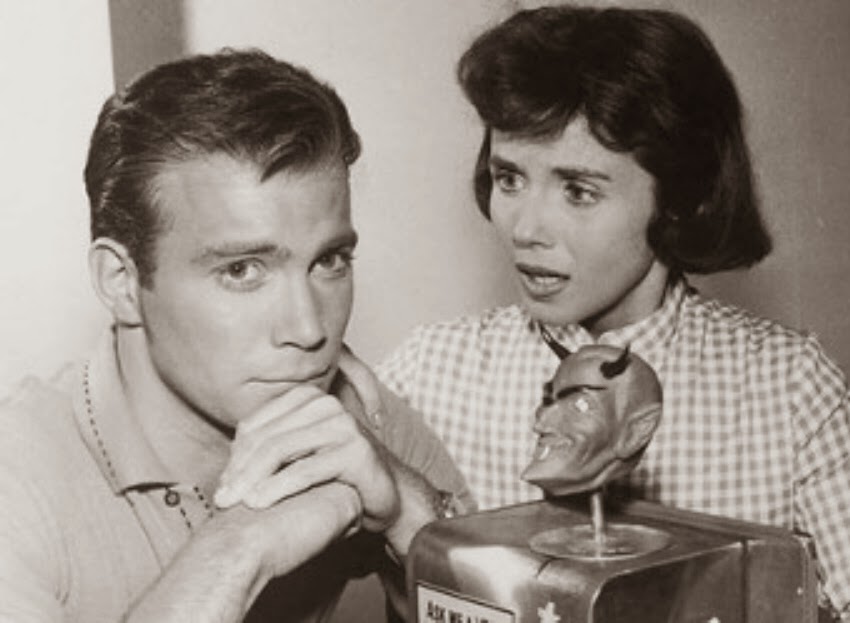
But on now to Don's unusual nemesis. It's a rinky-dink napkin dispenser with a Devil Bobblehead perched on top. It's the "one cent" "Mystic Seer," a fortune telling-device that for one penny will read you your future. It does so by ejecting little cards that cryptically answer yes or no questions.

Sounds harmless enough, right?


Not so fast...

First, the machine accurately predicts that Don will get the promotion he's been waiting for. 


Then it reports that the couple's car will not take four hours to be repaired, as was told the couple.

 Don grows ever more convinced that the "gizmo" is actually telling him his future. "Why was it so specific?" He asks Pam. "Every answer seems to fit," he insists. 

Pam isn't so sure.

And then things get really spooky. Don asks the machine if something will happen to the couple if they leave town. The answer: "if you move soon." 


He then asks, "should we stay here?" 

The answer: "that makes a good deal of sense." 

Finally, Bob interprets a message from the Devil Bobblehead to mean that he and Pam shouldn't leave the diner until after 3:00 pm that afternoon.

Pam objects and forces Don to leave the diner. At one minute to three, on the street outside, they are nearly run over by a speeding car...

Convinced and stubborn, Don returns to the diner and begins asking the Mystic Seer more questions, even though Pam begs him not to. "You made up all the details, and all that thing did is give back generalities," she tells him. 


He still won't leave. Not until his new wife tells him that the machine is running his life, and that she can't be married to a man who "believes more in luck and fortune" than in himself.


Don and Pam escape this trap, what Serling terms "the tyranny of fear and superstition," but in the episode's final shot, we see that another couple isn't so lucky. "Can we ask some more questions today?" They ask the machine.

"Do you think we might leave Ridgeview today?"

"Is there any way out?"


So again, in the most wonderful and entertaining terms imaginable, The Twilight Zone has presented us with a morality play of sorts, one about human nature.

Yet what's so enjoyable about "Nick of Time" is that we don't know whether Don is right (and the Devil machine is predicting the future), or if, in fact, he's merely superstitious and all the right answers are mere "coincidence" as Pam suggests. 

The ultimate point is, I suppose, what you choose to believe in: fear or hope. You can choose to believe that you are small and in danger; or you can take control of your life and face the hardships with strength,  and with the ones you love at your side.

Beyond a fortune telling device that may or may not be supernatural, there is no overt fantastical element in this installment of the Twilight Zone and yet it is oddly effective, and affecting despite this fact. 


Visually, it's assembled in clever fashion by director Richard Bare. The first shot of the episode is a wobbly view from a tow truck bed, looking down from a high angle at the car being towed, with Don and Pam inside. This is an important view, because it establishes right from the beginning of the episode that Don is not "driving" his life (nor his car). He's simply being pulled in one direction or another, towed by his fear and superstition.

Later, when the couple first enters the Busy Bee Diner with the Devil Bobblehead/Mystic Seer, the camera views Don and Pat from the far side of a lattice-work room separator/divider, a sort of visual frame-within-a-frame signifying entrapment or doom. 


This same camera set-up recurs at several important moments in the show. 

The first time, we view two other local residents in thrall to the Mystic Seer at the dining booth, also through this "entrapment" lens (the criss-cross frame of the lattice).

Finally, when Pam encourages Don to summon his inner courage, the shot has changed to reflect their strength. The lattice wall is no longer between camera and character -- a visual obstacle and blockade -- but rather behind the characters. They have escaped the trap. They have moved literally past it.

I also get a kick out of the extreme (and I mean, EXTREME) close-up shots of the Devil Bobblehead, always jittering ever so slightly but nonetheless playing his Satanic cards close to the vest. He's an interesting villain because he's inanimate and yet we "impose" some sense of fear or personality on him.


If it were just a napkin dispenser, minus the Bobblehead, this episode wouldn't work nearly so well.

Shatner's performance is so good because he plays a character suffering from a lack of confidence. That's funny, given that he's the guy who plays Captain Kirk, but I would argue that even there, in Star Trek, that's the quality that makes the character work so well. Kirk is a human being, a leader of men, but he still second guesses himself ("Balance of Terror") or fears losing his job ("The Ultimate Computer"). 


Watching early Shatner performances you get a sense at how deft the actor is in playing a likable yet vulnerable character. He doesn't quite reach the heights of hysteria in "Nick of Time" that he would achieve later in "A Nightmare at 20,000 Feet," but the script calls for different things. I really like Shatner in this kind of every man persona. To me, he represents the perfect 1960s young male: a self-aware, intelligent, resourceful, JFK-type with just enough self doubt and neurosis to make him thoroughly disarming.

I find it fascinating that Shatner's two Twilight Zones and one Outer Limits ("Cold Hands, Warm Heart") place the actor in the thick of a couple relationship in crisis. He's always playing a husband dealing with something terrible, and trying to convince his wife that he isn't insane. Gremlins on planes, Venusians on "Project Vulcan," or a fortune telling machine that may be the Devil Himself. 

Twilight Zone Day: "To Serve Man"


“To Serve Man” remains one of the most famous Twilight Zone episodes ever broadcast. 

Everyone remembers the tale’s unforgettable punch-line: “it’s a cook book!!!”  

But by the same token, it’s easy to forget what a sturdy, brilliantly-constructed episode it is.

Based on a 1950 short-story by Damon Knight (1922 – 2002), “To Serve Man” features a flashback structure. 

From his room (or cell…) on a spaceship in flight, an American man named Chambers (Lloyd Bochner) recounts how alien Kanamits (Richard Kiel) came to Earth promising friendship and peace, but actually executed an insidious and secret agenda.

Chambers explains how the alien spaceships were first seen over many cities across the globe, and how the U.N. Secretary General welcomed the aliens, with some reservations.


But the 9-foot tall Kanamits promised peace and honorable intentions. They planned to transform Earth into a veritable paradise by offering economical new power sources, and radically improving means of agriculture.  And if humans didn’t want their help, the aliens promised that “nothing would be forced” upon them.

All the while, Chambers worked on translating an alien book that one Kanamit representative left behind at the U.N. 

The deciphered title?

To Serve Man.

Over the months, Chambers toiled further on the extra-terrestrial book even as excited humans boarded Kanamit spaceships and headed to the distant home-world for vacations, shopping excursions, and guided tours.

Chambers then decided to go on one such visit for himself. 

But before he left -- right as he was boarding a saucer in fact – Chambers’ assistant discovered a terrible secret.

To Serve Man was a cook-book…


Much of “To Serve Man” appears to concern humanity’s short-sightedness.

Chambers regrets that the human race should have been focusing on the “calendar” and not the “clock” while contending with the Kanamits.

He states that humans should more often be worried about “tomorrow. And the day after tomorrow.”

This is a universal real-life refrain, certainly, in regards to man’s stewardship of the environment, and even his foreign policy principles.

Too often, it seems, we are focused on crisis-management and dealing with what is right in front of our face, rather than planning for the looming disaster just around the next curve.

Here, humanity is taken in by the Kanamit promises of a brave new world, and immediate gratification too.

“It was the age of Santa Claus,” Chambers notes with cynicism.

In other words, because things seem to be good at present, humans don’t look beyond that “shiny” surface to the future. In “To Serve Man,” no one really examines the alien race’s long-term motivations for fundamentally transforming the Earth.

In this case, the Kanamits end war (with the creation of national force-fields…), hunger, and poverty…but for the express purpose of growing and fattening the herd.

Clearly, given the episode’s prominence in the pop-culture, “To Serve Man’s” most memorable moment arises when the other shoe drops.

Chambers assistant tells him that “To Serve Man” is a cook-book. And then he is forced on the ship anyway…by a hulking Kanamit.

In that moment, Chambers learns that mankind has gone from “being ruler of a planet to an ingredient in someone’s soup.”

“Sooner or later,” notes Chambers caustically “we’re all of us on the menu.”

…”


“To Serve Man” doesn’t really reveal much detail or background information about the Kanamits. We don’t know if there is famine on their world…only that we are their latest smorgasbord, and that they have been to other worlds…and done the same thing before.

And, I suppose, we know that their name -- Kanamit -- isn’t far from our word “cannibal.”

That's enough.  This episode is one of the most chilling of all the Twilight Zone canon.

30 Years Ago: Chris Carter's Millennium (October 25, 1996)

Frank Black (Lance Henriksen), his wife, Catherine (Meghan Gallagher) and their daughter, Jordan (Brittany Tiplady) move into a beautiful ye...