Showing posts with label The X-Files Week. Show all posts

Thursday, September 12, 2013

The X-Files Week: "Scary Monsters"


The last two seasons of The X-Files -- while generally not well-beloved by longtime fans -- actually represent a great time of renewal for the long-enduring Fox series.  

Exciting new characters such as Doggett and Monica Reyes offered the writers and directors the opportunity to explore different facets of the paranormal and the supernatural.  And while viewers cannot be blamed for missing Scully and Mulder as the primary characters, I believe there is also much to love and admire in this “next generation” team-up of F.B.I. agents featured in these final seasons. 


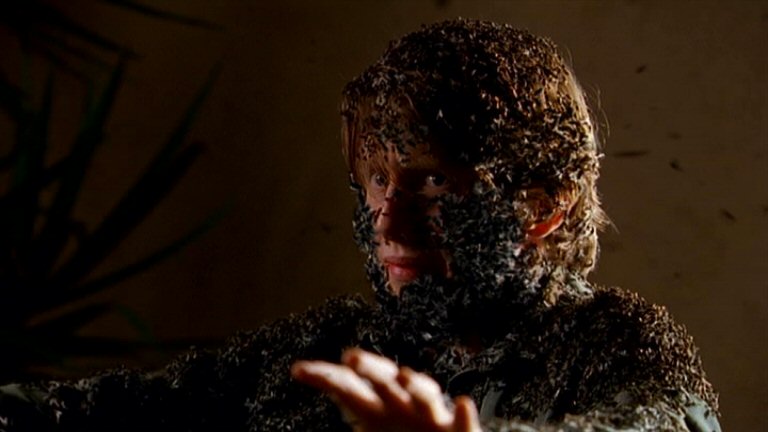
One case in point may very well be the ninth season story “Scary Monsters,” which finds Doggett, Reyes, and X-Files “historian” Leyla Harrison  (Jolie Jenkins) investigating a creepy case in Pennsylvania involving a terrifying or monstrous child. 

The child, Tommy Conlon (Gavin Fink) boasts the capacity to bring his imagination to life in murderous and hungry fashion.

Specifically, he creates out of his mind a brand of giant, skittering insects that consume people. In fact, they burrow inside of people…and need to be cut out, surgically.

Together, Reyes, Doggett and Leyla must ferret out the truth of this situation and defeat this child’s night terrors.  They find that his father, Jeffrey (Scott Paulin) can’t really help, and learn that Tommy’s over-active imagination killed his mother, and the family cat, Spanky, too.  But what killed them specifically? 

Could it have been…belief?


In short, “Scary Monsters” works for all the same reasons that The X-Files  has always worked: because the evocative cinematography creates an aura of dread, because the characters resonate as human and likable, and because, finally, there is a social critique (of television, of all things…) embedded in the action.

But ultimately, the quality I enjoy most  about “Scary Monsters” is that it presents an X-File that, simply, Mulder wouldn’t be able to survive, let alone solve, and then has fun with that  intriguing idea.

Allow me to explain: Mulder’s great gift as an investigator is his imagination, his amazing capacity to conceive of connections that others simply can’t comprehend.  His motto is, of course, “I want to believe.
In this case, however, that imagination would be an albatross around Mulder’s neck.  He shouldn’t believe, and his imagination would surely manifest itself and literally come up to kill him.   Doggett -- who is “dogged” and committed -- but lacking in such imagination -- is thus the perfect agent to walk into the lion’s den and face this particular opponent.  He can’t believe.  He can’t make real in his mind something he knows and feels is patently wrong.  

There are those fans who might think that this episode is belittling of Mulder (by presenting a case that isn’t tailor made for his brand of thinking), or belittling Doggett (for joking about his resolute lack of imagination), but I would argue that this perception is incorrect.  “Scary Monsters” instead shines a light on the differences between the two men, and reveals how there is a place for each in the world of The X-Files. And although Doggett is our likable protagonist here, Mulder is very much present in “Scary Monsters” in spirit, serving as that absent center that Chris Carter frequently discusses. 

If you gaze at the totality of “Scary Monsters,” you can see how the episode studies imagination from more angles than one.


For instance, Leyla is a walking-talking encyclopedia of knowledge regarding Scully and Mulder’s previous cases.  Every time she is presented with a new clue about Tommy’s case, she tries to contextualize it in terms of something that happened before…to Mulder and Scully. 

But strictly speaking, that’s not imagination, that’s movie criticism…or art appreciation; the attempt to organize facts into an order that helps one understand or contextualize life.  Leyla here makes references to several previous episodes including “D.P.O.” and “Field Trip,” but those cases provide no insight about this case, or about the boy, Tommy. 

I’ve written before about how The X-Files succeeds by re-purposing old horror stories and making them seem relevant and new at the turn of the millennium.  I feel that this observation is very much true of “Scary Monsters,” which re-creates the evil child of The Twilight Zone’s “It’s a Good Life” with modern (CGI) effects, but then adds a new coda to that child’s story. 

If you remember the episode, in “It’s a Good Life,” the imaginative but out-of-control Anthony couldn’t be stopped, and his parents were…permissive.  His reign of terror was endless (or at least until the 2003 series produced a sequel).  But here, “Scary Monsters” finds a way to subdue and ‘numb’ the imaginative child: by making him watch television all day long. 

This caustic ending is a perfect capper to the episode, a commentary on television functioning as babysitter in a society where two parents work, and a critique, again, of the culture of the day. It’s a culture in which children were fighting obesity at a heretofore unknown rate because they are not playing outside or running, or riding their books, but instead staying indoors, watching TV, or playing video games.  In other words, “Scary Monsters’ finds the perfect turn-of-the-millennium solution to imagination: numb it with reruns. Kill it with the “boob tube.”

And yes, this commentary might be considered “bite the hand that feeds you” commentary.  But The X-Files is a remarkable TV initiative because it is about ideas, and it follows those ideas – and makes the audience follow them too -- to their logical, if not always pleasant conclusions.


Episodes such as “Scary Monsters” prove that even in its last days on network television, The X-Files was delivering meaningful, worthwhile entertainment (and scares).

The X-Files Week: Monster of the Week Gallery (Season 9)

"Daemonicus"

"Lord of the Flies"

"Hellbound"

"Scary Monsters"


The X-Files Week: "Via Negativa"


In philosophy, the "via negativa" is an approach to understanding God. Somewhat counter intuitively, it's a strategy that seeks to define God by enumerating those things God is not. God is not mortal. God is not Evil. And so forth.

Sometimes, this unusual approach to comprehending the Divine is also called Negative Theory or The Negative Way.

And in the chilling X-Files episode "Via Negativa," this approach lives up to that nomenclature. The "Via Negativa" of the title is a lonely, unlit walk to the dark side: a spiritual dead end

More specifically, one possible pathway to "knowing" God turns out only to be a pathway to absolute darkness. The dimension of God's "absence" is not...a good place to be.


Written by Frank Spotnitz and directed by Tom Wharmby, "Via Negativa" aired during the eighth season of The X-Files, on December 17, 2000. As you may recall, this was the span that introduced the new lead character on the series, Agent John Doggett, played by Saturn Award winning actor Robert Patrick. All you need to understand about Doggett is encapsulated in his very name: he's literally "dogged:" adamant, firm, indefatigable, persevering, resolute, even pig-headed.

Or put another way, Doggett is your traditional good cop who doesn't let go of a case until it makes sense to him. In "Via Negativa," the character's faith in the rational, in cause-and-effect, in logic, is dramatically put to the test.

"Via Negativa" finds stalwart Doggett investigating the brutal murders of two FBI agents who were staking out an apocalyptic cult. In contravention of long-standing series format, Doggett is investigating this particular X-File alone because a pregnant Scully is away at the hospital. 

Still new to the X-Files unit, Doggett is uncertain and somewhat rudderless. He's no Mulder, and has no interest in being Mulder. Leaps of faith don't come easily, or naturally, to him. Without Scully to ease him in, the "dogged," meat-and-potatoes Doggett is, in a very real sense, vulnerable, to what he learns during this investigation.

While on the case, Doggett discovers that all the members of the apocalyptic cult also died horribly, and that their still-at-large leader, Anthony Tibbett, is an ex-convict who developed his own peculiar brand of evangelical Christian/Hindu philosophy. "Heaven's Gate" -- the UFO cult led by Marshall Applewhite -- is mentioned briefly in the teleplay here, and Doggett wonders if Tibbett's people were willingly part of a death pact similar to the one that claimed the 39 members of that cult in 1997.

The Heaven's Gate folks reportedly believed they were headed to the "next level of existence," one without the need for a physical body. By comparison, Tibbett suggests that "the body is but clay...to hold the twin aspects of the human spirit: the light and the darkness." Furthermore, he believes that if his dedicated followers gaze into the path of darkness ("the via negativa" of the title), they will see God there.


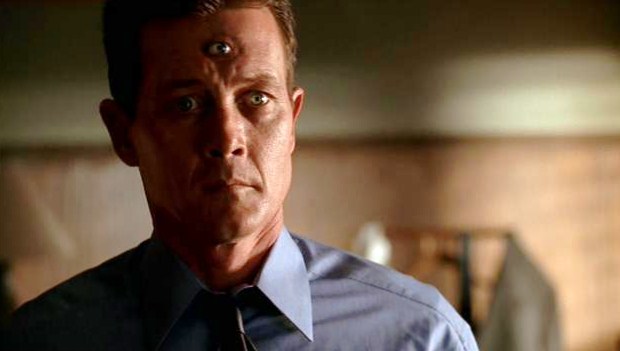
To help them reach this dimension of darkness, Tibbett administered experimental hallucinogens that would awaken their "Third Eye." It is this "Third Eye" -- the Hindu gyananakashi, or "Eye of Knowledge, positioned between hemispheres of the brain -- that could see into the realm of darkness. We have seen the Third Eye in Scripture (the Book of Revelation) and in modern horror films (From Beyond [1986]), and in The X-Files it is the telltale indicator of one's arrival on the Via Negativa, a dark, lower plane, rather than an enlightened, higher one.

When a now-comatose Tibbett evolved his own "third eye," the cult leader found he could actually enter into the subconscious minds of all those he encountered. Thus -- like nightmare avenger Freddy Krueger himself -- Tibbett could enter the dreams of his enemies. 

And as we all know from A Nightmare on Elm Street (1984), if you die in your dreams...you die in real life.


Doggett delves deeper and deeper into Tibbett's strange, dark beliefs until the agent himself takes an unwitting walk on the via negativa during a horrifying dream sequence. The scene is cast in a suffusing blue light, with intermittent fade-outs and pulsating strobes providing a sense of fractured time and consciousness. This tense, mostly silent scene sees a sweaty, desperate Doggett (depicted in extreme close-up) contemplating murder...and his own internal darkness. Doggett finds himself, he believes, inside Scully's apartment...holding a ceremonial hatchet...Tibbett's weapon of choice. Doggett is faced with the choice of becoming Tibbett's new murderous vessel...or killing himself and ending the nightmare permanently.

Another scene, in which a vulnerable, confused Doggett confesses to a baffled Skinner (Mitch Pileggi) that he is uncertain about his own state of consciousness (dreaming or awake...) also serves as Doggett's real indoctrination into The X-Files...the horrifying case from "outside" that changes him "inside." 

At the same time, this confession allows us to identify with Doggett for one of the first times on the series. He has gone from being "skeptic" to being "open" (if not a believer.) He understands -- or at least senses -- the danger...to his soul.

"Via Negativa's" climactic moments -- with Doggett wrestling with that decision of homicide/suicide -- today endure as among the series' grimmest. Often in The X-Files, the horror is tolerable because we "know" the characters and their central relationship so well; because we know Mulder will rescue Scully or vice-versa. 

But in "Via Negativa" there's a deep underlying fear at work. Doggett has no support system. He has no one to hold onto; no one to race to his side when he is faced with death. His walk on "the dark path" is really and truly a walk alone (or so we believe, until the denouement) and there's something incredibly unsettling about the brand of evil he faces.

As I wrote above, the Via Negativa attempts to describe God by describing what God is not. In essence then, it charts the absence of God. I'm a committed atheist, of course, and yet the final moments of "Via Negativa" make even the non-believer feel that weight of...absence. The absence of Good. The Absence of Light. The absence of conscious control. It's about existential...aloneness, and it's pretty terrifying.

I've always admired The X-Files. Week in and week out for nine years, the series devised new, cunning ways to terrify the audience, and "Via Negativa" remains one of the most original and most horrifying installments. Here, the horror rests not outside us in some third party. Not in a monster that can come and kill you. But in your own awakened sight. The skillfully-crafted, brilliantly-directed episode also puts truth to the lie that The X-Files somehow grew stale or unsatisfactory during the final seasons.

With episodes such as "Badlaa," (about a legless Indian peddler who would...climb inside people), "Roadrunners" (a body invasion story set in a weird, isolated town...) and the mystical, existential "Via Negativa" dominating the Season Eight catalogue, The X-Files' heritage of horror was honored. The writer here (Spotnitz) not only had to deal with the absence of God, he had to deal with the absence of Mulder (and Scully, actually...)!

"Via Negativa" is so stirring, so disturbing, that it brings us to a reckoning about Patrick's Doggett. Despite our allegiance to Mulder...we like the guy. 

And thanks to "Via Negativa," we're scared as Hell for him.

The X-Files Week: Season 8 - Underrated but Great


The Conventional Wisdom:

Many of you are already familiar with the conventional wisdom about The X-Files (1993 – 2002).  This conventional wisdom has been disseminated and repeated across fan hubs and critical review web-sites for many years now.

It goes something like this: After star David Duchovny departed the series as the lead actor, the series went down-hill…fast.  In fact, The X-Files stayed on the air a few years too long, and ended in something resembling disgrace and embarrassment.

Well, the truth is out there…and it’s much more nuanced and intriguing than the conventional wisdom suggests.  First, it’s accurate that during the eighth season of The X-Files, David Duchovny reduced his participation considerably.  He was no longer the star of the program, and he appeared as Mulder in less-than-a-dozen episodes airing that year.  But he wasn’t gone entirely.

His successor in the male lead position was actor Robert Patrick (Terminator 2 [1991], Fire in the Sky [1993]).  On The X-Files, Patrick played John Doggett, an ex-New York police detective who did not boast a familiarity with the paranormal or supernatural, but instead constructed his cases upon the bedrocks of common sense, a finely-tuned moral barometer, and good old-fashioned police work. 

In short, Doggett equaled “dogged.”  He was a superb, tireless agent (as Scully once noted: “above reproach”), and the character and performance provided the series with a welcome injection of fresh blood.  Yes, Doggett was quite different from the beloved Agent Mulder, yet if you speak to many X-Files fans that actively disliked Patrick’s tenure as Doggett, they won’t name either the actor or the character as the source of their upset.

Instead, a series of arguments are raised.  For instance, a few of these critics will suggest that the writing was bad in Season 8, even though episodes were by-and-large penned by the same authors who toiled on earlier seasons of The X-Files and knew their way around the series’ premise and characters.  Their stories in season eight at least deserve a fair hearing.

Some will tell you that the monsters of the week during Season 8 suddenly grew “tasteless,” based on disgusting premises like a vomiting monster (“The Gift”) or a creature that could crawl into the rectum of a grown man (“Badlaa”). 

And yet -- again -- one must wonder why earlier, highly-praised X-Files stories such as “Home” (featuring an amputee and genetic mutants), “F. Emasculata” (concerning a disease with exploding flesh pustules), “Bad Blood” (with extracted human organs dripping blood from a scale during an autopsy) or “The Host” (with a creature hiding in a port-a-potty) did not encounter the same negative response of “tastelessness.”  Throughout its run, The X-Files was persistently and gory, and that’s a good thing in my estimation, especially in a medium (at the time) that favored homogeneity.

Another oft-voiced complaint is that during Season 8, Scully and Doggett ended up striking off on their own too much, and thus ending up in mortal jeopardy without back-up.  Once more, did those folks complaining about this issue ever actually watch the earlier seasons of The X-Files? 

This sort of situation happened all the time to Scully and Mulder.

One potential answer underlying the conventional wisdom is that, at some point, many critics of The X-Files decided, a priori, that a Mulder-less version of the show wasn’t going to be something good, or something in which they could fully invest and actively engage with.

So they erected a series of false premises about the series to reinforce their pre-existing beliefs. 

The Affirmative Case:

So, if the conventional wisdom is wrong, why is Season Eight a strong season and one worthy of praise and The X-Files legacy?

First and foremost, there’s Doggett.

He is the third leading “Chris Carter male” we have encountered, following Fox Mulder and Millennium’s Frank Black (Lance Henriksen).  My wife, a therapist, coined the phrase “The Chris Carter male” because she became intrigued by the writer’s male characters, and their common traits.  She describes the Chris Carter males as “chivalrous and heroic, but unavailable emotionally to the women in their lives.” 

When I interviewed Chris Carter in late 2009, he responded to this psychological classification and noted that it was “dramatically-interesting to him” to write for characters when “it’s what’s withheld that counts, or is that important.”

He went on to say:  “If the character is remote or unable to speak about these things – because it’s series television we’re talking about here – it becomes something that needs to be discovered.  So if you discover these things too quickly, if a person is too emotionally available, it actually takes away from interest in the character.

What's Doggett laughing about with his budz?
With this premise in mind, Carter and the other writers of The X-Files grant Doggett a particularly intriguing arc in Season Eight. He starts out as a dependable but relatively unimaginative by-the-book agent in the premiere “Within/Without.”  In fact, viewers even feel a little suspicious of him starting out because when we first see him  approaching Mulder’s basement office in “Patience,” he is depicted laughing outside the door with colleagues…as if mocking the X-Files.  He’s responding to a joke we don’t get to hear, and so the audience response is suspicion…even paranoia.

Later in the episode, one penned by Chris Carter, a police detective, Abbott (Bradford English) proves downright dismissive of and hostile to Agent Scully (Gillian Anderson). Doggett steps in and whispers something to Abbott to back him off.  Notice that we never hear Doggett’s words, nor see his facial expressions as he speaks to Abbott in this particular scene.  Once more, the implication is that Doggett is not entirely trustworthy.  He may be sympathizing with the misogynistic detective…we don’t know for sure.  Again, the primary feeling with Doggett is one of suspicion, or uncertainty.

After these moments and a few others like them, we slowly warm to Doggett, and his sense of emotional unavailability begins to recede. In later episodes we learn that his marriage failed, and that his son died under tragic and mysterious circumstances (in “Invocation”), but more importantly, we begin to see how he and Scully develop a working relationship.  The distance we feel from him diminishes.  But the important thing is that Doggett as a character earns our trust over a period of episodes.  He is not inside “the circle” (like Skinner is, for instance) instantly.

In some ways, this is a touch very respectful of Mulder, and Mulder’s role on the series.  It would have been terrible, not to mention unbelievable, to have a character jump in and pick up where Mulder – after eight years – left off, emotionally vulnerable with Scully and trusted by Skinner.  Instead, the writers gave us a character that had to find his way both on the job, and with the dedicated fans of the show.

In addition to the new and at times ambiguous presence of Doggett, the eighth season of The X-Files is successful because, by and large, the stories feature interesting “monsters of the week” (soul eaters, Siddhi mystics, microscopic flesh-eating ocean life…), ones often based on myth and folklore.  But the stories are good for more than that reason.  In particular, they establish the new dynamic for the characters and their interactions.

The original and admittedly brilliant X-Files dynamic of Scully/Mulder is best expressed as the comparison of two distinctive and competing world views: science vs. faith/skepticism vs. belief.  Virtually every story in the first six years was filtered through this highly entertaining and cerebral double lens.

In Season Eight -- with a mostly absent Mulder to contend with -- that dynamic could no longer function.  So instead, the episodes of this span largely concerned how Scully had to re-train herself to “see” the world, accommodating Mulder’s genius into her own perspective.  This endeavor not only made Scully grow as a person, it kept Mulder as the “absent center” in Carter’s words, of the drama.

Consider for a moment just how often the episodes in Season Eight involve “sight,” or more specifically, “learning to see.” Here are some examples: 

In “Patience” Scully tries to see the world (and a specific case) as Mulder would see it, but admits she has difficulties making the same leaps of faith. 

In the episode titled “Medusa,” Scully assumes control of a command center on an investigation, and must “see” through Doggett’s eyes in the subway below.  Again, she’s re-learning how to interpret the world and its mysteries. She needs Doggett as her “eyes and ears” to do that.  He needs her, oppositely, calling the shots, because of his inexperience on the X-Files.

In “Via Negativa” a cult leader grows a “third eye” by opening his mind to the path of darkness, and Doggett nearly goes the same way, into a new realm of diabolical sight. 

In “The Gift,” Skinner commends Doggett for seeing a case through Mulder’s eyes…by getting inside the missing agent’s head.  

“Badlaa” involves an Indian mystic who can cloud the sight of normal people, including Scully and Doggett, making them see -- or not see -- what he wishes.  Our very reality is up for grabs, and Scully must make a decision based on what she believes, not what she actually sees. 

Even “Three Words” is about sight in some critical sense. It concerns how Mulder comes to see Doggett, and then how Doggett comes to see himself: as being manipulated by an untrustworthy informant. 

“Alone” is about blindness (another aspect of sight), and about how in the absence of clear sight, trust can substitute for vision.  This lesson comes in relation to competitors Doggett and Mulder, who are trapped by a kind of lizard monster in a dark labyrinth.  His eyes sprayed by venom, Doggett can’t see his nemesis well enough to shoot it.  He must place his trust in Mulder, and Mulder’s words to survive.

The leitmotif of “learning to see” appears in more than a handful of episodes, and grants the eight season an umbrella of unity that draws it together.   

Episode Highlights:

Scully (and the audience), on the outside looking in.
1. “Patience.” Written and directed by Chris Carter.  This is a standalone story (or “monster of the week”) involving a  sort of man-bat (who sees quite differently than human beings, by the way…) seeking vengeance against tormentors from the year 1956. 

But this episode – essentially a second pilot for the series – cunningly sets up the fundamentals of the Scully/Doggett relationship as well as the season’s obsession on sight.  Furthermore, it features a great commentary on what it means to live in fear.  On the latter front, consider Ernie Stefaniuk’s moving monologue about what fear did to his marriage…and to his (now deceased) wife.  For forty-four years the couple lived in virtual isolation on a six mile stretch of land and denied themselves modern conveniences, family contact, and more.  In the post-9/11 age, “Patience” takes on a new meaning given the government’s color-coded exploitation of fear during the last decade.

Chris Carter is a gifted director and he proves it again in “Patience” with the carefully constructed and perfectly framed scene I mentioned above wherein Scully is castigated and treated poorly by Detective Abbott, and Doggett steps in to ameliorate the detective’s concerns. 

A less clever director would have included a frontal shot of Doggett’s explanation or provided audio of his words.  Instead, the moment is left intentionally ambiguous because we never learn exactly what it is he said.  

This makes us wonder if Doggett will be there for Scully when she needs him…

“Patience” is the first standalone episode in the series sans Mulder, and it is therefore the template for the two final seasons, diagramming the fresh terrain of the burgeoning Scully/Doggett relationship and the importance that “learning to see” will play in upcoming episodes. 

Also, “Patience” is a coded-title and a message directly to X-Files fans.  Be patient, and you’ll be rewarded with a new character dynamic that, conceivably, could rival the richness of the original format.

Burks or Siddhi Mystic?
2.”Badlaa.”  By John Shiban. This absolutely go-for-broke episode concerns a Siddhi mystic (Deep Roy) who travels to America inside the rectum of a four-hundred pound businessman. 

Yes, you read that synopsis correctly…

When the vengeful mystic evacuates the rectum, the fat man bleeds out, and we are spared no nauseating detail.  One thoroughly terrifying scene finds the mystic hidden inside a corpse, and as Scully begins her autopsy, we see his tiny hands wriggle their way out of a chest incision.

Doggett or Siddhi Mystic?
The sense of escalating terror generated by this episode is not only visual.  The Siddhi mystic – an amputee -- drags himself from one location to another on a scooter with squeaky wheels, and that ubiquitous squeak quickly emerges a fearsome harbinger of terror.  We come to expect it, and fear it.

But the episode works splendidly not because of the nutso (if inspired) premise, but because it fits into the season’s leitmotif about “learning to see.” Specifically, director Tony Wharmy achieves something extraordinary in terms of visualizing certain crucial moments in the play.  It is established early on that the Siddhi mystic can control how people perceive him, and there are at least two instances in the tale when Scully sees people who are already present on the scene – in long establishing shot – standing in the distance, observing her.

One is Charles Burks (Bill Dow), bracketed inside the door frame at the X-Files FBI office.  Another is Doggett himself, standing pool-side, with strange light reflected on his face.  Neither figure gets a traditional entrance when Scully sees them: they’re already present -- motionless– and the implication is that there is something not quite right about them.

If you go back and watch this episode with a careful eye, be certain to ask yourself at all times, who is Scully actually “perceiving” and receiving information from? Those she knows and trusts, or the mystic himself, carefully insinuating his “sight” into her mind?  It’s a brilliant idea and a visual grace note in a highly disturbing and provocative episode.

Learning to see.
3. “Via Negativa.” By Frank Spotnitz.  This is another brilliant standalone episode. In philosophy, the "via negativa" is an approach to understanding God; a strategy that seeks to define God by enumerating those things God is not. God is not mortal, God is not Evil, and so forth. Sometimes, this unusual approach to comprehending the Divine is also called Negative Theory or The Negative Way. 

The episode "Via Negativa" finds stalwart Doggett investigating the brutal murders of two FBI agents who were staking out an apocalyptic cult. Doggett is investigating this particular X-File alone because a pregnant Scully is away at the hospital. Still new to the X-Files unit, Doggett is uncertain and rudderless. He's no Mulder, and boasts no interest in being Mulder. Leaps of faith don't come easily or naturally to him. Without Scully to ease him in, the "dogged," meat-and-potatoes Doggett is, in a very real sense, vulnerable, to what he learns during this investigation.

Doggett discovers that the members of the apocalyptic cult died horribly and that their still-at-large leader, Anthony Tibbett, is an ex-convict who developed a peculiar brand of evangelical Christian/Hindu philosophy. Tibbett suggests that "the body is but clay...to hold the twin aspects of the human spirit: the light and the darkness." Furthermore, he believes that if his dedicated followers gaze into the path of darkness ("the Via Negativa" of the title), they will see God there.

To help them reach this dimension of darkness, Tibbett administered experimental hallucinogens that would awaken the cult members’ "Third Eye." It is this "Third Eye" -- the Hindu gyananakashi, or "Eye of Knowledge, positioned between hemispheres of the brain -- that can see into the realm of darkness..

Doggett delves deeper and deeper into Tibbett's strange, dark beliefs until the agent himself takes a walk on the Via Negativa during a horrifying dream sequence. The scene is cast in a suffusing blue light, and intermittent fade-outs and pulsating strobes provide a sense of fractured time and  splintered consciousness. This tense, virtually silent scene witnesses a sweaty, desperate Doggett (depicted in extreme close-up) contemplating murder...and the specter of his own internal darkness.

Another scene, in which a vulnerable, confused Doggett confesses to a baffled Skinner (Mitch Pileggi) that he’s uncertain about his own state of consciousness (dreaming or awake...) also serves as Doggett's authentic indoctrination into The X-Files...the horrifying case from "outside" that changes him "inside."

In "Via Negativa" there's a deep underlying fear at work. Doggett has no support system. His walk on "the dark path" is a walk alone (or so we believe, until the denouement) and there's something incredibly unsettling about the brand of evil he faces here. This episode is absolutely terrifying.
A succession earned, not bestowed.

4. “The Gift.”
  This episode by Frank Spotnitz and directed by Kim Manners is another story that focuses on “sight” and how people see things differently.  Agent Doggett investigates one of Mulder’s old cases, and finds evidence that Mulder may have committed murder.  Through enigmatic flashbacks, we see Mulder’s unorthodox work on the case, and the execution of the crime. 

Only in the end do we come to understand that Mulder’s blood-soaked act of murder is actually one of mercy.  And we uncover this revelation not in straight-forward narrative fashion, but through Doggett’s investigation as he follows literally in Mulder’s footsteps, and comes to make a similar choice regarding mercy and decency.  The result, at episode’s end: Doggett – for the briefest of instants – imagines the specter of Mulder in his office, as if a tacit sign of approval of Doggett’s presence there.  He has, finally, earned the right to sit where Mulder once did.

The monster of the week in “The Gift” is a great one too: a “soul eater” who may be summoned to eat the bodies of the sick.  After eating sick people and absorbing their diseases, the soul eater than regurgitates the digested human beings…and they re-form and are resurrected.  Both Mulder and Doggett go through that horrifying process in this episode (another instance of “parallel” footsteps), and yes, the vomiting scenes are nausea provoking.  But regurgitation isn’t the point of the story.  The point is that the soul eater is a tortured creature who cannot die and who must keep healing others…and absorbing their horrible illnesses.  He’s in pain and wants his life to end.

As the episode commences, you think that “the gift” of the title belongs to the soul eater. He is giving those he digests and regurgitates the gift of health. But at episode's end, we learn that Doggett has actually given the monster the greatest gift of all: death. Release.

This is a poetic and lyrical X-Files episode, and one that asks us to see the soul eater differently at different times.  He’s a monster and a terror at first.  But then – as we look into his eyes – we register that if he is a soul eater, his soul too has been eaten by a lifetime of physical suffering.

The truth we now know, and have "learned to see..."
5: “Existence.” Written by Chris Carter and directed by Kim Manners.  In this season finale, a pregnant Scully gives birth to her unusual child, and we learn – at long last – that Mulder is the father.  Shippers will enjoy the Mulder/Scully kiss, but on a more significant note, the episode provides the punch-line to the season-long exploration of "learning to see."  

Before our eyes – for we don’t know how long – Mulder and Scully have been together…romantically. And, now, we suddenly see and understand it all.  It’s a beautiful end to the season, and to this nearly-season long arc.  We’ve traveled a long road believing one thing, or suspecting one thing, and then – in a single scene, and with a single line of dialogue – we finally see “the truth.”  It’s a perfect capper to Season Eight.  In this final installment of the year, the audience learns to see, thus mimicking the odysseys of Scully and Doggett.  How's that for elegant storytelling?

Season Eight could have been one of jarring change and false starts, but instead, The X-Files triumphed with fine storytelling, great performances, scary monsters and a recurring theme.

Other Season Eight high notes: “Roadrunners,” “Medusa,” “Three Words” and “Alone.”

The X-Files Week: Monster of the Week Gallery (Season 8)

"Patience"

"Roadrunners"

"Via Negativa"

"Badlaa"

The X-Files Week: "Sein Und Zeit"/"Closure"


"You know, I never stop to think that the light is billions of years old by the time we see it. From the beginning of time right past us into the future. Nothing is ancient in the universe. But, maybe they are souls, Scully. Traveling through time as starlight, looking for homes..."

-Fox Mulder contemplates the night sky, and the fate of his sister Samantha, in The X-Files, "Closure."


In the epic two-part X-File presentation, "Sein Und Zeit"/"Closure," a television inside Agent Fox Mulder's motel room in Sacramento plays important imagery from the classic sci-fi film, Planet of the Apes (1968).

In particular, orangutan scientist and Protector of the Faith, Dr. Zaius (Maurice Evans) warns the human astronaut Taylor (Charlton Heston) not to seek the truth about his people, about humanity.


"Don't look for it, Taylor," the simian urges. "You may not like what you find."


When asked by Dr. Zira (Kim Hunter) about what Taylor will find on that mysterious shore-line stretching to the horizon, Dr. Zaius replies, cryptically, "his destiny."


This quotation from a sci-fi, cinematic landmark underlines the thematic through-line of this emotionally-affecting X-File two-parter, which aired originally on Fox TV on February 6th and February 13, 2000. Written by Chris Carter and Frank Spotnitz, this seventh season story very explicitly concerns the idea of "seeing."

In particular, the narrative revolves around the way that people -- even good people -- tend to see only what they desire to see. Even heroes like Fox Mulder (David Duchovny) -- who believes he is seeing through conspiracies and secrets -- tends to see the world as it conforms to his particular world-view.

This isn't a critique of Mulder so much as it is an observation about human nature. It's just how we, as thoughtful, emotional beings, operate. We all boast a personal lens (our viewpoint) through which we see and attempt to interpret the world. The X-Files remains such a memorable and valuable television series because it provides not one, but two distinctive world-views, two perspectives, in the persons of Scully (Gillian Anderson) and Mulder (David Duchovny).

But the series also pointedly tasks us, the audience, with seeking the "balance" or "truth" between those perspectives, these two "poles" of human sight and insight. We are encouraged, on one literal level, to contemplate extreme possibilities (like the existence of the paranormal or supernatural), and but then, on a deeper, metaphorical level, to consider what these possibilities mean to the characters, even to the human equation as a whole.


In other words, The X-Files deploys both its stirring and scary supernatural cases and its two very-differently-inclined heroic investigators to gaze meaningfully at the essence of our human nature. In my opinion, this is the critical element that renders the series an artistic masterpiece in the tradition of Star Trek, The Twilight Zone or other genre greats. Although not as widely popular as many other installments of the Carter series, this two-part effort reveals The X-Files at its most meaningful, and indeed, most poetic.

As is also often the case with The X-Files, "Sein Und Zeit"/"Closure" commences with reality, and with a real life event from the 1990s as context, and then beelines into the unexpected, the supernatural.

Here, the action starts in Sacramento when a cute-as-a-button, six-year old girl, Amber Lynn La Pierre, disappears from her bedroom...never to be seen alive again. Oddly, her mother disassociates from reality and pens a cryptic ransom note (through the paranormal auspices of "automatic writing.") And her father experiences a precognitive vision of the little girl's bruised corpse.

If you remember the 1990s at all, you will appreciate many of the details of this strange, macabre introduction. Jon Benet Ramsey, a six year old girl, was discovered dead in her family home in Colorado on Christmas Day, 1996. The unsolved case became a media sensation for months and even years. As late as 2006 (and the false confession by John Mark Karr), this murder was still a topic of hot debate.

Importantly, the bizarre ransom note in the Jon Benet Ramsey case, believed to be written by the late Mrs. Ramsey, opens with the same two cautionary words as the note written by Mrs. La Pierre in the X-Files episode: "Listen carefully!"

Furthermore, the victim in both cases is a six-year old girl. And in both real and fictitious cases, the parents are believed to be the perpetrators of a terrible, heinous crime; the murder of a child. There's even a connection between Amber Lynn and Jon Benet in the Christmas day trappings. At the bottom of Mrs. La Pierre's ransom note is a mystifying, holiday-themed sentence: "No one shoots at Santa Claus!"This odd final sentence is the very clue that rouses Mulder's interest. He remember an earlier X-File in which the same sentence was also scrawled in a ransom note. Another woman, Kathy Lee Tencate (Kim Darby, of Don't Be Afraid of the Dark fame...) wrote the same words on a kidnapper's note for her "missing" son back in 1987. She is currently in prison, having confessed to his murder. But that is just a legal ploy and Ms. Tencate actually believes -- as Mulder comes to believe -- that ancient spirits called "Walk-Ins" are responsible for the disappearance of these children. That they are "old souls protecting the children" from terrible violence in this mortal coil, as depicted in the precognitive visions of the parents.

The particulars of the case are resolved at a place called "Santa's North Pole Village," a haven for a serial killer who abducts and murders children. One visitor at his tourist trap was...Amber Lynn La Pierre. She was destined to die at his hand, like too many other innocents, and the Walk-Ins spared her this terrible agony, transforming the child from matter into energy...into, poetically-speaking, "starlight."

Ultimately, however, this paranormal resolution of a murder case related to real-life isn't the point of Carter and Spotnitz's intricate and haunting tale. The narrative take a strange and unexpected turn when Mulder learns of his mother's suicide...and comes to realize that his missing sister, Samantha, may have also been taken by these Old Spirits as well.

For seven years up to this point, one of The X-Files most prominent mysteries involved Samantha and her ultimate disposition. Was Mulder's sibling abducted by aliens in 1973? Was she taken to another world? Is she still alive on another planet? Will Mulder ever be reunited with her?

This has been Mulder's continuing obsession, his white whale, and various episodes of the series have charted clues, intimated destines, and suggested possibilities. One episode even revealed the aliens harnessing Samantha clones, if I'm not mistaken.


But "Closure" suggests,Mulder has not seen the truth at all. The investigations, the trappings of the alien abduction and other bells and whistles of the case, have actively prevented him from seeing the truth.

And what is that truth? That his sister...a frightened fourteen year-old girl, for all intents and purposes died in 1979.

All Mulder's adult life, he has been chasing a ghost rather than dealing with the truth that his sister is gone. The Cigarette Smoking Man even encourages Mulder's wild goose chase. "Allow him his ignorance," he tells Scully. "It's what gives him hope."

It's a hard, human truth Mulder finally comes to countenance here, and much of this two-parter deals explicitly with our (understandable) sense of outrage and futility when innocence is corrupted, when innocence (like the innocence of Amber Lynn La Pierre or Jon Benet Ramsey) is destroyed. by human "evil." Carter and Spotnitz suggest a welcome spiritual remedy to such ugliness: Walk-Ins who take the children and spare them the pain of such destruction. But the writers also offer Mulder a sense of closure, if he will accept it. The quest for Samantha is over. Or as he realizes, he's reached "the end of the road."

What makes this sense of closure all the more emotionally affecting is that Mulder is joined in this story by a kindly psychic, Harold Piller (Anthony Heald) who lost a son to the kindly Walk-Ins, just as Mulder lost Samantha. But because Harold refuses to believe his son is dead...he can't see him. He refuses to see his boy's spirit, and acknowledge the truth, He cannot grieve, can never on, because his stubbornness won't let him. And thus he achieves the opposite of his desired goal. He remains eternally separated from the child.

Mulder attempts to sway him. "Harold, you see so much, but you refuse to see him," he says. "You refuse to let him go. But you have to let him go now, Harold. He's protected. He's in a better place. They're all in a better place. We both have to let go, Harold."

Our final view of Harold in "Closure" is a haunting one. He runs off, dedicated to finding his "truth"...which is no truth at all. He would rather chase the palatable fantasy than accept the sad reality. This is the object lesson. This could have been Mulder, forever tilting at windmills, never moving on, past the defining traumatic experience of his life.

What remains so remarkable about this X-File story is that Spotnitz and Carter successfully make the audience feel much like stubborn Harold. After seven years and over a hundred episodes, we all invested in Mulder's quest, and the possibility of a happy reunion, of Samantha's safe return. That's what we all hoped for. But this episode precludes such a happy ending, even as it grants Mulder a kind of release.

That sense of release, of catharsis, arrives in one of the most beautiful, lyrical sequences I've ever seen on a television program" a kind of perfect expression of magical, spiritual reality. By starlight, Mulder ascends a hill, accompanied by Harold's son...and sees a field where the "taken" children are at play...still innocent, forever young. There, he is reunited with his fourteen year-old sister. Shot in glowing white light, in slow-motion photography, cut to a haunting but cathartic song from Moby (called "My Weakness,") the long journey ends, and Mulder finds a degree of peace.

Yet some X-Files fans I know outright rejected this lyrical conclusion, mirroring Harold's rejection in the storyline itself. It is easier for us, often, to accept fantasy than reality . We don't have all the answers, and as Scully suggests, "we never truly know why" things happen. But, this tale reminds us, we must attempt to make our peace with the way things are. As as often the case in Chris Carter's works, he purposefully flouts expectations here in order to foster a deeper understanding of the human race. We had expected a Samantha resolution story to involve alien abduction, not, explicitly, grief, about the process of letting go.

Like Planet of the Ape's Taylor -- Chris Carter and Frank Spotnitz tell us -- we may not like what we find at the end of the road. The fans are in the same boat as Taylor and Mulder: we don't want to climb that star-lit plateau and know, finally, that Samantha is gone. But it's our destiny. Just as it is every human being's destiny to grieve a loved one, and, in fact, to die.


The popular meme, endlessly repeated in the media about The X-Files, is that it is a brilliant series that stayed on the air a few years too long, and in doing so, somehow damaged its permanent legacy. I would argue, contrarily, that episodes such as "Sein Und Zeit" and "Closure" reveal the opposite is actually true.

It would have been extraordinarily easy of Chris Carter and Frank Spotnitz to write a happy ending for Samantha and Fox Mulder. They probably could have done it in their sleep, actually. Mulder gets information from the Lone Gunmen that the Cigarette Smoking Man is holding Samantha for tests somewhere, and Mulder and Scully break her out. Brother and sister are reunited. Cue End Credits.

Instead, these writers pursued a more creative, artistic path and forged a tale about how difficult it is to accept our own mortality, or the mortality of loved ones. This is why human beings have religion...so that we don't have to openly acknowledge that for all of us, there is an end. Although this episode of The X-Files also promises a kind of moral hierarchy to the universe -- one in which innocence is preserved instead of destroyed -- it simultaneously acknowledges that death is an irreparable and grievous separation.


Mulder aches to "believe to understand." And in a beautifully-composed and delivered voice-over, Mulder contemplates the destruction of innocence, and human mortality:

"They said the birds refused to sing and the thermometer fell suddenly... as if God Himself had His breath stolen away. No one there dared speak aloud, as much in shame as in sorrow. They uncovered the bodies one by one. The eyes of the dead were closed as if waiting for permission to open them. Were they still dreaming of ice cream and monkey bars? Of birthday cake and no future but the afternoon? Or had their innocence been taken along with their lives, buried in the cold earth so long ago? These fates seemed too cruel, even for God to allow. Or are the tragic young born again when the world's not looking?

I want to believe so badly; in a truth beyond our own, hidden and obscured from all but the most sensitive eyes; in the endless procession of souls; in what cannot and will not be destroyed. I want to believe we are unaware of God's eternal recompense and sadness. That we cannot see His truth; that that which is born still lives and cannot be buried in the cold earth. But only waits to be born again at God's behest... where in ancient starlight we lay, in repose.
.
."

To me, this soliloquy a perfect summation of human existence, and particularly human doubt. It's an explicit grappling with the unanswerable "why" of our lives. 

We want to believe in something greater, something good and kind at the end of the rainbow Why? Because, again like Taylor, we're all going to be making that trip ourselves, whether we want to or not. "Sein Und Zeit" and "Closure" get at this truth beautifully. The episodes don't hit you over the head with everything, either. For instance, in a scene featuring ghosts, there's a young, World War II era couple depicted, and without acknowledging explicitly their identities, we understand that they are Mulder's (now-reunited) parents...supporting his "quest" and his attempt to learn the truth.

I suppose what "Closure" really comes down to is the idea that we can either accept hard reality, like Mulder, or retreat into "not seeing," like Harold. Even today, I think that's particularly relevant message, globally and individually, in our culture.

We sometimes need to understand that -- in seeking answers -- we may not like what we find. Still, we need the grace to accept the truth for what it is.

50 Years Ago: Star Maidens (September 1, 1976)

I remember watching this cult-TV series on WNEW Channel 5, out of New York, when it originally aired in American syndication. I was six year...