Showing posts with label The Horror Lexicon. Show all posts

Tuesday, July 03, 2012

The Horror Lexicon #18: The Tour of the Dead


While dissecting what he called “Dead Teenager Movies,” critic Roger Ebert once came up with a pretty funny joke.  I’m paraphrasing a little, because I don’t remember the words exactly.  But the joke went something like this: “How do you know when a Dead Teenage Movie is over?”

The same dead teenager turns up twice.”

Turns out, this was a pretty apt observation.  Though I don’t share Ebert’s disdain for the Slasher movie format, it’s undeniable that “The Tour of the Dead,” as I term it, has become a de rigueur component of the sub-genre.

In the so-called Tour of the Dead – universally set during the final act -- the resilient Final Girl flees from a terrifying mad-dog killer (usually masked), but the bloodied and savaged corpses of her friends and associates begin popping up in her path...sometimes quite violently.  The sudden re-appearance of these murdered characters provides both authentic jolt scares for the audience, as well as horrifying obstacles to the character’s successful escape trajectory.

One of the earliest (and still best…) Tours of the Dead appeared in John Carpenter’s Halloween (1978) and thus fits in with that film’s organizing principle: Halloween festivities, including trick-or-treat pranks. 

Here, poor Laurie Strode (Jamie Lee Curtis) visits the house across the street in suburban Haddonfield, and sees the body of her friend Annie (Nancy Loomis) posed on a bed…underneath a tombstone.  As Laurie recoils in horror from this macabre sight, other corpses pop out to terrify her, thus providing more than Laurie’s Halloween quotient of “one good scare.”  Laurie grows so terrified that she absently seeks retreat (walking backwards, a  big horror movie no-no…) at the doorway of a dark room…where the white-masked Shape emerges from impenetrable blackness.

The Friday the 13th movies adopted the “Tour of the Dead” convention, starting in the first, 1980-era film. There Alice (Adrienne King) runs from nutty Mrs. Voorhees (Betsy Palmer), and navigates a veritable battlefield of dead bodies.  Steve’s corpse comes down swinging from a Camp Crystal Lake sign, for instance.  Another corpse gets tossed through a window at Alice.  Yet another ends up hanged on a cabin door. 


For the sequels, it was a case of rinse-and-repeat as imperiled Final Girls ran similar corpse gauntlets.  The Tour of the Dead convention is entertaining in these franchise films, but entirely devoid of the "trick or treat" context of Halloween it doesn't make a whole lot of logical sense. Mrs. Voorhees (and later Jason)  not only move from place to place killing camp counselors, but apparently pose the bodies, and calculate -- with precision accuracy -- what path the prey (like Alice) will ultimately take. What makes the conceit interesting (and a little funny...) in the original Friday the 13th is the way that director Sean Cunningham uses signage like "Danger," or "Keep Out" to subtly punctuate the gruesome exhibits on the Tour of the Dead.

In some fashion, the Tour of the Dead is is not just a final challenge to navigate and a visual signifier that the Final Girl is really and truly alone and therefore without help, but a bloody reminder (to the character and to the audience) that she was right about sensing danger. Where the other characters blissfully ignored warning signs of impending massacre, the Final Girl heeded them.  I’m aware that some critics may term the Final Girl’s equation as being something akin to “Survival of the Chaste-st,” but I propose something more along the lines of “Survival of the Smartest.”   Final Girls – at least the good ones – boast insights, feelings and behaviors that their more impulsive friends lack.  And by undergoing the Tour of the Dead, the Final Girl gets confirmation of her greatest character traits.  She was right..and is still alive.  Her friends were wrong and are now...ornaments.

In some Slasher movies, the Tour of the Dead is more ritualized than in others.  In films such as Happy Birthday to Me (1981)  for instance, victims' bodies are propped up at a table (with a birthday cake…) and posed as if at an actual birthday party.  In Tobe Hooper's brilliant The Funhouse (1981), the bloody corpses become part of the amusement park environs, therefor blending entertaining, funhouse-style horror with the real thing.  

As is the case with other elements of the horror lexicon, "The Tour of the Dead" reveals how the best horror directors deploy familiar conventions to good and inventive effect, while others just ape and imitate for the heck of it, for the sake of doing something that's expected, rather than what best tells the story. 

Tuesday, June 12, 2012

The Horror Lexicon #17: Bio-Hazard Suits


Once upon a time, the wardrobe of the horror genre consisted of diaphanous white gowns and black vampire capes.  

But by the 1970s, traditional Gothic wear was out-of-fashion, and high-tech horror chic was in.  

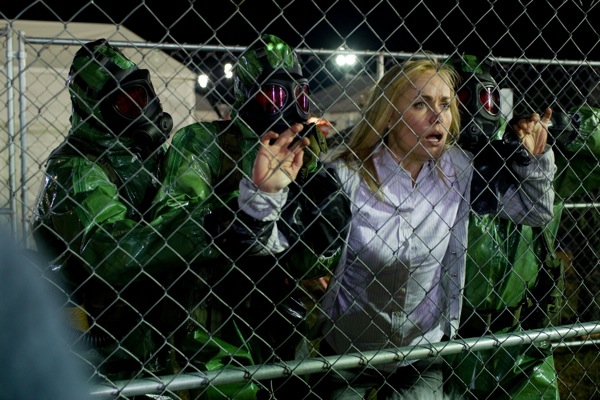
In films such as Robert Wise’s The Andromeda Strain (1971), environmental, hazmat or “bio-containment suits” were often the only thing that could protect heroic scientists from a new and insidious form of monster: the virus or “germ.”

And yet, during the same era, in harrowing films such as George A. Romero’s The Crazies (1973), the hazmat suit also became a short-hand for terror itself.  There, American soldiers occupied Evans City, PA, in bio-hazard suits, and declared martial law during the military’s attempt to contain a biological weapon code-named “Trixie.” 

These American soldiers carried flame throwers and guns, and saw the innocent families and denizens of the town as something akin to expendable cattle.  Therefore, the protective suits – on one hand a protection from danger – also became a barrier to communication, an impediment to human and humane behavior on the part of those who wore them.  Behind those suit masks, we couldn’t see how the soldiers felt, or if they were agonizing over their difficult choices.  We could only see how (horribly) they acted in the face of fear.

In short, that’s the yin-and-yang of the hazmat suit in horror films.  This wardrobe can work as a defense if a hero wears it, but represents a form of alienation or fear if worn by callous-seeming others or villains.  

Some films, such as Outbreak (1995) play with the conventions of the hazmat suit by featuring scenes wherein the protective suits rip and tear, and our heroes are exposed to a bug and therefore mortally endangered.  At another moment in the film, a scientist (Dustin Hoffman) is so convinced that he has discovered the cure for hemorrhagic fever that he (foolishly, in my opinion...) removes his helmet in the presence of the infected.  Fortunately for him, his gamble pays off.

The late 1980s and early 1990s represents the era of what I term "the Horror Genome Project," wherein many genre films featured “science gone amok” story lines.  These new age Frankenstein tales concerned irresponsible scientists who experimented with life – with the very building blocks of life – and created only…terror.  The remake of The Blob (1988) concerned this idea, as did such efforts as Mimic (1998).  In these settings, the hazmat suit was the scientist’s garb of choice.  We know that “clothes make the man” (or woman), so therefore the hazmat suit became a  de rigueur fashion touch in stories of scientists confronting their own creations, as well as seemingly alien or unknown terrors; Phantoms (1998) for instance.

In Steven Spielberg’s science fiction films, Close Encounters of the Third Kind (1977) and E.T. (1982), the hazmat suits are utilized by the master director as fearsome indicators of powers that audiences can’t understand.  The suits and helmets themselves obstruct transparency, hiding either conspiratorial government deceit, or “grown-ups” who obscure their “heart-lights” beneath layers of inhuman, inexpressive protection. 

The bio-hazard suit is featured in (but not limited) to appearances in films such as:

The Andromeda Strain (1971), The Crazies (1973), Close Encounters (1977), E.T. (1982), The Blob (1988), Alien 3 (1992), Carnosaur (1993), Return of the Living Dead III (1993), The Puppet Masters (1994), Mimic (1998), Phantoms (1998), Sphere (1998), The X-Files: Fight the Future (1998), [REC] (2007), Carriers (2009), and The Crazies (2010).

Tuesday, June 05, 2012

The Horror Lexicon #16 Female...Pulchritude


I referred to this cliché as “the breast part of the movie” in my books Horror Films of the 1980s and Horror Films of the 1990s.  

And yes, this element of the horror lexicon is proof-positive that the horror genre is not always high-minded or intellectual.  Sometimes the form appeals to more basic instincts; Sometimes, the first mission of horror is to exploit a fear or desire, and it’s foolish to deny that this is the case.

But absolutely without a doubt, the most common shot in all-of-the 1980s horror cinema involves a young female taking off her blouse and bra for the camera.  It’s almost a rite-of-passage for a prospective “Scream Queen” of that era. 

But why, you ask?

Some critics might inform you that the numerous instances of female nudity in genre films arose because we live in a sexist culture, and because young men – the dominant audience for horror films back in the 1980s -- wanted to see it.  Newsflash: men like looking at naked, attractive females.  Women like seeing men too, but in the 1980s, it was mostly men making and green-lighting horror films.

Others might point more directly to the specific conventions of the slasher sub-genre.  And the slasher format is a deeply conservative form of horror concerning the draconian price people pay when they step outside of moral and social traditions.

In particular, “The Vice Precedes Slice-and-Dice” trope requires teens to act badly before being killed by Jason or his ilk, and pre-marital sex is, of course, a big no-no.  The “Breast Part of the Movie” or “Thanks for the Mammaries” convention is part-and-parcel of that dynamic.  The shirts come off, the sinnin’ begins…and then the killer shows up with a machete to put an end to all the fun.  Some may see this as sexist, but generally both participants in the sex-act get killed simultaneously, so I'm not sure that's the case.

Today, the horror genre – which attracts a wider female audience – has backed off quite a bit from the heyday of this cliché in the 1980s. The genre has admirably focused instead on showcasing “final girls” as intelligent, resourceful, courageous heroes.  Even recent, tawdry fare such as Shark Night (2012) eschewed the Breast Part of the Movie cliché.  The trope was also mocked and satirized – and treated as a tease -- in Kevin Williamson’s Scream (1996).

At its most respectable, the trope actually can boast some iota of social value, as it did in Sam Peckinpah’s Straw Dogs (1971).  There, in the early 1970s age of “bra burning,” there was a question about the line of responsibility and where was it drawn.  When lines of traditional behavior were breached, how would the “old” guard react to new freedom?

By contrast, one of the most exploitative examples of this convention occurs in Howling II: Your Sister is a Werewolf (1986), which during its final, end-credits montage features seventeen views of Sybil Danning ripping open her shirt and revealing her…chest.  Another movie that took the trope to absurd new heights was Jim Wynorski’s vaseline-colored The Haunting of Morella (1990). 

You’ll notice that, aside from this cliché, these  two films don’t really have much going for them in terms of quality.

I don’t know that I need to write anything else about this particular convention in the horror lexicon, and please forgive the illustrations for being PG rated. But I don’t want my blog to be mistaken for an adult site.  I already get linked to far too often on Russian porn sites (don't ask).  

So…just use your imagination.

Here is a (very) partial list of “the Breast Part of the Movie” appearances in Horror Films

Straw Dogs (1971), Halloween (1978), Phantasm (1979), Altered States (1980), The Children (1980), Dressed to Kill (1980), Home Sweet Home (1980) Humanoids from the Deep (1980), Maniac (1980), Mother’s Day (1980), New Year’s Evil (1980), Night School (1980), Nightmare City (1980), The Silent Scream (1980), Terror Train (1980), American Werewolf in London (1981), Dead and Buried (1981), The Dorm that Dripped Blood (1981), Final Exam (1981), Friday the 13th Part II (1981), Ghost Story (1981), Graduation Day (1981), Halloween II (1981), The Howling (1981), The Boogens (1982), The Burning (1982), Evilspeak (1982), Humongous (1982), Madman (1982), Curtains (1983), The Evil Dead (1983), Mortuary (1983),  Night Warning (1983), Pieces (1983), The Black Room (1984), Crimes of Passion (1984), The Initiation (1984), The Prey (1984), Biohazard (1984), Friday the 13th: A New Beginning (1985), Fright Night (1985), Though Shalt Not Kill…Except (1985), Lifeforce (1985), From Beyond (1986), Howling II (1986), Psycho 3 (1985), Slaughter High (1986), Vamp (1986), Witchboard (1986), Angel Heart (1986), Hello Mary Lou: Prom Night 2 (1987), Slumber Party Massacre 2 (1987), Night of the Demons (1988), Sleepaway Camp II: Unhappy Campers (1988), Edge of Sanity (1989), 976-Evil (1989), Out of the Dark (1989), Society (1989), Baby Blood (1990), Demonia (1990), The Haunting of Morella (1990), Luther the Geek (1990), Maniac Cop 2 (1990), Highway to Hell (1992), Prom Night IV: Deliver Us from Evil (1992), Jason Goes to Hell (1993), Phantasm III: Lord of the Dead (1993) Leprechaun 2 (1994), Embrace of the Vampire (1995), Lord of Illusions (1995), Tales from the Crypt: Demon Knight (1995), Bad Moon (1996), Cemetery Man (1996), The Ugly (1998), Disturbing Behavior (1998), The House on Haunted Hill (1999), The Ninth Gate (1999), Friday the 13th (2009).

Tuesday, May 29, 2012

Horror Lexicon #15: The Organizing Principle


I wrote about this genre convention extensively in my reference book Horror Films of the 1980s (2007; McFarland) but if you seek to create a horror film in the slasher milieu, your first step must be to determine an organizing principle.

The organizing principle is a facet beyond mere setting or location.  It provides a horror film with a series of connected leitmotifs, and therefore a sense of unity.  In other words, the organizing principle is a film's central idea, transmitted or expressed across creative factors such as setting, motive, and even characterization.


I utilized this example in the book, but it illuminates what I mean when I discuss the organizing principle. Imagine that a producer seeks to create a knife-kill film titled The Librarian.

The organizing principle is therefore a character of a certain vocation, as the title indicates. That vocation lands that character in a specific place (a public library), and determines exploitable elements in the story: a card-catalog, a drop-off box, a study room, the long, dark aisles filled with books, and so on.

A decapitated head might be discovered in the drop-off box at a climactic moment, the key to the killer's identity might be discovered in the card catalog, and the last-act chase of the final girl (a grad student) could occur in a labyrinth of book rows.  The crime causing the murders could be a defaced library book, or a book that was returned late.

See how the library provides more than one element of the film's creative gestalt?  It grants you a lead character (a book-smart college student, let's say), a villain (a psycho librarian), and a story (a crime in the past causing a murder spree in the present).  It might even provide specific weapons (like a heavy book, for instance, wielded at a crucial juncture).  

So the organizing principle is the very thing the slasher film hangs its (blood-soaked) hooks upon.  It is the key to motivation, setting, slasher and more.  


Let's consider a real historical example, Terror Train (1980) in terms of the organizing principle.  In this film, the organizing principle is not the train, as one might suspect, but rather magic, or illusion.

Master-magician David Copperfield appears in the film as a red herring (a distraction in terms of determining the identity of the killer), and a magic show occurs on the train at one point.  Finally, the revelation of the killer's identity depends on illusion-versus-reality. Do you trust your eyes, or are they tricking you?

In virtually every slasher production you can name, the organizing principle determines virtually every ingredient the movie will require to succeed; a whole world of connections upon which to hang the narrative.  This is so important, I submit, because the slasher format is episodic by nature.  The narrative in most of these films consists of a series of stitched-together, almost complete-unto-themselves short films in which a victim is stalked and murdered.  When one victim dies, you rinse and repeat...and move to the next set-piece until, finally, the killer is destroyed. The organizing principle unifies all these episodes and gives them consistency of setting, location, motivation and victim.

Below is a chart slightly modified from the one I used in Horror Films of the 1980's.  It illustrates the organizing principle's usefulness in making coherent all the creative elements of a slasher movie.  I added two 1990's examples to the chart to show how, even after the 1980's, the organizing principle was utilized to make the format work.

Movie Title
Organizing Principle
Setting
Crime in the Past
Victim Pool
Friday the 13th
Summer camp
Camp, cabins, lake, woods
drowning;
negligence
Camp counselors.


He Knows You’re alone
Weddings
Dress shop, bride’s home, chapel
Bride jilts fiancé.
The wedding party, dress tailor…

Night School
College
Classrooms, dean’s home
Infidelity
Students, dean of college, professors.

Prom Night
Prom night
High school
Accident caused by classmates as children
Prom goers who as children participated in accident.

The Dorm that Dripped Blood
College campus
College campus (cafeterias, dorms, basement, etc.)
Unpopularity with fellow students
College students


Final Exam
Exam Week
College campus, et.
NA
College students

Friday the 13th Part II
Summer Camp
Camp, cabins, lake, woods
Murder of Mrs. Voorhees
Camp counselors


Graduation Day
Track Team
Track field, high school, locker room, prom
Death of a young track student
Track coach, track team members

Happy Birthday to Me
Birthday parties
College, birthday party
Family break-up on birthday
Birthday party invitees

The Prowler
Jilted Lover
School dance
Dear John Letter
Young lovers at a dance

The Burning
Summer camp
Camp, cabins, lake, woods, island
An accidental burning
Campers, counselors
Slumber Party Massacre
Slumber party
High school, slumber party location, the house next door
NA
Slumber party attendees
Curtains
Theatre/acting
A casting retreat weekend
Losing an important role
Young ingénues; older actress, director
Sleepaway Camp
Summer camp
Camp, cabins, lake, woods
Twisted sex role
Camp employees, campers
The Initiation
Sororities
Sorority house, campus
Witnessing of burning and infidelity
Pledges, sorority girls, frat boys
Silent Night, Deadly Night
Christmas
Toy store at Christmas, Christmas eve
Santa Claus kills parents
Naughty teens.
Terror at Tenkiller
Summer vacation at a lake
Cabin, lake, local diner
NA
Vacationers
Scream
Horror movies
Video store, high school, movie party
Marital infidelity
Movie-loving teenagers
I Know What You Did Last Summer
Fishing community
Fishing boat, fishery, local store, fishing holiday pageant
Murder
Teens of the fishing community trying to make good and leave hometown.


Tuesday, May 15, 2012

The Horror Lexicon #14: Through the Looking Glass


Mirror, mirror on the wall...

Horror movies frequently serve as a mirror to our world, a reflection of our deepest fears as individuals and as a culture. Given this notion, it’s no surprise that the mirror remains one of the most important and oft-used symbols featured in the genre.  The looking glass, simply stated, reveals a picture of us.

In many instances throughout the horror genre, the mirror represents a peek into another world, a dimension in view, but often beyond touch.  In films such as The Boogeyman (1980), the mirror contains a terrible evil, a repository for a terrible childhood memory, for instance.  In this case, we see ourselves in the mirror and remember the pain we’ve suffered, the pain visible to us, but not to others.

In John Carpenter’s Prince of Darkness (1987), the mirror is utilized to represent the “other world,” one where evil dwells, our “opposite.”  This film is exceptionally clever, creating a dynamic of God/anti-God, matter/anti-matter, and deploying the mirror as the visual cue to that similar but opposing realm.

Poltergeist III (1988) treads similar territory, revealing that the world of the supernatural lives as malevolent reflections in all our mirrors.  The idea is interesting, if not consistent with previous Poltergeist lore.


Mirrors in horror movies are also used to say something about how we face fear.  

In films such as Candyman (1992) and Paranormal Activity 3 (2011), characters face the mirror, and quote a name (like “Candyman” or “Bloody Mary”) three times in a row to summon a force of darkness.  In these situations, people are facing themselves and their own fears, and looking for some sign that our “belief” can re-shape reality itself.  We look in the mirror at our own expressions, our terror growing...

There’s an old saying that evil cannot gaze upon itself, and so a mirror has proven a weapon against evil in horror films such as A Nightmare on Elm Street IV: The Dream Master (1987).  


On a more frequent basis, mirrors are utilized in vampire films such as Fright Night (1985), because vampires don’t cast a reflection.  The mirror shows only empty space where Jerry Dandridge (Chris Sarandon) or other “monsters” should be.  In other words, a mirror reflects life, but not the undead.

The mirror has proven a potent symbolic and visual device in non-supernatural horror films too.  In Brian De Palma’s Dressed to Kill (1980), for instance, Dr. Elliott (Michael Caine) hides a terrible secret about himself, a fracturing of his very psyche.  Virtually each time his alternate identity, Bobbi, is mentioned even in passing, De Palma cuts to a view of Elliott looking in the mirror, an important visual cue of the psychiatrist’s schizophrenic nature. 

Single White Female (1992) treads a similar path.  The film involves a psychotic woman, Hedra (Jennifer Jason Leigh) who has never escaped her need for her twin…a girl who died years earlier.  Now, Hedra attempts to complete herself by making Allie (Bridget Fonda) a kind of twin-surrogate.  The film’s director, Barbet Schroeder features numerous shots of Hedra and Allie together in a mirror, a visual attempt to re-capture the film’s opening composition of Hedra and her twin sister.

On a very basic level, the mirror is also a useful device for generating jolts or jump scares.  A character runs into a room, slams the door...and something evil is reflected on the mirror hanging there.  We've seen this kind of surprise jolt in films such as Phantasm (1979) and even, to a degree, in Halloween IV: The Return of Michael Myers (1988), wherein we witness The Shape illuminated by lightning....in a mirror.  


One of my all-time favorite mirror shots appears in this film as well. The Shape lifts his knife, mirror behind him on both sides, and we see an endless lines of stalking Boogeymen in the frame.  This was a perfect visual representation of the film, which featured on more than one occasion "false" or "multiple" Michaels to confuse the authorities (and audiences).

The mirror is featured in (but not limited to…) such horror as: Phantasm (1979), The Boogeyman (1980), Dressed to Kill (1980), The Sender (1982), The Entity (1983), One Dark Night (1983), The Initiation (1984), Fright Night (1985), Cassandra (1986), Evil Dead 2 (1987), Hello Mary Lou: Prom Night II (1987), A Nightmare on Elm Street III: Dream Warriors (1987), John Carpenter’s Prince of Darkness (1987), Halloween IV (1988), Night of the Demons (1988), A Nightmare on Elm Street IV: The Dream Master (1988), Poltergeist III (1988), The Church (1989), Single White Female (1992), Candyman (1992), Paranormal Activity 3 (2011), Dark Shadows (2012).

40 Years Ago: Howard the Duck (1986)

In 1986, the comic-book adaptation  Howard the Duck  -- executive-produced by George Lucas -- landed in movie theaters with a splat.   The f...