Showing posts with label book review. Show all posts

Friday, April 01, 2016

Book Review: The Interrupted Journey (1966)


This riveting fifty-year old account of the Barney and Betty Hill Abduction is a cause celebre in UFO literature and lore. The story, told expertly by journalist John G. Fuller, has also become fodder for TV movies such as The UFO Incident (1975) and fictionalized hour-long dramas such as Dark Skies (1996-1997).

The Interrupted Journey (1966) recounts (in meticulous detail) the events of the evening of September 19, 1961, a span when an unassuming interracial couple -- the Hills -- saw their weekend drive in New England interrupted by a...flying saucer.

A UFO not only shadowed these unlucky sojourners for a time, but aliens actually took the humans aboard their craft, the Hills alleged. There, a slew of medical exams were conducted before the couple's release.

After this event, as Fuller recounts, the Hills returned to their home and their jobs. Life went on, but they both felt mysteriously unsettled, with significant gaps in their memories. Betty experienced nightmares for a time. Barney saw a flare-up of his ulcer.

Soon, Betty began to remember bits and pieces of the unnerving experience, even as Barney resisted the idea of aliens and flying saucers all together, fearing that friends and family would find his story ludicrous.

But slowly and surely, the couple began to come to terms with the bizarre, inexplicable events of that night.

The Hills were aided in this endeavor by a reputable, rock-solid psychiatrist, Dr. Benjamin Simon, who utilized hypnosis to excavate the Hills' buried (or blocked?) memories of the close encounter on September 19th 1961.

Their stories -- told separately in marathon individual sessions -- matched one another's very closely. Husband and wife both spoke of an alien visitation that featured missing time (a span erased by the aliens...), medical exams (including a painful pregnancy test for Betty...) and so on.

These thorough hypnosis sessions -- which often read as decisive, even prosecutorial cross-examinations -- are featured in The Interrupted Journey in the form of transcripts. These word-for-word accounts make for absorbing, provocative and even anxiety-provoking reading.

Fuller does well with the remainder of the text too, his prose devoid of unnecessary or distracting drama,
hysteria, or silliness. In fact, Fuller downplays everything in a just-the-facts writing-style that disarms the inner skeptic and generates a fair bit of, well, uneasiness. The idea of alien visitation is rendered entirely believable here...and palpable.

Ultimately, we come to judge this oddly disturbing story on a human basis, a personal basis. The Hills don't seem like craven attention-seekers (on the contrary actually...). They waited for years to come forward in the public square to tell their version of the story, and then only after an unscrupulous journalist published their story without permission or input.

In The Interrupted Journey, when Barney first sees the alien leader's inhuman black eyes glaring down at him (pressing telepathically into his skull), the reader shares Barney's sense of primal terror; mainly because Fuller's sketched the man in such realistic, human fashion.

The Interrupted Journey is a remarkable work of literature, and I recommend the book as such. Just don't take it at face value or as a priori, Gospel Truth. On the (admittedly-limited) basis of literature, however, The Interrupted Journey is entirely successful. You sympathize with the characters; you're caught up in the drama, and the book evokes a strange feeling that somehow, some way, you're being watched while you turn the pages. It's not good material to read while you're alone in the house.

Or after dark. The book makes you feel paranoid; like you're under a microscope.

Yet the inner skeptic in me still had some questions and concerns about the veracity of the Hill tale. Let me play devil's advocate for a bit, if you don't mind.

To start with during her encounter with the aliens, Betty is offered an extra-terrestrial book as proof of the aliens' existence. The aliens ultimately take the book back, however, conveniently defying Betty any hard evidence of the encounter.

But my problem is with the idea of the alien book itself. We're nowhere near the advent of interstellar flight, but in a few short years, print books will go the way of the dodo on Earth, totally extinct; relics. Would aliens capable of interstellar flight and mind-bending amnesia tricks still carry around books on their space ship (where space and weight would presumably be at a premium....)?

Wouldn't they at least have Kindle?

Secondly, there's the alien confusion about "time." To The Interrupted Journey's credit, the book openly and fairly acknowledges this paradox. Specifically, the aliens tell Betty to "wait a minute" at one point but later, during her exam, confess no knowledge and/or understanding of time or even of the passage of time.

For instance, concepts such as "years" and "old age" are beyond the Saucerites. If the aliens could translate thought well-enough to use the phrase "wait a minute," why couldn't the same technique bring them an understanding of time?

Thirdly, the physical description of the flying saucer -- Barney and Betty's mutual description -- feels uncomfortably like a 1960s phantasm of "future" technology. Barney sees (through his binoculars...) a group of aliens standing at a large black control panel. Again, in the decades since this book's publication, we've seen the revolution of miniaturization, not to mention the development of touch screen consoles.

So why would aliens from a futuristic society (a society advanced enough to possess interstellar flight...) rely on old-fashioned, bulky, non-touch screen computer panels? More to the point, perhaps, why would four-foot tall aliens have laboratory bays with human-sized examination tables?

When Barney first detects the aliens (as reported in a startling hypnosis session) he briefly mistakes the uniformed extra-terrestrials for Nazis. In another portion of the book, he admits that he has a deep-seated affinity for the people of Israel. He identifies with them deeply, apparently fearing a similar form of persecution (as a black man married to a white woman in 1960s America).

Given his initial description of the aliens as "Nazis" -- in tandem with this self-acknowledged psychological affinity for Israelis -- the intrepid reader may begin to suspect that this alien encounter could, in fact, be an hallucination, a folie-a-deux...an event entirely psychological and not what we would consider "real."

Also, there are a few notable difference in Betty and Barney's story that do bear a casual mention. Betty initially claims that the aliens possess "Jimmy Durante"-type noses. By contrast, Barney says that the aliens have no noses...only recessed nasal slits. I'd be willing to chalk this up to the fog of abduction, but it's a discrepancy nonetheless.

Finally, Betty admits that she and Barney do have some at least sub-conscious awareness of the burgeoning sci-fi pop-culture of the 1960s. In particular, she mentions The Twilight Zone by name during one of her hypnosis sessions. And then there's this little factoid, straight from Wikipedia:

"Entirely Unpredisposed author Martin Kottmeyer suggested that Barney's memories revealed under hypnosis might have been influenced by an episode of the science fiction television show The Outer Limits titled "The Bellero Shield", which was broadcast about two weeks before Barney's first hypnotic session. The episode featured an extraterrestrial with large eyes..."

But listen, I'm no debunker. I have no interest in that job assignment.

In terms of UFOs, let's just say......I want to believe. I really do. More than that, I'm inclined to believe. But to protect myself, I also set a pretty high bar for that belief.

Disappointment can be a bitch.

My feeling on the subject of UFOs has always been that, given the size of the universe, it seems entirely plausible that alien civilizations might indeed exist....somewhere.

It is also entirely plausible to me that some life forms "out there" would be sufficiently advanced for interstellar travel. There's a caveat, however. Space traveling requires considerable resources, not to mention a tremendous amount of energy, and it seems to me you would only travel some place far away (like Earth...) for a matter of great import.

Which leaves me to consider three options in regards to the Hills.

One: the abduction happened in exactly the way the couple described, and I'm incredibly wrong in whatever skepticism I harbor. I sure hope that's the case.

Or Two: the abduction happened all right, but it was a top secret government or military experiment. Probably one involving mind-altering drugs.

Or, lastly, the Hills (now both deceased, unfortunately...) experienced something traumatic but entirely human on September 19, 1961; something that they didn't understand, and that their minds couldn't adequately process. That mystery accounts for the story of The Interrupted Journey.

Again, I want to believe. And while reading this book -- for a time -- I did believe. Betty and Barney Hill seem like good people, caught up in a terrible mystery. I don't know that you could ask for better, more credible eye-witnesses. But in the end, one couple's word -- even word of honor -- is simply not good enough. Not to sway me, anyway.

I wish desperately that the Hill Abduction could be proven conclusively; that The Interrupted Journey could be respected as something more than a fine, remarkably frightening campfire tale.

Perhaps one day it will be. But for now, that’s the purpose (ably) and literately served by The Interrupted Journey.

Friday, March 04, 2016

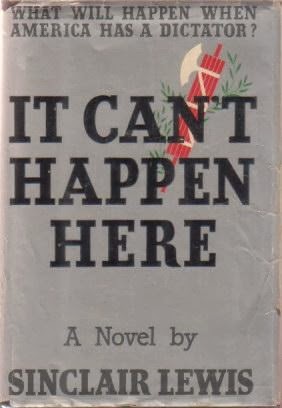
Book Review: It Can't Happen Here (1935)


Sinclair Lewis (1885 – 1951) was the first American writer to win a Nobel Prize for Literature, and the novelist’s most famous work to this day is It Can’t Happen Here. This work of fiction describes, in terrifying detail, how America becomes a fascist dictatorship.

The novel is set during the election season of 1935 – 1936 -- approximately 80 years ago -- and focuses on a journalist named Doremus Jessup as he watches national events unfold in a surprising way.

Specifically, a Democratic candidate, Berzelius “Buzz” Windrip” secures the nomination for the presidency away from incumbent Commander-in-Chief FDR, and then defeats Republican candidate Walt Trowbridge in the general election to gain control of the nation in 1936. 

After Inauguration Day, folksy Buzz Windrip declares martial law, relegates the Supreme Court and Congress to advisory status, and unlooses his armed “Minute Men” militia -- originally an “innocent” marching club -- upon the country.

American citizens who protest this turn of events are sent to labor camps while Windrip systematically scapegoats Jews, blacks, and women for the nation’s troubles. 

Soon, President Windrip and his PR advisor/deputy/minister-of-propaganda Lee Sarason abolish the names of the states, and partition America into administrative provinces for easier management. The Republican and Democratic Parties are outlawed, and one party replaces them: The American Corporate State and Patriotic Party. 

Leading members of this party become known as “Corpos.”

Watching America succumb quickly to fascism, Doremus joins up with the N.U (New Underground), which helps beleaguered American citizens escape to Canada.

In the end, the tyrant Windrip is run out of office, but Sarason first, and then another dictator follow in his footsteps.

At the end of the novel, America is still not a free country, and the ruling party wages war on Mexico as a distraction from the internal strife. 

After an apparent false-flag operation, the Party recruits a million American men to fight in the war on the border…


The Dictator: Buzz Windrip

A good starting place in any discussion of this Sinclair Lewis novel is the title.

“It Can’t Happen Here” is the resounding belief and refrain of many Americans in the book, who just don’t believe something as European -- and therefore alien -- as fascism can take hold in the United States.

It’s easy to see why, in the 1930s, Americans would have said “it can’t happen here.”

They watched as Mussolini and Hitler rose in distant lands, but because of language and cultural differences, simply couldn’t see such men assuming power in Washington D.C. 

One of the key conceits of It Can’t Happen Here is that American fascism -- while still fascism -- will be cloaked in different trappings. If it rises here, according to Lewis, it will do so draped in militant Christianity and fronted by a candidate boasting a “folksy," tell-it-like-it-is manner.

The dictator in the book, Buzz Windrip, for instance, likes to claim his birth-date is December 25, the day celebrating Christ’s birth.  He tells stories about himself that make him sound like a winner, like someone amazing.

In addition to his (false) proclamations about his pious religious nature, Windrup relies on homespun wisdom and colloquial speech to meaningfully connect with the “masses” suffering in the Great Depression. 

In other words, he's a populist.

I try to make my speech as simple and direct as those of the Child Jesus talking to the Doctors in the Temples,” he declares at one point, again comparing himself directly to Christ.

Windrip’s appearance and attire are similarly deceptive in their home-spun nature.

The politician is known, for example to wear a “ten gallon hat” -- meaning a cowboy hat -- and he flaunts his ignorance and bad academic grades. 

Windrip likes to tell people the story of how a teacher once called him “the thickest-headed dunce in school.”

In short, this fictional fascist dictator evidences what Sinclair describes as an “earthy, American sense of humor.” 

At one point, the author even compares Windrip’s style to Mark Twain. In this fashion, the reader sees how homegrown fascism would look very different in America, from the model across the world.

Windrip’s characteristics purposefully align him with the less-educated “common men” who support him. Like them, he has a disregard for learning and flaunts a no-nothing attitude.

For instance, Windrip decries diplomacy, calling it “talky-talk” and notes that America is only “wasting our time at Geneva.” 

When he complains and bullies the press, he refers to journalists as “wishily-washily liberal.

The new President of It Can’t Happen Here also derides so-called elites in other ways. 

He dislikes “haughty megapolises” such as New York and Washington D.C., and to assure that the intelligentsia doesn’t get out of hand he even re-writes college curricula to be “entirely practical and modern, free of all snobbish tradition.”

Lewis describes the America dictator, in fact, as a “professional common man,” one who speaks so that all other “commoners would understand his every purpose, which was exactly the same as their own.” 

And when he seeks power, accordingly, Windrip does so for his brothers, not for himself…or so he claims

I do want power – great, big imperial power – but not for myself, for you!” He declares. His promise? To somehow recreate the past, a time when the people who are suffering now were doing great.

His Policies

Windrip assumes control of the White House in 1937 according to It Can’t Happen Here, and establishes fifteen policy goals.

Among these policies is the creation of a Central Bank -- to be administrated by a Board appointed directly by the President. 

Also, Windrip seeks the establishment of a commission to determine which labor unions are “qualified” to represent workers… again answerable to the President. 

Both these policies are crucial ones vis-à-vis fascism: the centralization of authority or power in one person.

Very significantly, Windrip’s platform demands the absolute freedom of religious worship, and a maximum wage. 

It is this latter promise that the wages of millionaires will be capped and that veterans will receive a stipend -- wealth distribution, essentially -- that carries Windrip to the Oval Office in Lewis’s text.

Furthermore, Windrip’s platform targets certain demographics. 

Women, for instance, may work as nurses or in other “feminine” settings such as “beauty parlors,” but otherwise must return to the home to raise children. Typically, women are not valued in a fascist state, except as they can give birth to loyal and strong soldiers.

African-Americans, meanwhile, are to be prohibited from “voting, holding public office, practicing law, medicine, or teaching any class above the grade of grammar school.”  Windrip's supporters seek a return to pre-Civil War society, before the Emancipation Proclamation freed the slaves.

Furthermore, all African-Americans are to be taxed 100% of all income in excess of 10,000 dollars per family, a year.  Here, we see that a fascist philosophy believes it is appropriate to limit the right to vote to certain groups of people, so as to hold on to power.

As mentioned above, absolute freedom of religious worship is protected in Windrip’s platform, but there’s an important caveat.

No atheist, Jew, or “believer in Black Magic” shall be able to hold office until first swearing allegiance to the New Testament.  

In other words, you have to be a Christian to enjoy absolute religious freedom in Windrip’s America.

If one wonders why Windrip’s agenda specifically targets women, blacks, and non-Christians, it is because, in Sinclair Lewis’s words, “every man is a king so long as he has someone to look down on.” 

Fascism thrives, we can discern, when there is an enemy to hate, and an “inferior” to lord it over. 

Furthermore, any socialist, communist or anarchist in Windrip's America is to be tried for high treason. The minimum penalty upon conviction is 20 years in a labor camp, and the maximum penalty is death by hanging, or whatever method the judge in the case happens to find convenient.

In terms of the other branches of government, Congress will serve only in an advisory capacity and The Supreme Court shall have “removed from its jurisdiction” the power to rule the president’s actions unconstitutional, according to Windrip’s plan.

Finally, Windrip’s agenda includes “consistently” enlarging the military of the United States until it shall equal “the martial strength of any other single country or empire in the world.”


Actions Once in Office

After Windrip takes the oath of office in It Can’t Happen Here, he establishes a new cabinet position: Secretary of Education and Public Relations. In other words, this is the propaganda division of the re-formed U.S. government.

Then “The Chief,” as Windrip is called, disbands Congress with his re-branded“Shock Troops of Freedom,” the Minute Men, whom he has ordered recognized as an “official auxiliary of the regular army.” 

The Minute Men are issued machine guns, rifles, bayonets and other weapons.

It is clear that Windrip and his PR Man, Sarason, also understand the value of imagery and symbols. 

The Minute Men wear white uniforms and their ubiquitous symbol is a five-pointed star, like the one on the American flag. Obviously, there's a corollary for the use of this symbol in history, vis-a-vis the Swastika.

In this new America, the unemployed are sent to labor camps and paid a dollar a day for their work.  Unfortunately, it costs them between 70 and 90 cents a day for their room and board in the camp…

This is the new reality of President Windrip’s America.

Lewis writes: “There was a certain discontentment among people who had once owned motorcars and bathrooms and eaten meat twice daily, at having to walk ten or twenty miles a day, bathe once a week, along with fifty others, in a long trough, get meat only twice a week…and sleep in bunks, a hundred in a room.” (page 188).


Historical Context

FDR is one real-life historical figure featured in It Can’t Happen Here. He loses in a primary his bid for a second term because he can’t end the Depression quickly enough for the taste of many suffering citizens. 

Instead, FDR starts a new party, the “Jeffersonian” Party, which represents “integrity and reason.”

However, this is the wrong approach for the time, according to Lewis because this particular election year is about an electorate hungering for “frisky emotions.”  The public is angry, and desires a leader to channel that anger.

What Lewis hints at, then, is that fascism is a philosophy that hinges on emotions such as anger and resentment, and which isn’t, ultimately, susceptible to reason.  

Once you understand that resentment and other emotions are key to fascism, it is clear that the logic, and even the former positions of the dictator are largely unimportant.  He is a strong-man, one whose rage, not reason, is responsible for his popularity.

In the text, one of Windrip’s key supporters is Bishop Prang, a character based on real-life radio personality Father Charles Coughlin (1891 – 1979). 

Coughlin was a fierce anti-communist, a position which led him to come perilously close to advocating for the policies of Hitler or Mussolini at some points.  Coughlin was also apparently, anti-Jew, a quality reflected in his comment: “When we get through with the Jews in America, they'll think the treatment they received in Germany was nothing.

“The Chief” -- Windrip himself -- is loosely based on Huey Long (1893 -1935), the Democratic governor of Louisiana from 1928 – 1932, and a U.S. Senator from 1932 - 1935.  In fact, Long had planned to challenge Roosevelt for the presidency in 1936, but was assassinated in 1935. 

His platform called “Share the Wealth” featured elements of Windrip’s “maximum wage” plank.

I suppose the big question about It Can’t Happen Here involves how the American people could possibly let a fascist government come to power. 

In the first case, there is denial among the regular folk (hence the title…).  Nobody takes the threat of the fascist candidate seriously until it is too late to stop his ascent.

Secondly, It Can’t Happen Here suggests that fascism comes to a nation when the people are suffering and poor, and looking to blame someone for their situation.  In such a context, a strong-man who promises quick remedy, and does so with apparent “common sense,” “earthy” humor, and religious piety is difficult to resist. 

One of the reasons that It Can’t Happen Here is so abundantly worth reading today is that the issues it addresses have not disappeared. In fact, the book is scarily prophetic.

It Can’t Happen Here is a cautionary tale about what a lack of vigilance could bring to America if the so-called "poorly educated" get very angry, and tempers run irrationally hot; if experience and wisdom are no longer valued by voters and a strong man -- an authoritarian -- is sought.

For eighty years, Lewis's story has remained a cautionary tale, a fantasy. If we are vigilant, careful and informed, we have nothing to worry about.

Long may that be the case.

Friday, August 30, 2013

Book Review: Un-Dead TV: The Ultimate Guide to Vampire Television


Un-Dead TV is a five-hundred page+ reference book by Brad Middleton that focuses on the vampire's many appearances throughout television history.  

The book's sub-title -- "The Ultimate Guide to Vampire Television" -- is actually, in this case, truth in advertising. Un-Dead TV is a treasure-trove of useful information on its subject matter, and author Middleton has gone the extra mile (or fifty extra miles...) in terms of tracking down obscure TV series and providing relevant and important data about specific episodes.

Un-Dead TV consists of eleven chapters plus a whopping seven appendices, and each chapter includes a self-contained, vampire-oriented topic.  

For instance, the first chapter is dedicated to the vampire as the "monsters of the week," while the second chapter deals exclusively with entire series devoted to vampires (like say, Forever Knight, The Vampire Diaries or True Blood). 

Other chapters include information on TV movies-of-the-week, animated productions, documentaries (and reality-TV), and even programs currently in development.  One appendix even deals with vampire appearance on web programming!

But the book's glory -- as is often the case in terms of reference books -- is not merely the impressive breadth of coverage, but rather the well-considered organizational structure of the material.  Every section of the book features series titles listed alphabetically.  Then within each title entry, the author awards "bats" (instead of stars) on a 1 to 4 scale, and features credits, synopses, and commentaries on each production.  

But this means that if you remember an episode of Alfred Hitchcock Presents featuring a vampire you just go to the "monster of the week" chapter, scan for the title alphabetically, and find your title lickety-split.  And again, Middleton is an authentic completist here.  It's easy to remember a vampire episode on a horror-themed program like The X-Files or Rod Serling's Night Gallery, for instance, but how about remembering a vampire-centric episode of Bigfoot and Wildboy (1979)?

Also, Middleton leaves no stone un-turned, and has tagged vampire programming on non-genre shows such as Crossing Jordan and Diagnosis: Murder.  By doing so, he paints a broad picture of vampire television, and reveals the full breadth of the monster's influence on the format.

As a writer of reference books myself, I appreciate Middleton's obsessive attention-to-detail, and his willingness to track down the hard-to-find stuff: the programming that's well off the more-commonly traveled paths. I mean, who remembers that Little Gruesome -- a character in  Hanna-Barbera's Wacky Races -- was a vampire?  Part of being a good reference book author (and I'm still learning this facet of the job...) is being an intuitive detective, and guessing "where to look" for your subject matter.  

Accordingly, I wholeheartedly recommend this book if you enjoy reading about vampires on television, or if you are an author writing about those subjects.  Un-Dead TV is an invaluable resource, and one that will find prized real estate on my office shelf.

Thursday, December 13, 2012

A Matter of Time: The Unauthorized Back to the Future Lexicon


A good historian is someone who is curious, methodical, and can bring order to chaos. 

A good historian is someone who is meticulous to the point of being obsessive about the details. 

And a good historian can tie things together in a way that surprises, enlightens, and educates his or her readers.

Author Rich Handley (From Aldo to Zira: Lexicon of the Planet of the Apes, Timeline of the Planet of the Apes) is a very good historian indeed. 

His latest book, A Matter of Time: The Unofficial Back to the Future Lexicon is ample evidence of this fact.  It’s a 339-page text that leaves no factoid unturned in its exploration of the Back to the Future film trilogy and all its spin-offs.  And like the movies this encyclopedia explores so assiduously, the book is also a hell of a lot of fun.

Handley writes in his introduction that his new text is “designed for anal-retentive, die-hard fans, as well as those who simply enjoy the movies.”  However, I think he’s soft-peddling the obsessive nature of the book there. The abbreviation key alone provides nearly four dozen sources of information on the Back-to-the-Future-verse, from interviews with the writers to music videos, to “photographs hanging in the Doc Brown’s Chicken restaurant at Universal Studios.”

You want complete?  Hello, McFly!  This encyclopedia is complete.  There are (exhaustive) entries on every detail in the mythos from the bicycle shop seen in Courthouse Square (in 1955) to the von Braun family album. The book incorporates facts from an animated series, video games, amusement park rides and more…half of which, I must confess, I didn’t even know existed.

I can’t claim that my passion with Back to the Future runs as nearly deep as my passion for Planet of the Apes, but I am unhealthy obsessed, no doubt, with Back to the Future Part II (1989).  It’s actually my favorite film in the cycle -- kind of a Back to the Future Unbound -- and in my opinion it’s a seriously underrated and technically accomplished film.  I liked the original 1985 movie just fine, but it played, in some sense, on romantic nostalgia for a decade/time period I never lived through.  Back to the Future Part II travels to the past, the future, and even “inside” the events of the first movie.  It’s a crazy brilliant film that moves at a breakneck pace.

Reading through A Matter of Time, I really wanted to watch Back to the Future Part II again, and perhaps review it here on the blog.  Handley’s text reminded me of that film’s sense of joy…and utter madness. It left me feeling "Fired Up," to refer to a 2015 Marty McFly and the Pinheads compilation album (addressed in the book on page 93).

If Rich Handley keeps writing books of this depth and detail every year, I have no doubt his hair will soon go as stark white as Doc Brown’s.

Occupational hazard for madmen historians, I suppose…

Saturday, December 18, 2010

Book Review: Horror Noir

In 2008, I had the pleasure of receiving a review copy of Tech-Noir: The Fusion of Science Fiction and Film Noir by Paul Meehan. 

That highly-detailed film reference book utterly captivated me, and was a creative, thoughtful and thorough examination of the ties binding the film noir to the science fiction genre since the origination of film as an art form.

I've read and re-read Meehan's Tech-Noir ever since -- especially because I have hopes of crafting a Tech-Noir web or film production one of these days (named "Goblin Market")  -- and so I looked forward with great anticipation to the author's follow-up sister text, Horror Noir: Where Cinema's Dark Sisters Meet.

In short, this 2010 film book from McFarland doesn't disappoint. 

Meehan returns to his film studies with a well-written monograph on the "juncture of criminality and monstrosity" in cinema, the crossroads where horror and film noir  intersect.

In his introduction, Meehan rightly notes that, in large part, film noir and the horror film share a "realm of cinematic style," meaning, as he enumerates them: low-key ratio-lighting, absence of fill-light, wide-angle lens use in close-ups to distort faces, etc. 

Meehan also points out the deployment in both genres of "anti-traditional narrative techniques," meaning flashbacks and voice-over narration specifically. This chapter nicely sets the parameters of the ensuing survey, allowing the reader to understand which productions exist in the unique "space" of the horror noir, and why so.

Following the introduction, Meehan provides a nifty and pithy distinction between supernatural and psychological horror, and then launches right into the macabre meat of the book: a decade-by-decade survey of films he highlights as belonging to this union of genres; to this so-called "horror noir." 

The author begins the study in the 1930s with films such as Dr. X (1932) and Freaks (1932) and then moves into the 1940s with examples such as Nightmare Alley (1947) and Night has a Thousand Eyes (1948). 

The chapter-by-chapter scan of the decades brings readers right up to the present with discussions of recent films such as The X-Files: I Want to Believe (2008). That often-derided (but I think genius...) Chris Carter film is actually the epitome of horror noir, particularly in its emphasis on the film noir theme of "black medicine," (think Eyes without a Face, as Meehan trenchantly points out...).  

I must confess, this was not an angle of the Carter film I had really considered thoroughly, and which makes an I Want to Believe re-watch absolutely necessary.  On a side-note, I deeply respect and admire film books that achieve this goal; they make me want to go back and see a film again, with new information critical to a different interpretation of it.  In the course of the book, Meehan achieves this threshold over and over, bringing a new and valid viewpoint to films you have enjoyed in the past, but perhaps on a different basis.

In between the decade survey chapters, Meehan takes the reader down some fascinating side alleys too, into "Monster Noir," "Hitchcock's Psychological Ghosts and Dopplegangers," "The Noir Horrors of Hannibal the Cannibal" and my personal favorite, "Mean Streets of Hell," the chapter that discusses Exorcist III (1990), Jacob's Ladder (1990), Se7en (1995), Lord of Illusion (1995) and Scorses's Shutter Island (2010).  All of these films endlessly fascinate me -- even if some don't quite work -- and it was illuminating to read about them under this new, organizing rubric of horror noir.

As a writer of reference books myself, I am sensitive to reviews that note how I reviewed 300 films reaaly well, but forgot one.  I mean...nobody's perfect, you know?  Gee whiz!   I don't want to be a book reviewer who can't see the forest through the trees like that.  

However,  -- that caveat established -- I must point out that Horror Noir does not mention or review the film I consider to be the greatest horror noir of the 1990s, and one made by the film noir's greatest modern director, Roman Polanski. 

I'm talking about 1999's The Ninth Gate, starring Johnny Depp.  That work of supreme intelligence and depth co-opts the highest quality of the film noir (the outward "investigation" leading to an inner discovery about the nature of self) to imply a world beyond our mortal perception; a world of authentic evil.  The Polanski film also features a great, infinitely ambiguous ending which was perfect for the Y2K times in which the film was crafted.

Beside that gap in the discourse, however, Meehan ably and intelligently surveys over 110 horror noirs (from Alias Nick Beal [1949] to The X-Files I Want to Believe [2008]) here.  And to his credit, does a fantastic job discussing and analyzing Polanksi's famous Rosemary's Baby (1968) and the noir elements it co-opts so successfully.

Meehan ends his nearly-three-hundred page film survey with the thought that film's evil twins -- horror and noir -- will take new shapes in the years and decades to come.  If so, I hope Meehan will continue to document these evolutions and revolutions, and perhaps even tackle another intriguing subject he mentions tangentially in the text: Western Noir.

Paul Meehan's Horror Noir: Where Cinema's Dark Sisters Meet  is now available at Amazon.com and also through the publisher, McFarland, here.  I can recommend the latest Meehan book without reservation, and also suggest you pick up a copy of Meehan's groundbreaking Tech Noir.

Tuesday, December 22, 2009

BOOK REVIEW: The Christmas TV Companion (2009)


So, for a while now I'd been contemplating a blog post here about all the sci-fi and horror television episodes over the years that involve the holiday and holiday season. Then I received in the mail a fun book on that very topic entitled The Christmas TV Companion: A Guide to Cult Classics, Strange Specials and Outrageous Oddities by Joanna Wilson. I realized that someone else had already done all the hard work, so why re-invent the wheel?

Available from 1701 Press, The Christmas TV Companion is a dedicated survey of Christmas TV specials and episodes across the decades, and the book features chapters on both Christmas horror ("Have Yourself an Eerie Little Christmas") and Christmas sci-fi ("Christmas Stars and Men From Mars").

In the horror section, author Wilson digs pretty deep, remembering a 1949 made-for-TV production hosted by the late, great Vincent Price, Charles Dickens' The Christmas Carol. She also discusses one of my all-time favorite Night Gallery installments, "Silent Snow, Secret Snow," and remembers prominent X-Files ("How the Ghosts Stole Christmas") and Buffy the Vampire Slayer ("Amends") episodes. My only disappointment here: no mention of the outstanding (and really, really emotional...) Millennium Christmas episode: "Midnight of the Century." On the plus side, Wilson does feature some words on another Millennium holiday segment, "Omerta."

In the science fiction category, Wilson starts with the most notorious production of the lot: The Star Wars Holiday Special of 1978, set on the planet Kashyyk. Wilson is commendably even-handed and balanced in her criticism of this George Lucas show. She notes that it was our first introduction to Boba Fett, for instance, even if the low quality of the show was "a disappointing shock." In the rest of this chapter, the author remembers ALF ("Oh Tannerbaum!"), Mork and Mindy ("Mork's First Christmas") and Doctor Who's 2005 "The Christmas Invasion."

Additional chapters gaze at Variety Shows and animation (including South Park...), and there's even a chapter on "dark" Christmas specials. Here, Wilson discusses Peace on Earth (1939), a "stunning antiwar MGM Cartoon in technicolor" from animator Hugh Harmon.

A fun and fast read, The Christmas TV Companion is a good recap of Christmas television over the years. It's clear the author boasts a real passion for the topic, and has researched it thoroughly. The book brings up some great (and some terrible...) holiday-themed TV memories. After reading it -- or just flipping through - you'll want to make a beeline to your VHS collection (or DVDs...) to catch the holiday mood with Frank Black, Angel, Mulder and Scully, Alfred Hitchcock, or even the cast of Supernatural. This author is currently working on a Christmas-themed TV/film encyclopedia, and the Christmas TV Companion just whet my appetite...

Sunday, November 15, 2009

BOOK REVIEW: Cinema of the Psychic Realm: A Critical Survey


I have already read and admired two books on film from author and scholar Paul Meehan: Saucer Movies (Scarecrow Press, 1998) and Tech-Noir: The Fusion of Science Fiction and Film Noir (McFarland 2008). Tech-Noir, in particular, is one of the best film books I've encountered in the last several years.

Not long ago, I received a review copy of Meehan's latest effort from McFarland, 2009's Cinema of the Psychic Realm: A Critical Survey. Essentially, it's a guided tour across a century of productions that feature ESP, telekinesis, clairvoyance, and the like.

The book's first chapter, "A Brief History of the Paranormal in Fact and Fiction" sets the stage for the study, escorting readers from the Age of Antiquity (the Oracle at Delphi, "Psi in the Bible") to the Age of Aquarius. Meehan also includes crisp discussions of notable works of fiction that feature psychic themes, including Odd John (1935), Slan (1946) Theodore Sturgeon's More Than Human (1953), and Bester's The Demolished Man (1953).

The author's descriptions of these literary works proves illuminating because -- at least to a certain extent -- much of the modern Hollywood viewpoint on psychic power seems derived from one or all of them. This inaugural chapter ends with Meehan's notation that the paranormal's "shadow world of visions, mind-reading and prophecy would find its most popular expression in the medium of film."

In the following seven chapters, Meehan leaves no stone-unturned pursuing this thesis, excavating the fusion of the psychic world with art form of the film. He ponders silent films in Chapter Two "Early Paranormal Films," and "ESP in Drama, Comedy and Children's Films" in Chapter 3. He looks at the role of ESP in "Paranormal Crime and Melodrama" in Chapter Four. In the last half of the book, the author veers towards what is traditionally regarded as "genre" films, with a careful, thorough view of "The dark side of ESP," "Alien ESP," and even "Science Fiction Blockbusters."

I often tell anyone who will listen that the secret to penning a good reference book about film is not choice of topic; but organization of topic. Meehan understands this, and accordingly uses his premise to make connections that are inventive and rewarding. For instance, Star Wars (1977) and the franchise sequels/prequels have been reviewed approximately a million times in film books over the years, but Meehan thoroughly re-contextualizes the George Lucas film cycle in terms of the depiction of the psychic; in terms of the mystical "Force" that powers both the Jedi Knights and the Sith Lords.

Meehan notes the 1977 film's unexposed core theme: "the conflict between the intuitive, preternatural realm of the Force and the futuristic universe of technology and machines." Continuing, he writes "Darth Vader's seemingly counter-intuitive contention that the "technological terror" and overwhelming military might represented by the Death Star is vulnerable to the mystical workings of the Force proves to be correct." (page 145).

The same discussion notes how the Jedi represent an "atavistic return to the ancient shamanic traditions" of the past whereas Vader represents the "co-opting of these shamanic traditions by the machine world, his human identity having been subsumed" by mechanical life-extension techniques and devices. Another worthwhile insight about the Star Wars films arrives on page 161, where Meehan notes the Jedi Order's "hyper-masculinity," and how it takes over "what are traditionally thought of as aspects of feminine mysticism and magic" (a reliance on feelings and intuition, for instance...)

As you can detect by this example, the application of Meehan's organizing umbrella of the "psychic realm" provides new and interesting readings of many films you've watched a dozen times. And that's a great service, because the author makes you want to watch these movies all over again. In Cinema of the Psychic Realm, you'll find persuasive discussions about Minority Report, Dune and other films you've loved over the years.

If Cinema of The Psychic Realm exhibits any drawback worth noting it's that you want this compelling book to be...longer. The discussion is limited mostly to film, and you want Meehan to occasionally break-out to ancillary productions so he can keep making this valuable connections about the psychic realm. For instance, there's a valid argument to be made that psychic powers have found their most powerful expression not in film at all, but in film's cousin: television. From One Step Beyond (1959-1961) -- an anthology devoted entirely to the paranormal -- to programs such as Beyond Reality, Millennium, The X-Files, Medium, Ghost Whisperer, and Fringe, TV has become the dominant domain of the psychic realm on a near-weekly basis for the last two decades or so.

Of course, this book's topic -- as it states right there in the title for all to see -- is Cinema, not TV, so Meehan can't be faulted. Yet it would certainly be rewarding to see Meehan tackle Television of the Psychic Realm next; a necessary book-end to his thorough and valuable survey of the psychic in film.

Paul Meehan's Cinema of the Psychic Realm: A Critical Survey is currently available for purchase from McFarland here, and it's a book I can recommend to readers of this blog without reservation. And while you're at the McFarland site, pick up a copy of Tech-Noir too...

Saturday, June 06, 2009

From The Vanishing Hitchhiker to the Killer in the Back Seat: A Brief Survey of Urban Legends in Film and TV

I feel extremely fortunate in the fact that I was blessed with a happy and secure childhood. Yet despite my suburban cocoon of safety and contentment, I do recall -- sometimes only hazily -- that the outer fringes of my universe in the 1970s seemed populated by bizarre and inexplicable stories.

As a child, I didn't understand where these odd tales originated, but they circulated in and out of my buttoned-up world in hushed whispers and muted warnings, and they made me wonder about the nature of life beyond the borders of Glen Ridge, my affluent home town.

There were spider-eggs in Bubble Yum, you see...

And Little Mikey -- that freckled, friendly kid from the Life Cereal commercial ("He likes it! Mikey likes it!") -- died horribly when he drank soda and ate Pop Rocks at the same time.

Allegedly, his stomach exploded from the excessive carbonation...

Even as I grew older and more discerning, additional strange stories seemed to seep into the corners of my formerly inviolable daily life, suffusing the outer limits of my existence with a free-floating sense of mystery, irrationality and the unknown. And those "new" legends were even more bizarre than the two listed above.

To wit: a certain popular male movie star of the 1980s had appeared at the emergency room late one night with a, um..."colo-rectal" intruder.

And did you hear about the two teenagers who got...stuck...while having sexual intercourse? They had to be pried apart by rescue workers using heavy machinery...

These are America's urban legends, and for whatever reason, my safe, comfortable, upper middle-class town in the late 1970s-and-early-1980s seemed like a hot-bed for many of the most notorious ones. A breeding ground, actually, because we even had specific urban legends on my very street (Clinton Road); ones that didn't proliferate widely like the well-known examples, but that were just as potent and affecting to my impressionable young mind.

If you peeled the same scab off three times, your skin wouldn't grow back.

Oh, and there was a haunted house on the hill leading down to the Magic Fountain Ice Cream Parlor (near Bloomfield Avenue), and you had to hold your breath when you walked by it...or the house would steal it.

I bring up these stories -- and these odd, half-memories -- because, in the last few weeks, I've had the pleasure of reading two meticulous, scholarly resources on the sources, transmission, and nature of such urban legends; both penned by the amazing, acknowledged pioneer in the field: Professor Jan Harold Brunvand. These books are: 1981's The Vanishing Hitchhiker: American Urban Legends and Their Meanings, and the exhaustive follow-up, 2001's Encyclopedia of Urban Legends.

Brunvand's life work is the collection, researching, tracking down, and explanation (with occasional debunking...) of America's urban legends. The resourceful author isn't merely a dogged investigator, he's a skilled communicator and storyteller, and his rigorous, academic books actually make damn fine cover-to-cover reads too. In fact, I couldn't put them down.

As our informative guide into the shadowy realm of contemporary myth, Brunvand explains that urban legends are those "bizarre, whimsical, 99 percent apocryphal yet believable stories "that are too good to be true." They are too odd, too coincidental, and too neatly plotted to be accepted as literal truth in every place they are told." (Encyclopedia of Urban Legends, Norton, "Introduction," 2001, xxiii).

Brunvand furthermore reports that urban legends are folk narratives involving both the recent past and normal human beings (rather than ancient epochs, and characters like kings and knights...).

He also states that urban legends "gain credibility from specific details of time and place or from references to source authorities." (The Vanishing Hitchhiker, Norton, 1981 page 3). This means, essentially, that urban legends are transmitted from a friend of a friend...right to you. Somehow, we tend to believe that the transmitted tale is only removed from us (and our normal lives...) by one, measly degree of separation. And often, police or other "officials" (like fire-men or hospital workers) are dragged into the bizarre stories so as to lend them further verisimilitude and a veneer of authenticity.

So far as general theme and purposes go, urban legends appear to concern, primarily, the terrain of subconscious fears. Fears of "foreigners" and their customs (the Chinese restaurant, for instance, seems to be a hot zone for urban legends...); fears of marital infidelity ("The Cement Cadillac" story), and even fear of women. Urban legends also reflect fears of embarrassment/humiliation ("The Surprise Party"); fears of big, impersonal corporations ("The Spider-eggs in the Bubble Yum"/"the Rat in the Coke Bottle"); fear of sexual perversity ("The Colo-Rectal Rat/Gerbil"); even fear of technology ("The Cat/Baby in the Microwave").

In short, all the common anxieties of modern life and in particular "progress," seem to have at least one urban legend attached to them.

In his comprehensive Encyclopedia of Urban Legends, Brunvand discusses briefly the relationship between urban legends and mass media (film and TV), focusing the conversation in particular on the 1998 slasher film Urban Legend, and a few other productions (notably Candyman ([1992] and When a Stranger Calls [1979]). These references fascinated me, and I began to weigh some of the myriad connections between the horror genre and urban legends.

If You See Sally: One Step Beyond's Ghost in the Road
In the spirit (hopefully...) of Brunvand's work, I've decided to survey here some further examples of filmed urban legends. For instance, the great paranormal anthology hosted by John Newland, One Step Beyond (1959-1961), leapt head-first into the long-lived, much-told and constantly-evolving urban legend of the "Vanishing Hitchhiker" with the classic episode "If You See Sally."

That third-season installment (directed by Newland and written by Howard Rodman and Roberta Martin) aired in prime time on October 18, 1960, and concerned a lonely, sleepy night driver who picked up winsome Sally Ellis (Anne Whitfield) -- a grieving, tragic figure trying to find her way home -- only to learn that she had actually died years earlier. He had been sharing his front seat with a ghost...

This story of a phantom hitchhiker proved so powerful -- and so resonant -- that the makers of One Step Beyond received a whopping forty-five letters from viewers in which those audience-members described their own similar experiences. "In one variation," a letter described, the tired driver gives the young hitchhiker his sweater because she was cold. "When he is told that the child is dead...he immediately asks what happened to his sweater. The garment is retrieved on the headstone of the child's grave..." (Gary Gerani, Fantastic Television, Harmony Books, 1977, page 29).

The common urban legend of the "Vanishing Hitchhiker" likely goes all the way back to early America, and the age of horse-drawn carriages. The legend is considered by some academics a "rare hallucinatory event," one that "lingers in our collective imagination from a time when man first drove horse and chariots. Late at night, exhausted and alone on a dark road, the vulnerable driver may summon the ancient hitchhiker from his unconscious." (Remy Chauvin. Parapsychology - When the Irrational Rejoins Science, translated by Katharine M. Banham, McFarland, 1985, page 71).

One Step Beyond was not alone in depicting the story of the "Vanishing Hitchhiker," though "If You See Sally" is the most accurate and faithful filmed interpretation of this urban legend. Angelic/demonic hitchhikers have also sprung up on The Twilight Zone ("The Hitchhiker"). And one ghostly hitchhiker even hosted his self-named anthology series, HBO's The Hitchhiker. What seems most potently expressed by the story of the Vanishing Hitchhiker is the fear that -- alone on a dark stretch of road -- your trajectory crosses with that of the supernatural; that alone in your vehicle (with no recourse and no help...), you somehow pierce the invisible world of the supernatural and interact with it.

Over the years, this urban legend has continued to develop in unique ways. The ghostly hitchhiker -- eternally wandering the back roads of purgatory -- has morphed, in many such stories, into a "well-dressed" prophecy man: one warning of impending disasters, both natural and man-made.

Check The Children: The Baby-sitter and the Man Upstairs

The 1979 film, When a Stranger Calls, directed by Fred Walton, dramatizes the harrowing story of a teenage babysitter, Jill (Carol Kane). She is harassed on the job (and late at night to boot...) by unsettling phone calls. Alone in the dark house of her employer, Dr. Mandrakis, she becomes increasingly terrified as the calls grow more explicit...and more threatening.

More accurately described, this element of the narrative is the subject of the film's fifteen minute preamble, an almost perfect, text-book cinematic visualization of isolation, fear of the dark, and escalating terror.

In this taut sequence, Walton's camera often adopts the perspective of the long-shot angle and thus establishes Jill's location, but also the emptiness and quiet all around her. These moments are interspersed with "jolts" on the soundtrack that remind us how Jill is unfamiliar with her surroundings. The refrigerator ice-maker suddenly kicks in, for instance, with a loud ca-chunk, and the audience feels startled along with Jill. Walton also cuts to various insert shots of seemingly-innocuous house decorations (lamps, phones, the chain-lock on the front door, the fireplace, a ticking clock...) not only to establish the terrain of the incident, but to interrupt the cinematic flow of space/time.

Instead of a long, immaculate master shots -- suggestive of continuity and fluidity - these dramatic close-ups start to jangle our nerves in a manner reminiscent of the jarring and sudden (and frequent) ringing of the telephone. The insert shots come quicker and quicker as the menacing phone calls repeat, and Jill seems to wander increasingly into dark, unlit corners of the house..

We know, of course, the punch-line. The menacing caller is already inside the house, upstairs (where he has brutally murdered the Mandrakis children.) The killer was actually calling downstairs on a second phone line!

In his texts, Brunvand explains that stories like "The Baby-Sitter and The Man Upstairs" are designed as a warning to women; that the murder of the innocent children therein represents the young woman's "ultimate failure as a future home-maker and mother;" and that "the killer's positioning upstairs -- above the female sitter -- may signify the traditional dominant role of men in sexual and power relationships." (Encyclopedia of Urban Legends, page 29).

The urban legend inspiring When a Stranger Calls also boasts two other narrative components worth mentioning. First and foremost: a fear of modern technology subverted. The "convenience" of the household telephone becomes a gateway to terror and deceit; a trick that keeps the imperiled baby sitter tethered to the phone cord (and plugged in to the wall...) when she should be running like hell to escape.

And secondly, there's the notion here of an important "first job," a first responsibility egregiously failed. Young adulthood or adolescence is a span of extreme anxiety because it's the first time that a person engages with the outside world (beyond family and school...) in a way evoking, duty, responsibility and even monetary recompense. A failure the first time out on such an important endeavor is a very real fear for the young and diligent, and this urban legend exploits that fear...ruthlessly.

This latter explanation (a first responsibility failed...) may even explain one of the subconscious fears elicited in John Carpenter's Halloween (1978), another horror film involving a killer...and babysitters. Note that Linda and Annie are murdered by Michael Myers, and that they are the teenagers who forsake their "duties" (babysitting) for sexual interludes with boyfriends. Laurie Strode ultimately survives, perhaps, in part because she never lost sight of her responsibility (protecting her wards Tommy Doyle and Lindsey). It's not just that she's a virgin and then are promiscuous. It's that she takes her responsibilities and job seriously, and they don't.


Don't Flush Your Pets Down the Toilet: Alligators in New York's Sewers

There is a long-standing myth (repeated in an "urban legend" graduate class in Candyman in 1992...) that vacationers to sunny Florida returned to their New York City apartments with baby-alligators as pets.

Then, when the alligators grew too large (and inconvenient), the same pet-owners flushed the wee beasties down their toilets. Thus, -- as it became known around the world -- giant, hungry alligators dwell in New York's sewer system..

This myth was the impetus behind the humorous, Jaws-styled 1980 horror film Alligator, directed by Lewis Teague and starring the redoubtable Robert Forster.

In fact, the urban legend about alligators in the sewers was the very reason the director made the film in the first place. "The reason I said 'yes' to Alligator is that I always found the myth that there alligators in the sewers of New York amusing," he told me in an interview for Horror Films of the 1980s, "so I wanted to make an amusing film."

There are many "messages" that serve as the foundation of this strange urban legend, but primarily we see the theme of responsibility ignored. Pet owners take their "beloved" pets out of their natural environment and then treat them poorly -- and Mother Nature is scorned. Despite an attempt to get rid of the baby alligators, nature finds a way, to quote Jurassic Park (1993), and the alligators unexpectedly thrive in the new "technological" eco-system of the sewers.

Later in the 1980s, fear of radioactive fallout and contamination (no doubt-enhanced by well-attended anti-nuclear rallies across the States, productions like The Day After, and the escalating Cold War) led to a variation on the alligators in the sewer meme. The legend morphed into "radioactive waste" in the sewers, and that idea informed horror films like C.H.U.D. (1984) and Jason Takes Manhattan (1989). Here, the idea of irresponsibility was transferred from individual pet-owners to a bloated Federal Government.

Interestingly, as Brunvand points out in the Vanishing Hitchhiker (page 96), there is some basis in fact for the urban legend about alligators in the Big Apple's sewers. In his book, Brunvand reproduces a story, in fact, from The New York Times, dated February 10, 1935, entitled "Alligator Found in Uptown Sewer." Apparently, a group of youths found the offending beast in a manhole near East 123rd Street and the Harlem River. Yikes!

The Killer in the Back Seat; Or Smoking Can Be Hazardous to Your Health

The 1983 horror anthology Nightmares, directed by Joseph Sargent, also dwells explicitly in the terrain of urban legends. The first story in the film, "Terror in Topanga," depicts the misadventure of a harried, disorganized housewife, played by Cristina Raines. She runs out for cigarettes late one night. And even though an escaped mental patient and psycho-killer is loose in the nearby Topanga area, she needs her fix ("non-addicts cannot understand," she tells her irritated, baffled husband).

By herself, the housewife drives away in the family car, and nearly runs out of gas on her cigarette run. She stops at an isolated gas station (the only one that happens to still be open at such a late hour...) and is unexpectedly accosted there by a suspicious-looking attendant. The terrified housewife is unaware that the attendant is actually trying to protect her...and that the escaped mental patient is already in her back seat...waiting to strike.

"The Killer in the Back Seat" (and the narrative of "Terror in Topanga") seems an amalgamation of a few core ideas common to urban legends. Again, the lonely car ride becomes an opportunity for interface with something out of the ordinary (as in "The Vanishing Hitchhiker"). Again, as in "The Killer Upstairs," a female is isolated and alone (an aspect enhanced by the Nightmares filmmakers; here with the sounds of crickets and coyotes on the soundtrack during the late night excursion...). And again, a woman is tricked and arrives at the wrong conclusion (the mistaken identity of the killer).

Furthermore, this is a cautionary, anti-progressive tale in two ways. First, the female "caretaker" has failed in her "female" duties (having run out of groceries/supplies/cigarettes at an inopportune time). And secondly, her "need" for cigarettes (a dangerous vice...) imperils her life and well-being. Anti-smoking messages -- in which smoking was literally a fatal habit -- also appeared frequently in horror films of the 1980s, serving as the impetus for a tale in another anthology, Cat's Eye (1985).

Brunvand writes (on page 229 of The Encyclopedia of Urban Legends) that this "classic automobile horror legend" of the killer in the backseat was first reported in 1968 by Indiana University students. Given that specific derivation, one can't help but note that this legend arose shortly after the era of "cruising," a popular teenage activity of the early 1960s (and featured prominently in the George Lucas movie American Graffiti.) Given that teenagers engaging in this activity spent an inordinate amount of time in their cars (whether dining with window trays, attending drive-in movies, or just making out...), it's entirely logical that tales of horror would thus shift their primary locale from houses to automobiles.

The film Urban Legend (1998) repeated the "killer in the back seat" trope as its opening gambit, too.

Defrost, Cook or Explode? The Baby/Cat/Gremlin in the Microwave Oven

Since the 1950s and the so-called Age of Anxiety, Americans have embraced and integrated a remarkable number of technological advances into the very hearth and sanctuary of family life: the home.

Telephones, dishwashers, refrigerators, microwave ovens, computers, security/alarm systems, and more have come along and changed (and ostensibly improved...) the way we manage our lives.

It's only natural then, that each of these "advances" has been met with some form of push-back, resistance, and suspicion. And indeed, many urban legends concern an extreme paranoia regarding out-of-control or dangerous technology. We saw this dread manifested with the treacherous telephone in "The Baby-Sitter and the Killer Upstairs." Another trenchant example involves the microwave oven.

Again in this case, there seems to be a direct connection between women and urban legends: the backwards idea that women are abdicating their "kitchen" or "cooking" responsibilities by preparing meals with the "miraculous" and time-saving microwave oven.

And the fact that it is often a baby who ends up sizzled inside a microwave oven in urban legends represents another warning against progressive, non-traditional women: it's a failure of their responsibility as care-givers, since the child days. Amazing how many of these urban legends are often really about maintaining the status quo between men and women, isn't it?
The 1984 Joe Dante horror film, Gremlins, trades on a fear of technology (one evidenced as early as World War II). Here, malevolent little creatures gum up the works of a Norman Rockwell-style small town and wreak havoc. They cause automatic elevator chairs to become dangerous projectiles; they drive heavy construction vehicles into houses; they cause traffic accidents by changing traffic light signals willy-nilly. The gremlins are Loki (the spirit of mischief) personified...but always with an angle towards recognizing the hazards of modern technology. The victim is heartland America, and the American Dream.

In an interesting reversal of the "Baby/Cat in the Microwave Oven" urban legend, a dedicated Mom (Mrs. Peltzer) defeats the perils of technology (a malicious Mogwai) by harnessing another technology: the microwave oven. She gets the creature inside the device and broils him alive...in a memorably gory (and oddly PG-13...) sequence. Here, the Mother is decidedly the hero figure and the microwave is a weapon defending order, not a weapon of chaos and disorder. Thus Gremlins qualifies, perhaps, as an urban legend subverted or upturned.

The Man with the Hook meets Bloody Mary
Candyman (Tony Todd) -- a modern horror icon -- is actually a hybrid of two of the most notorious urban legends. The first such legend is the story of "The Hook" or the "Killer with A Hook."

This tale involves -- again -- an escaped and murderous mental patient who, for some arcane reason, boasts a hook for a hand. Cut to lover's lane, as two teenagers are passionately making out. It's coitus interruptus as they hear a warning on the radio to look out for the killer with a hook; that he is loose in the area.

The male teenager desires to ignore the warning, of course, but the girl is spooked and demands that they leave lover's lane immediately. Realizing he's not going to get laid on this night, the boy angrily drives the car away. It's not until he arrives at his girlfriend's house and opens the car door for his scared prospective partner that the boyfriend sees the strange metal hook stuck to a door handle. Brunvand sees the severed appendage -- a hook -- as a phallic symbol, a representation of the frustrated teen male's unsuccessful bid to get laid.

The story of "the killer with a hook" became the teaser sequence for a second season segment of Chris Carter's Millennium. That episode, "The Pest House" was written by Glen Morgan and James Wong and directed by Allen Coulter. It aired February 27th, 1998 (the same year, incidentally, the story appeared in Urban Legend). On Millennium, the entire "Hook" legend was lovingly re-staged, but with a new and gruesome ending: the amorous boyfriend (Brandan Fehr) ends up gutted and hanging upside down over the roof of his car...for his girlfriend to find.

The second urban legend recruited by the makers of Candyman is known, sometimes, as "Bloody Mary." In this legend, a group of teenage girls share a sleep-over and dare each other to say Mary's name five times aloud while gazing directly into a bathroom mirror. If they should do so, it is believed that Mary will leap out of the mirror and scratch the face of the summoner. As Brunvand describes it, "Bloody Mary" -- with a bathroom setting, with teenage girls as percipients, with blood-letting as a theme -- is a thinly-concealed parable about the onset of menses.

Candyman blends the idea of the Hook-Man Killer with the legend of Bloody Mary. Here, Candyman is summoned by a person calling out his name in the mirror five times. When Candyman appears, he doesn't scratch you...but rather cuts you "gullet to groin" with his sharp, rusty hook. In the original film, a graduate student (Virginia Madsen) crafting her thesis on the subject of urban legends uncovers the story of Candyman at the dangerous urban projects, called Cabrini Green. It's interesting to note that Candyman only continues to "exist" as a bogeyman so long as his story (the urban legend) is disseminated among followers (his "congregation.") Candyman seduces his victims with the promise that they -- like he -- will become immortal as new elements of his tale, of his oft-repeated myth. It's the Gospel of Candyman.

At the same time that Candyman depicts a hybrid of urban legends, it also comments on urban legends. At Cabrini Green, dangerous black gangs prey on innocent residents (also black Americans). The underlying message seems to be that rather than taking on black-on-black violence in such communities, it is easier and more convenient to create mythological/phony "boogeymen" who can be blamed for it. Instead of looking at the mirror, literally, and honestly facing problems within the community, it is simpler to look "outside" for an external monster.

As the title of this piece indicates, this post is but a brief survey of urban legends appearing on film and television. There are many other titles to explore. The CW series Supernatural crafted an episode about the "Bloody Mary" myth during its first season, for instance. Also, films like The Hitcher (1986) deal with other elements of popular urban legends, namely what Brunvand calls "The Dreadful Contamination" (for example, human fingers in a plate of french fries). Indeed, horror films and urban legends overlap to a remarkable degree. Both forms serve as cautionary tales, warnings, taboo-breakers, and modern myths. And the dedicated works of Professor Brunvand go a long way towards explaining why there is this connection, this symbiosis between horror and urban legends. Both "genres" know what scares us.

Which urban legends did you grow up with? And which ones stay with you to this day? Ever find any Bubble Yum with spider-eggs inside?

And by the way, Little Mikey is apparently alive and well...

CULT TV FLASHBACK: Dead of Night (1994-1997)

This year, Dead of Night: The Complete Series , was released on Blu-Ray by Vinegar Syndrome , and I just had the pleasure of falling into i...