Showing posts with label 2002. Show all posts

Friday, July 27, 2018

Memory Bank: Star Trek: Voyager: The Arcade Game (2002)


Imagine my delight and surprise, recently, when I was at a local bowling alley in Charlotte with my family, and strayed into a mini-arcade to find a deluxe cabinet version of this fifteen year old franchise game.  

Since the game was still playable, I knew I needed to snap some photos and feature them all here on the blog.

Star Trek: Voyager: The Arcade Game was released in 2002 (after the end of the actual TV series), by Monaco Entertainment and Team Play Inc. It's a first person shooter (FPS)-styled game, though re-modeled appropriately for Star Trek concepts.  The guns (presumably phasers) don't have to be reloaded but rather re-modulated instead (think: fighting the Borg.)


The enemies in the game hail straight from the series, but are not just the Collective, however, but also Species 8472, and the Hirogen.  There also some...imaginative new aliens.

Additionally, some game modules involve space combat with the Borg and feature the customized shuttle, the Delta Flyer. 


In short, if you are a fan of Voyager, this is a great game, in no small part because it recreates the settings (like Voyager's bridge) and characters (Borg, especially, down to their First Contact sphere) of the series.

I was glad to see this game still in service!

Thursday, August 11, 2016

The Films of 2002: Feardotcom


Feardotcom (2002) looks and sounds like a remake of a Japanese horror film that never was. This 40 million dollar horror film was released to terrible reviews in the dog days of summer 2002, months before the premiere of The Ring (2002), actually, and has never really seen its dreadful reputation rehabilitated.

The William Malone film’s antecedents or inspirations have been rightly tagged by horror scholars as Ringu (1998) -- the source material for The Ring -- and Kairo (2001), which was remade in America in 2006 as Pulse.

Like all these films, and indeed, their remakes, Feardotcom expresses two horror film tropes that were popular circa 1998 – 2008.  

The first involves technology. In many of these films, technology -- VCRs, cell-phones, or even Internet web sites -- house evil supernatural entities. Thus technology itself is a portal or gateway to evil.

Secondly, the horror films of this period eschew the American horror paradigm of the 1980s: vice precedes slice and dice, and propose a replacement aesthetic. 

In American slasher films of the Reagan Era, those who transgress by having pre-marital sex, or smoking weed, die horribly. But in the J-Horror and J-Horror Remake Epoch (again, circa 1998 – 2008), the crime or transgression has been altered drastically. 

The crime now is simply watching. This seems a comment, contextually, about the boom of 24 hour cable news stations in the 1990s, the affordability of camcorders, and the advent of the Internet.  Web sites, CNN, and cheap video cameras enabled audiences to “see” things from across the world, but respond to them as entertainment, not in a more human dimension. These movies all want top punish those who are but passive observers of human suffering.

Feardotcom is very much of this school, although it handles both modern tropes very poorly. The movie’s style is hyper and overwrought, which makes it, at times, actively unpleasant to behold (an unintentional comment, perhaps on CNN, Fox News, MSNBC…). 

But even beyond that deficit, Feardotcom never overcomes several plot holes and questions of motivation.


“Do you like to watch?”

Even as a fiendish serial killer -- a surgeon named Alistair Pratt (Stephen Rea) -- abducts his latest victim and plans to broadcast her torture and murder live on the Internet, metropolitan detective Mike Reilly (Stephen Dorff) investigates the strange death of Dr. Polidori (Udo Kier), author of the monograph, The Secret Soul of the Internet.  

Polidori’s corpse is found in a subway station, with bloody eyes.

Before long, more dead bodies are found, also having bled from the eyes and nose. At first, health inspector Terry Huston (Natascha McElhone) suspects a hemorrhagic fever, like Ebola. But then a strange clue emerges.

All the victims died exactly 48 hours after viewing a specific, and gruesome web site: Fear.com. 

A police investigator, Denise (Amelia Curtis) visits the site, and suffers the same terrible fate. Angry, Mike visits the site too, and appears to go crazy.

Looking deeper into the mystery, Terry views Fear.com and learns that it is a game site. The goal of the game is to find the site host, a beautiful woman, before 48 hours runs out. 

Terry investigates and finds that the woman on the site is actually long dead. Terry visits her mother and finds out that the girl, a hemophiliac, died at the hands of the serial killer, Pratt, but that her body was never recovered. 

Her name: Jeannine Richardson (Gesine Cukrowski)

Terry seeks out Jeannine's corpse, hoping to grant her spirit rest. 

Unfortunately, that spirit doesn’t want rest. She wants revenge.


“Play the game. Find me.”

Feardotcom makes it plain that those who watch, but do nothing to alter the events of the world are quite culpable for the atrocities of the world. 

When Terry texts with Jeannine, the host of the Feardot.com site -- a ghost or spirit, essentially -- she is told that she is “guilty.”  

Guilty “of what” Terry asks.

Watching,” the spirit replies.


This is the core ethos of the J-Horror film genre, transposed to Feardot.com. New technologies, such as the Internet offer not a place of connection or community, but rather voyeurism and sadism. 

For example, Pratt has a web site too, and is planning to kill his latest victim “live” on that murder site. A second season episode of Millennium (1996-1999) called “The Mikado” handled the same concept better in 1998, but it is clear that this concept is something the culture was grappling with at the turn of the century.  

If you give an “evil” web site your hits, or “clicks” are you responsible for that evil site as it grows more popular?  As a voyeur, are you taking part in the atrocities, or just passively “watching?”

I appreciate how Feardotcom explores this notion, and ties the crime of "watching" to a sickness or virus in the human eye. 

All those who visit the Fear.com web site develop Ebola-like symptoms, bleeding out of their tear ducts for watching the horror and not helping.  

At one point, Terry notes “We’re probably all infected,” meaning that with the ubiquity of 21st century mass media everybody is likely “contaminated" already.  The media is all-too easy to access.


The voyeuristic impulse is explored in the film through the site, which is a “live cam death site,” where one can find about “death…before it’s your turn.”

Fear.com thus promises its users a peek at how they will die, which it delivers. One character, Denise, dies surrounded by bugs, and at one point, the camera captures an insect literally crawling out of a desktop computer. That visual implies, simply and effectively, that the Internet is a place of pestilence and death.

I credit Feardotcom, too, with a sincere attempt to link the beginnings of the horror genre with the 21st century cyber-age. The name Polidori comes from Shelley, obviously, and the entire washed-out color palette of the film suggests German Expressionism to a high degree.


And yet, there is so much visual noise here -- lightning flashes, quick cuts, superimposition, distortion lenses, and cockeyed angles -- that the film grows increasingly unpleasant and jarring to watch. There’s too much of this noise here, and it detracts from the movie’s narrative and message.

Additionally, it seems that the screenplay could have been developed or honed a bit more to reduce implausibility.

For example, the dead girl/spirit, Jeannine -- who seeks revenge for her own murder -- was a hemophiliac. 

Female hemophiliacs are extremely rare, for one thing (uh...menstruation would be a factor right?). But more importantly, no responsible mother of a hemophiliac would permit her adolescent daughter to play in a rusty, broken down steel mill, as Jeannine's mother does. 

That is the location where the Jeannine is abducted by the serial killer, but it doesn’t really make sense that Jeanine would be allowed to go there. Why would the parent of a hemophiliac send a kid out at all, let alone to a pace with rusty metal and jagged corners?

Secondly, the movie goes to some lengths to establish that the Fear.com web site works in a specific manner. You log into the web-site, you watch, and you have 48 hours to find the body of the dead girl, or you die. That's the pattern.  That's the formula. There should be no deviation.

At the end of the film, the web-site is brought to the evil surgeon, and he watches it, thus becoming exposed. 

But it doesn’t take 48 hours to kill him. Instead, the ghost leaps out of the Internet and kills him then and there.  If this was Jeanine's intent all along, she should have just e-mailed herself as a virus to Pratt, and when he opened that virus up on his computer, she could kill him.  

Perhaps I should be more basic in my criticism. 

How does a spirit create a web site in the first place?

Character motivations in the film are not very sensible, either. It is established, early on, that if you log into the web site and play the game, you will die in exactly 2 days.  So when Denise dies, what does Mike do? 

He immediately logs on, thus marking himself for death.  

And then when Terry learns what Mike has done, what does she do?  

She immediately logs on too, starting the cycle for herself.  

We don’t see the characters hesitate or weigh the options, they just leap into decisive, and indeed, suicidal action.

The performances in Feardot.com are poorly calibrated too. Stephen Rea hams it up as the serial killer Pratt, and the great Natascha McElhone is oddly light and flirty with Mike Reilly right off the bat. This is just one more quirk that makes the film difficult to praise.  Feardotcom takes a good cast and misuses them, attempts a German Expressionist style, and makes your eyes bleed, and is nonsensical in its story of how “watching” makes one culpable.

The great value in Feardot.com is, without a doubt, historical. Here’s the film that beat The Ring to theaters, and tried to tell, essentially, the same story: of a female spirit bent not on resting in peace, but executing revenge from beyond the grave.

But in terms of specific, Feardot.com is not particularly scary, in part because of the lousy, headache inducing editing, and in part because the story and characters never hold our attention, despite the film’s use of a new, 21st century paradigm in horror storytelling.

Movie Trailer: Feardotcom (2002)

Friday, April 10, 2015

Friday Flashback: Solaris (2002)


“We take off into the cosmos, ready for anything: solitude, hardship, exhaustion, death. We're proud of ourselves. But when you think about it, our enthusiasm's a sham. We don't want other worlds; we want mirrors.

-       Solaris (2002).


It’s unusual that a contemporary Hollywood remake of 1970s Russian science-fiction film should succeed so dramatically on its own terms.  

Yet that’s precisely the case with Steven Soderbergh’s remake of Solaris (2002) starring George Clooney.  Although this remake diverges from both the Stanislaw Lem novel and the 1972 Tarkovsky film, the director’s post-millennial iteration of the tale nonetheless succeeds as a consistent and imaginative work of art.

This artistic success hinges in large part on Soderbergh’s splendid visualization of the story, and his creative decision to eschew the bells-and-whistles of the modern sci-fi cinema.  This is a film about the nature of the universe, and more trenchantly, how mankind views that nature and his place in it.  But it is vetted, surprisingly, through the excavation of a very human relationship.

Thus Solaris is resolutely not a film of action, or set-pieces, or special effects. There’s a significant segment of the population that, simply put, won’t exhibit much patience for it.  Writing for Rolling Stone, Peter Travers wrote: “Put George Clooney in a space-suit and you expect Star Wars heroics, aliens, massive FX. Get over it.” 

That’s excellent advice. 

Where most outer space films are determinedly “epic” in nature, Solaris appear painfully and resolutely intimate.  The film concerns, primarily, the concepts of grief, guilt, and God.  Furthermore, it is a meditation on human identity, and the ways that such identity precludes an honest reckoning with a life form that is authentically “alien” in nature.

Soderbergh’s Solaris -- as J. Hoberman noted at The Village Voice – “achieves an almost perfect balance of poetry and pulp. This is as elegant, moody, intelligent, sensuous, and sustained a studio movie as we are likely to see this season—and in its intrinsic nuttiness, perhaps the least compromised.”

The film qualifies as uncompromising because it doesn’t bow to commercial influences above artistic ones, and because Soderbergh deploys symbolic imagery and canny compositions to characterize both the protagonists’ lonely life on Earth and his once-in-a-lifetime opportunity to make, essentially, a “leap of faith.”

Thematically, Solaris can be interpreted on two tracks. 

On one track, the film is strictly a religious treatise, one affirming an important tenet of Christianity as set down by Paul in Romans.  It is about, simply, assurance of salvation. 

On a deeper and ultimately more rewarding level, Solaris functions admirably as a complex psychological mirror, one that reflects the lead character’s perhaps subconscious desire to believe in a cosmic order beyond secular science.

Accordingly, the film’s protagonist finds in the planet Solaris a sentient life form that accommodates and manifests his buried desire to “believe” in God and therefore in a religious hierarchy to the universe.  The planet’s manifestation of an eternal “after life” for this character in the film’s denouement makes one ask the question: is there any meaningful difference between “God” and a life form that acts as if it is God?  This interrogative parallels the movie’s other big question mark: is there any substantive difference between a human and a Solaris-generated “Visitor” who appears human?

No matter how one interprets it, Solaris (2002) qualifies as a masterpiece of the science fiction cinema, a very impressive achievement” and one that “measures up” to Tarkovsky’s brilliant cinematic progenitor.

We are in a situation that is beyond morality.”


In the near future, mourning widower and renowned psychologist Chris Kelvin (Clooney) is sent by the DBA Corporation to investigate a dangerous situation on Space Station Prometheus, a facility orbiting the mysterious world called Solaris. 

A video message from one of the scientists stationed on Prometheus, Gibarian (Ulrich Tukur) reveals that the crew is being overcome by…something.  Kelvin soon heads to the station in a capsule called Athena to arrange “the safe return of the crew.”

When Kelvin reaches Prometheus, he finds that Gibarian has committed suicide, Dr. Gordon (Viola Davis) has locked herself in her room, and Snow (Jeremy Davies) has apparently lost his mind.  After he sleeps for the first time on the station, Kelvin finally begins to understand the nature of the crisis.  His dead wife, Rheya (Natascha McElhone) appears in his quarters...apparently created from Solaris and from his very memories.

Kelvin learns that each of the other scientists also met important “Visitors” from their pasts.  At first he is terrified of Rheya and sends her away on a pod.  But when Rheya re-appears (following another period of slumber), Kelvin realizes that he boasts a “second chance” to be with his beloved wife.  All the guilt he feels over her suicide can now be repaired, he feels, and they can start again.

While Gordon masterminds a plan to obliterate the Visitors created by Solaris using an Anti-Higgs ray, Kelvin and Rheya grow closer.  Unfortunately, Rheya seems pre-programmed for suicide, a reflection of the true Rheya’s disturbed psyche…at least as Kelvin remembers it.

When the anti-Higgs ray affects Solaris…causing the planet to swell and grow in mass, Kelvin must make a fatal decision about his destiny. 

Should he return to an empty life on Earth? Or face absorption by Solaris, the seeming “entity” which brought (a version) of his wife back to him?  What awaits Chris in a symbiosis with the mysterious planet?

“Are we alive or dead?  We don’t have to think like that anymore…”


Unlike the source material created by Stanislaw Lem, the 2002 version of Solaris --- at least from a certain perspective -- offers something of a religious, Christian parable. 

The film tells the tale of a scientist -- Kelvin’s “nihilist psychologist,” as the dialogue terms him -- who takes a “leap of faith” and chooses “belief” rather than a return to the (lonely) reality he knows and deplores. Instead of going back to the “secular,” “real” Earth, Kelvin chooses to believe that there is another option: an eternal afterlife created by Solaris.

Kelvin’s favorite poem, quoted often in the film, is Dylan Thomas’s (1914-1953) “And Death Shall Have No Dominion” (1936).  The poem’s title comes from Paul’s Epistle to the Romans in the New Testament.  This epistle concerns, among other things, man’s assurance of “salvation” through the act of faith.  According to this work, man can join forever with Jesus Christ in the Kingdom of Heaven and find freedom from sin there.

In the film, we witness a flashback sequence wherein Kelvin, Gibarian, and Rhea share dinner and Kelvin self-righteously adopts an atheist or nihilist standpoint.  He claims that human existence is just one of a billion mathematical possibilities, and therefore random. 

The whole idea of God was dreamed up by man,” Kelvin and his friends assert.  Both Kelvin and Gibarian tease Rheya mercilessly about her belief in “God,” belief in that magical man with the “white beard” that listens to and answers human prayers. 

Although clearly a troubled soul, Rhea rejects this nihilist view of existence. She sees purpose and meaning in the cosmos. She is a believer.

In the face of the apparent miracles Kelvin witnesses on the Prometheus space station, he is asked, ultimately, to believe in something too.  If not a Christian God, necessarily, than in the powers of Solaris to reunite him with Rheya, the wife he lost. 

He stills feel guilty about her death, and that continuing burden of guilt leads Kelvin to the precipice of a spiritual awakening, as he reveals in voice over narration.  Kelvin notes that he is “haunted by the idea” that he remembered Rheya wrong, and that if he could be so wrong about someone he loved so deeply, he could be “wrong about everything.”

Everything” in this context means the existence of God. And perhaps even the very nature of the universe.  In other words, the nihilist Kelvin opens up his world view, just a crack, to accept the possibility of miracles, of real spirituality. Of all those things determinedly not incorporated into his carefully-selected, secular philosophy.

As Stephen Holden wrote in his review of Solaris Chris's tears aren't the warm, cathartic sobs of a grieving Rhett Butler softened by one too many brandies, but the tremors of a man who thought he had all the answers suddenly confronting a scary metaphysical conundrum.”

So to resolve that scary metaphysical conundrum, Kelvin makes a leap of faith, and decides to remain on Prometheus, even as the planet’s mass threatens to consume the facility.  As that act of planetary absorption occurs, Kelvin falls to the floor of one particular corridor, where he is greeted unexpectedly by a “Visitor” who takes a form of pure innocence: Gibarian’s young son.  

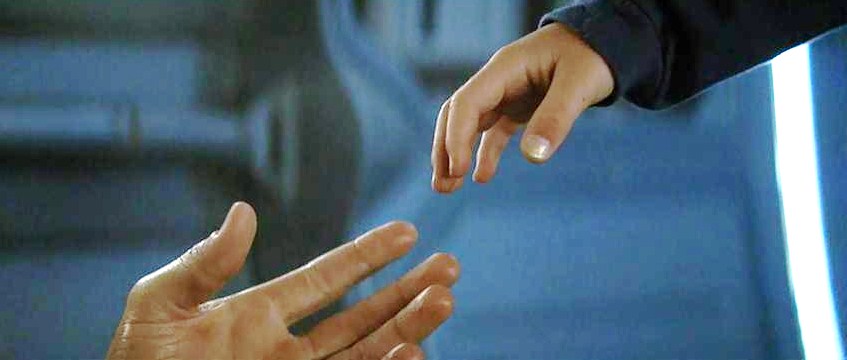
This boy -- a Christ or God figure -- offers an outstretched hand of support. In response, Kelvin stretches to reach the boy’s hand.  And for a moment here, Soderbergh cuts to a close-up image of the two hands in close-proximity, grasping for one other.


The Hand of God

The Hand of God?

The Hand of God

The Hand of God?
As you can see, this particular shot selection eerily echoes Michaelangelo’s “Hand of God” imagery in the Sistine Chapel.  In that Catholic venue, this image represents God giving life to Adam, the first man.   Here, the image suggests that Solaris (or Christ…) forgives and accepts Kelvin, and grants him an eternal after life.

Ensconced in that afterlife, Kelvin soon finds himself back in his apartment on Earth.  But he is not alone this time.  He is with Rheya…forever.  And his guilt over her death is now assuaged.  For her part, Rheya informs Chris that this is a place of eternal peace:

Everything we’ve done is forgiven,” she asserts, harking back to Paul’s assurance of salvation in Romans, and the specific line from Kelvin’s favorite poem.  Death shall have no dominion…at least for believers.

The spiritual and religious aspects of Solaris are consistently applied throughout the film, with Gordon – another scientist – fearing the planet’s “resurrections” (a term which also recalls the story of Jesus), and Rheya coming to interact with the planet as something akin to God; something which has set her down a specific path and which “wants” certain things from her.  In one scene, we witness Rheya talking to an invisible presence, asking, specifically, what it wants of her.  It is the stance of someone trying to discern the word of God.  And in one image (in a mirror), the figure she seems to be talking to is no longer invisible but, again, the Gibarian child.

Even the explicit discussion of a “place where” Kelvin and Rheya “can live” together in their “feelings of love” harks back to a Christian interpretation of the film.  That place of unending love can only exist when Kelvin takes a leap of faith; when Kelvin believes in something beyond science.

The irony of Solaris’s viewpoint if you subscribe to this interpretation is that it absolutely conforms to Gibarian’s damning line that “we don’t want other worlds; we want mirrors.” 

In other words, Solaris depicts the tale of man in space, and finds that in this frontier he must reckon with the Face of God Himself.  And here God conforms -- through the Michelangelo symbolism, the Dylan quotation (from Paul, originally), and the apotheosis of an after-life of “forgiveness” -- with pre-existing Earth beliefs, or specifically, Christian beliefs.  

Therefore, Lem’s original idea from the novel is indeed sacrificed.

This movie is not about Lem’s notion of countenancing something truly alien or incomprehensible, but rather about countenancing a “mirror” that re-affirms Earthly beliefs. In that vein, one can argue that Solaris takes man to the frontier of knowledge and finds there but a mirror reflecting earthbound, Western traditions of faith and spirituality.

There is another way to understand the film, however, and frankly, I prefer this second interpretation. 

Chris Kelvin is an avowed secularist (“the nihilist psychologist,” remember) and yet something in his soul connects emotionally and meaningfully to the works of the Dylan Thomas, particularly that poem about “death having no dominion,” and love lasting forever. 

Kelvin is already open, then, in some buried sense – perhaps even a subconscious sense – to the idea of an afterlife, to the idea of forgiveness, and even to the concept of God.  The planet Solaris – a vibrating, coruscating membrane, and, perhaps, a mirror – thus creates for him the very (religious) imagery his mind seizes upon at the point of his death.  Chris wants to “believe,” and Solaris accommodates that desire, making his belief a “real” dimension, a real afterlife.

Solaris is thus not God, and the afterlife we witness in the film's climax is not Heaven, at least not in the Biblical sense.  Instead, just as the Visitors are not exactly human, but rather representations of human, the after-life is a manifestation of Kelvin’s desire to find peace in Heaven, but not actually Heaven itself. Got it?  Just as Kelvin asserts in the flashback that man has "dreamed up" God, he, in the film's finale, dreams up (a version of) Heaven.

It seems even Kelvin’s name embodies his philosophical stance in Solaris.  On the Kelvin Scale of Belief, he seems to be on a consciously-applied "absolute zero," at least until he interfaces with Solaris and his repressed beliefs come to the surface.  I believe Kelvin boasts the repressed desire to believe in something beyond proven science because he feels guilty about Rheya, and can’t forgive himself for her death.  Science can't provide forgiveness.  Even behavioral psychology can't, really. So his mind creates a world – and Solaris manifests that world – where he can find that peace and forgiveness.

But that world is no more Heaven than the Visitor Rheya is actually the real Rheya. 

The forgiveness that Solaris grants Kelvin -- the very afterlife it manifests for him -- are thus but mirrors of what his conflicted mind seems to desire: a place where he can dwell forever in that feeling of love with the woman he cares about.

“How are you here? Where do you think you are?”


At the heart of Solaris is this crucial character, the nihilist, Chris Kelvin.  He goes on a mission that makes him re-examine his beliefs and feelings, and runs square up against the human concept of identity.  He comes to realize that the Visitor version of “Rheya” is created exclusively from his memory, from his mind. 

Accordingly, she can act only as he expects her to act; only within the confines of his established mental “definition” of her.  This realization proves incredibly troubling to Rheya.  She can’t deal with the fact that she is not “herself,” but rather a creation of Rheya vetted through the lens of Kelvin’s eyes.

What Solaris truly hints at, then, is the notion that no one can truly know anybody else. That our identities are fragile, self-constructed puzzles of deep layers and many facets.

No one else – not even our spouses, our children, our parents or our best friends – can fully understand the complexity of the inner, personal self.  Throughout the film, characters respond in fear and anger to the visitors because they don’t know “why” they have appeared, or “who made them.”

Well, why are we here?  And who, outside our parents, created us, the human race itself?

It’s completely hypocritical that Gordon and Kelvin, at least to an extent, ask existential questions of Rheya, Snow and Gibarian’s son that they can’t truly answer about themselves or human nature.  This is why the final revelation about Snow is so important.  Others accept him at face value, believing him to be human, when in fact he is a "Visitor."  For a person on the outside looking in, it's impossible to detect the difference.  That's the point.  

Soderbergh excavates this concept -- the ultimate un-know-ability of other people -- through a carefully selected visual approach.  In particular, there are an abundance of compositions in the film which reveal to us Chris Kelvin…but only from the back

These shots aren’t like the fast-moving, “intrusion” tracking shots of Black Swan that I pointed out last week, although they may resemble them from the screen grabs (which can't alas, accommodate motion or movement).  Instead, these are (mostly) still frames in which Kelvin’s back is deliberately facing the camera.  The image suggests that something important is being denied us.

This composition could be a visual prophecy of Kelvin’s approaching death, or a sign of the character’s alienation and isolation from the world.  He has literally turned his back on it (and to the camera). 

Or, if one chooses to consider the image symbolically, these composition choices represent Soderbergh’s reminder that even Kelvin – our protagonist – is a man of layers and contradictions.  Ultimately, we can’t understand more of his identity than what he reveals to us.  This interpretation fits in with the notion I described above, of Kelvin as both firm nihilist/atheist and Kelvin as secret “believer” (or want-to-be-believer, if you will).  Can we really know him?  Can he really know himself?


What's denied us in this image?

Trapped in the prison (notice the bars?) of his own beliefs?

Separated from the world outside.

Lost in a blur of unimportant faces.

Finally, Unknowable.

How can we know anybody, in fact, if “nobody can even agree [about] what’s happening” as one character describes the central mystery in the film.  The issue: We are all victims of and slaves to our own unique perspectives. 

Another intriguing composition that Soderbergh deploys repeatedly in the film involves a strange, inscrutable view of Rheya’s face.  She is universally in the middle of the frame during these moments, staring at the camera; staring at us.  This oddly serene and yet significant posture forces us to consider: who is looking at us from behind those wide eyes?  Is it Rheya?  Is it Solaris?  Is it God?


Who is looking at us from behind those eyes?

Rheya?

An imitation?

Solaris?

God?

Forgiveness?
The irony, of course, is that when we meet strangers and they look at us, we don’t understand everything behind their eyes, either.  Are we immediately suspicious and paranoid of them too?  Or do they get a pass because we assume they were born on Earth, and are therefore human?  Once that assumption disappears, however, do we face the unknown – even familiar faces -- with fear and paranoia?

In some sense, what Solaris concerns is the idea that we all see the world through our own individual lens.  We interpret the identities of other people through that lens, which includes, in many cases, a life time of memories.  Yet, in our memory, we get to control everything, explaining perhaps why we form judgments of people that are biased or wrong, or narrow, or ill-considered.  What we are really judging is not another person’s true interior “self,” but our perception of that self.

What I enjoy and admire about this remake of Solaris is that it is internally consistent, even if it is not faithful in terms of theme to the Stanislaw Lem original novel.  Soderbergh’s Solaris asks us to consider identity, and to consider the idea that mankind – even when broaching other worlds – will never be able to see anything other than mirrors.  The lens with which we view other people (and other realities?) is an individual, personal one, unable to reckon with something truly alien on its own terms.

The mystery of the planet Solaris can’t be resolved, because human beings can’t relate objectively – outside themselves and outside the mirrors of perception – to something truly otherworldly.  Instead, they see only shades of themselves and their own lives.  How can we assess something in terms of human characteristics, if it possesses no human characteristics to begin with?

If you keep thinking there’s a solution, you’ll die here,” one character warns Kelvin in the film.   “There are no answers, only choices,” Gibarian tells him, on another occasion. 

No answers, only choices?  That’s the crux of our human existence right here on Earth, isn’t it?  Again, Solaris uses the “alien” mirror to show us, in fact, our very reflection.

We can make choices about what we want to believe, of course.  But part of our questing human nature must involve the admission that there are no answers, except the ones we craft for ourselves, about our identity, and about how we choose to view the universe.  The human race has made God (or transformed God…), into an image we find acceptable, a reflection of our modern world and its value system.

When we face the idea of God, we don’t really want to see the Divine at all, do we?  We’re hoping, instead, for a mirror....

Friday, March 13, 2015

Happy Friday the 13th: Jason X (2002)


How time flies! Another Friday the 13th is now upon us. 

Last month I gazed at Friday the 13th Part VII: A New Blood (1988), as well as the landmark 1980 original.

Today, I want to look at the only Friday the 13th film (other than Freddy vs. Jason [2004], I suppose), not to actually carry the Friday the 13th brand name: Jason X (2002).

Jason X is a huge departure for the slasher series because it is set in the distant future…and in outer space. The film is also one of the lowest-grossing entries in the sturdy franchise, which means, perhaps, that audiences didn’t take too well to its many departures from the norm.

But I’ll tell you right now, straight-up: I love Jason X.

It’s an utterly ridiculous movie that tosses Friday the 13th, Star Trek: The Next Generation (1987 – 1994) and Aliens (1986) into a blender and comes up with one weird -- but also highly inventive -- horror film. The movie possesses a sense of joy about itself, and its own ridiculousness. The vibe is pure, anarchic glee.

While it’s true that the film is never overtly scary or suspenseful, Jason X is undeniably fun, gross, and ingenious. A few of the kills are downright inspired in conception and execution, especially the one involving a giant corkscrew, and another involving a doctor’s face dipped in liquid nitrogen.


Yet one particular moment in the film strides above all the rest, and deserves absolute, adoring respect.  

Late in the film, a cyborg version of Jason stumbles into a holodeck version of Camp Crystal Lake, and encounters two nubile young women (actually computer-generated distractions...) who proclaim -- loudly -- their love for premarital sex.  

Reverting to form, Jason stops to kill them, but the trick is that the avatars are designed just for that purpose, to appeal to his draconian (or perhaps Victorian...) sense of vice-precedes slice-or-dice morality.


I could watch this scene in Jason X a dozen times and not get tired of it. In part, this is so because the sleeping bag kill (my favorite in the series) is resurrected, and in part because the Friday the 13th franchise finally acknowledges on screen -- in true post-modern fashion -- its enduring subtext.  

You play...you pay.  You fuck…you’re out of luck. 

Lest we forget, the original franchise came about as the Reagan Revolution unfolded in our nation, and a tide of conservatism swept the country.  These films -- though despised by conservatives -- are very much about that draconian, black-and-white world view. If you engage in premarital sex or smoke weed...Jason's going to kill you.  

So be good for goodness sake!

But back to Jason X. Any film that is willing to wink at the the entire saga's central conceit is seriously deserving of some love and respect.  

Accordingly, I bow down before Jason X. It may not be good in any tangible artistic sense, but it sure is knowing, nasty and entertaining as hell.


“I’ve seen worse.”

In 2010, at the Crystal Lake Research Facility, Jason Voorhees (Kane Hodder) escapes captivity. A resourceful scientist, Rowan (Lexa Doig) manages to freeze him in a cryogenic unit, but not before being wounded and succumbing to the cryo-gases as well.

Four hundred years later, in 2455, a class of students explores the now abandoned, environmentally-ravaged planet Earth.  There, students uncover Jason and Rowan at the ancient facility, and bring back the frozen life-forms to their ship.  

Professor Lowe (Jonathan Potts), their teacher, sees an opportunity to make a profit.

When Rowan is awakened, she expresses concern about Jason, but Dr. Lowe assures her he is very dead. 

But Jason has never stayed dead for long, and this time is no exception...


“He just wants his machete back!”

Despite their charms, the Friday the 13th movies are repetitive in the extreme. Most of the films involve a lumbering killer (either Jason or his Mom) knocking off camp counselors under cover of approaching storm at scenic Camp Crystal Lake.  You get the scene involving pre-marital sex...and death.  Of smoking weed...and death.  Of skinny-dipping..and death. 

And then you get the tour of the dead, in which Jason has propped up all the bodies, so the Final Girl can run through them all like a fun house carnival. Then you get the coup de grace in which Jason apparently dies, and some twist-in-the-tail/tale that promises yet another sequel.  

Later movies throw in variations of the format, like adding a Carrie knock-off, or visiting Manhattan, but Jason X, perhaps, is the first of the franchise to turn its eyes towards wholesale assimilation of science fiction tropes.

Not surprisingly, Star Trek is a major inspiration, particularly The Next Generation. A major character, for instance, is a sentient android named Key-Em 14 (Lisa Ryder), who adapts to different environments, likes to role-play and is, apparently, fully-functional just like our old friend Mr. Data (Brent Spiner).  


Also appropriated from the Next Generation is the conceit of the holodeck, a kind of virtual reality chamber where reality can be re-molded to different settings based on user input.  As is the case on the Enterprise D, the space crew we meet in Jason X uses the holodeck for training and recreational purposes.

The Alien film series is also a major influence here. In particular, Rowan (Lexa Doig), plays basically the same role in Jason X as Ripley (Sigourney Weaver) does in Aliens (1986). Consider the specifics: She is awakened from a long cryo-sleep to contend with a threat that only she has direct, first-person information about. In Aliens, that threat is the xenomorph from LV-426. In Jason X, of course, it is Mr. Voorhees. 

Similarly, both Rowan and Ripley continually act as a brand of Cassandra figure. They warn all those around them about what will happen once the threat is encountered, but they are ignored until it is too late.


Similarly, Rowan is surrounded by other figures you may recognize from Aliens.  That film also had an android, named Bishop (Lance Henriksen), of course.  But there’s Sgt. Brodski (Peter Mensah) in Jason X, a dedicated fighter and protector who makes a good stand-in for Michael Biehn’s Hicks.  And then there’s the Carter Burke surrogate, an avaricious teacher more interested in profit than safety: greedy Professor Lowe (Jonathan Potts).

These qualities and characters might be decried as cheap or obvious shots at more popular film/TV franchises, and yet I can’t really quibble with how Jason X utilizes them. It’s not a movie’s subject matter that counts, remember, but the ways in which a movie explores that subject matter. In this case, the futuristic trappings provide two great moments in Friday the 13th history.

The first such moment involves sick bay Nanites or nano-bots (another idea familiar to us from the Trek-verse) that re-build Jason as a half-flesh/half-metal juggernaut. I loved the idea of Jason getting a dramatic visual and technological upgrade so late in his cinematic life. There’s a great moment of Frankenstein-like portentousness here as the Nanites swarm down on Jason’s corpse and bring it back to life in this new, flesh-and-steel form.


Secondly, there’s that holodeck moment I mentioned in my introduction above. The survivors of the spaceship realize that Jason can’t resist temptation. He sees gorgeous, nubile camp counselors…and…must…kill them.  The urge is too strong for him to overcome. Frankly, this is a perfect movie moment, an inspiration that could emerge, finally, only from synthesizing so many disparate creative sources, and from accurate recognition of Friday the 13th's symbolic legacy and "meaning."

I also appreciate the film’s ending, which finds Jason careening to Earth Two like a falling star, and landing in the proximity of a body of water.  This is New Crystal Lake, a perfect place for him to take up old (murderous) habits, and so one can view the whole movie as a kind of origin story that gets Jason Voorhees -- urban legend -- from Point A to Point B.

I realize fully that outer space tends not to be a fertile terrain for established horror franchises. Hellraiser and Leprechaun have both gone to the stars, only to experience severe orbital decay. I would argue that Jason X doesn’t suffer the same inglorious fate. Instead, the film gets better, moment to moment, one cribbed inspiration to the next, until it reaches that moment of bliss with the holographic camp counselors.

Was it a mistake sending Jason to space? The Friday the 13th  saga has made worse mistakes, frankly. Going to 3-D in 1982 didn’t make for great entertainment in my book. Tossing out a Jason impostor in A New Beginning (1985) is also a low-point. And of course, Jason in Manhattan (taking the city alongside the Muppets, presumably), is an historic misstep. Especially since the Big Apple looks more like Toronto in that eighth Friday film. 

None of those films, I would suggest, showcase the audacity to go big, to go weird with such apparent confidence. You might laugh a lot during Jason X, but you're laughing with the film, not at it.

Jason X captures well the idea that I expressed here a few weeks ago, and which I often attempt to explain to my son. That idea is simply that horror movies don’t always need to be serious and grim if they can have fun with their ideas, and move the ball a few yards down the field.  

Jason X features some cool special effects, a well-developed sense of humor, and a worthy upgrade for a durable movie monster. Throw in a fun cameo by genre great David Cronenberg and an utterly ridiculous scene involving Jason just wanting “his machete back,” and you have all the ingredients for a good time at the movies.

Soon after Jason X, the 2009 re-boot came along, and started the whole damn cycle over again, eliminating humor and silliness from Jason's DNA, and taking the scatter shot world of Friday the 13th very seriously. 

Over-seriously, if you ask me. 

To this day, I prefer the crazy ingenuity of Jason X.


40 Years Ago: Howard the Duck (1986)

In 1986, the comic-book adaptation  Howard the Duck  -- executive-produced by George Lucas -- landed in movie theaters with a splat.   The f...