Showing posts with label 20 years/Top 10 JKM Posts. Show all posts

Wednesday, November 12, 2025

20 Years/Top 10 Posts: #1: Prometheus (2012)


[The number one most frequently read post here in my first 20 years blogging is my 2012 review of the Alien prequel, Prometheus.  This review was originally posted on 6/19/2012, and has since been read well over 45,000 times, and linked to across the web.] 

Director Ridley Scott has already given the science fiction cinema two of its greatest and most cherished films: Alien (1979) and Blade Runner (1982).  His new  genre film, Prometheus (2012) brazenly grasps for the same zenith in terms of quality…and largely succeeds.  The film features twice the symbolic imagery of Blade Runner, and many, many times the implications of Alien.

In terms of visualization, Prometheus is nothing less than staggering. And in terms of narrative and meaning, Scott and his controversial writer Damon Lindelof have forged an intricate puzzle box, one which remains available to multiple interpretations and deep analysis.

This high-minded, symbolic approach to silver screen science fiction has not pleased some of the more literal-minded critics and audiences.  Indeed, there is a fine line between creating an open-ended, ambitious work of art that provokes discussion and crafting a movie that is so open-ended and impenetrable that the narrative itself seems muddled.  

Although I remain sensitive to those who insist that Prometheus is so confused and cryptic as to be  meaningless, I remain delighted that Ridley Scott has crafted an elaborate, complex film; one worthy of multiple viewings, and which can be best understood through careful dissection and consideration of the text’s symbols and multitudinous allusions.  A thorough understanding of the film is gleaned not necessarily by following the 1-2-3 steps of the plot, but rather through interpreting the deliberate nods to earlier films (such as Lawrence of Arabia [1962] or Blade Runner), and reckoning with a consistently-applied leitmotif that contextualizes all the players -- including the alien engineers -- in a specific manner.

If you’re a regular reader of this blog, you know that I have long been concerned with the way that the modern genre film has determinedly eschewed sub-text, and spoon-fed us obvious answers to  mysteries and puzzles.  Prometheus flouts this convention, and practically begs for an engaged, active, thoughtful viewership.  I would be a hypocrite if I complained both about the lack of ambiguity in most contemporary blockbusters and then shouted down Prometheus for its commendable surfeit of ambiguity.  If the film errs somewhat on the side of being inscrutable, so be it. 


In other words, this is precisely the kind of film I hoped Ridley Scott would give us.  Prometheus largely exceeds my own sky-high expectations because it is provocative, challenging, infuriating, dense, and daring.  Some of the specific questions that fans have hungered to have answered, like “what’s the exact life cycle of the creatures we see in the film?” are ultimately held subordinate to the committed exploration of Scott’s chosen thesis: that all parents -- God included -- in some manner hate their children, and that children, equally, despise those who gave them life.  This the film's thematic terrain, and once you accept it (even if you disagree with the premise...), the film opens up and becomes infinitely more accessible.  

By charting the dynamics of the parent/child dilemma, Prometheus thus emerges as the ultimate “Generation Gap” film. The underlying, subconscious reason for this reciprocal relationship of apparent hatred involves our very mortality, a topic that Ridley Scott also explored meaningfully in Blade Runner.  Parents want to live longer and hold onto their supremacy until the bitter end.  And children -- symbols of a future that parents won’t live to see -- want to usurp established authority and become dominant sooner rather than later.

The problem with the human condition, Prometheus suggests, is that we cannot see ourselves simultaneously as both children and parents, and that this tunnel-vision regarding our self image provokes resentment equally in those we raise, and those who raised us. This central running motif about parents/children actually resolves -- albeit obliquely -- many of the problems I’ve read that people have with the film.  

Why do the Engineers hate us?  Why does Holloway hate David? What does David feel for Weyland?

All the answers – or at least most of them – can be excavated by comprehending the particularities of the parent/child relationship in question. If we go in search of our Creator, Prometheus warns, we must understand that our Creator may not like, let alone love, his creation. After all, we possess something he does not: an unwritten future…one filled with potential and possibilities rather than an already-inscribed history of regrets and mistakes.  

If you view Scott’s Prometheus through this lens of parent/child relationships -- and consider the imagery and symbols that support this reading -- you may begin to view the 2012 film as a work of art that asks some very important and pointed questions about our nature.  This is worthy intellectual territory for an Alien-related movie to explore, since so much of that franchise mythos has been about the pain and horror associated with “birth.”  

Beyond that painful physical experience, Prometheus suggests, the real horror awaits.  Birth is just the beginning of the pain.  Try living up to God's expectations...

“A King has his reign, and then he dies.  It’s inevitable.”


In the distant past and presumably on Earth, a white-skinned humanoid – an Engineer – consumes a viscous black fluid and promptly begins to disintegrate. He tumbles into a roaring waterfall and his decomposing body fills the water with his DNA…the building blocks of life.

In 2089 AD on Earth, scientists Elizabeth Shaw (Noomi Rapace) and her lover, Charlie Holloway (Logan Marshall-Green) put together the final piece of a strange puzzle.  In a prehistoric cave on the Isle of Skye, they find the sixth pictograph showcasing a star map; one pointing towards mankind’s destiny in a distant solar system.

In 2093 AD, Shaw and Holloway awake from cryo-sleep aboard the space vessel Prometheus, a ship under the command of Captain Janek (Idris Alba). With the patronage of the Weyland Company -- represented by executive Meredith Vickers (Charlize Theron) and a polite android named David (Michael Fassbender) -- the two scientists explain their theory of the star map to a skeptical crew.  

Shaw and Holloway believe that mankind was created by a race of alien engineers, and that the pictographs in the prehistoric caves represent an invitation to seek them out.  Prometheus is now near its destination: a life-supporting moon around a ringed planet, called LV-223.  Here Shaw hopes to find evidence of man’s beginnings.

On the moon’s surface, an exploratory team discovers an Engineer construction: a giant earthen temple that generates its own breathable atmosphere.  Inside the temple stands thousands of vases which contain a viscous black fluid…possibly a life form, possibly a bio-weapon.  

When the containers start to leak, a chain of events is set into motion that will threaten not only Shaw and Holloway, but all human life on Earth itself.

“Don’t all children want their parents to die?”


Gazing deeply into Prometheus’s DNA, one can detect how the parent-child relationship is expressed up-and-down in terms of the dramatis personae and the central narrative.  In terms of the latter, man goes out in search of his “beginnings” or parents, the alien Engineers.  And man’s child, the android David (Michael Fassbender), also embarks on the search for his own destiny or freedom -- beyond man -- at the same time.

In terms of the former, most of the important characters in the film are developed in ways that signify they are either children or parents…or both. 

Take protagonist Elizabeth Shaw, for example.  We learn from an early flashback/dream sequence that she lost both of her parents when she was very young.  Furthermore, she is unable to bear children herself.  Because of the absence of parents in her life, and because of her own inability to become a parent, Shaw is a woman of deep “faith,” viewing the Christian God as parental source of wisdom, support, and comfort.   She has fashioned a "personal" parent in the western, New Testament God image.

In need of a benevolent father figure to replace the one she lost all those years ago, Shaw “chooses to believe” that the Engineers are mankind’s creators, and that they are good, loving, wise creatures awaiting her arrival -- or return? -- with outstretched arms.  Her assumptions -- forged in the heartbreaking absence of human parents -- prove utterly wrong, and Shaw grows vengeful and bitter in the course of the film, determined to hold the Engineers’ feet to the fire for failing to live up to her personal imaginings of them.  

Why do the Engineers hate their own children?  Shaw asserts that she “deserves answers” to this pressing riddle.  This is so because she has erected her entire life and self-image around the myth of a loving God, benevolent father to the human race.  As the film ends, Shaw doubles down on her belief that the Engineers must love their grown children, and heads off to their planet of origin to confirm the answer she seeks.  This pursuit of her Creators is not one based on facts, since we have seen with our own eyes that the Engineers are unremittingly hostile.  Rather, Shaw's zealous continuation of the journey is the result of a closed mind, one which won't accept new data and new facts.  And yes, her character -- while heroic -- is certainly a comment on epistemic closure in those of faith.  One wonders, perhaps, if Shaw views herself as the prodigal child, one who has committed some (unknown) sin, but who will ultimately be accepted upon her return.  If she (along with the human race)  represents the Engineers' prodigal child, then the xenomorphs may be our more dutiful siblings...


Meredith Vickers is also defined in Prometheus as a child.  She is the long-suffering daughter of tycoon, scientist and magnate Peter Weyland (Guy Pearce).  Vickers has waited patiently throughout her adult life for her father to relinquish control of his multi-billion dollar company so that she can assume it herself; so that she can start constructing her own legacy. 

But Weyland is reluctant to let go.  So reluctant, in fact, that he finances a mission to LV-223 on the long shot chance of discovering the secret of immortality from the Engineers…from God.  Late in the film, Meredith rails against her father for his failure to observe the accepted way of things. Like Shaw she is angry and embittered by her experience with a parent.  He won't let her complete the process of transformation...of becoming.

It’s inevitable, Vickers tells Weyland, that a king has his reign…and then dies.  But Weyland steadfastly refuses to end his reign, landing Vickers in a kind of arrested state of not-quite maturity.   Trapped in that purgatory, she is not respected by others, and her authority inside the company is constantly questioned. Vickers is always heir to the throne, but never gets to sit on that throne.  She watches her father's death not with dread or pain, but with something akin to acceptance.  It was time for him to go, and his last act -- going to an alien to demand more life -- was pathetic and needy.


Weyland’s other child is David, the android or artificial life form that he created. Weyland serves as both God and father to David.  But he has created David not to be an independent entity or even an individual with a unique personality, but rather a living glorification of Weyland’s reputation as a genius.  

Accordingly, Weyland is routinely dismissive of David, noting in front of others that although David is immortal, he possesses “no soul.”  The uneasy nature of the David/Weyland relationship is best expressed in a sequence in the medical bay, during which David washes his father’s feet.

Foot washing is a Christian religious ritual.  In the Roman Catholic tradition, Jesus washed the feet of his disciples on the eve of the Last Supper, his final night on Earth.  In this tradition -- unusually -- the superior washes the feet of the servants, or the apparent inferiors.   Jesus said: “You call Me Teacher and Lord, and you say well, for so I am.  If I then, your Lord and Teacher, have washed your feet, you also ought to wash one another’s feet.  For I have given you an example…that you should do as I have done to you.


What David’s act of foot washing signifies is not the love of a son for an elderly, infirm father, but rather a subtle warning to Weyland that he, perhaps, should be prepared to wash the feet (symbolically) of the Engineers rather than demand from these absent parents more life (fucker…to paraphrase Blade Runner).  

David’s act of foot washing looks like one of subordination and respect, but in the tradition of Jesus, it is actually not subordinate at all.  Rather, David informs his father -- in the deliberately symbolic terms of foot washing -- that he should act just as David has acted.  He should wash the feet of the others, to humble himself before the Engineers.  But David knows that Weyland is arrogant and prideful and will not follow his example.  This suits David, because he wishes his father dead so that he can chart his own path.  He no longer wishes to take orders from the Old Man. 

Another child in Prometheus, of course, is the human race itself.  It is the (perhaps unwanted…) child of the Engineers.  And in typically childish fashion, this child goes before its parents and demands answers about life.  The Engineers -- as parents -- however, clearly fear the humans.  The humans – their children – have in two millennia escaped their playpen (Earth) and sought them out at Daddy’s work, on LV-223.  This act suggests, perhaps, that the child shall eventually overcome the father, and eclipse the father. 

This deep fear, I submit, is the source of resentment on the part of the Engineers: they have created something that they can’t control, but which may outlive them and out-achieve them.  Now, if you read the net with any regularity, there’s much talk about the film's deleted “Space Jesus” and the idea that the Engineers sent an emissary to Earth, Christ, who was killed by humans.  That is the specific reason, apparently, that the Engineers dislike us.  But that omitted explanation was also rejected by Scott as too “on the nose,” and does not mitigate or undo the explanation I supply here. 

In fact, the idea of a parent being jealous or vengeful towards a child conforms beautifully with the Prometheus myth, which the film evokes.  In Greek Myth, Prometheus is a God-like creature, a Titan, who created man from clay and then stole fire for mankind so that the child could stand on equal footing with his progenitor.  Prometheus’s punishment from his fellow Gods was everlasting torment.  Implicit in this story is the belief that the Gods -- the ultimate parent figures -- don't want competitors.  They fear that Prometheus's gift will make man an equal, just as many parents fear that their children, once grown up, will be equals...or betters.

One interpretation of Prometheus suggests that the Engineer seen in the prologue is either a Prometheus-like renegade or heretic who similarly gives the “magic of life” – his very DNA – to create man, perhaps over the ardent objections of the other Engineers.  Why does he do so?  We can’t know, of course, but perhaps this Engineer wanted to create something that was “good” instead of something destructive, like the black ooze biological weapon which – no matter which way you cut it, or what life form you utilize as intermediary – always ends up as vicious population control: a nasty, saliva-dripping xenomorph.

In this reading of the film, an “unwanted” child, the human race, is created by an unsanctioned renegade, and the rest of the Engineers realize they must destroy it before the child threatens them and eclipses them.  

Another possible reading: the Engineer in the prologue creates man simply because he can.  This is a deliberate mirror of Holloway’s explanation for David in the film’s dialogue.  Holloway tells David that mankind gave birth to an artificial life form only to prove that it could create life, not out of love, not out of responsibility, and not out of any deeper meaning or emotional truth. 

By extension, perhaps this explanation applies to the Engineers and the human race too.  The Engineers conducted a test (they seem to be experimenters...)…and humans were the (fearsome) and unexpected result.  Not all parents intend to be parents in the first place, after all.  For some, parenthood is an unexpected and unwanted burden.  This is the existentialist, nihilist interpretation of the film.  Man goes out into space in search of the meaning of life, only to get the answer that his life -- his very existence -- is meaningless. How does he know?  Because the Bible (er, God...) tells him so.
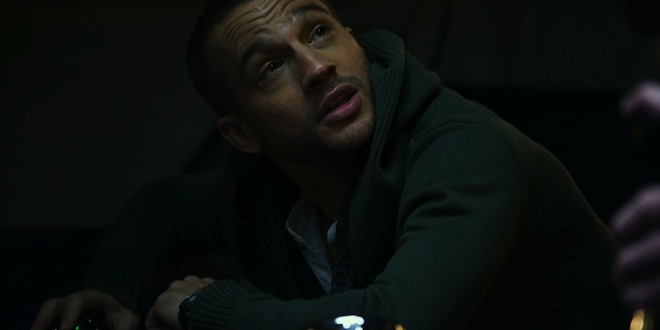

I have read in many venues since Prometheus’s premiere how much genre audiences apparently dislike the character of Charlie Holloway, and how critics and viewers have grappled with what a “shithead” he is.  Why is he so mean and condescending to David?  

The answer, again, determinedly concerns parents and children.  As the Engineers view their creation with disdain, so does Holloway view mankind’s creation, David, with disdain.  But it’s not merely disdain…it is casual disdain.  

This rude and condescending behavior expresses Charlie’s hypocrisy, and his absolute inability to see himself as both a father and a son.  He goes to space to find his genetic father, while belittling and destroying mankind’s son...a miracle who stands right there in front of him.  Can’t he see that he is treating David in a way he would not want to be treated by his father or God?

I submit Holloway is actually a pretty intriguing character because of this casual, reflexive, unthinking rejection of David as a “lesser” being.  This is racism in its worst form, a thoughtless denigration of one of God’s creations.  And sometimes, this kind of racism exists in even the most enlightened individuals.  The point is that men – even great men like Charlie Holloway – can’t always see their own hypocrisy, or their own blind spots.  Charlie never gives voice to a specific reason for his hatred of David, he just blindly considers him inferior because David is artificial...just as generations have blindly considered African-Americans inferior because of skin color, or gay people inferior because of sexual identity.   

Does this racist behavior make Charlie a shithead?  I don’t know.  It certainly makes him a genuinely complicated character.  He seeks a God who loves him, like Shaw, one that he wishes to “talk to,” but yet he steadfastly denies that very love to David, a being created by man.  It’s a very elegant dynamic and point of comparison, and one that reveals how so many people of faith wear blinders in the face of their own foibles.   Charlie can position himself only as a child, shirking his responsibilities as father.

Weyland’s trajectory is similar to Charlie’s.  He has played God, but is not kind or good to his creation, David.  Yet Weyland wholly expects his God to honor a personal demand for immortality.  The Engineers have no reason to grant Weyland this prize, and in fact the brazen nature of the request only seems to confirm the Engineers’ apparent belief that man will eclipse them and threaten them if left unchecked.  Human appetites are boundless.  As Weyland dies at the end of the film, he warns David that there is only “nothing” (a reference to the desert, and Lawrence of Arabia).  What he means, however, is that -- going back to the existentialist interpretation of Prometheus -- God has no answers to give.  This is important information for David. Weyland has no answers to give, either.

Given the importance of the parent/child dynamic in Prometheus, the significance of the black ooze may just be that it violently makes parents of even the most unwilling organisms.  It usurps the normal life process and co-opts life for its own agenda.  And again, that may qualify as a cynical definition of “children,” at least according to some.  Children are a demand on time and resources, and the grisly bio-weapon of the Engineers forces unwanted parenthood on one and all. But the children of the black ooze are literally monsters, slavering beasts dedicated to murder, and therefore true weapons of mass destruction.  And yes, if the Engineers did create the black ooze, that makes the black ooze -- and by extension the xenomorphs -- our "brothers."

Now, of course, I don’t feel this way about children and parents.  I’m a happy parent of a delightful and wonderful five year old boy…who happily plays with Kenner Alien toys, incidentally.  But Prometheus gazes deeply at the reasons why parents and children sometimes gaze at one another across a gulf of suspicion and dislike.  Parents and children vie for resources and time in the quest to achieve dominance and immortality.  “Don’t all children want their parents to die?” David asks late in the film, and Shaw rebuts him, stating emphatically that the answer is negative. 

But judging by the interactions between parents and children in the film, and taking into account the Prometheus myth, the film makes a case that David is right.  Parents fear children because the ascent of their offspring in some way portends the death of the creator.  And there's nothing more frightening -- even to Gods, apparently -- than facing annihilation and oblivion.  And children fear and hate parents because parents control them and hold onto precious life to the bitter end.

This is a rich, consistently-applied theme, diagrammed in character after character, and literally hard-written into the structure of Prometheus itself.  Of course, some will ask, if the Engineers despise their children so much, why give them an invitation to come visit?

The simple answer is that it’s a trick invitation.  Notice that the children are invited not to a home world, but to a dangerous weapons facility.  If the children come, they’ll more than likely be destroyed.  If you've ever been ambushed at a family gathering, you kind of get the point.  An invitation to "come home" isn't necessarily or automatically benign, is it?
  
“It looks insubordinate, but it isn’t really:” David the Android, and the Lawrence of Arabia (1962) connection.


One of the key characters in Prometheus is Michael Fassbender’s effete android, David.  As we witness early in the film, David has adopted as his human role model the character of T.E. Lawrence in Lawrence of Arabia.  Specifically, he models his hair to resemble Peter O’Toole’s cut in that film.  One also wonders if he is  named David after that film’s director: David Lean.

By remembering some of the details and dialogue of Lawrence of Arabia, we begin to unlock the puzzle of David’s behavior and motivations.  Other critics have already pointed out, accurately, that dialogue in Prometheus deliberately and explicitly references Lawrence of Arabia on three occasions.  

These are when David notes “Big things have small beginnings,” when Weyland notes that the “key” to doing risky things is “not minding that it hurts,” and the commentary, finally, that “there is nothing in the desert and no man needs nothing.”

Yet such references are only the tip of the metaphorical iceberg.  

In ways important and complex, David clearly models his very behavior and actions after his cinematic hero.  For instance, T.E. Lawrence tells General Murray (David Wolfsit) in the Lean film that his manner looks insubordinate “but it isn’t really.”  

This is precisely David’s manner. He operates by an agenda that is seems insubordinate, but is not. Over and over, David ignores the orders of his superiors. Specifically, he opens the door to the temple vase room over Holloway and Shaw’s objections, and then de-activates the live feed showing his progress to the ship’s bridge, irking Vickers.  By and large, David -- like Lawrence -- “pretends” to be insubordinate, when this is not the case.  He is secretly operating by Weyland's command.  In other words, he is perfectly subordinate...at least until he can be free of his "father."

Also harking back to the filmic T.E. Lawrence, David recognizes his isolation and also independence from those surrounding him.  He is neither human, nor alien engineer.  He is singular in his nature. In Lean’s film, Lawrence describes himself as similarly possessing “no tribe,” and believes that this lack of specific membership makes him the perfect person to “execute the law,” as he tells Aida Abu Tayi (Anthony Quinn).  

Again, consider David’s behavior in Prometheus: It reveals no allegiance to any particular group, but rather a consideration only for David’s “law,” his personal quest, I believe, to “kill” his parents (Weyland and the other humans) and become, essentially, for the first time, a free man instead of a slave.  

When David suggests to Shaw that she rescue him from the alien bridge and return to the engineer spacecraft, he is essentially operating according his own agenda.  When he “views” Shaw’s dreams, similarly, we are led to believe that this is not something that was part of David’s recognized duty, since Shaw registers surprise.  David also lies to Vickers about Weyland and seems to suggest, to Shaw, that he would like to see Weyland – his “father” – dead.  Everything David says and does in the film is -- on some fundamental level -- related to his own desires and needs.  If those needs conform with Vickers’s, Shaw’s, Holloway’s or Weyland’s, that’s fine.  But if they don’t, David doesn't hesitate to take the path that seems to most benefit him.

Finally, David, like his cinematic mentor, seems to recognize the fact that he is virtually indestructible, or at least hard to kill.  He observes safety protocol and rituals, such as adorning a spacesuit and helmet, but these are affectations for the comfort of the nearby humans. David can touch biological black ooze without worrying for his survival, for instance.  And even when his head is severed from his body, he continues to thrive. 

As T.E. Lawrence joked with Colonel Brighton (Anthony Quayle) in Lawrence of Arabia: “They can only kill me with a golden bullet.”  Very clearly, the same assessment could be made of David.  He expects to be immortal, sans a nasty encounter or two with an angry Engineer.

The point of all these allusions is simple.  T.E. Lawrence suggests in Lean’s film that his allegiance is to “England…and other things,” a comment which cements his status as a man of uncertain or conflicted loyalties.  David could very well describe his sense of allegiance as being to “Weyland…and other things.”  He has thus learned from viewing Lawrence of Arabia how to successfully navigate conflicts and still achieve a goal he desires.  The Lean film is our visual cue to understanding David’s “nature,” and there are even scenes in both films where the David/T.E. Lawrence make mention of their emotional or unemotional state of “fear.”

The Lawrence of Arabia comparison is important in another way.  Specifically, in context of the parent/child dynamic the film explores so assiduously, T.E. Lawrence grants David the advice and wisdom of a mentor he actually likes, an important alternative to the cruel Weyland.  Similarly, the film itself is considered one of the greatest works of film art in history.  This is a status Prometheus hopes to achieve, only as a science fiction masterwork.  

In other words, David longs to be T.E. Lawrence, and Prometheus longs to be David Lean’s Lawrence of Arabia, metaphorically-speaking.  A key to understanding Prometheus is to understand what the text of Lawrence of Arabia means to both David and to Ridley Scott.  If you aren’t familiar with the classic film, you’re missing a whole avenue of interpretation and symbolism.

The Alien (1979) Connection: Too Much or Not Enough?


Prometheus depicts the story of the space jockey – an alien engineer – and reveals to audiences more of that famous alien’s technology and history.  As you can see from the Alien Movie Matrix that I printed below this post this morning, Prometheus also knowingly conforms to many of the tropes established in the Alien series.  There are familiar character types, including an android, a company man (or woman in this case), and comic relief.  In terms of plot situations, we get another pregnancy, plus new alien life forms, a heroic self-sacrifice (Janek), and a failed mission (Weyland’s quest for immortality).  So for those who wonder if Prometheus is truly an Alien film, the component parts – the DNA – answer in the affirmative.  A xenomorph may not hold center stage, but the conventions of the franchise play out all over again, in recognizable but adapted form.  Using all the paints and ingredients of Alien, Scott has created a new masterpiece in the same vein.

The connection to Alien established, Ridley Scott is also creative the father here, and so we can also recognize his career DNA in Prometheus

Specifically, the director has imported Roy Batty’s quest from Blade Runner to serve as an important motivating factor here.  Weyland, much like Rutger Hauer’s famous Replicant, is facing a built-in expiration date, the impending end of his life.  As Batty went to visit his God, Tyrell for answers about immortality, so does Weyland petition his God, the Engineer in this matter.  In both situations, the quest ends…badly.  But the connection between Prometheus and Blade Runner is made explicit in visual terms during Weyland’s holographic presentation.  Weyland’s office closely resembles Tyrell’s sun-drenched sky-rise paradise, right down to the majestic columns bracketing the frame.  Weyland is thus – interestingly -- both petitioner and petitioned in this film, both a Creator and a child; both Tyrell and Batty, essentially. But Weyland picks up the quest for immortality where Batty left off.

In terms of Alien, Prometheus certainly continues Scott’s penchant for showcasing grisly, unexpected births.  Here, Shaw’s alien “baby” turns into a protean, giant face-hugger-like creation, and uses the Engineer’s body to incubate a monstrous, vaguely familiar xenomorph.  

Again, I realize that many fans of the Alien series have been upset with Prometheus for not more directly creating a definable life-cycle for the creatures in this film.  However there’s an easy and simple enough way to understand the monsters: Every road that the black goo embarks upon leads to one destination, eventually: the xenomorph.


Sometimes the route is direct, sometimes not.  It depends, I suppose, on the host DNA and the amount of black goo utilized.  But in the end, the weapon acts as just that, a weapon, and always creates a near-indestructible “beast.”  It’s a clear enough dynamic: whatever intermediary medium is used, you start with black goo and end up with a monster that eliminates, hopefully, your enemies.  I can see, however, why this kind of amorphous process rubs Alien fans the wrong way.  It’s a big change from what we have seen before, and change is always difficult to reckon with, at least initially.  Over time, as audiences come to accept Prometheus, I believe this concern will dissipate and people will start to recognize the film as, indeed, a genre masterpiece.

That sense of mastery rests in Scott's sense of composition, in the visuals he so carefully crafts to allude to other, great stories.  The film's opening -- an aerial tracking shot across a primordial planet surface -- is incredibly beautiful, and reminds one (intentionally, we must assume) of the Dawn of Man passage in Kubrick's 2001: A Space Odyssey (1968).  As the camera move over roiling river rapids (a UFO hovering above), we intuit the sense of the swirling, turbid forces that give rise to life.  Sequences later in the film, overtly Lovecraftian in nature, fill us with anticipatory dread.  The temple of the Engineers -- a veritable necropolis -- is a vision inspired by Milton.  Again, this is an appropriate allusion.  The crew of Prometheus goes out in search of God and finds, instead, the devil.  In Paradise Lost, man was tempted by the devil (and by the fruit of the tree of knowledge) to leave innocence and paradise behind.  That loss of faith and innocence seems reflected in the film in Shaw's spiritual journey and loss of faith.

Clearly, I’ve written a lengthy piece here, and I’ve only begun to scratch the surface of Prometheus, its symbols, and hidden meaning. I think it's a wonderful thing to be given a film so rich in meaning, motif, and allusion that it can’t easily be digested or parsed in one 250-word review.  Before I close, I just want to comment, finally, on the canny design of the Engineers.  With their alabaster skin and haunting black eyes, they resemble – to me anyway – humanoid sharks.  There’s something fearsome and predatory about them, and by coincidence, no doubt, here’s a recent news story on the net suggesting that sharks and humans share a common ancestor.   Engineer DNA?

That’s a nice bit of serendipity that works in Prometheus’s favor, I think. But at least on a subconscious level, when we view the Engineers, we are viewing things that we already judge fearsome....human and shark natures. That's important to the success of the film's final act.  For here, the terror rests not on slimy shape-shifting aliens, but on a reckoning with these twisted, over-sized reflection of ourselves.  That fact fits in with the theme of parents and children too.  The Engineers are a mirror for human life, only with an overtly wicked visual twist.

These are my thoughts on Prometheus right now, but I will continue to communicate them in future postings, hopefully with significant interaction from all of you, the readers.  Right now, more than anything, I want to see the movie again.  It was definitely worth the wait.

Thursday, November 06, 2025

20 Years/Top 10 Posts #2: Walkabout (1971)


[This review is the second-most read blog in its first twenty years, with 45,000 (45K views) It was originally posted on February 15, 2011.]

Before director Nicolas Roeg gave the world one of the finest and most disturbing horror films ever made, Don't Look Now, in 1973, he crafted an equally brilliant but very different film set in the Australian Outback, 1971's Walkabout.  

Based loosely on a 1959 adventure novel by James Vance Marshall, Walkabout amply displays the director's unfettered, prodigious talent for crafting symbolic visuals. Roeg's considerable efforts here remind the engaged viewer that film -- in the final analysis -- is truly a visual art form.  

To wit, Walkabout is a film consisting of very little dialogue, and the shooting script was reportedly just fourteen pages long.  And yet there isn't a moment of "emptiness" to be found anywhere in Walkabout.  Rather, through the repeating motif of cross-cuts, director Roeg encourages audiences to consider a story about innocence, and perhaps more specifically, the death of innocence.

With the Outback serving as both a backdrop and character in the film's narrative, and by marshaling a voice-over poem at just the right moment (from Alfred Edward Housman's 1896 work "A Shropshire Lad,") Roeg crafts an immensely emotional film; one that will deeply affect you for days after a screening.  This is even more the case now, since Roeg's director's cut is featured on the blu ray edition rather than the original theatrical release (which trimmed much of the film's full frontal nudity).

When Walkabout was released in 1971, Roger Ebert awarded the film four stars but sheepishly discouraged reading too much into the film's overwhelming symbolism.   Other critics have generally been more willing to engage the film on its own terms.  Writing in The San Francisco Chronicle, critic Edward Guthmann (in 1997) wrote that Walkabout is a "a film that's part anthem to the primitive world and part rebuke to the dull, overinsulated selfishness of contemporary man."  


Dominated by dazzling photography, gorgeous images and a lush John Barry score, Walkabout ably serves up a side-by-side comparison between disparate worlds: city life in modern Adelaide (though it looks like Sydney) and the wild, untamed life of the Outback.  

Unexpectedly, the crueler, more savage  and difficult world, according to the film, is that of the modern and "civilized" man. In the desert, at least, you can understand your enemies.


"I don't suppose it matters which way we go..."

In Walkabout, a teenage girl (Jenny Agutter) and her pre-adolescent brother (Lucien John) are transported out into the desert by their emotionally-distant father, a "structural geologist."  While the girl prepares a picnic in the desert and the boy plays with a toy airplane, the father -- seen rifling through work papers -- unexpectedly snaps.  Taking out a gun, he begins shooting at his own children.

The girl and the boy escape the surprising homicide attempt, and only the girl witnesses her father kill himself.  While their Volkswagen burns in the desert, the forsaken girl and boy begin a long, lonely trek through the desert, hoping to find their way home.  

This 1970s equivalent of Hansel & Gretel, the boy and girl, walk for days until coming upon a miraculous oasis: a small pond and a fruit-bearing tree.  After a few days, however, they have used it  all up and the slice of paradise becomes a haven for serpents; for snakes.

Soon, the girl and boy encounter an Aborigine teenager (David Gulpilil) on a "walkabout," a rite of passage in which young men trace the heritage of their ancestors on the land.  

This kindly Aborigine leads the boy and girl through the desert safely, provides for their survival needs (by kangaroo hunting and fishing...) and teaches them his ways.  The white boy even picks up his language.  After a time, these three youngsters cohere like a true family, and the Aborigine develops an unspoken -- and forbidden -- romantic love for the girl.

After some time in the desert, the Aborigine young man gets the lost youngsters to an abandoned farm, another safe haven for this "family" to play house. But when the lovestruck Aborigine launches into a courtship dance before the English girl, she coolly and silently rejects him.  

The next day, the girl and the boy find out exactly what that rejection has meant to their generous friend, and then head on...down the road, in hopes of returning to civilization.

Some years later, the grown girl -- now a bored housewife in Sydney -- tunes out her dullard husband's vacuous talk of office politics and remembers those long-gone days in the Outback; her days with the Aborigine boy and her brother...  

A final voice over ends the film on a melancholy and wistful note.  "That is the land of lost content/I see it shining plain/The happy highways where I went/And cannot come again."

"Every man, every woman, is a star."


As noted above, Walkabout is a comparison of disparate worlds. To achieve that comparison, Nicolas Roeg uses a variety of visual symbols in Walkabout to suggest the corruption -- or at least strangeness -- of the so-called "civilized world." 

Early in the film, for example, we see Agutter's character setting-up a blanket and picnic lunch out in harsh desert; clearly a misguided attempt to tame the unspoiled Earth. While she imposes mankind's sense of order on the desert, the film cross-cuts to views of lizards and other inhabitants, going about their business, oblivious to her attempts. 

In the same scene, the girl's father goes crazy after Roeg cuts to insert shots of work papers: seemingly endless alphabetical lists of minerals and sheets of byzantine maps. The visual implication set up by the editing is that the father's madness is caused by his job; that the pressure (represented by his work papers) makes him irrevocably snap. The civilized world has made him deranged. 

This critique of civilization recurs throughout the film.  For instance, as mentioned above, the boy and the girl find an oasis of life in the desert -- water and food -- and without thought of consequences, use it up in a matter of days.  When they leave, the land is dry; the fruit is stale and only snakes inhabit the tree.  

It wouldn't be a stretch to suggest that this image is a veiled reference to the Garden of Eden parable; and the idea of man expelled from paradise.  

Perhaps more plainly, the destruction of the desert oasis and its resources is referenced late in the film when the boy and the girl come across a similar setting, writ large: a virtually abandoned mining town.  

The town is now nothing but a scrap heap, a garbage junk in the middle of the Outback.  Everything of value has been taken from it (as was the case at the desert oasis) and man has left behind only his garbage and detritus; mountains of twisted steel and rubber.

Another scene, mid-way through the film, also deliberately critiques modern man.  The Aborigine, the boy and the girl come in close proximity to a plantation where a white man is exploiting the local Aborigine youth to create cheap plaster statues of kangaroos and the like.  Again, the idea here is one of taking a resource (in this case, a human resource) and using it for self-interest; to line one's own pockets.

Later in the film, Gulpilil's character spies  white hunters shooting game near the abandoned farm.  We see an animal die in slow motion, struck by bullets.  The sight of this deeply upsets the Aborigine, a hunter himself.  And the reason, I suspect is that the hunters have evidenced no respect for their quarry.  Their technology (their guns and their jeeps) gives them an unfair advantage over the land, and a distance from their behavior.  Skill does not come into the picture.  

By contrast, the Aborigine boy hunts to provide for his new family; and and does not kill more than the family can eat.  He survives based on his skill; not based on the technology he possesses. To express this point, Roeg again crosscuts between images of the Aborigine boy cutting up a kangaroo and images of a city butcher chopping up meat in his store.  The idea implicit here, again, is that one culture is interested in survival, the other in commerce; in making money off the land

Eventually, even the heroic Aborigine boy played by Gulpilil is contextualized as a resource to be used up.  He rescues the boy and the girl, even leading them safely to a highway and a home of sorts.  But when he seeks a deeper meaning -- an emotional connection with the English girl -- she shuts him down.  She ignores him.  He has crossed a barrier she will not tread across and she essentially ignores him and spurns him for it.  Her attitude, now that  personal survival safety has been established, seems to be "what have you done for me lately?"  

Only in the film's last scene, do we see an older, reflective woman consider the Aborigine boy; and what he meant in her life; and what he gave to  her.  She imagines a scene right out of Paradise: the three wanderers in the desert frolicking in the water; on a rock.  It is an image of lost innocence, and it is the image we leave on in Walkabout.

In toto, the image of civilized man in Walkabout is not at all positive.  He is a creature who uses the land, rather than living off it in harmony, and he is obsessed with things that -- in the context of the desert -- have no significant meaning (consider the read weather balloons set loose in the wild by a group of horny European scientists in one scene...what purpose do they serve?).

Roeg's point isn't so much that we should all live in the wild and hunt for our own food.  The point is that in the vast desert, commerce, alphabetical lists of minerals, weather balloons and society's rules concerning miscegenation serve no useful or meaningful purpose.  Rather, torn from their context in city life, they actually go against nature, even human nature.

Although it is uncomfortable to write about this in our morally judgmental society today -- especially given that both Jenny Agutter's and David Gulpilil's characters are minors in Walkabout -- the plain fact of the matter is that as the film plays out, the Aborigine boy and the English girl become very much aware of each other's sexuality.  An attraction forms, and in this environment who can say it would be wrong for them to act on it?  They are, essentially, the only inhabitants of this vast desert, and also the mother and father figure in the ad hoc family.

Gulpilil's character -- a man of nature -- understands that this is a relationship that could and should happen, given the circumstances.  

But returned to modern civilization (and bred to that civilization), Agutter's character cannot make the same leap.  Instead, she denies any feeling she might have for the Aborigine boy and falls back on the "etiquette" of her culture.  Early in Walkabout we see her practicing etiquette lessons while listening to a program on the radio; and that's the very world the English girl retreats to at film's end.

One of the best sequences in Walkabout (and one trimmed upon theatrical release) finds Roeg  again cross-cutting, this time between the Aborigine boy hunting with the English boy, and Agutter's young girl swimming sensuously in a desert pool, nude.  The feeling evoked here is of total freedom and innocence; of doing what comes naturally to survive. Of just living --and enjoying life -- in such an unforgiving, chaotic terrain.

Walkabout suggests that living off a harsh, natural land is tough work.  You have scorpions, ants, dehydration and other challenges to overcome.  You have to find water and hunt for your supper.  But I believe the film's ultimate point is that there is nothing harsher and more difficult than living a life that goes against your very nature.  

I submit that's the unhappy destination where Agutter's character finds herself at film's end.  A caged bird in an antiseptic high-rise apartment building, with only her memories of freedom to sustain her.  Certainly, the wistful nature of the final voice over suggests the idea of a paradise lost.

Walkabout's ending diagrams the death of innocence.  Gulpilil's character has learned that he cannot adapt  to the strange rules of  modern "civilization."  And in that coda -- set years after his demise - Agutter's sense of hoplessness is tangible.  It reflects, purposefully, the little boy's sense of defeat early in the film, upon reckoning with the unending desert, one stretching to unknown horizons.

"We're lost, aren't we?"

Monday, September 22, 2025

20 Years/Top 10 Posts #3: The Black Hole (1979)

[Originally published on the blog on April 21, 2009, this review has had over 35,000 (35K) views.

In 1979 and in the wake of Star Wars, Walt Disney Studios released a big-budgeted outer-space adventure called The Black Hole directed by Gary Nelson. It was the first movie in Disney history to be rated PG rather than G for general audiences. And it faced direct competition in theaters from the likes of Star Trek: The Motion Picture (1979), the long-awaited revival of the popular sci-fi TV series. 

Reviews of the film at the time were generally negative. The word from science-fiction magazines and writers was far less gracious. "Poisonous" might be a better descriptor. 

Even three decades after the film's theatrical release reviewers were still deriding the movie in articles with titles like "Does The Black Hole still suck?"

The main point of contention for most science-based writers appears to be The Black Hole's flagrant ignorance about the laws of physics. 

For instance, there appears to be a breathable atmosphere in outer space at the mouth of the black hole during the film's fiery finale. 

And then there is Kate McCrae's (Yvette Mimieux's) famously mangled line of dialogue early on insisting that the Palomino and Cygnus vessels share the same mission: "to find habitable life" in space.  

Technically, the learned scientist claims to be looking for "life" that people can inhabit or live in, and obviously that makes no sense. Had Kate simply said they were in search of "habitable worlds" or new "life forms," this wouldn't have been a concern. But there you have it: The Black Hole didn't do itself any favors by featuring a nonsensical line that should have been cut.

Despite such problematic moments, The Black Hole has survived and endured mainly on the affection of fans, I suspect, who first viewed the film in childhood and never forgot it. But is there more to The Black Hole than the inescapable gravitational pull of nostalgia? Exactly what are the film's merits? And why, thirty years on, does it remain such a polarizing and influential film?

Foremost among The Black Hole’s merits is its exploration of Manichean universe. More about that aspect of the film, and other positive attributes too, after the synopsis, below.


"If there's any justice at all, the black hole will be your grave!"

A small Earth space craft, The Palomino, has been charged with seeking out and discovering life in space. On mission day 547, however, the exploratory craft commanded by Captain Dan Holland (Robert Forster) discovers something else of interest: the largest black hole ever detected by man

Intriguingly, the ship's robot, V.I.N.Cent (Vital Information Network Centralized) (Roddy McDowall) detects a stationary object near the black hole: the shrouded silhouette of a vast spaceship. The crew soon recognizes the craft as Space Probe One, or the Cygnus...the costliest fiasco in America's space program history. 

The Cygnus's eccentric commander, Dr. Hans Reinhardt (Maximilian Schell) -- "one of the greatest space scientists of all time" -- refused Mission Control's recall order and the Cygnus has not been seen or heard from since.

Now, the quiescent Cygnus sits at the lip of the swirling black hole, miraculously resisting the pull of the devouring maw. 

After acquiring some damage the Palomino lands on the Cygnus and the crew comes to learn the secrets of Reinhardt and his vast "death ship." V.I.N.Cent learns from another robot, Old B.O.B., that Reinhardt is insane; and that he lobotomized his mutinous human crew, eradicating their will and leaving the men and women of Cygnus mindless, spiritless automatons.

Also, Reinhardt has created a devilish red robot, Maximillian to help him carry out his plans to travel inside the black hole, inside “the mind of God.” 

The survivors of the Palomino attempt to escape from Reinhardt even as the Cygnus sets a fateful course for the black hole. The escape attempt fails, and characters good and evil meet their fates inside the strange, mystical forces of the black hole


"Some cause may have created all this, but what caused the cause?"

Mani was a Persian philosopher of antiquity (210-176 AD) who contended in his writings and teachings that that the universe was split into two opposing natures: Darkness and Light. He furthermore suggested that these warring forces fought their battles in the terrain of the human being. Man's body -- the material world -- was the world of sin and darkness. And man's soul -- his spirit side -- represented the Light. Roiling inside all of us is the never-ending conflict between these forces.

In The Black Hole, viewers can detect a number of Manichean ideas expressed in the dramatis personae and the narrative situations. This is especially so during the metaphysical journey through the black hole in the finale, a strange religious twist on the trippy denouement of Kubrick's 2001: A Space Odyssey.

Mani believed that Evil had many faces...but that at all those faces were part and parcel of the same Evil, not different ones. 

In The Black Hole, audiences see Maximillian and Hans Reinhardt as two faces of Evil (mechanical and human, respectively) throughout the film, but in their nightmarish last scene, these two evils literally join to become one: Reinhardt is subsumed inside the robot demon Maximillian. 


Hauntingly, we see Reinhardt's frightened human eyes peering out from the machine's mechanical shell. This is our last close-up view of the characters, of twin evils welded together.

This strange inhuman union occurs inside the black hole, in a realm that resembles a Boschean vision of Hell, with hopeless souls (the spirit-less humanoids) trudging across a Tartarus-like underworld as flames lick at the bottom of the frame. High atop a hellish, craggy mountain, the Maximillian/Reinhardt Hybrid rules, like Milton's Lucifer. 

In keeping with Manichean beliefs, this is visibly the realm of physical things: bodies, mountains, fire...materialism. It is no coincidence either that the production designs of the film have colored Maximillian, Dr. Hans Reinhardt and Hell itself in crimson tones. 


This bond of red -- whether Reinhardt's uniform, Maximillian's coat of scarlet paint, or the strange illuminating light of Hell itself -- connects all of them as "the One Evil," not separate evils, as conceived by the ancient philosophy of Mani.

Contrarily, the four survivors of the Palomino expedition (Holland, McCrae, Pizer and V.I.N.C.ent) find not Hell in at the event horizon of the black hole, but rather a celestial cathedral of sorts. Their vessel, the probe ship, is guided through this realm of the spirit (not the body), by another soul...a white guardian angel. The protagonists temporarily seem to exit the world of the body, and the film reveals their thoughts -- past and present -- "merging" during a brief, strange scene involving slow-motion photography.

What this scene appears to portend is that the three humans -- and robot (!) -- have been judged by the cosmic, Manichean forces inside the black hole and found to be above "sin," hence their journey through the long, Near Death Experience-style "light at the end of the tunnel" and subsequent safe re-emergence back into space. 


Instead of remaining trapped in a physical Hell (like the Reinhardt/Maximillian hybrid), the probe ship and those aboard it pass through the gauntlet of "spirituality" where nothing -- not even sin -- can escape, and arrive safely in what appears to be a new universe. The closing shot of the film finds the probe ship on course for a giant white sun...a beacon of light and hope, and perhaps even a new beginning for the human race (and again, oddly enough, robot-kind...).

Reinhardt's final utterance before entering the crucible of the black hole is simply a mumbled..."all light."

This might be an allusion to William Wordsworth's poem, An Evening Walk Addressed to A Young Lady: "all light is mute amid the gloom," It may be Reinhardt's (too late...) recognition of the fact that just as he has squelched out all light in the souls of his crew so will the black hole mute out his spiritual light...sending him into utter, eternal darkness.

Whether intentionally or not, the climactic and symbolic final moments of The Black Hole -- long a subject of debate among the movie's detractors and admirers -- fit the philosophical tenets of Manicheism perfectly, positing for audiences the metaphor of devouring black hole as a spiritual testing ground or judgment day: one where humans understand that the secret of creation...is man's spirituality; his sense of morality.

So the use that the movie ultimately puts the black hole to is not scientific at all, but rather spiritual or even religious. For some viewers, that may simply be a bridge too far in belief. For other', it's a recognition, perhaps, that man must ultimately reckon with himself, especially when facing what Reinhardt explicitly terms the Mind of God.

Another, all-together different way to appreciate The Black Hole is as a virtual compendium of Jules Verne concepts and characters as they appeared in both literature and film history, only translated from the sea to the realm of outer space. 


For instance, Hans Reinhardt is clearly a futuristic version of Captain Nemo. Like his literary predecessor, Reinhardt is a figure associated with a magnificent and highly-advanced vessel. In this case, that vessel is Cygnus not Nautilus.  

But consider that both Reinhardt and Nemo also grant their "guests" (prisoners?) an extensive tour of those ships, with special attention paid to technological innovation. In the book 20,000 Leagues Under the Sea, Nemo created a ship that ran on electricity; in the film it was atomic energy that powered Nautilus. In The Black Hole, Reinhardt discusses his creation of a limitless power source called "Cygnium" after his beloved ship. This is the thing that allows his ship to resist the forces of the black hole.

Furthermore, both Nemo and Reinhardt are defined as characters in terms of their ingenious ability to live off the resources at hand; off the sea or off outer space, as it were. In both 20,000 Leagues Under The Sea and The Black Hole, the Nemo figure explains this fact in a dining room setting to his guests. 

In the former tale, Nemo serves Aronnax and the others delicacies acquired from the abundant sea. In the latter narrative, Reinhardt discusses his personal hydroponic garden, which has grown all of his food. 

Again, it's intriguing that both dining rooms (on the Nautilus and Cygnus respectively...) genuflect to the traditions of the past in terms of decor (candelabras, crystal glass ware, a naval telescope, statuary...) while the remainder of rooms on each ship suggest an overtly technological future.

As is the case in Mysterious Island (1961) and 20,000 Leagues Under The Sea (1954), The Black Hole's screenplay explicitly debates the essential, conflicted, and perhaps Manichean nature of Hans Reinhardt with the very words we've seen utilized before in relation to Nemo: "insane" and "genius." 

Similarly, like Nemo, Reinhardt is a man who has left mankind behind, dwelling in a realm of exile. Yet there's an important distinction here: Reinhardt is not an anti-hero like Nemo. He is not a hero of any kind. Reinhardt is actually an egomaniac who has robbed his crew of their very souls in his quest to probe the mysteries of God. 

Reinhardt is so narcissistic in fact, that he has forced his soulless crew members to wear reflective, mirrored face-plates over their own visages. What does this mean in practice? When Reinhardt looks at his crew, he sees only his own face reflected back. This is arrogance and vanity far beyond anything which Nemo ever aspired to or considered.

It seems clear that if the film Mysterious Island transforms Captain Nemo into a more palatable, rational 1960s "man of peace," Reinhardt is a post-Watergate, post-Three-Mile-Island, post-Vietnam figure of corruption, avarice, and madness. He is Nemo, perhaps, but Nemo skewed heavily to the dark side, instead of to the light.

The remaining characters in The Black Hole also seem to have distinct corollaries with those found in Verne's works. 


Most clearly, Alex Durant (Anthony Perkins) is a dedicated man of science and one in "search of his own greatness." He thus seems a skewed version of the noble Professor Aronnax (another French name...) from 20,000 Leagues Under The Sea. Aronnax clearly boasted a healthy moral compass, however, and by comparison Durant seems mesmerized, star-struck, and overcome by the dreams and accomplishments of Reinhardt. Again, we see a character from Verne's universe skewed to the dark side. This is appropriate given the increasingly low public approval of scientists as the 1970s wore on.

Harry Booth is very much the same story. A journalist, he could very well be the "war correspondent" Spillit from the movie Mysterious Island, only once more decidedly tweaked to seem more negative: this time emerging as a treacherous coward. Both Mysterious Island and The Black Hole feature confrontational scenes in which the Captain Nemo figure reveals his disdain for the reporter. Perhaps it is because the reporter, in both situations, represents the interests of the population back home and their "earthly" concerns: the so-called "unwashed" masses.

The similarities between Verne's world and the world of The Black Hole don't end with character descriptions.

Consider that a crew funeral plays an important role in both the Fleischer version of 20,000 Leagues Under The Sea and also the Disney space film. 


In 20,000 Leagues Under The Sea, the underwater funeral is the first thing Aronnax sees of Nemo's nature, crew, and world. In The Black Hole, Holland spies a humanoid funeral and garners the first clue about the nature of those "robots." 

The dangerous black hole itself seems to represent the ocean-bound whirlpool, the deadly maelstrom that destroyed the Nautilus in Verne's literary masterpiece, serving the same function in The Black Hole.

Finally, it is impossible not to notice that Reinhardt and Nemo share very similar death scenes in both The Black Hole and the movie version of Mysterious Island. In The Black Hole, Reinhardt is crushed by a falling view screen, and we see him die with his (bulging...) eyes wide open. In Mysterious Island, Nemo also dies with eyes open, after a crushing beam has fallen on his torso.

While one or two of these Verne-style visuals, narrative points, characterizations or story traits might simply prove a coincidence, there is such a preponderance of them in The Black Hole that it becomes incumbent on us to view the film as almost literally a post-Star Wars adaptation of 20,000 Leagues Under The Sea. It is one that has updated the "fantasy" setting from the bottom of the sea to the most distant reaches of outer space; one that has re-fashioned the anti-hero Nemo as a more cynical, more corrupt 1970s-style figure. It is also one that has replaced atomic age fears of self-annihilation, with the 1970s "Me Generation" fear of personal oblivion and spiritual malaise.

Leaving behind Manichean interpretations and thoughts on its Jules Verne-ish qualities, The Black Hole impresses on another field of play.  I believe it was Nicholas Meyer, director of Star Trek II: The Wrath of Khan and The Undiscovered Country who discussed the idea that many of the greatest works of art leave some sort of "gap" for the percipients to fill in for themselves. When we listen to music, our mind supplies the images. When we gaze at a great painting, our mind fills in movement or "life," perhaps. And in great, artistic films some gaps in motive, narration, and explanation are left open so that we -- the viewers -- can bridge that gulf with our own imagination. We thus engage the material not with passive disinterest, but with active thought.

For all of its flagrant ignorance regarding science and physics, The Black Hole is positively filled with bizarre, almost throwaway moments of remarkable imagination and implications. For instance, late in the film, after Maximillian has disemboweled Dr. Durant with his spinning propeller blades, Dr. Reinhardt approaches Kate with extreme fear in his eyes. He begs her in a whisper (so that his machine minion cannot overhear...): "Protect me from Maximillian."


There is no explicit follow-up to this moment; no real mention of it later in the film, just this urgent, persuasive conversational alleyway (lensed in medium shot) that suggests -- for a fraction of a second -- that Reinhardt fears his own Frankenstein monster. That it is the hovering, scarlet cyclops named Maximillian who rules the Cygnus, not the fallible, eccentric human being. It is as though Maximillian is Reinhardt's Id, only physically separated from him, acting of his own volition.

We might extrapolate that this single line of dialogue helps better to explain Reinhardt's final disposition -- his personal Hell. Inside the black hole, he is forced to join with Maximillian, to go inside the beast and dwell there for eternity. We know from that single, odd line of dialogue that Reinhardt fears such a thing...a monster he can no longer control, but that controls him. Where many people believe that in death we leave our bodies for non-corporeal spirit forms, the Manichean truth of Reinhardt's afterlife is that the Darkness has prevailed and he will be trapped in a metal shell for eternity. There is no ascension for him because of his sins. We know this later when we hear (inside the probe ship), his repeated and tortured calls for "help."

There are several odd little moments like this one in The Black Hole that are worthy of mention and analysis. 


Many critics picked on V.I.N.Cent -- the Cicero-quoting platitude machine -- as some kind of R2-D2 rip-off. They complained about his mode of communication too. Throughout the film, the robot speaks almost entirely in proverb and platitudes, throwing out one after the other in clearly...mechanical fashion. One can look at V.I.N.C.ent's mode of expression as a result of bad writing, or as something a bit more interesting. That V.I.N.C.ent apparently sees his world in terms of metaphors suggests that he possesses some sense of understanding of life beyond the literal.

Again, this uncommented-upon touch plays into the ending of the film: the robot boasts a "soul," apparently, and survives the crucible of judgment inside the black hole since he -- a machine -- is put there on equal footing with Dan, Kate and Charlie Pizer...and we are privy to his thoughts. Even his throwaway line about disliking the company of robots seems to indicate that V.I.N.C.ent for all his lamentable cartoonish qualities...is more than mere robot.

Kate is able to communicate telepathically with this distinctive robot, another indicator that  V.I.N.cent is more than the sum of his parts.

And that realization brings us to another interesting line of dialogue laden with implications: while on the Cygnus V.I.N.C.ent reveals the specifics of something called "Project Black Hole," a governmental operation which sent robots to the event horizon and telepathically recorded their responses to the strange events occurring there. 


Again, this idea has no play in the remainder of the film, but it raises all kinds of notions. Are robots the slaves of man in the future envisioned by The Black Hole? Or are they an artificial life form slowly developing sentience? And if Project Black Hole existed a long time ago as V.I.N.C.ent indicates, then did Reinhardt know of it? Did he actually create Maximillian to house his body (knowing a robot could survive there...) in case of emergency? Was Maximillian's armor but Reinhardt's second fallback measure, behind the probe ship?

It's very easy to gaze at many moments in The Black Hole as being mere "fun with robots," or other such nonsense, but if one returns to the argument about Manichiesm, one might see how Maximillian symbolizes the realm of the body/darkness and V.I.N.C.ent seems to evolve beyond that, achieving the level of the spiritual/Light.  The movie is thus about not only about man, but the evolution of his machines into self-aware beings who are expected to conform to a moral compass.

Another thing that The Black Hole does remarkably well is hint at the larger universe of the characters. You see that in V.I.N.C.ent's casual mention of Project Black Hole, but elsewhere as well. 

Early in the film, the crew of the Palomino attempts to identify the Cygnus on a holographic projector, and we are treated to a visual litany of missing ships. Arcturus 10 from Great Britain, Liberty 7 from the U.S., Russian Series 5 Experimental Space Station and the French Sahara Module.  Eventually the crew hits on the Cygnus, but not before we get a sense of how "dangerous" outer space can be in this particular universe.  This gives a much-needed context to the main storyline, that space is a dangerous and mysterious realm.

Indeed, another part of the film's longevity derives from the fact that it possesses this creepy, almost gothic texture of dread and terror. The humanoids are like faceless medieval monks, and Maximillian is deliberately a devil in red armor. The Cygnus itself is a vast, empty, “Flying Dutchman” of ghosts, loaded with mysteries (like limping robots, and eerily empty crew quarters...) that lurk around every corner.

The Black Hole even opens in macabre fashion, with an early digital representation of a black hole -- here something like a neon green spider-web leading to a kind of inescapable funnel. We spin inexorably towards this cosmic whirlpool faster and faster, all to the portentous strains of John Barry's Herman-nesque score. The stage is thus set for dark fantasy.  

But the creep factor finds its fullest voice in a scene set in the Cygnus control tower. Dr. Durant removes a humanoid's face-plate and in horrifying close-up we see briefly what a human looks like without his soul. The face we see is drawn, dry, and desiccated; awake but unseeing. It's a gruesome visage...and certainly nightmare fodder for children. And that moment is followed almost immediately by the sequence in which Maximilllian brutally slices and dices Dr. Durant (and Perkins' reaction is particularly effective.) Finally, the end of the movie takes us on a tour through Hell. Sci-fi movies don't get much darker than that.

So while it would be foolish and counterproductive to deny "nostalgia" as a reason for remembering The Black Hole fondly even today,  one must wonder if the movie's creepy, unsettling nature is the thing that, over the years, has brought many adults back to the movie a second, even third time.  

Like the cosmic force of its titular phenomenon, there’s something tantalizing about The Black Hole that draws in and captures the attentive and engaged viewer.  

CULT TV FLASHBACK: Dead of Night (1994-1997)

This year, Dead of Night: The Complete Series , was released on Blu-Ray by Vinegar Syndrome , and I just had the pleasure of falling into i...