Showing posts with label 1975. Show all posts

Saturday, February 17, 2018

Saturday Morning Cult-TV Blogging: Far Out Space Nuts: "Galaxy's Greatest Athlete" (December 11,1975


Two beautiful space aliens -- who are really alien hags -- want to recruit Barney (Chuck McCann) and Junior (Bob Denver) as the galaxy’s greatest athletes in a kind of cosmic Olympic Games.

These space sirens determine that only Honk is actually intelligent, and attempt to seduce Junior, the dumbest of the trio, to their cause.

He participates and wins in different events such as “laser leap,” (a long jump), “astro arm wrestling” and more.

Junior proves victorious, and must battle the “space fuzzy” as the final contest.


The final episode of Sid and Marty Krofft’s Far Out Space Nuts (1975) doesn’t chart much new territory in terms of theme or plot, but remains enjoyable in the campy manner of much Saturday morning TV from the era (think: The Ghost Busters [1975].) 

As always, the humor remains juvenile, but pleasantly juvenile.

Once more, in “Galaxy’s Greatest Athlete,” we get female characters who appear to be beautiful, but are really hideous aliens, a story idea we have seen before in the series.

Once more, Junior is singled out as the stupidest man in the universe, and recruited to some cause (space piracy, scientific experimentation, or Olympic Games) that he has no desire to be involved with.

Once more, the “space nuts” out-maneuver the “superior” aliens they contend with.

This episode, intriguingly, does rely more heavily on chroma-key technology than most installments of the series do, with Junior (Bob Denver) visually inserted into miniature arenas and sets.  These shots are not visually-accomplished by today’s standards, yet remain inventive for a low-budget 1975 series.

The focus on crazy “futuristic” games at the galactic Olympics here also forecasts similar imaginings in the Buck Rogers in the 25th Century (1979-1981) episode “Olympiad.”

As this is the final episode of the series, I should offer a summation of the program as a whole.  I’m as surprised as anyone to note this, but I actually enjoyed Far Out Space Nuts more than the previous two Krofft series I covered: Lidsville and the Bugaloos.  

Perhaps it’s all the crazy aliens, or the outer space milieu, or perhaps just the fact that the series arises from an era I am nostalgic about (the immediate pre-Star Wars era; the epoch of Space: 1999), but I’m sad to have reached the end of a program I watched when I was five years old.

Saturday, January 27, 2018

Saturday Morning Cult-TV Blogging: Far Out Space Nuts: "Vanishing Aliens Mystery" (November 20, 1975)


In “Vanishing Aliens Mystery,” the Space Nuts (Chuck McCann, Bob Denver, and Patty Maloney) seek shelter from a space storm aboard a haunted space platform or station.

There, assembled aliens, including Lantana, are waiting for the reading of a dead man’s will. They all hope he will leave his estate, including the space station, to them. Unfortunately, a glowing creature is also guarding the station, and kidnapping the guests, one at a time.

Barney and Junior are accused of being behind the disappearances, and they get one hour to prove the theory wrong.


Bad title. Good episode.

In fact, “Vanishing Aliens Mystery” is one of the most enjoyable episodes of The Far Out Space Nuts. It is a lot of fun, and very silly. The whole episode plays like a live-action, future-based version of a Scooby Doo cartoon. There’s the haunted setting, the reading of the will, the colorful suspects, and then the hackneyed, prehistoric gags like a painting with moving eyes, and a secret door that rotates around.  The space station even has cob-webs, making it, in Barney’s words “a computerized home for space spiders.”

Intriguingly, “Vanishing Aliens Mystery” even devises a version of Alien’s (1979’s) famous tag-line four years early. At one point, a character notes “If you get very afraid and scream, no one can hear you.”  It’s an awkward precursor to “in space, no one can hear you scream,” but it transmits the same idea.

Also fun is the fact that “Vanishing Aliens Mystery” brings back the costumes and aliens from previous episodes, including Crystallites and Pippets. Sure, it’s just a re-use of what the series  already had in its wardrobe closet, but the return of these various aliens suggests a larger, consistent universe.


Next week: "Barney Begonia."

Saturday, January 20, 2018

Saturday Morning Cult-TV Blogging: Far Out Space Nuts: "Captain Torque, Space Pirate" (November 13, 1975 )


Captain Torque, notorious and tyrannical space pirate wants to recruit the two stupidest volunteers in the galaxy to serve on his crew, and settles on the space nuts: Barney (Chuck McCann), Junior (Bob Denver) and Honk (Patty Maloney).

Once on the pirate’s spaceship crew, the space nuts must “walk the space beam” (a plank made of light) and endure other indignities, until contacted by space authorities for a secret mission.

Now they must double cross the captain, and procure an important treasure protected by “zapatron” rays, so it doesn’t fall into Torque’s hands.


The set-up for this week’s episode of Far Out Space Nuts (1975) is familiar indeed: a villain seeks nincompoops for henchmen and settles on the series protagonists. 

Why villains should require idiots (instead of smart, competent assistants) is a peculiarity of this particular Saturday morning universe.  The Space Nuts are constantly being chosen for jobs on their basis of their stupidity. They guard alien eggs, because they are dumb. They are made space pirates, because they are dumb.

The problem, which villains rarely see, is that not only are the starring characters stupid, but they are cowards as well.


Here, the old cult-TV “space pirate” trope gets trotted out for a heist episode in which a “cosmic treasure” aboard an intergalactic museum ship is the quarry.  That treasure, the “Quasar” is captured by our heroes, but they almost contend with another sci-fi trope: space foam! 

Here, a device called “the vaculator” can douse people in slimy, sticky foam. Such foam has appeared as a menace to space adventurers on Doctor Who (“Seeds of Death”), Space: 1999 (“Space Brain”), and Blake’s 7 (“Space Fall”) to name just a few classic series, but it isn’t much of a menace here. It looks like shaving cream is sprayed in characters’ faces, straight from the (off-camera) can.


Next week: “Vanishing Aliens Mystery.”

Saturday, December 30, 2017

Saturday Morning Cult-TV Blogging: Far Out Space Nuts: "Birds of a Feather" (October 30, 1975)


In “Birds of a Feather,” alien bird men -- the Vultrons -- require a lower species as slaves. They want two of the dumbest "lowest species” they have ever seen to guard their ruler, Falco’s, sovereign egg, which is due to hatch.

The Bird men settle quickly on Junior (Bob Denver) and Barney (Chuck McCann) as their choice for slaves, and take them back to their mountain kingdom.  There, Junior and Barney must sit on the giant incubating egg, and they end up playing tic-tac-toe on its shell.  They are also told to guard the eggs with their lives.

Two bird-man insurrectionists, including Eaglon, however, plan to mislay the egg in the communal incubator, so that Falco has no rightful heir, and they can rule the kingdom in his place.

Junior and Barney outwit them, however, and watch in joy as their egg ward is born safely. After donning bird wings, they fly home to their lander, and with Honk (Patty Mahoney) launch into space to the next adventure.


This week on Sid and Marty Krofft’s Far Out Space Nuts (1975), Junior and Barney are again captured by malevolent aliens who, by crazy circumstances, need them for some important job.  In this case, they are to witness “the birth of royalty,” and care for a bird-man’s giant egg.

Naturally, things go awry, though in this case the space nuts are actually underestimated. By playing tic-tac-toe on the egg’s shell, Junior and Barney have marked it for later recovery, foiling the plan of the insurrectionists.

The bird man costumes used in this week's installment are pretty cheap-jack and terrible, and some questions of believability also crop up. For instance, where and how do Junior and Barney end up with bird wings to escape their life of slavery?

Since the Bird Men actually have biological wings, why would they have spare bird wings stored in their headquarters for easy access? Perhaps so their slaves can fly?   

But of course, if the slaves can fly, they can get away; they can fly the coop, so-to-speak, and leave the mountain.

Also, most episodes of Far Out Space Nuts so far do a great job of keeping Honk in the loop. Sometimes, the diminutive creature even comes to the rescue, since the alien is undoubtedly the smarted individual in the trio of “space nuts.”  

Here, however, he witnesses the kidnapping of Junior and Barney, but doesn’t do anything to attempt to find, follow, or rescue them. He just shows up at the end of the episode, relieved to see them.

Next week: "Dangerous Game."

Saturday, December 23, 2017

Saturday Morning Cult-TV Blogging: Far Out Space Nuts: "Flight of the Pippets" (October 18, 1975)


In this episode of Sid and Marty Krofft’s Far Out Space Nuts (1975), miniature alien beings called “Pippets” capture and then shrink Junior (Bob Denver) down to miniature proportions so they can store him in a jar and bring him back to their intergalactic museum.

Honk (Patty Mahoney) rescues Junior from this fate, bu Junior is trapped in tiny form, no bigger than a matchbox.

Now Honk and Barney (Chuck McCann) must restore Junior to his normal size, and outwit the Pippets.

To do so, Junior uses the lunar lander’s jet pack, which in turn gets miniaturized.


“Flight of the Pippets” makes extensive use of chroma-key technology, the innovation that was so crucial to Sid and Marty Krofft series including Land of the Lost (1974-1977) and Dr. Shrinker (1976-1977).

Here, chroma-key allows the miniature Pippet flying saucer miniature to be composited over live-action footage of Denver, and McCann. Later, it is utilized to composite the tiny Junior into live-action scenes with Barney.  The technique was cheap and easy to do, but the drawbacks can be noted today. Chroma-key effects (which I love, and used extensively in my web series, The House Between), sometimes look very cheap in color.

Some of the shots work better than others. For instance, there is a shot here of a miniature Junior encountering a normal-sized, but giant-seeming Honk. The shot stands up remarkably well.


Far Out Space Nuts seems to possess two major plot formulas. The first involves Barney being sought by nefarious alien purposes, and captured. The second involves the Space Nuts helping to restore (a female) alien ruler to her rightful throne. “Flight of the Pippets” sees a return, after some weeks, to the first plot line.

The silliest aspect of the story involves all the “tiny” jokes the comedic duo make about Junior’s situation. “I’m so hungry, I could eat an ant,” Junior notes. Or “Let’s talk some small-talk.”  It’s goofy, but not un-amusing.


Finally, the aliens this week are another homage to classic movie monsters. Last week, the aliens resembled the famous Gill Man. This week, the Pippets are modeled after the Metalana mutant from This Island Earth (1951).


Next Week: “Birds of a Feather.”

Saturday, December 09, 2017

Saturday Morning Cult-TV Blogging: Far Out Space Nuts: "The Tower of Tagot" (October 2, 1975)


In “The Tower of Tagot,” the evil alien named Tagot (Paul Wexler) utilizes his “future machine” to determine that he will, within 24 hours, clash with alien visitors: Barney (Chuck McCann) and Junior (Bob Denver). Tagot then sends an alien ship that resembles a giant spider to prevent this encounter from occurring.

Meanwhile, in space, Junior is reading a comic book that seems to predict their next adventure, while Barney pilots the lunar lander between planets.

The space nuts soon run afoul of the spider space ship and crash on a planet. There, they learn from the alien Zarlam (Robert Quarry) that the beautiful Princess Pulma (Barbara Rhoades) has been captured in the tower of Tagot and must be freed so she can reclaim her throne.

Junior uses a space sword (which can erase any flesh or object it strikes…) to battle Tagot, and Pulma soon falls in love with him.


“The Tower of Tagot” is the weirdest, most stream-of-consciousness episode -- so far -- of Sid and Marty Krofft’s live-action series Far Out Space Nuts (1975).

Do I write that sentence every Saturday? It certainly seems like it.

Basically, a villain, Tagot, can see the future using an alien machine. But this miraculous device is countered by Junior’s comic-book, which can also see the future of the space nuts.  So good guys and bad guys are evenly matched, I suppose.

The big news here is the guest appearance by Robert Quarry -- Count Yorga himself -- as an alien who resembles Brain Guy from Mystery Science Theater 3000 (1988-1999). 


Otherwise, the story about Barney, Honk, and Junior returning a female ruler to her rightful throne is a repeat of an earlier story, one involving Queen Lantana (“The Robots of Pod.”) 

The difference here is that Junior falls in love with Pulma, and wants to remain with her on the planet. This is how he feels, until the future machine shows him how hideous the queen looks when she isn’t wearing make-up on her face.

The highlight of the episode is the sprawling, ridiculous pre-Star Wars (1977) light-saber duel between Junior and Tagot.  Ambitious use is made of chroma-key effects as Barney and Junior dangle from a tower during the final battle.  The battle ends when Junior accidentally hits a switch that collapses the tower.

Next week: “The Three Spacekateers.”

Saturday, November 04, 2017

Saturday Morning Cult-TV Blogging: The Lost Saucer: "Return to the Valley of the Chickaphants"


The last episode of Sid and Marty Krofft’s The Lost Saucer (1975) available currently for viewing on YouTube is “Return to the Valley of the Chickaphants” by John Greene and Arthur Phillip. It is a sequel to another episode -- currently unavailable -- titled “Valley of the Chickaphants.”

What is a chickaphant? Well, it’s a giant chicken-elephant hybrid, of course. Or more accurately, it is an animal with the legs of a chicken and the head of an elephant.

In this episode, the lost saucer’s “year-o-meter” breaks down again, and the spaceship lands in a jungle that looks very familiar to the passengers. It turns out they have all been here before. In fact, they last visited this locale 700 years ago, and are blamed by the current caveman populace for the down-fall of their society.

The cavemen capture Fi (Ruth Buzzi) and make her sweep their cave with a broom, which necessitates a rescue attempt by Fum (Jim Nabors).

Meanwhile, a baby chickaphant boards the saucer after hatching, and its mother comes looking for her wayward clucker.


In a funny way, “Return to the Valley of the Chickaphants” anticipates the plot-line of The Lost World: Jurassic Park 2 (1997) since it features a baby monster captured by protagonists, and its mother’s quest to get it back. As you may guess, however, the productions aren’t exactly comparable.

There’s not much else to note about this episode, except that it probably isn’t the series’ finest hour.  Despite this fact, I’d very much like to see a full, official release of the series, so I can continue blogging it here on Saturdays.

Saturday, May 27, 2017

Saturday Morning Cult-TV Blogging: The Ghost Busters: "The Abominable Snowman" (December 13, 1975)


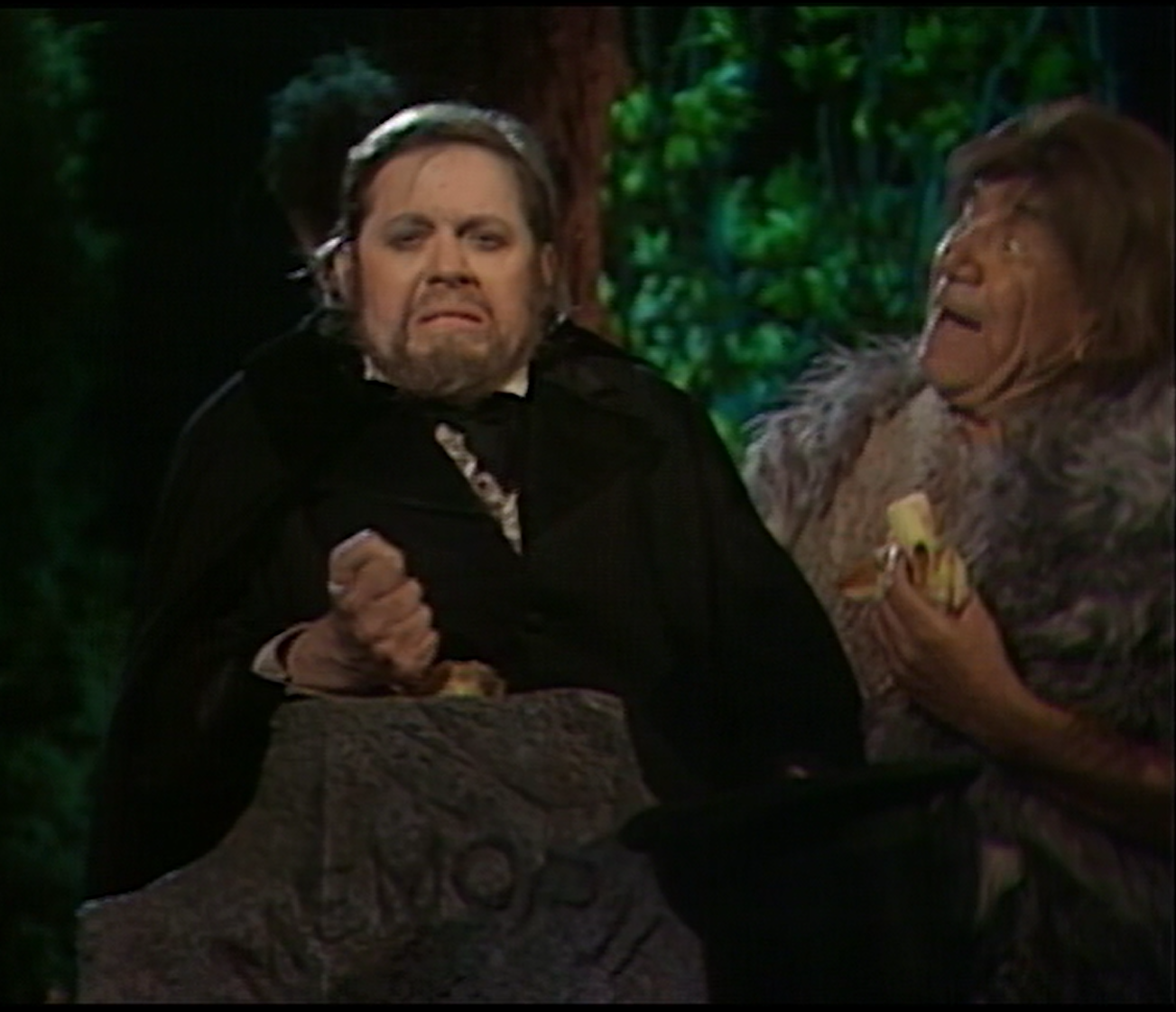
In the final episode of the Saturday morning series The Ghost Busters, the evil Dr. Centigrade (Ronny Graham) materializes with his sidekick, the Abominable Snowman, in the local graveyard. 

Everything the Abominable Snowman touches turns to ice, so he needs the heart of a warm-blooded human to replace his own.  

Dr. Centigrade determines the perfect candidate: Spenser!

Zero (Lou Scheimer) assigns the Ghost Busters to take down the ghostly duo, but Spenser bumbles his way onto Dr. Centigrade’s operating table.


The Abominable Snowman certainly made the rounds on Saturday morning television. He appeared in the third and final season of Land of the Lost (1975-1977), and in Bigfoot and Wild Boy (1977-1978) too.  Here, in The Ghost Busters, he is a shaggy, innocent (ghost) creature with no menace whatsoever. 

All the evil in the episode is provided by the scenery-chewing Ronny Graham who, as Dr. Centigrade, delivers his dialogue to the camera, consistently breaking the fourth-wall.

The actual plot here is a hold-over from “Jekyll and Hyde: Together for the First Time.” That episode saw Dr. Jekyll plotting to use the personality-less Spenser for a supernatural grafting of the Mr. Hyde personality.  In this episode, Spenser’s heart is needed to give the abominable snowman new life.


As we come to the end of The Ghost Busters journey, I will confess that I have developed a grudging respect for the slapstick, immensely silly series from 40-plus years ago.  

The same jokes get repeated every single week, the plots are ludicrous, and the sets and acting are cardboard.  And yet the show breaks you down with its inanity and good-heart. 

The Ghost Busters breaks through your resistance, and you just have to laugh at its weird flights of fancy.  I don't know that Saturday mornings have ever produced a weirder program than this one. 

Saturday, May 20, 2017

Saturday Morning Cult-TV Blogging: The Ghost Busters; "Merlin the Magician" (December 6, 1975)


The ghost of the great wizard Merlin (Carl Ballantine) and his jester, Gronk (Huntz Hall), materialize in the local graveyard. Unlike most ghosts who appear there, this duo wishes only to return peaceably to “The Great Beyond.”

Unfortunately, Merlin has forgotten the spell that would take them back.  

Worse, Merlin's arch-enemy, Morgan La Fay (Ina Balin), has materialized in the present too, and wishes to destroy him.  She sets a trap for Merlin and the Ghost Busters after stealing their de-materialization ray.


“Merlin the Magician” is actually one of the more entertaining episodes of this vastly silly series from 1975, and it changes-up the format just a hair. Although we still get the obligatory ghost-and-sidekick duo, we also get a third character this time: Le Fay.  

Perhaps because of Balin’s performance, Le Fay somehow manages to seem more legitimately threatening to the protagonists than do most of the monsters on the series.  She even robs the gang of its ghost dematerializer weapon.

All’s well that ends well, and Merlin and Gronk get their wish to be returned to The Great Beyond, but they certainly are friendlier ghosts than most featured in the series.


Next week, the last episode of The Ghost Busters: “The Abominable Snowman.”

Saturday, May 13, 2017

Saturday Morning Cult-TV Blogging: The Ghost Busters: "The Vikings are Coming" (November 29, 1975)


In “The Vikings are Coming,” Eric the Red (Jim Backus) and the Viking warrior Brunhilda (Lisa Todd) materialize in the local cemetery hoping to prevent their (unseen) enemy, Lothar, from planting his flag on this new territory.

Now they just need to find their own banner to plant.

The Ghost Busters are on the job, however, and send the Vikings back to the Great Beyond using the ghost materializer, giving the ghosts an inept variation of a Viking funeral.


“The Vikings are Coming” features Jim Backus -- Mr. Howell of Gilligan’s Island (1964-1967) -- as a Viking warrior.

Let that description settle in for a while.

The episode is absolutely as ridiculous as that casting suggests. His casting makes one wonder why almost every guest star on the series is well-into-middle age.  Backus doesn't exactly have what we might think of as a Viking physique, or mind-set.

Backus can also be seen in an episode of Filmation’s Ark II (1976), “The Cryogenic Man.”  Here, he chases the Ghost Busters through a variation of the series’ running “corridor” joke.  Another running gag sees Brunhilda blowing a Viking horn in close proximity to him, causing him immense pain.


Next week: “Merlin the Magician.”

Saturday, May 06, 2017

Saturday Morning Cult-TV Blogging: The Ghost Busters: "Only Angels Have Wings" (November 22, 1975)


In “Only Angels Have Wings,” The Red Baron (Howard Morris) and his grease-monkey, Sparky (Robert Easton), materialize in the local graveyard and need a new plane.  

They wish to take revenge on the British pilot who shot the Baron down in World War II: Lord Smedley Hargrove.

Unfortunately, Spenser is a descendant of the British flyer, and so the ghosts' revenge focuses on him.


The (extreme) budgetary limitations of The Ghost Busters (1975) come into play a bit in this week’s episode. 

In particular, there are scenes here in which the ghosts of The Red Baron and Sparky ostensibly take flight in a plane, and attack Tracy, Spenser and Kong.  

We never see the plane, even once, only actors pointing towards the roof of the sound-stage.  Similarly, the finale involves Spenser downing the plane by throwing split pea soup (as thick as fog!) at it.  

Again, we don’t actually see the plane crash, or come down.

This week’s ghost is not a silver screen monster, either, but a famous historical figure. We have seen this aspect of the series formula before, with “They Went Thataway,” an episode about Billy the Kid.  At least when the monster ghosts are inept fools, no real person's memory is being slandered.


Fans of Mystery Science Theater 3000 will recognize Sparky as Robert Easton, an actor in two films skewered by the Satellite of Love: The Giant Spider Invasion (1975), and The Touch of Satan (1971).  

Outside that singular honor, Mr. Easton had a diverse and impressive acting career, appearing in Star Trek VI: The Undiscovered Country (1991) and playing a character called Sparks in Voyage to the Bottom of the Sea (1961).


Next week: “The Vikings Are Coming.”

Saturday, April 29, 2017

Saturday Morning Cult-TV Blogging: The Ghost Busters: "Jekyll and Hyde: Together for the First Time!" (November 15, 1975)


In "Jekyll and Hyde: Together for the First Time,” the ghosts of Dr. Jekyll (Severn Darden) and Mr. Hyde (Joe E. Ross) materialize in the local cemetery and begin their search for someone without a real personality.

That person, they have learned, can be attached to “Hyde,” freeing Jekyll from his alter ego permanently. 

The person they choose for this honor: Spenser (Larry Storch).

The Ghost Busters retrieve their newest assignment from Zero (Lou Scheimer), and learn they must stop the villainous duo. 

But Jekyll and Hyde require just one personal item from Spenser before they can make their supernatural transfer...


The characters of Jekyll and Hyde -- straight from Robert Louis Stevenson’s 1886 novel -- get a strange update indeed in this episode of Filmation’s wonky live-action series The Ghost Busters (1975). 

Dr. Jekyll is portrayed as the real villain of the duo, rather than as a proper gentleman whose dark side is manifested. And Hyde is quite oddly portrayed as a bumbling cave-man rather than as a legitimate figure of evil, a repository for all human vices and dark impulses


Severn Darden plays Jekyll. Of course, he is a familiar presence to fans of Conquest of Planet of the Apes and Battle for the Planet of the Apes, wherein he played the villain, Kolp. 

Joe. E. Ross may not be as well known to today’s audiences, but he (infamously) portrayed a cave-man named Gronk in the sitcom It’s About Time (1966-1967) from Gilligan’s Island creator Sherwood Schwartz. Ross resurrects his cave-man act for The Ghost Busters, and is similarly garbed as well.

I suppose the creators of the program decided that Hyde could not be too menacing, and so made him a primitive counterpart for Jekyll, rather than an evil one.

One big question about this episode involves the writer’s description of Spenser as lacking a personality. This is a guy who always wears a zoot suit, essentially, works hand-in-hand with a gorilla, and demonstrates outright terror at the drop of a hat.  


I wouldn’t exactly describe him as lacking a personality. Love him or hate him, I’d say that Spenser is pretty unforgettable.


Next week: “Only Ghosts Have Wings.”

Thursday, April 13, 2017

Cult-TV Movie Review: Satan's Triangle (1975)


“Within the last thirty years just off the east coast of the United States, more than a thousand men, women and children have vanished from the face of the Earth. No one knows how or why. This is one explanation.”

-Title Card, Satan’s Triangle (1975).


A coast guard rescue copter out of Miami flies to the dead center of the Devil’s Triangle in response to a distress call from a yacht, the Requite. Aboard the copter are pilots Lt. J. Haig (Doug McClure) and Pagnolini (Michael Conrad).

They soon find the yacht adrift in the Triangle, with the corpse of a Catholic priest, Father Martin (Alejandro Rey) swinging from the main mast. When the helicopter begins to develop engine problems, Haig decides to board the ship, and Pagnolini returns to port for repairs..

Upon exploring the dark vessel, Haig discovers more oddities. In one room, a corpse seems to be levitating in mid-air, his face frozen in terror.

The only survivor on the yacht is lovely Eva (Kim Novak), a prostitute who tells Haig her strange story. She reports that the yacht encountered Father Martin, adrift and alone.  Once the priest came aboard, however, the crew abandoned ship, leaving only the captain (Ed Lauter) and the passengers. 

Then, one at a time, the passengers -- including the man that Eva was with -- began to die horribly, and some in apparently supernatural fashion.

Haig is a non-believer, however, and refuses to believe that the Devil is at work in these waters, even though Eva warns that “there is no way off this damn boat.”

Haig is able to convince her that there is no supernatural intervention by providing logical explanations for all the deaths, even the one involving a levitation (the man is speared on a sword fish…).

Eva acquiesces, and the couple make love.

Soon, Pagnolini returns to rescue the survivors. But aboard the helicopter, J. Haig experiences his first face-to-face encounter with the Devil…


Satan’s Triangle (1975) is another one of those weird and wonderful made-for-TV movies of the 1970’s that is scarier than it has any right to be. 

Satan’s Triangle is scary beyond the meager resources that went into its making. It is scary despite the network restrictions on violence limiting filmmakers working in those years.  It remains scary, even though audiences realize the TV-movie is also, oddly, hokey.

When I study the made-for-TV film today, I assess that it works so well, in part, because of the film techniques it utilizes. 

Satan’s Triangle is in no way, shape or form a found-footage film, but nonetheless there is an almost documentary feeling to the film’s early scenes. The camera is perched in control rooms, in cockpits, and it captures all the action without much by way of dialogue or overly theatrical acting. In these early sections, artificiality is reduced.


Satan's Triangle, at first, feels more like a movie documenting the Coast Guard and a rescue mission than it does a movie about the devil. When Haig takes a rescue basket (via winch) to the deck of the stranded yacht, the camera captures it all in one long take, and water even splashes on the lens several times.  The characters don’t comment much, or talk unnecessarily, and so we are left to assess the images alone for their verisimilitude.

These moments hold up to scrutiny.

On the soundtrack, meanwhile is a weird, ubiquitous howling sound. Is it just the wind? Or is it…Satan?

The pseudo-documentary feel by director Sutton Roley changes once Haig is inside the ship; in the belly of the beast, as it were. The movie suddenly takes on a more overt (and theatrical) “haunted house” feel with dim-lighting, strange noises and odd occurrences. The appearance of the levitating body, for example, is quite shocking. 

There’s one amazing shot here in which the (levitating) face of the deceased man -- face frozen in a rictus of terror -- is perched in the foreground, and Haig and Eva are in the background. It’s a super-imposition of terror, and evil, over normality.

The movie also attempts to craft a legitimate theme, arguing rationality vs. irrationality. The script ultimately comes to explain every “supernatural” event as a factor of the natural world. The blow-back from firing a flare gun is what knocked Father Martin from the mast, and killed him.  The “levitating” man is just speared on a fish, suspended by the sword. Even the crew disappearances are explained (via speculative flashbacks.)

In short, Satan’s Triangle goes to great pains to establish that the world is not an irrational, supernatural one.  It may even convince you.


Until the bottom falls out.  

Until the movie collapses -- or perhaps ascends -- into a final scene of bizarre, utter madness. Haig finds that he has returned to the helicopter not with Eva but with the Devil.  Eva's body has been discovered on the ship with the rescuers. Instead, the pilot has brought the devil to the helicopter, in the form of Father Martin.

The Devil then attacks, and events descend deeper into chaos.  This denouement features a real dream-like, or more appropriately, nightmare-like quality.  Again, this third act functions as a very strong contrast to the almost-documentary feel of the movie’s start, and is thus doubly effective.


There are no real special effects to speak of in the finale, except an exceptionally nice stunt fall, as Haig is driven by Satan from the copter to the ocean far below. Instead of effects, the movie relies on Conrad’s ability to convey terror, and Rey’s expressive capacity to depict bug-eyed evil.

It all works perfectly.

I have peers, particularly a brother-in-law, who saw this film on ABC on January 14, 1975, and swear, to this day, that Satan’s Triangle is the most terrifying movie they’ve ever seen. Having not seen it as an impressionable child, I don’t know that I would make exactly the same claim.

Instead, I’ll just say that Satan’s Triangle, a low-budget, 74 minute made-for-TV movie, is eerily effective, and surprisingly well-made.  The film techniques save the day or at least this is "one explanation," for the movie's cult-status.

Tribute: Dr. Howard Margolin

The voice of science fiction has gone silent. I woke up today to the sad news that my friend, Dr. Howard Margolin, has passed away.   Howard...