Showing posts with label ShatnerDay. Show all posts

Saturday, March 22, 2025

Shatner Day: Mission Impossible "Encore"


"Encore" is one of the most audacious installments of the entire seven season run of Mission:Impossible (1966-1973). At times, the premise of this sixth season episode beggars beliefs, but at other times, the execution is so convincing that the audience buys the whole thing.

In "Encore," William Shatner guest stars as a gangster named Kroll who, nearly forty years earlier, committed the murder of a rival mobster, Danny Ryan. Kroll hid the body, and weapon used to kill him, but nobody knows where.  

Accordingly, to this day, no one has been able to pin the murder on the powerful Kroll, or his partner, Stevens.  Worse, to maintain their "innocence," Kroll and Stevens have been murdering all the witnesses to the crimes, arranging accidents for them. Their latest victim is a little old lady in a hospital.  Kroll and Stevens blow up her room in the hospital to keep her from talking.


Enter the IMF. 

Jim Phelps (Peter Graves) hatches a plan to turn back the clock. Using a potent combination of make-up, medicine, and a studio lot, the IMF endeavors to make Kroll believe it is 1937 again, and have Kroll relive the crime -- the murder of Ryan -- that they wish to solve, and nab him for.  They hope, in the exact recreation on the lot of his home in Long Island, Kroll will make sure history happens twice, and show them where he intends to hide Ryan's body, and the gun,

In previous (and later) episodes of this stellar series, the IMF has tricked "marks" into believing they have been in comas, encountered ghosts, been cured of diseases, stranded on a desert island and other wild outcomes, in order to glean important information from them. In "Encore," however, the IMF must perfectly recreate an era half-a-century gone. If one detail is wrong, the plan fails.  If one example of modernity is seen, the mission fails. If Kroll makes it off the studio lot, the plan fails.

More than any of that, even, the team must convince an old man that he is young again, both in appearance and stamina. It's a tall order. They are asking not only his mind to sabotage his sense of reality, but his body to do the same.

Doug (Sam Elliott), in his final appearance on the seires uses medicine to temporarily stop the pain in Kroll's aged, bum knee, and provides him a latex mask of youth that will last, precisely, six hours.  

All the details must be perfect in the studio lot version of 1937, and at one point Jim Phelps sees an "extra" wearing 1970's style sun-glasses and rips them off his face abruptly.

Adding tension to "Encore," Kroll's partner, Stevens, is aware that he has been kidnapped, and on the look-out for him. So the IMF team must get Kroll to reveal the location of the body, and they have two deadlines. First is the six hour make-up duration. The second is the circling Stevens, getting ever closer to the movie lot.


A few things make this audacious episode work, and, finally, feel believable. 

The first is William Shatner's brilliant performance as Kroll. He doesn't let the gangster fall for the trick at first.  That would make him seem gullible, and an easy mark. Instead, as the IMF team walks the mobster through a series of "clues" that make 1937 seem real, Kroll relents, but a little at a time.  A great moment occurs mid-way through the story when Kroll hears a plane flying by overhead, from his apartment.  He looks up from his window, and sees a plane above.  Amazingly, it is a plane appropriate to the 1930's era.  In other words, it is not a flaw in the plane, it is part of the plan! Phelps has thought of everything, including stopping flyovers of modern planes, and providing for the flyover by the older plane.  This meticulous detail, one can see on Shatner's face, is the thing that sells the idea of Kroll time traveling back to 1937.  Who would possibly go the trouble of having an era-accurate plane fly overhead, apparently at random?

Only Jim Phelps, who apparently has a huge budget to run his intelligence ops, given what he pulls off in "Encore."  Think about it. There's the plane flyover. There are dozens of extras. There are 1930's era cars. There's the complete make-over of two city blocks on the studio lot. There are the perfectly timed tape recordings of 1937 baseball games for the radio, and more.

But it is the denouement of "Encore," perhaps, which makes the episode so memorable in this M:I canon.  Jim, Barney, Willy and Casey get the information they need, and evacuate the studio lot, along with the extras who have been cast as 1930's denizens. After fingering the spot where he hid the body, Kroll walks out into a deserted metropolitan street. In minutes it has gone from bustling metropolis to ghost town. This is revealed in a stunning pull-back.

Kroll begins to realize what happens, and starts running, to escape the lot. As he runs, the medicine Doug gave him wears off, and he starts to limp, hobbled again by old age.  Then, the make-up on his face begins to melt, and he is fully restored to old age, and to the present  At just that moment, Kroll's partner, Stevens, finds him, and both men realize, without saying a word, the "impossibility" of the trap that has snared them.  It's one of the most colorful and satisfying conclusions in the sixth season of Mission:Impossible.


"Encore" is a controversial episode of this series, because for some, it is really about mission or format creep near the end of the series' long run.  They see the episode as an example of the series running out of good ideas.  Most stories in the canon, after all, are grounded far more clearly in reality. The plots are usually based on playing the mark's assumptions against him  or herself, and therefore psychological in nature.  

By contrast, the plan in "Encore" is big, bold, brassy and wild.  But the 1930's details, and the great (and largely forgotten) Shatner performance make this "mission" an unforgettable hour.  I would argue this episode isn't representative of mission creep, rather some kind of go-for-broke example of creative inspiration.

Shatner Day: Twilight Zone: "The Nick of Time"


With all the bad and scary going on in the world right now, this week, at least, is an opportunity to celebrate something wonderful, the great William Shatner's 94th birthday! 

We'll start here, with a Twilight Zone episode starring the Shat: "Nick of Time."

"Nick of Time" is a Richard Matheson story, and one of my all-time favorite installments of the 1959-1964 Rod Serling series, The Twilight Zone. There are flashier shows, there are scarier shows, but I really enjoy how ambiguous this story is.

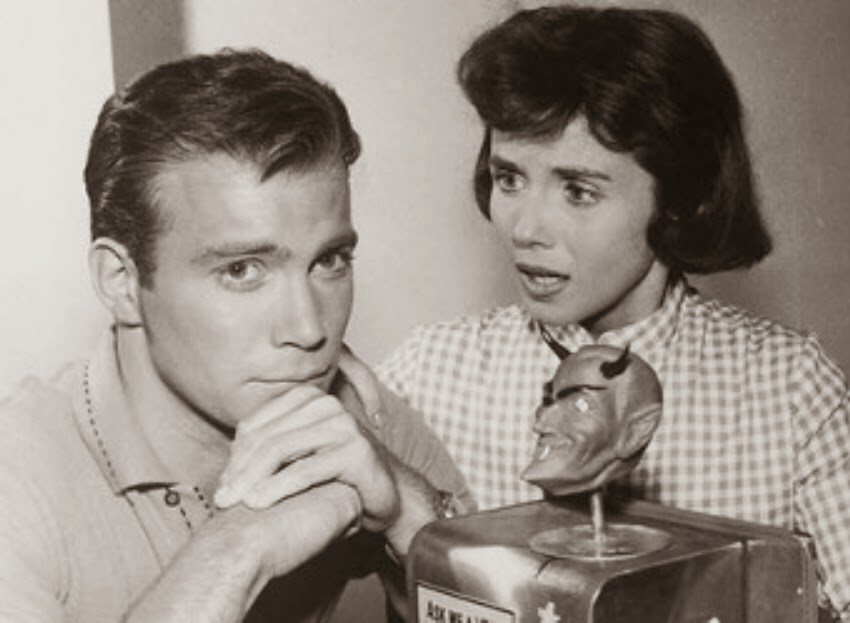
"Nick of Time" is the story of Don S. Carter (William Shatner) and his new wife, Pam (Patricia Breslin). Their car has broken down on their honeymoon trip to New York, and the couple is forced to make a pit stop for repairs in the sleepy little town of Ridgeview, Ohio. 

It is there, in the Busy Bee Diner, that this couple will -- according to narrator Serling -- find "a gift most humans will never receive," the ability to "learn the future." 

Why? Well, because this town and this diner rests on "the outskirts" of The Twilight Zone.

Our central character Don is an interesting guy, and Shatner's performance here is one of his best. Don's the superstitious type, with a rabbits foot on his key chain right beside a four-leaf clover. He is given to expressing himself in phrases such as "keep your fingers crossed." 

"It's like you married an alcoholic" he admits to Pam in one of his more lucid moments, aware of how superstitious he really is.

But on now to Don's unusual nemesis. It's a rinky-dink napkin dispenser with a Devil Bobblehead perched on top. It's the "one cent" "Mystic Seer," a fortune telling-device that for one penny will read you your future. It does so by ejecting little cards that cryptically answer yes or no questions.

Sounds harmless enough, right?

Not so fast...

First, the machine accurately predicts that Don will get the promotion he's been waiting for. 

Then it reports that the couple's car will not take four hours to be repaired, as was told the couple.

 Don grows ever more convinced that the "gizmo" is actually telling him his future. "Why was it so specific?" He asks Pam. "Every answer seems to fit," he insists. 

Pam isn't so sure.

And then things get really spooky. Don asks the machine if something will happen to the couple if they leave town. The answer: "if you move soon." 

He then asks, "should we stay here?" 

The answer: "that makes a good deal of sense." 

Finally, Bob interprets a message from the Devil Bobblehead to mean that he and Pam shouldn't leave the diner until after 3:00 pm that afternoon.

Pam objects and forces Don to leave the diner. At one minute to three, on the street outside, they are nearly run over by a speeding car...

Convinced and stubborn, Don returns to the diner and begins asking the Mystic Seer more questions, even though Pam begs him not to. "You made up all the details, and all that thing did is give back generalities," she tells him. 


He still won't leave. Not until his new wife tells him that the machine is running his life, and that she can't be married to a man who "believes more in luck and fortune" than in himself.

Don and Pam escape this trap, what Serling terms "the tyranny of fear and superstition," but in the episode's final shot, we see that another couple isn't so lucky. "Can we ask some more questions today?" They ask the machine.

"Do you think we might leave Ridgeview today?"

"Is there any way out?"


So again, in the most wonderful and entertaining terms imaginable, The Twilight Zone has presented us with a morality play of sorts, one about human nature.

Yet what's so enjoyable about "Nick of Time" is that we don't know whether Don is right (and the Devil machine is predicting the future), or if, in fact, he's merely superstitious and all the right answers are mere "coincidence" as Pam suggests. 

The ultimate point is, I suppose, what you choose to believe in: fear or hope. You can choose to believe that you are small and in danger; or you can take control of your life and face the hardships with strength,  and with the ones you love at your side.

Beyond a fortune telling device that may or may not be supernatural, there is no overt fantastical element in this installment of the Twilight Zone and yet it is oddly effective, and affecting despite this fact. 

Visually, it's assembled in clever fashion by director Richard Bare. The first shot of the episode is a wobbly view from a tow truck bed, looking down from a high angle at the car being towed, with Don and Pam inside. This is an important view, because it establishes right from the beginning of the episode that Don is not "driving" his life (nor his car). He's simply being pulled in one direction or another, towed by his fear and superstition.

Later, when the couple first enters the Busy Bee Diner with the Devil Bobblehead/Mystic Seer, the camera views Don and Pat from the far side of a lattice-work room separator/divider, a sort of visual frame-within-a-frame signifying entrapment or doom. 

This same camera set-up recurs at several important moments in the show. 

The first time, we view two other local residents in thrall to the Mystic Seer at the dining booth, also through this "entrapment" lens (the criss-cross frame of the lattice).

Finally, when Pam encourages Don to summon his inner courage, the shot has changed to reflect their strength. The lattice wall is no longer between camera and character -- a visual obstacle and blockade -- but rather behind the characters. They have escaped the trap. They have moved literally past it.

I also get a kick out of the extreme (and I mean, EXTREME) close-up shots of the Devil Bobblehead, always jittering ever so slightly but nonetheless playing his Satanic cards close to the vest. He's an interesting villain because he's inanimate and yet we "impose" some sense of fear or personality on him.


If it were just a napkin dispenser, minus the Bobblehead, this episode wouldn't work nearly so well.

Shatner's performance is so good because he plays a character suffering from a lack of confidence. That's funny, given that he's the guy who plays Captain Kirk, but I would argue that even there, in Star Trek, that's the quality that makes the character work so well. Kirk is a human being, a leader of men, but he still second guesses himself ("Balance of Terror") or fears losing his job ("The Ultimate Computer"). 

Watching early Shatner performances you get a sense at how deft the actor is in playing a likable yet vulnerable character. He doesn't quite reach the heights of hysteria in "Nick of Time" that he would achieve later in "A Nightmare at 20,000 Feet," but the script calls for different things. I really like Shatner in this kind of every man persona. To me, he represents the perfect 1960s young male: a self-aware, intelligent, resourceful, JFK-type with just enough self doubt and neurosis to make him thoroughly disarming.

I find it fascinating that Shatner's two Twilight Zones and one Outer Limits ("Cold Hands, Warm Heart") place the actor in the thick of a couple relationship in crisis. He's always playing a husband dealing with something terrible, and trying to convince his wife that he isn't insane. Gremlins on planes, Venusians on "Project Vulcan," or a fortune telling machine that may be the Devil Himself. 

CULT TV FLASHBACK: Dead of Night (1994-1997)

This year, Dead of Night: The Complete Series , was released on Blu-Ray by Vinegar Syndrome , and I just had the pleasure of falling into i...