Showing posts with label 1993. Show all posts

Friday, October 27, 2017

The Thing-a-Thon: The X-Files: "Ice" (1993)


The X-Files episode “Ice,” which first aired on November 5, 1993, is a sterling tribute to one of the science fiction genre’s greatest short stories: Who Goes There? (1938) by John W. Campbell.  

As I wrote about earlier in the week, that novella is set in Antarctica and involves a group of scientists who discover an alien ship and pilot that have been trapped frozen in the ice for twenty million years.  When thawed out, the extra-terrestrial pilot is revealed as a dangerous shape-shifter, one who can “hide” in human and other biological forms. 

In the end, the alien invader is barely stopped (with just a half-hour to spare…) before it can escape isolation and reach (and contaminate...) the rest of Earth’s population.

“Ice,” written by James Wong and Glen Morgan and directed by David Nutter, remains a notable variation on the Campbell theme, one bolstered by some unique, even trademark X-Files twists.  

In fact, this episode might be Exhibit A in terms of my theory about the Chris Carter series as a whole; that it deliberately re-purposes commonly told tales in the genre and then imbues them with new meaning and relevance for the 1990's.

From Campbell’s source material to "Ice" we see a similar location (an ice-bound installation), a similar threat (an alien life-form) and even the presence of a dog as an infection vector.  

But “Ice,” uniquely, develops in an original fashion because in The Thing, for example, there aren't many close relationships or friendships on the line.

Instead, the story has been interpreted frequently as a comment on man’s alienation from his fellow man.   

Nobody trusted anybody in John Carpenter's The Thing because nobody really liked or even knew anybody else. Hidden inside a man's skin, the Thing was indistinguishable from man.  

What does that say about man?

It's alive!
The X-Files deliberately explodes that artistic conceit by landing two sets of dedicated partners or allies into the paranoia blender and then diagramming the manner in which close-relationships contend with the possibility of individual infection. The responses to this challenge are either burgeoning independence (Scully) or total abandonment of personal will in favor of the stronger personality’s will and desire (Da Silva). 

In a way, then, The X-Files amplifies the horror of The Thing.  It’s one thing to face a shape-shifter in a battle to the death when there is no one you really care for to worry about on the battlefield.  But in “Ice,” Mulder and Scully have one another to fight for, and must face the very real possibility that one of them could die or be permanently infected.  They are more "connected" individuals than many we meet in various versions of the Campbell story.

Are you who you are?

I am who I am.

In “Ice,” Mulder (David Duchovny) and Scully (Gillian Anderson) join a team of scientists including Dr. Hodge (Xander Berkeley), Dr. Da Silva (Felicity Huffman), and Dr. Murphy (Steve Hytner) to investigate the deaths of a government research team at a base in Alaska.  

The team had been digging deep down into an icy shelf believed to be a prehistoric meteor impact.  Without warning, however, the members of the expedition began murdering one another, reciting the mantra “we are not who we are.”

This phrase relates to the shape-shifting ability of the Thing, in a way. People are not who they appear to be.

After a helicopter pilot named Bear (Jeff Kober) flies the team to Alaska, Mulder and Scully discover that the previous team had found core samples containing strange alien worms frozen in the ice…from 250,000 years earlier. 

At least some of these worms have thawed out in the base, and discovered that human beings make for perfect hosts. 

While living on the excretions of the hypothalamus, these parasites also cause extreme paranoia and aggression in their prey….

Who do you trust?

An almost unbearably claustrophobic and tense hour, “Ice” is a deliberate nod to Who Goes There? and The Thing, but also a tale, ultimately, about territoriality. 

The episode’s climax reveals that two worms cannot exist in the same host…or they will kill each other.  

Similarly, the episode-long tension between Mulder and Hodge -- each looking to assert leadership -- nearly imperils everyone.   Both men believe they are right in their belief-system and engage in a kind of paranoid “pissing” contest, trying to swing the allegiances of the other team-members to their viewpoint. 

There’s even an amusing scene here where the men must strip down naked to check each other for signs of parasitic infection.  Mulder jokingly reminds everyone that they are in the Arctic, a not so-subtle joke about penis size.

But joke or no joke, the matter of which man possesses the “biggest dick” -- to state it inelegantly -- is  a sub-text in this particular tale.  Once you make the thematic connection, it’s intriguing to see how the “territoriality” theme mirrors the infection theme.  A terrified Bear asserts control of the situation early on, since he is the only person capable of flying the plane, and he stakes out a command position early.  Simultaneously, he is the first infected by the alien organism.   Power and infection are definitively linked.

Then, after Bear dies, the battle of wills moves over to Hodge and Mulder.  Soon, nobody is certain which of them, if either, is infected. In the end, we learn that neither man was infected, only that each was driven (by adrenaline? by testosterone? by ego? by all three?) to attempt to take charge of the situation. 

Why were they so aggressive, if neither was actually infected?  Is it simply the human condition?

Why can't these two get along?

Why can't Mulder and Hodge?

Just remember, we're in the Arctic...
The underlying social commentary, then, seems to concern man's capacity for self-destruction, particularly if he doesn't get his way. This quality impacts even the usually sensible (and sensitive) Mulder. What complicates this issue of territoriality, and what is explored rather fully in “Ice” is the notion of allies, friends and subordinates in such a dynamic.

Dr. Da Silva is Hodge’s ally, but treated like a subordinate, and Scully is Mulder’s ally and equal.  Neither woman is truly impartial or on the side-lines,  but Hodge bullies Da Silva to see things his way, and acts in a borderline abusive fashion in his treatment of her; thus keeping her in line.

Scully -- recognizing the weight of evidence against Mulder at one point -- backs Hodge over her partner.  She never gives up on Mulder, and finds way to protect him, but she is able to weigh the facts…and the facts seem to go against Mulder's perspective.

Unlike Da Silva, however, Scully is not cowed into making a decision by either Mulder or Hodge.  Instead, she studies the available facts and makes a logical decision, to Mulder’s dismay, since her choice doesn’t favor him in the short term.  Scully thus becomes the de facto leader because she is able to bridge the gap between parties.

Scully also must face the difficult possibility that Mulder, because of infection, has become a murderer and a psychopath.  One thing I love about The X-Files is that this possibility doesn’t impact Scully’s affection, feelings, or loyalty for Mulder.  She wants to protect him and wants to heal him, but to do that, she must first make certain he doesn't represent a danger to everyone. She uses science and wisdom to do so, again showcasing her finest human qualities.

Given all this dramatic material, it’s probably fair to state that what “Ice” truly involves is relationship dynamics in a difficult situation, where no clear chain of command can be respected or even determined.  

Going further, "Ice" involves the way that men sometimes behave in a crisis. Who do you choose to follow?  Why does someone, like Mulder, choose to lead?  

The elegant quality of this thematic dynamic is, as noted above, that it mirrors so beautifully the nature of the aliens  in he episode.  There can’t be two big worms (another phallic symbol…) vying for the same “command” post, or else hostility, anger, and violence will result.

Location plays a crucial role in “Ice’s” success as drama and as horror.  The episode feels like a pressure-cooker because after the first act, it never leaves the claustrophobic outpost interiors.  All versions of “Who Goes There?” are set in icy environments, and that sets up an imposing, endless sense of isolation.  Not only is there terror inside the various “Thing” outposts, but terror outside as well.  

The frozen environment will kill you too, just not as quickly as an alien invader.  

In other words, a person can’t just run outside and catch a bus to escape. The Arctic or Antarctic installation in all these production is thus a trap within a trap. Escape is simply not possible. The "monster" must be reckoned with, no delay, no negotiating.

As a title (and phsyical substance...) “Ice” is also a contrast or counter-point to the hot, passionate, aggressive behavior we witness among the dramatis personae here.  It may be well below zero outside the outpost, but inside temperatures and tempers continue to rise.

In the final analysis, "Ice" succeeds because it develops the relationship between Mulder and Scully in a clever way, by landing them in, essentially, The Thing's story. The episode intelligently re-configures this beloved horror standard, and even offers a healthy dose of social critique.  For the seventh episode of a series' first season, such depth is simply astounding.

Wednesday, July 27, 2016

Video Game of the Week: The Flintstones (Sega Genesis; 1993)


Thursday, October 08, 2015

Movie Trailer: The Last Action Hero (1993)

Tuesday, June 09, 2015

Jurassic Park Week: Jurassic Park (1993)


"If there is one thing the history of evolution has taught us it's that life will not be contained.  Life breaks free, expands to new territories, and crashes through barriers, painfully, maybe even dangerously..."

- Jurassic Park (1993)


In October of the year 1990, the Human Genome Project began mapping the DNA building blocks of humankind, and a new era of genetic science was upon us. 

As had been the case with the atom bomb in 1940s and 1950s genre cinema, this dawning chapter in man’s scientific understanding was quickly recognized by intrepid Hollywood filmmakers, and immediately recruited as a template for new silver-screen initiatives.  

Specifically, the “science run amok” horror and sci-fi films of the 1990s -- much like their “don’t tamper in God’s domain” predecessors (Them! [1954] for instance) -- explicitly concerned the idea of a new Pandora’s Box being wantonly and recklessly opened.

And once opened, that box could not be closed…or at least not easily closed. 

Thus genre cinema gave the world such DNA-based horrors as The Island of Dr. Moreau (1996), Mimic (1997) and Deep Blue Sea (1999).  The biggest blockbuster of this brand, however, was undoubtedly Steven Spielberg’s Jurassic Park (1993), a work based upon the best-selling 1990 novel by Michael Crichton.  

According to critic Malcolm W. Brown in his New York Times article “In New Spielberg Film, a Dim View of Science,” – Jurassic Park “revived” the image of Frankenstein in terms of “amoral scientists unleashing forces they can’t control.”

Furthermore, Brown concluded, the film featured an “anti-science message.”


In terms of Jurassic Park’s thematic DNA, the “science run amok” conceit was indeed powerfully vetted, and, yes, it concerned scientists unleashing forces they weren’t able to control.  

Yet the message of the film wasn’t necessarily so much anti-science as pro-responsibility.  The scientists who created the dinosaurs in the film did so explicitly for profit, and because technology made it possible.  In other words, they went climbing a dangerous mountain…because it was there.   

By unleashing the “most awesome force this planet has ever seen” -- namely genetics – the scientists featured in Jurassic Park failed to respect and heed nature itself, much as Brown’s critique suggests.  But what the Spielberg film actually seemed to seek was not a total curtailing of scientific progress, but rather some sense of modesty and judiciousness on the parts of those who chose to tamper in God’s domain. Janet Maslin got it exactly right in her review, noting that Jurassic Park involves “both the possibilities and the evils of modern science.”

Indeed, it would have been remarkably hypocritical for Jurassic Park to eschew science and progress entirely, since the film itself exists, primarily, because of advancements in technology, particularly the new special effects breakthrough of computer generated imagery.  

The film thus owes much of its power, even to this day, to its breathtaking dinosaur specimens.  These “living biological attractions” move and roar and rage with a sense of realism previously unseen in the cinema.  The dinosaurs in the film even seem to boast personalities or specific characteristics, from the nobility of the T-Rex to the cunning, cold intelligence of the Velociraptors.  For all intents and purposes, our eyes register these creatures as "alive" and no bad effects exist to undercut that accomplishment.

More to the point, perhaps, the idea underlying Jurassic Park is that “life will find a way,” and that if man chooses to play God by creating new life, he must also possess the modesty to understand that he cannot control that life, once he sets it in motion.  Science even boasts a champion in the film, after a fashion, in the voice of "rock star" mathematician Ian Malcolm (Jeff Goldblum), who hunts for some sign of restraint or modesty from the geneticists, but finds none.  His view of the world -- Chaos Theory -- provides the key to understanding Jurassic Park the amusement park and Jurassic Park, the film.

I often write here on the blog, and in my books, about how a film's visual form should reflect or mirror the content.  I consider this the highest value of the art: revealing to us in images a reflection of the film's theme or meaning. 

I admire Jurassic Park so much because Spielberg understands this dynamic perfectly. Many compositions in the film as imagined by the director showcase the idea of technology as the "monster" to be reckoned with.  Since the film concerns the dangers of relying on technology without first judging technology in terms of how it affects the surrounding landscape, this approach is appropriate.  

But lest this approach sound preachy or heavy-handed, Spielberg leavens Crichton’s jargon-laden narrative – one highly reminiscent of Westworld (1973) – with large dollops of visual humor and roller-coaster ride tension.

In short, for all its debate over modern science, Jurassic Park remains a great entertainment: a thrilling, action-packed movie that, while never quite possessing the same cutthroat mentality as the book, nonetheless boasts some unbelievably suspenseful moments.  The T-Rex attack on a tour caravan by night and the hunting of two children in a kitchen by a tag-team of Velociraptors leap to mind in this regard. 

These scenes retain surprising power, more than twenty years after the film was released. The powerful idea underneath those images is quite resonant: what if man "recreates" with science a being with the power to usurp him, to replace him on the food chain?  The T-Rex attack, and especially the Velociraptor hunt remind us that except by a quirk of destiny, dinosaurs may have "ruled the world."  

 Is man so foolish and imprudent a creature that he could undo that favorable destiny, even after God "selected" dinosaurs for extinction?

“Creation is an act of sheer will.”


On Isla Nublar, an island close to Costa Rica, InGen CEO John Hammond (Richard Attenborough) has harnessed cloning technology and genetic engineering to create a new breed of dinosaurs.  

Utilizing dinosaur DNA found in mosquito corpses trapped in amber -- and filling in the sequence gaps with frog DNA -- Hammond has brought back to life specimens including a T-Rex, triceratops, brachiosaurus, and even the pack-hunting velociraptors. 

Now, Hammond wants to share his discovery with the world at large, and to that end has created an amusement park for the wealthy, Jurassic Park, where visitors can pay to see the extinct species.  However, an accident involving a Velociraptor and the death of a park worker instigates investor concerns about the safety of the park.  Hammond now needs experts to sign off on the park for his lawyer, Gennaro (Martin Ferrero), and he recruits paleontologist Alan Grant (Sam Neill), paleobotanist Ellie Sattler (Larua Dern) and mathematics expert and chaotician Ian Malcolm (Jeff Goldblum).

These experts are joined at the park by Hammond’s grandchildren, Tim (Joseph Mazzell) and Lex (Ariana Richards), but the first tour goes badly when a high-tech saboteur, Nedry (Wayne Knight) de-activates the park’s safety systems in hopes of stealing trade secrets.  The dinosaurs, including the T-Rex, escape their paddocks as a dangerous storm washes across the island

While Dr. Grant, Tim and Lex attempt to stay alive in the wild park, the others work to re-boot Jurassic Park’s computer systems, a task which is made exponentially more difficult by the fact that the clever – and merciless – velociraptors are now free to hunt.

“You think they'll have that on the tour?


From Jurassic Park’s opening scene, director Steven Spielberg reveals his penchant for visual humor, but importantly, visual humor that buttresses or reflects the movie’s theme.  

As the film opens, for example, we see a group of nervous, armed men standing in a nighttime jungle.  From their expressions, we know that they now face grave danger.  The film then cuts to shots of trees rustling, and leaves swaying as something unseen moves through the shadowy foliage at a high altitude.  

Importantly, this is a shot that, if you boast any familiarity with monster movies, is quite commonplace.  

You’ll see it in Guillermin’s King Kong (1977), for instance, just as Kong is about to appear for the first time and take Dwan (Jessica Lange).  It’s the trademark moment when the monster is about to be revealed, standing high above man, coming into a clearing for his first close-up, essentially.


And yet what emerges from the jungle in Jurassic Park is not a biological monster or beast, as we would expect.  Instead, it’s a man-made machine -- a dinosaur paddock or container -- on a crane.  This shot is our first indication that the dinosaurs are not the true monsters of Jurassic Park.  Rather, that honor goes to technology or science that has been allowed to run amok.


This leitmotif is carried on throughout the film, in a variety of ways.  The protagonist, Alan Grant, for example, is a proud technophobe.  “I hate computers,” he announces early on, and this point of view is reinforced by his experiences on the island.   When Alan is on the amusement park tour, for instance, the computers don’t fail, but the electrified fences do, meaning that dinosaurs are free to escape and endanger him.  He is constantly, throughout the narrative, being imperiled by products of technology, from DNA-enhanced dinosaurs to failed security systems.

Also, during the height of the film’s climactic action, a Velociraptor jumps up on a table in a control room, and bright images from a computer monitor are reflected upon its face.   Superimposed over the dinosaur’s visage, specifically, are the letters representing DNA code: A, C, T, and G.   This shot expresses well the nature of the dinosaur: he's man made; science made.

Once more, the message is clearly that these dinosaurs are not the source of the danger themselves, but that the unrestrained, irresponsible science that created them represents the true menace.  I must admit that I deeply love this particular composition (pictured at the top of the review), because it declares in one still what Jurassic Park concerns: danger created by overreaching science.  You can't blame the animals for being what they are; but you can blame amoral science for bringing these dinosaurs back into the mix.


Genetic science isn't the only kind of "progress" that gets tweaked in this Spielberg film.  In short order, Jurassic Park invites us to peer and gawk at virtual reality gloves, CD roms, driver-less cars and night goggles, even.  The idea seems to be that -- at the time of the film -- we were on the verge of taking a giant step forward in terms of our understanding and application of technology.  We were either going to go forward responsibly and carefully, or chase recklessly behind our science, “just racing to catch up,” as Alan Grant worriedly notes.  Again, it should be noted that this thematic through-line needn’t be seen as being merely anti-science, rather one in favor of the notion that human morality should dictate our scientific investigations.  We must control our tools, not let them control us. 

"Spared no expense," Hammond's near-constant refrain isn't a statement of morality, after all. It's a statement noting that all available resources were utilized.  Thought was not given as to whether they should have been utilized on this endeavor in the first place.  


Still, Hammond in the film, a man much softer and friendlier than his counterpart in the novel, boasts good intentions regarding his amusement park.  Although yes, he wants to make money, what he seeks more deeply is the respect of his audience.  After starting out creating “flea circuses,” he feels desperate to create an attraction with inherent value or merit, hence the dinosaurs of Jurassic Park.  But Hammond has allowed his own insecurities to take over his good sense. He has let his desire to please others short-circuit his sense of  moral responsibility.  Finally, even he can't endorse his own park.  


If "creation is a sheer act of will," as Jurassic Park suggests, then one must pose two additional questions.  First: whose will, in particular, stands behind the act of creation?  And secondly, what is driving that sheer act of will?  Insecurity? Avarice?  If human failings stand at the need to push scientific boundaries to their limits, then we’re all bound for a lot of trouble.  As James Spence wrote in his essay, “What’s Wrong with Cloning a Dinosaur,” human beings boast a “limited capacity to control our own technological innovations.”  

That's okay, so long as we are mindful of it, and take precautions, I suppose.

All of this dialogue about scientific responsibility might have come across as pretentious in the hands of a lesser director. And indeed, one on-the-nose scene with Hammond and Sattler discussing the dangers of the park does play very much that way, and should have been cut back radically. 


But for the most part, Spielberg plays lightly with the film's premise, and incorporates a number of visual jokes.  

One of the funniest, by my estimation, occurs as Lex -- sitting in the cafeteria -- spots a Velociraptor on approach.  She turns to jello, literally, even as she holds a spoon of green jello in her hand.  

The girl and the jello both begin to jiggle at the same time.


The film’s action scenes, furthermore, appear inspired wholly by Chaos Theory.  Events seem to spiral out of control, with each random event causing increasingly dangerously and random results.  Alan rescues little Tim from a car lodged in a tree, for example. They escape the car and the tree, but then the car falls to the ground…over and above them, and they barely survive.  “Here we are…back in the car,” Tim says, and the line is funny because the moment seems unpredictable and spontaneous.  So many moments in Jurassic Park actually play that way, with spontaneous incidents generating chaos and disaster.


Another great in-joke involves a T-rex chasing a car in motion.  We see the dinosaur’s toothy mouth open wide, filling the screen.  Right beneath it reads the legend: “objects in mirror are closer than they appear.”  In some way, this is another lesson about the danger of technology: it can sometimes distance us from that which is menacing...and close-by.


All these witty moments suggest to me that Spielberg had a great deal of fun making Jurassic Park, perhaps because in terms of the heavy lifting, he had a good template in the script by Crichton and Koepp.  The script was solid enough that Spielberg could direct his energy towards creating sharp-as-nail visuals, ones that actively reflected the content, and even had some fun with it.         

“How’d you do this?”


Why does Jurassic Park hold such a powerful grip on our imagination and affection, even after nearly twenty years? 

For me, I know it’s not just Steven Spielberg’s sense of directorial humor, or even the message about morality guiding scientific progress. 

No, it’s the dinosaurs themselves.  

I realize this isn’t true for younger generations, but I grew up during an era when dinosaurs on film invariably disappointed.  They never looked quite real.  Sometimes they appeared...laughable.  They never seemed to move with authenticity, or with the grace and majesty I knew they really, really should possess.

           
That all changed with Jurassic Park.  When a gorgeous, majestic Brachiosaurus lumbers across the screen at approximately the 20-minute point in this Spielberg film, the secret dream of all dinosaur-lovers is potently fulfilled.  You feel as if you are seeing a real, living, breathing creature, not an over-sized lizard projected over a miniature landscape, or a man in a suit.  No, you are seeing the regal dinosaur as it was meant to be seen.

            
I still recall the first time I saw that Brachiosaurus scene in Jurassic Park.   It brought a tear to my eye.  In rendering the dinosaurs so beautifully, so nobly, so wondrously, this film understood my unspoken dream as a dino-loving child. One I’d forgotten I’d ever even had, at that point. There’s just something so glorious, so right about the dinosaurs in Jurassic Park, especially in conjunction with John Williams’ rapturous score.  

For me, this movie felt like a destiny fulfilled, somehow.


Because there is not an ounce of phoniness in their physicality, Jurassic Park truly awes. I don’t want to lavish all the credit to the CGI, either.  Special effects genius Stan Winston (1946 – 2008) created animatronic, life-sized replicas of many dinosaurs and controlled them using cable actuation, rod-puppets, cranes, radio control, hydraulics and whatever else could sell a scene effectively.   

Amazingly, Winston’s mechanical creations blend perfectly with the digital creations of Phil Tippet and Dennis Muren at ILM so that we believe, truly, dinosaurs walk the Earth again.  This idea also gets dramatic visual punctuation in the film.  There's the valedictory image of a real life T-Rex occupying the former space of a T-Rex skeleton, as a banner reading "When Dinosaurs Ruled the Earth" flutters before him.  

In short, this is a magnificent passing of the baton, as though a new generation of special effects are supplanting the skeletons of the old one.  Certainly, these dinosaurs ruled the box office in 1993. And given their outstanding appearance, justifiably so.  When I think of Jurassic Park, I think of a tense, funny, intelligent film about "living biological attracts so astounding" that they indeed captured the "imagination of the entire planet."  

For those of us who wondered after Hook (1991) if Steven Spielberg still had it in him to re-capture the magic of Close Encounters, or Raiders of the Lost Ark, Jurassic Park was our rather definitive answer, and the beginning of a beloved movie franchise to boot.

Tuesday, February 03, 2015

Cult-Movie Review: RoboCop 3 (1993)


RoboCop 3 (1993) is the weakest entry in the sturdy sci-fi film franchise, and that tally includes the 2014 reboot (which I’ll review here soon…)

It’s not so much that RoboCop 3 features an underwhelming story, but rather that the narrative is vetted in a flat, colorless manner, with no flair or humor whatsoever. RoboCop/Murphy undergoes some major life events here -- including the tragic, unjust the loss of the only human who has consistently stood by him -- but there’s not a moment in the whole picture that feels important, or emotionally powerful. The few jokes featured in the film fall flat too, or are poorly executed.

And even the social critique is less prominent and less pointed than it ought to be. This Fred Dekker-helmed sequel is positively toothless, and that’s something you could never say about Verhoeven’s original, or even the controversial Kershner follow-up.

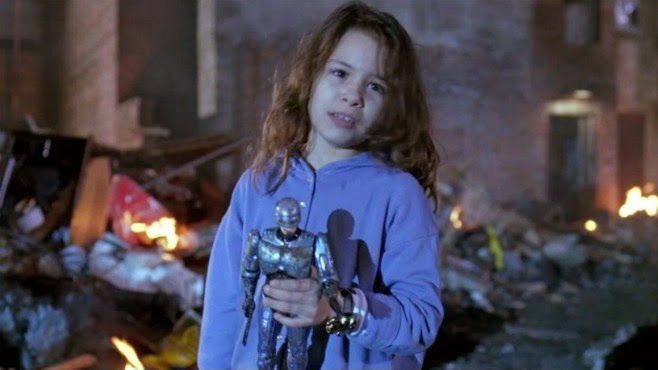
Perhaps most disappointingly, a rampant form of “kiddie-fication” has seeped into this the formerly adult franchise. The first and second RoboCops were violent, adult satires, but RoboCop 3 is abundantly kid-friendly -- and bloodless -- to its own detriment.  A major character in the tale is a little orphaned girl who saves RoboCop, and the whole subplot is underwhelming.

RoboCop 3 is only 104 minutes long, but it seems to go on forever, without anything truly interesting or original occurring.


“Driving people out of their homes is no job for a police officer.”

OCP (Omni Consumer Products) struggles under new management, and has been bought out by the Japanese company, Kanemitsu. The corporation's only chance of survival is the long-delayed Delta City; a new metropolis to rise from the ashes of crime-ridden Old Detroit.

OCP has hired mercenaries and organized them as an outfit called “Rehabilitation Services” to clean out the last vestiges of Old Detroit, particularly an area known as Cadillac Heights. There, an armed resistance has sprung up among the people.

When RoboCop (Burke) and Officer Lewis (Allen) join the ranks of the resistance, Kanetmitsu sends robo-ninjas called “Otomo” to assassinate the cyborg.  Meanwhile, Lewis is killed in cold blood by McDaggett (John Castle), leader of Rehabilitation Services.

Badly wounded, RoboCop is nursed back to health by his friend, Dr. Lazarus (Jill Hennessy), and by a computer-minded orphan, Nikki (Remy Ryan). 

Once back to full strength, RoboCop utilizes a jet-pack to take the fight to OCP…


“Stay here. Fight for your home. There is no silver lining.”

The first thing to note about RoboCop 3, perhaps, is that some of the franchise's most important cast members have left the building. 

Peter Weller is gone as Alex Murphy, replaced by the satisfactory-but-not-particularly-memorable Robert Burke. And Dan O’Herlihy -- who played OCP’s Old Man so effectively -- is also gone. Nancy Allen is back as Officer Lewis, but her character is killed off relatively early in the proceedings. 

So RoboCop 3 feels a bit like going back to your family home only to learn that everyone you love has moved out. This helps to create the impression that the franchise has been downgraded from top-of-the-line to run-of-the-mill.

Certainly, budget is a problem too. RoboCop 3 is a catastrophic step down in terms of spectacle from the previous two entries.  

In RoboCop, for example, our hero went up against the amazing (and funny) ED 209.  

In RoboCop 2, Cain was also a memorable leviathan, a true menace in his giant metal armor (and Nazi-styled helmet).  

Here, RoboCop goes up against...a team of identical Ninja warriors (who happen to be cyborgs or humanoid robots).  It saves money, I suppose, to have the same actor play multiple humanoid bots.

But the cost of that "savings" is significant. 


There’s just no one here in terms of villainy who successfully holds the screen when RoboCop is missing.  

Rip Torn’s OCP CEO is a silly, inconsequential knock-off of The Old Man, and Bradley Whitford’s Fleck is a poor copy of Miguel Ferrer’s Bob Morton. Even McDaggett, the leader of the Rehabs, feels like a by-the-numbers villain all the way. Why is he evil? Why does he take such glee in killing and evicting people?  He's a sneering two-dimensional villain, but no more than that.

The sequel does introduce a unique menace...briefly. At one point, Lewis and some other Detroit officers are surrounded by freaky gang members called "Splatterpunks." After the punks are introduced (and dispatched by RoboCop), they are hardly examined by the screenplay at all, except as back-up soldiers for OCP when the cops go rogue.

Who are these guys? Why do they dress like this?  Why are the cops terrified of them?

RoboCop 3 has no answers for you.

More genuinely disappointing than any of these lapses or deficits, however, is the fact that the balance of the RoboCop world has shifted in a way that diminishes the special nature of that world.

Specifically, OCP has always sat in the cat-bird seat because of the (fictional) culture’s exaggerated adherence to capitalism. And OCP has had the media in its back pocket too. Meanwhile, the people -- going up against such corporate interests -- simply can’t fight back. In some sense, OCP is unbeatable because it is part of the Establishment. The whole system is revealed as corrupt because OCP is untouchable.

RoboCop -- a product of OCP -- fights crime, but, importantly, never takes down OCP, only its malfunctioning machines and law-breaking board room (ex)officers. The company survives and endures, and that’s a message about capitalism and its position of favor and entitlement in American society. 

In real life, look how well Big Business did after the taxpayers bailed it out in the Great Recession. A lot of regular folks lost their jobs, their savings, and their retirement accounts. But how many businessmen went to jail for gambling and losing that wealth?  How many huge companies went under?

In RoboCop 3, this view of unregulated business is undercut. Now OCP has an army in the streets and is literally waging war on the people.  The people have taken up arms and are fighting back.  These facts make the conflict very different in nature, and don't permit for the kind of biting satire we have seen before.  Suddenly, we’re in a much more traditional, non-satirical world, where OCP, the equivalent of the “Galactic Empire” can simply be defeated...by guns (and a cyborg with a jet pack prototype). 


My point is that the government (in this fictional world) would never let OCP fall. It’s too big to fail. OCP would be propped up in some way by the taxpayers, and the media would be selling that idea morning, noon and night. But instead, OCP becomes just a paper tiger in the film, one to be knocked-down by freedom fighters in Detroit who are protecting their homes.

It doesn't ring true, based on the already-established RoboCop universe.

To its credit, RoboCop 3 clearly does anticipate a few aspects of the 21st century. First, it imagines that private mercenaries will be used in armed conflicts. In the Iraq War, we saw just that with Blackwater, for sure.  

And secondly, the film imagines the age of military equipment patrolling our streets; the idea of law enforcement as an army occupying American neighborhoods.

The idea was actually suggested in RoboCop (1987) when Dick Jones noted that OCP and the military were “practically” one in the same. That idea is developed here, in the 1993 sequel, and is indeed prophetic. But the point isn’t transmitted in any satirical or trenchant way.  

The media, similarly, is rendered toothless. The vapid anchor of Media Break actually walks off-set rather than believe that RoboCop is a criminal, thus totally undercutting the franchise’s criticism of the media as a tool of corporations.  

Why make a point about principled journalism here when previous movies went to great lengths to view corporate media as brown-nosing propaganda tools?

Alas, humor is pretty much absent from RoboCop 3, at least in any effective way. 

One visual gag involves RoboCop shooting an enemy’s gun repeatedly, so that the weapon bounces around in the air, like it has a life of its own. The moment looks so completely fake and unconvincing that there’s no opportunity for laughter, only derision.

Similarly, the stunt wherein Murphy rides his squad car off a parking garage roof and it lands perfectly parked in the middle of a gun battle, is edited poorly.  The angle of the car going off the roof, and the angle of the car at landing don’t fit together at all, thus acknowledging visually the physical impossibility of the stunt. When focusing on the physics, again, the desire to laugh is lost.

There are fewer funny “commercial breaks” in RoboCop 3 too, and these moments are missed. “Nuke Em” and “Magna Volt (Lethal Response)" revealed to audiences something about the larger culture, in the earlier films, in particular its sense of blood-lust.  RoboCop 3 gives us a propaganda commercial for Rehab action figures, transforming cold-hearted evictors into macho heroes. But the commercial just isn’t funny.

RoboCop 3 also makes one more unforgivable misstep. It takes away the gum-snapping, tough-talking Lewis, and replaces her, as RoboCop’s buddy, with a cute-as-a-button little orphan girl.  

It’s not a fair trade.  

RoboCop is not kid friendly, and that’s actually one of the points made in RoboCop 2.  Remember how Dr. Faxx attempted to transform our favorite cyborg into a cuddly friend of children?  RoboCop had to purge himself of that role; violently so.  

Here, however, it seems like Dr. Faxx is in charge of the movie itself, turning RoboCop into an acceptable role model, hero, and buddy.  

Why?  Was that really a story that needed to be told?


The kiddification is bad enough, but this is such a lousy story in which to lose Lewis.  What does she have on the line when she dies? Is her death meaningful? Does it add to the story, if only in terms of RoboCop's learning?  

Alas, it's difficult to answer in the affirmative.  Like every other moment in the film, Lewis's death plays as flat and unimportant.   

A beloved character dies and the film can't bother to get emotional about it.  Right there, on your screen, the movie just flat-lines.  

A deeply disappointing film, RoboCop 3 is too long and not nearly sharp enough to carry its franchise title. The next stop for the property was Canadian Television, and RoboCop: The Series (1994).

But honestly, RoboCop 3 feels like its half-way there already.  

This is the worst, most unsatisfying entry in the entire line.

CULT TV FLASHBACK: Dead of Night (1994-1997)

This year, Dead of Night: The Complete Series , was released on Blu-Ray by Vinegar Syndrome , and I just had the pleasure of falling into i...