Showing posts with label Breakaway 2018. Show all posts

Friday, September 14, 2018

Breakaway 2018: "The AB Chrysalis"


1296 Days after Leaving Earth Orbit

For two weeks, Earth’s errant moon has been approaching a series of cosmic explosions. The detonation recurs every twelve hours, and each time, Alpha is damaged more heavily. The next detonation will destroy the base completely.

The source of the explosions -- a planetary system ahead -- is discovered by Maya (Catherine Schell), and Commander Koenig (Martin Landau) launches a team to investigate.

The first world approached in that system is a small moon, where a series of mechanical stations exist. These stations are the energy-gathering devices for the recurring, man-made explosions. 

Koenig and Alan Carter (Nick Tate) speak with Voice Probe 248, an automaton who informs the Alphans that his makers -- who have not yet been “born” -- live in an inhospitable atmosphere of poisonous chlorine gas.  The explosions occur to protect the race during its chrysalis stage.

Koenig begs for an audience, and is told that “The Guardian,” the last of the race's current iteration, is currently outside the chrysalis stage, and still conscious on the planet.

Koenig and his team travel there, only to learn that the Guardian is senile, and unable to respond to their request to stop the next explosion. Carter accidentally breaks the atmospheric seal/glass on the Guardian’s chamber, threatening the alien’s life, and weakening their case for mercy.

Two of the life-forms -- A (Ina Skriver) and B (Sarah Douglas) -- emerge from chrysalis form, and Koenig must convince them to stop the next detonation, lest Alpha be reduced to rubble.


“The AB Chrysalis” is a weird and a wonderful episode of Space: 1999 (1975-1977), and one that demonstrates the possibilities of the Year Two format. The episode is colorful, suspenseful, and highly-imaginative.

Not only does Alpha encounter a race of immortal, chlorine “perfection seekers,” but also the architecture of their alien culture.  In this case, that includes their defensive system: a ring of high-tech mechanical stations that build up energy, and radiate explosions into space; a kind of galactic “keep away” measure.  


More impressively, the episode reveals the alien “Voice Probes,” a series of spherical machines that travel from interior system to interior system, “jumping” on to transparent rods or poles, to perform different functions.  

It is true that these probes are bouncing balls, filmed in reverse, with footage shown in slow-motion, but the concept is so creative and different from anything else in the sci-fi TV Valhalla that one cannot help but be impressed. When coupled with weird sound-effects, the depiction of the alien culture is remarkable.


In some commendable manner, the episode also closely recalls the more desperate Alphans of the first season of Space: 1999.  

Faced with imminent annihilation, Commander Koenig recognizes “desperation” as his motive, and tries everything -- including a futile show of force (with an Eagle laser) -- to save his people.  

Later, when he realizes he has no cards left to play, Koenig voices his frustration with the aliens, but in an act of defiance and pure humanity, comes to see that “hope is better than despair,” and loyalty (to his people; and they to him) is "better than logic."  It’s a great statement of philosophy, but more than that, a fine example of Koenig’s learning during the episode.  He acts rashly and violently, out of fear, until he realizes, perhaps, that if he and his people are to die, they must do so with their key human qualities -- hope and loyalty -- intact.

When Space: 1999 aired, it was often accused of being the pessimistic yang to Star Trek’s optimistic yin, and it is certainly clear why that was the case. 


But episodes such as “The AB Chrysalis” feature their own unique brand of optimism. That optimism states, simply, that man can find his best -- and be his best -- even in the face of seemingly hopeless odds.  

The Alphans possess no rule-book of principles, no fleet infrastructure, no real resources to fall back. Instead, they must rely on themselves, and each other.  Nowhere in Year Two, one might argue, is that bond more apparent than in this particular installment.

There’s a wonderful moment, here, for example, near the end of the episode, when Koenig must tell Helena he has failed to stop the next detonation. And worse than failing, his Eagle does not even have enough fuel to carry him home to her; so they can die together.  The characters must say their goodbyes, essentially, over Facetime, to use modern lingo.  The characters say very little, but their expressions convey everything. It's a very human moment in a show that was accused of not having enough humanity.

“The AB Chrysalis” succeeds, too, by creating, throughout its hour, all these mini-action sequences or climaxes. 

Maya must transform into a chlorine breather to save Alan from dying of the poison. Alan must pilot the Eagle straight up -- through the equivalent of a rock shaft -- with very little maneuvering room. And Koenig interacts with devices and people that are alien beyond immediate recognition or understanding. 

The story hops from dramatic moment to dramatic moment with aplomb, and shows how an action format, handled well, could have been applied successfully to the series overall.

Not all stories in Year Two manage such a dynamic, successful mix, but “The AB Chrysalis” is smart, imaginative and emotionally engaging, as well as being splendidly-realized, action-packed, and highly creative.  

For my money, it’s one of the very best installments of the series’ second sortie.

Thursday, September 13, 2018

Breakaway 2018: "Mission of the Darians"


Late during Space:1999 Year One, author and script-editor Johnny Byrne penned a memorable entry called "Mission of the Darians," the tale of the intrepid Alphans rendering help and assistance to a damaged space ark from the planet Daria.


What Commander Koenig (Martin Landau) and his rescue team discover on the colossal, nearly-destroyed spaceship, however, is a real horror. Because of a nuclear accident on board the Ark generations earlier, the Darians have splintered into two societies, two classes.

Existing on one level of the damaged ship are primitive, mutated Darians, ones who have no technology, and worship a deity called "Neman."

On another level are the technologically-advanced, genetically "pure" Darians. They are led by the likes of aristocratic Kara (Joan Collins) and Captain Neman, who exploit the unknowing primitives of Level 7 as a "resource." 

Specifically, the "pure breed" Darians manipulate the primitives' belief in God to abscond with body parts...for limb replacement surgery...and food.


Simply put, the Darians are cannibals. The upper class feeds on the lower class. 

Literally. 

Commander Koenig, Victor Bergman (Barry Morse), astronaut Alan Carter (Nick Tate) and Dr. Russell (Barbara Bain) learn about the Darian society up-close-and-personal, and Russell is herself almost used as "spare parts" in a Darian operating room.


As Johnny Byrne noted on more than one occasion, the creative impetus for "Mission of the Darians" came from a real life, disco-decade story about human nature...and survival. 

On October 13, 1972, Uruguayan Air Force Flight 571 crashed in the inhospitable Andes mountains on the way to Santiago, Chile. 

Forty-five rugby team players were on board the doomed flight. Twelve people died in the crash, and another five expired from injuries sustained in the accident. With no medical supplies, no food, and no immediate possibility of help, the survivors resorted to cannibalism, to eating the flesh of their dead comrades.

On December 23, 1972, sixteen survivors were rescued from Flight 571, suffering from acute frost-bite, dehydration, malnutrition and altitude sickness. Their harrowing story was related in the best-seller, Alive: The Story of the Andes Survivors (1974; J.B. Lippincott). Johnny Byrne later told TV Zone magazine, in relation to "Mission of the Darians" that "The Andean plane crash had happened, and I was struck by the fact that people had eaten each other to live." (David Richardson. TV Zone, Issue # 54: "Writing 1999: Johnny Byrne." Page 10, 1992.).

Later, Byrne informed me an in interview that his goal in crafting "Mission of the Darians" was not to make villains of the story's cannibals (or by extension, those who had resorted to cannibalism here on Earth.)

"They had suffered a catastrophe and were trying to survive, and so the Darians weren't evil," Byrne explained to me. "Cannibalism happens. Flesh is flesh, whether it is human flesh or animal flesh. When I wrote that episode, it had just happened [in the Andes]..."

This idea of desperate times calling for desperate measures goes back to one of Space: 1999's most important and enduring "memes," what The Los Angeles Times' Dick Adler termed "limited options for survival" in a domain where resources are scarce. 

The same writer also noted that where Star Trek had been "recklessly liberal," Space: 1999 was far more "realistic" in approach.

When I read Byrne this particular quote, he approved of Adler's observation, calling it "astute." "Space:1999 represents a very definite shift from the 1960s to the 1970s," Byrne elaborated. "It wasn't a hippie dream. It was the wake-up after the dream."

In Exploring Space:1999 I note that not one of the alien cultures encountered by the Alphans in Year One are technologically less advanced than the turn-of-the-century Alphans. As "advanced" peoples, these alien cultures thus prove examples (or teachers) for the humans of Alpha to either emulate or reject. 

For instance, In "The Guardian of Piri," Koenig rejects the Pirian manner of "perfection" because it robs humanity of its impetus to achieve.

In "Missing Link," Koenig likewise rejects the Zennite way of life because it values intellect entirely over emotions, and Koenig still believes it is "more important to feel" than to dispassionately reason. 

In Byrne's "Voyager's Return," the Alphans reject a society that has found purpose only in vengeance, the Sidons. 

And in "The Last Enemy," the Alphans encounter two humanoid races that have fallen into a state of everlasting war, and reject that outcome as well.

If, as viewers, we are to believe that the Alphans are, perhaps, being "guided" to a particular destiny (as Byrne's Year One denouement, "The Testament of Arkadia" indicates) then these particular planetary stops (Piri, Delta, Zenno, etc.) along the way are, essentially, object lessons for a species that seeks a second chance in space after the destruction of the Earth's environment/civilization following the premiere episode, "Breakaway."

In "Mission of the Darians," the Alphans receive another object lesson about survival in outer space. In particular, they are confronted with a terrible "what if" scenario that mirrors, in many ways, their own possible future. 

Without resources, and facing a long trip to a destination planet or "home," the humanoid Darians have fed on themselves, on their people, and on their people's hopes. They've even fed on their people's spiritual beliefs to assure continued survival. This "what if" situation is put into explicit perspective for John Koenig by a final question from Alan Carter.

The pilot asks his commander: "If the same thing happened on Alpha, would you have chosen differently?"

Notably, Koenig doesn't answer the question directly. "Remind me to tell you sometime," he quips, deflecting the query.

I asked Byrne specifically about this exchange, and he told me that Koenig's deliberate non-answer is particularly important. Koenig could not have chosen differently, Byrne explained, because ultimately survival is the name of the game for mankind. Even the humane John Koenig, -- if trapped in a desperate situation -- would act...desperately.

What makes "Mission of the Darians" such a powerful and enduring episode of this 1970s series, I submit, is that Byrne offered a very clever space-age parallel for the Andes story, on virtually all fronts. For instance, the survivors of the plane crash who resorted to cannibalism sometimes likened the process of eating the dead to Christianity's sacred "Holy Communion."

Likewise, Byrne's fictional Darian society -- which uses a "God" Neman and angels (men in space suits) to abduct healthy, non-contaminated members of the society as food stuffs and replacement "parts" -- incorporates this spiritual, religious angle in its narrative; though in an entirely futuristic/space-age setting.

Byrne also inventively and imaginatively takes the idea of "cannibalism" to the next level here. In "Mission of the Darians" cannibalism is not just eating the dead but harnessing the dead for personal (and species) immortality; and in a very real sense, feeding on the "hopes" and "dreams" of a people in the process. Cannibalism in "Mission of the Darians" is thus literal and metaphorical.

A very strong example of the long-lived "space ark" sub-genre of science fiction Space:1999's "Mission of the Darians" is also distinguishable as one of the program's most lavishly-designed and executed stories. The episode features impressive miniatures, gorgeous matte-paintings of the S.S. Daria, and several new live-action sets.

Byrne also remembered the episode's production values as "simply astounding," and credited director Ray Austin for his visualization of the narrative.


"Just the way it played out, I was amazed how one three-minute sequence featuring Barbara Bain and the Darian 'vetting' procedure so completely explained the bizarre food-chain of the devastated environment," Byrne reported.

Breakaway 2018: "Space Brain"


Yes, this is the (in) famous Space: 1999 (1975 -1977) that sees Moonbase Alpha’s interior overrun with…soap suds. 

Yet despite such a silly-sounding (and appearing…) menace “Space Brain” by Christopher Penfold is still pretty great. This is so because the episode intimates an alien (and ultimately impenetrable…) order to the universe, and more-so, an alien hand influencing Alpha’s journey…and perhaps not for the better.

In fact, I was so taken with the sub-text and “under”-story aspects of “Space Brain” that my first officially licensed Space: 1999 novel, The Forsaken (Powys Media; 2003), might be interpreted as a direct sequel to this episode’s events, one that seeks to address some of the mysteries presented in the televised story.


In “Space Brain” Moonbase Alpha’s routine is unexpectedly disrupted by the sudden transmission on every vid-screen of streaming alien hieroglyphs. Commander Koenig (Martin Landau) sends out an Eagle to investigate the transmission’s point of origin, but quickly loses contact with the craft. 

In short order, a second ship is sent out, but one astronaut, Kelly (Shane Rimmer) returns from a spacewalk as a changed man.  He is now the “programmed” vessel for a vast entity in space, one on a collision course with the Moon. 

Meanwhile, a small but incredibly-heavy meteorite crashes near Alpha.  Concerned about the impending collision with the larger obstacle, Koenig orders an Eagle filled with nuclear charges launched.  It is tagged to detonate at the center of the space-going entity.

As the threat progresses, Dr. Helena Russell (Barbara Bain) and Professor Victor Bergman (Barry Morse) seek to understand the threat better, and Bergman soon realizes that the meteorite is actually the crushed remains of the first eagle craft, destroyed by alien antibodies. 

At roughly the same time, Helena understands that Kelly is acting as an intermediary, relaying messages from Alpha’s Main Computer to the entity in space, attempting to avoid the collision.

After undergoing a dangerous mental symbiosis with Kelly, Koenig accepts that the entity -- the so-called “space brain” -- is a peaceful organism, and one that turns at the “center of a whole galaxy, maybe hundreds of galaxies.” 

But disaster looms when the eagle armed with the nuclear charges can’t be recalled, and the Space Brain begins to emit deadly antibodies so as to crush the Moon in the very way it crushed the first eagle spacecraft…


One of the arguments I universally make in support of Space: 1999 as a highly-visual science fiction initiative is that it functions (like Prometheus [2012], for example) on largely symbolic terrain, and its stories -- often criticized as being somehow confusing -- are crystal clear once the symbols are noted, studied and then thoughtfully interpreted. 

“Space Brain” is no exception, and in terms of both visuals and musical choices, this episode proves rather impressive, despite the onslaught of killer soap suds.

For instance, “Space Brain” opens with various scenes of Moonbase Alpha personnel relaxing off-duty, solving puzzles (and trying to beat a puzzle record).  One of the first such shots depicts Alpha’s commander, Koenig, completing a puzzle in his office. 

The puzzle itself depicts a painting by Jacque Daret (1404 – 1470), created circa 1435.  Called “The Visitation,” this work of art reveals Mary (with Jesus still in utero) visiting another pregnant woman, Elizabeth.  Art critics have interpreted Deret’s work to symbolize Mary’s role as intermediary between God and Man. 

This work of art, then, reveals, in a sense, Kelly’s role in “Space Brain” as the go-between for Alpha and the entity in space.  In both circumstances, there is indeed a “visitation” and a human being is transformed by what she/he carries within.  The shot of the painting also reveals what Koenig only learns later: that the space brain, like Mary’s God, is a benevolent one.  On a much more basic level, all the “puzzle-solving” suggests the modus operandi of the teleplay: Koenig, Bergman, and Helena must each put together a piece of the space entity’s puzzle, from the indecipherable hieroglyphs, to Kelly’s odd physical condition, to the true (and horrific…) nature of the meteor.


Late in the episode, the action is scored to Gustav Holst’s Planets’ suite, namely the movement titled “The Bringer of War.”  In terms of practicality, this music was likely seeded in to lighten the load on composer Barry Gray.  There’s a real world, production reason for its use.

And yet in terms of appropriateness and interpretation, Holst’s composition also fits in well with “Space Brain’s” themes. Specifically, Holst’s work is a seven part suite, and each part describes the “character” of that planet, and that planet’s influence on the psyche of humans.  Consider then that “war” ascends in Koenig’s mind as he prepares a pre-emptive strike with the eagle carrying nuclear charges, and only later realizes the errors of his ways.  The “Mars” composition is also scored to literal war, as Alpha falls under siege, nearly crushed by the killer antibodies of the space brain. 

Put the two artistic visions and ideas held together -- peaceful interaction or Visitation between God and man, and then all-out war --- essentially present the two main perspectives depicted in “Space Brain.” The entity wants peaceful contact. The Alphans prepare for war.  The entity opens with communication and an intermediary. Human-kind faces a puzzle (and a crisis) with plans for destruction.  The book end works of art in “Space Brain” -- Daret’s and Holst’s -- convey much of the narrative’s deeper meaning.  Ignore the imagery and the soundtrack, and you’re not getting the entire picture.

Also, I often laud Space:1999 in terms of another quality for which it is widely disliked: it’s refusal to explain every aspect of its narrative and spoon-feed the audience easy answers. 


“Space Brain” never satisfactorily explains, for instance, why the nuclear-charged Eagle remote-control guidance system should short-out, rendering the collision with the space brain impossible to avoid.  Koenig himself dismisses – in explicit dialogue -- the idea that the space brain is behind the act.  By inference, this could mean, quite simply, that a third, unseen hand, is at work in this episode.  And that hand desires the space brain destroyed for some reason.  Thus it is using Alpha as its vessel for that very purpose. 

Again, we must go back to the painting, and the idea of Visitation.  Is Moonbase Alpha being used or visited by another force, only as a bullet to the brain, for some unknown purpose?

That’s the plot-line of my book, The Forsaken. 

But clearly, Alpha’s destruction of the space brain at the conclusion of this episode must boast terrifying and cosmic ramifications.  The dialogue explains how thousands of worlds depended on the space brain.  Accordingly, I speculate that the entity was a kind of regulating factor, ensuring the stability of stars and other environments.  Thus in its absence, everything becomes unstable, unpredictable…chaotic.  If you’ve read my book, you realize that’s my explanation for the wild, out-of-control, action-oriented events of Space:1999’s second season.  The galaxy has descended into chaos, and all bets are off.

Like I said, that’s my interpretation, but it need not be anyone else’s.  What I love about “Space Brain” is that it leaves open these little intriguing mysteries, and the viewers can fill them in, interpreting the clues in a way that they see fit, and that seems to fit the facts.  I’ve done so, as I note above, but other viewers are also welcome to interpret the symbols in a different fashion.  I much prefer these open-ended, stimulating mysteries to “techno-babble” resolutions we get in latter-day space operas.


The biggest stumbling block, of course, for “Space Brain” is the visual depiction of the alien antibodies.  The foam or soap-suds don’t look like organic antibodies, but rather just like a washing machine has gone dangerously out-of-control. 

I realize that this visualization will be a deal breaker for some viewers, and I accept that fact, but it’s truly a shame because there’s a lot going on in “Space Brain” beneath the bloody foam attack in the last act.  Open-minded s.f. viewers forgive the giant ice-cream cone-shaped planet killer in Star Trek’s “the Doomsday Machine” and the panto-Myrka in Doctor Who’s “Warriors of the Deep, so I would ask (again) that Space:1999 be given the same consideration.

Going back to the possibilities inherent in “Space Brain,” I once pitched to Powys Media a novel titled “Ordination” in which a race of high priests to the Space Brain arrived on Alpha and attempted to induct Maya into their number, for nefarious purposes…the destruction of a rogue space entity like the one seen in this episode...

Wednesday, September 12, 2018

Breakaway 2018 "End of Eternity"


“End of Eternity” by Johnny Byrne and directed by Ray Austin is one of the most suspenseful, nightmarish Space: 1999 episodes produced during the series’ forty-eight episode run in the mid-1970s.  

In particular, this installment represents a near-perfect blend of cinematic visual style with a thoughtful science fiction premise involving immortality. 

Featuring strong horror overtones, the episode reveals, almost without flaw, the Space: 1999 creative aesthetic at is best.  

Simply put, “End of Eternity” depicts how visual touches -- in terms of innovative editing techniques and detailed production design-- actually buttress and express characterization, and other critical information.  In other words, the story itself -- with all its nuance and coloring -- is not contained merely in the dialogue, but in the meticulous, beautifully-wrought imagery.

“End of Eternity” commences with a team of Alphan astronauts, including Commander John Koenig (Martin Landau) exploring an asteroid that has been adrift for a thousand years.  Professor Victor Bergman (Barry Morse) discovers a chamber with a breathable atmosphere inside the rock, and the Alphans detonate explosives to reach it.  Deep inside, they find a “one room world,” and its single occupant: the humanoid Balor (Peter Bowles).  He is a citizen of the planet Progron and has been trapped in this prison for a thousand years.

When Balor recovers from the injuries he sustained during the Alphans' opening of his asteroid jail, Dr. Helena Russell (Barbara Bain) realizes that his cells are regenerating at an amazing rate.  He is, practically-speaking, immortal.  

When questioned about this quality, Balor notes that his people “cast him out” after immortality was discovered on their world.  They did so, he states, because they did not appreciate his efforts to make immortality meaningful in the absence of death.

Soon, the Alphans get a taste of Balor’s governing philosophy.  He believes that sadism, torture, pain and terror are the true pathways to wisdom for both the immortal and mortal, and wants to introduce these components to life on Alpha.  And since he’s virtually invincible -- impervious even to lasers -- Koenig and the Alphans have no way to stop him.

I had the pleasure of interviewing teleplay author and 1999 script editor Johnny Byrne (1935 - 2008) about “End of Eternity” after we became friends in the early 2000s.  He told me that his goal in crafting this story had been to present a terrifying horror story, right down to the opening scenes on the asteroid.  “It’s always more sinister when you break into a place,” he told me.  “There’s the feeling of a secret discovered.  It sets up a kind of resonance.  You’re in for grief, and that is the essence of good horror writing.”

He also based the character of Balor on precedents throughout Earth history.  “Balor was named after Baal, an old Indo-European God,” Byrne explained.  “Those who worshipped Baal gave their first born to him in these horrible human sacrifices.  That is something echoed in the story, that Balor needs placating, and that his appeasement can only be achieved through the pain and suffering of others.  Basically, he saw the Alphans as 311 laboratory rats that he could do with as he pleased.”

Another reference point for author Byrne was Lucifer, particularly in the description of Balor as being “cast out” from his people, and his incarceration in a kind of Hell-like prison.  “It’s a Lucifer metaphor taken to an extreme point of view,” Mr. Byrne acknowledged.  “Many people, you know, say Lucifer got a bum deal.  He got what’s called “victor’s justice.”  He lost the war, therefore he’s demonized.  He’s Milosevich or Saddam Hussein.  He is all those people who failed in their endeavors and ended up on the losing side.  That’s what Balor was: the loser in a terrible conflict, but he still had that humanity in him.  His fatal flaw was that he could no longer sympathize with the experiences of others because he considered himself immortal.”

And immortality, of course, is the beating thematic heart of “End of Eternity,” the issue at the crux of the debate for the curious, technologically-inferior Alphans:  “If you think about it, human beings are immortal in many ways,” Johnny explained.  “In the continuing of family, we’re immortal.  We’re immortal in the sense of our work living beyond us.  We’re even immortal in terms of memory: when we die those who come after remember us.  But Balor in “End of Eternity” wanted physical longevity, which as I see it, is quite different from true immortality.  True immortality should be something beyond the body, not merely the medical extension of life.  That was Balor’s mistake. He saw immortality as the instantaneous regeneration of tissue, when in fact he was immortal in a quite different sense.  People would forever remember his wickedness.”

Balor’s story is depicted in "End of Eternity" striking visual terms. These visualizations accent Balor’s physical strength and his sense of domination over those around him.  Specifically, when Balor escapes from Medical Section, he encounters two Alphan security guards, lifts them off their feet, and effortlessly defeats them with his bare (or gloved…) hands.  Throughout this sequence, there are no sound effects and no dialogue featured.  Instead, the scene is scored only with an eerie musical composition.  The utter lack of the human, individual sounds we associate with fist-fights or battle thus gives the audience a sense both of Balor’s other-worldliness and his other-worldly power and physical strength.  

The next scenes -- with Balor stalking the corridors of Moonbase Alpha -- are similarly designed and executed to reflect Balor’s incredible physical power.  We see him from a low-angle, and he looks enormous.  He towers over the Alphans, and dominates totally.


Low angle: The Power of Balor

The Power of Balor: His victims don't make a sound.

Balor's Power redux.

What’s so brilliant about this visual approach  and motif -- that no sound even gets close to Balor -- is that the editor cannily reverses the technique at one dramatic point in the tale, and horrifyingly so.  Koenig asks Victor about Balor’s paintings, and what he feels they represent or symbolize. Barry Morse’s Victor turns towards Koenig and the camera, and, stone-faced, says, simply “Terror. Destruction. Torture.”

At this moment, immediately preceding Bergman's stunning conclusion, the episode shock cuts to close-ups of Balor’s disturbing paintings, but the artwork is accompanied by the screaming and wailing of Balor’s victims.  In other words, this is a deliberate inversion of approach.  Now, all of the sudden, we hear amplified (and see amplified as well…) the terror generated by Balor’s philosophy and “wisdom.”  It's a descent into Hell itself.

Between these two opposite approaches, we have depicted both Balor’s incredible strength and ability to stand above others, and the terror of those he dominates. It’s a brilliant visual contrast, and incredibly effective in terms of building suspense.


Victor suddenly understands Balor's philosophy of (endless) life.


...Terror...

...Destruction...

...Torture...

...Sadism...
Another significant scene in "End of Eternity" also amplifies the episode’s horror underpinnings.  A grounded Eagle pilot, Mike Baxter (Jim Smilie), falls under Balor’s diabolical influence and attacks Koenig. But it is no ordinary attack.  Mike bludgeons Koenig (literally to death...) with a model biplane. Once more, shock  cutting, which fractures continuity (and thus expectations and spatial geography) is deployed.  Making the moment even more alarming, the camera assumes Koenig's subjective POV as he is attacked.  

Often, Space: 1999’s visualizations possess a kind of grand scale and but minimalist formality, a carefully meted sense of order in terms of blocking and staging.  However, this brutal scene breaks down that well-established sense of TV decorum, and the attack is lensed entirely from Koenig’s perspective.  With jump cut ferocity, we watch as the biplane strikes the camera, --and therefore us -- again and again.  It’s absolutely vicious, and the wicked, inventive punch-line is that, at some point, the camera even mimics an angle we might see from a real plane, as the weapon/plane banks and turns to attack Koenig again and again.

Speaking of Mike Baxter, he’s a critical character in “End of Eternity,” and I appreciate how Space: 1999 handles this supporting guest character.  He’s an Eagle  pilot who “takes flight very seriously” as Balor notes.  But instead of giving us a long, predictable, exposition-laden speech about Baxter’s love of flight -- one establishing how disturbing his medical grounding is -- Space: 1999 conveys his story through production design. 

In Baxter's quarters, we can easily make-out artwork of the lunar lander, for instance, and also a brass or silver model plane.  The decoration of his quarters -- uncommented upon -- tell us what we need to know about the character’s passion…and therefore his weakness.  Balor exploits that weakness, and Koenig is bludgeoned with that weakness.  It's a perfect metaphor for the ways that the Devil "tempts" his victims with the very things they love and covet.


POV Attack.

Shock cutting POV Attack.


Plane banking, Shock Cutting, POV Attack...

“End of Eternity” reaches its crescendo of horror and suspense in the last act, as Balor and Koenig go head-to-head for total control of Moonbase Alpha.  This mano-a-mano contest is, again, expressed through dynamic visualization.  As Balor attacks Main Mission and rips up a computer panel, the camera zooms in to a tight close-up, and that very shot -- the zoom to close-up -- is mimicked and reflected in the very next shot of Koenig.   It’s all between these two men now, the photography and editing reveal, and indeed, that’s how the episode resolves.  

"End of Eternity's" final moments fulfill the promise of the mirror-image zooms to close-up when Koenig sends Balor out of Moonbase Alpha’s airlock (foreshadowing Alien’s [1979] finale).  But the lead-up is a nail-biting contest between sadism and power (Balor) and self-sacrifice and experience (Koenig).

In the end, it’s a simple, human thing that renders Koenig victorious. He knows the lay-out of Moonbase Alpha better than Balor does, and is thus able to lead him into a trap.  He also understands that Balor -- a bully at heart -- is incapable of resisting the temptation to physically lord it over him, to hit him.   Thus Koenig knowingly goads Balor into striking him, so that our stalwart commander will fall into a safe ante-chamber, leaving Paul Morrow (Prentis Hancock) in Main Mission to open the airlock and send Balor out into space.  Adios.

All the stylistic editing and revealing production design in “End of Eternity” make the episode a stirring and even breathtaking installment of the series.  And yet, uniquely, considering all the overt horror we register in the episode, the most terrifying moment involves Bowles’ performance as Balor.  Throughout the episode he is calm and composed, and then -- terrifyingly -- he faces Koenig at about the thirty-six minute point and this veil of civilization absolutely drops.  Suddenly, we see his wicked smile, and his insane eyes.  Balor's sinister nature is visibly and irrevocably made apparent.


Balor's veil.

Balor's veil lifted.
Discussing Balor and “End of Eternity” with me, Johnny Byrne once told me this.  “Oh, I always intended to write another story about Balor. It was in my mind at the time.  He was a great character, so beautifully portrayed by Peter Bowles, and the episode was shot so wonderfully.  Even when I see it now, I’m still impressed.  When you see that scene played with the toy airplane, you just know Koenig isn’t going to get out of this one unscathed.”

Alas, Johnny never had the chance to write more about Balor and the world of “End of Eternity,” but author William Latham took up the challenge in the first officially-licensed Powys Space:1999 novel: “Resurrection.”   

So if you ever wanted to know what happens the second time Balor and Commander Koenig, this book provides the (riveting) answers.

Breakaway Day 2018: "The Full Circle"


The reconnaissance team on Eagle 6 has not reported back from the forested planet of Retha. 

Commander Koenig (Martin Landau) orders Paul Morrow (Prentis Hancock) to retrieve the craft by remote control.  When the ship is explored at Moonbase Alpha, a primitive cave-man is discovered dead in the passenger module. He is the ship's only occupant.

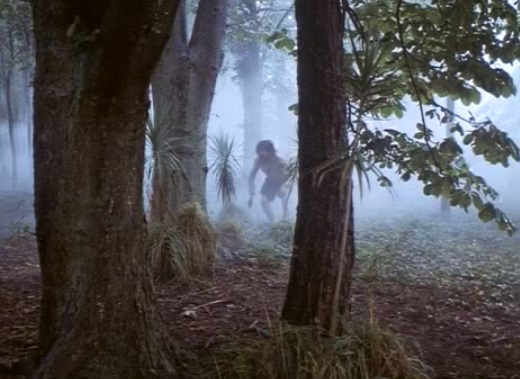
Koenig orders a full-scale rescue mission to the planet, unaware that a mysterious mist found on the planet surface is actually a time warp of sorts.  

When the Alphans step through the fog, they are re-made as primitive cave-people. As a primitive man, Koenig becomes Cave Chief, while Helena Russell becomes the tribal healer, and the Chief’s consort.

Unaware of what has happened to her fellow Alphans, data analyst Sandra Benes (Zienia Merton) encounters several cave people, who capture her and bring her back to the cave.  There, a primitive hunter (Oliver Cotton) and the Cave Chief battle for ownership of the beautiful and strange female in their midst.

On Alpha, Dr. Mathias (Anton Phillips) solves the alien riddle during an autopsy.  The caveman in the Eagle has caps on his teeth.  

He is one of the Alphans, not an inhabitant of Retha…


“The Full Circle” is likely not one of the better-regarded episodes of Space: 1999’s (1975-1977) Year One.  And yet, it is an episode that I like very much, and for two key reasons. 

First, the episode is set mostly in natural, real environs, and that fact gives the story a remarkable boost in terms of visuals and excitement.  The planet Retha is a combination of Black Park and Pinewood Studios back-lot exterior locations, and the contrast between sterile, technological Moonbase Alpha and such natural, wild locales is remarkable.

You could not recreate the “primordial” look and feel of Retha on an interior sound-stage, using papier mache rocks, nor, truthfully, by using a familiar So Cal location.  

To American eyes, therefore, “The Full Circle” looks genuinely like a journey to the prehistoric era, to a wild, untamed world.  Director Bob Kellett’s camera-work is also remarkable, especially during the pursuit of Sandra by the cave-man Alphans.


Secondly, the episode’s thematic framework works very successfully. Specifically, "The Full Circle" ponders the (unchanging?) nature of humanity. It compares turn-of-the-millennium, space-age Alphans to Stone Age counterparts, and finds few meaningful differences.  

To wit: Sandra Benes (Zienia Merton) nearly bludgeons Commander Koenig (as cave man) to death with a rock.  And Alan Carter (Nick Tate) literally goes “cave-man,” vengeful and hungry for blood when he worries that Sandra has been injured. These are the acts of rational, modern human beings?

As the episode’s coda suggests, the narrative is really about basic human emotions, about human instincts.  Sandra still acts by fight-or-flight dictates, for example, and this means that she is not far removed, in terms of nature, from the Cave Chief who -- in a manner very unlike Commander Koenig -- desires her.

As Koenig notes “it was only us there,” and the point is made. In 40,000 years, according to the episode’s timeline, man has not really evolved beyond savagery, beyond jealousy, rage, and other primitive emotions.  Those things still drive us, sometimes to survival, sometimes to disaster.


One scene suggests the similarities visually.  

At around the half-way point of the episode, we meet Alan, Victor and Kano huddled around a camp-fire, getting ready to turn in for the night. 

In the very next scene, we see the interior of the tribe’s cave, where a camp-fire is also at the center of the population, at the center of civilization.  The costumes have changed -- from Rudi Gernreich 1999 chic to primitive furs -- but man has not.  He still needs fire. He still huddles with his fellow humans in the dark.  And he still doesn’t understand all the mysteries of nature, and the universe.


Where “The Full Circle” vexes some critics and viewers, I suppose, is in the story mechanism that makes the comparison between primitive man and space age man possible.  Here, a swirling mist is a time warp that changes Koenig, Helena and other Alphans from civilized to primitive. Even their clothes change with them.


The time warp mist is a solid device for making the story’s point, but leaves a lot of questions unanswered.  

How do the Alphan’s change costumes in the mist?  How does the time warp achieve that end? Does all the mist on the planet act in this fashion, or only in this one spot?  Is the time warp naturally occurring, a function of “nature” on Retha, or is it something that was designed by unseen inhabitants?

Personally, it doesn’t bother me that Space: 1999 fails to address such questions. I prefer to speculate, and have always felt that the time warp is some device or entity left behind the planet’s inhabitants.  

Perhaps they created it because they foresaw the end of their race, and wanted to go back to the beginning...get a second chance. Or perhaps they left it behind on Retha to preserve the planet’s natural, unspoiled nature.  Any visitors would lose the capacity to alter the planet’s climate or terrain if reverted to primitive form.

In the end, the details don’t really matter a whole lot, and it is what “The Full Circle” states about human nature that is valuable, and memorable.  When you combine that statement with the beautiful location work, the episode emerges as one that is less disposable, and far more intriguing.  Barry Gray's score is also one of his most unusual contributions, and underlines the action brilliantly.

Also, as is the case in many Year One stories (and “Earthbound’s” coda is an example), “The Full Circle” gains interest and suspense from a twist in the tale.  

It is learned, late in the story, that the cave-man in Eagle 6 is actually an Alphan.  Specifically, he has caps on his teeth.  This information changes the whole nature of the story on the first watch.  Before this reveal, it is a natural assumption that the Alphans have encountered a world of primitive man.  

In fact, as Mathias's discovery suggests, they have encountered only themselves at a different stage of development.  That twist is a surprising one, and like the device of the misty time-warp, makes the final point about humanity’s unchanging nature, all the more powerful.

60 Years Ago: Star Trek: "The Corbomite Maneuver" (November 10, 1966)

Stardate 1512.2 On the third day of a star mapping mission in previously uncharted space, The U.S.S. Enterprise is blocked by a cube: a bord...