Subscribe To JKM


 Posts
All Comments
Tuesday, November 03, 2026
Deep Focus Episode 6: The Man Trap (Star Trek)

 award-winning creator of the web series Abnormal Fixation (2024), the audio drama Enter the House Between (2023) and author of 35 books including Horror Films FAQ (2013), Horror Films of the 1990s (2011), Horror Films of the 1980s (2007), TV Year (2007), The Rock and Roll Film Encyclopedia (2007), Mercy in Her Eyes: The Films of Mira Nair (2006),, Best in Show: The Films of Christopher Guest and Company (2004), The Unseen Force: The Films of Sam Raimi (2004), An Askew View: The Films of Kevin Smith (2002), The Encyclopedia of Superheroes on Film & Television (2004), Exploring Space:1999 (1997), An Analytical Guide to TV's Battlestar Galactica (1998), Terror Television (2001), Space:1999 - The Forsaken (2003) and Horror Films of the 1970s (2002).
60 Years Ago: Star Trek: "Dagger of the Mind" (November 3, 1966)

Stardate: 2715.1
On a routine mission beaming down supplies to the penal colony on Tantalus V, the Enterprise becomes embroiled in an unexpected crisis.
A mad-man, Simon Van Gelder (Morgan Woodward) -- formerly a doctor at the facility -- has smuggled himself aboard the starship during the cargo transfer, thus escaping the penal colony’s security force field.
Van Gelder is captured quickly, but the incident requires Captain Kirk (William Shatner) to conduct an investigation of the colony. He is sheepish about doing so, because he deeply respects the director of the Tantalus Colony: Dr. Tristan Adams (James Gregory), and his life’s work.
In particular, Adams has “revolutionized and humanized” the treatment of prisoners in the Federation, transforming prisons into “clean, decent hospitals for sick minds.”
While Mr. Spock attempts the Vulcan mind-meld on Van Gelder, to learn what happened to him on Tantalus.
Meanwhile, Kirk and ship’s psychiatrist, Dr. Helen Noel (Marianna Hill), beam down to the facility for an extended tour.
There, they learn from Adams that he has been experimenting with a rehabilitation beam -- “a neural neutralizer” that is supposed to help “incorrigibles.”
In fact, as Captain Kirk learns the hard way, the neural neutralizer is a method of control, and even torture.

The creative template for “Dagger of the Mind,” is rather obviously, and disappointingly, an installment from two weeks back: “What are Little Girls Made Of.”
Consider: in both narratives, Kirk beams down to an isolated planetary location with a beautiful female medical practitioner at his side, and is experimented upon there by a deeply-respected individual who is using new technology to bend others to his will. Kirk's idealism is shattered as he realizes that his idol is no paragon at all.
In “What are Little Girls Made Of,” Kirk and Nurse Christine Chapel visit the treacherous caves of Exo III, where the “Pasteur of Archaeological Medicine,” Dr. Roger Korby, is working on a plan to have androids infiltrate the highest levels of the Federation. Korby experiments on Kirk, making an android duplicate. Fortunately, Kirk is able -- from the planet surface -- to send a message to Spock, so that the half-Vulcan first officer can intervene and save the day.

In “Dagger of the Mind,” Kirk and Dr. Helen Noel beam down to a penal colony protected by a force field, where a great humanitarian, Dr. Tristan Adams is controlling minds using the neural neutralizer. Kirk is forced to submit to the device. Meanwhile, on board the Enterprise, Spock uses the Vulcan mind-meld to determine what is happening on the surface, intervenes, and saves the day.
Sound familiar?
In both cases, deeply respected professional men go off the rails, and become monsters. Yet “What Are Little Girls Made Of” is a much superior episode because Korby possesses a reason to go off the rails. His consciousness has been transferred to an android body and his “humanity” didn’t survive the transfer. He is no longer himself, and the message that viewers glean is that man is not meant for immortality, or mechanical bodies Something vital -- something compassionate and beautiful -- is sacrificed.
There is a reason, or motivation, in other words for Korby's anti-social behavior. We pity him, because we understand he is not really evil, and not really, even, at fault.
And Dr. Adams in "Dagger of the Mind?"
There is no reason or motivation even suggested in the episode that such a deeply-respected humanist would change his nature, jeopardize and his reputation and life’s work, to act as the monster we encounter.
His plan doesn’t even make sense, when one considers it.
Dr Adams is going to experiment on Kirk and torture Kirk, a starship captain?


Well, Dr. Noel will be able to testify what happened to him, even if Kirk can’t. Or is Adams planning on keeping her prisoner...an act which would the Enterprise would surely respond to.
If not, let’s assume Adams takes the extra step and tortures and plays with Noel’s memory too. If this is his plan, he’s still taking an enormous risk that the Enterprise crew will discover the truth. After all, even while in orbit of Tantalus for just a few hours, the crew has determined the identity and history of Van Gelder.
Why on Earth would Adams not believe that the crew, especially with a Vulcan involved, could not discover what happened to its beloved captain?
The truth would come out, sooner rather than later.
More so, it simply isn’t clear what Adams has to gain by torturing people, particularly a starship captain. There is no plan in place here to take the neutralizer out into the universe and turn people into zombies, so it is difficult to understand, exactly what Adams’ agenda really is, besides being purely and simply evil.
Even assuming Adams is purely and simply evil -- that he has cracked under the pressure of his difficult vocation -- why would he torture and abuse his biggest fan?
Captain Kirk treats him with tremendous deference and respect. He's looking for a reason, any reason, to exonerate a man he admires. And so what does Adams do? He makes a friend and a supporter into an enemy.
Instead of torturing Kirk under the neural neutralizer, Adams could have stuck with his story that the device is a failure, and the room is closed down. He would simply not use it again, until Kirk left. Then, with the Enterprise long gone and the investigation closed, he could resume torturing the inmates at his leisure.
The character’s lack of real motivation makes Adams a poor guest start, and a poor villain. Usually on Star Trek, when a character commits what is considered an evil act, his or her motives are examined. The agenda is understood, even if we don’t agree with it. “Dagger of the Mind” fails that benchmark rather egregiously. Even assuming Adams is purely and simply nuts, his behavior makes no sense. It’s silly and self-destructive.
So not only is "Dagger of the Mind" structurally a rehash of “What are Little Girls Made Of,” it is an inferior one, in terms of the details.
In a three week period, essentially, Star Trek has twice proposed that great, respected leaders in their field actually possess feet of clay, and can be transformed into monsters by their quest to push the limits of science.
Again -- and I make no moral judgment or political preference about this -- the message is undoubtedly conservative in nature. It is better not to broach a new frontier -- like the creation of androids or an experimental beam -- because doing so will make slaves or inferiors of the human race.
Progress, in both cases, is arrested so that the status quo remains in effect. I find it odd not that Star Trek would (wisely) question the pace of new technological development or the impact it might have on humanity, but that it would repeat this same idea over three episodes in three weeks. "Miri" had the same theme of over-reaching scientists causing havoc.
If scientists are such dangerous, irresponsible folk, how did the Federation ever get to this point of space exploration? Isn't some advancement good? Doesn't it sometimes improve the human condition?
I guess I'm saying it would be nice to see a little variation in the messaging. Let's have some conservative wisdom, but let's also talk about pushing boundaries too, occasionally. Fortunately, next week's episode ("The Corbomite Maneuver") adopts that approach so Star Trek's message doesn't feel so consistently in favor of the status quo.
Sadly, “Dagger of the Mind’ is not made any more effective through its visualization.
If you were Dr. Adams, hoping to keep your real work a secret, would you house your prisoners in a room with a giant vent shaft leading right to the power generator controls that feed into your security field?


Again, you can’t assume there’s nowhere else to house Kirk and Noel, because this is a penal colony, presumably with housing units (cells?) for all the inmates.
But let's assume, for argument’s sake, that there is no other room to use but the one with the biggest vent shaft opening in cult-TV history.
Would you not attempt to seal it off so your prisoners can’t use it?
I mean, it’s not like a starship captain and his psychiatrist aren’t going to notice a gigantic vent shaft right there, at eye level, in their quarters.
Although “Dagger of the Mind” makes no sense from a story or character perspective, and opts for easy ways out, in terms of narrative solutions (see: the giant vent shaft), it nonetheless does boast some strengths that should be note.
I like the idea, for instance of the “Devil’s Island” setting; a realm reachable only by elevator, and once a shield is de-activated. In concept (but not design; again see: vent shaft) Tantalus should be an inescapable prison. It is always fascinating to have characters cut off from the power and technology of the Enterprise, forced to manage their own escape.
Also, I admire the performances of Morgan Woodward and Marianna Hill. Both Van Gelder and Helen Noel are welcome additions to the Star Trek universe. Van Gelder must overcome his own mental demons to help the Enterprise crew, and Noel is truly ‘tantalizing,’ a gorgeous and smart love interest for Kirk.
Most notably, “Dagger of the Mind” introduces the Vulcan mind-meld to Star Trek, and for that development the episode deserves, certainly, to be remembered and lauded. Star Trek’s first season is such a great time of invention, especially for Vulcan culture, given that we see the nerve pinch in “The Enemy Within” and the mind-meld here.
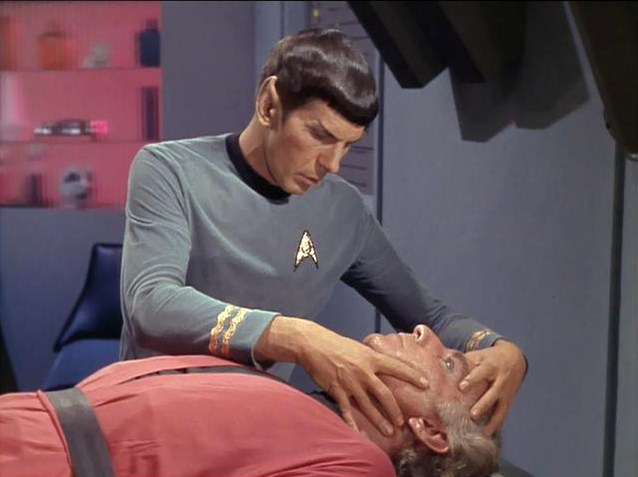

It’s just a shame that Spock’s ability to mind-fuse with other beings is featured in a rehash story notably lacking in any other brand of invention.
Also, it's intriguing to note how the concept of the Vulcan mind-meld being a very private, intimate matter falls by the wayside in franchise history. By the time of Star Trek VI: The Undiscovered Country (1991), Spock performs, without hesitation, a mind-meld on Valeris (Kim Cattrall) in front of the entire bridge crew!
award-winning creator of the web series Abnormal Fixation (2024), the audio drama Enter the House Between (2023) and author of 35 books including Horror Films FAQ (2013), Horror Films of the 1990s (2011), Horror Films of the 1980s (2007), TV Year (2007), The Rock and Roll Film Encyclopedia (2007), Mercy in Her Eyes: The Films of Mira Nair (2006),, Best in Show: The Films of Christopher Guest and Company (2004), The Unseen Force: The Films of Sam Raimi (2004), An Askew View: The Films of Kevin Smith (2002), The Encyclopedia of Superheroes on Film & Television (2004), Exploring Space:1999 (1997), An Analytical Guide to TV's Battlestar Galactica (1998), Terror Television (2001), Space:1999 - The Forsaken (2003) and Horror Films of the 1970s (2002).
50 Years Ago: Carrie (1976)

The director's critically and financially successful adaptation of the Stephen King novel not only assured De Palma a long and storied career in Hollywood, it also set off a virtual blizzard of celluloid King adaptations vetted by high-profile film directors (Tobe Hooper and Salem's Lot [1978], Stanley Kubrick and The Shining [1980], David Cronenberg and The Dead Zone [1981], George Romero and Creepshow [1982], John Carpenter and Christine [1983], Rob Reiner and Misery, etc.). This is a horror trend that endured well into the 1990s, and even to into this decade, though to perhaps a less-significant degree.
Carrie proved so resonant as a horror genre initiative, in fact, that it spawned a fad, a significant number of B movie imitations. These were films about wronged, lonely teens seeking bloody vengeance against their cruel school mates. These films had titles such as Ruby (1977), Jennifer (1978), Laserblast (1978) and Evilspeak (1981)
With his keen and accomplished visual sense, De Palma creates an intimate portrait in Carrie of this aforementioned adolescent, high-school cruelty. It's Lord of the Flies in a locker room...only with mean girls instead of wild boys. In her review of the film for New Yorker, critic Pauline Kael noted that prior to De Palma's film, "no one else has ever caught the thrill that teenagers get from a dirty joke and sustained it for a whole picture," terming Carrie a "terrifyingly lyrical thriller."
Most critics strongly agreed with the assessment that King's novel found perfect expression in De Palma's capable hands. Film Quarterly, Volume XXI (page 32) in 1977 noted that "De Palma develops his familiar motifs of exploitation, guilt and sexual repression with a sure hand, so that his visual fireworks for the first time do not seem themselves obsessional and out of control."
Roger Ebert wrote in his review of January 1, 1976 that: Brian De Palma's Carrie is an absolutely spellbinding horror movie, with a shock at the end that's the best thing along those lines since the shark leaped aboard in Jaws. It's also (and this is what makes it so good) an observant human portrait. This girl Carrie isn't another stereotyped product of the horror production line; she's a shy, pretty, and complicated high school senior who's a lot like kids we once knew."
Today, no less than three major sequences in Carrie have entered the pop-culture lexicon (and endured there for over thirty years.) These three sequences are so well-directed, so brilliantly-staged that they jump immediately to mind when considering the film. More importantly, they visually support the film's narrative: forging an understanding of Carrie's world and what it means, in some cases, to "grow up." Those scenes are set in a girl's locker room, at the senior prom, and finally, (ominously...) grave side.

We're All Very Sorry For This Incident: The Curse of Blood
In part, Carrie works so splendidly, because of the universality of the high school experience. Sometimes it feels like high school is a realm where cruelty -- along with apathy -- has become institutionalized.
Teenagers often seem to boast a sixth sense (or is it a killer instinct?) about those students who are less well-adjusted, who come from bad homes, or who are just more sensitive...and therefore vulnerable. And then those kids are ridiculed, teased, shunned and mocked sometimes, to the point of sadism.
Probably nothing could expose this milieu more clearly (or more artfully) than the locker room scene that opens Carrie. After a game of volleyball (shot from a high angle, as if to clue in the audience to the fact that something terrible is soon to occur...), De Palma cuts to the gym locker room. The steam from the showers softens the image on screen, providing the impression of a lulling dream, or even a sexual fantasy. Immediately, we start to understand how high school represents a time of sexual awakening.
As the camera pans right, accompanied by the romantic strains of Pino Donaggio's score, the audience sees gorgeous young women frolicking, nude or half-nude after their exertions on the court. As I wrote in Horror Films of the 1970s, this is an "erotic image of wood nymphs at play," one intended to arouse, titillate and stimulate. But as the camera moves past this fanciful action in a forward motion, we soon spy Carrie White (Sissy Spacek) alone in a shower. It's a strangely solitary, personal and erotic moment too. The young woman caresses herself in slow-motion. Glistening water drops decorate her euphoric face. A phallic-shaped shower-head sprays water down upon her.
Carrie's hands wander innocently down to her stomach, then her legs -- and, as curious viewers -- we wonder how far this scene is going to go. As Carrie's hands continue to spiral downwards to her legs, scarlet blood suddenly stains her skin, mixing with the pounding water. It's menstrual blood. On her fingers, on her legs. On the floor.
This is a typical De Palma bait-and-switch, a deliberate reversal or undoing of expectations. Those males in the audience aroused by the sight of female nudity are no doubt -- much like the disturbed school principal featured in the next scene -- not at all aroused by the visual of a high school girl getting her period. A sexy fantasy has given way to common reality
The dream-like nature of this sequence dissipates quickly now, giving way to abject horror. Carrie does not know or understanding what is happening to her. She believes she is dying. From a subjective point-of-view shot, we now see harsh reality: the other high school girls categorically reject Carries' entreaties for help and the "misty" look of the scene has evaporated. With startling cruelty, the girls even toss tampons at the desperate Carrie. We get close-ups of taunting, ugly faces, and hear the girls' mean chants. Those beautiful bodies in the slow-motion dream have given way to the cruel reality of high school. Mocking, teasing, the mob mentality. Like pack animals, the teen girls can smell the weak number in their pack...and go in for the kill.
This scene serves a few important narrative functions. First, the visual obsession on young, sexy bodies (and Carrie's body, in particular...) serve to note the full extent of this character's burgeoning womanhood. Though shy and awkward, Carrie is also beautiful in an innocent way...stepping into the realm of sexual maturity with awkwardness.
Secondly, the hurling of the tampons and the close-ups of twisted, evil faces mocking Carrie help to dramatize what a delicate, uncomfortable, embarrassing time this can be for those undergoing puberty. Through the cruelty of the girls in the locker room, we comes to sympathize for Carrie's feelings of isolation and separation. In addition to her sexual maturation, this scene charts Carrie's first steps into "psychic" maturity as well. Her outrage at the cruel treatment causes a telekinetic burst: the shattering of a lamp bulb over the shower enclosure. This is clear foreshadowing...
Another scene -- less showy and far less notorious than the locker room sequence -- also reveals much about Carrie's school life and builds on our compassion. The only bright light in Carrie White's world is her quiet, heretofore secret affection for classmate Tommy Ross (William Katt). De Palma finds a unique way to connect these characters visually the first time that they share a scene. In English Class, Tommy is highlighted in the foreground of one shot, in an extreme close-up. Meanwhile, Carrie is depicted as diminutive and tiny, in the background of the self-same shot. Interpreting what our eyes see, he is thus paramount -- a towering paragon -- and she is literally almost a midget, an after-thought in distant orbit of his "star." Yet importantly, the characters share the same frame. De Palma's choice of shots here expresses Carrie's own (insecure) view of self. To her, Tommy is "big" and "shiny," at center stage, while she is "small" and far from attention. Almost unseen.
In Horror and Science Fiction Films II (Scarecrow Press, 1982, page 52), critic Donald C Willis noted that "it's debatable who's meaner to Carrie - her fellow students or her director, who draws out their elaborate prank for 90 minutes, then lovingly shoots its penultimate moments...in slow motion."
I understand his point, but, as always, we should ask the question "why?" I submit that that De Palma makes much of the film a torturous build-up to Carrie's moment of explosive rage not so we can mock her; but so we sympathize with her. The film spends much time on Carrie's home life with her stark-raving-crazy mother (Piper Laurie), a zealous, Christian, fundamentalist freak. Between these harrowing home sequences and those set in high school, the audience rightly wonders how much this poor girl can endure Then, De Palma grants us that gleaming moment of hope as Tommy and Carrie appear to develop a meaningful relationship. De Palma again pulls a bait-and-switch (with his lying camera, dammit!), letting the hope linger in our minds that perhaps, just perhaps, Carrie has found the very kindred spirit who will allow her to join the rest of the world and vanquish her intense loneliness and awkwardness. Of course, this is not to be...

Split-Screen Prom Queen
De Palma is renowned for the cleverness of his climactic set-pieces, and Carrie gives us one of his most terrifying, and his most accomplished. His camera prowls the prom as Carrie and Tommy attend the dance and Carrie -- for the first time in the movie -- is all smiles. She is still tender, vulnerable, but her hopes have been raised (as have ours). The gym coach, Mrs. Collins (Buckley) even shares a tender story with Carrie about her own prom.
This is the brand of personal, human story another horror film might not pause to record with such meticulous attention, but again, De Palma pulls the rug right out from under us (and his characters). Mrs. Collins' anecdote -- like the dream-like moment in the shower, or like the hope of a relationship with Tommy -- encourages us in the hope that Carrie is going to have a beautiful experience too. To that end, De Palma's camera dizzily revolves around the happy couple (Carrie and Tommy) as they dance together.
At first, these camera revolutions are euphoric and romantic, an intoxicating moment of hope realized, dreams come true. But then the rotating accelerates, out of control, faster and faster. Because of the off-kilter, fast-moving camera, we just know things are not going to go well. When De Palma's camera then tracks one of the mean girls, P.J. Soles, onto the stage, and the camera determinedly banks up to the rafters, to a shaky pail filled with pig's blood, our hearts sink.
The trap is set.
And again, De Palma gives us a happy moment. Carrie and Tommy are crowned king and queen of the prom, and this revelation is shot using triumphant slow-motion photography. Only this time, we don't feel dreamy or intoxicated...or even triumphant. On the contrary, we're agonized. We know what is coming now, and the slow-motion victory lap drags out our tight-throated feelings of anticipation and dread to an almost unbearable degree. We see what is going to happen but we can't stop it. Now the film marches inexorably towards terror, and the explosion of Carrie's monstrous rage; the force of her anger.
When Carrie is finally "crowned" in pig's blood on stage, the horrifying moment is a specific reflection of the locker-room/shower debacle at the beginning of the film, wherein Carrie first confronted the flowing of her vaginal blood; her messy, confusing entrance into adulthood. Her mother has told her that blood represents sin ("First comes the blood, then comes the sin,") so imagine poor Carrie's terror at being covered in such blood in public; worse -- on stage. By loving Tommy, she must fear, she has again brought the flowing of blood.
Carrie's climactic psychic outburst is depicted utilizing one of De Palma's favorite techniques: the split screen. In this case, the split-screen connotes the instantaneous, light speed transmission of telekinesis; the cause-and-effect relationship of the psychic power. Visualized in one side of the frame, Carrie turns her head, widens her eyes, and casts her gaze upon a specific tormentor. In the other side of the frame, we see the simultaneous psychic effect of the murderous gaze. Someone falls down, someone catches fire, or there is an explosion.
The prom apocalypse also flashily reflects the film's themes. Adults in Carrie are depicted in various shades of negativity. They are colored as uncaring (the principal, who can't remember Carrie's name), utterly mad (Mrs. White), sedated and drunk (Mrs. Snell), or heartless and bitter (Carrie's mocking English teacher). At their very best, the adults might come off as capricious, like Mrs. Collins, whose draconian punishment of the mean girls spawns the revenge against Carrie.
But now that Carrie is an adult -- covered in blood -- we can therefore no longer sympathize with her. Accordingly, she goes beyond the bounds of the "sane" during her incredible telekinetic attack, killing friends (Mrs. Collins) and foes without distinguishing between them. The innocent and the guilty both fall to her wrath and in the end, that's what makes Carrie a monster here...an adult monster like all those around her. De Palma has proven successful at making Carrie sympathetic until this point, until Carrie's "real" entrance into adulthood. The world has taught Carrie to be cruel, and at the Prom, she learns that lesson too well.

Carrie White Burns in Hell. Or, Did You Ever Stop to think that Carrie White Has Feelings?
The third "famous" moment in Carrie arrives at film's end. It's possibly the best sting-in-the-tail/tale ending ever captured on film. It's certainly the most-imitated. Shot in misty slow-motion (again like the locker room sequence preamble...), Sue Snell (Amy Irving) lovingly deposits flowers on Carrie's grave. Her intentions had been good; and despite all the horror Carrie wrought, Sue still has some residual feelings of compassion for the girl who everybody teased. But then, without warning, Sue is pulled down into the grave by Carrie's groping, burned claw. The message: even the innocent must fear Carrie, because she has lost control of her hate.
Sue awakens from the nightmare, traumatized and terrified, and the movie ends with heart-pumping, breathless intensity. We understand that Sue will never be the same; will never view the world the same way. If Carrie has moved into adulthood in the film; so has Sue. She has learned that the road to hell is paved with good intentions.
Carrie is a terrifying film dominated by the three memorable scenes I have outlined in this review (the locker room opening; the prom set-piece, and the terrifying coda). But it is more than that too.
Again, as I wrote in Horror Films of the 1970s, what you ultimately take away from Brian De Palma's adaptation is a sense of growing frustration with a world that allows good people to be tormented and then turned into monsters themselves. Carrie was so harried, so abused by everyone in her life that she finally retaliated with the very force of hatred she despised so much in others. In charting this story, Stephen King and Brian De Palma chart a cycle of violence. They remind us how children turn to us -- adults -- for guidance and compassion. How they turn to us as role models, and how they sometimes fall through the cracks and find themselves lost, rudderless..emulating only the worst angels of human nature.
De Palma executes Carrie like a perfectly-realized cruel practical joke indeed; but not to debauch us; not to make us gawk or laugh at lonely Carrie White. On the contrary, De Palma victimizes the audience, much as Carrie is herself victimized throughout this harrowing film. He reminds us that in youth (and indeed, adulthood) we've all had to contend with our own Chris Hargensons and Billly Nolans: people who are cruel simply for the sake of cruelty. With his dream visions shattered by harsh reality, with his dazzling split screens, even with his anticipatory, anxiety-provoking slow-motion photography, De Palma reminds us to stop and remember that other people have feelings too.
Carrie White burned in Hell all right. But that Hell was called high school. And the real thing could hardly have been worse than gym class.
award-winning creator of the web series Abnormal Fixation (2024), the audio drama Enter the House Between (2023) and author of 35 books including Horror Films FAQ (2013), Horror Films of the 1990s (2011), Horror Films of the 1980s (2007), TV Year (2007), The Rock and Roll Film Encyclopedia (2007), Mercy in Her Eyes: The Films of Mira Nair (2006),, Best in Show: The Films of Christopher Guest and Company (2004), The Unseen Force: The Films of Sam Raimi (2004), An Askew View: The Films of Kevin Smith (2002), The Encyclopedia of Superheroes on Film & Television (2004), Exploring Space:1999 (1997), An Analytical Guide to TV's Battlestar Galactica (1998), Terror Television (2001), Space:1999 - The Forsaken (2003) and Horror Films of the 1970s (2002).
Subscribe to:
Posts (Atom)

-
 Director Ridley Scott has already given the science fiction cinema two of its greatest and most cherished films: Alien (1979) and Blade...
-
 "Other Worlds lie outside our seeing; beyond the beyond; on the edge of within. The Great Pyramids: erected by the Ancient Ones as a ba...