Showing posts with label cult movie review. Show all posts

Friday, December 26, 2014

From the Archive: Saturn 3 (1980)


Stanley Donen's Saturn 3 is a half-crazy, occasionally-inspired mating of Frankenstein and 2001: A Space Odyssey...one that plays out between three humans and a giant robot against a high-tech, futuristic backdrop.

Taken on those simple terms, the film is enjoyable, literary, occasionally exciting, and consistently watchable, despite all the bad reviews you may recall from its theatrical release.


Saturn 3 depicts the the story of the psychotic Captain Benson (Harvey Keitel), a scientist who travels to the Experimental Food Research Station on Saturn 3 during a twenty-two day eclipse and communications black-out called "Shadow Lock."

There, the good captain provides "assistance" to two scientists working to alleviate a famine on our overpopulated, polluted planet Earth. Major Adam (Kirk Douglas) and his young romantic partner, the beautiful and innocent Alex (Fawcett) are wary, however, of Benson's form of help: a colossal humanoid robot named Hector, the first of the "Demi God" series. Hector boasts human intelligence (not to mention human brain tissue...) and can even pattern his personality on the direct input he receives from human beings. Since Benson is psychotic, this means that Hector is also psychotic. In short order, the robot begins to develop the same lustful feelings for lovely Alex that Benson has rudely begun to demonstrate...

Named after the Trojan Prince beaten by Achilles outside the walls of Troy, the robot Hector represents Saturn 3's embodiment of the classic Frankenstein Monster, a lumbering abomination given life by a Prometheus-style scientist, here essayed by the over-dubbed (but still creepy...) Harvey Keitel.


Hector has been created, it seems, to glorify Benson; to prove to skeptical (and off-screen) co-workers that he is a genius. As is the case in Victor Frankenstein's tragedy, there's a high degree of vanity involved in the genesis of this new life. As Victor sought to "bestow animation" upon "lifeless matter," so does Benson seek to introduce intelligence and even "human learning" to cold machinery. And again like Victor, Benson pioneers a "new way," or new science to achieve his aims. Though he is not technically breaching "the awful boundary between life and death" that Shelley artfully described, Benson is breaching the barrier between man and machine.

Hector's biology also merits comparison to the Frankenstein Monster. This Demi-God class robot is a collection of metallic spare parts and pure brain tissue grown in a lab, not organic corpse parts given life.But much like the Frankenstein Monster, Hector boasts the interesting (and unusual...) combination of a fully formed (or adult) physicality with a naive, almost child-like sense of intelligence. And, as the Frankenstein Monster quickly determines, it is "miserably alone," and seeks companionship. 

Interestingly, Hector seeks companionship too...sexual companionship with Alex.

In both stories, the "child" (the monster) turns on the Bad Father, the Creator. In the case of Frankenstein, the rejected/unwanted child draws out the process of killing the parent ("I will work at your destruction, nor finish until I desolate your heart so that you shall curse the hour of your birth...") In Saturn 3, Hector quickly kills Benson and turns his attention towards dominating Alex, a subtle acknowledgment, perhaps of a more sexually-liberated culture in the 1980s.

Going back to 1968's 2001: A Space Odyssey, one might also be temped to gaze upon Hector as HAL's child: a computer with a menacing, ambulatory physicality to go along with the parent's cold, calculating brain. 

In the Kubrick film, however, one never knows why HAL goes insane and murders the crew of the Discovery.The reasons for Hector's instability are plain in Saturn 3, and they reflect the Frankenstein story again. Benson, like Victor, is a bad father. One who, through his own intrinsic psychological flaws, overreached and was not able to handle the role of parent. And in this case, the son has inherited the father's psychosis.

Saturn 3 also fascinates in the manner it re-purposes the Biblical story of Adam and Eve. In the Old Testament, God created Adam and Eve and provided them a glorious Paradise in Eden. This couple wanted for nothing until a serpent invaded the Garden and tantalized Eve with the apple from the Tree of Knowledge.

This simple story is re-cast in explicitly technological (and secular, scientific...) terms in Saturn 3 with a character named, of course, Adam dwelling in isolated bliss with his lover, Alex. Their facility is an Experimental Food Research Station featuring an abundance of greenery, a hydroponics bay that could easily be interpreted as...a "garden."

The film also defines the lives of Adam and Alex as ones of unending bliss. Their facility is like a health spa. They exercise regularly, jogging the curving, empty corridors. They live in love and peace, sheltered away from the modern, polluted world. Alex is a total innocent, never having visited Earth and knowing nothing of its customs.


Into this paradise arrives the Serpent (or Serpents, in this case) -- Hector and Benson. It is not the apple that Benson offers Alex, but lustful sex and recreational drugs, the latter in the form of psychedelic "Blue Dreamers." He awakes in Alex, at the very least, the realization that she has lived a sheltered life. He spawns in Alex a desire to see Earth, which Adam also encourages.

In the coda of Saturn 3, following Adam's sacrifice to defeat Hector, Alex leaves the sealed-up paradise, boards a spaceship and heads for Earth. The Garden is left behind permamently. Alex has tasted the fruit of the tree of knowledge and now returns to the world of fallen man.

There's a nice, commendable simplicity to the narrative of Saturn 3. Against the plainly mythological and literary backdrops, there are but few characters and locations. The movie cleverly isolates its dramatis personae in a trap within a trap within a trap. They're in a hermetically sealed facility on an inhospitable planet during an eclipse. 

Thus -- again like their Biblical counterparts -- Adam and Alex are really in a sort of "bubble world." The outside world doesn't exist for them, and that means there is no chance of a rescue operation. The future of man (and machine...), it seems, is to be settled here, in this place, with just these few people and their values.

Hector also makes for a powerful, memorable villain. Although he apparently lacks human genitals, Hector has been (inadvertently) programmed with a physical lust for Alex, making him one of the screen's most memorably randy robots (though probably nobody can give Demon Seed's Proteus a real run for his money...). Hector is a murderous child, a sadist, and entirely malicious. At least with the Frankenstein Monster, you felt some sense of compassion. He was "malicious" because he was "miserable." Hector is somehow...colder.

The sets, special effects and costumes in Saturn 3 are all top-notch too, at least for 1980 vintage. And then, of course, there's the late Farrah Fawcett in a central performance: effortlessly exuding innocence and sexiness at the same time.As in her other roles, there was a winsome and fetching quality to Fawcett. Saturn 3 makes fine use of her naturalness, her seeming sin-lessness, even as it exploits her amazing good looks.


Perhaps the aspect of Saturn 3 that I enjoy most involves Adam's journey, however, not Alex's. 

Adam deeply fears contamination from the outside (from Earth). He has thus set up a utopia on Saturn 3, a perfect little existence. While Earth starves, he possesses plenty of food. While lust and casual sex dominate among Earthers far away, Adam has found a perfect, innocent mate who truly loves him. He has attained the goal of intimacy.

But when Hector and Benson arrive, they bring "the tree of knowledge" with them. On Earth, Adam would have feared being at the mercy of society, of the government, of his peers. Well, suddenly, in his perfect world, he is at the mercy of Hector, a psychotic who can control every aspect of his environment. Hector controls the air, the food supply, the temperature...everything. Adam is thus made slave to the very technology he has always feared and disdained, and that's a metaphor for the life he fled: one of regimented control where he was but a cog in the wheel. Perhaps that is the reason why Adam chooses to fight Hector to the death, because like Alex, he too has been ejected from paradise by the arrival of this interloper.


Saturn 3 even closes with a commendable message: that it is the capacity for self-sacrifice that ultimately separates a human soul from artificial intelligence. Hopefully, that's the message that Alex takes back to Earth and preaches. That mankind -- in his ability to put the welfare of those he loves before his own life -- can conquer the machines, overpopulation, lust and the other bugaboos that threaten to destroy a species in perpetual crisis.

With DNA culled from the Old Testament, the work of Mary Shelley and even Stanley Kubrick, Donen's somewhat silly Saturn 3 sure has a "great body." 

May I (respectfully...) suggest...you use it?

Thursday, December 18, 2014

Cult-Movie Review: When a Stranger Calls (1979)


Fred Walton’s When a Stranger Calls (1979) remains one of the most effective and terrifying horror movies made during the disco decade.

This statement is accurate, I reckon, because I knew the film’s punch-line before I ever saw the movie.  

When I was ten years old, my beloved aunt Vivian would frequently regale me with horror movie stories at family gatherings. I just couldn’t get enough of these cinematic tales, which she recited in every fantastic and grotesque detail. Vivian told me, over the years, the stories of Halloween (1978), Alien (1979), The Fog (1980) and When a Stranger Calls.

So I actually knew that the film’s killer was calling “from inside the house” before I ever saw the movie’s first frame.

Yet when I finally saw When a Stranger Calls with my own eyes, my pre-knowledge of that crucial “twist” made no difference whatsoever. The movie scared the shit out of me.

Watching the film again this week for the first time since 1999 (when I wrote Horror Films of the 1970s), the opening scene still unsettled me, and left my wife feeling anxious and jittery as we turned off the lights and went to bed.

And yes, that’s absolutely the sweet spot for horror movies: the promise of a troubled night’s slumber as you turn out the lights and your head hits the pillow.

Based on an urban legend (the babysitter and the man upstairs…), When a Stranger Calls opens with a meticulous, self-contained set-piece of near perfect execution. A high-school age babysitter (Carol Kane) is inside a suburban house alone, and being tormented by an increasingly creepy telephone caller. The frequency of the calls escalate, and the police trace the call….

...And, well, you know doubt know the rest.

When a Stranger Calls undeniably falters some in its second act, even as it establishes the pitiable character of its boogeyman, Curt Duncan (Tony Beckley). The film also explores the seedy terrain of late-1970s city life, but the movie’s lead, Charles During (as Det. John Clifford) proves pretty unappealing.

Finally, When a Stranger Calls pulls itself back together with a rip-roaring finale -- and one of the creepiest jump scares of the decade -- making the audience forget how listless some scenes in the second act actually are

So When a Stranger Calls is not perfect, perhaps, in the sense that a film such as Halloween may be. But the film nonetheless opens and closes with some of the scariest imagery in the 1970s genre canon.


“Have you checked the children?”

High-schooler Jill (Kane) arrives at the house of Dr. Mandrakis (Carmen Argenziano) to babysit his two children, who are already in bed and asleep. The good doctor and his wife leave for dinner and a movie, reporting that they will not return until after midnight.

Jill settles in, and begins to study in the family living room. But before long, she begins to receive disturbing, threatening phone calls from a stranger. Jill contacts the police, and they endeavor to trace the call. 

Jill learns, to her horror that the caller is inside the house, using the upstairs phone line.

The police, including Det. Clifford (Durning) arrive and apprehend the killer, Curt Duncan (Tony Beckley), but not before he has murdered the children with his bare hands.

Seven years later, Duncan escapes from an asylum, and Clifford, now a P.I., resolves, with Dr. Mandrakis’s funding, to kill him.

Clifford follows Duncan’s trail to a city bar called Torchy’s, and to a barfly named Tracy (Colleen Dewhurst).  She has seen Duncan on more than one occasion, and allows Clifford to use her as bait to catch the killer.

Duncan escapes, however, and chooses different prey. 

Jill, the babysitter he once stalked (and nearly killed), is now a mother herself, with two young children…


“It’s probably some weirdo. The city is full of ‘em.”

In 2014, iPhones and cell phones have perhaps made the central scenario of When a Stranger Calls feel dated.

Now, it is easy to call anyone, from any location, including the next-room-over. But by the same token, that caller’s name is identified on a screen, so it’s tougher to prank call folks too.

But the standing assumption in 1979 was that telephone calls were coming from an exterior location, from outside the house. When a Stranger Calls thus plays wickedly with the status quo, and intriguingly, does so in the very year that AT&T’s advertising agency coined the memorable slogan “reach out and touch someone.”

Curt Duncan is someone who has taken that idea all-too literally. He uses the telephone to psychologically terrorize his prey, and he utilizes his surprising position -- inside the Mandrakis house -- to “touch” (or kill…) them.

The film’s opening scene is elegant, simple, and beautifully shot and edited. Walton doesn’t over-gird the sequence with too many elements or too many competing ideas. Instead, the inaugural set-piece boasts a purity of intent, and allows the audience to proceed from the assumption of a mystery phone caller outside the house, and then, with increasing tension, pulls the rug out from that particular assumption.  In other words, the movie tricks us.

I admire the way Walton sets the terrain for the battle too. We meet Jill and the Mandrakis parents, and then move into the living room, where the sitter does her school work. A series of long shots establish both Jill’s isolation and vulnerability, and then the shrill ringing of the telephone interrupts the solitude of the night.


Jill explores her terrain tentatively at first, a half-lit world of doors that are half-open, and freezer ice machines that make disturbing noises.  This scene is true to life in a very visceral, literal sense. How many times have you heard something you can’t readily explain, and explored your house in the dark, seeking the source? 

I have a couple of rowdy cats, so I feel like I go tracking down weird nocturnal noises in the dark at least two or three times a week.  I don’t expect or anticipate finding anything weird or disturbing or dangerous. 

But the thought that I could do so is always there in the back of my mind, lurking.


We then view Jill from outside the house, through the windows, and the visual impression is of a bird in a cage. 

Another impression created by this composition is that Jill is being watched or stalked from the outside of the house.  We thus mistake the perspective for a point-of-view subjective shot. Of course, this isn’t so.  We are observing that Jill is in danger, trapped inside.  There is no danger outside.

This is the film's "inversion" principle, which I love. When Jill locks herself in for safety's sake (on the instructions of the police), she is not saving herself, she is trapping herself.


As the scene progresses, and events reach a fever pitch, the phone seems to take on a larger stature within the frame. The device is seen -- looming ever-larger in the frame -- in insert shots and close-ups. The phone is the avenue by which Jill is terrorized, and so its importance seems to grow as the scene gears up.  In Poltergeist (1982), the TV is the portal through which terror enters the world of the normal or routine.  In When a Stranger Calls, it is the phone that introduces a sinister element to the real world.


After the killer’s down-right terrifying enunciation of a mission statement -- he wants Jill’s blood, all over him -- we then get the panicked police calling Jill and warning her to get out of the house…that the killer is inside the home with her. Jill runs for the door and the film cuts to the upstairs hallway, where light bleeds suddenly out of a bedroom, and a silhouette appears.


We see no killer, no weapon. There is no violence at all, actually, only a beam of light and that menacing shadow to suggest the presence of evil.

And the restraint works like absolute gangbusters. What we fear is not a particular person or even a particular pathology, but rather the Id-like specter that can, somehow, pierce the balloon of safety we have erected around our neighborhoods and our homes.

Uniquely, the second act veers in the opposite direction, making Duncan much more than a shadow or “Shape.”  We see him hitting on Tracy (Dewhurst) in Torchy’s and getting beaten up by another bar patron.  We see him living on the streets, in skid-row, trying desperately to connect to someone.  

The malevolent silhouette of the first act becomes a hauntingly human – and frail -- individual in the second act.

In a sense, this is the way of all fear. It starts out palpable and urgent when we don’t understand it. But when it becomes recognizable or quantifiable, the sense of terror lessens.

I must confess, I have mixed feelings about this development in the film. On one hand, familiarity diminishes the sense of horror, as I wrote in Horror Films of the 1970s. The more we see that Duncan is a slight-of-build, mentally-ill British man, the less fearsome he becomes.  Horror absolutely thrives on the things we don’t know and don’t understand, not the things we do know and do understand.

Oppositely, it is interesting and ambitious that When a Stranger Calls doesn’t hew to a two-dimensional approach to its boogeyman. Duncan is not Evil Incarnate, but a deeply sick man whom society has abandoned.  I suppose my real problem with the second act may be that Duncan seems no match -- physically or mentally -- for the portly, grave-faced veteran cop Clifford, a man who is willing to commit murder outside the confines of the law to bring his quarry to justice.

But even this somewhat deflated second act possesses moments of raw power, and more importantly, fear.

On two occasions, director Walton takes the audience on a night-time sojourn through the seedy city, from Torchy’s to Tracy’s apartment building.  The camera seems to move further and further away from her as she walks home by sickly-green city-light. As the camera retracts, and Tracy gets ever smaller in the frame, one can’t help but get the impression of a world in which the city has been ceded to criminals, or to the sick.  This isn’t a place of safety or security, and Walton’s expressive camera work expresses this notion well.


Again -- in the second act this time -- Duncan violates the safety or sanctity of the hearth, of the home. He hides in Tracy’s hall closet and leaps out at her when she least suspects danger. This scene is lensed almost entirely in close-up, which makes for a real and dramatic switch from the long, lonely, dark shots of the city streets. Walton’s visual approach and selection of shots seems to suggest that Duncan’s violation is highly intimate, even if his stalking grounds feel lonely, abandoned, and vast.


I suppose the real test of Beckley’s effectiveness in the role of Duncan is that the final act works effectively.  Curt goes after Jill again, in her suburban home this time, and hides in her bed -- in plain sight -- as her sleeping husband.  In extreme, warped close-up, Duncan looks sick and twisted, and attacks Jill, and the moment is utterly terrifying.  Even when he know the killer, then, his disruption of our expectations of safety has a mighty impact.


Gazing at Walton’s visual technique, one might be able to detect a subtle message or subtext here. Society (epitomized by the cold, clinical Dr. Monk) has given the cities to the crazies, to the violent, to the wackos.  And worse, those crazies aren’t satisfied with what has been ceded to them.  They are encroaching ever deeper into the suburbs, appearing in places that should be safe: the bedrooms of our most cherished family members: our children or our spouses.


This leitmotif may make the film sound paranoid, but the horror genre is not, largely, about reason or logic, but rather about the fears that won’t go silent, even when we know they aren’t entirely rational.

When a Stranger Calls is really about the crazy “outside” making in-roads “inside,” not just in your family room or kitchen, but inside your head too, in your very imagination. 

The killer is inside the house already -- and has been for some time -- but you don’t know it yet.

Tuesday, November 18, 2014

Cult-Movie Review: The Town that Dreaded Sundown (1976)


Charles B. Pierce -- the director who brought the world the box office hit The Legend of Boggy Creek (1972) -- also gave audiences another beloved horror picture in the same decade: the recently re-made and re-imagined The Town that Dreaded Sundown (1976).

A fictionalized, semi-documentary telling of the Moonlight or Phantom Murders that went unsolved in Texarkana in the immediate post-World War II era, this bicentennial year film has earned praise from horror aficionados over the decades. In part this praise is due to the disturbing nature of the movie's unforgettable boogeyman: an anonymous killer who attacks unsuspecting victims at remote lover’s lanes by moonlight, and who dons a white sack over his head (much as Jason Voorhees would in Friday the 13th Part II [1981]). 

The mysterious killer in the film not only escapes detection and capture, but undertakes a genuinely harrowing reign of terror. Pierce, adopting a blunt approach to the action, spares the audience nothing. 

Accordingly, at least two sequences in The Town that Dreaded Sundown -- one involving a trombone as a murder weapon (!) and the other featuring Gilligan’s Island’s Dawn Wells as the prospective victim -- have achieved cult status today. They are effective genre set-pieces that raise one’s blood pressure significantly.

Uniquely, The Town that Dreaded Sundown also appears to forecast both the 1980s slasher movement in the genre and the 1990s obsession with serial killers. The boogeyman in Town is a strange combination of both types: a masked, murderous assailant who can be anywhere at any time, and a man -- sans “uniform” -- who can move freely about in Texarkana.  

That double-identity lends the film a significant degree of paranoia, since one is never certain if the killer hails from the police force or local government, or is otherwise nearby as Texas Ranger Morales (Ben Johnson) outlines his plans to catch the criminal. Clearly, the killer is someone who knows his way around the town, and regularly visits local establishments, like a restaurant seen late in the picture. Like Norman Bates in Psycho (1960), this madman can hide in plain sight.

A bizarrely-paced movie of highs and lows which pauses for some imbecilic humor and slow-motion car chases, The Town that Dreaded Sundown nonetheless impresses, even today, because of its strong period details, and its compelling story of a killer who emerges from nowhere to terrify a community and then, creepily, recedes to nowhere, leaving trauma and terror in his wake.

It's likely we will never know the identity of this real-life killer, and yet the movie places him squarely and prominently in the collective imagination, even attending a screening of the film itself...seeing his life's "work" reflected on the silver screen. In this way, Pierce ties the events of 1946 to the year 1976, and suggests that horror still dwells when the sun goes down.


“Texarkana looked normal during daytime hours...but everyone dreaded sundown.”

Just eight months after the end of World War II, on March 3, 1946, a Phantom Killer appears in Texarkana, attacking two youngsters at a local lover’s lane.

The killer goes silent until March 24, when he strikes again, this time murdering Emma Lou Cook and Howard Turner on a rainy night. 

While the Texarakana police, including Deputy Norm Ramsey (Andrew Prine) attempt to make sense of the killer’s motives and movements, legendary “lone wolf” Texas Ranger J.D. Morales (Ben Johnson) arrives in town to take over the investigation.

Meanwhile, the Phantom Killer becomes the subject of national news as the residents hide behind locked doors after sundown, and the killer strikes again, this time attacking a high school band player with a trombone and knife on the night of April 14.

Eventually, the Phantom Killer’s trail goes cold, but Morales and Ramsey get one last, unexpected chance to apprehend him…


“The fear spread like cancer…”

It looks like The Town that Dreaded Sundown actually got its title from Pierce’s The Legend of Boggy Creek. In that film, the narrator, Vern Stierman notes that the town of Fouke is fine by daytime. But by sundown it becomes a place of fear because of the Fouke Monster. 

Stierman's vocal services are also retained for The Town that Dreaded Sundown, and he repeats, almost verbatim that (good) line of dialogue about the fading of the light, and the fear that comes with the shroud of darkness.

Although based on a true story, The Town that Dreaded Sundown also captures a slow-dawning sense of uneasiness, circa 1946, in the American psyche. World War II had been won and soldiers were returning home, buying houses and attending college, thanks to the passage of the G.I. Bill. 

But the end of World War did not mean, necessarily, the end of anxiety. 

For example, Russia was developing and testing atomic bombs as early as 1949 and there was a feeling of marking time's passage, perhaps, until the next crisis emerged..such as the Korean War. 

One might describe this feeling as waiting for the other shoe to drop. 

That’s the very fear that feels almost tangible in The Town that Dreaded Sundown: a knowledge that a killer will strike again, but without knowing when or where. Thus the film thrives on the same sort of anticipatory anxiety that we saw again in the nineties, and in particular, in the works of Chris Carter.  All exterior signs indicated that times were good, but fears nonetheless lurked underneath the surface. Both time periods, in a sense, represented retrenchment, either after either World War, or the Cold War, as focus returned to the homeland, and the problems brewing and growing there.

One idea dropped from (the good) 2014 remake of The Town that Dreaded Sundown is that the killer in Texarkana is some brand of sexually frustrated psycho. For example, he “chews” on his female victims, leaving bite-marks on their flesh, including their breasts.  

And the film’s famous trombone death is symbolic, no doubt of the sexual act. In this scene, the killer straps a knife to the end of a trombone, and then keeps stabbing the knife (and trombone) into the back of a female victim, then retracting it, and doing it again. 

It’s no stretch or over-reading to see the repetitive thrusting and retraction of the trombone/knife as a coded visualization for an act that the killer himself can’t seem to complete successfully: sexual intercourse. Today, the scene plays as weird and almost a little comical, and yet if one considers the imagery, it’s clear that the trombone is standing in for something…else.  

Later, the film goes further, describing the character’s pathology. He’s a “sadist…motivated by a strong sexual drive,” according to the police. The killer targets desirable women he sees at the remote lover's lane locations. He doesn't sexually penetrate his victims, however, likely because he can't do so, for psychological reasons. He's impotent.


More harrowing in a conventional sense than the strange trombone scene is the set-piece in which Dawn Wells (as Texarkana local Helen Reed) is attacked in her home at night by the Phantom Killer.  

He shoots Helen's husband through a closed window, shattering the glass. She runs to the telephone to call for help, and he fires again.  This time the bullet perforates the side of her face, and she falls to the floor, attempting to crawl away from her assailant.  

This scene is alarming not merely because of the extreme violence portrayed on screen and the likability of the victim, but because Wells’ character -- even after being catastrophically wounded -- must continue to fight for her life. The terror doesn’t end quickly for her, and as viewers, we root for her to escape the killer alive.


The trombone scene and the Dawn Wells sequence make The Town that Dreaded Sundown truly horrific on a gut, visceral level, but the film’s sense of terror runs deeper than either set-piece suggests.  

In particular, the killer is often identified on screen only by the style of his boots. We never see a face to go with them.

At one point in the film, those tell-tale boots are seen on a restaurant patron, one sitting very near Morales. The killer has been listening all along to the officer's strategies and plans, and has not been noticed. This fact is chilling. It means that the killer can move in and out of polite society with impunity, without a second glance, even. 


The punctuation for this chilling thought is the film’s final, lingering scare.  A line queues up to see The Town that Dreaded Sundown -- this very film -- and we see those trademarks boots again, walking on the sidewalk outside the theater.  

The notion is, explicitly, that the killer is still out there, still unidentified. Half-a-century after his killing spree, the wolf is still hidden among the sheep, among the flock.


This final gut punch isn’t simply chilling, it suggests Charles B. Pierce’s cerebral, even nimble approach to the material. 

To wit: The Town that Dreaded Sundown is a retelling of a true story. The film goes back to the beginning of the Phantom Killings in 1946, and then chronicles the time period right up to and including the premiere of the film itself.  

In other words, Pierce writes his own film into the legend, on screen, so that it becomes the de facto myth or version of the tale.  

So the movie is "meta" and post-modern in nature well before Scream (1996) was even a glimmer in Kevin Williamson’s eyes...which is no doubt why the scribe referenced it in that popular film. To its credit, the Town remake of 2014 plays gamely with this aspect of the story in a way that honors the original and escalates the self-reflexive aspects of it.

The last time I watched The Town that Dreaded Sundown was likely during the preparation of my text Horror Films of the 1970s, and so I must assume from the timing that I viewed a kind of faded VHS copy. For this screening, I watched an HD streaming version, and the film looked absolutely incredible, gorgeous even. The period details are crisp and attentively-drawn, and part of the film’s appeal is our absolute immersion in 1946 Texarkana. For a low-budget film, this remains a remarkable feat, to so convincingly excavate a long gone time period.

Sadly, all of Pierce’s cerebral, visceral and period work is undercut, at least to some degree by the strange moments that lurch towards cheesy comedy. Pierce himself plays a character called Spark Plug (a policeman), who dresses up in drag in an attempt to catch the killer. Virtually every scene involving the character is hokey and dumb and off-putting.  

And the film’s third act foray into a Bonnie and Clyde (1967)-styled car chase is equally ill-advised. It's Smokey and the Bandit...forties style!

Pierce must have known that his movie had no real ending and been at something of a loss. After all, the Phantom Killer was never caught, let alone identified. So the director attempts to distract from the lack of an effective denouement with slow-motion stunts that would fit better in a Hal Needham flick than in a horror movie. The misdirection may be amusing, but it is hardly successful.

Despite the tonal missteps, one could make a case that The Town that Dreaded Sundown is Pierce’s most accomplished horror film, though The Evictors (1979) -- which I’ll review here on the blog this Friday -- would have to run neck and neck with it. But Town is more well-known, for certain, and the scenes featuring the killer on the prowl remain the stuff of nightmares.

On Thursday, I take a look at the new remake, 2014’s The Town that Dreaded Sundown.

Friday, August 22, 2014

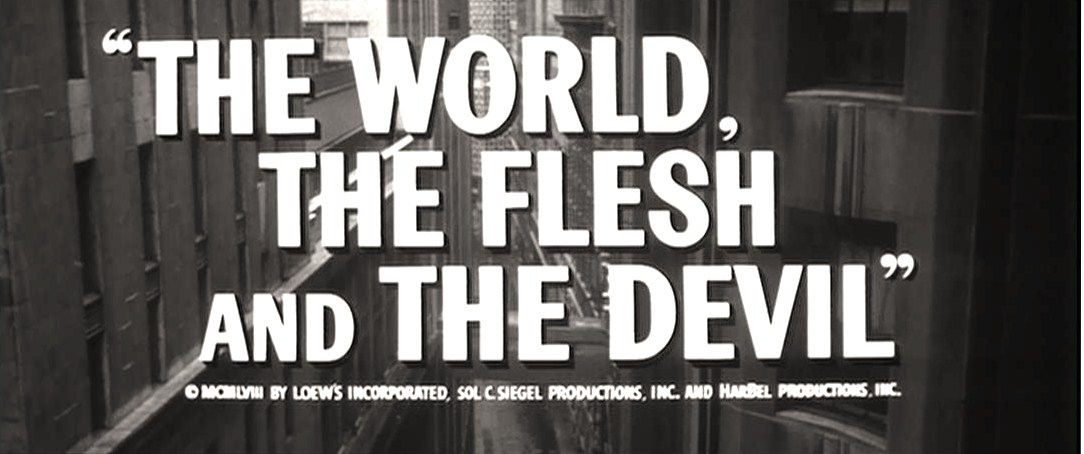
Cult-Movie Review: The World, The Flesh, and The Devil (1959)


Directed by Ranald MacDougall, The World, the Flesh and The Devil (1959) commences with the end of the world itself. 

An African-American miner named Ralph Burton (Harry Belafonte), survives the widespread effects of "atomic poison" in the atmosphere because he is trapped in a cave-in beneath the Earth's surface when the war occurs. After Ralph discovers a path to the surface, he learns from newspaper headlines that nuclear war has wiped out almost all animal life on the planet.  He is alone. 

The early portions of The World, The Flesh and The Devil remain staggeringly beautiful, not to mention eerie, as the solitary Ralph makes his way to New York City, avoiding bridges and tunnels crowded with abandoned cars.

Once in Manhattan, Ralph calls out for help -- for any sign of life -- and editor Harold Kress cuts to a visually-dramatic montage of empty city streets near the Empire State Building. 


These scenes, lensed in the early mornings and in extreme long shot are completely convincing and discomforting. 

In particular, they create this overwhelming feeling of a hustling-and-bustling modern world transformed instantaneously into a relic; one of eternal silence and isolation. 

Dwarfed by the ubiquitous 20th century urban architecture of the Big Apple -- and with no other people around -- Ralph truly seems vulnerable; a man trapped in a very large cage.  Around him are all the sights of the old world; all the shapes and forms, but nothing else. It's like Hell on Earth, after a fashion, being able to see and touch everything that you loved...except for the very people who made life special.

Despite such impressive and affecting end-of-the-world vistas, however, The World, The Flesh and The Devil remains most famous for its controversial narrative, which in very blunt fashion revolves around racism and even, to a surprising degree, monogamy.

As much as Ralph stands beneath the shadows of a vast, dead, technological metropolis, it's clear he also lives under the shadow of a dead and corrosive world view. One that dictated he was less valuable than white people because of the color of his skin.

In short order, the three human survivors of The World, The Flesh and The Devil must make a choice about what kind of new world they hope to dwell in. 

Specifically, the plot revolves around a black man, Ralph, a white woman named Sarah (Inger Stevens), and a white man named Ben (Mel Ferrer). And they all keep circling around one inevitable, inescapable conclusion.  If the "old" and traditional ways are to be respected and followed, Sarah can only be with one man; and she can never be with a black man.  Even if she prefers Ralph to Ben.  

In the end, the white man, Ben, is even willing to launch what he callously terms "World War IV" to re-establish the rules of yesteryear; threatening to murder Ralph if he doesn't flee town and leave Ben to his would-be bride. 


The film ultimately walks back from such a violent precipice in a way that is surprisingly hopeful and also  -- let's not be coy about it -- revolutionary. 

The World, The Flesh and The Devil's  notorious valedictory shot consists of a black man, white woman and white man holding hands together -- a threesome -- as they walk off into the sunset to the superimposed words "The Beginning.

This visual conclusion is wholly suggestive, as many critics have noted, of a new world order that eschews violence, war, and racism and encourages...polygamy. 

That's something you don't see everyday in the cinema of the 1950s, post-apocalyptic or not, and The World, The Flesh and The Devil is truly like few post-apocalyptic films you've ever seen. There's no overt, walking "outside" menace (zombies, mutants, giant scorpions etc.) for the characters to battle against.

Rather, they must each confront their own belief systems and relationships.

Do you know what it means to be sick in your heart from loneliness?


The inaugural portions of The World, The Flesh and The Devil deal explicitly with Ralph's sense of utter loneliness when he believes he is the last man alive on Earth.

Desperate for company, he brings two department store mannequins back to his apartment in the city, and promptly names them Snodgrass and Betsy. 

Both mannequins are white and Ralph quickly develops a kind of love-hate relationship with Snodgrass (the male mannequin) over his (imaginary) treatment of Betsy.  After one especially contentious conversation Ralph has had enough of Snodgrass, and actually throws the mannequin over the ledge in his apartment.  The mannequin crashes to the street below and is destroyed. 

It is neither difficult, nor inappropriate to read the sequence with the mannequins as one that deliberately foreshadows Ralph's experience with Sarah and Ben.  He literally "kills" Snodgrass in defense of Betsy's honor, and later almost succumbs to Ben's war-to-the-death over "possession" of Sarah. 

But in some way, Ralph manages to make a different choice in that real-life, climactic scenario; impelled in part, perhaps, by his reading of an inspirational quote in United Nations Plaza. Ralph throws down his rifle and refuses to kill  Ben -- the real life Snodgrass -- lest he repeat the mistakes of the world, and, finally, Sarah brings the two men together.

But the important thing to consider here is that Ralph is able, at least in some way, to release his built-up sense of hatred and oppression on the inanimate Snodgrass, not on the living, breathing Ben.

And that hatred is a result -- without mincing words -- of the racism of the culture.

Ralph is acutely conscious of matters of race, and keeps bringing race up to Sarah even as they become friends. After her first, hostile words -- "don't touch me," the couple nonetheless builds a bond of real friendship, but Ralph always, very carefully monitors his "place" in relationship to her. On Sarah's birthday, for instance, Ralph fixes a fancy dinner for her at a chic restaurant...but then notes that the help doesn't dine with the patrons. You can see that this comment breaks her heart.

Interestingly then, Ralph -- a victim of the old social construct --- remains trapped in that construct to a much more significant degree than Sarah does. She is occasionally insensitive about matters of race, at one point noting arrogantly that she is "free, white and 21." But Sarah also admonishes Ralph to be "bold" when cutting her hair, a line that clearly holds a double meaning for her. What Sarah is saying is that she wants and desires Ralph to make the first move.

When Ralph reminds Sarah that he is "colored," Sarah's encouraging response is "You're a fine, decent man and that's all I need to know." Although Sarah often appears weak and frail in the early portions of the film, she is actually stronger than Ralph in one critical sense. She is ready to lay down the past (and old traditions) to live happily in the present with the man she loves.This is something that Ralph, for the longest time can't seem to do.

Really, Ralph is caught in a terrible bind. The way he deals with the death of the world at large is trying to re-build it.  We witness him making a radio station operational, and restoring power to various apartment buildings with a portable generator. Ralph also collects books and paintings in his apartment, so that the beauty of the old world is not lost. 

In other words, Ralph keeps attempting to deny the new world order and restore the old one. But this is strangely unproductive in a personal sense. For if Ralph restores the old world -- the world he lived in before the bombs fell -- than he must also restore the old, racist ways and ultimately lose Sarah to Ben.

Ralph can't rebuild the old world and make a new world with Sarah.  He has to choose one or the other.


The least developed character in the film is likely Mel Ferrer's Ben, who arrives in the late second act, just when Sarah and Ralph are finally growing close. 

Ben rather blatantly represents the old world social constructs in that he immediately resorts to violence and killing; the very things that turned our planet to a cemetery. Unlike Ralph, Ben does not take his anger out on inanimate though symbolic objects of his hatred like the mannequins, but upon Ralph himself.  He takes up a rifle and nearly kills Ralph.

If Ralph represents "the world;" man's indomitable drive to bring civilization back from the precipice and wilderness, and Sarah -- with her longing for Ralph and human intimacy -- represents "the flesh," then certainly, in some fashion, Ben is definitively "The Devil" of the film's title.  He sees only what he wants: -- Sarah -- and his obstacles to possessing her, namely Ralph. 

And Ben is willing to wage bloody war when the world has seen enough of war for five billion lifetimes. 

Again, consider the audacity of such a characterization in 1959 America for just a moment.

Ben -- a symbol for the prevailing social order -- is portrayed not as a great hope, but as sinister; as the Devil culpable for the state-of-the-world itself.  Again, this is an idea that very much escapes most post-apocalyptic films. In Damnation Alley (1977), for instance, we are asked to root for the very men (Peppard and Jan Michael Vincent) who unquestioningly "pushed the button" in a nuclear exchange.

Sooner or later, someone will ask me what I want...


As progressive as The World, The Flesh and The Devil remains in terms of dealing with matters of racial equality, it is perhaps even more so in terms of sex roles. 

The action in the film resolves not when the well-armed white man says it should; not even when another man, Ralph, refuses to kill Ben (having acted out his murderous urges on Snodgrass). Rather, the action resolves in the film when Sarah, a woman, steps up and asserts her choice.

Her choice is -- shockingly -- that she will not settle for either/or, for either Ralph or Ben. 

Rather, she will take both of them.

Sarah takes both men's hands and marches them out of their self-established war zone, into what a title card reveals is "the beginning."

She positions herself as peace-maker and power player in the triumvirate, a latter-day Lysistrata, forcing those who would fight and kill to bend to her will. Certainly, it takes her a while to get to this point; of being treated like the property of either man. But eventually Sarah realizes her power over both men, and uses that power to unite all factions. This is the Biblical creation story re-told, but in this case, Eve has two Adams.

One should not make the mistake of thinking that because The World, The Flesh and The Devil was produced in the late 1950s it avoids matters of sex. At one point, a frustrated (with Ralph) Sarah begs Ben to make love to her, for instance. 

And Belafonte and Stevens share a potent sexual chemistry throughout the film. The scene in which Sarah implores Ralph to be "bold" while cutting her hair isn't just about a hair cut.  It's about intimacy, about sexuality, about physical contact.

And in such a clear-cut situation --- when only a few humans remain on Earth -- it plays as completely natural and right.  That's (one) point of the film: that the old social construct -- which forbade love between blacks and whites -- was the unnatural order. It's just a shame it takes the death of nine-tenths of the Earth's population for that fact to become obvious, right?


The danger when interpreting a film as intriguing The World, The Flesh and the Devil is that by excavating these unique aspects of theme and narrative, I end up making the film sound like some dull polemic on race relations, politics and women's rights. 

I want to clear about this: the film's not like that at all. It's a movie about three charismatic and interesting people who survive the end of the world, and then have to find their way to a new order, a new peace, and a new sense of individual happiness. 

What remains so beautiful about the film today is that despite the end-of-the-world scenario, the movie never forsakes the hope that people -- and the systems people make -- can change for the better.

That hope is the necessary prerequisite, perhaps, for human civilization to continue in the face of disaster, apocalypse, or even just bad days. I can't imagine this film being re-made in the same fashion  today. Today, we would demand that Ralph kill Ben, and walk off into the sunset with Sarah alone.  No mercy, no forgiveness, simply violence and reward for violence. The World, The Flesh and the Devil goes out of its way to avoid so simplistic and banal a resolution of the drama.

As The World, The Flesh and the Devil moves into its third and final act, natural life slowly begins to return to New York City. Flowers once more bloom again as the atomic poison dissipates. It's in this environment of re-birth that "the Beginning" commences for Ralph, Sarah and Ben, and for the human race. 

It's a beautiful and hopeful grace note -- the return of nature -- to go alongside the latest development in human nature, including an end to racial prejudice. Today, we might dismiss a film like this as recklessly optimistic or idealistic, but The World, The Flesh and the Devil's genetic equation is unique and admirable. 

It's a movie about mankind finally flexing the better angels in his nature, after for so long vigorously exercising his worst.

CULT TV FLASHBACK: Dead of Night (1994-1997)

This year, Dead of Night: The Complete Series , was released on Blu-Ray by Vinegar Syndrome , and I just had the pleasure of falling into i...