Showing posts with label 1964. Show all posts

Tuesday, August 30, 2016

The Films of 1964: Seven Days in May


“There’s been abroad in this land in recent months a whisper that we have somehow lost our greatness; that we do not have the strength to win without war the struggles for liberty throughout the world.  This is slander, because our country is strong. Strong enough to be a peacemaker. It is proud. Proud enough to be patient.  The whisperers and the detractors, the violent men are wrong. We will remain strong and proud, proud and patient, and we will see a day when on this Earth all men will walk out of the tunnels of tyranny into the bright sunshine of freedom.”

-Seven Days in May (1964), written by Rod Serling; directed by John Frankenheimer.

Last week I reviewed John Frankenheimer’s The Manchurian Candidate (1962) on the blog, and it just didn’t seem right not to devote equal space to another brilliant and thoughtful Frankenheimer political thriller of the sixties: Seven Days in May.

The film, penned by Twilight Zone (1959-1961) creator Rod Serling is based on a 1962 best-selling novel that concerns an attempted military coup of the U.S. government by an extreme right-wing, four star general.

Like the tale depicted in The Manchurian Candidate, Seven Days in May is actually an unusual -- and often uncomfortable -- fusion of historical inspiration, and speculation that, given the vantage point of time, reads like prophecy in 2016.

Specifically, Seven Days in May looks to historical figures and events for the nature and details of its villain, the treasonous General Scott (Burt Lancaster).

But simultaneously, the 1964 film forecasts the future (or rather, the now…) in terms of right-wing outrage over any U.S. President or agenda not to its ideological preference. 

As you may have noticed if you’ve been conscious at all for the last eight years, it’s not just that the President’s agenda is wrong to these folks, it is that it is illegitimate and dangerous, and that the Commander-in-chief is actually traitor (or “other”) for possessing non-right wing values and beliefs.

We have seen this very dynamic recur in at least three presidencies in modern times, and Seven Days in May -- in a brilliantly-worded finale -- exposes such narcissistic “patriotism” for what it really often is: sedition and treason. 

You simply can’t lay claim to being a patriotic American citizen if your sole mission in life is to destroy the legally elected U.S. President. 

Seven Days in May gives us two military men, both right-wingers, and allows us to compare them, side-by-side (much as The Manchurian Candidate provided us two right wing senators -- Harding and Iselin -- and afforded audiences the same type of comparison).

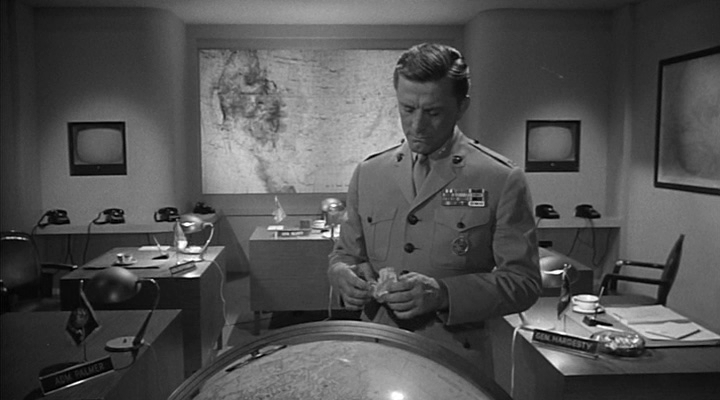
One right-wing soldier in Seven Days in May, played by Kirk Douglas, understands his duty, and obligation under the law, to serve the Commander-in-Chief, even though he disagrees with the president’s politics.  Douglas’s Casey is able to put his personal belief system aside and trust in the people, who sent the President to office.

And then there is another right-wing soldier, the aforementioned Scott (Lancaster), who plots a revolution to substitute his own judgment for that of the lawfully elected U.S. President. Duty is not what calls Scott. Evangelical certainty, and moral self-righteousness are his only guideposts.

Seven Days in May is a battle between these two men and their competing visions. One man serves his country, and realizes that to be President is to see things in a different way than a general, or soldier might.

The other man serves only his ideology (and thus his vanity). In serving this idol, he steps over the will expressed by the American people.

Seven Days in May is disturbing -- and tautly edited -- as the exquisite screenplay by Serling fleshes out the details of the coup attempt, and the President’s last-ditch attempt to hold onto the sacred responsibility that “We the People” entrusted him with.

Like The Manchurian Candidate, this film may feel dated to some today, in part because the Halls of Power featured in Seven Days in Men are populated exclusively by white men, and in part because the depiction of Eleanor Holbrooke (Ava Gardner) is a bit patronizing. She is treated, even by Casey, as a child; one who can’t select for herself how she should live, or who she should be.

But again -- as I always like to point out -- films are made in a historical context.

It’s true that Seven Days in May has seen time pass it by in some ways. But like The Manchurian Candidate, it seems to resonate more fully today, in 2016, than has in some recent years.  In some fashion, it has been passed by modern contexts, and in other ways Seven Days in May is again frighteningly timely.


“Why, in God's name, do we elect a man president and then try to see how fast we can kill him…”

Marine Colonel Jiggs Casey (Kirk Douglas), through happenstance and coincidence, discovers that his superior, the head of the Joint Chiefs of Staff, General Scott (Lancaster) is moving men and equipment in preparation for a coup in just a matter of days.

In just a week, Scott and those he commands will seize all television and radio communication in the United States, using a secretly-funded and secretly-manned unit, ECOMCON (Emergency Communications Control) to usurp authority from the historically unpopular President, Jordan Lyman (Fredric March).

Scott’s reason for the coup is simple. He disagrees with a disarmament treaty between the Soviet Union and the United States that the President supports and wishes to see ratified.  Many Americans feel just as he does, and many of them protest outside the White House.

Casey reports everything he knows about the coup attempt to the President, and Lyman’s chief of staff, Paul Girard (Martin Balsam).  Girard rejects the tale as paranoid fantasy, but the President realizes he can’t afford to be caught flat-footed, and organizes a brigade of trusted aides to help him determine where he stands. 

As everyone is quick to realize, General Scott controls the military, and therefore possesses force. The President’s great power, by contrast, is the moral authority of his office, and the Constitution.
Girard is killed in a suspicious plane crash while soliciting the aid of a Navy officer (John Houseman) who refused to be part of the coup. 

Meanwhile, the President’s friend, Senator Raymond Clark of Georgia (Edmond O’Brien) is held in custody by Scott’s men when he attempts to find the secret ECOMCON base.

Casey is ordered, against his will, to hunt down incriminating love letters from Scott to his former lover, Eleanor (Ava Gardner), so that the President, if necessary, can “slime” his enemy with them. 

The President absolutely resists this option -- realizing it works against his moral authority -- and instead demands, in a face-to-face meeting, Scott’s resignation.

But Scott is not ready to give up his grab for power just yet…

“And from this…desperation we look for a champion in red, white and blue. Every now and then, a man on a white horse rides by, and we appoint him to be our personal god for the duration.”

Seven Days in May opens with a pan down across the United States Constitution. The writing on the document is large enough, and clear enough, that we can read it. 

As the camera pans down this founding document, the numerals 1 to 7 are scrawled hastily and awkwardly over it, in black writing. 

This writing suggests that in just seven days, the Constitution can be desecrated, if Scott’s plan is carried out.

The writing over the founding document is thus akin to graffiti, despoiling the image of the Constitution.


And this optical “superimposition” of graffiti, of writing, over our Constitution also serves as a metaphor for Scott’s actions. By planning to take power from the President, and from the people who elected him, he is similarly spoiling or betraying America.  We see the Constitution literally soiled. And we see Scott’s plan to trample it.

After this dynamic and effective opening, Seven Days in May cuts to a protest outside the White House as it becomes violent.

On one side of the divide are the folks who see the disarmament treaty as a cowardly, treacherous act. 

On the other are those who agree with Lyman, and view the treaty as a way to help secure peace in our (nuclear) age. Frankenheimer’s camera takes us right into the scuffle with a shaky cam, quick cuts, and very informal camera work. This approach makes the protest surprisingly visceral, and also has the effect of making us feel under siege; like we are there, experiencing the protest and the blows ourselves.


This technique is perfect because, of course, we are there. We all grapple with issues like this, on a daily basis.  We all stand to win or lose, depending on how things turn out, depending on what our leaders decide.

These two scenes, in tandem, create quite an ominous or tense mood right out of the gate. First, we see our most revered founding document desecrated, and then we see civil debate break down into irreconcilable violence. 

Together, these two moments light the match, the fuse that burns throughout Seven Days in May right up until the film’s cathartic and uplifting final speech by Lyman, a true statesman.

In terms of its approach to history, Seven Days in May has clearly selected some historical inspirations for Scott, the self-aggrandizing “patriot” who is convinced, primarily, of his own greatness/correctness.


Some critics (and indeed, Frankenheimer himself), view Scott as a Senator McCarthy figure. McCarthy, as I wrote last week, led a witch-hunt against “Communist infiltrators” in the U.S. Government to make, actually, a name for himself.

Other see Scott as a corollary for General Edwin Walker, a man whom President Eisenhower chastised for putting his own personal politics above his duty. Eisenhower asked for, and received, Walker’s resignation.

Today, men of this stripe are still with us, putting their personal religious beliefs and views on ideology ahead of their job as military men or advisors to the government.  So, Seven Days in May has not created Scott out of whole cloth in some attempt to discredit people on the right side of the political spectrum.  Instead, a straight line can be drawn from men like McCarthy, and Walker to Scott…and then people in the present time.

And again, we have the example of Casey. He is from the same political party and belief system as Scott, but he is not a demagogue or an ideologue.

What Seven Days in May also gets right is the long, historical -- and let’s face it -- disgraceful attempt to dismiss and diminish peace efforts (and treaties, specifically) as insidious weak-kneed methods by which Presidents plan to destroy America. 

Think this is a belief that only occurs in fiction? 

Consider the skepticism with which President Reagan -- a conservative! -- was greeted, by right-wingers in 1988, when attempting to get a disarmament treaty with Russia through the Senate.  One senator said, almost word for word, in that meeting, what Scott says to Lyman in Seven Days in May, beginning with the assertion “The Soviets have broken most every treaty they have ever signed.”

If you require a more recent historical example of the principle and scenario spelled out in the Frankenheimer film, just remember the response to the U.S.’s attempt to make peace with Iran in 2015-2016.  Some 47 senators signed a letter warning Iran that they would not consider any such treaty binding.  Essentially, they were circumventing the prerogatives of the U.S. President, in an act that some have called “mutinous” and “traitorous.” 

Seven Days in May cannily includes a Senator (Whit Bissell) in the conspiracy “loop” with Scott, and goes just one step further: making the mutiny and treason manifest as a military take-over.


Most deftly, however, Seven Days in May gets right the notion we see so often in our national discourse; that people are loudly patriotic only so long as their party and beliefs are in power. 

When they are not in power, what do they do? How do they act? What do they say?

They talk down America.

They say specifically, that America is no longer great. They say it is weak. (And only they can make it strong again. Not with their action, but with their “beliefs.”)

Posted at the top of the review is the speech by President Lyman in Seven Days in May, which addresses this terrible quality, the diminishing of America to score political points…even when the whole world is listening. 

President Lyman rightly reports exactly what this kind of talk really is.

It is “slander,” he declares. America is great.  Great enough to be both strong and patient, and to seek ways out of wars, rather than finding excuses for fighting them.

That speech calls out men who purport to be patriots but actually root against America when their team isn’t in power. 

Lyman has another great moment in the film.  He is baffled -- as often I am -- by the hatred of these so-called patriots for the very government they claim to revere.


He reports: “You have such a fervent, passionate, evangelical faith in this country. Why in the name of God don’t you have any faith in the system of government you’re so hell bent to protect?”

That’s a good question.

And one we should all still be asking, even fifty years since Seven Days in May’s premiere

Movie Trailer: Seven Days in May (1964)

Wednesday, December 02, 2015

Trading Cards of the Week: Combat (Donruss; 1964)


Friday, November 27, 2015

Cult-Movie Review: Godzilla vs. The Thing (1964)


Godzilla movies can often be quite blunt in presentation, so -- in honor of that trait -- allow me to be blunt about Godzilla vs. The Thing (1964).

It is, basically, a superior, artistically-coherent version of King Kong vs. Godzilla (1962). 

This movie dramatizes a very similar tale, but Godzilla vs. The Thing ties all the familiar elements together into a caustic and effective critique of Big Business.

Accordingly, this film feels far more direct and meaningful than its predecessor did.  In fact, I would agree with critics who state Godzilla vs. The Thing is one of the all-time best Showa Godzilla films.  

In particular, it is noteworthy how Godzilla vs. The Thing forges a link between irresponsible Big Business and environmental and manmade catastrophes. Even Godzilla himself is contextualized in light of this nexus.

In man’s blazing desire to profit from things that aren’t his to profit from, says the film, he risks total apocalypse, even if that apocalypse is unintentional.

But Godzilla vs. The Thing doesn’t desire to be a polemic, either, and also comments meaningfully on man’s connection not just with nature, but with his fellow man.

The great Mothra -- who has seen her island devastated by atom bombs -- could refuse to help civilized Japan in its hour of desperate need.  But, as the film states, “we must learn to help one another,” or we’ll all go down, if not to rampaging Kaiju then to some other dire threat.

Agree or disagree with its premise about reckless capitalism, Godzilla vs. The Thing really works splendidly, and the battle scenes are fantastic too, featuring more cut-ins and extreme close-shots so the fighting monsters seem even more vicious than before.


“Money, that’s all they’re interested in….”
Following a dangerous typhoon, a reporter, Ichiro (Akira Takarada), and his new photographer, Junko (Yuriko Hoshi) survey the damage to the shore-line. They uncover a giant reptile scale, but that discovery pales in comparison to another.
A giant, colorful egg has been seen in the shallow waters of the coast.
This colossal egg is brought ashore by the poor locals, and studied by scientists, including Professor Miura (Hiroshi Koizumi) until a businessman named Mr. Kumayama (Yoshifumi Tojima) brazenly explains that the egg is his property. He has just purchased it from the desperate locals, who have endured the typhoon damage. He plans to sell it to the head of Happy Enterprises, with the express purpose of creating an amusement park attraction based on it. 
Soon work is under-way to incubate the egg in a large structure…
Before long, the Shobijin -- two tiny fairy women -- appear in Japan, and ask the businessmen for the return of the egg to its home on Infant Island.,The egg belongs to their deity, a giant old creature called Mothra. Their pleas are ridiculed and ignored, however and the small women face capture themselves.  They escape from custody and return to Infant Island.
Meaenwhile, Godzilla rears his head in Japan again, this time near the beach where he washed ashore (and lost his scale…) in the hurricane.  Godzilla promptly begins to cause great damage to Japanese industry and property, prompting Ichiro and Junko to visit Infant Island and beg Mothra’s help to defeat him.
On the island, Mothra’s help is solicited, even though the island has been ravaged by atomic testing, and civilized man refused to return the giant monster’s egg. Still, Mothra agrees to help…but the monster is aged, and may not be able to defeat Godzilla.
When Mothra dies in a fierce battle with the giant radioactive lizard, her egg finally hatches, and two Mothra grubs continue the fight, for all mankind.


“I’m sure they hate us for what happened here.”                                     

If the angle about a pharmaceutical company and its CEO was played largely for laughs in King Kong vs. Godzilla, a similar plot-line gets more serious treatment in Godzilla vs. The Thing. Here, a company takes possession of an egg it clearly didn’t hatch, and offers to let scientists study it…for a price.

The “entrepreneurs” that turn this egg into a commodity hope to mint a fortune by making it the center of a tourist attraction. In short, they seek to exploit that which is not theirs. An egg is a symbol for nature, and for life, but these men see it as a golden egg, a path to personal wealth.

Then, when the fairies -- speaking on Mothra’s behalf -- ask for the return of the egg, the company people all but laugh at them. The egg is the company’s asset now, and they have extended themselves with some expense to build an incubator, and so forth.


There’s no way the company is giving it back.

Uniquely, the company’s representatives see the egg exclusively as property. They purchase it from a previous (illegitimate…) owner, the locals whose land it came to rest on.  But now, because payment was made, it is a resource that belongs to the company for reasons of exploitation.

In contrast, the fairies make an argument based not on property, but on the common good.  They are afraid that the egg could hatch, and inadvertently cause tremendous destruction.  The fairies, in other words, are looking out for all mankind, while the company just cares about its own profits.

The fear that a hatched egg could inadvertently cause tremendous damage is significant in Godzilla vs. The Thing and we see that fear realized visually with Godzilla. He begins a reign of destruction in Japan, but notice that in this case, his destruction doesn’t seem at all intentional.

For example, his tail gets caught in a tower, and the tower falls down on him. 

Moments later, Godzilla actually slips on a stretch of land. He loses his balance, and falls into another building.  Then, trying to stand-up and re-balance himself, he further damages the building.


This is not the behavior of angry animal pulping a city. This is a natural force doing what natural forces always do: inadvertently causing great damage in man’s world. There is not malicious intent, but damage is nonetheless caused.

The commentary about big business in Godzilla vs. The Thing also extends to journalism.

Journalism is supposed to be a beacon of hope, exposing corruption and danger and keeping the public informed in a timely fashion.  But as one character notes “a newspaper has a limited capacity to reach people. It can’t enforce the law.”

By implication, the government – in bed with big business – should be the one enforcing the law, but it isn’t doing so. 

Again, Godzilla vs. The Thing forges its critique of laissez-faire capitalist practices.  The government and military in vain try to stop Godzilla’s reign of terror, when a route of diplomacy -- with the fairies – has been neglected.

The general idea applies to Mothra’s island, as well.

Look what the countries of the so-called First World have done here, with their fearsome, high-tech military-industrial complex. Such forces have destroyed a once-beautiful island, leaving it an environmental wreck.  Only one small area is still green, and the rest of the island is barren, littered with skeletons. 

The land -- representing nature itself -- was used as man’s property (much like the egg is treated as property…), by people unconcerned with the common good, focused instead on ideological or material profit.


But Godzilla vs. The Thing isn’t cynical or pessimistic about such matters, which is one reason why I love it so much.  Instead, the film is actually hopeful, and shows that two wrongs don’t make a right.

Mothra and her people were treated rudely by the new owners of the Egg, and their needs and desires were never taken into account. It would be easy to treat the people of imperiled Japan the same way now.

The people of the island could have reciprocated cruelty with cruelty. They could have stuck to their “we will not help” line, when assistance was requested. 

Instead, the fairies see how bad judgment should not be repaid with bad judgment.  A line of dialogue in the film notes that “as humans, we are responsible for each other,” and that’s the film’s positive message. 

If we can help each other in a time of crisis, we must do so.  This is true even in times when there is nothing for us to “gain” or “earn.”  That’s the behavior Mothra models.  The giant creature is weak and infirm, and has no “vested” interest in fighting Godzilla.  But Mothra goes into battle for the common good, putting selfish concerns aside. 


It’s true that Godzilla vs. The Thing moves along some familiar story lines and plot points. As was the case in King Kong vs. Godzilla, we here visit the native island and meet a culture that worships another monster.  In both cases, that “other” monster is recruited to battle a rampaging Godzilla. 

And also as in King Kong vs. Godzilla, Godzilla apparently goes down in the last round, and the victor (Kong or the Mothra grubs…) begins the long trek back to an island home. 

In this case, the two closing shots are practically identical.

But if you put aside the familiarity of this narrative’s overall structure, you can begin to see how there is (red) meat on this Godzilla film’s bones, and how the filmmakers have found a way to again explore aspects of man’s world, and his short-sighted misdeeds. 

The best Godzilla films are ones in which the creatures represent some force or aspect of human life beyond themselves. They become, instead, avatars of atomic war, avarice, or even pollution.

Here, sweet Mothra is a shining symbol of hope, and selflessness, representing the capacity for man to do the right thing, even if there are personal consequences.

Wednesday, July 15, 2015

Theme Song of the Week: Jonny Quest (1964)

Wednesday, February 18, 2015

The Man from U.N.C.L.E. "The Quadrapartite Affair" (October 6, 1964)


In “The Quadrapartite Affair,” a scientist in Yugoslavia, Dr. Raven, is infected with a terrible “fear gas.” His grown daughter, Marion (Jill Ireland) manages to return to the States and warn U.N.C.L.E. about the situation.

Ilya Kuryakin (David McCallum) is assigned to protect her, should the forces of THRUSH seek to capture her.  But a delivery man drops off a box of chocolates that emits the fear gas, incapacitating the agent.  

Consumed by fear, Ilya is unable to save Marion.

Napoleon Solo (Robert Vaughn) stages a dangerous rescue mission of Marion, freeing her from imprisonment on the yacht of a deadly THRUSH operative, Gervaise Ravel (Anne Francis).  

Then, Napoleon, Marion and Ilya head to Yugoslavia to meet up with a local scoundrel who may be able to provide information about the fear gas, first developed in World War II.  

But can they trust Milan Horth (Roger C. Carmel)?


The “Quadrapartite Affair” opens with the unusual sight of our favorite U.N.C.L.E. operatives breaking the fourth wall and introducing themselves to the audience.  After a narrator reveals the HQ in an “ordinary tailor shop” (or “is it?”), Solo, Kuryakin and Waverly all tell us their names, and their positions in the organization. 

I suppose this was deemed necessary, to make certain that viewers were caught up with the details of the series, but today it nonetheless plays as a bit strange, and labored.  Imagine if, on Star Trek, Captain Kirk (William Shatner) and Mr. Spock (Leonard Nimoy) suddenly broke the fourth wall, addressed us directly, and began discussing the details of Starfleet hierarchy.


Otherwise, this early episode of the series in notable, perhaps, for the increased role played by Kuryakin. 

The Soviet agent comes across in the episode as supremely self-confident, but also physically edgy in a way that Solo is not, really. Solo is dashing and debonair.  Kuryakin, it is clear -- especially from his flirtations with Marion -- is more direct, or more basic. There is real attraction in the air here, and that may be a result of the fact that McCallum and Ireland had been married since 1957. They starred in five episodes of Man from U.N.C.L.E. together, the last in 1967.


One extremely impressive aspect of “The Quadrapartite Affair” is the interlude aboard Gervaise’s yacht.  Solo breaks Marion out of the brig, and then must get her off the ship, which is sailing in New York Harbor.  

The chase goes up to the deck of ship, over the deck roof, back down to the deck, up and down stairways, and finally onto a waiting skiff, and is genuinely exciting.  There is no fakery or studio-bound footage here, and it looks like Vaughn and Ireland really jump onto the boat’s bow seconds before it speeds off.  This is a sustained, well-directed action set-piece, and a nice reminder who well assembled some 1960s cult-television really was.

The main threat of the episode a “fear gas,” is one that, for some reason, was extraordinarily popular in 1960s cult-television. An episode of Voyage to the Bottom of the Sea (also from 1964) called “The Fear Makers” involved fear gas.  

Similarly, an episode of Batman (1966 – 1968) saw Shame (Cliff Robertson) unleash a similar type of fear gas on the Dynamic Duo.

CULT TV FLASHBACK: Dead of Night (1994-1997)

This year, Dead of Night: The Complete Series , was released on Blu-Ray by Vinegar Syndrome , and I just had the pleasure of falling into i...