Creator of the award-winning web series, Abnormal Fixation. One of the horror genre's "most widely read critics" (Rue Morgue # 68), "an accomplished film journalist" (Comic Buyer's Guide #1535), and the award-winning author of Horror Films of the 1980s (2007) and Horror Films of the 1970s (2002), John Kenneth Muir, presents his blog on film, television and nostalgia, named one of the Top 100 Film Studies Blog on the Net.
Showing posts with label Halloween 2016. Show all posts
Monday, October 31, 2016
From my Ten Year Old Godzilla: Happy Halloween 2016
So, my son Joel was Godzilla for Halloween this year, and we had an epic trick-or-treat excursion.
I hope all you boys and ghouls also had a great night too!
Labels:
Godzilla,
Halloween 2016
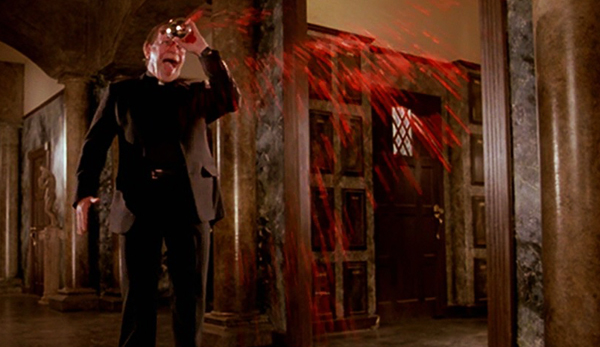
Halloween 2016: Phantasm II (1988)
Don Coscarelli’s Phantasm (1979) is a brilliantly-crafted horror movie, and a classic of the genre too, in no small part because it appears to operate on multiple levels of meaning and symbolism.
For
example, taken literally, the film is about a horrible ghoul (The Tall Man), and
his agenda to strip-mine Earth’s dead.
On
a far more complex level, Phantasm concerns the industry of death itself, from hearses
and coffins to graves and mausoleums. Death, we see, is an impersonal,
industrial process -- a factory, in some sense -- and the Tall Man is its
(cinematic) overseer.
Yet
as I’ve written before Phantasm also serves as a sensitive examination
of one boy’s reckoning with death as an inescapable fact of life.
Our
protagonist, young Michael (Michael Baldwin) dreams of combating the Tall Man
(Angus Scrimm), because he is a boogeyman or personality who can be defeated. Death itself -- the unstoppable, face-less force
that took away his brother Jody (Bill Thornbury) -- cannot be destroyed.
So
adolescent Michael conjures a “phantasm” -- a dream -- that is palatable to him
in a time of grief and mourning.
In
that dream, mortality can be overcome; death can be defeated. The Tall Man can
be buried forever. The film, featuring
moments of innocent, almost child-like wonder (witness the giant fly, born from
the Tall Man’s blood..), can thus be explained as a boy’s childhood fantasy of
beating death once and for all. A
fantasy that, in the denouement, he sees is but mere delusion.
Death
always wins.
The
sequel, 1988’s Phantasm II, is a very different film, and overall a far more
conventional one. By and large, the
metaphor behind the first film -- which involves both man’s desire and
inability to defeat death -- is left by the wayside, and the follow-up focuses
instead on action, weaponry, and loads of stylish excess.
These
predilections make Phantasm II a perfect horror film of the 1980s, an era when
escalation was the name of the game, and action replaced, to a large extent,
atmosphere.
Here,
the action scenes are deliberately stylish and over-the-top, in the mode of Sam
Raimi’s Evil Dead franchise, and Raimi himself is name-checked in one
crucial scene. Guns, grenades, flame throwers and other weapons dominate the
action, and one gets a thorough sense of the Rambo-fication of the franchise.
At
least two suburban houses explode in the film, and one (impressively lensed)
moment sees the Tall Man standing in the foreground while all hell breaks loose
behind him. He is literally surrounded by hellish fire.
It’s
not necessarily a bad tor unsatisfactory approach and Phantasm II is a wholly
entertaining rollercoaster of a film, even if it resolutely lacks the
intellectual and artistic heft of the 1979 original.
Where
Phantasm
II proves most intriguing is not in its crazy, often gruesome action,
but rather in its surprisingly effective (and prophetic?) vision of a
small-town America decimated by that Bringer of Death, the Tall Man.
I’ve
always liked Phantasm II second best in the franchise, judging it a solid,
well-made, involving sequel.
But
I do miss the absent piece of Phantasm’s creative legacy: the
acknowledgment and through-line that the Tall Man, his minions, and Michael’s
adventures are all some phantasm that reflects a very real fear in our kind;
the fear that death -- like taxes and horror movies sequels -- is utterly inescapable.
“Remember,
it was all in your imagination.”
Several
years after the death of his brother Jody, and his incarceration in a psychiatric
hospital, Michael (James Le Gros) is released and declared cured of his mental
illness. He promptly teams up with his old friend, Reggie (Reggie Bannister).
This
duo heads out on the road, in pursuit of the Tall Man, itching for a
fight. Michael can find The Tall Man
because he shares a mental link with another possible victim, a young woman in
Perigord, Oregon named Elizabeth (Paula Irvine).
Along
the way to reach and rescue Elizabeth, however, Reggie and Michael pick up a
stranger, Alchemy (Samantha Phillips), and must contend with booby traps left
by the Tall Man.
Finally,
the hunters reach Perigord, where Elizabeth has teamed with a priest, Father
Meyers (Kenneth Tigar), to put an end to the Tall Man’s reign of terror once
and for all.
“Let’s
go shopping.”
While
watching a sequel like Phantasm II, or for that matter,
James Cameron’s Aliens (1986), I often remember some of the punchy and very
smart dialogue from Wes Craven’s Scream 2 (1997). There, Randy Meeks
(Jamie Kennedy) explains how all horror genre sequels must ratchet up the body
count, feature more elaborate death sequences, and highlight what he terms “carnage candy.”
There’s
indeed much carnage candy in Phantasm II.
For
example, one unlucky minion of the Tall Man sees a silver sphere burrow inside
of him, hollow out his innards, then make its way through his neck, to his
mouth.
Another
extremely gory (and accomplished) scene finds the Tall Man’s face
disintegrating after being pumped full of hydrochloric acid.
Clearly,
the disgust quotient has been upped significantly since 1979, and now the
flying spheres or balls not only drain victims of their blood and gut them from
within, they lop off ears, shoot lasers (like a Predator shoulder cannon) and
the like.
This
“bigger is better” mentality informing sequel is part and parcel of the 1980s
genre cinema. Consider, again, Aliens. The film stresses action over suspense, and
pits the original hero, Ripley (Sigourney Weaver) not against one
acid-for-blood xenomorphic monstrosity, but a veritable planet-ful of them.
Or
consider Tobe Hooper’s Texas Chainsaw Massacre Part II (1987),
which features -- amusingly -- dueling chainsaws, and entrenched commentary
about small-business owners in the Reagan Era.
Phantasm
II gets its
own dueling chainsaws scene (in which it is proved, for the record, that size
doesn’t matter…), and gives its audience full-on battle sequences with Reggie
and Michael overcoming dwarf minions by the dozen.
Reggie
takes out four of them with a customized shot-gun, with one pull of the
trigger.
One
early scene -- also perfect for the excesses of the eighties -- also sees
Reggie and Michael going “shopping,” buying items from a store and crafting their
signature weapons, including a fire extinguisher and the aforementioned shot
gun. They pay for all that they take,
and the focus is on making weaponry, so they can take the fight straight to the
Tall Man. As Reggie actually says in the film: “Come on, let’s go kick some ass!”
Phantasm
II possesses
two saving graces; ones that keep the film from being a brain-dead Rambo
in the Graveyard film.
The
first is the film’s sense of visual humor/style. As I noted in my introduction, Sam Raimi is
name-checked during one scene in an embalming room. A bag of ashes (Ash?) are
thrown in a bag labeled with the director’s name. This tribute is perfect, because Phantasm
II, much like an Evil Dead film, never stops moving, and
never remains still for along. Coscarelli’s camera plows through doors, one
after the other, in a very Deadite-ish gag that nonetheless works like
gangbusters.
Similarly,
Reggie’s run-in with a Graver (another Tall Man minion) is funny, tense, and
grotesque. Coscarelli demonstrates here
and throughout the film that he can shift between tones with aplomb, and keep
the whole enterprise moving at a crazy, gonzo clip.
More
impressive, however, is the subversive idea, just under the surface in Phantasm
II, that when Big Time Industry comes to a small town…the small town
dies. Much of the film involves Reggie
and Michael pursuing the Tall Man from American ghost town to American ghost
town. Michael observes that “small towns are like people. Some grow old
and die a natural death. Others are murdered.”
What
murders these small towns is the arrival of the Death Industry, under its CEO,
the Tall Man. He arrives, and strip-mines the towns for all their usable (on
his terms) resources. He takes over the local mortuary, and before you know it,
graveyards are being emptied at a rapid rate. His take-over (with his own
employees: dwarves and gravers, namely) literally kills the small towns in
short order. The denizens of the town die, and are made slaves.
Not
low-wage slaves, either. Just slaves.
For
many years (ten, actually) I lived in a beautiful southern small town; one with
beautiful old architecture and a downtown consisting of long-standing mom and
pop shops. In the span I lived there, this town was murdered, per Phantasm
II’s lingo, by the arrival on the main highway, not far away, of
shopping goliaths like Wal Mart, K-Mart and Target. The downtown shops emptied at an incredible
rate until the whole area -- so picturesque
and evocative of an earlier era in American history -- became a ghost town,
an image like something out Phantasm II.
So
perhaps Phantasm II is more than a perfect representative of its
gung-ho era -- the hyper-militarized, excessive, action packed 80s.
Perhaps
in some way the sequel was forecasting what the future of that world could one
day look like, in the 90s and beyond. Considering
the death, in so many places, of old fashioned, small-town America, it’s hard
not to view the enthusiastic line of dialogue in the film, “let’s go shopping!” as carrying an
ironic, double meaning.
I
also find Phantasm II’s undercutting of traditional religious belief to
be startling, especially given the traditional nature of the time period from
which the film hails. One of the most frightening notions ever put to the
horror film is voiced by the Tall Man here.
When
confronted with Father Meyers and his Christian faith, The Tall Man mocks
religion as fantasy, as delusion. “You think when you die, you go to Heaven?
You come to us!” He taunts.
It’s
a chilling declaration, and promise that the afterlife is not paradise, but
slavery. It’s downright chilling.
Finally, I appreciated Coscarelli's choice to tell Mike and Reggie's story (the 1979 original) through charcoal sketches in Elizabeth's notebook. I felt, personally, that this was an interesting and artistic way to resurrect images from the first Phantasm.
Phantasm
II cannot
match the brilliance and artistic depth of the original 1979 film, but in the
era of Freddy Krueger and Friday the 13th sequels,
it stakes out a claim for quality by balancing so well its scares and its laughs.
The sequel doesn’t open itself up very well to multiple readings, and the “dream”
or “rubber reality” concept is half-enunciated.
Here,
for example, Reggie doesn’t remember being attacked by the minions at Michael’s
house, even though Michael remembers it. This suggests the scene was a dream. But it is never explained how Michael parses this
experience in the real world. Was his
house actually destroyed by a gas leak?
It’s
awkward and confusing to viewers that Reggie only comes on board with the plan
to eliminate the Tall Man after his house also explodes, in the present. If the
movie had just treated the first scene as real, it wouldn’t need to create a
modern, artificial explanation for Reggie’s loyalty to the cause.
And
the film’s end, of course, is a slapdash re-assertion (or regurgitation) of the
original’s idea that Michael’s battle with the Tall Man is just a phantasm, not
reality. But it’s more difficult to make
that case here than it was in the original film because Michael seems to be sharing
a folie a deux with Elizabeth. Their delusion of a Supernatural (or alien?) Death
Merchant is mutual, thus making it unlikely to be just a young person’s fantasy
about defeating mortality.
So Phantasm II is great to look at, watch, and experience…but not so great to think about deeply. If you can accept the sequel on those terms, it remains one of the most entertaining horror sequels of the last half of the 1980s, and one featuring a few superb sequences. The Tall Man’s denunciation of our faith is one example, and the view of small town America decimated by the Big Death Industry is another.
Labels:
Halloween 2016
Halloween 2016: Phantasm (1979)
In some fashion direct or indirect, all horror films grapple with the ultimate human fear, mortality. But Don Coscarelli’s landmark 1979 horror Phantasm is a film veritably obsessed with the cessation of life, and also the terrible grief that accompanies death for those left behind on this mortal coil.
In fact, it is not at all difficult to interpret the
film’s events as one teenager’s powerful subconscious
fantasy, his sublimation and re-direction of grief as he attempts to make
sense of all the death happening around him, in life and in his immediate
family. The film’s almost childish tale
of a Fairy Tale monster -- a witch-like “Tall
Man” (Angus Scrimm) who enslaves the
dead -- is actually but
Michael’s (Michael Baldwin’s) self-constructed mythology
regarding mortality.
Simply put, it’s easier to deal with that orderly
“horror” – a world of monsters and
villains and happy endings – than one in which those Michael loves are lost
and gone forever.
Surreal and haunting, Phantasm confidently moves
and tracks like almost no other horror movie ever made. It vacillates between scenes of outright
terror and ridiculous comedy, and treads into terrains not exactly…realistic. The universe as expressed in the film doesn’t
seem to conform to order or rationality as we understand it, frankly. But importantly, all of this disorder, chaos
and pain feels as though it arises from a deep understanding and sympathy for
childhood. The film’s trademark soundtrack
composition -- which repeats frequently and effectively -- adds to the overwhelming
sense of a lullaby or trance, one we can’t quite awake from.
So many horror fans (rightly) love and cherish
Phantasm because of the horror, because of the flying silver “ball” and
the gore it creates in its monstrous wake.
Yet for me the film is actually a horror character-piece of the highest
magnitude, and actually a tender, even
whimsical reminder of how the world might appear to a sad and lonely adolescent.
“I just don't get off on funerals, man, they give me the
creeps.”
![]() |
| The shadow of death hovers behind Michael. |
Michael
attempts to convince his older brother, Jody (Bill Thornbury), of this bizarre
truth, but Jody is burned out and skeptical.
Since their parents died, he’s been caring for Michael full time, and wants
to leave town. Michael knows this, and
is deathly afraid of abandonment. But
soon, however, Jody is swayed by Michael’s evidence and together with a friend,
Reggie (Reggie Bannister), the trio launches a frontal assault on the Tall Man…
After the Tall Man is defeated,
Michael awakes from the long dream to face hard reality. Not only are his parents dead, but Jody is
gone too. He died in a car crash. Now Reggie promises to take care of him, but
the specter of death is not yet gone from Michael’s life…
“First he took Mom and Dad, then he took Jody, now he's after
me.”
![]() |
| Surrounded by the trappings of death |
In some instances, however, teenagers do not
react to such losses as expected, with tears and outright declarations of
sadness or pain. Instead, they may not
confront their grief at all. Rather they
sublimate and deny it, even crafting complex stories and belief systems around
the death of their loved ones, such as the fiction that they are somehow
responsible or guilty for those deaths.
We are confronted in Phantasm, then, with a young
protagonist, Michael, who has seen the death of both his parents, and also -- as we learn at film’s end -- the death
of his brother, Jody. Instead of coping
outright with the grief, however, his mind has fashioned a phantasm, a dream which
to attempts to “re-order” his disordered life.
In this story, Michael and Jody are still a team, defeating monsters and
solving the mystery of Morningside. In
this dream, death has become embodied in a person, the Tall Man, and as
something that Michael, importantly, can combat and defeat.
![]() |
| Michael (left, background) is left behind, while Jody heads...where? |
In terms of grappling with the idea of death, the
film proper actually opens with it, as a friend of Jody’s named Tommy is
killed. Michael observes the funeral
from a distance, with a set of binoculars.
This particular shot stresses the importance of how Michael sees, and later scenes in the film are similarly composed
to reflect the same thing: effectively highlighting Michael’s eyes (as he sees
through a crack in an open coffin, for instance) as he views the world. This visual framing is our cue that the film
itself is Michael’s “phantasm,” his way of perceiving and interpreting the
things he experiences.
![]() |
| How Michael sees #1 |
As adults, these things are accepted, perhaps
reluctantly, as part of the landscape, and don’t necessarily have the power to
frighten or disturb us. We know such things
exist, and we deal with them. But because Michael is obsessed with death, the
film reflects his fetish most vividly, creating a world where the trappings of
death are visible and prominent in nearly every frame, and suffused with a dark
malevolence. The funeral director is a
monstrous crone (The Tall Man), the graveyard is a place of darkness, danger
and entrapment. The hearse is a vehicle
for the enslaved “dead” dwarves employed by the Tall Man, and so on. The Tall Man hovers in the background of some
shots like the Angel of Death himself.
He marshals all these familiar trappings of death and renders them
frightening once more. They serve him.
![]() |
| How Michael sees #2 |
I’ve written above that some aspects of Phantasm
seem childish or childlike. This is not
an insult or a put-down. For instance,
Michael and Jody easily destroy the Tall Man, essentially trapping him in a
hole in the Earth (a mine shaft). That
this simple, almost cartoon-styled plan works against a Dedicated Agent of Evil
reminds us that we are dealing with a child-like intelligence as the primary mover of the action. We are seeing Michael’s dreams made manifest
before our eyes. We can destroy the devil by burying him up on that mountain!
![]() |
| How Michael sees #3 |
I believe this interpretation is borne out, to
some degree, by the depiction of the film’s deadly siren, the Lady in
Lavender. She is a mysterious figure
promising sex but delivering death. She
is very much a product of a fearful teen’s imagination and fear. That teen does not yet understand what sex
is, or the power of sex as a desire and appetite. Instead, the “unknowns” of sex become, in the
film, disturbingly intermingled with death.
The moans of love-making transform, in short order, into the groaning of
a monster lurking in the nearby bushes. Both
sex and death are things that seem to take Jody away from his brother, after
all.
Although all the Phantasm sequels surely
preclude the possibility that this film is but the dream of a sad, grief-ridden
teenager, the interpretation tracks admirably if you take Coscarelli’s original
as a standalone effort and not part of a “franchise.” As I have also written before, I believe this
quality of the film (as a teen’s dream) is also made clear by Michael’s
unbelievably good survival rate. He
tangles with the Tall Man and his minions no less than four times in the film,
and always emerges unscathed, only to prove, finally, victorious in his
campaign. I submit that this “luck” too
is a reflection of a youthful mentality: the belief that you are somehow immune
to death. Furthermore, it reflects the
idea that we all place ourselves at the center of our fantasies, as the heroes
in our own adventures. Here, Michael
deals with death by becoming a superhero of sorts, one who conquers long-lived
monsters and solves mysteries.
I admire the film because its distinctive visuals so beautifully mirror Phantasm's themes. In some shots, the Tall Man seems to be the shadow of death himself. And in one haunting composition, Michael sees Jody for the last time (before waking up into a world where he is dead). Jody stands high in the frame, atop a mountain. Jody stands on that pinnacle, a heavenly light (like angel wings?) behind him. It's the distant, final view of a man going to the great beyond, and Coscarelli's imagery captures it with wonder and a degree of lyricism.
![]() |
| Our last, wistful view of Jody, from a distance and bound for parts unknown. |
Charting the disturbed mental landscape of a
grieving boy, Phantasm gets to a very simple and emotional truth about human
existence. It is often easier to live in
a fantasy world (even one with monsters, dwarves, giant flies, and alien worlds…)
than it is to face head-on the fact that, in the final analysis, we are all
going to lose our loved ones. Because it
deals so sensitively and succinctly with that tough, hard-to-accept idea, Phantasm
always gets to me on some deep level. The
film makes me ask myself an important question: Why do I like and enjoy horror
movies so much? Why do I love being
scared and challenged by them?
With films like Phantasm, am I actually
preparing myself, in some way, for the inevitable?
Perhaps
so.
I know only this: I deeply fear death, and
sometimes obsess on it, both in relation to the end of my own life, and deaths
of those I love. In Phantasm Michael reveals
one way to grieve, or perhaps to escape grieving. Phantasm makes me wonder about my own
solution to the Phantasm equation. Am I
going to be that boy, left behind on the bike while others leave me behind? Or
will the Tall Man show up for me first?
At some point, the Tall Man is going to look all
of us straight in the eye, commend us for a good game -- now finished -- and remind us it is time to die. You don’t have to be a teenager to fear that
day, and in some way Phantasm helps us to explore
meaningfully the ideas of grief, loss, and the inevitability of death.
Labels:
Halloween 2016,
Phantasm
Friday, October 28, 2016
Halloween Week: Rob Zombie's Halloween II (2009)
Director Rob Zombie's second Halloween film raises a question that nobody was dying to have answered.
Is it possible to make an absolutely brilliant horror movie that everybody -- and I mean everybody -- despises?
His sequel to a remake, Halloween 2 (2009), is indeed such a film. It has outraged horror enthusiasts, paying audiences, and critics around the globe.
And it will likely be reviled, dismissed, and spit upon for decades to come.
Why?
The movie is an absolutely unsparing and bleak, balls-to-the-wall expression of Zombie's personal vision of humanity as irredeemably corrupt and sleazy. It is the cinematic equivalent of a middle-finger directed at the audience. Apparently, Zombie was essentially offered a blank check from Malek Akkad to pursue his personal vision on this Halloween sequel, and that's precisely what he does here.
Relentlessly.
To wit, there is only one even marginally likable human being in the entire film: Brad Dourif's Sheriff Brackett. Everyone else is literally scum-of-the-earth. Once a dogged hero, Dr. Loomis (Malcolm McDowell) is portrayed here as a horny, exploitative fame seeker, both a fraud and a suck-up.
Laurie Strode (Scout Taylor-Compton) isn't a heroic final girl either. Rather, she is shrill, self-absorbed, mentally cracked, and teetering on the verge of violent psychosis. She is not noble, likable or heroic in any sense. She expresses every situation with the epithet "fuck this."
Even lovely, long-suffering Annie (Danielle Harris) is impatient, crass, and utterly rude in the way she expresses herself. She has a moment in the film when she is being confrontational with a helpful police officer and is so mean and nasty that you begin to wonder: how has it come to this?
Are we a nation of rage-a-holics, just ready to go off on anybody, at anytime?
It isn't just individuals that are corrupt and worthless in Halloween 2. Zombie hates authority in general, and that comes through loud and clear. The police (even as led by kindly Dourif) are portrayed as impotent...useless.
Psychotherapy (as represented by Laurie's psychologist, Margot Kidder), is ribbed as a touchy-feely waste of time.
And journalists? They just want more grist for the mill.
Psychotherapy (as represented by Laurie's psychologist, Margot Kidder), is ribbed as a touchy-feely waste of time.
And journalists? They just want more grist for the mill.
I'm not saying any of this commentary is utterly untrue or always off-the-mark in terms of our real, twenty-first century world. Only that there is nothing to lighten the mood here; no character to really identify with, follow, or admire as an entrance point into Zombie's uncompromising vision.
The result is plain.
There is not a sliver of happiness in Halloween 2; no light, and no hope.
No joy exists in this white-trash world of pain, death, betrayal and murder. Ideas like grief, sadness, redemption, tragedy or fear are only things to be joked about on late night TV with Weird Al Yankovic.
Nobody is going reach out and give someone else a helping hand.
The only place Laurie finds even the barest measure of relief or happiness in Halloween 2 is in the bottle; in alcohol consumption. When she gets falling-down drunk at a Halloween party, that is the only opportunity in which she can "let go" of the pain that dominates her existence.
And even here, director Zombie doesn't grant the audience respite: he undercuts Laurie's moment of beer-induced cutting-loose by cross-cutting it with images of Michael Myers strangling one of her best friends in the back of the van. Even when pain is made numb by booze, suffering goes on elsewhere in the world.
So...did I mention the movie is bleak?
It goes even further.
Zombie continues his systematic dismantling of the Halloween "brand" by removing Michael's mask from most of the action and revealing him to be simply....a psychotic giant with a Grizzly Adams beard.
And then the screenplay firmly identifies the root causes of Michael's homicidal rage: He often hallucinates the ghost of his mother (Sheri Moon Zombie), who tells him he must unleash a "river of blood" to bring her back to life.
Michael accommodates this wish, but now we have a clear, unequivocal motivational window onto his homicidal soul: he's a Momma's Boy extraordinaire. Accordingly, Halloween 2 may just be the biggest paean to mother love in the horror genre since Hitchcock's Psycho (1960).
It is perhaps strange to talk about violence being enjoyable or entertaining, or suspenseful, but the violence in previous Halloween films has always been depicted at a more removed, subtle, culturally decent level. Carpenter's initial film relied on suspense (and musical zingers), not blood shed, to achieve terror. And the most of the follow-up films didn't linger on the suffering of Michael's victims either.
Zombie also turns this franchise convention upside down
Early in the film, we follow Annie -- wounded by Myers -- to the hospital, and watch in nauseating, realistic close-up as the doctors wash, drain, sew-up and otherwise tend to her knife wounds. It is a document of misery. And it goes on for several minutes.
Is it realistic? Yes.
Is it pleasant to watch? No.
There is not a sliver of happiness in Halloween 2; no light, and no hope.
No joy exists in this white-trash world of pain, death, betrayal and murder. Ideas like grief, sadness, redemption, tragedy or fear are only things to be joked about on late night TV with Weird Al Yankovic.
Nobody is going reach out and give someone else a helping hand.
The only place Laurie finds even the barest measure of relief or happiness in Halloween 2 is in the bottle; in alcohol consumption. When she gets falling-down drunk at a Halloween party, that is the only opportunity in which she can "let go" of the pain that dominates her existence.
And even here, director Zombie doesn't grant the audience respite: he undercuts Laurie's moment of beer-induced cutting-loose by cross-cutting it with images of Michael Myers strangling one of her best friends in the back of the van. Even when pain is made numb by booze, suffering goes on elsewhere in the world.
So...did I mention the movie is bleak?
It goes even further.
Zombie continues his systematic dismantling of the Halloween "brand" by removing Michael's mask from most of the action and revealing him to be simply....a psychotic giant with a Grizzly Adams beard.
And then the screenplay firmly identifies the root causes of Michael's homicidal rage: He often hallucinates the ghost of his mother (Sheri Moon Zombie), who tells him he must unleash a "river of blood" to bring her back to life.
Michael accommodates this wish, but now we have a clear, unequivocal motivational window onto his homicidal soul: he's a Momma's Boy extraordinaire. Accordingly, Halloween 2 may just be the biggest paean to mother love in the horror genre since Hitchcock's Psycho (1960).
It is perhaps strange to talk about violence being enjoyable or entertaining, or suspenseful, but the violence in previous Halloween films has always been depicted at a more removed, subtle, culturally decent level. Carpenter's initial film relied on suspense (and musical zingers), not blood shed, to achieve terror. And the most of the follow-up films didn't linger on the suffering of Michael's victims either.
Zombie also turns this franchise convention upside down
Early in the film, we follow Annie -- wounded by Myers -- to the hospital, and watch in nauseating, realistic close-up as the doctors wash, drain, sew-up and otherwise tend to her knife wounds. It is a document of misery. And it goes on for several minutes.
Is it realistic? Yes.
Is it pleasant to watch? No.
Similarly, Michael proves not merely violent in this film, but brutally sadistic: he literally turns one victim's face into unrecognizable pulp.
And though, in Halloween, there was dialogue indicating that Michael Myers ate a dog, Zombie decides to show us that feast here. He cross-cuts between a scene of Dourif chowing down pizza, pretending to be a neanderthal man with Michael Myers ripping apart the flesh of a dead dog...and eating it. Again, it's not scary...just kind of nauseating.
The grounds to which to dislike Halloween 2 are all here in abundance. The "fun" horror of Halloween has been replaced by a lingering, gruesome close-up view of pain, suffering and death.
And the heroic characters many of us have lived with and grown up with for thirty years -- Loomis and Strode, particularly -- are made not just into more fallible, recognizable humans with feet of clay, but utterly despicable people.
And sans his iconic mask -- and now given to primal grunts of effort during his kills -- Myers is no longer a mythic, larger-than-life threat. He's just a run of the mill Dahmer or Bundy.
The Shape no more.
The Bogeyman no more.
This Michael is mankind as the ultimate monster.
Given all this, it is difficult to imagine someone who has liked other Halloween films liking this one.
Zombie's movie -- the tenth in the durable and now predictable horror franchise -- willfully and determinedly undercuts every image, every character, every concept of the property as it has existed for three decades. Anyone expecting a fun, jolting horror experience will be disappointed. This film is a bucket of cold water in the face.
Yet at the same time, I found Halloween 2 absolutely absorbing.
The film is undeniably the unfettered vision of one committed, empowered artist. It is uncluttered by committee-thinking; unburdened by the desire to please the audience, and it is absolutely extraordinary in terms of the visuals, and especially the editing.
As a critic, I often deride horror movies that take the safe route; the run-of-the-mill, conventional approach. You can't accuse Rob Zombie of that pitfall here.
Nothing in Halloween 2 is run-of-the-mill. So while the whole movie feels like you've spent two hours circling a dirty toilet bowl, it's an exquisitely-filmed toilet bowl. Zombie has a great eye for every nauseating, degenerate detail. His world feels real, complete, and powerful.
So yes, Halloween 2 is skanky, sleazy, corrupt, degenerate and excessive. But you know what? I really admired it once I accepted it for what it was.
Initially, I couldn't let go of John Carpenter's Halloween while watching Zombie's 2007 remake, in part because Zombie re-staged much of the action from the classic 1978 picture in slavish -- and inferior -- detail. His original "vision" was corrupted by his need to pay homage to what Carpenter clearly did better.
Wisely, Zombie's Halloween 2 doesn't imitate Carpenter's work (or the 1981 sequel) in any substantive fashion after an early chase set in a hospital.
Instead, Zombie freely pursues his inner demons and does his own thing with a minimum of creative interference.
Pleasence's Loomis and Curtis's Strode couldn't exist in this cinematic hell...but the beauty of that is that they don't have to.
Zombie populates his Halloween 2 with the "people" he sees in that world, and while I would never, ever want to live in that world, it's all of a particular piece. It's unified ugliness, at least.
Furthermore, Zombie provides two pitch-perfect scenes that argue cogently for this franchise's right to exist in this dark, depressing realm. I didn't expect intellectual gamesmanship from Zombie, not when he so frequently prefers a bludgeon, but it's there in glorious detail if you go looking.
In the first instance, Zombie stages a scene between Laurie and her psychologist in the office. Behind them,on the wall hangs a big Rorschach poster. It is white in the center, black around the edges. Laurie is asked what she sees in it, and she replies that she sees a white horse (a reflection of Michael's vision of his mother). Fine. But if you look closely at that Rorschach spot, there's something else the audience sees: a big white spots, with two black "eyes."
What we are looking at, no doubt, is a kind of Rorschach version of Michael Myers' famous Shatner mask.
It is a ghostly white face...upon which our fear is reflected. Laurie's psychologist establishes the blot could be "whatever you think it is," and that is Zombie's specific road map or escape valve in choosing and executing this narrative, stylistic path.
He has gazed at the Rorschach-like mask of the Shape and then written this movie based on what he saw. In his head. This vision of Michael Myers is what Zombie imagined in the lines of that famous, Rorschach-like mask.
Later in Halloween 2, there's a scene in which Annie, Laurie and Sheriff Brackett share a pizza together for dinner. Brackett starts to discuss the great actor Lee Marvin, and the actor's fantastic, colorful, romantic films of the 1960s-1970s: Cat Ballou, The Professionals, Paint Your Wagon.
Well, the two teenagers sharing this conversation with Brackett are clueless. They don't know who Lee Marvin is; and furthermore, they don't care. That artificial world of musicals, westerns and movie decorum is as distant to today's youth as is Ancient Latin. That's not the world they live in. That's not the world this movie lives in either.
Again, this is Zombie's studied and important comment upon the Halloween mythos.
John Carpenter's Halloween -- with all its brilliant 1970s film values -- is the Lee Marvin in this particular comparison.
It is something well-remembered by the older generation but something that -- Zombie suggests -- doesn't carry cultural currency or relevant meaning in the world of today's youth.
Musicals are gone. Artifice is gone. Romance is gone. What we have today is ugly, naturalistic entertainment for an ugly world. Zombie seems to understand that fact, and this scene spells it out quite explicitly.
In a sense, this Lee Marvin metaphor justifies Zombie's approach to Halloween 2.
In terms of his visuals and editing, Zombie is truly audacious. He cross-cuts Brackett's discovery of Annie's corpse with home movies of Annie as a happy little girl. It's a breathtaking, and enormously affecting conceit. Without a doubt, it makes you "feel" the impact of this death more than just about any other in the Halloween film cycle. You understand what loss feels like for Brackett. It's heart-rending. He has lost a child.
Often in horror movies, teenage victims are types. They are jocks or bitches, nerds or cheerleaders. Hence, when they die, we don't feel grief, rage or sadness. But in Halloween 2, Zombie makes us see how it feels for Brackett to lose Annie.
At other times, Zombie ramps up the violence during Michael's rampages so that the very film stock itself seems to convulse and spasm with rage. It's like we're tied into Myer's pulse itself. Again, it's like we're in his veins.
Some scenes with Michael Myers traversing beautiful natural landscapes alone, or walking through town by moonlight are positively lyrical in presentation.
Lastly, the film's final coda -- accompanied by the unexpected and ironic strains of "Love Hurts" (a call-back to the 2007 film, and a scene of Michael's mother stripping at the local dance club...) -- synthesizes everything we need to understand about this Zombie universe: the pain, agony and psychosis of a life destroyed by violence; of violence brought on by love and hate for...family.
Let me be clear: I would never make a Halloween movie like this. I don't prefer my Halloween movies like this.
But it's my job as a critic to give the devil his due. There's something enormously absorbing, immersing and impact-ful about this die-hard approach to the Halloween universe.
There are, indeed, moments of pure genius in this movie. It's widely regarded as a fiasco, I realize, but the director's cut that I watched is a fascinating and bloody work of art.
Once more, my therapist wife Kathryn helped me clarify my thoughts about a movie. After Halloween 2 ended (and after a moment or two of stunned silence), I asked her what she thought.
She said "It was absolutely amazing....and I never, ever, EVER want to see it again."
That's exactly how I feel.
There are aspects of this one-of-a-kind film that should be lauded (the style; the editing, the unity of vision). But I doubt I would ever want to re-visit this corrupt, hopeless world.
In Carpenter's universe, the terror is iconic; Michael Myers is the Bogeyman and Dr. Loomis is St. George slaying the dragon.
In Zombie's universe, hardcore, bitter reality has replaced such mythic touches to produce a grounded "real" Halloween for our times.
I worry for our times.
Labels:
Halloween,
Halloween 2016,
Rob Zombie
Subscribe to:
Posts (Atom)
CULT TV FLASHBACK: Dead of Night (1994-1997)
This year, Dead of Night: The Complete Series , was released on Blu-Ray by Vinegar Syndrome , and I just had the pleasure of falling into i...
-
Last year at around this time (or a month earlier, perhaps), I posted galleries of cinematic and TV spaceships from the 1970s, 1980s, 1...
-
The robots of the 1950s cinema were generally imposing, huge, terrifying, and of humanoid build. If you encountered these metal men,...