Showing posts with label Jonas Schwartz. Show all posts

Wednesday, July 30, 2025

Guest Post: I Don't Understand You (2025)


I Don’t Understand You, Either

By Jonas Schwartz-Owen

Note: Spoilers ahead—all of which appear in the trailer.

Buried inside I Don’t Understand You is a razor-sharp satire that never fully emerges. In a polarized world where opposing sides seem to speak in code, the concept of a gay couple trapped by cross-cultural misunderstandings feels timely and full of potential. But the film, co-written and co-directed by real-life spouses David Joseph Craig and Brian Crano, loses momentum early and never quite recovers.

Dom (Nick Kroll) and Cole (Andrew Rannells) are celebrating their anniversary in Rome while awaiting news from an adoption agency. After being previously duped by one mother-to-be, they’ve now pinned their hopes on Candace (Amanda Seyfried). Meanwhile, they’re invited to dinner by Dom’s Italian uncle at a remote country estate. What follows is a misadventure marked by language barriers, poor navigation, a busted power line, latent homophobia—and eventually, an escalating body count.

The setup plays like Babel meets Tucker & Dale vs. Evil. Like Iñárritu’s Oscar-winning film, Craig and Crano explore how language and cultural confusion sow chaos. A recurring theme is miscommunication: an early gift of pocketknives, intended as a nod to their passion for cooking, becomes symbolic (yes, Chekhov would be proud). A misread road sign leads to a crash. A panicked conversation during a blackout devolves into bloodshed. Even the local police misinterpret their one witness, fueling further disaster. It’s a comedy of errors that builds cleverly—until it hedges its bets.

The comparison to Tucker & Dale highlights the film’s identity crisis. Unlike that film’s innocent hillbillies, Dom and Cole contribute significantly to their own spiral. Yet the script refuses to let them fall. Enter the adoption subplot—a narrative safety net that seeks to exonerate them. After all, can loving prospective parents be held fully accountable? The baby thread feels like a calculated plea for jury nullification, softening characters who might otherwise be compellingly flawed. Lift that element out, and the story might dare its audience to grapple with real ambiguity. Instead, it blinks.

Still, Craig and Crano display a flair for suspense and have a deft hand at spinning grotesque farce into laughs. Their major set pieces are crisply staged, and the tension is often laced with a slapstick edge.

Kroll and Rannells shine as the central couple, radiating both friction and fierce loyalty. You believe these two share a kitchen, a bed, and eventually, parental potential. Nunzia Schiano delivers a touching turn as a nearly blind and deaf chef mourning her lost son—pouring out her grief in Italian to two men who understand none of it. Her monologue lands like a private exorcism. Morgan Spector also stands out as her volatile surviving son whose garbled diction seals his fate.

In the end, I Don’t Understand You is a nasty little black comedy that blinks when it should bite. Strip away the emotional cushioning, and the satire might have left a scar.

Monday, July 07, 2025

Guest Post: The Drop (2025)


Getting The Drop on Meghan Fahy

By Jonas Schwartz-Owen 

The Drop, a new thriller directed by Christopher Landon (Happy Death Day), lifts storylines from a slew of films, classics like Hitchcock’s The Man Who Knew Too Much and Wes Craven’s Red Eye, to entertaining schlock like the Doris Day shocker Midnight Lace. Landon has a strong sense of tension and keeps this film entertaining despite well worn material. But it’s Meghan Fahy, who stole scenes in White Lotus’ season two, who keeps audiences riveted. 

Violet (Fahy) ventures onto a blind date for the first time since her husband’s death with Henry, a handsome photographer (Brandon Sklenar). She starts the evening apprehensive and hopeful, mingling with the bartender (Gabrielle Ryan), the unctuous restaurant pianist (Ed Weeks), and other desperate diners, until her date arrives. The evening would have been wonderful, except for the messages bombarding her phone challenging her to play a game. Violet ignores these annoyances until the anonymous stranger demands she kill her date. Her terrorizer appears to have eyes and ears everywhere, and as wily as Violet can get, the harasser appears several steps ahead, and with an armed accomplice inside HER house, with her sister and son. 


Landon, who has taken the tropes of other films like Groundhog Day and Freaky Friday and reinvented them as horror comedies like Happy Death Day and Freaky, doesn’t pervert the genre as much this time. The plot points are rather standard, which is a bit disappointing. To be fair, he didn’t write Drop, unlike the others. Jillian Jacobs and Chris Roach of Fantasy Island and Truth or Dare, two horror duds, had.  Maybe had Landon rewritten the film it would have that sense of something radical. As a director, Landon successfully builds  Hitchcockian tension: a character isolated in a crowded room, long camera moves up to heaven as if god is omniscient but impotent to help. He also achieves a manipulation of sound and of silence to tweak the pressure. 

Fahy is always so likable and here she has the audience completely in her corner, praying for her safety. The cast is charming, with comedian Jeffery Self riotous as the waiter with no sense of personal space. Once they are revealed, the glib villain makes you want to reach through the screen and throttle them, making their eventual downfall all the more delicious. 

In the last year, Christopher Landon has taken single duties in films.  He only wrote Heart Eyes, and only directed this.  Since those films where he has complete control are his most entertaining and successful, perhaps he needs to return to double dipping

Monday, June 30, 2025

Guest Post: The Monkey (2025)


The Monkey

By Jonas Schwartz-Owen


The Monkey, based on a Stephen King short story, is more an exercise than a movie. Death becomes so trivial that the cornucopia of mutilations portrayed rolls off one’s back as innocuously as clouds in the sky drift on the screen. Without a point of view or commentary, the film is empty, even if it is a lot of fun. 

Twins from an erratic broken home fear that their new toy, a drumming monkey, is causing the violent deaths in their neighborhood. They bury the menace, but it returns with a vengeance years later. As an adult, Hal (played by Theo James, who also plays his twin Bill) can’t stop his life from unraveling. His wife has left him for a marriage guru (Elijah Wood in an amusing cameo), and he has lost custody of his child (Colin O'Brien). When he discovers the cursed creature has returned, he tracks down Bill to stop the toy once and for all. 


Written by Osgood Perkins, whose Longlegs made a splash last year, adapted the film with a mission of working out his own childhood traumas. He had told Empire Magazine, “The thing with this toy monkey is that the people around it all die in insane ways. So, I thought: Well, I'm an expert on that.' Both my parents died in insane, headline-making ways” – father, Anthony, Norman Bates of Psycho, publicly suffered with AIDS before dying, and mother, Berry Berenson, died as a passenger of the plane that crashed into the North Tower on 9/11. 

A spirit of futility oozes through the script and mise-en-scene. Perkins does capture an otherworldliness which works with the humorous tone despite the nihilistic nature of the story. For instance, this is the kind of movie you want to shout at the screen, “DON’T YOU KNOW WHAT MOVIE YOU’RE IN??? DON”T go to a hibachi restaurant!!!!!” to no avail.

Perkins exploits the design of the creature for maximum effect.  Its presence is pure menace: with huge eyes and a vicious grin, a pulled back face like it had a bad face lift, every tooth visible and ready to rip someone apart, uncomfortably stiff like it’s ready to explode. The big joke is that the creature barely moves in the film and physically commits no murders, making it creepier. A Rube Goldberg series of events leads to decapitations, skewerings and bursting blood vessels.

The performances set the tone, including Tatiana Maslany as the twin’s loopy mother, Wood as the self-impressed interloper (he should have been given more screentime), Perkins as an uncomfortably pervy uncle, and Adam Scott as the kid’s frenetic dad. James handles the weight of being the protagonist, the straight man in an insane world, and his parental chemistry with O’Brien makes you care about their storyline. 

The Monkey satirizes life and nightmarish adolescence in a clever, but ultimately unrewarding way. Nothing is to be taken seriously (even a funeral has no gravity). That can sting, especially in this current world order, but in a film where people are just meat with no control over circumstances and no weight in this universe, it is difficult to do anything but point and laugh. 

Thursday, May 15, 2025

Guest Post: Novocaine (2025)


Time To Call It: Jack Quaid Is A Star

By Jonas Schwartz-Owen 

Jack Quaid overflows with magnetism, whether playing a hero or villain.  A scion of Hollywood royalty, he bubbles with charm. In the action comedyNovocaine, Quaid’s boyish appeal and sincerity grounds the cartoonish film.

The plot is as high concept as you can get. Hapless Nate (Quaid), a man with a lifetime ailment -- he can feel zero pain -- chases after sadistic thieves who have kidnapped his new girlfriend, Sherry (Amber Midthunder). Because of his disorder, he’s able to do things no one would be able to, like retrieve a gun from boiling oil or continue fighting despite losing limbs or blood. 

Always an outsider due to his “superpower,” Nate is used to being isolated, so the burgeoning love with Sherry is a brand new emotion for him. If only he can survive the night. 

Screenwriter Lars Jacobson tailor-makes his story for Quaid and his vast charms. Filled with many twists and turns, the film is controlled chaos, where the audience has no idea where the film will progress. 

Directors Dan Berk and Robert Olsen (responsible for the crafty Villains with Bill Skarsgård) manage to keep the romance from becoming saccharine and always has the audience on the edge of their seat. The violence is grotesque in a Tarantino way. Audiences will be cringing but laughing at the same time. Nate may not feel pain, but the squeamish will feel every stab and burn that eludes his senses.

Quaid is backed by a quality cast. Midthunder, with her self-assuredness, is no one’s maiden is distress. Their dynamics are of two equals protecting each other. Ray Nicholson, as the villain,  exudes contempt for the peons that fill this earth.  His high-pitched, maniacal giggle will remind audiences of his dad, Jack’s, playful malevolence as Joker in the Tim Burton Batman. After this role and Smile 2, Nicholson makes for an uncomfortable, vicious monster. It will be intriguing to see if he has the vast range of his father and can play romance, drama, and light comedy. The final lead is the tall, strong, connected game partner of Nate’s, someone who has bonded with him in the virtual world but has never actually met Nate. When he defies his best interests and agrees to help this essential stranger who’s wanted from the police and stalked by killers, Nate discovers the online bio does not match this warrior IRL.  Goofily played by Jacob Batalon (Tom Holland’s sidekick in the latest Spider-Man trilogy), he’s a hilarious cherry on the top. 

An early entry in the summer blockbusters, Novocaine is a delightful, action-packed comedy that will have audiences swooning, squirming, and woo-hooing. The film proves that its two nepo-babies – Besides Ray Nicholson being Jack’s son, Quaid is the son of Dennis Quaid and Meg Ryan -- stand on their own two feet.

Thursday, March 20, 2025

Guest Post: Heart Eyes (2025)


Heart Eyes Warms The Heart, Then Stabs It to Pieces

By Jonas Schwartz-Owen


Sometime the WHO matters. It does in a whodunit, where the audience is invested in the crime, and it does in a who’s done it (as in who are the creators). Had Heart Eyes been written and directed by a newcomer, it would show a glimmer of hope for a future career. However, the script was co-written by the inventive Christopher Landon, creator of Happy Death Day 2U and Freaky, two smart, breezy comedy horror films with sly concepts and witty execution. The film was helmed by Josh Ruben, whose Werewolves Within and Scare Me were delightful, original horror comedies. Heart Eyeslacks the ambition and the skewed approach one expects from Landon and Ruben. Pretty much anyone competent  with a film school degree could have made this film. 

Melding the rom-com and slasher genres, Heart Eyes follow two attractive colleagues (Olivia Holt and Scream series dude-in-distress Mason Gooding) as they are targeted by a serial killer who slaughters couples on Valentine’s Day. The killer mistakes them for a couple, and, like cupid, sets up his arrow, but as a lethal weapon.

The script, which besides Landon, was also written by Phillip Murphy and Michael Kennedy, follows many of the elements in the Sandra Bullock romantic comedy milieu. Our protagonists, young Ally (Holt) and Jay (Goodling) meet-cute over a cup of coffee and are instantly charmed, only to discover they’re now competitors at their cutthroat marketing firm, so they hate each other.  A life in jeopardy makes Jay more attractive and Ally finds herself falling in love.  Her stubbornness leads him to  disappear from her life, only for Ally to finally acknowledge that love, and chase him through the city to the airport for that romantic kiss.  It’s perfect ‘90s comedy, except with buckets of gore.

If the movie’s rom-com aspects are Pitch Perfect (pun intended to those who recall the Jennifer Aniston comedy), the film’s parodying of ‘90s horror conventions is less on target.  The film begins with our pre-credit victims, usually a big star (Drew Barrymore, Jada Pinkett-Smith, Kristen Bell/Oscar Winner Anna Paquin in the Scream franchise) or someone with cache (like Natasha Gregson Wagner in Urban Legend or Joseph Gordon Levitt in Halloween H20). No offense to Alex Walker and Lauren O'Hara, but both are unrecognizable and limited actors and don’t start the film out with a bang. The killer is also obvious, with a murky and bland motive. It almost feels like the real antagonist had been revealed on the internet à la Scream 2 and they quicky reshot a new villain and motive.

There are some gnarly kills, including one in the backseat of a car that is a variation on both a famous skewering from Death of The Twitch Nerve and a “holy” view from the remake of Texas Chainsaw Massacre.  The killer’s mask, two glowing hearts, is visually creepy, while also comic. The authors also subvert the useless authority trope found in Last House on the Left, amongst others.

Holt and Goodling lend charm to their roles and build legitimate chemistry.  The always delightful Michaela Watkins is doing her best Parker Posey impression as a high strung, browbeating Southern boss. There are also roles for ‘90s horror starts Devon Sawa (Final Destination) and Jordana Brewster (The Texas Chainsaw Massacre: The Beginning) that are tongue in cheek. 

Though a solid enough horror comedy, with some enjoyable moments, Heart Eyes could have been something special. Both Christopher Landon and Josh Ruben have proven they think miles outside the box. Heart Eyes just isn’t subversive enough. 


Tuesday, February 11, 2025

Guest Post: Companion (2025)


By Jonas Schwartz-Owen


Humanity goes on trial in the latest black-comedy thriller film Companion, and it does NOT paint us in a good light. A satire on toxic masculinity, this latest by Producer Zach Cregger of Barbarian is crisp, acerbic, and predictive of man’s eminent extinction.


Iris (Sophie Thatcher) dreads spending the weekend with her boyfriend, Josh’s, judgy gang of friends. She worships the handsome Josh (Jake Quaid), so against her better judgment, she willingly goes along to meet his friends, though she thinks everyone looks down their noses at her. She arrives and Josh’s bestie Kat (Megan Suri) makes snide comments, while she gets unwanted attention from the owner of the isolated house, Sergey (Rupert Friend). Little does Iris know she’s being set up for something nefarious that will question everything she knows about herself, her boyfriend, and civilization itself.


Writer/Director Drew Hancock, who wrote for the clever ABC comedy Suburgatory makes his directorial debut here, and he has a great sense of comic timing. The affluent home, the wooded surroundings, all play into the satire but also give a creepy otherness. He puts Thatcher in soft focus unlike the other characters, giving her an ethereal essence -- Hancock borrows visually from Brian Forbes’ 1975 adaptation of Ira Levin’s The Stepford Wives. The gore is limited, but when it comes, it’s inventive. He also plants seeds in his script that flower into great set pieces.  The commentary on love as transient in the “love lock” sequence is spot on. 


There does seem to be a huge disconnect between the script and marketing. The script hints at the reveals with incisive dialogue and camera movements, which all seems for naught when the poster, trailer, and marketing EPKs gives the first twist away immediately. Hancock may have been better off ripping the Band-Aid off in the first moments or hiring the marketers for The Crying Game.


Thatcher, fresh off the success of Heretic, has the audience in the palm of her hand the entire film. She’s an endearing protagonist, tough, but vulnerable. Quaid is pitch perfect in mocking his mother Meg Ryan’s 90’s romcoms, exposing the flip side of the perfect lover.  Harvey Guillén (What We Do In The Shadows) is hilariously flippant as the gay best friend, who shatters the sexless gay cliche (sort-of) from those earlier romcoms by bringing along his own true love (Lucas Gage). 


Horror has always wrestled with the question “what is humanity?” Is it flesh and blood? Is it empathy? Is it an entitlement to those who walk the earth? Companion clearly believes the answer: humanity is bunk, and not worth saving. 

Saturday, August 31, 2024

Guest Post: A Quiet Place, Day One (2024)


The Fault In Our Star-ship Troopers


By Jonas Schwartz-Owen


Finally, the spend-your-last-day-on-Earth-to-the-fullest love story/alien bug mash-up for which audiences have been clamoring. A Quiet Place, Day One, a prequel to the hit John Krakowski films, hands the reins to Michael Sarnoski. While the action scenes seem like retread War of the Worlds, there are tiny magical moments that illustrate Sarnoski’s talents. 


Sam (Oscar winner Lupita Nyong'o) is dying of cancer in a hospice center across the bay from Manhattan. She has lost hope and will, and only wants to relive a memory from her childhood with a slice of pizza in Harlem. She reluctantly agrees to join fellow patients to the city so she can indulge in this final slice. Vicious creatures who look like giant crickets with xenomorph mouths land on earth and quickly demolish civilization. Sam, her cat Frodo, and the hospice nurse (Alex Wolff) wind up hiding in a theater under attack. As she journeys up to Harlem for that pizza, she picks up a dazed, shellshocked Eric (Joseph Quinn), who tags along, as they escape monsters at every turn.


Sarnoski made the exhilarating Pig in 2021 starring Nicolas Cage in one of his best performances. Both films follow a simple genre plotline but find layers in the unlikely relationships. The invasion sequences have been done before and shot/edited better by other directors, but choosing a protagonist ready to die but invested in a trivial but momentous (to her) journey elevates the through-line. The marionette performance, the charming scene at the jazz bar, the rapport Sam has with both Eric and Reuben, the nurse, go beyond the one-dimensional relationships in many action films. Though Sarnoski leaves out the central Abbott family of the first two films, he ties Day One to the sequel by reintroducing Henri (Djimon Hounsou) in New York, before he escaped to the island where Emily Blunt’s character finds him later. 


The script has a few quizzical short-hands. We’ve sadly seen governments in chaos before in the real world, and information does not flow quickly. Yet, in the movie, the government manages to decipher and disseminate that the aliens can’t swim, and the fact that noise draws them to attack, within an hour. That’s a lot of details to get to the panicked public under attack and makes you wonder if the Director of Defense watched the first two films as a primer when the monsters begin raining down in the major cities.  


Nyong'o plays all of the emotional beats so you warm to her even though she has essentially given up on fighting to live. The character starts as despondent and though her impending death still doesn’t worry her, she’s more at peace and heroic than miserable. Quinn, who won over Stranger Things audiences as the misunderstood rocker, Eddie, has an endearing persona and builds great chemistry. Their scene in the Harlem Jazz Club is celebratory. 


A Quiet Place, Day One, may have not proven its necessity to exist -- the information it adds to the saga is meager --  yet, Michael Sarnoski is a special director, who’s reminiscent of the RKO ‘40s legendary producer Val Lewton. It’s never the title nor the plot line that invests the audience in his films, but his reflection of the human condition in even the most insane circumstances. It would have been more interesting to see what he could have done if all the extraneous action scenes were stripped away. 

Friday, July 26, 2024

Guest Post: Immaculate (2024)

'


An Immaculate Ass Kicking


By Jonas Schwartz-Owen


John Wick for the rectory set, Immaculate is a vicious satire of religious fanaticism. Produced by its lead, Sydney Sweeney, the movie takes its revenge on thousands of years of misogyny.


Novice American nun Sister Cecilia (Sydney Sweeney) enters a remote Italian convent where the priests and nuns are overly welcoming in a transparent way. She quickly discovers that, though a virgin, she is with child. Suddenly, the convent, run by Father Tedeschi (Álvaro Morte), sets to make her the martyr, carrying the next coming of the messiah. 


Director Michael Mohan clues the audience in on the creepy underbelly of the convent almost immediately. His protagonist, even before discovering her immaculate pregnancy, is on edge, noticing peculiar behavior from the nuns and priests.  Mohan and writer Andrew Lobel remind the audience of Dario Argento’s classic Suspiria with its similar lead character’s trajectory (an American in a foreign land stumbling upon a demonic plot), but without Argento’s technicolor pallet. In its stead is a character finding her power to fight formidable, nefarious forces. The film highlights the church’s cruelty towards women, and its disregard for anything but their fetus. 


Sweeney makes a refreshing heroine, and allows her character’s arc from fragile child to empowered, avenging angel to be eminently credible. Morte makes a strong antagonist as a character who proves that a science background doesn’t guarantee an enlightened soul. Benedetta Porcaroli is engaging as Sister Gwen, Ceciia’s only ally. 


The film has ambitious intentions about weighty religious subjects and hits the zeitgeist during our hangover after the Supreme Court’s once-unthinkable reversal of Roe Vs Wade.  However Immaculate devolves into a crowd-pleasing but superficial film, where Cecilia transforms into Sister Rambo. There are some wild cringeworthy visual moments, including a hilariously grotesque metaphor for the birthing canal, which make the film worth watching — even if it’s no classic on the level of other religious horror films The Exorcist or The Omen.

Monday, July 15, 2024

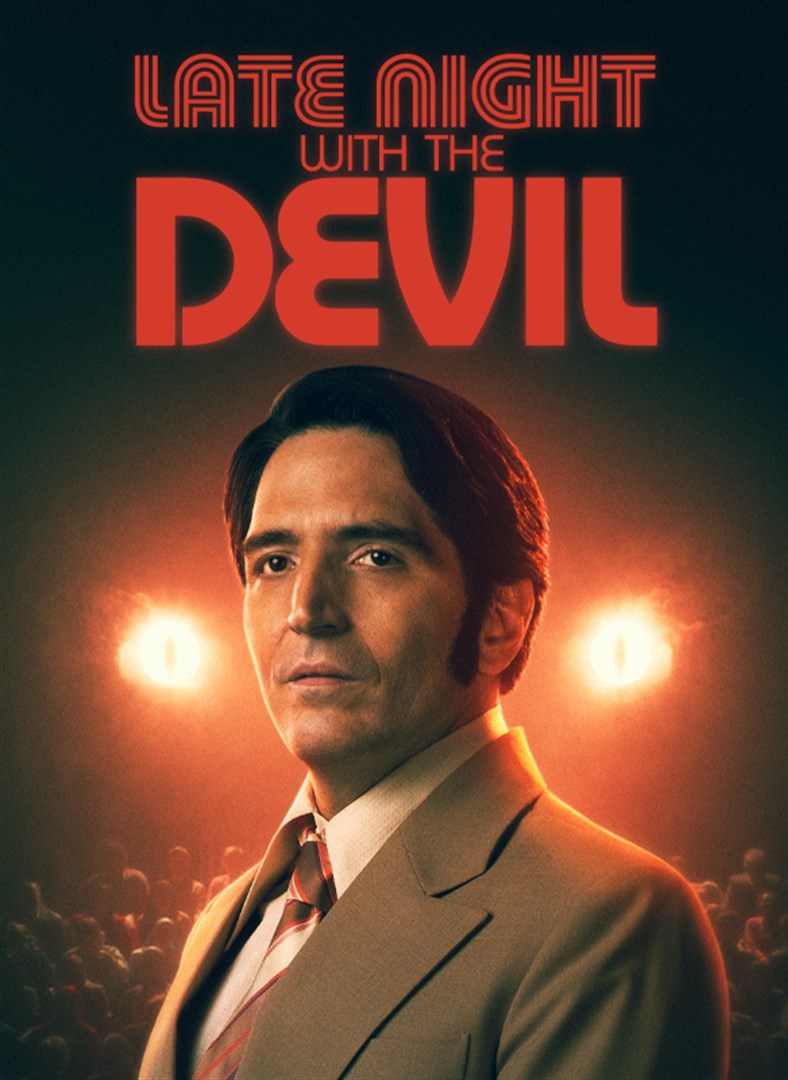
Guest Post: Late Night with the Devil (2024)


Late Night With The Devil, The Ratings Are Killer


by Jonas Schwartz-Own


The demonic time capsule of the tumultuous 1970s, Late Night With The Devil, is a mastery of the Me Generation mise-en-scène. The production design is pitch perfect in its dreariness, visually evoking dread in a tale of television and the desperation for success.


Halloween 1977, Night Owls with Jack Delroy is fighting to beat the ratings of that epoch, The Tonight Show With Johnny Carson. But while Johnny features A-Listers Jane Fonda, Mark Hamill, and Burt Reynolds as guests, Jack Delroy (David Dastmalchian) and his third-rate studio book grade-Z hacks and charlatans, yet still mysteriously pull in viewers. To celebrate the holiday, Jack brings on a side-show psychic (Fayssal Bazzi), a former magician turned skeptic (Ian Bliss), a reluctant parapsychologist (Laura Gordon) and her charge, a young survivor of a mass suicide cult (Ingrid Torelli). The little girl appears to have been invaded by a demonic being. Would an exorcism lift Jack to the top of the ratings?


Brother-writer/directors Colin and Cameron Cairnes successfully capture ‘70s television so well, audiences may mistake the footage for being actually shot in 1977. The burnt colors of the set and costume design pallet, the tacky suits the actors wear, and muted tones of the cinematography pull the viewers through the looking glass. The opening, a montage of the chaotic ‘70s, works well on its own. Though it’s obvious the narration, provided by horror icon Michael Ironside, pays homage to the schlocky In Search Of…” series with Leonard Nimoy or to the opening of Texas Chainsaw Massacre, it’s too on the nose, and sets an overstated tone. The visuals themselves would have been better.  


It works well for the plot twists that the film set and its occupants are amateurish, despite the show’s high ratings. It suggests more milquetoast daytime fare, like the news show Panorama or The Dinah Shore Show, than the late -night master Johnny Carson or his competition. The camerawork also hammers home the shoddiness of the crew with its zooms and camera angles. 


Besides the blandness of the boob tube, the directors slyly reference two major classics of the era. The most obvious is Friedkin’The Exorcist with its tale of a child possessed, as well as a visual reference to Jack MacGowran’s death. The directors also allude to Brian DePalma’s Carrie – the little girl’s long hair dripping down resembles everyone’s favorite prom queen, the screen splits to share different conversations at the same time, and the TV audience climbing over each other and tripping over seats is almost shot-for-shot the gymnasium carnage. 


The lead cast is outstanding.  Dastmalchian masters smarminess with a faux warmth hiding contempt that many late night guests notice from their hosts. Bliss is hilariously supercilious, as the debunker whose delusion of dominance is revealed by endlessly pontificating. Torelli unhinges the audience every time the camera hangs on her. With a haunting smile and menacingly calm demeaner, she’s the embodiment of a Manson girl. 


Some of the smaller roles though are a bit stiff, like Jack’s cameraman, which lifts the audience from believing that the terror is real in the behind-the-scenes moments. 


While their writing could use a bit more refinement (the opening and the fantasy denouement are both more over the top than necessary), Late Night With The Devil exposes the fresh talent of the Cairnes brothers, particularly with their direction.  

Wednesday, April 03, 2024

Guest Post: Lisa Frankenstein (2024)


Lisa Frankenstein Is Made Of More Stale Parts Than Its Creature


By Jonas Schwartz-Owen


The trailer for the new horror comedy Lisa Frankenstein presents a satirical, goofy horror film that melds ’80s fashions and sensibilities with modern meta styles. But the actual film delivers a mirthless slog that offers no new twists, no funny lines, and no tension -- the movie is a major disappointment. Only a sly, unhinged performance by Kathryn Newton is worth recommending.


In the late 1980s, tragic Lisa (Newton, Blockers) must move in with her cold father, hostile stepmother (Carla Gugino, The Haunting of Hill House) and popular, mean-girl stepsister (Liza Soberano) after her mother has been brutally murdered. Practically invisible at her high school, she spends her time at the local cemetery mooning over a grave of an 19th-century boy (Cole Sprouse,Riverdale). When a lightning storm brings him to life, Lisa comforts him and teaches him the modern world. After he starts a killing spree, she sews body parts of his victims to make him a “real boy.”


Written by Oscar winner Diablo Cody (Juno, as well as the cult horror/comedy Jennifer’s Body), Lisa Frankenstein has elements that could make for broad parody, but the script does a lazy job, following the predictable path without rewarding the audience with anything surprising. We’ve seen so many fish-out-of-water movies, as well as ugly-duckling-turns-into-a-psychopathic-swan movies, that this film really needs to raise the bar, but the bar remains firmly planted at ground level. 


This is the feature directorial debut of Zelda Williams (the late, great Robin’s daughter), and her pacing and stylizations could have used some of the zaniness that made her father a genius. She does film one black & white fantasy sequence early in the movie that evokes the music videos of ’80s New Wave artists Siouxsie And The Banshees, but for the most part, this film could have been shot for television. 


Newton, who was delightfully insane as both a wallflower high school student and a gleeful serial killer in the imaginative horror/comedy Freakyonce again shines, especially when her character embraces a goth look and blasé attitude. Her silent stares at other characters lift the character from the flatness of the page. Sprouse appears to have studied hard to perfect the walk (or rather, the stiff drag) of a dead creature, but he’s not really given much character. Gugino, who stole the Netflix series Fall of the House of Usher from all her talented co-stars, could have had fun with her evil stepmom role, but the performance also felt rote and perfunctory. 


Lisa Frankenstein feels forced the entire time, like a monster trying to fit into the modern world. I don’t expect even angry villagers to care enough to chase this monster down.  For a better spoof of the ’80s and horror, catch Totally Killer on Amazon starring Kiernan Shipka (Chilling Adventures of Sabrina) as a time-traveler tracking down her mother’s murderer. Everything missing here in Lisa Frankenstein – thrills, laughs, surprises – are given out freely in Totally Killer like Halloween candy at the cool neighbor’s house. 

Thursday, March 07, 2024

Guest Post: Mean Girls (2024)


The Mean Girls Musical Can’t Find Its Note


By Jonas Schwartz-Owens


Remakes have enough trouble competing with the original, especially when it’s a classic. Mean Girls (2024) was not only blinded by the shadow of the treasured 2004 comedy with Lindsay Lohan and Rachel McAdams, but also the 2018 Broadway musical that adapted the story with clever songs and striking choreography by Casey Nicholow. This movie remake adda nothing of value to the first film and cannot convey the excitement and freshness of the Broadway show, leaving it redundant.


Following the original story to a tee, Mean Girls (2024) explores young, home-schooled Kady (Angourie Rice) as she leaves Kenya for the jungles of the modern American school system, with dangerous turns – of phrases from two-faced friends – and master predators, The Plastics, led by the alpha herself, Regina George (Reneé Rapp). Kady’s new outcast friends, Janis (Auliʻi Cravalho, the voice of Moana) and  Damien (Jaquel Spivey), convince Kady to snuggle up to the Plastics and bring them down from the inside. But as often happens, some of the contagion contaminates Kady, and her own plasticity begins to shine through as well.


There is consistency in that Tina Fey (30 Rock) wrote the screenplay for the original, the Broadway Musical, and this latest version.  In both movies, she plays the same role, Kady’s teacher, and brings the same everyman delivery that makes Fey ever-endearing. The script feels rushed in this version, with the shortlist songs (abbreviated from the Broadway score) limiting the audience’s understanding and connection to the characters.


Rice captures none of the endearing traits that made Lindsay Lohan so good in the role. She has a wispy singing voice, and never becomes the lead in her own movie. Spivey is very funny as the audience’s inlet Damien, peppering his performance with clever asides. Rapp, who played Regina on Broadway for a period, conveys that ethereal, bitchy allure that makes a prom queen so tantalizing.  Unfortunately, no one can make you forget the 2004 originals. Lohan, McAdams, Amanda Seyfried, Lacey Chabert, Daniel Franzese and Lizzy Caplan are indelibly iconic. Although it was fun to see Tim Meadows repeating his role as the put-upon principal and Lohan as a mathlete judge. 


Relative newcomer directors Samantha Jayne and Arturo Perez Jr. bring a lackadaisical approach to the visuals. Cell phone social media is used throughout to check in on characters, but even when not inside the phone, the movie looks like it was shot on a handheld. The camera overutilizes zooms, the tone is haphazard, and the whole project appears to be made with no understanding of movie musical mechanics. Most sequences were (perhaps intentionally) shot like TikTok videos.


The score, when on Broadway, was inventive and intoxicating. In a musical comedy, the songs should be infectious, people should want to join in. Here, the numbers are shot so statically that it distances the audience. All the songs are whispered like the characters are afraid to wake someone — the audience, perhaps?—up.


When I first saw the reviews coming out about the recent movie (whose advertising campaign wallpapered over the fact that it’s a musical), I assumed that critics may not have seen or appreciated the Broadway production. I saw the show in Los Angeles last year and it was a highlight. After catching Mean Girls (2024), it’s not the newness that catches people off guard, it’s the slipshoddiness. 

Tuesday, March 05, 2024

Guest Post: The Iron Claw (2024)


The Iron Claw Comes At A Cost For One Family.


By Jonas Schwartz-Owen


The Iron Claw, Sean Durkin’s biography of legendary wrestling family The Von Erichs, is a refreshingly methodical film with many quiet moments, harkening back to the New Hollywood films of the 1970s. 


The Von Erich patriarch (Holt McCallany from Netflix’s Mindhunter) owns the World Class Championship Wrestling company. A former wrestler himself, where he utilized the Iron Claw move, he has passed his compulsion about wrestling onto his boys. The adult sons do not even have time to form their own passions before they dive headfirst into the ring. His most successful, Kevin (Zac Efron), takes on the family burdens and everything comes at a cost. The tragic tale of the family is part superstition, part the brutality of the sport. 


Efron is unrecognizable as the wrestler. Bulked up in both his body and his face, fashioned with a bowl cut, Efron leaves behind any teen idol pretentions for the role. He brings an earnestness and sweetness that hits the heartstrings successfully like Sylvester Stallone’s performance in the inaugural Rocky (1976). 


McCallany is intense as the wrestling world version of Gypsy‘s Mama Rose. Single-minded, he treats his boys as an extension of his legacy. They are his second, third, fourth, and fifth chance, and it’s almost a Greek tragedy how he pays (as an original story, it would seem contrived, but this was real life).


Huge fans of Jeremy Allen White (from his award winning The Bear) may be disappointed by his minor role in the film. Though he is not featured for much of the two-and-a-quarter hour running time, his determination and frustrations as brother Kerry are well done. 


Lily James (Cinderella) is given little to work with in the nominal wife role, but as the matriarch, Maura Tierney (Showtime’s The Affair) is heartbreaking, representing an overly supportive wife who quietly laments her constant loss.


Durkin, who made a splash with the contemplative Martha Marcy May Marlene creates a very ‘70s Americana feel: the deliberate, un-splashy pace, the washed-out hues, the deglamorization of a beloved American tradition, that are reminiscent of the films of Academy Award winner Hal Ashby (Bound for Glory)


Along with the exciting, well-choreographed wrestling scenes, Durkin has presented a poignant slice of life. The Iron Claw interprets the famed lives of people foreign to many audience members and captures the commonality of their struggles. 

Tuesday, August 22, 2023

Guest Post: Spider-Man Across the Spider-Verse (2023)


Spider-Man: Across the Spider-Verse Suffers from Middle Child Syndrome


By Jonas Schwartz-Owen


The original Spider-Man: Into The Spider-Verse from 2019 delighted in blowing audiences' minds. The animation was revolutionary for a major film studio, even if they borrowed from tried-and-true Asian tropes. So, it's not surprising that audiences went crazy for the second in the Spider-Verse trilogy, as the box office receipts of $663 million internationally in less than three months prove. Even though most critics had much to crow about, this critic (who was dazzled by the first film) found this one whiplash-inducing, with most of the animation an off-shoot of what was so magical the first time. Plotwise — a downside of some penultimates in a trilogy — the film takes too much time maneuvering all the characters into position for the upcoming climactic final episode: Spider-Man: Beyond the Spider-Verse.


Miles Morales (Shameik Moore) continues to navigate the life of a superhero, especially when his folks (Brian Tyree Henry and Luna Lauren Velez) are still in the dark. From another parallel world, Gwen Stacy (Hailee Steinfeld) has joined a super society of Spideys, including Jessica Drew (Issa Rae) and leader Miguel O'Hara (Oscar Isaac). Miles has been purposely banned from the group, and Gwen has already broken rules by remaining in touch. Meanwhile, a casualty from a Miles escape in the first film has built his shame into a rage, and is now Miles' arch-nemesis, Spot (Jason Schwartzman), who has the power to slip in and out of parallel worlds and is becoming more and more formidable. 


New directors to the franchise, Joaquim Dos Santos, Kemp Powers, and Justin K. Thompson, overload the screen with images and plot details. The end result appears to be one TikTok colliding into another for 140 minutes. Many of the visuals of the different Spider-Verses — which include a Studio Durga influenced world, a character based on Jamie Reid's punk graphics for the Sex pistols, pastel worlds, Lego worlds, etc. — are all inventive, but not as much after watching that concept already in the first film. 


Miles's story arc is compelling, and one wishes the filmmakers had given it time to breathe. Having your life mission stripped away, and your calling invalidated is so relatable, as is being faced with how your actions do destroy whole worlds (metaphorically in real life, literally here). Miles is such a well-drawn (sorry for the pun) character that the movie could have lost a few bells and whistles and worked much better. So much information is constantly being thrown at the audience to prep them for the third film, that one eventually uninvests to protect their brain. 


The voice work is strong as always. Most of Miles' empathy with the audience is thanks to Moore's talent. Isaac is autocratic as the leader, while both Oscar winner Daniel Kaluuya, as the punk infused Hobie Brown, and Karan Soni, as the heroic Indian Spidey, have hilarious line readings.


Writers Phil Lord and Christopher Miller, (this time with Dave Callaham as well) lend that spoofy energy they had to the first film and Tthe Lego Movie, which lends a breezy appeal.


 Spider-Man: Across The Spider-Verse is an accomplished film, with creative energy to spare, however, there's a chaos that doesn't vibe with the flow of the film, that left this reviewer drowning in graphics instead of being sucked into a story

CULT TV FLASHBACK: Dead of Night (1994-1997)

This year, Dead of Night: The Complete Series , was released on Blu-Ray by Vinegar Syndrome , and I just had the pleasure of falling into i...