Showing posts with label animation. Show all posts

Sunday, September 15, 2013

Star Blazers Episode #26


The first season of Star Blazers (1979) comes to an end with episode 26.  The Argo makes its return trip to Earth as Captain Avatar succumbs to “space radiation sickness.” 

At the same time, Desslok makes a last-ditch attempt to destroy the Star Force, this time using a special cannon. 

The Argo escapes destruction, but Nova nearly gives her life to activate the Cosmo DNA after the ship is contaminated with Desslok’s “radioactive sleeping gas.”

Finally, the Argo sees Earth again…and prepares to come to its rescue.


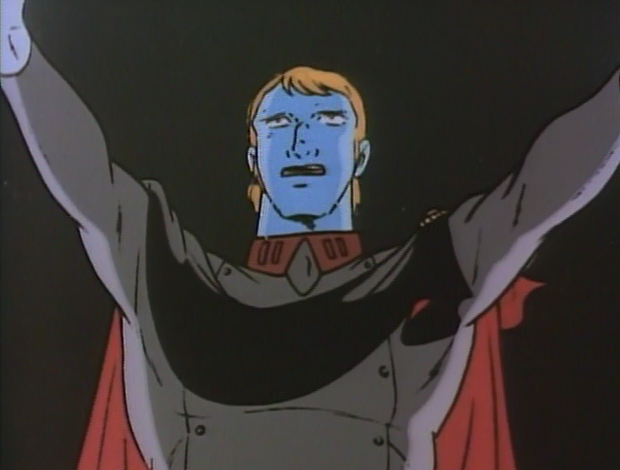
The final chapter of Star Blazers sees the long-expected demise of my favorite character, gruff but brilliant Captain Avatar.  The series has been building-up towards the character’s death for some time, and the moment doesn’t disappoint now.  In fact, the moment is highly emotional.  Avatar sees Earth for the final time, gazes at a photograph of his wife and son, and then…passes away.  I love how in his last moments he focuses on the things he loved in life, and that were meaningful to him as a human being.  It's a touching moment and one that focuses on humanity, rather than space opera tropes.

With Avatar’s death, Derek Wildstar’s heroic journey is also, essentially, complete.  He is in command of the Argo, he defeats Desslok, and he has learned all the lessons he needed to learn from Avatar.  Still, this episode nearly deals him a major setback: Nova almost dies to save the ship.  In fact, this segment forecasts The Wrath of Khan (1982) to some extent: with a character sacrificing his or her life for the safety of the ship, braving a toxic environment to do so.


The only disappointment here, really, is yet another return engagement by Desslok.  

Once more, the Gamilons get their asses handed to them by the Star Force.  They can’t eke out even a minor victory against a single Earth ship, which makes them -- with their vast resources – a kind of lame villain.  The worst aspects of Star Blazers as a series involve the repetitive plot of Gamilons devising a secret weapon (ultra-menace missiles, reflex guns, Desslok mines, and so on…) and still failing to stop a single Earth ship.  They really do transmit as rather pathetic.  They have a vast Empire and they can muster nothing in terms of credible defense/offense.

The strength of Star Blazers, as one of my good friends, SGB, has noted trenchantly, is the emotional impact of the long journey to Iscandar.  It's a journey of loneliness, desperation, and for Wildstar emotional maturity and growth.  I'm glad I watched the series from star to finish, though in honesty, the same story could have been told far more effectively and judiciously in perhaps eighteen installments.  There are so many stand-out shows in the Star Blazers canon, but also so many time-wasters with new Gamilon weapons being used to endlessly attack the Argo.

There are two more Star Blazers TV seasons to watch, but I'll return to them another day.  Next week, on Sunday, I begin blogging Firefly (2002).

Sunday, September 01, 2013

Star Blazers Episode #24


In this installment of the first season of Star Blazers (1979), the Argo escapes from a trap in Gamilon’s “sulfuric acid” ocean, as Desslok activates the Sulfuric Acid Storm Machine in an effort to melt the ship.

Facing missiles, acid, and other hazards, Deputy Captain Derek Wildstar takes Nova’s advice and seeks guidance from the bed-confined Captain Avatar. 

The good captain recommends total submersion of the Argo in the acid sea for ten minutes, so the ship can get a good shot (with the wave-motion gun) at the unstable volcanoes devastating Gamilon.  This could be the advantage the Star Force so desperately desires...


Wildstar accepts this risky recommendation, and even as Desslok orders the Argo “erased from the skies forever,” the great ship survives the final battle and devastates the planet Gamilon.  

One of Desslok’s panicked underlings notes that they “have been fighting a force” they “don’t understand" since the day the Argo left Earth.

After the fierce battle, Nova and Wildstar share a quiet moment atop the hull of the Argo, now twisted and nearly melted by the Gamilon oceans.  Nova expresses her fatigue with constant war and strife, and Derek assures her: "I think this was the last battle..."


Whether that observation is true or not remains to be seen, as two episodes of Star Blazers remain.  

Still, this episode makes a satisfying conclusion to the long-standing chess game between the Gamilons and the humans from Earth. For episode after episode, we've witnessed the Star Force defeating the plans of Gamilon underlings such as Lysis and Volgar.  

Here, Desslok himself is in charge, and there's no one else to blame for his failure.  During some moments of this episode, he seems to go mad at the prospect of defeat.  Oddly, there is not as much joy in seeing Desslok's defeat as one might expect.  We know now that Desslok is trying to save his own planet.  That knowledge adds a melancholy feeling to the episode.  Earth and its people may be saved, but Gamilon still, will die. 


Once Desslok and Gamilon are firmly in the rear-view mirror, Star Blazers features a great visual composition. Near the end of the episode, we witness the Argo rising triumphantly over the planetary curve of Gamilon.   Then, the planet recedes out of view as another planet appears directly ahead: Iscandar.  

The danger is passed, and the destination is in sight!

Only 161 days left!

Sunday, August 25, 2013

Star Blazers episode #23


This week on Star Blazers (1979), the Argo nears its destination -- the distant planet Iscandar of the Magellanic Cloud -- but soon finds itself mired in a metallic cloud that causes navigational instruments to go haywire. 

While Captain Avatar is confined to bed for his worsening illness, Derek Wildstar faces his first test of command: Should he trust Starsha, Queen of Iscandar, or worry that she is somehow allied with the Gamilons? 

What’s the right course of action?


Surprises and reversals come at the viewer `fast and furious in this Star Blazers installment, one of the very 
best episodes of the series thus far.

Part of the reason for that success is that we learn a tremendous amount about the Gamilons this week.  For instance, Gamilon is a doomed planet, just like Earth.  The people there need a new home world because volcanoes are systematically destroying theirs.  That’s the reason Desslok so desperately wants Earth.  This motivation helps to humanize the Gamilons, who often come off as simply “black hat” bad guy characters.

Secondly, we learn the shocking fact this week that Gamilon and Iscandar are twin planets, ones sharing a close orbit around their sun.  Therefore, the whole time that the Argo has been heading for Iscandar it has also been heading directly for Desslok and Gamilon! 


This is a pretty mind-blowing revelation, and I must confess, I had forgotten this plot detail (if I ever knew it to begin with…).

We get to see more of the enigmatic Starsha this week as well.  She shares an orbit with Gamilon, but not that planet’s value system.  Instead, she is doing everything she can to save Earth, and even notes that Desslok’s solutions to their mutual crisis “are all evil.”  Starsha also reveals to the Argo that the “twin planets are very different from each other” in terms of governing philosophy.

Desslok is also a powerful presence in this episode, noting that “the only battle that counts is the last one,” and then, literally, releasing the hounds on the Argo. 


This episode reveals Desslok launching a gaggle of missiles and using a “climate de-stabilizer” to plunge the Argo into Gamilon’s turbulent oceans, which are made of “pure sulfuric acid.” 

And it is there -- in that swirling sea of acid -- that the Argo remains as the episode closes (with a cliff-hanger), facing a missile barrage and the threat of being totally dissolved…


Only 164 days left to save Earth!

Sunday, August 18, 2013

Star Blazers Episode #22


The battle royale -- the main event of the series -- occurs in Star Blazers (1979) episode 22.

In this story, the Argo goes toe-to-toe with four Gamilon space cruisers, and the depiction of the sprawling battle makes it feel like naval combat in the Pacific during World War II…only set in outer space.  Fighters strafe the Argo, and giant explosive plumes appear on the buffeted, listing ship.

Here, the Gamilons launch their attack, and use the powerful new weapon S.M.I.T.E. (Space Matter Instant Transforming Equipment) to transport fighter ships across vast distances instantaneously.  Once the Argo is badly damaged because of this tactic, the Gamilons launch a “drill missile,” which is designed to burrow into the Argo’s forward hull and destroy the wave motion gun.


The plan comes incredibly close to succeeding, but Sandor and IQ9 manage to set the drill on reverse once it has damaged the hull.  It backs out…into the Gamilon ships.

This supreme space battle continues throughout the episode in new and dangerous iterations as General Lysis refuses to relent.  He plants a bomb on the Argo’s hull, and also tries to ram the great ship.  Finally, however, Lysis is defeated and the Argo is victorious.

The episode is almost entirely action-oriented, but it resolves with strong characterizations and intense human moments.  A funeral for the Argo’s dead is held on the hull of the ship, with the full crew in attendance. 


We all belong to the Star Force and to each other,” declares Captain Avatar. 

At this point, we all belong to Star Blazers, it is fair to state.


This episode is gripping, and it is downright tense to see the beloved Argo under such vicious, damaging attack.  This episode is a high-point for the battle, but the battle is effective, finally, because we care for the characters…

Sunday, August 11, 2013

Star Blazers Episode #21


Rather uncharacteristically, this twenty-first episode of Star Blazers (1979) commences with activity on the planet Gamilon as General Lysis is prosecuted and held under house arrest for his failure to destroy the Star Force. 

Lysis is found guilty for his failures, and destined for execution until Desslok intervenes and claims that Lysis is actually the only general he can count on.


With Desslok in his corner, Lysis gets a (dangerous) second chance to destroy the Argo.  Acting immediately, he takes a war fleet consisting of four space carriers to the Magellanic Clouds to intercept the Earth vessel. 

Predictably, he also has a brand new secret weapon available, one (hilariously…) termed S.M.I.T.E. (Space Matter Instant Transforming Equipment) to move ships through space instantaneously.  Lysis believes that this will be the critical factor in destroying the Argo.

Lysis then issues a challenge to the Star Force to meet at the rim of the “Rainbow Galaxy” and settle their differences there.  After prodding from Derek Wildstar, Captain Avatar agrees that it is time to confront the Gamilons, once-and-for-all.  “We must face and defeat them before we get to Iscandar” is the thinking that dominates discussion.

This episode ends with preparations for the mother of all space battles, and tension builds nicely throughout the half-hour as all-out war nears. 

In this episode, Avatar walks with a cane and looks weakened, which is a good, consistent character touch.  He addresses his crew in the Assembly Room of the Argo and notes that “no man ever had a better crew.”  This compliment is especially poignant given the facts that Avatar may not live very long, and that he is lauding his crew at the same time he is reflecting, essentially, on his final command.

This episode features the typical “Gamilons invent secret weapon to terrorize the Star Force” plot-line – which recurs every other episode of Star Blazers -- but nonetheless succeeds because of the character touches on Argo, and because the episode opens on Gamilon, with more background on the enemy than we’ve seen before on the series.  At the very least, we get a sense of Gamilon “justice” from Lysis’s trial.


The secret weapon plot, I know, relates to World War II and history, and so I understand and appreciate it.  America dropped two atom bombs on Japan in 1945, two devices of frightening, staggering, and heretofore unknown destructive power.  The recurring plot of Star Blazers is one that suggests that even as an alien invader develops fierce new weaponry of unimaginable destructive power, the old-fashioned qualities of sacrifice, honor and dedication to duty will win out. 

This through-line represents a nice, romantic construct, but it’s a shame that the same single point is reiterated constantly, at the expense of more creative and varied narratives.  Still, the next episode is a very strong one, and everything is on the line for the Star Force as the battle begins…

Only 215 days left! 

Sunday, August 04, 2013

Star Blazers Episode #20


Compared to last week's non-traditional installment of Star Blazers (1979), which concentrated on the demons of inner space (guilt and self-doubt), this week's installment about the demons of outer space -- the Gamilons -- feels dull and formulaic.

Once more, the narrative involves the dedicated attempts of a Gamilon underling, this time Lysis, to defeat the Star Force and achieve glory.  He does so, naturally, with a new secret weapon THAT CAN'T POSSIBLY FAIL...but does.

This time, that secret weapon is the "artificial sun" that orbits the planet Balan (instead of vice-versa).  Lysis can control the star's path remotely, and hopes to crash the sun into Argo when it attempts to attack the Gamilon outpost on Balan, one built inside a crater.


Volgar naturally objects that playing with a sun that close to the planet surface could harm the outpost, and goes over Lysis's head to get Desslok involved.  Desslok is none too pleased, but in the end, the outpost is destroyed anyway.

In the end, the Argo -- 44 days behind schedule now -- escapes destruction only because Wildstar, on the bridge of the ship, gets a hunch about the sun, and is prepared to evade it.  

Afterwards, Captain Avatar promotes Wildstar to the rank of deputy captain, noting that he can no longer perform all the responsibilities of that important rank.  "I need your help," he tells Wildstar, "I want you to take on some of my duties."


I love this scene because it represents the torch-passing aspect of the hero's journey, the moment when the wise elder must step down and hand control to the next generation. The great last (tender) scene in this episode between Wildsstar and Avatar all but makes up for the fact that this is probably the sixth or seventh time we have seen this story on Star Blazers already.  Gamilon secret weapons are, at this point, literally a dime a dozen.  And seeing the nefarious aliens handed their hats so frequently by the Star Force only makes them like like ineffectual buffoons.

Only 253 Days Left!

Sunday, July 28, 2013

Star Blazers Episode #19


The nineteenth episode of Star Blazers takes the story of the Argo in a more intimate and intriguing direction than some installments do.  The story by-and-large focuses on a minor character, the communications officer named Homer, as he grapples with feelings of guilt about his family on Earth, as well as feelings of homesickness for the distant planet.  His parents don't do much to help him, either  In long-range transmissions from Earth, they are accusatory and histrionic.  They all but ask him to forsake his mission and return home.  But of course, to do that would mean the end of every human life on the planet.

Homer's existential angst goes much deeper than homesickness and guilt, however.  He is literally obsessed with impending death.  He worries that "every space warp takes us further into the dark unknown," and that Earth and his family are truly lost to him.  


At one point in the drama, Homer asks for guarantees of success, and Captain Avatar very rightly provides him none.  "No one knows tomorrow.  There are no guarantees," he notes.   

This comment reflects one reason why I admire Avatar so deeply as a character.  He doesn't candy-coat anything, and he doesn't underestimate the danger that the Star Force faces.  On the contrary, Captain Avatar is facing his own "dark unknown" in the form of his illness, but even that sickness doesn't prevent him from continuing to focus on the job at hand.

In moments such as this one, this episode of Star Blazers ably charts the psychological impact of the long journey to Iscandar, and in a way that only a few episodes thus far have managed to equal.  The story resolves with Homer becoming a hero, which is a nice, optimistic touch.  After he attempts to commit suicide by leaving the Argo in a space suit, Homer encounters a Gamilon relay satellite, and helps Derek Wildstar to destroy it.  This act refocuses him on his mission, and his duty.


This episode of Star Blazers also features scenes of Homer in the "holography room," experiencing his home on Earth during the winter.  This "holography room" is very much a forerunner to the holodeck on Star Trek: The Next Generation though in fairness to that franchise, Gene Roddenberry had envisioned this brand of rec room technology as early as Star Trek: The Animated Series (1973 - 1974) and episodes such as "Practical Joker."    

Again, the important thing here regarding the holography room is the emotional important. Homer recognizes that a simulation of home is not home. "It's not that way now," he objects, before storming out of the holography room, offering the audience an explicit reminder that the beauty of Earth has largely been destroyed by Gamilon bombing.

All in all, what this episode points out rather nimbly is the notion that on a long, lonely voyage through space, self-doubt and guilt can prove just as dangerous to the Star Force as a Gamilon weapons array.

255 Days Left!

Sunday, July 21, 2013

Star Blazers Episode #18


In this week's installment of Star Blazers (1979), the Argo nears the mid-point of its long journey when it encounters a mysterious object in space.  This strange space vessel causes Sandor's fighter to break-up, but fortunately he bails out and survives.  He reports to Captain Avatar that his plane "shook itself apart."

The Star Force soon realizes it is dealing with another Gamilon threat: a "space fortress" that can pursue them and which emanates deadly "magnetron waves."   These waves are powerful enough to destroy the Argo, or even damage it upon entry into space warp, and so the enemy ship must be destroyed.

To that end, Wildstar and Sandor board the living space fortress and attempt to destroy the organic ship. 

While navigating its weird passages, Sandor tells Derek a story about his brother, Alex, and how Sandor was assigned to repair his ship, the Paladin.  Even today, Sandor feels guilty that he didn't do a good enough job on that work, and that if things had been different, the Paladin and Alex might have survived the Battle of Pluto.

When Sandor and Wildstar become trapped in the control center of the biological space fortress, Sandor reveals that his limbs are bionic -- and therefore removable -- and that he can escape from captivity...


The eighteenth episode of Star Blazers is filled with weird contrivances, and those contrivances manage to undo some of the strong emotions the episode hopes to engender.

For instance, when it is learned that the Gamilon space fortress can shake apart any conventional spaceship, Sandor effortlessly wheels out a pre-existing "seamless" fighter, one with no parts which can be shaken loose by the magnetron waves. 

Convenient that such a fighter should exist, and more-so that one would be aboard the Argo, which left Earth in a tearing hurry.

Then, late in the show, Sandor reveals that he is an amputee and can thus escape the wriggling bonds of the space fortress's command center.  

Again, Sandor is a character we have known for some time, and yet this information has never been forthcoming.  Instead, the information about his arms and leg arrives at the very moment in which such information is most useful to the plot's resolution.  Even if Sandor's condition had been explained at the start of the episode (maybe when he bailed out of his ruined fighter...), it would not seem so contrived as it does now.

If these contrivances scuttle much of the episode, other aspects are certainly noteworthy. 

For instance, I love the organic design of the Gamilon Space Fortress (though it doesn't look like other Gamilon construction....).  At points, it looks like Sandor and Derek are walking through a human digestive system...


Also, once more, the flashbacks into the characters' past are most welcome.  It's nice to see Alex Wildstar once again, and to get a deeper sense of Sandor as a character. 

Only 260 days left...

Sunday, July 14, 2013

Star Blazers Episode #17


In this seventeenth episode of the animated series Star Blazers (1979), the Argo has just 45 days left in its voyage to distant Iscandar, and the great ship has fallen three days behind schedule.  This delay means that it may be necessary to activate the motion wave engine early, and possibly risk the ship in the process.

At the same time, the Gamilon officer Volgar -- working for Lysis -- has developed a bizarre new weapon to challenge the Star Force.  On the planet of a nearby Gamilon outpost, energy cells in a sea of volcanic lava are actually life-forms that can combine and form different shapes.  Volgar has been training these creatures to form a giant, space-going (kaiju) monster called a Balanosaurus.  

His plan is to let the Balanosaurus destroy the Argo...

But as this challenge rises, the Star Force faces another problem.  Captain Avatar falls gravely ill, and collapses on the bridge.  He must undergo surgery immediately...or die.  "Any time you can give me...I'm counting on you," he tells the ship's doctor. 

Avatar's illness provides a test of command for Derek Wildstar as the giant balanosaurus approaches...


In many senses, this episode of Star Blazers relies on a tried-and-true series formula: a new Gamilon weapon endangers the mission to Iscandar.  

We've seen ultra-menace missiles, reflex guns, Desslok space mines, and other various and sundry threats thus far.  The energy-cell "colony" -- in the form of a space-going dragon/Balanosaurus -- is only the latest in a long line.  

And not unpredictably, this threat also fails to destroy the Argo.


Yet, this episode's subplot about Avatar is affecting.  

As viewers, we have known for some time that Avatar is weakening, and coming to the end.  Here, his condition is "very serious," and he pulls through, but there's also the sense that he is living on borrowed time. 

I find it interesting (and very human) how he uses that limited time: once awake, he commends Wildstar (in front of other crew members) for pulling the Argo through the latest scrape with the Gamilons.  Avatar is no doubt proud of Wildstar's accomplishment, but his public appreciation for the young man's actions serve another purpose: they allow the process of building-confidence in Avatar's replacement, when the time comes.  Avatar understands that he will leave big shoes to fill, and that the crew must feel committed to and confident about his successor.

It's for moments such as this one that Star Blazers proves so fascinating and worthwhile, at least to me.  All the space battle stuff we've seen before (and will see again...), but the character arcs are the ones that keep us watching.

Only 263 days left...

Wednesday, November 15, 2006

CULT TV BLOGGING: Return to the Planet of the Apes: "Flames of Doom"

Some of my less-than-positive comments about the re-imagination process in modern Hollywood (particularly as it applies to the new Battlestar Galactica...) have made the rounds on other blogs and I guess I may be getting a reputation as an anti re-imagination guy. That's okay with me, I suppose, but it's not always true.

Exhibit A in my defense just may be the 1975 animated series Return to the Planet of the Apes, a re-imagination of the first order. It's a program developed for television by David De Patrie-Fritz Freleng, which assimilates and re-invents characters, plotlines, devices and technology from all previous incarnations of the once-popular franchise, including the Pierre Boulle novel, the 1968 film and sequels (Beneath, in particular...), and even the 1974 live-action TV series. The result is nothing less than an invigorating shot in the arm for the franchise. I hadn't watched these half-hour episodes for something like thirty-one years, but re-discovering them today on DVD, I was shocked and pleased at just how attentive and committed to details (and an overall story arc) this animated series remains.

Because frankly the buzz from the old genre press wasn't good. Going back to Fantastic Television a reference book from 1977, the author writes in a summary review of the NBC series that it "was a not very exciting animated version of the short-lived CBS live-action series," and that the artwork and plots were "simplistic." (page 177). Frankly, I don't see how anyone with a pulse, anyone with an intellect, anyone who actually watched the animated series, could honestly make such an assessment.

The premiere episode of Return to the Planet of the Apes, "Flames of Doom," (by Larry Spiegel), finds a NASA space capsule called the "Venture" traveling on a routine deep space mission on August 6, 1976. Aboard are three diverse astronauts: Bill Hudson (a white man), Jeff Allen (an African-American) and Judy Franklin (a woman). Bill narrates the captain's log and confirms Dr. Stanton's theory of "time thrust;" that man can utilize faster-than-light speeds to propel himself into the future. Admirers of the 1968 film will recognize this comment as a reflection of Chuck Heston's opening narration, and Dr. Hasslein's theory named there. It's been simplified for children in this cartoon, but the idea is the same.

No sooner has Hudson informed us about this theory than the ship's chronometer goes wild and the Venture plunges into some kind of time warp. The "Earth Clock" goes crazy, and the Venture arrives battered in the year 3979, where it crashes on a strange planet in a dead lake.

Meanwhile, on the planet below - a planet ruled by intelligent apes - General Urko, a gorilla power-monger, addresses the Supreme Council of Ape City and demands genocide for all humans. Arguing the opposite case is the kindly chimpanzee Cornelius, who pleads for a "different course." He and his wife, a behavioral scientist named Zira, wish to study humans as the key to "simian origins." Arbitrating this dispute of national importance is the ruler of the apes, an orangutan named Dr. Zaius. I must note, the level of attention to detail in this scene is remarkable, for as Zaius issues his decision on the matter at hand, a stone relief on the wall behind him reveals the long history of ape-human relations. There are images of apes hunting humans, and domesticating them. Nice.

Humans may be hunted as legitimate sport, Zaius concludes, or brought into the city to perform "menial tasks." They may even serve as domestic pets, but Zaius will not demand their total destruction. However, on an ominous note, he warns that Article 18 of the "Book of Simian Prophecy" demands that man must be destroyed at any cost if he develops the power of speech. In other words, this is a temporary victory for Cornelius's cause, and for the primitive, mute, stone-age humans who populate caves outside the technologically advanced ape-city.

Watching this portion of the episode, a few things become plain. First and foremost, the franchise has returned to the ape society as depicted in Boulle's novel. In other words, the apes dwell in a twentieth century city with television, radio, automobiles and the like. Their city is not a rock-outcropping like in the popular movie, but rather a contemporary metropolis with buildings that resemble those from human history (in a wonderful nod to the adage "monkey see, monkey do.") The ape culture of the original film was almost medieval, despite the presence of guns and such things as brain surgery. Not so here.

For instance, the imposing ape council building resembles nothing so much as our own Capitol Building, where Congress deliberates.. Since this is a re-imagination and updating of Planet of the Apes for the mid-1970s, not only is there the burgeoning notion of diversity (this was the era of the equal rights amendment, we must not forget...) on hand in the make-up of the astronauts, but the focus on the Council and its proceedings reveals a more bureaucratic bent to the apes. Instead of ape culture being essentially of one mind (as in the see-no-evil/hear-no-evil/speak-no-evil triumvirate of the Schaffner film showcases), here Ape society is bedeviled by partisan politics, with chimpanzees representing the pacifist left, gorillas the militant right, and orangutans the sensible center. This is especially important considering the context of Return to the Planet of the Apes: immediately post-Watergate (and the congressional hearings would have been seen by Americans on TV), and soon after the Vietnam conflict. Again, this is an example of updating and changing a franchise, but not throwing out the baby with the bath water.

Continuing with the story, Bill, Jeff (voiced by the amazing Austin Stoker of Battle for the Planet of the Apes and Assault on Precinct 13), and Judy abandon their sinking spaceship and flee into the Forbidden Zone. Recalling the portions of the original film shot in Death Valley, the series here offers a brilliant and artistic montage as the three astronauts search for water and food under the glaring sun of what they believe is an alien world.

Here, the animated frames turn a bright scarlet hue to represent the heat of the desert and there are close-ups of human faces caked in sweat. Close-ups of tired feet marching in the sand also appear. This montage doesn't rely on dialogue but rather clever images. There is a lengthy interlude wherein we pan across (again, animated...) desert images to carry the mood and atmosphere of the story. The animation is limited perhaps, but these limitations are marshaled as a strength on the program. Overlapping views, double exposes, intense close-ups, insert shots and first person subjective point-of-view shots all provide a texture to the desperate march through the wasteland. This march ends, appropriately, with the sighting of an Ape Mount Rushmore. Another new touch, but again one that (along with the city), reveals the ape talent for mimicry (monkey see, monkey do) and is therefore thematically valuable; a subconscious reminder that all of the simian accomplishments are built on "aping" human society.

In the desert, Jeff and Bill lose Judy when fires spontaneously erupts in front of them and an earthquake splits the ground in a series of lovely frames that reveal a high degree of fidelity to images from Beneath the Planet of the Apes (particularly Taylor's abduction by the underground mutants). The astronauts have little time to ponder the loss of their companion, however, as Bill and Jeff encounter a tribe of stone age humans, including the beautiful Nova.

Suggesting an interesting mystery, Nova wears the dog tags of another astronaut, someone named Brent (again, a reference seemingly to Beneath the Planet of the Apes). His birthdate was May 2, 2079, so Jeff and Bill are forced to ponder the notion that an astronaut who was born after them arrived on the planet of the apes before they did. Boggles the mind, no? This is a pretty advanced concept for a kid's show, and it also provides an underlying mystery for adults to enjoy. Where is Brent? What happened to him? I suspect the series will explore that further...

Before long, the apes arrive - on the hunt - in tanks, jeeps and with heavy artillery. The gorillas even lob gas grenades at the primitive humans. Here, the series uses zooms inside individual frames (not actual motion, but rather camera motion...) to suggest the frenetic pace of the hunt. Jeff and Bill are separated, and Bill is captured and taken to ape city.

That's where the first episode ends, but already, the attentive viewer can detect how this canny re-imagination assimilates the important aspects of the Planet of the Apes mythos with something akin to 20/20 hindsight. Instead of making up the saga as it goes (a deficit of the otherwise outstanding motion picture series...), Return to the Planet of the Apes accounts for - from the beginning - the mutants in the Forbidden Zone (here termed "The Underdwellers.") It also employs old characters in new ways and new situations, and even incorporates movie imagery to vet the story.

In terms of characters, Urko comes from Mark Lenard's character on the 1974 TV series. In Beneath, the same character was known as "Ursus." He is essentially the same here, as are Zira and Cornelius, but Dr. Zaius has changed the most. He is no longer a hypocritical religious zealot, but rather an equalizing force of moderation in Ape Society...almost heroic! "The free ape is he who does not fear to go to the end of his thought," he even states; an ideal that the movie's "chief defender of the faith" could never get behind. This is actually an intelligent structural change as well as a symbolic representation of the left/right divide in our culture. Why? Because with Zaius moderating pacifists and war-mongers, we can more logically believe that humans (particularly the astronauts) can continue to escape and outmaneuver a technologically advanced simian culture. The whole planet isn't out to kill them; they have allies.

From the original Planet of the Apes movie, "Flames of Doom" also incorporates other powerful visuals. We see the ape scarecrows on the border of the Forbidden Zone again (and, on a connected note, hear the same gorilla "hunt" horn on the soundtrack...). We see a small, yellow rubber raft and a U.S. flag planted in the Forbidden Zone too, as well as the discovery of a first green plant indicating life on the fringe of the desert.

Again, the approach here seems to be to this: take what worked in the apes movie, book and TV series, and then put them all together in a more coherent, cohesive story, smoothing out the bumps and making everything jibe. That's important, because long time Planet of the Apes fans will remember some of the more dramatic gaps fouling continuity in the film series. In Planet of the Apes, for instance, it is the year 3978 when Taylor arrives, but when Brent arrives on his heels in the follow-up, Beneath, it is magically 3958. Similarly, there are discrepancies between Escape and Conquest in the story of how the apes ascended to superiority in man's world. Cornelius's story involves an ape named Aldo (whom we meet in Battle), but does not take into account the true ape revolutionary, Caesar. Return to the Planet of the Apes - coming at essentially the end of the apes cycle - benefits from knowing everything that came before.

Indeed, this is the true reason for a re-imagination. Taking what worked ine one production and maintaining it; and taking what didn't work and improving it. Notice that there is not merely change for the sake of change here; that characters have not miraculously switched sexes, and whole swaths of mythology have not been removed or altered. What I'm saying is that fundamentally there is a respect in evidence here for the the productions that came before, for the apes mythos. So yes, Virginia, a re-imagination CAN work, and this dedicated animated series is one example where it did so. Splendidly.

Saturday, November 11, 2006

SATURDAY MORNING CULT TV BLOGGING: Flash Gordon: "Tournament of Death"

Our multi-ethnic Mongo/Earth crew is now in the clutches of Ming the Merciless and Princess Aura, as Chapter 12, "Tournament of Death," commences on the Filmation series Flash Gordon. There are some lovely views of Mingo City in this installment as Gordon, Zarkov, Dale, Thun, Barin and Vultan are escorted (in shackles...) into the metropolis to participate in "the great games."

As for Prince Barin, he has a plan. If he wins in the arena, he can marry the woman of his choice; and he wants Princess Aura. Unfortunately, she wants to be the bride of Flash Gordon. Awkward...

Before the games commence, Flash engineers an escape into the caves beneath Mingo City, using Zarkov's inviso-ray to take out several of Ming's metal men. The team subsequently escapes, but Aura sends three dragons - the "Royal Groks" - after them. Flash gets the Groks to fight each other instead of the humans, but then there's another obstacle to face. The group encounters "The Cavern of Fire," and the only way to escape is through a tunnel on the far side of the "flame barrier." A cable car can carry them there, but Aura intercepts the fugitives and re-captures Flash, Dale and Zarkov. Vultan, Thun and Barin are free, but again, Barin has a plan...

While Ming threatens to take Dale to his "apartment" (a funny line...), Flash is led to the arena. "Let the Great Games begin," Ming declares, as Flash the gladiator fights many of the creatures we've seen in previous episodes. There are royal Groks, the lobster-like "Talors" (The Fire King...), and the giant blue magic worm from Azura's kingdom, among others. Flash makes short work of the beasts and other gladiators (including a man with a bull-heat - a minotaur?), but then runs into a tough masked warrior who suspiciously resembles Prince Barin. Hmmm.

At the end, only Flash and the Arborian prince stand, and Ming warns that the gladiators must next face the dreaded "cable of green flame." Whatever that is...

To be continued...

Saturday, November 04, 2006

SATURDAY MORNING CULT TV BLOGGING: Flash Gordon: "King Flash"

More "peril and adventure await us" on this week's Flash Gordon episode, Chapter 11, "King Flash."

When last we left our stalwart hero, he was trapped in the caverns of the Blue Magic witch queen, Azura. She had cast a spell on Gordon making him believe he was "Gor-Don," a conquering King of Mongo from years past...and her lover.

As "King Flash" opens, Gordon and Azura lead their war chariot and magical sorcerer minions in battle against Vultan and Barin. Dr. Zarkov has concluded that Azura's spell is "electrical," but is still unable to free Flash from the clutches of his new queen. Zarkov then determines he must "fight magic with magic."

Gor-don's army is triumphant and Vultan and Barin are captured. But when Barin says "Flash...remember," something comes through Gordon's psyche. Azura attributes this to weariness and sends Flash off to bed. There, Zarkov, Thun and Dale capture him and restore his memory, leaving in his stead a hologram. Unfortunately, Zarkov notes, Flash will retain a double personality for some time, even after he is healed. Another side effect of the restoration: Flash Gordon literally becomes "a shadow," a tool he will use to defeat Queen Azura.

When Azura realizes she can never own Flash Gordon body and soul, she releases the ancient "Fire King" Talors from the cavern to destroy him. But Flash is able to defeat the lobster/dinosaur creature in battle, and thus wins freedom for himself and his friends. Azura is now his new ally in the war to overthrow Mongo's despot, Ming.

Free and triumphant, Flash, Barin, Vultan, Dale, Zarkov and Thun leave the blue magic caverns...only to be captured by Princess Aura and Ming the Merciless...

To be continued...

Saturday, October 28, 2006

SATURDAY MORNING CULT TV BLOGGING: Flash Gordon: "Blue Magic"

Flash Gordon's Chapter Ten, "Blue Magic," (by Samuel Peeples), involves Flash's adventure in yet another Mongo kingdom commanded by a gorgeous Queen. Let's see, there was the underwater queen, Undina and then the Fridgian Queen, Fria. Now there's Azura, "witch queen" of Sik, a ruler "linked with the Evil Gods themselves." Like her queenly counterparts, Azura has a hard-on for Flash Gordon, which makes me ask the question: Aren't there any eligible males on Mongo besides this guy?

Anyway, we find out in "Blue Magic" that Flash is the spitting image of Azura's long-departed lover, named "Gor-Don." You see, "Gor-Don" was once the all-powerful ruler of Mongo, a sort of Alexander the Great figure. He ruled the planet wisely with Azura as his mate, but then he left to conquer other worlds and his high priest - Ming the Merciless - seized power on Mongo. Ming once attempted to defeat Azura but she used her magical powers to destroy his million-man army. Now, Ming gives Azura a wide latitude and no longer attempts to conquer her domain.

In this episode, Azura, who commands the "Blue Fire Worms," captures Flash, Thun, Zarkov and Dale while they are still riding the railroad back to Arboria (from Fridgia) to rendezvous with Barin and Vultan. Inconvenient that the rocket rail passes right through her kingdom. But anyway, the captives are ushered into the blue cavern kingdom on a magic carpet (by a wizard.) Then Zarkov, Thun and Dale are entrapped in a giant crystal ball, as Azura imposes the personality of Gor-Don upon Flash with a "memory crystal," thereby making him forget his friends and become her consort. Hubba-hubba.

But Zarkov, realizing that "knowledge is the sharpest weapon of all," manages to outfox the evil wizard minion, and he and the others race to stop Flash as the earther leads Azura's army (on a chariot, no less...) into battle against Barin and Vultan, who have come to his rescue.

Next week: "King Flash!"

Saturday, October 21, 2006

SATURDAY MORNING CULT TV BLOGGING: Flash Gordon: "Monster of the Glacier"

Flash Gordon's ninth chapter, "Monster of the Glacier" (by writer Ted Pederson) finds Dr. Zarkov, Thun, Dale and Count Mallow in the evil clutches of Bruka and the giants of Fridgia. Flash and throaty-voiced Queen Fria are assumed to have perished in an avalanche, but in truth, they have survived and are plotting to rescue their friends.

While Dale resists the thuggish advances of the brute Bruka, Flash makes googly-eyes at Fria, calling her a "lovely lady." She offers him a place near her throne (*ahem*), but then they get back to business. While Fria frees the group in a pit, Flash battles Bruka underground for Dale's freedom. Flash is victorious (thanks to a well-placed rock, in a variation of the David vs. Goliath battle).

All together now, the fugitives flee into the caverns (which Flash quips are "worse than the Los Angeles freeway system.") They dive into an underwater river to escape Bruka once and for all, but then find themselves in the "dominion of Korel," a multi-headed electrical hydra. The team appears doomed until Zarkov figures out a way to short circuit the monster, and Thun and Flash do the grunt work. After the beast is destroyed in a cataclysmic series of shocks and pops, Flash comments: "Some fireworks, huh?"

Free now, Flash says goodbye to Queen Fria, who has come to realize that the hunky hero will never leave Dale Arden. They part friends and Flash, Thun, Zarkov and Dale next raid Mongo's rocket railroad! They board the train for Arboria with the Orium they came for, and after destroying several of Ming's metal minions. Then it's au revoir at last to Fridgia (the subject of two chapters).

Watching "Monster of the Glacier," one can determine why Flash Gordon (like Buck Rogers or James Bond) is such a basic and enduring male hero. He's got cool friends (like Thun, a lion man, for goodness sake), a good girl at his side (Dale), and the affection of bad, sexy girls like Aura and Fria. And, he has super-cool adventures in caves, in water, on trains, in spaceships and the like. Who wouldn't want to be this guy? What's funny is that this variation of the character Flash is such a square. Sure, this is a program for kids, but Flash is still awfully righteous and stolid. Every now and then, I miss the leer (and the blatant sexism...) of Gil Gerard's Buck Rogers in the 25th Century.

Saturday, October 07, 2006

SATURDAY MORNING CULT TV BLOGGING: Flash Gordon: "The Frozen World"

This week on Filmation's Flash Gordon, we have Chapter 8: "The Frozen World." Flash, Baron and Zarkov are hatching plans to unseat Ming (while Dale dutifully brings them tea...). The group realizes that the rebellion will need huge quantities of fuel to power their fighters, in particular, Orium. Prince Barin notes that Orium can be found in large quantities in the kingdom run by his cousin, Fria. It's called "Fridgia," and it is at Mongo's North Pole.

Flash, Dale, Zarkov and Thun head off in a leaf fighter (evading Ming's forces...) to meet Fria and request her help. Once again, Fria is a beautiful woman and Dale gets jealous (Hey, didn't that also happen with Queen Undina?) Anyway, Flash tells Fria that "the time is coming when the people of Mongo will rise up." Fascinated by the Earthling, Fria escorts Flash on a tour of her snow castle and informs the delegation that "ice itself" is the building block of her culture. She also tells Flash that he will find the "pleasures" in the city to his liking. Translation: she may live in Fridgia, but the Queen's not frigid.

Anyway, one of Fria's suitors, Count Mallow (That's Marsh Mallow, to you...) grows angry over Fria's attentive attitude towards Flash and attempts to kill Dale and Flash while they're swimming in a pool. Later, Flash rescues Mallow from a giant ice worm, and Mallow recants his evil ways. Unfortunately, before everyone can kiss and make up, Mallow, Dale, Zarkov and Thun are captured by a race of giants, and Flash and Fria are buried in an avalanche.

To be continued...

"The Frozen World" re-uses some footage we've seen before in Flash Gordon. The lair of the giants is actually the headquarters of the Beast Men from an earlier chapter. It wouldn't be so noticeable except that Fridgia is all icy blue, and the Beast Man mountain is desert red and orange. Oopsy.

Some other fun facts from this episode: Thun lets us know that "worry" is the natural state of the lion men. And also, Zarkov points out Sol, Earth's sun, to Dale, during the voyage to Fridgia. It looks very, very far away...

If you're keeping tabs, so far Flash has united The Hawkmen, Barin's Arboria, the Lion Men, the underwater kingdom of Undina, and now he's added Fridgia to the list. It's his own coalition of the willing to stop that despotic dictator, Ming.

Saturday, September 30, 2006

SATURDAY MORNING CULT TV BLOGGING: Flash Gordon: "Adventure in Arboria"

In the seventh chapter of the animated Filmation series Flash Gordon, Flash and his buddies Zarkov and Dale reach the shores of Arboria, but are quickly confronted there by a swarm of "Squirrelons." In case you're wondering, these rabid animals are literally flying squirrels...and they make pterodactyl noises as they swoop around the jungle. Of course, right after Zarkov notes that Squirrelon bites are fatal, he gets bitten by one. Oopsy.

While Zarkov and Dale climb a tree to escape the flying squirrels, Flash attempts to dissuade the swarm from attacking...so he starts a forest fire. Umm...good plan, Flash! The Squirrelons are repelled, but the fire burns out of control (and somewhere, Smokey the Bear is crying...).

With the Squirrelons gone, Flash must rescue Dale and the increasingly deranged Zarkov from the forest fire he just set. They're all given an assist by Vultan and his Hawkmen, who fly in and shoot Barin's "ice arrows" into the fire, squelching it.

Now it's up to Flash and Dale (with the help of Barin and Thun) to cure Zarkov's fatal bite with a special Arborian root that grows only in *ahem* "the bowels of Mongo." Note to self: beware of roots that grow only in bowels. Unfortunately, Ming the Merciless has sent his Metal Men Minions (say that three times fast...) to intercept the good guys, spawning another battle...

This is a zany episode of Flash Gordon, since Flash starts a fire in the forest world of Arboria without the slightest sense of worry or alarm. What's up, Flash? Don't you know that only you can prevent forest fires. Also, after weeks of being a wilting violet, Dale can't stop talking in this episode. My (very pregnant...) wife Kathryn watched "Adventure in Arboria" with me this morning and noted that Dale has much more to say this week...but it's "all insipid." Indeed.

Chapter Seven of Flash Gordon culminates with Zarkov cured, and Dale, Flash, Thun, Vultan and Barin "teamed" up to take on Ming the Merciless...again. Meanwhile, they have a secret, not-quite-trustworthy ally in Princess Aura...

Saturday, September 23, 2006

SATURDAY MORNING CULT TV BLOGGING: Flash Gordon: "Into the Water World"

Chapter Six of our Filmation Flash Gordon serial from the early 1980s, "Into the Water World" by Ted Pederson, finds a magnetic ray pulling Flash's rocket-ship deep into Mongo's turbulent oceans. "Will we ever get off this horrible planet?" Dale Arden wonders.

Shortly, Flash, Zarkov and Dale are captured under the sea by the minions of sexy Queen Undina (rhymes with...?). She's the ruler of Coralia, an underwater domed metropolis. Like all her gray-green-skinned people, she's a water-breather. Worse, Undina has used her laboratory to convert the Earthlings into water breathers too.

Zarkov and Dale attempt to reverse the process, while Flash distracts Undina on a swim to salvage their damaged rocket ship. Unfortunately, Dale and Zarkov are caught and made prisoners. They're taken to a dungeon, and Dale remarks "This planet seems to be filled with dungeons..." Clever observation, Dale.

Meanwhile, Flash learns from Queen Undina that she too hates Ming the Merciless, and that the despot would like nothing better than to rule Coralia as he does the rest of Mongo. "As long as Ming rules, there will be no peace on this planet," the Earthlings are told.

Before long, Ming sends his Gill-Men and an armada of submarines to attack Coralia. When Coralia's magneto-ray is destroyed by Ming's forces, all looks lost. However, Zarkov and Flash come up with a plan to super-heat the water around Coralia. They boil the water and destroy the Gill-Men, earning Flash and his friends the gratitude of Queen Undina.

Now, Flash Gordon has united another kingdom of Mongo behind his cause. Queen Undina agrees to convert the Earthlings back to being air-breathers and all's well that ends well. Thematically, as you might be able to tell, "Into the Water World" is a thematic retread of earlier Flash Gordon stories. Flash visits a bizarre kingdom of Mongo; sees it attacked by Ming; defends it, and gains a new ally. It's all overly familiar, and one has to wonder at the stupidity of Ming that he keeps letting his kingdoms slip through his kingdoms, whether it be Arborea, Vultan's city, or Undina's underwater domain. Also, I was sad to see Flash's cool rocketship get destroyed in a battle with a sea monster this week. I love that retro rocket design; and have an inflatable toy of it here in my office...

CULT TV FLASHBACK: Dead of Night (1994-1997)

This year, Dead of Night: The Complete Series , was released on Blu-Ray by Vinegar Syndrome , and I just had the pleasure of falling into i...