Showing posts with label Saturday Morning Flashback. Show all posts

Saturday, January 02, 2021

Saturday Morning Flashback: Land of the Lost: "The Orb."


The third episode of Land of the Lost’s final season, titled “The Orb,” is only a slight improvement over the disastrous second installment, “Survival Kit.”  

Here, Enik (Walker Edmiston) is transformed suddenly into a clone of Mr. Spock, adopting the term “logical” no less than seven times in a twenty-two minute span. I counted, because the use of the term became so egregious after the first couple of uses.

Of course, “logic” is Spock’s buzzword, derived from his planet’s obsession with logical behavior.  Why should Enik -- the resident alien of Land of the Lost -- suddenly adopt this obsession with “logical” behavior?  In all of Land of the Lost history, in every Enik episode -- if you added them up -- he wouldn’t have used the word logical seven times. It’s insulting here, and even as a kid I knew that Star Trek was being ripped-off.  I felt cheated, but also baffled.  Enik was a well-established, well-defined character by the third-season.  Why was he being re-written as a Spock clone?


In “The Orb,” the Sleestak spontaneously decide to eradicate all humans in Altrusia and believe that the key to doing so involves a mystical Sleestak orb that will plunge the world into total, permanent darkness.  Unfortunately, this plan -- making it permanently night -- was also at the heart of “Blackout,” the second-to-last episode of Land of the Lost’s second season. There, the Sleestak used a secret second clock pylon to freeze time.

So…in a relatively short span, the Sleestak have forgotten they already attempted this plan...and it didn’t work the first time.  Permanent midnight in Altrusia means, as that episode explained, that the moths that fertilize Sleestak will die in the cold. Permanent night is thus a death sentence not for humans, but for the Sleestak race.  

Alas, there’s no sense of continuity between this installment, and “Blackout.”

In hopes of acquiring the orb, the Sleestak capture Enik and Chaka (Philip Paley) in the hopes that the Marshalls will come for them and retrieve the orb from the God in the pit.  Fortunately, Will (Wesley Eure) happens into a pylon that no one has ever seen before, and it unexpectedly grants him invisibility. Invisibility, it turns out, is quite handy in stealing the orb and releasing Chaka and Sleestak.

Long story short: the writing here is just unbelievably bad. Forget Enik’s aping of Mr. Spock. Forget the fact that the Sleestak strategy was just attempted…five episodes ago in terms of chronology.  

But isn’t it awfully convenient that Will should develop the power of invisibility just when that one, specific power can solve the crisis of the day?  In a sense, all of dramatic writing is about fashioning manufactured crises, but a problem arises when there is so much contrivance involved.  That’s the case with “The Orb.”  The contrivances stack-up.

On top of all these concerns, “The Orb” is the second episode in row in which Holly (Kathy Coleman) has virtually nothing of consequence to do. There is a case that could be made that she is the true main character of Land of the Lost, but the third season so far simply dismisses her as a little girl, and lets Will and Jack do the heavy lifting.  

And in terms of Jack (Ron Harper), one can see why he proves necessary to the series in this episode. He brings a long a new influx of important equipment from matches and antibiotics to flare guns and flashlights.  All those items, incidentally, make it much easier to solve the problem of the week. That established, the moments with flares lighting a dark Altrusia are memorably wrought.


I’m a long-time admirer of Land of the Lost, and not one to dismiss the third season out of hand. But between “Survival Kit” and “The Orb” one can detect that the series is on a fatal downward slide.

Saturday, December 26, 2020

Saturday Morning Flashback: Land of the Lost: "Survival Kit"


It’s very rare to come across an episode of Land of the Lost -- in any season -- that I vehemently dislike and judge almost entirely worthless. 

But “Survival Kit,” the second episode in the third season catalog, certainly fits the bill.

In this story, an arrogant Cro-Magnon man, Malak (Richard Kiel), whom the Sleestak apparently revere as “The Exalted One,” seizes control of the Land of the Lost’s river and threatens to drown the denizens of the Lost City unless he is continually brought “tribute.”  He also wants a slave to serve him.

The Marshalls see the Sleestak take their “survival kit,” after Uncle Jack recovers it from the Marshalls’ raft at the bottom of the lagoon and Uncle Jack realizes they must retrieve it because it contains medicine that can treat Holly (Kathy Coleman), who is suffering from a terrible fever.

Accordingly, Jack (Ron Harper), Will (Wesley Eure) and Chaka (Philip Paley) visit Malak in his stone home, a structure also never-before-seen in the Land of the Lost, and attempt to trade goods for their survival kit.  Jack treats Malak’s tooth-ache and tricks him with the “magic” of a flash light before Malak acquiesces to his demands and also agrees to release control of the river. Holly is healed, and Malak is never seen nor spoken of again.


There is so much wrong with this episode, it is hard to know precisely where to start…

But first, let’s get to Malak. He is apparently a long-time denizen of the Land of the Lost, but in two seasons worth of episodes, there has been no mention of his presence.  One might think his presence is important, since he -- like the Marshalls -- is a human being.  At one point in the episode, Enik reveals that the Sleestak live in fear of the time when the moons align and they must give tribute Malak. So he has apparently appeared before, and regularly at that. Yet none of the Marshalls (or Chaka) have noticed Eegah hanging around?  Or made note of his impressive home…which controls the river?

Then, there’s the matter of the titular survival kit.  It apparently sank to the bottom of the lagoon when the Marshalls arrived in the Land of the Lost, but as you’ll remember from the opening credits of the first two seasons, the raft did not land in the lagoon.  It landed on dry land. Remember the image of the family unconscious in the raft, as Grumpy’s roar awakens it? 

So had did the raft -- on dry land -- sink?

And while on the topic of the survival kit, how is it that Jack recovers it from the lagoon so quickly and easily?  Are we to believe that Lulu is the only critter in Land of the Lost Lagoon?

It’s hard to know which characters gets the worst of this particular story, but my vote would go to Enik (Walker Edmiston), the evolved Sleestak from Altrusia’s distant (but evolved) past.  Here, he misinterprets the Library of Skulls’ wisdom and responds by, essentially, robbing the Marshalls’ temple for “tribute” items.  A man who knows the great sweep of history and who can control time doors is here thus reduced to stealing crockery to appease a bully and cave-man.

By the way, the Skulls in the Library pretty much reveal that Malak is not a god, because Gods would not demand human things…like crockery.  But Enik misses the clue entirely, and acts as stupidly and irrationally as his Sleestak cohorts.  

This episode also reduces significantly the terror of the Sleestak, as they are held at the mercy of a giant brute in a fur loin cloth.  It’s a low-point not merely for Enik, but the entire Altrusian race.  I can’t believe that ten or eleven Sleestak from the Lost City couldn’t overwhelm the guy or his home.


The cheapness of “Survival Kit” is also shocking. We never even get one full-exterior shot of Malak’s home, which an is important oversight considering that last week (“After Shock”) the Marshalls and the Sleestak were fighting over the only real estate available: the Old Temple.  Only here, suddenly, Malak’s got a man-cave, literally.

All of this may read like nitpicking, but the obvious conclusion about “Survival Kit” is that it is written with absolutely no regard or respect for Land of the Lost history.  Malak surely would have been noticed in years past if he was there, and I can’t believe it is an established Sleestak tradition to kowtow to his demands.  And we know -- from our lying eyes -- that Marshall raft never sank in the lagoon.  

And worst of all, to dramatize this miserable, entirely unworthy story, Land of the Lost must make a fool of the dignified, regal Enik, and even of his menacing fellow-denizens in the Lost City, the Sleestak.

When fans claim that they dislike the series’ third season, “Survival Kit” must be a prime reason why.  There’s absolutely no attention paid to series continuity, detail, or even characters.  It’s a dramatic low-point for a series that had previously made it a point never to talk down to kids.

Saturday, November 14, 2020

Saturday Morning Flashback: Land of the Lost: "Elsewhen"


"Elsewhen" by D.C. Fontana (and directed by Dennis Steinmetz) has always been one of my favorite episodes of the 1970s kid-vid series, Land of the Lost. Even today, decades after it first aired, it is poignant, intelligent and endlessly fascinating.

This story finds the Marshalls exploring the Lost City of the Sleestak. The family heads to Enik's cave to open the time doorway there (or to attempt to, anyway...). Rick Marshall's (Spencer Milligan) experimentation at the matrix crystal table seems unsuccessful, or so it appears. He opens up a misty gateway...but to which world? It's unclear.

Meanwhile, Holly (Kathy Coleman) wanders off by herself. After an encounter with the allosaurus Big Alice, she discovers a deep cavern leading hundreds of meters below the stone city. She spies a pylon key ensconced on a cave wall by the entrance, and brings back Will (Wesley Eure) and Rick to investigate this anomaly. The Marshalls quickly find a "black hole" in the cave and wonder if it will lead to a time doorway. The hole appears to be bottomless.

While her brother and father research the black hole further, Holly returns to Enik's cave and is surprised to encounter a beautiful young woman, Ronnie. Ronnie lovingly tells the young girl things about herself and her future; things that Ronnie couldn't possibly know, and Holly is able to use this knowledge to save Will and Rick from the Sleestak, as well as survive a trip into that black hole (and conquer her fear of heights).

In the end, Holly comes to realize that Ronnie is actually an older or "future" version of herself; that she came through the time doorway that Rick Marshall opened. 


"Cherish your father and brother, Holly," Ronnie warns the young girl in closing. "They won't always be there."

That message -- that loved ones die -- is a powerful one that has always resonated with me; since I first saw the show in 1974-1975. It seems like a particularly strong message for a kid's show, but that's one of the things I love about Land of the Lost. Say what you want about it being a "kiddie" program, but it deals with real issues in an intelligent fashion, like the notion that friends, pets, and family don't...live forever.

I had the good fortune to discuss "Elsewhen" with its creator, the late writer D.C. Fontana, back in 2001. 

"The idea had been on my mind that it would be nice to know things as children that we do as adults," Fontana said. "They [the producers] wanted to do a Holly story because they didn't have too many. And so Holly's adult self came back to give her younger self a warning, which was like 'If I knew then what I know now...'"

I remember commenting to Ms. Fontana that this was all "pretty heavy stuff" for a childrens' show, since it implied Holly would lose both Will and Rick -- that they would die and apparently leave her to fend for herself in the Land of the Lost.

"I have two brothers, and my mother was alive when I wrote that show," Fontana expressed. "But I was exploring the idea of what would happen if you lost those people in your life that you care most about. In many ways, you're out in the world alone, and you have to be prepared for that."

Watching "Elsewhen," all this material comes through so clearly, and I also appreciated the notion of that inexplicable pylon key showing up. It is never explained why it is there, what it is connected to, or what the purpose may be. I've always enjoyed the fact that this mystery is not resolved. 


We are not always privy in life to answers, after all, so why should the Marshalls figure it out? "I can't explain the unexplainable, Holly," Ronnie wisely tells Holly, and that's one of the undercurrents in this episode as well.

"Elsewhen" is a superb episode, and probably one of the ten best episodes of Land of the Lost.

Saturday, November 07, 2020

Saturday Morning Flashback: Land of the Lost: "The Pylon Express"


This is my son’s all-time favorite episode of Land of the Lost, and I understand why.

In “The Pylon Express,” young Holly (Kathy Coleman) unexpectedly enters a pylon and takes a trip through time and space.  She visits the land of Altrusia in the distant past when the Lost City was a thriving metropolis.  She visits an alternate land of the lost, but one possessing a poisonous atmosphere (shaded in violet).  

Holly also meets aliens and creatures great and small, and even returns briefly to 1970s California, her home…where she catches a frisbee in flight.

Best of all, “The Pylon Express” involves a great mystery. When Holly is about to follow a strange bouncing life-form out of the pylon, she pauses when she sees a note scrawled in the sand.  It reads, simply: “Holly Don’t.”

The message (rightly) gives her pause, and suddenly she sees her little strange friend explode in the poisonous atmosphere.  At the end of the episode, when Holly thanks Will and Marshall for leaving the warning in the sand (on their separate journey on the pylon express), they inform her that they didn’t write it.

If they didn’t write that note, then who did? 


It’s a unique and interesting puzzle, and part of the reason I love Land of the Lost so much.  This episode harks back in some crucial to the great entry "Elsewhen" from the first season, written by Dorothy Fontana, in which Holly met her future self.  That future-self, named Ronnie/Rani informed the girl that there would come a time when Holly would be alone in the Land of the Lost, without her father and brother. 

And of course, that’s what happens, for a time anyway, in “The Pylon Express.”  Similarly, one wonders if Holly’s future self traveled through time to save Holly here, and wrote that note in the sand herself.  But of course, how did she ever survive through her trial in the first place?

Again, I should just pause here and ask you to consider how many kids’ Saturday morning shows from the 1970s involved temporal incursions, alternate worlds, and open-ended mysteries.  As I've always said,  Land of the Lost succeeded by never insulting the intelligence of its young audience.

In addition to this mystery, Land of the Lost is a great Holly-themed episode. All alone and confronted by terrifying ideas (the loss of her family, and transportation through time and space), Holly’s constant -- and very adult -- refrain is “what would Daddy do?”  This reliance on lessons learned from a parent shows terrific character and maturity, and I’m glad the series allowed Holly to grow up and show good-decision making skills.  In too many episodes, she is relegated to cleaning up the cave or cooking, and it's great that "The Pylon Express" does right by the character.


“The Pylon Express” is such a fun and imaginative show -- and my son enjoys it so much -- because of Holly’s colorful and extended trip through time and space.  The episode takes her to a snowy mountaintop, to the world of that strange bouncy thing (a robot?) and to a terrifying world where a giant machine seems to be absorbing materials from the atmosphere.  It looks like a malevolent vacuum cleaner crossed with the Martian war machine from the Pal version of War of the Worlds (1953).  

Again, none of these realms are explained, just briefly visited.  It’s very…cool, and represents a vast opening up of the Altrusiverse.

Also, very interestingly, this episode suggests that the pylon express will open again in three years or so (when the three moons align in the night sky), which means that the Marshalls --  if they can survive -- have a guaranteed way home.  Of course, as we know from the events of the third season, this does not occur…

Saturday, October 24, 2020

Saturday Morning Flashback: Monster Squad (1976-1977): "Queen Bee"


Monster Squad (1976 - 1977) -- not to be confused with the late 1980's movie, The Monster Squad (1987) -- is a one-season Saturday morning series developed by Stanley Ralph Ross, one of the key writers of the Adam West Batman (1966 – 1969) series. 

Like Batman, Monster Squad’s style is high-camp, meaning that all the heroes face their various crises with melodramatic solemnity, a solemnity that plays to adults as funny but kids as serious.  

Also like Batman, Monster Squad is famous for its rogue’s gallery of celebrity villains.  Some of the actors who wore crazy get-ups and twirled their metaphorical mustaches on the program included Julie Newmar as “Ultra Witch” and Jonathan Harris as “the Astrologer.”

Briefly stated, the premise of Monster Squad is that a young and hopelessly earnest criminologist, Walter (Fred Grandy) has developed a fantastically advanced crime computer at the Chamber of Horrors exhibit in the basement of Fred’s Wax Museum. This large-scale computer can rise out of a sarcophagus platform when in operation, and features a “secret government” channel and radio transmitter.

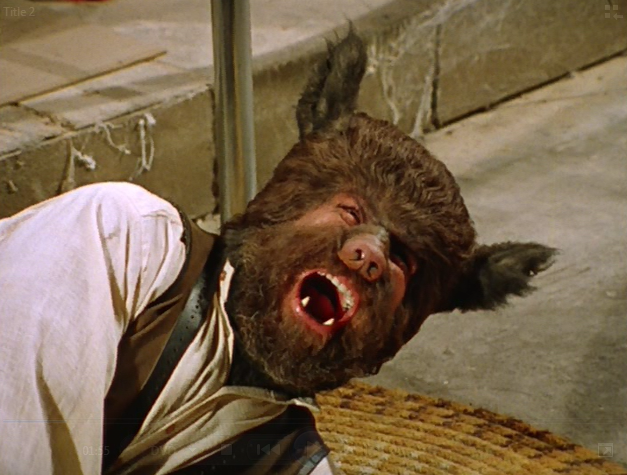
One day however, the “oscillating vibrations” of Walter’s crime computer awaken three of the museum’s figures, Dracula (Henry Polic II), the Frankenstein Monster (Michael Lane) and The Wolfman (Buck Kartalian). These figures are apparently the real deal, resurrected, and not merely wax representations of them.  However, it is never explained why the wax museum was housing the bodies of such dangerous monsters.


Regardless of their precise nature, these three “monsters” from history wish to atone for their sins by solving crimes with Walter, and thereby making reparations to society.

With Walt operating out of the Chamber of Horrors, Dracula, The Wolfman and The Frankenstein Monster are thus frequently dispatched -- in a black 1970s van -- to combat evil-doers around the city.


The first episode of Monster Squad, “Queen Bee” -- which aired on NBC the morning of September 11, 1976 -- stars Alice Ghostley as the insect matriarch, the aforementioned Queen Bee. As the episode commences, she has ordered her bee minions around the world to attack unsuspecting humans.  This “unexplained rash of bee stings” is noticed by Walt, who captures a bee and attempts to interrogate it with the Crime Computer.

One will notice here that the Crime Computer has a slot designed and labeled for insect analysis. This makes one wonder how often evil bugs show up in town…


After a time, Walt frees the bee, and Dracula tracks it in bat-form to Queen Bee’s headquarters. There, he and his monster must stop the Queen Bee’s plans before the United Nations can surrender the world to her.

The 1970's represents the great era of “killer bee” entertainment, from the movies Invasion of the Bee Girls (1973) and The Swarm (1978) to TV series such as The Starlost (1973-1974) which featured an episode about giant bees called “The Beehive.”  


In terms of “Queen Bee,” the Monster Squad episode reports about the South American killer bee briefly, but otherwise conjures up little in terms of fact.  Instead, the installment features about a hundred bad “bee” puns for Ghostley and her buzzing minions.  

“I bee-seech you,” says one character.  “Bee-ware your fate,” says another.

After a while, we also get “bee-lieve me,” “bee-guiling,” “bee-wildering,” “bee-headed,” “bee-trothal,” “bee-tray” and other variations on the theme.  One non -“bee” joke is Queen Bee’s comment that one of her minions always “bumbles.”

As you can probably guess, this approach grows tiring after a while, though it anticipates the approach to Mr. Freeze in Batman and Robin (1997).  

The episode -- like all Monster Squad episodes -- plays as particularly arched, and not overly amusing. Everyone is in on the joke, but the joke isn’t as amusing as it is on Batman, and this Saturday morning series also lacks the resources, and hence production values of that camp classic.  For instance, here Dracula is put in a vat of honey, and the vat is a tiny little barrel.


Viewers who were kids in the 1970's may be most interested here to see a Mego toy re-painted and used as a prop in “Queen Bee.”  Ghostley’s “bee” communicator is actually a Star Trek walkie-talkie from the age, but painted gold.  The prop -- with a different paint job -- recurs as Walt’s crime computer remote control in the next episode, “Mr. Mephisto.”


Although Monster Squad doesn’t hold up particularly well-today, I remember that I absolutely loved it as a seven year old, and that I wished and hoped for action figures, playsets and other toys featuring these lovable and familiar monsters. There was, as memory services, a board game available at one time.

Saturday, October 17, 2020

Saturday Morning Flashback: Valley of the Dinosaurs (1974)


"Deep in the heart of the Amazon, the Butler family was exploring an uncharted river canyon. Suddenly, caught up in a violent whirlpool, they were propelled through an underground cavern and flung into a hostile world of giant prehistoric creatures, a world that time forgot. Now befriended by a family of cave dwellers, each day is an adventure in survival for the Butlers in the valley of the dinosaurs."

-Opening narration from Valley of the Dinosaurs

In the autumn of 1974, American children had a tough choice. They could watching stop-motion dinosaurs on the live-action Sid and Marty Krofft spectacular Land of the Lost (1974 – 1977), or cartoon dinosaurs on Hanna-Barbera's similarly themed animated series Valley of the Dinosaurs.

The common points between the two programs are quite intriguing, and worth enumerating.

Both series involve modern American families on inflatable rafts "tumbling" down dangerous bodies of waters and ending up in prehistoric worlds, for example.

On Land of the Lost, it's the closed pocket universe of Altrusia; in Valley of the Dinosaurs, it's merely a hidden valley in the Amazon that serves as the family’s destination. 

Both series also involve contemporary, 20th century technological man interacting with more primitive "natural" creatures, whether a family of “cave dwellers” in Valley or Chaka's people, the Pakuni in Land of the Lost.


Where the series diverge is in storytelling approach, level and style.  

Land of the Lost quickly began to feature surprisingly mature and intelligent narratives about environmentalism, hard science fiction concepts (like time loops), and even featured a recurring (and scary) villain for the Marshalls: the unforgettable Sleestak. 

By contrast, Valley of the Dinosaurs is much more the tale of two families learning to help one another, to survive. There is no real enemy to fight, save for the dinosaurs, ants, and other challenges in valley. There is a focus on pre-adolescent humor and hijinks, and getting across a moral lesson with each story.


The first half-hour episode of Valley of the Dinosaurs aired on Saturday, September 7, 1974 and is titled "Forbidden Fruit." This episode was directed by Charles A. Nichols and the writing team included Peter Dixon, Peter Germano, Dick Robbins and Jerry Thomas. Interestingly, the story editor on Valley of the Dinosaurs was Sam Roeca, who later served as story editor on the third season of Land of the Lost. Talk about closed pocket universes...

Anyway, we meet the Butler family in this episode. It consists of white-haired patriarch, John Butler,  who is a high school science teacher, his troublesome and prone-to-mischief son, Greg (who likes to say things such as "jumping jeepers!"), teenage daughter Katie, and the protective mother of the clan, Kim. The Butlers have also brought along their loyal dog, who closely resembles Scooby-Doo (remember, this is Hanna-Barbera too...), named Digger.

As I noted above, the thematic leitmotif of Valley of the Dinosaurs involves the Butler's learning to cooperate, respect and live alongside a "mirror" human family of primitive cavemen, which includes patriarch Gorok, hunky son Lok, and matriarch Gara, among others. Tana is the little cave-person girl and Greg's playmate. 

The cave family even cares for a pet Stegosaurus named "Glump."


Each episode involves one family teaching the other family a lesson in tolerance and diversity. The differences in evolution don't matter, the show informs us as viewers; we can still be "good neighbors."

For instance, "Forbidden Fruit" involves the Butler family discovering a stash of delicious tree-growing fruit. However, the cavemen, led by Gorok, forbid the family from eating it. 

Why? Well, apparently, a local brontosaurus is quite adamant about devouring all the fruit itself. Still, Greg fails to honor this edict and steals a basket of the fruit, which results in the angry brontosaur assaulting the home of the two families, an expansive mountain cavern. 


The attack by the dinosaur precipitates a cave-in, and then a flooding of the habitat. The two families must then work together to siphon water out of the cave, utilizing bamboo shoots that happen to be plentiful.  Greg feels guilty for breaking the cave man law and finds a way out to warn the local village about the dinosaur.


In the end, order is restored and Gorok provides viewers with the lesson of the week. "We have laws and customs," he reminds the Butlers. "You know things we do not, and we listen. We know things you do not...and you listen." 

This episode also features the cave man realization that "The Butlers...they are strange...but nice."

Saturday, October 10, 2020

Saturday Morning Flashback: Far Out Space Nuts: "It's All in Your Mind"


This week, our Saturday morning flashback takes us back again to the Kroffts, and the year 1975. Although Land of the Lost (1974-1977) and The Lost Saucer (1975) were both airing on NBC at the time, another genre production from the duo found a berth on CBS: Far Out Space Nuts (1975).

This live-action series ran for 15 episodes in 1975, and starred Bob Denver of Gilligan’s Island as Junior, a hapless maintenance man thrust into space on a U.S. rocket alongside his equally hapless buddy, Barney (Chuck McCann).  

After their unfortunate take-off, the duo tries to return home to Earth in their lunar lander, meeting up with a cute, if diminutive alien, Honk (Patty Mahoney), on the journey.

The whole show is basically an even more slapstick version of The Lost Saucer, though without androids and the time travel angle. 


The first episode of Far Out Space Nuts is “It’s All In Your Mind.” On a distant planet, Barney and Junior attempt to repair their ship’s engine, a “space combustion system.” Barney tries to teach Junior how to complete the repairs, and he shows a bizarre knack for it.

Meanwhile, the denizens of the planet -- minions of an intelligent computer called G.A.L. 36-24-36 -- seek to capture Junior. These mindless drones serve the machine, which in turn demands complete control over the will of everyone on the planet. “All thoughts on this planet must be mine,” G.A.L. reports, showing an obsessive interest in Junior.


The Drones captures Junior, and attempt to transfer his mind into the machine’s storage banks. Meanwhile, Barney and Honk are held captive behind a magnetic wall. Fortunately, Junior’s extreme illogic causes G.A.L. to malfunction, and the drones are freed after an imprisonment of 132 eons.

As you can tell from the preceding synopsis, “It’s All in Your Mind” sounds very much in keeping with the other Saturday morning programs I’ve covered here on the blog over the years. We have our hapless heroes (acting firmly in the tradition of Abbott and Costello), the cute costumed side-kicked, and a moral or didactic lesson about the importance of thinking for yourself.


What the synopsis does not capture, however, is the truly creepy nature of this episode. The drones march, Cyberman-style, in lock-stop, after their prey, throughout the tale. And their attacks are accompanied by unsettling sound effects and music.  


Sure, the story isn’t scary in a conventional sense, but the elements add up to a presentation that actually feels a bit less kiddie-friendly than one might expect. The Kroffts, to their everlasting credit, went this way occasionally in their entertainment, with the Sleestak on Land of the Lost, for example. 

The result is that for all its budgetary restraint and dopey comedy, “It’s All in Your Mind” is actually a pretty compelling little tale, which is a claim I can’t necessarily make for many episodes of either Lidsville (1971) or The Bugaloos (1970), which I’ve covered on the blog. Far Out Space Nuts also seems lower-budgeted than even The Lost Saucer. That series had a great standing set (the saucer interior) and elaborate costumes for its stars, Ruth Buzzi and Jim Nabors. Here, we never see the inside of the lunar lander craft, only its landing site, for example. And the enemy minions, though fearsome, number under half-a-dozen.

Saturday, October 03, 2020

Saturday Morning Flashback: Ark II (1976): "The Flies"


“For millions of years, Earth was fertile and rich. Then pollution and waste began to take their toll. Civilization fell into ruin. This is the world of the 25th Century. Only a handful of scientists remain, men who have vowed to re-build what has been destroyed. This is their achievement: Ark II, a mobile storehouse of scientific knowledge manned by a highly trained crew of young people. Their mission: to bring the hope of a new future to mankind.”

-          Voice-over narration for Ark II (1976)


Ark II aired on Saturday mornings beginning September 11, 1976 and ran for fifteen 22-minute episodes. Like many science fiction TV efforts of the time, it was rather determinedly a “civilization of the week” program; meaning that each week, the diverse protagonists traveled (usually by a ground vehicle; sometimes on foot…) to a new and strange civilization. 

Basically, it was Star Trek all over again, only without the U.S.S. Enterprise and outer space as useful backdrops.  With some variation, the format was seen in The Starlost (1973), Planet of the Apes (1974), Logan’s Run (1977) The Fantastic Journey (1977) and in the 1980s program Otherworld, to name a few examples. Star Trek creator Gene Roddenberry himself had attempted to take the civilization of the week formula to new heights with Genesis II and Planet Earth, two made-for-tv movie/backdoor series pilots from the early 1970s.


Although it aired during America’s optimistic bicentennial year, Ark II was set in the new Dark Ages of 25th century, and focused on a large, impressive, high-tech tank-like vehicle, the Ark II, which traversed the wasteland in order to aid the survivors of an environmental disaster. 

In a hold-over from the popular youth movement of the late 1960s and early 1970s, Ark II’s crew is described in each week’s opening narration as a “highly trained crew of young people.” 

Specifically, the crew of Ark II consisted of the bearded Captain Jonah (Terry Lester), scientist Ruth (Jean Marie Hon), and young scholar Samuel (Jose Flores).  In a weird, unspoken acknowledgment of Planet of the Apes’ continuing popularity, these young humans also traveled with a talking chimpanzee named Adam who could play chess and drive the Ark in a pinch.   

You may have noticed that all the crew names listed above arise from Judaism, and thus carry resonances beyond the obvious.  In the Hebrew Bible, Jonah was a “truth seeker,” which is a term you might use for the stalwart captain of Ark II.  Ruth was the name for a “companion,” in the same text, and Samuel was a man on the cusp of two eras, the last Hebrew judge and the first prophet.  Similarly, on Ark II, the young Samuel is a child of the Dark Age who will also live in the period of the New Enlightenment, or recovery. As for the ape, he is named for Adam, the first human male.  


The name “ark,” of course, calls up imagery of Noah’s Ark, the craft that repopulated the Earth after a disaster, the Great Flood.     

The first episode of Ark II is called “The Flies.” Written by Martin Roth and directed by Ted Post, it finds Captain Jonah recording his log entry numbered 1444. The Ark is patrolling Sector 83, Area 12, investigating a gang called “The Flies” that is responsible for “serious infringements on the rights of the others.” The assignment: bring “discipline” and “reason” into their lives.  The name “The Flies” conjures images of William Golding’s novel Lord of the Flies (1954), which also concerned a society of children.

Unfortunately for Jonah, the Flies -- an interracial gang of youngsters -- are entirely loyal to their leader, a rapscallion named Fagan and a scoundrel played by the one-and-only Jonathan Harris, Lost in Space’s Dr. Smith. Fagan is named after Charles Dickens’ famous Oliver Twist character Fagin, a “receiver of stolen goods” and man who encourages a life of crime in children, turning them into thieves.  In Ark II’s “The Flies,” Fagin and his group of thieves discover ancient poison gas canisters, ones that are still functional.


After capturing Jonah, Fagan takes the poison gas cylinders (and a gas mask to protect himself), and heads to the HQ of a local warlord Brack (Malachi Throne), who lives in the “the Village of the Lords,” actually the Ape City set from the live-action Planet of the Apes TV series and films. Fagan believes he has found “the ultimate weapon,” and attempts to wrest control of the warlords from Brack. Brack beats Fagan at his own game, however, and captures the Flies, forcing Fagan to forfeit his leadership

Ruth, Samuel and Adam save Jonah and free Fagon and the Flies from warlord subjugation.  They also retrieve and dismantle all the dangerous gas canisters without ever resorting to violence. Instead, they neutralize the gas and change it into Nitrous Oxide (laughing gas). 


Finally, the episode ends with a moral statement from Jonah: “weapons man creates to use against others can easily be turned against himself.”

Although the series is now over forty years old, the look and production design of Ark II remains admirable.  The main cast, for instance, wears skin-tight and attractive space-age uniforms with computerized belts and cuffs (replete with wrist communicators). 

One can see how this design influenced later Star Trek outings, including The Motion Picture (1979).  Also the exterior, post-apocalyptic set design is kind of interesting: a mix of the Old West, Vikings, and the aforementioned Planet of the Apes. Interestingly, Ark II presages the barbarity and chaos of The Road Warrior (1981) on a TV budget and within TV restrictions. 


The Ark II itself, built by the Brubaker Group, remains a remarkable piece of hardware, a life-size, operational vehicle. It looks thoroughly convincing….especially in motion. In the series, this high tech truck is equipped with a protective force field.  The Ark II also billets a smaller exploratory vehicle, the fast-moving roamer.

I find it fascinating that Ted Post directed this premiere episode of Ark II.  A veteran director of The Twilight Zone and Boris Karloff’s Thriller, his movie career had taken off in the early 1970s with Beneath the Planet of the Apes (1970) and the Dirty Harry sequel, Magnum Force (1973).  

Given this impressive CV, it’s odd that, by 1976, Post was helming Saturday morning television. He does a good job handling the actors and action in “The Flies,” and of introducing all of the various tech, from the Ark itself, to the roamer, to Jonah’s rocket pack (which looks identical to one used on Lost in Space years earlier.)

30 Years Ago: Chris Carter's Millennium (October 25, 1996)

Frank Black (Lance Henriksen), his wife, Catherine (Meghan Gallagher) and their daughter, Jordan (Brittany Tiplady) move into a beautiful ye...