Showing posts with label 007 Week. Show all posts

Tuesday, January 31, 2017

Star Trek 50th Anniversary Blogging: "Return to Tomorrow" (February 9, 1968)


Stardate 4768.3

The Enterprise receives a distress call from a dead planet, and is contacted by a being called Sargon.  This individual asks that a landing party beam down to a vault beneath one hundred miles of solid rock.  Mysteriously, Sargon refers to the crew as “my children.”

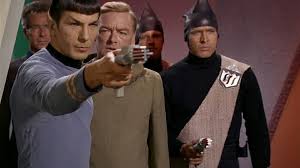
Captain Kirk (William Shatner), Mr. Spock (Leonard Nimoy), Dr. McCoy (De Forest Kelley) and Dr. Ann Mulhall (Diana Muldaur) beam down and discover that Sargon is from a long-dead race of god-like beings who once explored the stars, and even visited the human race. 

A destructive and terrible war tore apart their world, Arret, half-a-million years ago, and now Sargon, his wife, Thalassa, and a representative from the other side, Henoch, are all that remain of the planet’s populace.

They exist, however, not as physical bodies, but as incorporeal forms encased in large orbs.  

Sargon’s proposal for Captain Kirk is simple. He, Henoch and Thalassa would like to use the bodies of Kirk, Spock, and Mulhall to inhabit while they build robot bodies for themselves to spend eternity dwelling in.

McCoy is unhappy about the idea, because each body “possessed” undergoes dangerous spikes in cardiac function, and risks being “burned out.” Sargon insists that this symptom can be tempered with regular injections, but Kirk must sill convince his crew that they should take the risk, because the possibility of interacting with the incredibly wise Sargon, and his wealth of knowledge, promises to be worthwhile.

What Kirk has not counted on, however, is that Henoch has no desire to live in a robot body. Instead, Henoch would rather keep Spock’s. And knowing that Sargon would never let that happen, Henoch plans to murder his -- Kirk’s -- body…


Like last week’s “A Private Little War,” “Return to Tomorrow” is one of those thoroughly entertaining and impressive episodes of the original Star Trek (1966-1969) that seems to get forgotten when lists of ten best, twenty best, or even season best episodes are drafted.

“A Return to Tomorrow” deserves at least some consideration for ten best of Season Two, I would suggest, because of Kirk’s incredible speech about risk, and the reason that mankind must accept risk if he wishes to thrive, and move forward. It is an inspiring speech, and I like to think of it as the Kirk Doctrine, or the Kirk Manifesto.


It goes something like this:

“They used to say that if man could fly, he’d have wings. But he did fly. He discovered he had to. Do you wish that the first Apollo mission hadn’t reached the moon, or that we hadn’t gone on to Mars, and to the nearest star? That’s like saying that you wished you still operated with scalpels and sewed your patients up with catgut…

…I'm in command. I could order this. But I'm not because Doctor McCoy is right in pointing out the enormous danger potential in any contact with life and intelligence as fantastically advanced as this.

But I must point out that the possibilities, the potential for knowledge and advancement is equally great.

Risk….risk is our business. That’s what this starship is all about. That’s why we’re aboard her.”

Looking back, this doctrine isn’t merely inspirational, it’s a blueprint for the next steps that we need to take, right here, right now, in 2017, to move forward into the universe. I love this particular Kirk speech, and believe it speaks to the core appeal of Star Trek as a franchise, and indeed, as a philosophy, or futurist movement.

The speech also speaks to Captain Kirk’s character; his heroism, his innate optimism.  It demonstrates his ability to lead, to rally others to his cause, even to be an effective public speaker. (Sorry, I teach public speaking, and one lesson I enjoy teaching every semester concerns the art of persuasion, and how the great speakers summon us by calling to the best angels of our nature, not the gutter emotions.) Kirk’s speech in this episode is a textbook perfect example of that approach. He acknowledges that there is danger, but then moves right into the inspirational talk about the rewards that lay beyond the danger. He tells us not only to strive, but why we should strive. And he ties that striving right back to human history, and the history of space travel.

Because Captain Kirk has this opportunity to lead, and to inspire, “Return to Tomorrow” takes on a special quality, at least as far as I’m concerned. Kirk isn’t just reacting to a crisis here. He isn’t just choosing a course of action. He is proving why he sits in the center seat, and why his crew would follow him to the edge of the galaxy and beyond.


Of course, the episode possesses other values worth noting

In fact, “Return to Tomorrow” is nearly a textbook example of why William Shatner and Leonard Nimoy were each cast in the series. Shatner gets the opportunity to go big, to make us feel inspired with his character’s rhetoric and discourse. 


And Leonard Nimoy -- who holds back so much as Spock -- gets to play a diabolical, smirking character, Henoch.  Since we are so accustomed to seeing Spock as an emotionless persona, it is a shock to the system to see small changes, like that devilish smirk, or Spock leaning casually against a door frame.  It’s as if Leonard Nimoy understands that just by doing little things – by turning outward his performance just a notch or two, the impact would be huge.  It was a brilliant calculation.

The theme underlining “Return to Tomorrow” is also powerful. The episode concerns vanity, or overconfidence (rather than a fear of progress). Sargon and his people reached a point of advancement so great that they began to consider themselves Gods. 

Considering oneself a god means that laws are no longer needed, or simply required for others. That rules no longer matter.

Henoch believes he is owed survival, and Spock’s body as well, because of the gifts he could bring the galaxy. Thalassa nearly travels this route too, until she sees how much she is privileging her own happiness over the existence of the others.  She is horrified to realize she has been so selfish, so impulsive.

The message is that even as we advance, even as we grow and develop, we maintain our “human equation,” which consists of jealousy, avarice, selfishness, and other emotions. We can walk forward into a brave future, but we will still carry these cave-man legacies with us.  We must master them, or they will be our undoing, as Spock might remind us.

That’s what happened to Sargon’s people. They thought they were Gods.  They forgot they were human, and still tethered to mortality, and fallibility.

The story is a powerful tale of love, too. Sargon and Thalassa have loved one another for 600,000 years, through war and a virtually incorporeal existence. Here, they face the possibility of oblivion, but face it together.  It’s a powerful argument for love, for connection, even for monogamy, if you wish to take the lesson that far.

I haven’t mentioned Diana Muldaur yet, and I must do so, before closing.  She is an important actor in Star Trek history, for her roles in the original series and The Next Generation. She is an exceptionally strong presence in this episode, and transmits brilliantly an understanding of the conflict that her character, Thalassa, faces.  She is not evil. She is not a menace to the universe. She is a person who wants, above anything else, to live, to be human again And in wanting that, she is able to look right past the rights of others. Muldaur makes Thalassa very human, both petty and transcendent.


Indeed, that seems to be the whole point of this episode, to explore the human condition and our ability to be those things.  We must take risks and strive as we move forward, but heaven help us if we ever forget that we are mortal and fallible.

Next week: “Patterns of Force.”

Tuesday, June 07, 2016

Star Trek 50th Anniversary Blogging: "A Taste of Armageddon" (February 23, 1967)


Stardate 3192.1

The Enterprise transports Ambassador Robert Fox (Gene Lyons) to a star-cluster where an inhabited world, Eminiar VII, has rebuffed all efforts by the Federation to make contact.

Although Kirk (William Shatner) is weary of forging ahead, Ambassador Fox demands it.

Captain Kirk beams down to the planet and learns from its leader, Anan 7 (David Opatoshu) that the planet is has been locked in a war with a neighboring world, Vendikar, for five hundred years. 

Unusually, the war is fought via computerized simulation. Computers select targets, and living people must then report to disintegration chambers as “casualties.”  In this way, neither civilization days, even as conflict continues.

The same computers have now designated the Enterprise a casualty in the war too, and so Anan 7 holds Kirk, Spock (Leonard Nimoy) and the landing party in an attempt to coerce the Enterprise crew into beaming down and offering themselves as sacrifices.

Believing that the people of Eminiar have only succeeded in sanitizing war, Kirk takes action to end the status quo between the planets.


Critics of Star Trek (1966-1969) who term the series’ political philosophy imperialism, or “gunboat” diplomacy are likely referring to this episode, “A Taste of Armageddon.”

In this installment, Kirk disobeys the Prime Directive, and veritably bullies a planet (with threats of world-wide destruction...) into changing its culture to satisfy his sense of what is morally right, and what is “human” or not.  He substitutes his own wisdom for the wisdom of the people of a different and alien culture.

One can debate semantics, of course, but that’s pretty much the core of this (admittedly) entertaining show. We can prosecute Kirk’s actions here, based on Starfleet’s rules. He rather clearly disobeys them.

Before getting there, certainly, it should be acknowledged that “A Taste of Armageddon” is  powerful  anti-war story.

The episode strongly suggests that advanced technology makes war antiseptic, and therefore entirely more likely.  The people who die in the Eminiar-Vendikar conflict are (to the leaders of both worlds...) merely numbers on a spread-sheet, not people with families, careers, dreams and aspirations.  They aren't seen or heard; and they don't suffer in the historical sense of that word.  They merely...die.


Since the U.S. was locked in a conflict in Vietnam at the time this episode aired, these are not small or irrelevant points of interest.  The value of the episode -- and it does possess clear value -- rests in its commentary on the futility of war, and the fact that greater technology lessens the very things that make us recoil in horror.  War is a thing to be avoided because it is so damn terrible.

If war is no longer bloody, and no longer physically destructive, why do everything possible to avoid it?

If we can keep our gleaming cities, and our culture intact, why avoid war?

That's Kirk argument, and his strategy reminds Anan 7 and his people why war is so awful.


Alas, “A Taste of Armageddon” also paints a very unfortunate picture of Starfleet, the Federation, and even Kirk. 

Why it does so is an open question. My point would be, simply, that the series was still developing at this point, and so the Prime Directive was not a key issue of the story…as it should have been. 

The background context of Starfleet, the UFP and so forth were still only half-formed when this story was conjured, and yet this is a story in which those rules clearly call for a debate. In stories such as "The Apple" or "Return of the Archons," there is discussion about violating the Prime Directive, and also, importantly, what exactly constitutes a violation.

There is none of that here. 

But let’s talk about General Order One, or the Prime Directive. 

Sometimes it is also referred to as the non-interference directive. Basically, it prohibits Starfleet officers from interfering in the affairs of other planets, other cultures.

This is how Kirk describes it in “Bread and Circuses,” a second season show: “No interference with the social development of [said] planet.”

And this is how Kirk describes it in “The Omega Glory:” “A starship captain’s most solemn oath is that he will give his life, even his entire crew, rather than violate the Prime Directive.”

Put the two remarks together and what you have is a law prohibiting interference in a world’s social structure or culture, even if a ship is endangered, even if a crew dies.

Pretty clearly, Kirk’s actions in “A Taste of Armageddon” are aimed at saving both his starship and crew, both of which have been declared casualties of war. He does so at the expense of an alien culture's natural development.

In this case, he has, therefore, violated his most solemn oath. He has failed to give his life and his crew;s lives to avoid interference with the social development of Eminiar VII. He has put himself and his ship ahead of an alien world.


Worse, Kirk doubles down -- with the help of Starfleet regulations -- on his interference.  If Anan 7 and the ruling council of Eminiar VII fails to conform to his agenda, he threatens to initiate General Order 24, which permits a starship to completely destroy a planet.

So, quite simply, this scenario is horrifying. 

A starship captain can visit -- without permission or request -- an alien world, judge it against human standards, and if he doesn’t like it, threaten to destroy that planet to enforce compliance with a pre-existing agenda.  

This is, without a doubt, gunboat diplomacy. How horrifying is it that Starfleet actually possesses an order which permits the devastation of a planet?


Now, I absolutely agree with Kirk that the people of Eminiar VII have made war antiseptic (and eternal) by taking the blood and guts out of it.  I share his distaste for the suicide booths, and the failure of the leaders to end their conflict by talking about it; by forging an agreement.

However, Kirk is clearly in violation of his oath, and worse, a bully. To threaten a planet’s entire population because you disagree with its politics is abhorrent. Kirk knows virtually nothing of the planet's history, society, culture, or even the context for the war, and in that ignorance decides how that planet should conduct its affairs.

So what we have in "A Taste of Armageddon" is an entertaining Star Trek episode that nonetheless has much trouble existing “in universe,” with the knowledge we glean of the Prime Directive in later episodes.

“A Taste of Armageddon” seems to occur in a universe wherein there is no Prime Directive at all.  Instead, a Starfleet Captain -- if his or her ship is threatened -- can simply re-organize a planet’s society to his or her liking by using superior technology and firepower.


The episode also provides another example of Star Trek’s vehement dislike for diplomacy, even though diplomacy is precisely what Kirk demands of Anan 7 and the leaders of Vendikar.  

Robert Fox is an insufferable, imperious jerk, who makes one wrong-headed decision after another.  Then, once his neck is on the line, he drops all pretenses of having a coherent point-of-view, and meekly follows Kirk around with a disruptor in hand.  It is a negative portrayal of a diplomat, but Fox is a straw man.  He is so abundantly weak so that Kirk can look strong and decisive by comparison.

All this established, I do love the episode’s final summation of Kirkian philosophy (or more aptly, humanist philosophy).  Our good captain doesn’t deny that man often kills, or that violence isn’t instinctual.  Instead, he says the following:

All right. It's instinctive. The instinct can be fought. We're human beings with the blood of a million savage years on our hands, but we can stop it. We can admit that we're killers, but we are not going to kill today. That's all it takes - knowing that we won't kill today.”

Ironically, this wonderful philosophy applies to Kirk too, who plays a very dangerous game of brinkmanship in “A Taste of Armageddon.”  

Would he (or Scotty?) have followed through with their threats of General Order 24 if Anan 7 had not complied with their strategy?  Would they have destroyed a world?


It is food for thought, certainly, and “A Taste of Armageddon” is one atypical episode of Star Trek. It suggests we can go to the stars and dictate our desires to the aliens we meet there.  That we know better.

Most episodes, contrarily, suggest that we reach out with respect and tolerance, and not with the might and the will to level planets that don’t conform to our belief systems.  

Tuesday, November 10, 2015

Cult-Movie Review: Spectre (2015)


[Warning: Major spoilers abound. Swim at your own risk.]

There are two” James Bonds, a character notes in the 2015 film, Spectre. This trenchant observation is likely as good a place as any to commence a review of the latest film in a cherished line that goes back to Dr. No in 1962. 

Spectre is the fourth entry to star Daniel Craig-- a direct follow-on from Skyfall (2012) --  and it is a film that is simultaneously not all I hoped it would be, and yet nonetheless of a better quality than many online reviews suggest.

It’s not a bad Bond film (like Diamonds are Forever [1971], A View to A Kill [1985], or Die Another Day [2002]), for certain.

But nor does Spectre ascend to the top tier of 007 cinema, which by my estimation includes From Russia with Love (1963), Goldfinger (1964), On Her Majesty’s Secret Service (1969), Licence to Kill (1989) and Casino Royale (2006).

Instead, this 2015 007 installment falls somewhere in the middle of the two-dozen strong pack. It lands, perhaps, twelve or so films down from the top. 

It’s not bad, yet Spectre is still a disappointment, especially given the success of the Bond films in the Craig Era.

Thematically, Spectre revolves around the idea of the two James Bonds; the man that 007 is now (a determined, grim assassin), versus the man he could be (one who takes a chance on life and love, and thus leaves MI6 behind).

Or perhaps the 'two James Bonds' are the man that Bond turned out to be (loyal to queen and country) versus the man he could have been -- Ernst Stavro Blofeld -- one loyal only to himself and his personal ambitions. One scene certainly seems to suggest this latter possibility when Blofeld’s face is reflected or superimposed over Bond’s visage.

The men share a common history, so how did they turn out to be such polar opposites?

Lacking your strong sense of duty, Mr. Bond, you would have been the villain in this particular story, not the hero…

The leitmotif of the “two” James Bonds co-existing in one man is intriguing, for certain, yet is not quite enough to recommend Spectre as an unqualified success. 

Although Craig is again excellent as our 007 in the age of serialized Bond movies, overall Spectre feels like it might be missing a reel or two.

Specifically -- and despite its two-and-half-hour running time -- Spectre seems bound and determined to rush through all its best, most compelling moments, and dwell instead, inside its weakest, most uninspiring ones.

Production values remain impressive, and some moments in Spectre practically pulsate with a sense of the diabolical or sinister. There is real tension in this film, and that quality is worth noting.

Yet when it’s all through, one feels that opportunities have missed, especially since this is the first Bond film of the modern age to put all the pieces -- heroes, supporting characters, and a familiar villain -- in place.


“If you go there, you will cross into a place where there is no mercy.”

On an unauthorized mission to Mexico City, James Bond -- 007 (Daniel Craig) -- assassinates a man named Sciarra. He learns that Sciarra was a member of a secret organization of criminals and terrorists called Spectre.

While M (Ralph Fiennes) grapples with an unctuous underling named C (Andrew Scott) who wishes to scuttle the 00 program and replace it with a vast surveillance state, Bond attempts to infiltrate Spectre in Rome and learn the truth about it

The leader of Spectre, Oberhauser (Christoph Waltz), turns out to be someone from Bond’s past, and this revelation sends Bond one of the most dangerous and personal missions of his career.


 “The dead are alive.”

Spectre opens with a dazzling and highly effective pre-title sequence.

In this case, I’m not referring specifically to the looping helicopter stunts, but rather to the background detail. We watch as Daniel Craig (no stunt doubles, thank you…) strides out on a high hotel ledge, and approaches a target in Mexico City. 

All around him (or rather far, far below him…) are the revelers at the Day of the Dead celebration. The execution of this composition is absolutely exhilarating. In all the Bond catalog, there has rarely been as persuasive or truly spectacular a shot. 

As Spectre opens, we see our hero in the foreground of the frame, moving over a veritable tide of humanity, and at a very dangerous altitude to boot. There’s no trickery or gimmickry involved, just the authentic thrill of seeing our man, 007 on a mission in the (very) real world.  The tide of movie history is to make the theatrical more naturalistic, the artificial more real, or gritty. This shot -- of Craig in real environs -- takes James Bond quite far down that path way. 007 is no longer a superhero or comic book hero living in a rarefied fantasy world (think: Moonraker), but a man in reality as we understand it.

The successful (and jaw-dropping) imagery of this pre-title sequence is, however, quickly undercut by the opening credits montage and song, “The Writing’s on the Wall.”  

Standing independently of one another, both the montage and the song would qualify as uniformly dreadful, as series low-points. As a combo, they veritably drive Spectre into a brick wall. The images and sounds, the movement and the lyrics, simply don’t blend together well at all, and in conjunction this melange represent the audience’s first recognition that something is amiss, that something has gone wrong from an artistic standpoint.  Our sense are shaken, not stirred, by a creative misstep.

Alas, again and again Spectre seems to repeat this pattern; hopping from victory to defeat and back again. 

For instance, a mobster widow (Monica Bellucci) is introduced in an impressive early scene. She is smoldering, gorgeous, and in desperate need of…rescue. James Bond obliges, and the sparks fly between the two characters.  

The implication is that this character -- Lucia Sciarra -- is a match for Bond in terms of wit and cunning. Like him, she lacks idealism. Like him, she knows exactly what their encounter signifies.


Yet Sciarra appears in the movie for precisely two scenes and then is never mentioned or seen again. She doesn't even get a death scene so she could qualify as the film's sacrificial lamb. This is a criminal, inexcusable waste of a remarkable actress, and a fascinating character.

The new Bond girl, Madeleine Swann (Lea Seydoux) looks like a callow child after we've met the widow. And this vapid youngster -- we are asked to believe -- is special enough to make Bond quit the service. 

If there were no other compelling love interests in the film, that might be a plausible outcome. But after the delectable Bellucci’s glorified cameo, the invidious comparisons are inescapable. Sciarra is not only in Bond’s age group, but also, clearly, someone who, like him, has lived life and sees it in a similar fashion.

What's the case for Swann being someone that Bond leaves the service for? 

Why is she more a match for him than, say, Octopussy ("we're two of a kind"), or Melina Havelock, or Solitaire, or any other lover he has taken over the years?

Spectre doesn't make an affirmative case that Swann is "The One" that could change Bond. Oppositely, it makes a case that Sciarra is far more intriguing a personality.  

Still, I liked the plot twist near the end of the film. Swann realizes that Bond will never change and walks away from him, and the relationship.  That's a new wrinkle in the series, the Bond Girl seeing 007 with open eyes, and choosing not to have a fling with him.


As I wrote above, Spectre keeps making the same sort of mistake: introducing a fascinating person or location, and then dropping it like a hot potato. 

After much intrigue, for example, it is discovered that Blofeld has erected a magnificent headquarters in the African desert. From there, he can see the world!  Bond and Swann make a trek there, but after just two or three scenes, Bond blows up the whole installation with a few well-placed shots…the whole bloomin’ thing.

Now imagine if 007 had found Blofeld’s volcano in You Only Live Twice, and instead of exploring that location for awhile, he just destroyed it after about ten minutes.

That wouldn’t feel very satisfying would it? 

Indeed, the destruction of Blofeld’s headquarters in Spectre feels cursory, like an after-thought.  It’s as if the film’s writers have given absolutely no thought, whatsoever, to this location, and how it could be used in the plot.  Instead, it is introduced only to be destroyed, moments later.  

What a waste of some impressive sets. 

What a waste of a villainous headquarters.

By contrast, I should point out, Spectre absolutely features some effective moments.  

After the Widow Sciarra incident, Bond infiltrates a meeting of Spectre in Rome, a very old city.  The architecture suggests age, antiquity, and the idea that such predators upon society have always existed, historically-speaking.  

Then we are introduced to Blofeld, and for his first several moments on camera, he sits with a shroud of darkness obscuring his face.  He is only a silhouette, a shadow, a...spectre.  This sequence feels legitimately suspenseful, and dangerous.  Bond is privy to a world with “no mercy,” a world that few have witnessed, and Blofeld is built up as a real threat; one who draws his powers from the very sinister world he inhabits. 

Later we see Waltz in the role, and the (impressive) actors plays the role far too lightly for my taste. Once Blofeld comes out of the shadows, the fear and terror subsides, and we are left watching an effeminate man wearing loafers and no socks.  He is too much Charles Gray, and not enough Donald Pleasence for my taste.


Later, of course, there is a revelation that ties Bond and Blofeld together. 

They aren’t genetically related (thank goodness…) but they did live together under the same roof for a spell.  

I have read exaggerated reviews which suggest this new origin for Blofeld destroys the entire Craig Era.  

I disagree, but by the same token, I feel that no such “personal” connection is necessary to establish the animosity or, even, really, the link between the two characters. It’s a genuine weakness of storytelling -- a short-cut to thinking -- that Blofeld needs, on his first encounter, to already hate and despise James Bond. 

No, this plot doesn’t ruin the Craig Era. But it sure feels like a blatant and cheap way to manipulate audience emotions. Blofeld and Bond should be alike because they both traffic in the same world.  And because they both kill to achieve their ends. Bond’s ends, however, are not personal, and, in some way, pro-social.  Blofeld is quite the opposite. 

These facts could have been established without the film’s screenplay making them foster brothers, essentially, and their conflict one of filial resentment.

I suspect that Spectre is the pinnacle and final chapter of the Craig Era.  

Why? 

For one thing, there are numerous call-backs to the earlier films. The villains of Casino Royale, Quantum of Solace (2008) and Skyfall are all seen momentarily, and name-checked at least once. There is mention of Vesper, too, and we even see her in the opening credits montage.

The debate over 21st century espionage techniques -- raised in Skyfall (2012) -- is also continued here.  Finally, all the supporting characters -- Q (Ben Whislaw, Moneypenny (Naomie Harris) and M (Ralph Fiennes) are fully integrated as useful team members. Blofeld is introduced too, and gets his scar (and his pussy).

So a new lead actor could come in, with all these ingredients in place, and take over as 007.  There’s part of me that hopes that’s the case. After nearly a decade of “serialized” Bonds, I would love someone to make a  one-off, lounge-lizard, Roger Moore-style stand-alone Bond film; one light and goofy just for the heck of it, but with the supporting team in place.

The other way it could go, and I would appreciate this too: sign Craig for two more Bonds (bringing his total up to six).  

Then, next up, remake On Her Majesty’s Secret Service, so that we see Craig's Bond falling in love, marrying, and clashing with Blofeld one more time before the tragic ending. Then, in his last film, the filmmakers could have Craig wreaking unholy vengeance on the murderer of his wife, and slip into the role of the cruel, callous, unemotional Bond. 

Craig should only stay in the role if he is willing to take that two-film journey, I feel, since Spectre has offered his Bond closure. 

In the original continuity, we lost the Bond we had identified with, Sean Connery's, just as the filmmakers depicted his most important adventure (On Her Majesty’s Secret Service). Now that audiences have a powerful connection with Craig, and serialized story-telling is in vogue, let’s get the gang back together to vet the story of Bond’s marriage, and bloody aftermath.

Will that happen?  I don’t know. But the series needs refreshing after this entry. I will confess that the unstable, inconsistent nature of Spectre -- vacillating from good to bad and back again -- has shaken my confidence in the Bond filmmakers. 

The ‘two James Bonds’ is an intriguing conceit, but it shouldn’t be deployed to express a schizophrenic approach to storytelling, right?

Movie Trailer: Spectre (2015)

Friday, November 06, 2015

007 Week: Final Post


Well, 007 Week is now at an end!

I hope you have enjoyed it as much as I have.  As you read these words, I’ll be screening SPECTRE (2015) with my wife, and experiencing the next chapter in the Craig Era. 

Hopefully, it’s a worthwhile entry.  Look for my review next Tuesday, right here.

Now, to end the week, I’m including my extremely individual and biased ranking of the Bond films from best-to-worst.

This is a snapshot of my evolving ideas on the movie franchise, and in three years -- in time for the next film -- I may rank some entries differently. 

But for right now, here’s how I tally ‘em up, and a few thumbnail reasons for my choices.

007 Films, Ranked Best to Worst (and categorized by quality):

The Great:

1. From Russia with Love (1963): Greatest fight in the series (Train Car); greatest soldier villain (Red Grant), and Sean Connery at his most charming/fit.

2. Goldfinger (1964): Greatest villain (Auric Goldfinger), greatest car (Aston Martin), great pre-title sequence prototype, great car, great sacrificial lambs (Jill and Tilly Masterson), and greatest overall leitmotif (gold).

3. On Her Majesty’s Secret Service (1969): The most human Bond film. The first “re-grounding” effort in the saga, and one that considers Bond as a person.  Greatest Bond Girl Ever: Diana Rigg’s Tracy Bond.

4. Casino Royale (2006): Another great “re-grounding” effort, after the ludicrous Die Another Day (2002) Gives us the most physically-fit, believable Bond in Daniel Craig, and offers a solid villain (Mads Mikkelsen) and great Bond Girl, to rival Tracy: Eva Green’s Vesper. In a way, a great “origin story,” and in 20 something other films, we’ve never really had that.

5. Licence to Kill (1989): Timothy Dalton’s final film was only twenty-five years ahead of its time, giving us a bloody, serious, tortured Bond on a mission of vengeance. Features one of the franchise’s all-time great villains, the quasi-Shakespearean Sanchez (Robert Davi).

6. For Your Eyes Only (1981): The Bond re-grounding film, after the excesses of Moonraker (1979) that proved Roger Moore can be a great James Bond. The film eschews fantasy, and shows how resourceful Bond can be. The car chase with the junky old Citroen proves it’s not the car that matters, it’s the man behind the wheel. The film also features the most suspenseful scene in all the canon, with Moore’s 007 scaling a sheer mountainside as villains attempt to send him plummeting to his doom.

The Good:

7. Skyfall (2012): Who knew Bond had a Mommy Complex? This film, in keeping with the Craig Era, gives us more insight into the creation of Bond’s world, adding flesh to the bones of Moneypenny, Q, and even the new M. 

8. Dr. No (1962): The first Bond film, and the one to set the tone/style for the series.  Features a great villain, an amazing Bond girl, and made Sean Connery a star.

9. The Living Daylights (1987): Another re-grounding film (this time after A View to a Kill), giving us a younger, more vigorous Bond in Timothy Dalton. The film speaks meaningfully to then current events (the Reagan Administrations’ shadowy arms deal with the Iranians), and gives the audience the most human, flawed 007 since Lazenby’s in 1969.

10. Never Say Never Again (1983): Overall, this one gets high marks from me because the film acknowledges that Bond (Sean Connery) has aged, and must now rely on his wits and cunning. The film’s villains are of the 1980s “push button” age, playing video games and remotely detonating bombs, but Bond is a moving human target, relying on instincts.  Great antagonists here, too.

11. Live and Let Die (1973): This Bond, the first starring Roger Moore, apes the Blaxploitation movie trend of the time period, but holds together well.  Features the best title song of the franchise, and one of the finest Bond girls, Jane Seymour’s Solitaire.  The presence of Baron Samedi – Death Himself – also adds a layer of visual and thematic artistry to the affair.

12. The Spy Who Loved Me (1977): A veritable remake of You Only Live Twice (1967), only with nuclear submarines instead of rockets. But this movie features a great Bond car (the Lotus Esprit) and the finest pre-title sequence of the saga, with Moore’s Bond skiing off a mountainside and deploying a parachute.

13. Quantum of Solace (2008): Craig’s sophomore outing in the 007 role is best enjoyed as the second half of Casino Royale (2006). On that basis – as well as its pastiche-style recycling of classic Bond images (girl in oil; girl in gold; Quantum = SPECTRE) -- the film worth revisiting.

14. Tomorrow Never Dies (1997): Brosnan’s best Bond; a rip-roaring social critique of the 24-hour news cycle, and the rise of cable news. Michelle Yeoh is a fantastic ally for Bond, and Brosnan seems especially committed to the proceedings, especially in his scenes with Teri Hatcher.

15. Goldeneye (1995): After the ahead-of-its-time Licence to Kill, Pierce Brosnan’s first outing is a perfectly entertaining -- and perfectly bland -- re-establishment of the series’ spectacular side.  Unlike other re-grounding Bond films, this one is all about re-establishing the series’ “big,” outrageous moments. One downside is the funeral dirge-like soundtrack, which casts a pall over what should be a fun, buoyant, Bond film.

The Fair:

16. Thunderball (1965): This Bond film is over-long, edited poorly, and features one of the dullest villains ever: Largo. By this time, it’s also clear that Sean Connery is also getting bored in the role of 007. This is the “tipping” Bond in his era, the film that starts the descent towards crap (see: Diamonds are Forever.)

17. You Only Live Twice (1967): Features a great villain (Donald Pleasence), a great gadget (Little Nellie), and a great headquarters (inside a volcano), but also feels bloated, and is weighted down by Connery’s apparent disinterest in the whole enterprise. Also, there’s his terrible Japanese make-up…

18. The Man with the Golden Gun (1974): Roger Moore’s second film is fun but pretty unmemorable, overall.  A low point in the film is the return of Live and Let Die’s bigoted Southern sheriff. A high point is Maude Adams

19. Octopussy (1983): Another disposable entry in the Moore Era. Not bad, but nothing special either (except for the pre-title sequence with the AcroStar mini-jet). Roger Moore looks old and disinterested, and the last thing the series needed at this juncture was to feature his 007 dressed as a circus clown.

20. The World is Not Enough (1999): Sophie Marceau is fantastic in this film as Bond’s lover/nemesis, but Denise Richards isn’t exactly cut out to be a nuclear physicist. More than Brosnan’s first two Bond films, this one feels like little more than re-shuffled elements (another boat chase, another ski chase, another submarine set-piece…).

Below Average:

21. Moonraker (1979): Pardon my schizophrenia. As a Star Wars kid I love this film without reservation.  As a Bond fan, this film is low-points of source, made so by the campy, tongue-in-cheek approach and every single scene featuring Jaws.  That said, I could watch this any day and be thoroughly entertained. I could do without the pigeon doing a double-take, and the gondola-turned hover-craft.

22. A View to a Kill (1985): I should look as good as Roger Moore does in this film, when I’m his age. That said, he’s still way too old to be a convincing James Bond at this point.  The film is bloated and slow, and Tanya Robert’s Stacy Sutton is the most annoying Bond Girl of the series.  Christopher Walken, Grace Jones, and Duran Duran are all “fresh” ingredients in the franchise that utterly fail to enliven this beached-whale of an epic.

23. Diamonds are Forever (1971): Terrible, awful, no-good effort that sees Connery’s retirement from the role until 1983. The film’s steadfast refusal to connect itself to On Her Majesty’s Secret Service is insulting, as is Blofeld’s death scene.  Overlong and with a confusing plot.


24. Die Another Day (2002): The first twenty or so minutes of this Bond film -- which see 007 (Pierce Brosnan) captured, tortured and humiliated in North Korea -- are great; a fresh launching point for the saga. But then – after a serious first act – the film devolves into excess: ice palaces, invisible cars, power gloves, and Bond surfing CGI tsunamis. Excessive, stupid, and a sad end for Brosnan’s era.

NOW PLAYING ON STASH TV: Abnormal Fixation