

Subscribe To JKM

 Posts
All Comments
Posts
All Comments
Friday, August 28, 2026
NOW PLAYING ON STASH TV: Abnormal Fixation

 award-winning creator of the web series Abnormal Fixation (2024), the audio drama Enter the House Between (2023) and author of 35 books including Horror Films FAQ (2013), Horror Films of the 1990s (2011), Horror Films of the 1980s (2007), TV Year (2007), The Rock and Roll Film Encyclopedia (2007), Mercy in Her Eyes: The Films of Mira Nair (2006),, Best in Show: The Films of Christopher Guest and Company (2004), The Unseen Force: The Films of Sam Raimi (2004), An Askew View: The Films of Kevin Smith (2002), The Encyclopedia of Superheroes on Film & Television (2004), Exploring Space:1999 (1997), An Analytical Guide to TV's Battlestar Galactica (1998), Terror Television (2001), Space:1999 - The Forsaken (2003) and Horror Films of the 1970s (2002).
60 Years Ago: Ultraman: "The Blue Stone of Baraji" (August 28, 1966)

Created by the legendary Eiji Tsuburaya of Godzilla fame, this early incarnation of Ultraman originally aired from July 1966 to April 1967 on the Tokyo Broadcasting System, and came to include some thirty-nine half-hour installments.
Set in the future world of the 1990s, Ultraman centers around the activities of the high-tech "Science Patrol" organization, particularly the branch operating in and around Japan.
The Patrol roster consists of no-nonsense Captain Mura (Akiji Kobayashi), deputy commander Shin Hayata (Susumu Kurobe), and communications/radio specialist Fuji (Hiruko Sakurai), the group's only female.
Providing comic relief (and occasionally breaking the fourth wall) is accident-prone engineer Ito (Masanari Nihei). Also included in this stalwart group is the ubiquitous child mascot, Hoshino (Akhilde Tsuzawa), and Ito's occasional partner in mischief, Arashi (Sandayu Dokumamushi).
The members of the Science Patrol zip about, to and fro, in fancy, futuristic aircraft, and always adorn orange and white, Star Trek-like uniforms (but with ties) and air-force-styled helmets. The Patrol's communicators -- worn on their chests -- forecast the communicator models of The Next Generation as many other reviewers have also pointed out. In Ultraman, the commbadges are shaped like a star upon a rocket nose, and feature tiny antennae that activate when the device is in use.
The job of the Science Patrol is to defend Japan, and indeed, other nations as well from rampaging monsters of extra-terrestrial origin. These monsters are almost universally depicted by men in elaborate and creative monster suits, in the fashion of a Godzilla or Gamera film.

In the first episode of Ultraman, the Science Patrol is called into action to stop the dinosaur-like Bemlar, a colossal reptilian menace who can shoot heat rays from his mouth.
While battling the beast, Hayata's airplane collides with the spherical alien craft belonging to another alien being called Ultraman, a law enforcement official from Nebula M78.
Rather than let Hayata die from the accident, Ultraman shares his life force with the human, and grants Hayata the power to transform into Ultraman in times of crisis. Hayata can usher in this transformation by utilizing a tube-like device known as a "beta capsule." In various episodes, tension is wrought from Hayata's ownership (or loss) of the beta capsule. In one episode, he drops it off a roof accidentally and it lands on a ledge many feet below, where he must retrieve it.
But even the great Ultraman -- a red and silver costumed titan with glowing eyes -- is not invincible. On his chest is a round power indicator. When the indicator blinks, the light is a "warning" and should it go dark entirely, "Ultraman will never rise again."
In other words, Ultraman can only fight the bad guys for a short time, or he will die. This is another near-constant source of tension in the half-hour episodes, as prolonged battles drain Ultraman ever faster.
In various episodes of Series One, the Science Patrol and Ultraman are called upon to battle the monster or menace of the week. And this is where the series really proves itself fun and infinitely imaginative. The "monster of the week" may be universally taller than skyscrapers, but each one is highly individual and inventive in appearance, and boasts different capabilities or powers so as to challenge our hero.
For instance, in the second episode, "Blast the Invaders," Ultraman must battle the bug-eyed Baltan aliens, who boast mammoth pincers for hands, and who can freeze their enemies in their tracks. More uniquely, the alien Baltan can project visual decoys, so it is difficult to detect and kill the "real" alien.
Another monster, in the third episode is called "Neronga" and he is -- at least for a while -- invisible. These monsters are really great, and it is a lot of fun to start each episode and wonder what brand of monster is going to endanger the Earth this time. It could be something from space, something long-buried beneath the Earth's surface, or even something living at the bottom of the sea.

Each episode of Ultraman usually begins with just such a threat or mystery emerging from space. In "The Ruffian from Outer Space," for instance, a group of Japanese school children find an unusual object fallen from the sky that can transform into any shape that someone wishes for. The device is stolen (in a very droll, ingenious sequence) by a criminal mastermind who wishes for it destroy everything.
Before you know it, the device morphs into a giant monster, Gango, that appears to possess rotating satellite dishes for ears.
In another episode, "Passport to Infinity," two meteors crash on Earth, and -- when fused together -- form a time and space warping leviathan. Before the monster forms, the episode has a great deal of fun with the meteor's time and space twisting capabilities. Ito runs up a staircase to nowhere, and two scientist find themselves unexpectedly walking on the ceiling of Science Patrol HQ. Once formed, the strange, shell-like monster extends weaponry that transports attacking planes in flight from the air to the ground; and then does the opposite to a trio of tanks.
After the threat of the week is introduced each week, the Science Patrol attempts to stop the ensuing invasion, but the human technology proves ever ineffective. In the last five or so minutes of each half-hour, Hayata finally realizes Ultraman is needed, and presses his beta capsule at the moment of highest drama.
In short order, Ultraman appears and wrestles, then defeats the enemy. Finally, in a regurgitation of the Superman premise, Hayata returns to his mild-mannered self and nobody in the Science Patrol realizes that Ultraman and Hayata are never seen together at the same time.
One impressive episode from the first Ultraman series is called "The Blue Stone of Baraji." Here, the Science Patrol travels to the Middle East with an American patrol member, Adam Jeffers, to investigate an apparent meteor crash in the desert, near Afghanistan and Turkey. The Science Patrol's jet goes down, however, after encountering a strange atmospheric disturbance, a ray of magnetic energy.

After surviving a harrowing crash landing, the Science Patrol is shocked to see a huge monster -- Antlar -- pulp their plane.
Antlar looks like a giant terrestrial insect with a hard exo-skeleton, and his mandibles fire the very light/magnetic beam that brought the Patrol down in the first place.
Seeking help and sanctuary, the Patrol members make their way to a lost city that stands in the shadow of Mount Ararat.
There, a beautiful princess with the power of telepathy ("a gift of the Gods"), tells them of the city's long, storied history. It was once a busy metropolis, the capitol of the desert, but soon traders began to disappear into the desert, victims of Antlar, the monster who has hidden beneath the sand for centuries. The city survives only because Antlar is afraid of "Ultra" -- Ultraman, himself -- and the blue stone or "good luck charm" he once wielded.
When Antlar follows the patrol and lays siege to the ancient city, Hayata uses the beta capsule. Soon, Ultraman and Antlar duke it out, but Antlar's magnetic powers are too strong for Ultraman to resist. The blue gem, finally, is the key to destroying Antlar, and it is removed from a stone statue of Ultraman in the city's temple. When the gem is thrown at Antalr, the beast is finally destroyed.
With their job complete, the Science Patrol leaves the cityand the Princess says she prefers to keep the city lost, "far from wars and the like."
Intriguingly, this episode of Ultraman gives some nice back story about the super-sized hero from space. It turns out Ultraman has come to Earth many times before his initial meeting with Hayata in episode one, "Ultra Operation Number One."
In fact, he has been protecting this city from harm for generations, and there is that mysterious statue of Ultraman in the temple. The statue and Ultraman's involvement in human affairs, protecting the city of Baraji, make the viewer aware that Ultraman and his enemies are not a new phenomenon, but rather part of the planet's very history...and even mythology. It's a nice contextual touch that adds to the legend of the hero from another planet.
What is particularly enjoyable about "The Blue Stone of Baraji" is the shift in setting away from urban, futuristic Tokyo to the wide open desert. This episode also includes a plane crash (rendered in miniature), an impressive giant monster, a lost city, and a pitched battle between evenly-matched titans. I grew up with movies such as Godzilla, War of the Gargantuas and Rodan, among others, and Ultraman (called a "kaiju" in Japan) is a perfect, 23-minute extension of that world, featuring carefully-crafted miniatures (which are nonetheless instantly recognizable as miniatures), fantastic monster suits, and a lot of heart.
For my son, Joel, when he was a kid, I know the thrill here was seeing Ultraman fight the monster of the week, and he often grew impatient with Hayata's perpetual dithering. As soon as the monster appeared, Joel was ready for Ultraman to beat it back to space. But before that can happen, a few things are certain to occur first in every episode: hijinks with Ito, (who gives himself a black eye in one episode by falling out of his bunk bed), and Hoshino and Fuji invariably find themselves in need of rescuing.
The Ultraman format is repetitive and predictable, but also a hell of a lot of fun. And that goes for the whole 1966-1967 series, really. It's so good-hearted, thrilling and fantastic that it is impossible to resist.
award-winning creator of the web series Abnormal Fixation (2024), the audio drama Enter the House Between (2023) and author of 35 books including Horror Films FAQ (2013), Horror Films of the 1990s (2011), Horror Films of the 1980s (2007), TV Year (2007), The Rock and Roll Film Encyclopedia (2007), Mercy in Her Eyes: The Films of Mira Nair (2006),, Best in Show: The Films of Christopher Guest and Company (2004), The Unseen Force: The Films of Sam Raimi (2004), An Askew View: The Films of Kevin Smith (2002), The Encyclopedia of Superheroes on Film & Television (2004), Exploring Space:1999 (1997), An Analytical Guide to TV's Battlestar Galactica (1998), Terror Television (2001), Space:1999 - The Forsaken (2003) and Horror Films of the 1970s (2002).
Thursday, August 27, 2026
Sneak Preview of Abnormal Fixation Season 3
award-winning creator of the web series Abnormal Fixation (2024), the audio drama Enter the House Between (2023) and author of 35 books including Horror Films FAQ (2013), Horror Films of the 1990s (2011), Horror Films of the 1980s (2007), TV Year (2007), The Rock and Roll Film Encyclopedia (2007), Mercy in Her Eyes: The Films of Mira Nair (2006),, Best in Show: The Films of Christopher Guest and Company (2004), The Unseen Force: The Films of Sam Raimi (2004), An Askew View: The Films of Kevin Smith (2002), The Encyclopedia of Superheroes on Film & Television (2004), Exploring Space:1999 (1997), An Analytical Guide to TV's Battlestar Galactica (1998), Terror Television (2001), Space:1999 - The Forsaken (2003) and Horror Films of the 1970s (2002).
Friday, August 21, 2026
What They Found on America's Most Haunted Road...
award-winning creator of the web series Abnormal Fixation (2024), the audio drama Enter the House Between (2023) and author of 35 books including Horror Films FAQ (2013), Horror Films of the 1990s (2011), Horror Films of the 1980s (2007), TV Year (2007), The Rock and Roll Film Encyclopedia (2007), Mercy in Her Eyes: The Films of Mira Nair (2006),, Best in Show: The Films of Christopher Guest and Company (2004), The Unseen Force: The Films of Sam Raimi (2004), An Askew View: The Films of Kevin Smith (2002), The Encyclopedia of Superheroes on Film & Television (2004), Exploring Space:1999 (1997), An Analytical Guide to TV's Battlestar Galactica (1998), Terror Television (2001), Space:1999 - The Forsaken (2003) and Horror Films of the 1970s (2002).
Monday, August 17, 2026
Abnormal Fixation hits 10,000 Subscribers on YouTube!
 award-winning creator of the web series Abnormal Fixation (2024), the audio drama Enter the House Between (2023) and author of 35 books including Horror Films FAQ (2013), Horror Films of the 1990s (2011), Horror Films of the 1980s (2007), TV Year (2007), The Rock and Roll Film Encyclopedia (2007), Mercy in Her Eyes: The Films of Mira Nair (2006),, Best in Show: The Films of Christopher Guest and Company (2004), The Unseen Force: The Films of Sam Raimi (2004), An Askew View: The Films of Kevin Smith (2002), The Encyclopedia of Superheroes on Film & Television (2004), Exploring Space:1999 (1997), An Analytical Guide to TV's Battlestar Galactica (1998), Terror Television (2001), Space:1999 - The Forsaken (2003) and Horror Films of the 1970s (2002).
Sunday, August 16, 2026
60 Years Ago: Fantastic Voyage (1966)

"Maybe the philosophers were right. Man is the center of the universe. We stand in the middle of infinity; between outer and inner space..."
-Dr. Duval (Arthur Kennedy) ponders the miracle of life in Fantastic Voyage.

This memorable Richard Fleischer effort was the special effects spectacular of 1966; an imaginative, big budget (6.5. million dollar...), award-winning science fiction adventure. If you grew up in the late 1960s or 1970s, Fantastic Voyage was also likely one of your favorite genre movies; one filled with action, danger and special effects spectacle the likes of which you had never conceived.
This well-regarded genre film escorts the audience inside the HQ of the CMDF (Combined Miniature Deterrent Forces), an American military-intelligence agency that has developed the ability to shrink down to microscopic levels everything from people and equipment to large-scale vehicles. The problem with this technique is that the miniaturization process becomes unstable after a mere sixty minutes, and all shrunken persons or objects then return to normal size.
Only one scientist -- a Soviet named Jan Benes -- knows the answer to this riddle. Unfortunately, he's been badly wounded during his defection to the West. An inoperable brain injury threatens his life and all of his advanced knowledge.
CMDF doctors quickly realize that the only way to clear a large blood clot from the scientist's brain is to arrange a "little trip." Specifically, a nuclear submarine named Proteus (model U91035) and a team of medical personnel are to be miniaturized and injected into the dying man's blood-stream. The strategy is to travel by artery to the brain clot, slice open the dangerous occlusion with experimental laser beam, and wait for removal at the base of the neck.

And all this must occur in just sixty minutes.
The mission doesn't quite turn out that way. Security agent Grant (Stephen Boyd), neuro-surgeon Dr. Duval (Arthur Kennedy), his beautiful assistant Cora Peterson (Raquel Welch), sub Captain Owens (William Redfield) and team leader, Dr. Michaels (Donald Pleasence) encounter an array of unexpected and wild dangers on their fantastic voyage.
A whirlpool at an artery branch shunts the Proteus into the veins, forcing a dangerous journey directly through the human heart (which is stopped for sixty seconds to permit transit). Then, the Proteus's air supply mysteriously fails, requiring a pit-stop in the lungs, where the oxygenation process is observed and then exploited. A trip through the inner ear is equally dangerous, because any vibration inside the operating theatre could rattle the ship and crew into pieces.
Before the mission ends, the surgical laser is damaged (sabotaged?) and jury rigged, and an enemy agent is found among the crew.
Take a look at the cast members, and then take a good guess at who the saboteur might be.
Finally, a swarm of puffy, jelly-fish like white corpuscles attack the Proteus, crushing the marvelous high-tech sub completely. After a successful operation to remove the clot (conducted in four minutes, no less...), the mission survivors evacuate through Benes' tear ducts...just in the nick of time. Their "full reduction" reverses and they are restored to normal dimensions as the end credits roll.
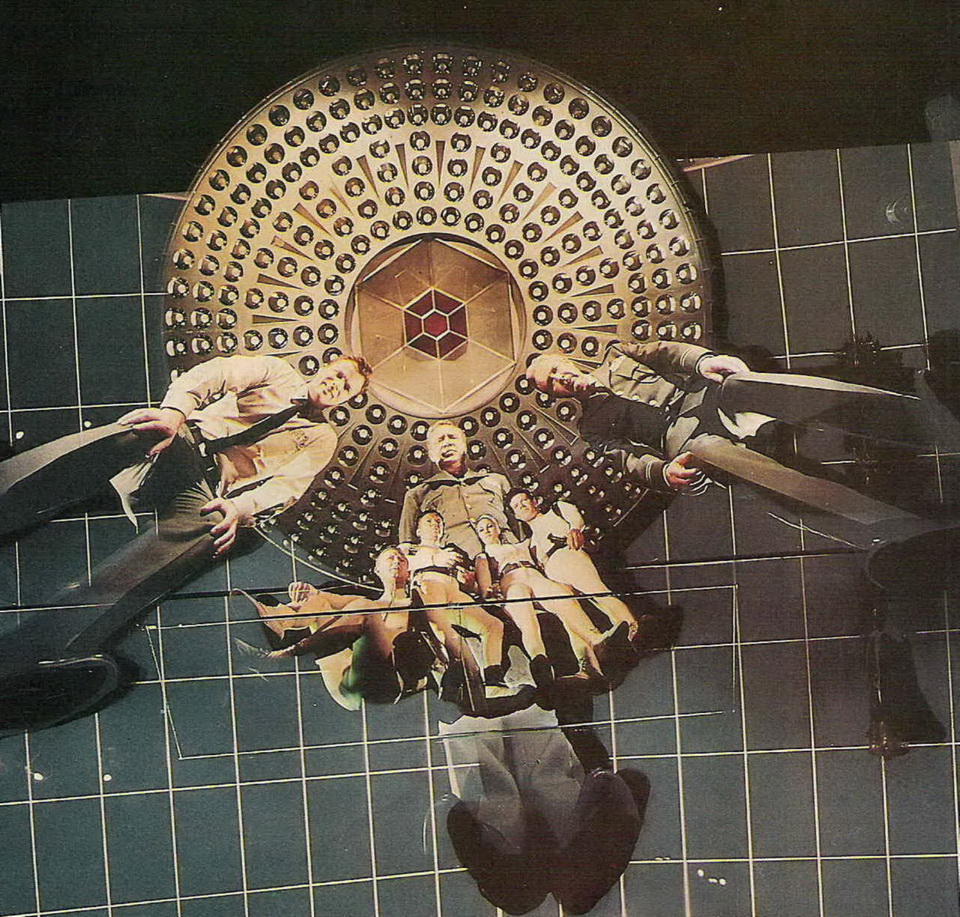
I've always admired and enjoyed Fantastic Voyage, but watching it again today, it is not difficult for the objective viewer to discern some of the film's more notable shortcomings.
All the characters are two-dimensional and deadly dull, their dialogue stiff and uninteresting. The film also wastes an inordinate amount of valuable screen time on military brass arguing amongst itself and barking orders at subordinates, who dutifully carry these technical instructions out in mission-control-style environs.
Most troublesome, it takes the movie nearly a full thirty minutes to get to the miniaturization process and the actual impossible mission, so the movie starts out at a snail's pace. The pace does pick up, but some won't have the patience to stick with the film.
Still, I would have to say that all of these drawbacks are largely immaterial, given the movie's strengths. The premise would have to be counted key among those. Movies often exist for the express purpose of revealing to us worlds and vistas we've never imagined or seen before. On that criteria alone, the wacky miniaturization plot of Fantastic Voyage succeeds magnificently. It's the doorway to a world of awesome visual delights and some great 1960s-era effects.
Some of the amazing and jaw-dropping sights you'll see in Fantastic Voyage include: a nuclear submarine submerging inside the choppy waters of a hypodermic needle; a roller coaster ride through that needle into human flesh; a passage through a school of globular red blood cells; a flight through a human heart; a close-up view of the oxygenation process, an exchange of gases that is one of the "miracles of the universe;" and even a rendering of a "blazing" single thought, as Benes' sparkling synapses fire all about the rocketing Proteus.
My two favorite images, however, occur late in the film. There's a terrifying moment wherein a white corpuscle descends on the dorsal dome of the Proteus, where Captain Michaels (Pleasence) has become trapped following a crash. The corpuscle crushes the glass of the dome, and proceeds to envelope Michaels' (screaming) head before our eyes. That fatal moment -- which Pleasence really sells -- has haunted me since I was a kid. Imagine being eaten, head-first, by a giant cell.
My two favorite images, however, occur late in the film. There's a terrifying moment wherein a white corpuscle descends on the dorsal dome of the Proteus, where Captain Michaels (Pleasence) has become trapped following a crash. The corpuscle crushes the glass of the dome, and proceeds to envelope Michaels' (screaming) head before our eyes. That fatal moment -- which Pleasence really sells -- has haunted me since I was a kid. Imagine being eaten, head-first, by a giant cell.

And secondly, I love the shot that finds the mission survivors swimming wildly in a single tear drop -- to them the size of a lake -- after evacuating the body through the corner of the eyeball. I remember I once owned the Fantastic Voyage comic-book too (long gone, alas...), and this image really resonated with me both in print and on screen. The kid in me has also nurtured a long fondness for that high-tech submarine, the Proteus ("quite a canoe," as one character describes it...). I always wished there had been a model kit of that ship in the 1970s.
As a dazzling visual travelogue into inner space, a journey into a contained universe all its own, Fantastic Voyage remains an involving cinematic experience. I also detect now a thematic leitmotif I missed as a kid: an early debate about intelligent design vs. evolution. Dr. Duval (the good guy...) sees the oxygenation process as a sure sign of a "Creator's" hand, while the godless communist agent, Michaels, views it as nothing more than evolution.
As you can guess, the movie falls philosophically on the side of intelligent design. Message: do not tamper in God's domain.
So Fantastic Voyage is a nostalgic favorite that features some imaginative sets and more than a handful of grand physical effects. It also generates a fair degree of tension in the final act, especially during the hair-raising "absolute silence" scene involving the journey through the inner ear. The film has been imitated on Doctor Who and satirized on The Simpsons, and has, in some sense, achieved pop culture immortality.
award-winning creator of the web series Abnormal Fixation (2024), the audio drama Enter the House Between (2023) and author of 35 books including Horror Films FAQ (2013), Horror Films of the 1990s (2011), Horror Films of the 1980s (2007), TV Year (2007), The Rock and Roll Film Encyclopedia (2007), Mercy in Her Eyes: The Films of Mira Nair (2006),, Best in Show: The Films of Christopher Guest and Company (2004), The Unseen Force: The Films of Sam Raimi (2004), An Askew View: The Films of Kevin Smith (2002), The Encyclopedia of Superheroes on Film & Television (2004), Exploring Space:1999 (1997), An Analytical Guide to TV's Battlestar Galactica (1998), Terror Television (2001), Space:1999 - The Forsaken (2003) and Horror Films of the 1970s (2002).
Friday, August 14, 2026
Abnormal Fixation wins Best Director (TV Episode/Pilot) at Tokyo Film and Screenplay Awards!
 award-winning creator of the web series Abnormal Fixation (2024), the audio drama Enter the House Between (2023) and author of 35 books including Horror Films FAQ (2013), Horror Films of the 1990s (2011), Horror Films of the 1980s (2007), TV Year (2007), The Rock and Roll Film Encyclopedia (2007), Mercy in Her Eyes: The Films of Mira Nair (2006),, Best in Show: The Films of Christopher Guest and Company (2004), The Unseen Force: The Films of Sam Raimi (2004), An Askew View: The Films of Kevin Smith (2002), The Encyclopedia of Superheroes on Film & Television (2004), Exploring Space:1999 (1997), An Analytical Guide to TV's Battlestar Galactica (1998), Terror Television (2001), Space:1999 - The Forsaken (2003) and Horror Films of the 1970s (2002).
Thursday, August 13, 2026
Abnormal Fixation Season Three Sneak Peek - Character Fireworks!
award-winning creator of the web series Abnormal Fixation (2024), the audio drama Enter the House Between (2023) and author of 35 books including Horror Films FAQ (2013), Horror Films of the 1990s (2011), Horror Films of the 1980s (2007), TV Year (2007), The Rock and Roll Film Encyclopedia (2007), Mercy in Her Eyes: The Films of Mira Nair (2006),, Best in Show: The Films of Christopher Guest and Company (2004), The Unseen Force: The Films of Sam Raimi (2004), An Askew View: The Films of Kevin Smith (2002), The Encyclopedia of Superheroes on Film & Television (2004), Exploring Space:1999 (1997), An Analytical Guide to TV's Battlestar Galactica (1998), Terror Television (2001), Space:1999 - The Forsaken (2003) and Horror Films of the 1970s (2002).
Saturday, August 08, 2026
Guest Post: "Teenage Sex and Death at Camp Miasma"

As Sondheim wrote, "Every Day a Little Death."
By Jonas Schwartz-Owen
Two worlds run through Jane Schoenbrun's Teenage Sex and Death at Camp Miasma, and the whole trick of the movie is watching them bleed into each other. World one: the present day, where Gillian Anderson and Hannah Einbinder play actual people. World two: Camp Miasma, a fictional 1980 slasher — a movie inside the movie — that Anderson's character starred in as a teenager. Schoenbrun shows us both. Then they collapse them.
Start with the fake franchise. Camp Miasma launched in 1980 and sequelized into oblivion: one in 3D, one at Christmas, one in Manhattan, one somehow in medieval times (or at the theme restaurant Medieval Times — the film enjoys the ambiguity). The rights-holders want the IP revived, but the series is blatantly homophobic, misogynistic, and transphobic, so they hire Kris (Einbinder), an up-and-coming queer filmmaker, to give it a modern edge. Kris decides the reboot needs its original final girl: Billy Presley (Anderson), a recluse who fled moviemaking as a teen and now lives at the real lakeside summer camp where the splatter films were shot. Something in that lake is hungry. Something miasmic gets into everyone.
That's the present-day thread. The 1980 film runs alongside it, and Schoenbrun signals which is which — until they stop.
Any suspicion that the David Lynch of it all is coincidental dies the moment Patrick Fischler, unforgettable in the opening scene of Lynch's Mulholland Drive, turns up inside the fake slasher as the harbinger, warning a slew of camp counselors that they're doomed. Every gag here is also a reference and also an existential tome on the unreality of reality.
Schoenbrun reassures us early that it's all tongue-in-cheek. The killer, a gender-fluid ghost named Little Death (as in the idiom for orgasms), wears an air conditioning vent as a mask, and it looks as silly as it sounds. Camp Miasma spoofs the genre while living in the same video store as Jason, Freddy, and Michael — competitor and parody at once. The homages come by the cornucopia: the spear through the lovemaking couple (à la Bay of Blood and its own ripoff, Friday the 13th Part 2), music suspiciously close to Charles Bernstein's A Nightmare on Elm Street score, a killer's weapon reflected in an eye in close-up (Argento's Opera).
The sly move is that the supposedly real world gets the same treatment. Schoenbrun shoots Kris and Billy's story through The Shining — days of the week stamped on screen, a snowbound resort, a creative type coming apart — so reality is skewed from the jump. If Camp Miasma is Friday the 13th, the outer world is a blood-drenched Oz (Lynch's Wild at Heart got there first). The natural world is unnatural; the fake film defies logic. By the end, characters with no business being anywhere near each other show up in the same frame for the slaughter, and the border between the two worlds is gone.
Einbinder and Anderson are extraordinary as women from different planets pulled into orbit. Einbinder's performance is weighted in reality; Anderson's heightened southern drawl, seductive movements, and slippery asides make her a 1940s femme fatale who wandered in. They tango to the death like the leads of Mulholland Drive.
Schoenbrun shoots the '80s footage on film stock, with the sleazy rhythms of the pre-studio slasher wave, then stitches the worlds together with rhyming images: the killer's vent becomes spiral paintings becomes a whirlpool opening at the bottom of the lake. Sometimes the mask reads as a movie camera. The 1980 cast is wiped out in a brisk five-minute massacre scored to Counting Crows' "A Long December" — a song from 1996, in a movie from 1980. The impossibility is the point. A song that cannot exist inside Camp Miasma plays over Camp Miasma anyway, and the seams of the fiction show without anyone onscreen noticing. The absurdity isn't a wink at us; it's the movie admitting it was never a movie from 1980 in the first place.
Because, Teenage Sex and Death at Camp Miasma, seems to be saying, none of us are really here. We all are in a movie for someone else's pleasure — the killer's, God's, take your pick. All the world's a stage, and we are merely players. Blood is orgasmic, flesh is fragile and penetrable, and what we do here doesn't mean a thing in the scope of the universe, at least according to this tasty but poisonous morsel of a movie.
Considerably heavier than Jason Takes Manhattan.
award-winning creator of the web series Abnormal Fixation (2024), the audio drama Enter the House Between (2023) and author of 35 books including Horror Films FAQ (2013), Horror Films of the 1990s (2011), Horror Films of the 1980s (2007), TV Year (2007), The Rock and Roll Film Encyclopedia (2007), Mercy in Her Eyes: The Films of Mira Nair (2006),, Best in Show: The Films of Christopher Guest and Company (2004), The Unseen Force: The Films of Sam Raimi (2004), An Askew View: The Films of Kevin Smith (2002), The Encyclopedia of Superheroes on Film & Television (2004), Exploring Space:1999 (1997), An Analytical Guide to TV's Battlestar Galactica (1998), Terror Television (2001), Space:1999 - The Forsaken (2003) and Horror Films of the 1970s (2002).
Friday, August 07, 2026
Sneak Preview of Abnormal Fixation Season Three: "The Spirit of '76"
award-winning creator of the web series Abnormal Fixation (2024), the audio drama Enter the House Between (2023) and author of 35 books including Horror Films FAQ (2013), Horror Films of the 1990s (2011), Horror Films of the 1980s (2007), TV Year (2007), The Rock and Roll Film Encyclopedia (2007), Mercy in Her Eyes: The Films of Mira Nair (2006),, Best in Show: The Films of Christopher Guest and Company (2004), The Unseen Force: The Films of Sam Raimi (2004), An Askew View: The Films of Kevin Smith (2002), The Encyclopedia of Superheroes on Film & Television (2004), Exploring Space:1999 (1997), An Analytical Guide to TV's Battlestar Galactica (1998), Terror Television (2001), Space:1999 - The Forsaken (2003) and Horror Films of the 1970s (2002).
Monday, August 03, 2026
Abnormal Fixation Wins "Best Editing" (Short Film) at Calgary Independent Film Festival!
 award-winning creator of the web series Abnormal Fixation (2024), the audio drama Enter the House Between (2023) and author of 35 books including Horror Films FAQ (2013), Horror Films of the 1990s (2011), Horror Films of the 1980s (2007), TV Year (2007), The Rock and Roll Film Encyclopedia (2007), Mercy in Her Eyes: The Films of Mira Nair (2006),, Best in Show: The Films of Christopher Guest and Company (2004), The Unseen Force: The Films of Sam Raimi (2004), An Askew View: The Films of Kevin Smith (2002), The Encyclopedia of Superheroes on Film & Television (2004), Exploring Space:1999 (1997), An Analytical Guide to TV's Battlestar Galactica (1998), Terror Television (2001), Space:1999 - The Forsaken (2003) and Horror Films of the 1970s (2002).
Saturday, August 01, 2026
40 Years Ago: Howard the Duck (1986)

In 1986, the comic-book adaptation Howard the Duck -- executive-produced by George Lucas -- landed in movie theaters with a splat.
The fantasy film cost thirty-seven million dollars to produce (some sources report a budget as high as 52 million, however…), and barely made back its budget.
Meanwhile, audiences and critics hated the film from director Willard Huyck and writer Gloria Katz.
So much so, in fact, that the words “Howard the Duck” became synonymous with the term “Hollywood movie fiasco” (at least until Waterworld came out, in 1995).
It shouldn’t have been that way.
Not because the 1986 movie is good.
It isn’t.
But because the source material, a Marvel Comic created by Steve Gerber in 1973, was beloved, inventive, and off-beat. In other words, Howard the Duck was the perfect fodder for cult-movie immortality in the age of non-conventional efforts such as Buckaroo Banzai (1984) or Big Trouble in Little China (1986).
Thus Howard the Duck may still not have found favor as a mainstream audience attraction had it been a good movie, but it would have likely found a secondary half-life as a beloved movie, at least from cine-philes and aficionados of the comic.
Instead -- as is so often the case in comic-book movie adaptations -- too much got lost in translation to the screen.
Howard the Duck’s deficits are much too easy to rattle off, today.
First and foremost, the film never decides on its audience. Is it a toothless slapstick comedy made for kids? If so, it is dull for long stretches of time, and not particularly amusing.
Is it an adult social satire with scatological humor and sexual situations? If not, the scene in which Beverly (Lea Thompson) extracts a duck condom from Howard’s wallet sticks out like a sore thumb.
Is the movie an adventure? A relationship drama? A fish-out-of-water story? A social commentary on human existence with a nihilistic bent?
Indeed, there are moments which qualify the film as all of the above. As Richard Corliss aptly reported, in Time Magazine, Howard the Duck is “too scuzzy to beguile children” and “too infantile” to appeal to their parents.
Even though Howard the Duck never finds a consistent tone and sticks with it, it might have succeeded had its central character not been such a letdown in terms of his portrayal. The cinematic Howard is earnest and mopey, and a far cry from the cynical, caustic, cigar-chomping character of the comic-books.
Worse, Howard -- as devised by the filmmakers -- is largely inexpressive. At the Chicago Tribune, Dave Kehr described the visualization of the title character and noted that “the disappointment is devastating.” He went on to call Howard “A small person…in a latex rubber suit pasted over with feathers.”
His observation is right on the money. There is no life to this version of Howard.
Memorably, the tag-line for the Howard the Duck comic was “Trapped in a world he never made!” The tag-line for the movie should have been, Trapped in a Movie That Doesn’t Know Who He is.
Howard the Duck’s greatest deficit, in the scheme of things, is that the film successfully making an alien, talking duck an utterly dull and uninteresting character. This Howard is a drag.

“No More Mr. Nice Duck.”
A highly intelligent duck, Howard, from Duck World, is unexpectedly dragged from his distant planet to Earth, and Cleveland.
There, Howard befriends rock-and-roller Beverly Switzler (Lea Thompson) from the band Cherry Bomb, and hopes to find a way home.
He learns from Beverly’s friend Phil Blumbert (Tim Robbins) that a scientist, Dr. Jenning (Jeffrey Jones) was conducting an experiment the night he was transported, involving a giant laser and a process of “energy inversion.”
Howard hopes that by repeating the experiment, he will be able to return to Duck World. Instead, Dr. Jenning accidentally pulls something monstrous from the Nexus of Sominus: A Dark Overlord of the Universe. This monstrous creature inhabits Jenning’s body and wants to use the laser to bring more of his people to Earth.
When Beverly is captured by the Dark Overlord, Howard must make a choice. He can rescue Beverly and save the world, but by destroying the laser, he will be trapped on Earth permanently.

“You think I might find happiness in the animal kingdom?”
In his comic-book form, Howard the Duck was born one “hard-boiled egg,” to quote a funny line in the movie. He was an attitudinal, cynical duck who, based on his very appearance, seemed to be a twisted version of cartoon ducks throughout animation history. More than that, the comic-book version of Howard functioned as the ultimate outsider, able to comment sensibly on human beings (“talking apes” in Howard’s parlance) without, necessarily, sympathy or affection.
His cinematic counterpart, by comparison, has no edge whatsoever. Howard is voiced by Chip Zien, and whether it is a flaw in his characterization or in the writing of the character, he comes across as woefully milquetoast.
Almost none of his jokes stick the landing land, and that fact, coupled with the underwhelming visual presentation of the character, gives Howard all the charm and charisma of a wet blanket. Total Film, in 2009, latched onto the problem: “…he’s portrayed as a sweet innocent with gooey eyes and a squeaky voice (which manages to neuter the vitriol in even the more sassy lines.)”
I would argue that Howard the Duck exists for the vitriol. Take it away, and he has no purpose, and no reason to exist.
It’s clear that there’s a schizophrenic quality to Howard and his film. At times he is supposed to be a lost, cute creature (think: E.T. The Extra Terrestrial [1982]) and at other times he is supposed to be an adult, agent provocateur (think of his relationship with a human woman). It’s bewildering that the script never decides how it feels about Howard, or, finally, even the specifics of Howard’s identity. Is he an adult? An avatar for a child? A sex object?
I suppose Howard the Duck has gotten a bit of a bum rap in terms of its visualizations. The special effects are of their time, the mid-1980s, but nonetheless quite good. The set-piece involving the Dark Overlord and Howard in a diner is probably the film’s best, at least in terms of pacing, effects and impact.


And Jeffrey Jones certainly makes the most of his villainous character, mining every possible moment for twisted humor. I also admire the stop-motion Dark Overlords that appear in the climax. They are absurd, Lovecraftian beasts that feel like they belong in the same world as Howard of the comics.
Sometimes, when a film goes so far astray, it’s difficult to enumerate all the misfires. I suppose one more criticism here, and hopefully a pertinent one is that the film mistakes pace, or velocity, for humor. The film is frenetic and fast-paced, and everybody always seems to be running and screaming from location-to-location, set-piece to set-piece.
To stand still, I suppose, would be to acknowledge that the film has no idea of its center. Howard the Duck is thus loud, but rarely funny; save for those moments when the Dark Overlord is on-screen and making mischief.


“Every duck has his limits,” according to Howard, and I guess that goes for movie critics too. I am always up for a re-evaluation of a critically-disdained cult movie, or a rehabilitation, even, of its reputation, if one is merited.
But Howard the Duck is sidelined by a colorless script, an eminently forgettable title character, a lack of bite, and even a lack of laughs. This is a movie that has no idea what it wants to be. One minute, it’s E.T. The next it wants to be Ghostbusters. In the shuffle to find material to ape, Howard the Duck misses the comic book characters anarchic spirit.
Poor Howard, he’s right about something in this movie. At least so far as this film is concerned, nobody laughs at the master of Quack Fu.
award-winning creator of the web series Abnormal Fixation (2024), the audio drama Enter the House Between (2023) and author of 35 books including Horror Films FAQ (2013), Horror Films of the 1990s (2011), Horror Films of the 1980s (2007), TV Year (2007), The Rock and Roll Film Encyclopedia (2007), Mercy in Her Eyes: The Films of Mira Nair (2006),, Best in Show: The Films of Christopher Guest and Company (2004), The Unseen Force: The Films of Sam Raimi (2004), An Askew View: The Films of Kevin Smith (2002), The Encyclopedia of Superheroes on Film & Television (2004), Exploring Space:1999 (1997), An Analytical Guide to TV's Battlestar Galactica (1998), Terror Television (2001), Space:1999 - The Forsaken (2003) and Horror Films of the 1970s (2002).
Subscribe to:
Posts (Atom)

-
 It is an indisputable fact that fan service and good drama don’t always go hand-in-hand in the cinema. In fact, sometimes these factors div...
 -
 It is quite difficult to believe, but in 2024, Ridley Scott’s Alien (1979) turns 45 years old. Perhaps the most amazing thing about Alie...