Showing posts with label 40 Years Ago Today. Show all posts

Saturday, December 07, 2024

40 Years Ago: 2010: The Year We Make Contact (1984)


Stanley Kubrick’s 2001: A Space Odyssey is absolutely, indisputably a one-of-a-kind movie. It is a cinematic masterpiece, and more than that, one of the greatest films ever produced.   

So the simple and apparent fact that must be acknowledged and embraced regarding the Peter Hyams sequel -- 1984’s 2010: The Year We Make Contact -- is that it is not in the same class. 

Kubrick’s film was part science fiction, part art film, and part “ultimate trip” head movie, and 2010’s ambitions are, well, if not smaller, then at least a great deal more direct. 

When approaching 2010, one must, therefore, dispense with the perhaps-unreasonable expectation that the enterprise is going to rival, or even near the majesty and awe of its 1968 predecessor. 

Because a funny thing might happen once you jettison those personal expectations (or, perhaps, your memories of 2001). 

Another truth looms ever more apparent. 

2010: The Year We Make Contact is still a good science fiction film, though of a markedly different style.  

Where 2001: A Space Odyssey took man to the precipice of his own future, and to the next step of his very evolution, the sequel is very much about who man is “now” (in 1984, essentially).

Where 2001: A Space Odyssey offered a commentary on how man’s tools could overwhelm his life, and his environs (remember the white-on-white minimalism of the production design) 2010 instead reveals man grappling with his still-human nature: the propensity to fear that which he doesn’t understand, and to go to war over territory or ideology.

2001 paid some attention to that idea, certainly. One scene in the space station lounge saw Heywood Floyd meet some Soviet scientists, and they questioned him about all the secrecy on Clavius. The scene hinted at on-going rivalries and distrust between Super Powers.

Similarly, the orbiting nuclear platforms depicted in A Space Odyssey suggested that war and hostility had survived and endured to the 21st century. Man’s competitive nature -- apparent from the moment the ape-man tossed a bone-weapon into the air at the dawn of the species -- was thus seen as unchanged.

Yet in Kubrick’s film that idea was merely a note in a great and elaborate symphony.

In Hyams’ 2010, by contrast, that note underlines and dominates the entire composition. It does so in faithful, earnest adaptation of Clarke’s 1982 literary source material, as well as in a brutally honest reckoning with the political details of the early 1980s.

In many ways, 2010 is thus the “hot” to 2001’“cold.”  

The snow-blind whites, minimalism  and yet majesty of the space station and other settings in 2001 have been replaced, largely, in 2010 by cluttered, smoky control rooms bathed in suffusing red alert lighting.  


And the sequel’s characters -- instead of showcasing smooth, emotionless efficiency as Frank Poole or David Bowman did -- experience outbreaks of panic, fear, homesickness, and even…humor.

If Kubrick’s film took a big step back from the characters and attempted to observe the long arc of man’s development with a sense of cerebral detachment, Hyams’ film instead examines man at this juncture with passionate, colorful, up-close strokes.

When considered in such terms, 2010: The Year We Make Contact might be viewed as a pretty strong and, yes, wholly valid complement to Kubrick’s film. It is both a faithful continuation of the franchise’s overall narrative, and at the same time an apparent commentary on the visionary world envisioned by Kubrick.  

It’s almost as if this sequel applies the brakes -- the aerobrakes? -- in response to 2001’s flights of imagination and futurism.  

It says, instead,  Hold on!  We’re not quite there yet.  

The famous black Monolith may have judged Bowman ready to evolve into a star child, but for now, the rest of humanity remains mired in conflict and self-destructive impulses.

Absent entirely in 2010: The Year We Make Contact is Kubrick’s sense of “order in the universe,” the amazing compositions which suggest a God’s eye view of the cosmos. 

Missing as well is the feeling that we humans are part of a long, ongoing process of development, moving from our “dawn” to “the infinite and beyond.”  

The sequel substitutes such awesome visions and ideas with a direct, teletype-style message to mankind (from the aliens…), transcribed by HAL.  “All these worlds are yours except Europa. Attempt no landing there. Use them together. Use them in peace.”

In 1984 -- soon after The Day After (1983) aired on television, and at the height of East-West Cold War tensions -- the Klaatu-esque message of this film really resonated, at least with my teenage self. It was less “grand,” perhaps, “less cosmic” than Kubrick’s intellectual musings, but perhaps 2010’s direct approach was the very thing that audiences needed to hear at that moment in history.

Bluntly worded, 2010 tells its audience this: you can’t evolve and be “a star child” until you grow the fuck up.  

The astronauts of the film -- men and women from the United States and the Soviet Union -- are at the vanguard of that growth, and become the very symbols for man’s ability to, even in dire circumstances, to evolve beyond basic tribal instincts.

So if 2001 concerns what man will one day become, 2010 suggests how he needs to get there, through the end of war and petty conflict.


“My God, it’s full of stars.”

Nine long years after Discovery One went silent near Jupiter, and Dave Bowman (Keir Dullea) was lost approaching the strange, alien monolith, the Cold War on Earth has grown hot.  

The Soviet Union and the United States of America tussle over the resources and loyalty of the Third World.  A problem in Central America, in Honduras, grows ever worse, and the United States threatens a naval blockade.

Meanwhile, Dr. Heywood Floyd (Roy Scheider) is asked to spearhead a mission to Jupiter, to re-activate the HAL 9000,  nd then determine the nature of the mysterious Monolith.  

Unfortunately, the Russians will beat the Americans to the derelict Discovery One, so an accommodation --- a joint mission -- is broached by the competitors.

Floyd and an American team consisting of computer expert Dr. Chandra (Bob Balaban), and Discovery One designer Walter Curnow (John Lithgow) thus board the Russian craft, Leonov, under the command of Captain Tanya Kirbuk (Helen Mirren) for the journey.  In turn, they will share their findings about the Monolith.

Leonov begins its long space journey, and takes a detour to Europa, where chlorophyll -- an early sign of life -- has been detected.  A probe is sent to examine the surface of Europa, but is destroyed by an unknown force.

Later, the Leonov conducts a difficult aero-braking maneuver on approach to the Discovery, and Dr. Chandra revives HAL. 

Meanwhile, on Earth, an entity resembling Dave Bowman begins to appear to the astronaut’s surviving family members.  He tells them that something wonderful is going to happen, and soon.

Tensions on Earth grow exponentially worse, and at the same time, HAL warns the crews of the Leonov and Discovery One that this area of space is becoming dangerous because of a strange “storm” of Monoliths in the atmosphere of Jupiter.

With the storm expanding, and the outcome unknown, the two space crews must put their ideology and suspicion behind them to survive and escape this region of space.


“We should each be treated with appropriate respect.”

2001: A Space Odyssey raised many questions about the universe, mankind’s evolution, and even the reasons why the HAL 9000 went berserk. 

2010: The Year We Make Contact makes no bones about the fact that it is in the business of providing answers. 

For instance, early in the film it is established that the final reports regarding Discovery One and the Jupiter Mission failure left its readers with “a good amount of questions.”  Just like some members of the audience for 2001. Later, Floyd reveals, in voice-over, very detailed information about the Monolith “controlling” everything in nearby space. He seems to know a lot about it.

If the sequel boasts any substantial flaw it is that it feels both conceived and executed to satisfy those who were unsatisfied by 2001: A Space Odyssey. Accordingly, the answers just keep on coming.

And yet, if you were unsatisfied by 2001, you didn’t really get the movie, did you?


Leaving that issue aside 2010 takes great artistic pains to “ground” all the proceedings in terms that its audience would easily comprehend. For example, Floyd feels guilt and remorse about sending the Discovery One crew people to die, and so this Leonov mission is explicitly one about his redemption. 

This won’t bring those men back,” or provide “absolution” suggests Heywood’s wife.  

And again, one need only note that in 2001, we had no such insight into Mr. Floyd, or his motivations. He was not humanized in such fashion.

Other characters are similarly endowed with traits that ground them, or make them more recognizably human and contemporary. Chandra is prideful at times, and Curnow undergoes a bit of fear or agoraphobia on a harrowing spacewalk. During the tense aero-breaking scene, Floyd and an attractive Russian astronaut clutch one another, out of abject fear.

Even when Dave was locked out of the Pod Bay of the Discovery in 2001, he evidenced no such outward signs of fear.

Indeed, the film’s entire approach to character is best exemplified by Curnow’s line that he misses the color “green.”  

Was there any green (outside the Dawn of Man segment) in 2001?  Was there any explicit longing for it?

What 2010: The Year We Make Contact wants to suggest, then, is that although man may erect a white-on-white future, he’s not going to like it, and he’s still going to long for the “green” of terrestrial Earth.  He’s still going to be “man" as we recognize him now.

HAL is newly humanized as well in this sequel. We learn that he is, essentially, schizophrenic, because of the contradictory orders he received from home base. Instead of acting as a ruthless, cunning opponent, he becomes here a figure of sympathy, one who even asks if he will “dream” when Discovery One is destroyed.


Finally, the ghost of David Bowman indulges in behavior that we would consider extremely human and emotional too. He visits his relatives on Earth. He combs his elderly mother’s hair.

Again, this kind of material is absolutely absent from 2001: A Space Odyssey, where even a vid-phone call between father and child feels strangely distant and unemotional. But 2010 is a different film. 

This film’s modus operandi -- also evidenced in the desire to create thrilling space action scenes like the space walk or the aero-braking --  is to showcase the yin/yang of human emotions or passions. 

The environs of the Leonov, the new ship created for the sequel, likewise showcase this aesthetic. The ship’s control room is always either under-lit and dark, or bathed in red light. Papers are scattered everywhere, on panels and tables. The visual aesthetic is much more Ridley Scott’s Alien (1979) than it is Stanley Kubrick’s 2001. And again, that’s because the film wants to present a realistic portrayal of emotional, contemporary man in space.  

Why? Well, the film examines man at close-up range. He can be wonderful and good, seeking absolution, longing for nature's "green," or acknowledging his fears. Or he can bring the world to the precipice of nuclear Armageddon.  

And again, I feel it incumbent to note as well the apocalypse mentality of the country in the first Reagan presidency, which forms the cultural context behind this sequel. This was a time when in public forums Russia was derided as “The Evil Empire,” and it was announced (as a joke) that bombing Russia would begin in "five minutes." It was an era in which cabinet appointees like Secretary of the Interior James Watts declared it was not really necessary to take care of the planet's environment because Jesus Christ would return in his lifetime, and this would be the last generation. These words are not my opinion of what happened, they are historical record, and therefore not partisan or biased. These things were said in public, and heard in the public square, by children and adults alike. They were noted.


2010: The Year We Make Contact is very much about that context (as well as the Falklands Island War…), an environment of distrust and concern about nuclear war in which it becomes impossible to visualize your “enemy” as another human being, but rather as a godless monster that must be destroyed.  

The message is made plain in the film terms of the astronauts’ behavior, and their cooperative solution for survival.  

To endure a disaster near Jupiter, two ships and two crews must literally become one.  

The Russian Leonov and the American Discovery One must join together and pool resources -- literally as one ship -- to see a new sunrise.  This is the Monolith’s lesson for the entirety of Earth as well. The two rival super-powers --  if they hope to claim their stake in space -- must become one. They must treat each other “with appropriate respect” and recognize their enemy’s common humanity.

The aliens final message in the film is very on the nose.  “Use these worlds together. Use them in peace.”  

If humans do not do so, the implication is that the Monolith aliens will respond accordingly. The events on Europa with the destroyed probe reveal that these aliens will brook no interference with their agenda. Again, this seems highly reminiscent, at least to me, of The Day The Earth Stood Still (1951), and its alien ultimatum. 

“Join us and live in peace, or pursue your present course and face obliteration.”

2001: A Space Odyssey doesn’t transmit an easily-digestible message like that, which can be stated in a few simple words, and 2010: The Year We Make Contact does.  The two films stand in stark contrast because of that difference. 2001 coolly asks its audience to interpret its message, and 2010 states its message, rather bluntly and emotionally, and with some degree of heat and excitement.

In general, I prefer Kubrick’s approach, but there are times when the 2010 approach becomes a necessity too…especially if you are the parent of a misbehaving child.  

As such a parent figure (as the Monolith aliens may be to humanity), it is necessary at times to make certain you are heard and clearly understood

The message in 2010 is indeed clearly heard and understood. That fact doesn’t make the movie “bad.”  It just makes the film a very different kind of space opera from its predecessor.  


Beautifully mounted, and buttressed with splendid recreations of the Discovery One, and some tense moments in space, 2010 is a worthwhile film, and a solid sequel to one of the cinema’s all-time greats.  We can remember it that way, in part, because it sought not to imitate a great film, but to chart its own (if ultimately less challenging..) territory.

Another way to put it. We may not give 2010 equal respect to 2001, but let us all treat it with "appropriate" respect nonetheless, especially on its 40th anniversary.

Saturday, November 16, 2024

40 Years Ago: A Nightmare on Elm Street (1984)


As difficult as it is to believe, 2024 marks the 40th anniversary of Wes Craven’s A Nightmare on Elm Street (1984), the horror film that introduced the world to dream monster Freddy Krueger (Robert Englund).  

Historically-speaking, A Nightmare on Elm Street is significant not merely for commencing a franchise that came to include five direct theatrical sequels, but a two-season TV anthology, Freddy’s Nightmares (1988 – 1990), a nifty re-imagination in Wes Craven’s New Nightmare (1994), a cross-over, Freddy vs. Jason (2004) and a misguided re-boot in 2010.  

The Freddy series put New Line Studios -- “The House That Freddy Built” -- on the map, as well.

In a broader genre context, A Nightmare on Elm Street was the rubber-reality venture that ended the long reign of the naturalistic slasher films of the early 1980s; films with titles such as Happy Birthday to Me (1981) or My Bloody Valentine (1981). 

Those older films eschewed supernatural horrors, and focused on mad-dog killers (usually in masks) who killed teenagers with very sharp implements. The killers were largely silent killing machines, without much by way of personality.

The slashers’ episodic nature remained intact in A Nightmare on Elm Street’s modified “rubber reality” format, but in general, rubber reality tales (like Hellraiser [1987], for instance) were buttressed by more imaginative special effects, and supernatural, loquacious monsters.

Eventually, even the ultra-naturalistic Friday the 13th film series moved towards more rubber-reality-type fare because of Freddy’s re-direction of the genre.

In just a few short years, then, Freddy Krueger became the king of American horror films, and a pop culture sensation. The modern, 21st century horror film has moved back towards a more naturalistic setting and tone, in large part due to the success of the found-footage sub-genre, and so Freddy today seems like a character who perfectly captures his particular era: the 1980s.

The relative quality of A Nightmare on Elm Street’s sequels has been debated up and down, again and again, even in the Wes Craven movie Scream (1996), but the original film remains a powerhouse of terror, even thirty years later. The 1984 film has lost none of its atmosphere of mounting, pervasive dread, and Craven’s imaginative style and content continues to impress. 

The film’s artistic success is based on a few crucial factors.  

As Sharon Packer writes in Movies and the Modern Psyche (page 49), A Nightmare on Elm Street is “intriguing because of its ability to blend the supernatural with psychoanalytic subtexts.”  

In Visions of the Night: Dreams, Religion and Psychology, Kelly Bulkeley argues that Craven’s effort generates it “narrative power by tapping into people’s common dream experiences, in this case, the experience of recurring nightmares.”

These observations about A Nightmare on Elm Street seem right on target, and yet for this critic, the film always resonates because it globally applies its surface vs. reality conceit.  

In other words, A Nightmare on Elm Street concerns both the appearance of reality, and the true reality that dwells or roils underneath that (false) appearance.  

Virtually every aspect of the cinematic tale can be studied utilizing this particular bailiwick. Impressively, A Nightmare on Elm Street even finds a literary precedent for this conceit, and frequently references the works of Shakespeare, mostly Hamlet, but also Julius Caesar.

In addition to this thematic virtue, A Nightmare on Elm Street remains a turning-point in horror history, I submit, because the “final girl” archetype, -- here represented by Heather Langenkamp’s Nancy Thompson -- finally blossoms to full maturity.  

Although Jamie Lee Curtis’s Laurie Strode survived her experience with boogeyman Michael Myers in Halloween (1978), Nancy’s battle with Freddy in Nightmare is determinedly different.


At some point in the crisis, Nancy takes control and responsibility for her life and her struggle, and defeats Krueger on his own terms. Nancy does so using her insight, resourcefulness, and planning…not just by a lucky turn of fate.  

This fact is perfectly dramatized when one contrasts the “High School English Class” scenes featured in the Carpenter and Craven films.  The former is about fate, and the way that fate determines action and destiny.  

The latter is about a hero (Hamlet) digging for and excavating the truth against great odds and entrenched power. 

One scene is about surviving by circumstance, the other is about actively participating and re-shaping your own future.  Nancy is a hero, then, who takes responsibility for her survival in an affirming, powerful fashion.


“Nancy, you dreamed about the same creep I did…”

A high school student, Tina (Amanda Wyss) becomes obsessed with a recurring dream.  At night -- every night -- she dreams of a stalker in a fedora and red-and-green-sweater.  He is armed with a razor-tipped glove.

Tina discovers that her best friend, Nancy (Langenkamp) is experiencing the same nightmare, about the same boogeyman, and holds a sleep-over at her home when her mother goes out of town.  

Also at the sleep-over are Nancy’s boyfriend Glen (Johnny Depp), and Tina’s juvenile delinquent beau, Rod Lane (Nick Corri).  When all the teens are asleep, the nightmare man strikes Tina and kills her brutally in her dream.

Rod is arrested for the murder of Tina by Nancy’s father, Detective Thompson (John Saxon), but Nancy is convinced that he is innocent, and that the dream stalker is “real,” and responsible for the crime. 

Nancy presses her alcoholic mother, Marge (Ronee Blakeley) for details.  She learns that some years earlier, the parents of Elm Street hunted and down and killed a man, Fred Krueger (Englund), who was a child murderer but escaped justice on a legal technicality.  The Thompsons and the other parents burned him alive, but kept his hat and finger knives in Nancy’s house -- in the furnace -- as a kind of trophy.

The murders on Elm Street continue, and Nancy realizes she must take affirmative steps to defeat Krueger and stop his plans to kill her.  

But should Nancy proceed as her boyfriend, Glen, suggests -- and which goes against her nature of “digging” and confronting the truth -- and turn her back on Freddy…thus robbing him of the energy she gave him?


“I’m into survival.”

In blunt terms, A Nightmare on Elm Street concerns the surface, and the underneath or “truth” that co-exists with that surface.  

Many aspects of this Craven film visit and explore this duality, or double nature.  

We detect this duality in terms of location, both with the suburban high school that seems normal, and the sinister boiler room underneath it, where Freddy rules. Many of the film's most terrifying scenes are set in dark labyrinth, or maze-like basements, a connective tissue between the surface above and the truth below.


We see the same duality in the real world, where people are presumed safe and protected by the rules of consensus reality, and the dream world, where there is mortal danger.  You die in your dream, you die in real life.

We see the duality in the Elm Street parents, who profess propriety and adherence to law and order, but who are, in fact, murderers. 

We even see it in regards to morality.  

Again, the Elm Street parents have crafted a world of apparent moral absolutism (where Christ on the cross protects teenage girls’ in their bedrooms…), but they actually practice moral relativism. For example, Lieutenant Thompson uses his own daughter, Nancy, as a pawn so as to achieve his goal of apprehending Rod Lane.  Similarly, Marge Thompson sees the murder of Freddy as the parents' "right" because the legal system failed to arrive at the conclusion they preferred.


Throughout A Nightmare on Elm Street, then, there exist two lines or tracks to keep abreast of simultaneously: reality as it appears to be true, and reality as it actually is. Craven's conceit here was extremely timely, and reflected something larger -- and disturbing -- happening in American 1980s culture.  

Specifically, America was experiencing, very much, the same duality on a national scale. The myth that was being peddled at the time by those in power (and which was preferable to hard reality…) was that it was possible to “have it all.”  

As the authors of Landslide: the Unmaking of the President (1984 – 1988) wrote of this time, the new (Reagan) administration said it was possible “to cut taxes, and increase defense spending and at the same time, fight terrorism, roll back Communism and the threat of nuclear war, all without risking American lives. Reagan seemed to be offering a miracle cure.”  (Houghton-Mifflin Company, 1988, page 11).

Again and again during this time, symbolism (or rhetoric) and reality clashed. The new Administration promised to reverse the growth of an out-of-control Federal government, but after two terms under its control, the Federal work force actually expanded by over 60,000 employees. The same administration promised tax cuts, but actually raised taxes three times: in 1983, 1984, and 1986.  

What is the price when actions don’t match words or symbolism? 

It’s fairly simple to calculate. From 1980 to 1988, America countenanced a staggering 2.7 trillion dollars in debt, roughly 200 billion dollars a year. 

Who was going to pay that debt? 

Future generations of course, and that’s precisely where the direct comparison to Freddy and his behavior comes into play.  

After all, Freddy is all about visiting the sins of the father upon the children.  He explicitly doesn’t go after the surviving parents of Elm Street (save for Marge in the finale…), but instead punishes those parents by taking their children away.  

A national debt of the egregious size we racked up in the 1980s was, similarly, a visitation of the sins of the fathers upon the children. It was the kids who would be faced with paying the piper.

Other epochs and other decades bring other bugaboos. A whole raft of horror films from the 1970s, including Dawn of the Dead (1979) seem born from Carter’s “Crisis of Confidence” malaise, for example, and 1950s horror films, in general, arise from fears about the 1940s detonation of atom bombs in Japan. So partisanship has nothing to do with it. Reaganomics is simply, in some sub-textual way, the basis for the sub-surface fears expressed in A Nightmare on Elm Street.

As a protagonist, Nancy Thompson fits perfectly into this discussion of reality vs. symbolism, or surface vs. reality, if you prefer. 

Like the Prince of Denmark, she digs and digs, uncovering lies and murder, until she gets to the truth behind all the death and corruption.  

She discovers that her parents are murderers, and worse, that they are okay with the fact that they took the law into their own hands.  Their protestations of righteousness are hollow-sounding lies.  And it is here, in reckoning with those lies, that Nancy realizes no one can help her.

The police are powerless to stop Freddy, because he operates in his own reality. 

Her parents are similarly helpless, because they are either alcoholic, are unwilling to listen to their child’s fears.  

And at a dream clinic, scientists also prove unable to help Nancy survive against the looming threat to her very survival.


So Nancy learns the hard-lesson in A Nightmare on Elm Street that the older folks aren’t going to help her.  The Establishment, as it stands, is unwilling and unable to confront the truth, and solve the problem in an effective fashion.  In a sense, her parents have already sold her and her friends out.  Their illegal behavior – their solution to the problem of Freddy -- has given Krueger license to hunt and murder their children. 

Nancy’s task is to see past the rhetoric and lies, and figure out a way in which she makes it forward. This task resonates not only with what was happening to the American economy in the eighties, but in terms of the Cold War as well. Nuclear War was never more than the push of a button away in this age, and the young generation wanted no part of it, and sought solace in what older generations called "death metal" and "dead teenager movies."

Again, the parents who brought the world to the brink of war might be viewed as culpable for creating that “demon,” while the younger generation, represented by Nancy, had to carry the burden of knowing that death -- apocalypse -- could come at any moment.  Freddy -- Craven's "bad father" -- is the avatar for all these generational fears; but particularly the fear that the world is fucked up, that it isn't your fault, and that, without doubt, the world is going to come and kill you.

What remains so fascinating about A Nightmare on Elm Street is Nancy’s predicament. Her mother notes: “You face things. That’s your nature…But sometimes you’ve got to turn away too.”  

What we are left with here, then, is a reckoning with the idea that society can’t continue -- that teenagers can’t grow up safely -- in the full light of reality, because it is too unpleasant. There are some things that are so horrifying that it is necessary to turn away from them.

But does turning away from them mean burying them? Does turning away mean medicating yourself to a state of numbness?  Some amount of denial may be desirable, healthy even, but first you must know what you are denying.  Nancy must learn when to dig for truth and when to turn away from the lies and corruption she finds.  So, in some weird and very eighties way, A Nightmare on Elm Street is about growing up, and finding your own way to navigate a messed-up world.

Again, this crisis speaks of a duality, doesn’t it? Do we face our demons, or turn our backs on them?  Perhaps because the world is so complex, both realities must be given their due...


All the sub-textual currency in A Nightmare on Elm Street makes the film pulsate with ideas and cultural fears, but what is actually seen on screen is…visceral.  

The death of Tina is one of the most horrifying and remarkable death scenes ever put to film (with Glen’s a close second, perhaps).  Tina’s death is violent, irrational, and based on the idea that a reality ignored is a reality that is dangerous, or deadly. 

An unseen assailant rips the beautiful teen apart, and razor cuts “happen” to her, because her parents have not been able to help her, or acknowledge the truth about the danger she faces.  Future Elm Street films boast far more elaborate death sequences, but for my money, Tina’s remains the most effective in the entire franchise.  Her murder galvanizes the senses. It terrifies. It goes so far beyond the pale -- and beyond rationality or Physics -- that viewers realize they have crossed over into a whole new world of terror.

A Nightmare on Elm Street succeeds as rubber-reality and as horror film because it brilliantly charts the overlap between real world and dream world in ways that are shocking, and yet simultaneously familiar to us. 

We've all had that terrible dream in which we are being chased, and our feet sink into the ground, delaying and jeopardizing our escape. Craven harnesses that universal image for a chase scene here, in which a staircase turns to goo under Nancy's feet, and Freddy looms nearer.

Another universal image of terror involves Freddy -- just an unformed shadow -- in a dark alley.  He is a menacing but vague boogeyman who suddenly grows even more menacing, as his arms stretch and stretch to inhuman proportion.  There's something very basic or primeval about this vision, of arms growing longer and longer to entrap their prey.  And because Freddy is silhouetted, we can pour all of our various fears into him. He can be a bad father, a child murderer, a supernatural entity, or all of the above.


As a reflection of timely national fears and universal "nightmares," A Nightmare on Elm Street still succeeds wildly today...much more so than its unfortunate remake.  The film also represents a milestone in terms of the horror genre's portrayal of women, and is highly effective in generating its terror.  

Long story short: forty years later A Nightmare on Elm Street is still bloody good.

Tuesday, October 29, 2024

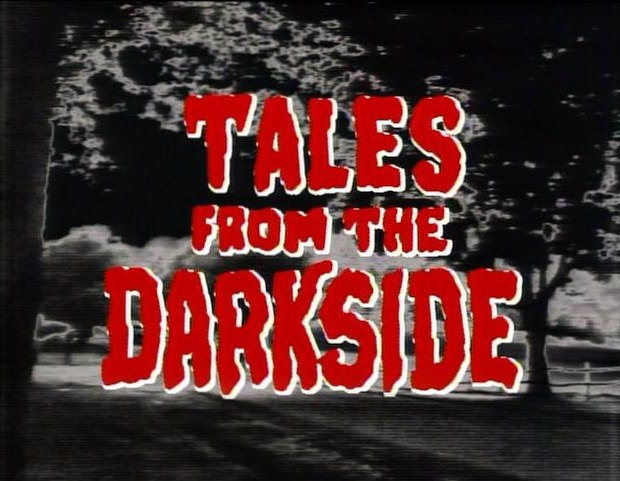
40 Years Ago: Tales from the Darkside (1984)


The low budget Laurel horror anthology, Tales from the Darkside, may be a relic from the 1980s, but it's one relic eminently worth excavating, especially around Halloween time.   

Like its brethren, Rod Serling's Night Gallery and The Twilight ZoneTales from the Darkside -- produced by George A. Romero, Richard Rubinstein and Jerry Golod -- remains a highly didactic horror television enterprise, one very concerned with  social commentary. 

As I wrote in Terror Television (1999): "if one looks beneath the veneer of gore and grue, it seems fairly clear that many episodes of this series" are "modern morality plays, cautionary tales about what might happen to an individual who acts selfishly or maliciously."

The Writer's Bible for Tales from the Darkside made this conceit explicit. "The Other World" or "Darkside" intervention featured in each 30-minute tale was a deliberate mechanism or tool by which the cosmic scales of justice could be balanced.  

And yes indeed, this notion is squarely rooted in the great and noble tradition of EC's Tales from The Crypt or Vault of Horror.

Exhibit A regarding this didactic aesthetic is the series' sterling premiere segment, "Trick or Treat" written by George Romero himself.   Although set in rural America in the 1940s, the program aired in the early Reagan years, and remains just as powerful a parable about greed in 2011 as it was during the time of its original broadcast. 

Directed adroitly and economically by Bob Balaban, "Trick or Treat" involves a nasty old miser, Mr. Hackles (Barnard Hughes) who "collects every penny" that is due him, and gives nothing back to the poor farmers in his community who support his business at a general store.  

And in point of fact, Hackles has even set himself up as a sort of local bank by offering the farmers ample credit when the chips are down.  With nowhere to turn, they accept his "kind" help, only to see him ruthlessly leverage control of their very lives.

Explicitly, the vulture-like Hackles views the people in his town as "backward" primitives, and notes that "people make their own misfortune."  Hackles also derides "the little people and their little lives."   Accordingly, on Halloween night, this "self-made" man doesn't give out candy.  Instead, he dispenses advice.  He tells young Trick or Treaters that "I made my fortune...and so should you."

In today's vernacular, then, old Mr. Hackles is clearly part of the 1 percent.

Each year on Halloween night, Mr. Hackles makes it his business (and pleasure...) to torment the so-called little people of his town.  In particular, he instructs the poor farmers to deliver to his house their children every October 31st.  There, they will be permitted to search the imposing home for his I.O.U.s.  If the children find them, their parents' debt will be completely absolved.  If not, the debt stands.  

Of course, in all the years Hackle has played this sadistic game, no child has ever found the stash of creditor's notes, in part because Hackle's arranges nightmarish "frights" for the children: booby traps and  monster effigies that scare the kids away.

Essentially, Mr. Hackles demands that the good citizens of his town literally turn their children into "debt slaves," becoming his play things for a night in the vain hope that one lucky family might get a reprieve from their bills.  

Again, this idea represents a metaphorical commentary on the nature of the American dream.   Studies have revealed that many low-income Americans don't want the rich to pay their fair share in taxes because they believe they too will one day be rich.  After all, they might just win the lottery, right?  And every Halloween night, Mr. Hackles organizes just such a lottery...but with no real winners.  It's hard to win a game in which one man (or one percent...) leverages all the power and holds all the cards.


In "Trick or Treat's" denouement, Mr. Hackles inevitably gets the tables turned on him.  This Halloween night, it is not children who show up to play his game...it is an array of ghouls, including a terrifying witch.  

One might say that these ghouls occupy his house, even...

In short order, these representatives from "The Other Side" play a little trick on Hackles: they cast his cash (and his prized I.O.U.s) to the four winds.  Hackles attempts in vain to retrieve his "belongings" and ends up chasing the almighty dollar right down the corridors of Hell.  

"You're getting warmer now.  Warmer..." a hideous devil informs Hackles as the miser goes at last to his just reward in the Lake of Fire.  Notably, Hackles feels treated unfairly by those who wield more power than he.

But Mr. Hackles...I thought we all made our own misfortune?  Aren't you a self-made man?

Produced on a budget of just $200,000, "Trick or Treat" dominated the 1983 Halloween weekend Nielsen ratings in major markets such as New York, thereby assuring that Tales from the Darkside would soon become a weekly series; a series that lasted for four years and eighty-nine episodes.  

Episodes such as "Trick or Treat" were generally the norm rather than the exception, and various series installments tackled issues of racism, "hate" radio and other topics from the national discourse of the day.   "Trick or Treat," of course, serves as a pretty explicit and ghoulish reminder (in the early Yuppie era, no less) that "upward mobility" should concern more than the bottom line on a bank account; that our final, eternal "upward mobility" might depend on our accumulation of other currency, namely decency, empathy and compassion.  

In other words, the episode conforms to that line from Matthew: "It is easier for a camel to pass through the eye of a needle, than for a rich man to enter into the kingdom of heaven." 

Trick or Treat...

Thursday, August 15, 2024

40 Years Ago: Dreamscape (1984)


Joseph Ruben’s Dreamscape (1984) is a science-fiction action movie that involves psychic researchers entering the dreams and nightmares of their patients and becoming “active participants” in them. 

The forty year old film shares some qualities in common with Douglas Trumball’s Brainstorm (1983), but is ultimately not as dazzling in terms of its special effects or imagination.  Perhaps more to the point, Dreamscape also features many plot-points -- including a man with finger-knives – that appear in Wes Craven’s masterpiece, A Nightmare on Elm Street (1984).

But where Brainstorm and A Nightmare on Elm Street approach their subject matters with a sense of gravitas and seriousness, Dreamscape often descends instead into silly action clichés, and features chase scenes (on motor bikes, no less…) instead of any consistently-applied leitmotif about the nature of the human subconscious, or the power of dreams.

These facts established, Dreamscape is very much a product of its turbulent time, and it expresses beautifully the “apocalypse mentality” of the 1980s Cold War Era.  

Lest we forget, this was the age of The Road Warrior (1982), War Games (1983), and The Day After (1983), when fears about nuclear Armageddon ran high in the nation.  Russia had invaded Afghanistan in early 1980, and President Reagan began his administration as a hard-line Hawk.  

Remember, President Reagan -- in addition to being a peacemaker with the Soviet Union in his second term -- was initially the fellow who joked on a live mic that he had outlawed Russia and that we would start bombing it in “five minutes.” He was also the leader who said that the Soviet Union was an “Evil Empire,” and that -- once launched from submarines -- nuclear missiles could be recalled.

Such statements, in conjunction with right-wing debates about “winnable” nuclear war, created an atmosphere of fear. When you coupled these comments with Secretary of the Interior James Watt’s comments that we were living in the “End Times”…things got really scary.


I grew up in the 1980s, lived through these times, and heard -- as a boy -- quite clearly the comments politicians were making about our planet’s future. I went to bed many a night in those years worrying about nuclear holocaust and wondering if I would live long enough to attend college, or get married. Dreamscape connects with such fears very well.

Today, we are all fortunate indeed that President Reagan underwent a re-think of his policies -- similar to the one the president of Dreamscape undergoes -- and became such a committed “warrior” for peace in his second term, going so far, even, as to walk-back his “Evil Empire” statement.

But the point is here is not politics, rather that this very 1980s apocalypse mentality context finds terrifying visualization in Dreamscape, and that the moments concerning nuclear war remain the film’s most powerful and resonant.  

Throughout Dreamscape, we see mushroom clouds, hideously-scarred children, and a burned-out crimson landscape function as symbols of man’s self-destructive ways.  At one point, a President who blames himself for nuclear war takes a train tour through the apocalyptic landscape, and spies the ruins of the capital building.

America -- that shining city on the hill -- is in ruins because two countries couldn’t see to get along, or to cooperate peacefully.

For all its goofy lightness and ho-hum concentration on action and romance, Dreamscape actually works best as a science fiction film when its phantasms grow darkest; when they deal bluntly with the national “dread” of nuclear war rather than the personal, subconscious fears of specific patients.  

Dreamscape could have been a great film about the biggest fear of an epoch. Instead, it’s just a mediocre film that never quite lives up to its incredible potential.


“Who’s your decorator? Darth Vader?”

The U.S. government recruits a small-time con artist and psychic, Alex Gardner (Dennis Quaid) to work at Thornhill College’s dream research center, located in the Bates Building.

Dr. Jane DeVries (Kate Capshaw) and Dr. Paul Novotny (Max Von Sydow) train Alex to psychically-link with dreaming patients, including a construction worker with a fear of heights and a boy, Buddy (Cory Yothers) suffering from nightmares of a snake man. Alex is successful in treating both patients, and helping them overcome their nocturnal fears.

At the same time, however, Alex’s success fosters resentment in another dream “traveler,” Tommy Ray Glatman (David Patrick Kelly). 

In addition to being psychic, Tommy is a murderer, a trait which comes in handy when shadowy government agent Bob Blair (Christopher Plummer) approaches him with a secret assignment.

Specifically, the President of the United States (Eddie Albert) has been suffering from dreams involving nuclear apocalypse, and Bob fears that he will give away America’s nuclear store at upcoming peace talks with the Soviet Union.  

To prevent this eventuality, Bob orders Tommy Ray to enter the Commander-in-Chief’s dreams…and assassinate him.  To the rest of the world, it will appear that the President simply died of a heart attack in his sleep.

Alex learns the truth about Bob’s plans, however, and -- without the aid of instrumentation -- also enters the President’s dream to confront Tommy.


“He’s going to emasculate our nuclear deterrent...” 

Although decidedly not a great film, Dreamscape perhaps deserves a little credit for two things.

First, it expresses perfectly the “apocalypse mentality” of its time, as noted above. 

The president’s recurring dreams of apocalypse are strongly-visualized by Ruben.  The film opens with them, in fact, as the President’s (deceased) First Lady attempts -- and fails -- to outrun a nuclear mushroom and shock wave.


Later, the President (in another nightmare) tours the post-apocalyptic landscape in an ornate train car, and he gazes out across the barren, blood-red landscape. Out on the ruined land, we see the Capitol building, and the Lincoln Memorial.

Importantly, this vision of the President on a train, observing the land, calls to mind the American tradition of presidential whistle-stop tours.  Only here, a leader surveys not a beautiful land of plenty and a happy populace, but a ruined land of death and desolation.


Another dream finds the President confronted by horribly burned and scarred children, and that’s a potent image, as well.  In any war, children are always innocent victims.  They have no control over the policies of the government, or even the policies of their parents.  Here, the children have their innocence -- and their future -- taken away from them in grisly, visceral terms.  This is the true obscenity of nuclear war. Millions of children will die in such an event simply because two countries can’t accept that they have different philosophies about economics

Yet another nuclear vision is powerfully wrought in Dreamscape: Alex and the President end up in a subway car of scarred survivors, and that packed, modern car contrasts perfectly with the ornate old-fashioned presidential train.  

It’s as if this old, set-in-his-ways President cannot quite think in modern terms, and so out of misguided notions of patriotism and peace through strength, he leads the contemporary nation -- a nation of subways and commuters, not romantic whistle-stops -- into ruin.


Secondly, it should be noted that Dreamscape actually predicts real-life world events to a large degree.

On the latter front, Eddie Albert makes for a very Reagan-esque president a gentle-seeming, avuncular older man. 

His terrifying dreams of nuclear annihilation lead him to re-think his policy about the Cold War, and he plans to negotiate with the Russians at an upcoming summit in Geneva.  But by doing so, the President provokes an insurrection or rebellion on his right flank. Hawks in his administration, including Blair, are afraid he will give up the nuclear store and simply “appease” the Russians.

This is almost precisely what happened in real life, in 1985. 

First, President Reagan experiences his conversion about nuclear war. But that conversion arose not from personal dreams or nightmares, but rather from a viewing of The Day After, allegedly. 

When Reagan softened his hardline stance regarding the Soviet Union, in anticipation of – again -- a Geneva Summit, members of his administration rebelled. 

Secretary of Defense Caspar Weinberger, for instance, wrote a letter to the Washington Post urging President Reagan not to give up any bargaining chips, and not to appease Gorbachev in any way. The letter was made available to the press on November 16, 1985.

Fortunately, no one attempted to assassinate President Reagan as he transitioned from “cold warrior” to crusader against nuclear war. 

Once more this is the journey Albert’s president takes in Dreamscape.

There’s one another effective scene in Dreamscape worth discussing, though it is off the subject of the 1980s apocalypse mentality. 

Alex journeys inside Buddy’s dreamscape, and encounters a world straight out of German Expressionism, at least if we take the angles and compositions into effect.  In this world of cockeyed, jarring angles, Buddy asks his father to save him from the Snake Man, but the father is out to lunch, and can’t -- or won’t – help him. So Alex runs with him, and they descend through what looks like infinity itself, on a suspension staircase surrounded by blackness.

Despite some bad stop-motion photography involving the Snake Man, this night terrors scene is effective because it speaks legitimately in the language of nightmares. In our nightmares, we are all children in a sense -- alone and vulnerable -- and our imaginations run wild, unfettered.  

Between the expressionist angles, the snake man, and the dizzying descent, down and down, Dreamscape effectively visualizes this idea, as well as the notion of parents who somehow can’t help us. 

In dreams, we’re always on our own…unless Alex Gardner shows up. 


Given such successes, it’s a shame that Dreamscape isn’t a better film.  All the material involving Alex getting pursued at the race-track by small-time hoods is a waste of time, and even the romantic angle with lovely Kate Capshaw seems to diminish the film. For the most part, the film feels light and inconsequential, rather than searing or sharp. Except for the moments in Buddy’s nightmare, or on the President’s post-nuclear landscape, Dreamscape feels jokey and kind of dim-witted.

I should preface my next remarks by stating that I have no idea how this occurred, but Dreamscape also ends up aping, relentlessly, A Nightmare on Elm Street

Dreamscape was released first, but Craven’s script made the rounds in Hollywood well before either film was made. Spontaneous creation does happen occasionally in Hollywood, but there is certainly something fishy about the narrative overlap between films.

Both efforts, for instance, feature scenes set at dream clinics, where scientists discuss the nature of REM sleep and dreams. 

Both films find the opportunity to discuss the Malaysian Dream People.

And it’s impossible not to notice that Tommy Ray sprouts finger-knives at one point, or that the Snake-Man battles Alex in what looks like a hellish boiler room…Freddy’s digs.

Again, I cannot and would not assert rip-off or plagiarism without further knowledge of the facts. But I will state this: All the moments of similarity carry less psychic weight and impact in Dreamscape.

In other words, the moments discussing the Dream People or REM sleep feel casually dropped into Dreamscape, as if to give it a veneer of respectability or legitimacy, whereas in A Nightmare on Elm Street, all those elements tie together brilliantly with other aspects of the story.  

For instance, in the Craven film the Malaysian Dream People are discussed because they turn their backs on Evil, and that’s the very thing that Nancy (Heather Langenkamp) -- ever the digger (hence the film’s comparison to Hamlet) -- has trouble doing.

Accordingly, it’s much easier to make a case for the validity of these concepts in Nightmare than it is in terms of Dreamscape, even though Dreamscape arrived in theaters first.  


Dreamscape is one of those films from your youth that you probably remember fondly. Alas, I found that the fond memories are erased a bit in modern re-watch.  

The film features powerful nightmare imagery, but instead of exploring it fully, wants to waste your time on car chases and bike-chases, and fisticuffs.  The movie strenuously avoids trying to be about the thing it is supposed to be about: the subconscious mind.

Thus Dreamscape’s approach is not the stuff that dreams (or good science fiction movies…) are generally made of.