Showing posts with label 1958. Show all posts

Tuesday, December 06, 2016

The Films of 1958: It! The Terror From Beyond Space


It! The Terror From Beyond Space (1958) is famous -- or perhaps, notorious -- these days mostly because some viewers and films scholars view it as a heavy influence on Ridley Scott’s landmark horror film: Alien (1979).

It’s easy to see why people might make this particular case.

In particular, both films involve hideous, hostile alien life-forms killing the crew-members of a space ship in flight. Both films involve scenes set in spaceship vent tubes too. 

Plus, both malevolent alien life-forms do nasty things to human bodies during their rampages.

The truth, however, is that there are many possible antecedents for Ridley Scott’s Alien. These include Bava’s Planet of the Vampires (1965) and episodes of Gerry Anderson’s Space: 1999 (1975-1977), namely “Dragon’s Domain” and “End of Eternity.”

But what makes Alien endure as such a classic genre movie isn’t really the streamlined plot outline -- monster on a spaceship killing people! -- but rather the fashion that Scott so adroitly visualizes the tale.

The Scott film imagines a lived-in world of blue collar astronauts, and puts that world in dynamic juxtaposition with a bio-mech alien life-form in a constant state of physical flux.  We never know what the alien is going to “be” the next time the crew encounters it.  The vastness of the Nostromo means that there are plenty of places for the nasty xenomorph to hide, too. And there is no escape possible, since the ship is alone in the vastness of space, light years from port.

So there indeed exist commonalities in terms of narrative between It! The Terrror From Beyond Space (penned by the late Jerome Bixby) and Alien.

But in terms of imagery and impact, Alien remains light years beyond the 1958 film.

To put it bluntly, Alien is a masterpiece of the format, and It! is but an occasionally resourceful or inspired B movie.

In fact, It! suffers greatly in 2016 because of its low-budget production design, general lack of meaningful characterization, and, finally, the director (Edward Cahn’s) visual selections. 

On the final front, the film features few close-ups, relying instead on master or long shots. This approach subtracts from the horror quotient, and diminishes the feeling of “isolation” or terror that should be (but isn’t…) generated.

It! The Terror From Beyond Space is a lot of fun, and, of course, it deserves credit for scaring a generation of kids silly.  But the film also plays a bit like a low-rent version of a truly remarkable monster picture of the 1950s: the brilliant and (quite possibly immortal) Creature from the Black Lagoon (1954). The creature featured here, however, lacks the elegance and pathos of the Gill Man.

Maybe someone should look at how that film influenced Alien?

So today, It! The Terror From Beyond Space plays as mostly a curiosity. It features moments of intrigue and horror, but more-than-half-a-century later many other films (and TV programs) have dramatized a similar story with more flair, color, and successful imagery.


“This is where we die. Or where it dies.”

The futuristic year of 1973, Colonel Van Heusen (Kim Spalding) leads a rescue mission to the surface of Mars. There, an earlier ship, the Challenge 141 under command of Col. Edward Carruthers (Marshal Thompson) has suffered a terrible tragedy.  All the crew members are dead, save Carruthers. They have been murdered.

Carruthers is arrested for the crime, and Van Heusen suspects that he murdered his crew as a way of preserving supplies. By contrast, Carruthers insists that his crew members have all been killed by a monstrous alien being. 

With Carruthers aboard, Van Heusen’s ship leaves Mars, but with an unwanted stowaway in hiding: a terrifying alien creature bent on killing every human it encounters.  It begins picking off the crew-people, and it is theorized that the monster may be the last survivor of a once-great Martian civilization, reverted to barbarism and hostility

Grenades, bullets and fire don’t stop the monster, and the crew soon learns that it is deriving sustenance from the men it kills, draining “every ounce of fluid”from their bodies.

A desperate plan is launched to depressurize the ship and suffocate the creature.


“You were right. And we were all wrong.”

It! The Terror From Beyond Space clocks in at 69 minutes, and yet it ends not a moment too soon.  Had it lasted any longer, viewers might very well begin to ask questions that the filmmakers would probably rather not answer.

For example, how can grenades be detonated, and bullets fired willy-nilly on a spaceship in flight -- especially the one the size of a Challenge rocket -- without damaging the vehicle?

Here, there is no problem at all using explosives and projectile weapons aboard what is apparently quite a small craft.  And on the same deck as the power generator, to boot!


The crew people wire grenades to a vent covering, for instance, without any worry that it might cause a hull rupture, or cause explosive decompression. The possibility of such a disaster is not even name-checked.

With so many crucial ship’s systems and control panels around, the plan to fight the monster with grenades and guns might be a little reckless, no?

A second question might involve the creature itself. How does it successfully stay hidden aboard a craft of this size for any length of time whatsoever?

Basically, the inside of the rocket consists of just three “ringed” decks. Each deck or ring contains a large center room, with, apparently, a string of rooms on the outer ring that are only accessible form the center portion of the ring.  The monster -- which is large and loud -- wouldn’t seem to have many places to hide here.

While it’s true that the sequence involving a crew-member in a circular vent shaft does forecast Captain Dallas’ death scene in a similar locale in Alien, it’s important to clarify that this vent doesn’t apparently traverse the levels of the ship. It’s limited to one level, so the alien is, for much of the film, limited to one ring or deck, and not able to move back and forth between them. In other words, it’s contained there.


Nobody suggests just decompressing that deck, or sealing it off till they reach Earth. Both seem like eminently logical solutions.

The entire movie takes place on these rings or decks, which would seem an opportunity for a clever director to create and maintain an aura claustrophobia, but director Cahn instead shoots mostly from a distance, populating his shots with many characters, as they debate the crisis. 

The relative lack of close-ups not only makes it more difficult to identify with particular, individual crew-members, but lessens the impact of the terror.  If all the crew-members -- ten or so -- stay together in the frame, there’s little opportunity to create a mood of terror or isolation, rather just a feeling of overcrowding.


A movie like this depends on scenes with crew-members, by themselves, moving through dark corridors, not knowing what is around the next corner. It! The Terror from Beyond Space doesn’t feature many scenes like that because of the rocket’s size and interior layout.

The book-end scenes on Earth, with an official briefing a press gaggle, are also shot in dull fashion, and seem to exist as padding. I do enjoy the film’s final lines of dialogue, however, which suggest that a.) Mars be bypassed in future space travels. And b.) it should be renamed “Death.”

I understand why It! The Terror From Beyond Space maintains a fan-base, for certain.  Some of the scenes of the monster skulking in the darkness, or in silhouette, remain effective.  The monster loses some of its impact, however, when we see it in the light.


Also, the notion of something damn-near unkillable ripping open deck flooring/hatches with its bare hands -- like sardine cans -- is one that is downright nightmarish.

I also admire the fact that the film doesn’t go overboard with explanations or a back story. We don’t really know anything about the monster except what one scientist concludes. But it’s just a theory, and so the monster retains its mystery throughout the film.

Oddly enough, I would say It! The Terror From Beyond Space may share more in common with Aliens (1986) than it does with Alien.  Think about it: the survivor of a doomed expedition (Carruthers/Ripley) is rescued.  Then, that character is suspected of wrong-doing, and illegality, until his/her story of an alien monster proves true.


Movie Trailer: It! The Terror From Beyond Space (1958)

Tuesday, November 29, 2016

The Films of 1958: The Fly


Based on the 1957 story by George Langelaan, The Fly (1958) is an unforgettable horror movie that has -- across the long decades -- spawned a full-fledged franchise. 

Sequels to the original film followed in 1959 (Return of the Fly) and 1965 (Curse of the Fly), while the David Cronenberg remake (1986) and its sequel, The Fly II (1989) bowed in the late eighties.

I must have watched the 1958 original a good half-dozen times during my upbringing in New Jersey, on The 4:30 PM Movie and in other syndication venues. The Fly is one of those movies that, once you start watching, you can’t turn away from. 

Even though you know how it is going to end.


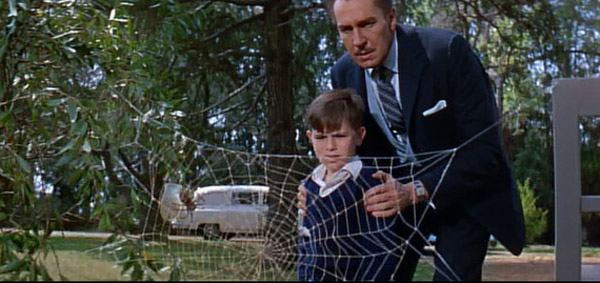
Speaking of endings, the film’s horrific climax --- featuring a fly with a human head trapped in a spider’s web -- stands as a pop culture touchstone, and has been excerpted on series including The X-Files (1993-2002) and Millennium (1996-1999). That chilling denouement remains effective, even today, after being lampooned multiple times on Mystery Science Theater 3000 (1989-1999) and The Simpsons (1990 - ).


Today, the 1958 film certainly shows its age, though it remains a thoroughly entertaining and immersive picture.  The Kurt Neumann (1908 – 1958) film stands the test of time, primarily, in terms of its commitment to scientific progress, even in the face of disaster.  As for scientific accuracy, that's a different story.

“God gave us intelligence to uncover the wonders of nature,” The Fly asserts, and so even though the film involves a nightmarish end to a noble experiment, audiences are left with the impression that man will move forward, and eventually conquer the universe itself.  That's a philosophy I can buy into, with hope and optimism.

So there’s, oddly, a hopeful message embedded in The Fly's dark and creative imagery.

Every time I watch The Fly, I recoil with horror from the results of the experiment, in particular the fly with the human head, trapped as a spider arrives to devour it. But I also appreciate that the film recognizes that sometimes there are casualties in the great march of human progress.


“You’re the first to see a miracle.”

Francois Delambre (Vincent Price) answers a telephone call from his factory night-watchman, Gaston, who tells him he has just witnessed a horror.  His brother’s wife, Helene (Patricia Owens), apparently killed her husband, Andre (Al Hedison) using a hydraulic press to commit the bloody crime.

Francois asks a police inspector, Charas (Herbert Marshall) to investigate.  Eventually, Helene is cajoled into telling the story of this horrendous murder.

It began when Andre, a brilliant and committed scientist commenced a “completely new line of research,” the instantaneous transport of matter across vast distances. He invented a device called a "disintegrator/integrator” and after much experimentation was ready to start with live experiments.

Unfortunately, Andre first tested the device on the family cat, Dandelo, and the experiment ended in disaster. Later, he tested it on himself, but something went terribly wrong. A house fly found its way into the matter transmitter, and Andre’s atoms were mixed with that of the insect. Specifically, his head and arm were replaced with fly equivalents.

Helene and her son, Philippe (Charles Herbert) went in search of a fly with a human head and arm, with Helen aware it was the key to restoring Andre to normal. 

Unfortunately, the fly could not be captured in time and Andre, fearing losing his mind to a fly intellect, demanded Helene help him kill himself. He led her to the hydraulic press, and the rest was history.

Inspector Charas considers the story preposterous, until he and Francois unexpectedly have a close encounter with a fly with a human head, trapped in a nearby spider’s web.


“Humanity need never want nor fear again.”

Today, it is not difficult to poke holes in several aspects of The Fly’s narrative. Most of these problems stem from the science as it is presented in the film.

I will review these problems briefly, just to give readers a flavor of them.  

The first involves Dandelo, the cat that Andre experiments with. Forget the fact that it is unethical and inhumane for Andre to experiment on the family cat. Let’s just consider the feline's fate.  He goes through the disintegrator/integrator and doesn’t come out. He never re-forms.  We are told his atoms are scattered through all of space. 

But, on the soundtrack, we hear Dandelo's plaintive (and disturbing) meows echoing about the laboratory. 

Now, I’ll be the first to admit that this scene qualifies as authentic nightmare fodder. But as science?  

If Dandelo’s atoms are scattered throughout the universe, how does he meow? He has no mouth, or tongue, or skeleton, or circulatory system, or…on and on. There's no way he could make a normal cat sound or vocalization.

That issue is relatively minor compared to the next one. 

Andre and the fly switch heads and arms, but how does the fly head and arm become human-sized, and how do the human head and arm shrink to fly size?  

Even if we permit that the organs trade enough matter for the size differentials, how can one explain that Andre -- for days -- retains his human identity, while boasting a fly head (and presumably, a fly brain)?  

If the transfer truly did occur as it seems to, then the fly brain would be in control from the minute the transfer is complete.  There would not be -- as suggested in the film -- a slow loss of identity and humanity, at least so far as I understand the science.  

In this regard, the 1986 The Fly is truly superior, since it involves gene splicing and the total DNA interweaving of fly and human.  The science in this film doesn't make any sense at all. 

(Though, as always, I'm open to reading any theories readers may have...)


Another problem involving this version of The Fly involves the details of the murder investigation. Even if Andre’s head were crushed in the hydraulic press, wouldn’t the police be able to determine that it was wrong in coloring, specific nature, and size? An examination of the corpse, it seems, would validate Helene’s story almost immediately. 

In a nutshell, these are the elements that age the picture in a significant way today. 

However, I don’t feel that these issues actually hurt The Fly significantly in terms of  the film's visceral impact.  

Why?

Well, there is a nightmarish, dream quality to the reality of the film, and some of the incongruities actually lend to the irrational, dream-like quality of the story. The most effective passages in the movie are those in which Andre lurks in his basement laboratory, a black cloth draped over his head.  

Andre moves about stealthily, hiding his true appearance, and the audience imagines all sorts of horrors hidden beneath the cloth.  The fly head is actually still pretty effective in appearance, but not as effective as that cloth is. 


The ebony cloth hangs like a shroud not only over the scientist’s head, but over the march of human progress as well. There's something incredible and highly resonant about the idea of science "blanketed" by the truly irrational; the monstrous.  The daylight of discovery gives way to an eclipse of nightmarish monstrosity.


Helene’s mental state, sometimes lucid, sometimes not, also lends an important element to the dream/nightmare aspects of the film. She is trapped in a dream world from which she cannot awake; one in which she and her son are engaged in fruitless, bizarre activities (attempting to catch a specific fly) to help her husband return to her, to be restored to humanity.

The scenes with Helene -- in her beautiful, very modern, mid-20th century home -- chasing a fly with a net, border on the insane. Her real life has given way to an absurd purpose.

Juxtaposed with the weird, nightmare imagery, is The Fly’s sincere belief that Andre’s experiment is but a bump on the road to a grand future. 

There’s a remarkable scene here in which Helene laments the fast march of progress. She thinks everything is moving too fast, too quickly for people to assimilate her.  Andre replies, brilliantly, that to their young son, all this progress will be an accepted fact of life, and nothing to fear.

This is very true. 

A generation ago, homes did not have computers in them. That was an advancement of the early eighties that changed, forever, the family household. Lately, we have seen iPhones and tablets incorporated into daily life, and again, to the younger generation, this seems completely normal. Not like something that should be feared.

Each generation assimilates technological progress almost effortlessly.

But fear is the first reaction to the unknown, to the shock of the new, and The Fly’s Francois aptly describes Andre as an explorer in a dangerous country. That is a great metaphor. Andre is the first to chart the unknown world that could, one day, be common place. The danger of that frontier is worth it to such explorers, for the betterment of all mankind. They take such risks knowingly.

The film actually ends with young Phillipe noting that he wants to be the same type of explorer as his father was.  

That isn’t just the plot of the 1959 sequel, but the promise that in the march of generations man will always drive forward, in spite of the setbacks, in spite of the catastrophes. It is inevitable. 

So The Fly is one part "don't tamper in God's domain," and one part, "the march of human progress can't be stopped."  

Between those two poles, rests a terrified, mutant fly, screaming, "Help me...!" for cinematic immortality.

Movie Trailer: The Fly (1958)

CULT TV FLASHBACK: Dead of Night (1994-1997)

This year, Dead of Night: The Complete Series , was released on Blu-Ray by Vinegar Syndrome , and I just had the pleasure of falling into i...