Showing posts with label 40 Years Ago. Show all posts

Saturday, December 20, 2025

40 Years Ago: Enemy Mine (1985)


Wolfgang Peterson's Enemy Mine (1985) is a Cold War Era film about the possibility of brotherhood between unlike people, in this case man and alien.  The story's backdrop is war itself; and the model for the film's conflict is clearly World War II, particularly the War in the Pacific fought between the U.S. and Japan.

Though based on Barry B. Longyear's story of the same title, the film version of Enemy Mine actually harks back to a 1968 film from director John Boorman: Hell in the Pacific.

In Hell in the Pacific, Toshiro Mifune and Lee Marvin play pilots in opposing air forces who crash on an inhospitable island and who, over time, accept each other -- and their differences -- in the battle for survival.

Hell in the Pacific's amazing natural photography, by Conrad Hall, captures the primacy of that difficult island landscape in the blossoming of the friendship between these sworn enemies. There is comparatively little dialogue spoken in the film (Mifune speaks only his native Japanese...), and the tension is often made bearable only by what Variety's reviewer called Marvin's "sardonic" lines, "which resemble wisecracks intended for onlookers."

In very precise terms, Enemy Mine strives for the same atmosphere, but does so under the bailiwick of a sci-fi veneer.

Story-wise, the tale involves the Bilateral Terran Alliance (think the Allies...) battling in space (think the Pacific...) against the reptilian, stoic Dracs (think the Japanese...).

The pilots crash not on an island, but on the inhospitable planet of Fyrine IV, which is subject to wild seasonal changes, not to mention incessant meteor showers. The Terran pilot, Willis E. Davidge (Dennis Quaid) and Jeriba, the Drac (Louis Gossett Jr.) first fight with one another, before eventually joining forces to survive death from above (the meteors), and death from below in the form of carnivorous sand pit monsters. Enemy Mine's screenplay also gives Davidge (Dennis Quaid) the same kind of sardonic banter that Marvin excelled with in Hell in the Pacific. From the very shape of that sarcastic language, we learn how Davidge feels about the Drac. He's given to derogatory nick-names (not "gook," but "Toad Face") and seems to view the Drac as inherently inferior, deigning to learn a "few words" of Drac's "crude lingo."

Over time -- and the togetherness of the three years -- Davidge begins to understand the grace, beauty and dignity of the Drac culture. In that regard, Jeriba comments on the fact that humans are "always alone" within themselves and thus somewhat capricious by nature. By contrast, the Dracs seem more at peace with themselves, a fact which allows them to give birth without the help of a mate. The Drac are also tied, explicitly, to their ancestors, and Jeriba teaches Davidge how to recite the "Jeriba Line" -- 170 generations of ancestors -- so he can testify for Jeriba's son, Zamis, at the Holy Council on Dracon.

It is never stated anywhere in the film, and this no doubt will make some viewers uncomfortable, but watching Enemy Mine this time around, I couldn't escape the notion that young Zamis is actually the spiritual offspring of Jeriba and Davidge's friendship. Not a literal, biological offspring, but the logical, inevitable result of a friendship as deep and intense as that shared by these two unlike men. 

On a more epic scale, Zamis becomes the bridge between Drac and Terra, and in the film's beautiful last sequence, we come to learn how the human Davidge literally becomes part of Jeriba's family. This is a beautiful message of peace and brotherhood, especially since it came at the height of the Cold War.

Although The New York Times derided Enemy Mine as a "costly, awful-looking science fiction epic," I disagree. Taking a cue from Hell in the Pacific, I submit that Enemy Mine is a beautifully-realized film, though -- as always -- it is best not to judge by today's standards of special effects. The visuals are as stirring, convincing, impassioned and persuasive as the film's central friendship.
Enemy Mine's very first shot stands as a stark example of this. It gives the audience a dynamic example of counterpoint.

On the soundtrack, Davidge's voice-over narration informs us that all the nations of the Earth have found peace. But on screen, we actually see the contrary: the next frontier; a war with an alien species.


The film opens with a creepy view of a human skeleton in a ruptured space suit -- a futuristic yet resonant image -- and then pulls back to reveal that this corpse drifts in a debris field in the aftermath of a star battle. Again, this shot could be accomplished easily with CGI today, but even for 1985, it remains gorgeous, macabre, and powerful. It shows us that even in space, our nature to "fight" that which we don't understand may be our worst enemy.

Later, the film lingers on long shots of lonely, rocky landscapes, as a solitary figure (Davidge), traverses the surface of an inhospitable world. Again, in the spirit of Hell in the Pacific, the landscape of Fyrine IV is almost a character in this particular play, always driving Human and Drac towards a friendship that might never have existed on another world.

Again and again, Peterson provides us shots of Jeriba and Davidge besieged by the natural Fyrine-ian elements: snow, rain and fire. And so we understand that petty differences (over territory) don't play a role in this harsh environment. 

In the battle for survival, there is no time for political differences.

While discussing visuals, it's necessary to make a special note of Chris Walas's make-up, which transforms Gossett Jr. into the reptilian Jeriba.

Whereas some of the mattes and optical composites of Enemy Mine have indeed aged in the intervening decades since the film's theatrical release, the make-up has not.

Jeriba or "Jerry" is on screen for a tremendous amount of the film's running time, and transmits to my eyes as a completely believable being. Simply put this is some of the finest make-up in cinema history, especially given the fact that it is put up to such intense and long-lasting scrutiny. 

Gossett's performance is also impressive. His Drac is an inquisitive, bird-like thing of trilling, hissing language; cockeyed-looks, and a real sense of nobility. There's nothing stock, silly, or remotely derivative about the actor's performance. From the moment we first see the Drac (coming up out of a lake, naked...) to his last sequence, giving birth to his son, nothing about Gossett's make-up or performance rings phony in the slightest. I remember there was a lot of talk in 1985 that Gossett should have been nominated for an Academy Award for this performance, but sadly it never happened.

Perhaps the finest visual imagined by Enemy Mine arrives just before the final fade-out. In the film's stirring, awe-inspiring closing-shot, we see Davidge and Zamis standing at the Holy Council on Dracon. A human being -- for the first time in history -- recites a Drac lineage before the gathered peoples of the planet.

This watershed view of a beautiful, water-rich alien world is a truly glorious one. The prominence of the sun in the auburn Drac sky cements the parallel to the Hell in the Pacific template since Japan is known, in some corners, as "the Land of the Rising Sun."

A sun on ascent may also be an efficacious metaphor for the Drac/human relationship: a sign of impending peace between people under the new "light" of understanding.


The closing shot even serves as the perfect visual punctuation for Davidge's personal journey. Before life on Fyrine IV, the callow, All-American pilot had lived under the specter of jingoism and hatred/prjeducide for an "enemy," although he had no personal cause to hate Dracs ("It's funny, but I'd never even seen a Drac...").

By film's end, however, Davidge has been "illuminated" by an understanding of the Drac culture, So much so that he had fought to save Jeriba's son, Zamis, from slavers (fellow humans). He has traveled to this alien homeworld -- the enemy homeworld -- to speak on the boy's behalf. By film's end, Davidge basks in the sunlight of understanding, peace, and even the kind of belonging that Jeriba suggests evades humans.

Visually, Enemy Mine is unimpeachable. And if a picture is worth a thousand words, then Enemy Mine achieves whatever greatness it possesses through those gorgeous, inspirational visualizations. In terms of words, and narrative, however, one wishes that Peterson's film had stuck more closely to the film's two central relationships: Davidge and Jerry/Davidge and Zamis, and not gotten bogged down in action-adventure set-piece at a slave ship compound.

Specifically, in the last third of the film, Zamis is captured by snarling, vicious human scavengers (led by the bug-eyed Brion James) and Davidge mounts a rescue operation to save the Drac boy. A film about relationships -- about survival in a harsh wilderness -- is suddenly transformed into a shoot-out: a Hollywood-ish stock battle that makes use of the most hackneyed movie cliches.

It is disappointing in the extreme that a movie which has toiled so hard to remind us that every person is more than the sum of stereotypes about their people descends to the easy stereotype of vicious, cruel, violent villains. I like and admire the late Brion James and he is always an effective villain, but his savage, wild-eyed, two-dimensional "evil" has no place in a film about shades of gray.

Enemy Mine gets back on track with that beautiful finale at Dracon and in that dynamic, heartbreaking last shot.  But I wish the film had heeded its central message and excised the unnecessary material with the silent-movie slavers. The third act of the film could simply have consisted of Davidge and Zamis working together to escape Fyrine; to build a "raft" to space (as in Hell in the Pacific), or something like that. The black hat villains just aren't necessary, and they drag down an imaginatively presented, near-great film of the 1980s. Enemy Mine is a powerfully-told story about the universal nature of friendship, spectacular in presentation, and acted with authentic heart. The film would likely be remembered as a classic instead of as a cult film today were it not for the disappointing third act.

Monday, September 29, 2025

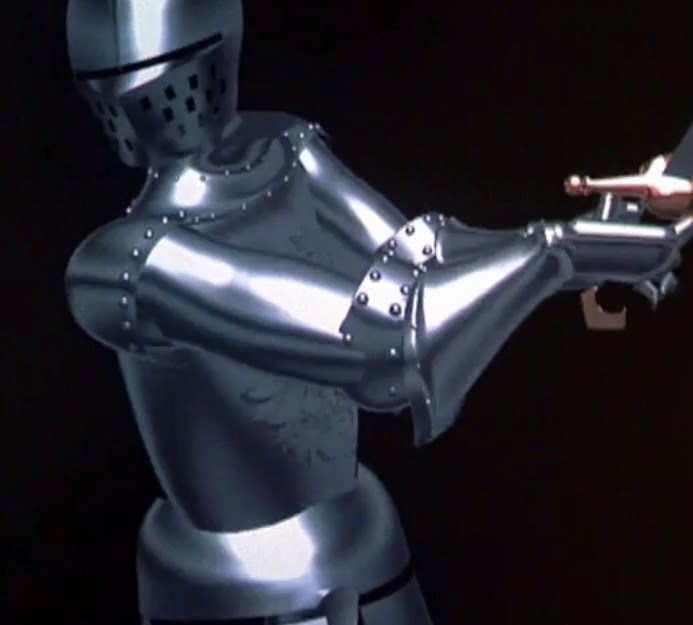
40 Years Ago: Amazing Stories (1985)


The 1985-1986 television season brought the world the Great Anthology War. It was the year that CBS revived The Twilight ZoneThe Ray Bradbury Theater premiered in syndication, and NBC resurrected Alfred Hitchcock Presents

Meanwhile, The Hitchhiker and Tales from the Darkside were already broadcasting their later seasons on HBO and in local syndication, too. 

The most ballyhooed anthology of all, however, was Steven Spielberg's Amazing Stories, which aired on Sunday nights at 8:00 pm on NBC, and which was guaranteed for a full two seasons --  a whopping forty-four episodes -- before the first episode even premiered. Each half-hour installment was budgeted at the princely-sum of $800,000 dollars.

Amazing Stories, however, didn't quite live up to the hype.

In fact, I'll never forget my (bitter) disappointment with the series' first few installments. "Ghost Train" was a special effects-laden variation of an old One Step Beyond story called "Goodbye, Grandpa," only re-made to tug at the heart-strings, and "The Mission" -- a claustrophobic, well-shot World War II story set aboard a damaged bomber -- ended with a fantasy cartoon moment out of left field.  

Critics didn't hold back. 

The New York Times called the series a "spotty skein of cliches, sentimentality and ordinary hokum." Tom Shales termed the Spielberg program "one of the worst ten shows of all time, in any category...over-cute and over-produced...with primitive premises."  

And at The New Leader Marvin Kitman coined the series "Appalling Stories."

Despite the bad reviews, however, the opening or introductory montage for Amazing Stories remains absolutely stirring. 

Accompanied by a soaring, triumphant John Williams theme song, the introduction dramatizes -- in a short amount of time -- nothing less than the entire history of storytelling.

We begin in prehistory, as a caveman family (no, not Korg 70,000 BC...) sits around a blazing campfire, and a grandfatherly tribe leader dramatically tells a remarkable tale, his loved ones at rapt attention.  

As the camera probes closer, we see, in close-up, the man's passion for his stories. At this point in our development, oral storytelling was the mode of communicating and maintaining a common or shared history.


In the next series of images, we move up through the ashes of the tribe's camp-fire, and ascend towards modernity. 

First, we see an ancient Egyptian construction, a tomb perhaps, and witness a scroll unfurl, with a story inscribed upon it.  

Next, we move up and forward into the Middle Ages, and a cathedral, where a bound book flies the length of the chamber. 

The CGI here may look primitive today, but it still gets the job done.  The imagery reminds us of the role that the written word, and storytelling, have played in human civilization across the centuries.  In this span, words on a page are a way of maintaining history, and sharing favorite tales.


Next, the flying book promises stories of horror (represented by a painting of a haunted house) and magic (symbolized by a magician's black hat, and playing cards...).

We're not just countenancing run-of-the-mill stories then, the imagery suggests, but amazing, wondrous ones.


Next, a book is opened, and on the page an illustration of a knight comes to life, suggesting that stories serve a wonderful purpose: They ignite the imagination.


The knight transforms, next, into a spaceship, and so we consider the idea that when we broach the stars in our future, we will continue to tell stories, and take our cherished stories with us. 


The spaceship veers off and we turn our attention back to planet Earth.  We move toward the planet, and careen down towards a 20th century city in America...


The lights of the city at night become, intriguingly, a circuit-board on a TV or computer, suggesting that in our age, technology -- not the voice of the prehistoric cave leader, or the bound scrolls and books of antiquity -- bring us our favorite tales.  Once more, the mode of transmission has been altered, but not man's love of stories and storytelling.


The montage ends with that same cave-man from the opening imagery.  Only now, we are watching his story on our TV set, an act which completes the tradition and history of human storytelling.  The cave man's story, with us since the very beginning, is now transmitted to millions on television, as a middle-class, 20th century family watches.


Next our series title forms.


Say what you want about the quality of the actual stories depicted on this Steven Spielberg TV series, the introduction remains an inspiration, and a wonderful journey through the history of storytelling. 

Perhaps the stories themselves felt so lacking, in part, because this introduction (and John Williams theme...) raised expectations to a near impossible level.

Here's the intro to Amazing Stories in living color, 40 years later:

Saturday, September 27, 2025

40 Years Ago: The Twilight Zone (1985 - 1989)


Submitted for your approval (or lack thereof): the mid-1980s CBS remake of Rod Serling's classic 1960s anthology. 

But, in a twist worthy of the famous land of shadow and substance itself, there's no Serling here (the legendary writer passed away in 1975); there's no moody black-and-white photography either (the series is shot in gauzy colors) and the bland stories -- with a few spiky exceptions (namely "Her Pilgrim Soul" and the intense "Nightcrawlers") -- don't quite feel like they would have passed muster had Serling been steering the ship.

Yes, you have just entered...The Twilight Zone....lite.

The 1985-1986 TV season actually saw several anthologies debut on network television, and none of them were particularly good. 

"Proud as a Peacock" NBC offered the dreadful and over-hyped Spielberg production Amazing Stories, plus a remake of Alfred Hitchcock Presents. The latter venture offered the Master of Suspense himself (also long dead) vetting colorized introductions to new episodes, and we can surely be grateful, at least, that the new Zone did not choose the path of featuring Zombie Serling. 

Despite the myriad flaws, this Zone lasted longer than the other anthologies named above, running for two uneven years on CBS before being shunted to syndication for a dreadful, low budget final season that is not merely Twilight Zone lite, but an insult to the heritage of the franchise.

But during the first two years on CBS, talented executive producer Phil De Guere and a stable of terrific writers made a serious, well-intentioned effort to update the classic series. Harlan Ellison was aboard (briefly) as a creative consultant, and well-known directors such as William Friedkin, Wes Craven and Tommy Lee Wallace helmed standout episodes. I watched this series religiously as a teenager (I was sixteen years old), and still have nostalgic memories. Honestly, you can tell everyone was giving the new series their all, but this new Twilight Zone has not -- for the most part -- aged well.

First off, I blame that fact on the uninspiring look of the series. Most of the episodes ("Nightcrawlers" excluded) resemble dreamy 1980s commercials for feminine hygiene products. There's no distinction, no originality in the visual component of the series, and so you can watch an episode and not be certain whether you're watching Simon & Simon or The Twilight Zone.

Even back in the black-and-white age, there was no mistaking the crisp, black-and-white canvas of the original Twilight Zone for anything else (One Step Beyond, for instance, aired simultaneously, but it lingered more on long shots and featured fewer close-ups).

On the original Twilight Zone, the photography was as distinctive and the editing as staccato as Serling's trademark narration. Who can forget the brilliant photography and mise-en-scene in "Eye of the Beholder," or the careful balancing of shadow and light in "The After Hours?" 

Separating The Twilight Zone from a distinctive, even trademark look was a terrible, perhaps fatal mistake. Now, I understand the series had to be shot in color for the 1980s, but there are ways -- even in color -- to forge visual distinction. 

Witness the white-on-white minimalism of Space:1999, the lush fairy tale golds and bronzes of Beauty and the Beast, the grainy documentary look of the original Texas Chain Saw Massacre; David Fincher's silver Seven, or even the various color palettes of such series as Prison Break, Firefly and Battlestar Galactica.

 Something, nay anything, would have helped in this regard.

The 1980s Twilight Zone doesn't win plaudits for internal consistency either. Serling's opening and closing statements on the original series always let you know where you were, who you were with, and why you were there. There was no hedging. On the new Twilight Zone, some episodes included back and front end narrations, some had no narrations whatsoever ("Nightcrawlers"), and some - oddly - featured an opening narration but yet no closing narration ("A Little Peace and Quiet.") Often times, you couldn't tell what the hell the narration was talking about, either.

Charles Aidman narrated the new Twilight Zone (when there was a narration), and he did a fine job. His voice was sweeter, more whimsical more grandfatherly than the rat-a-tat machine gun-style of Serling. 

Ironically, this was also the choice of Spielberg's Twilight Zone: The Movie (which went with another kindly voice, the one belonging to the great Burgess Meredith). 

I respect these selections as a way not to imitate Serling's delivery, yet still hold serious reservations about the appropriateness of a kindly-sounding narrator. After all, The Twilight Zone is a place where the scales of justice are often righted; where the unheard are heard; where the cruel get comeuppance. Serling was sharp, witty and occasionally brutal in his approach to the narration. Thus, I would have preferred a similarly hard-edged narrator, a more aggressive, commanding voice. Why? When you have only fifteen minutes to vet a story, and you must gloss over certain aspects, it's good to have someone strong offering the punctuation. Otherwise, you start and end with a whimper, not a bang. 

And at the end of every twisty Twilight Zone, you deserve that bang.

Rod Serling wrote something like ninety episodes of the original Twilight Zone. He was narrator for all of them. He also rewrote various episodes by other superb writers and produced the entire five year series. Considering his ubiquitous presence, it's fair to state that the Twilight Zone represented (primarily) his voice, his morality, his artistic sensibilities. Since he was gone by '85, the new series had no choice but to find its own voice. 

And it is here, that I think the show failed to live up to his legacy. 


Take for example, "Little Boy Lost." In this story, a woman photographer must make the choice between taking a new job or starting a family with her steady boyfriend. During the course of the story, she is haunted (on a photo shoot at the zoo) by the spirit of the child - a boy named Kenny - she ultimately chooses not to have. This is odd, because she's not even pregnant. (So to be clear, she doesn't have an abortion.) She's just a woman who decides it isn't the right time to start a family.

But she is "haunted" by the unborn child.

"All you have to do is want me,"
 the boy tells her pitifully. Yikes! The sweet little boy (Scott Grimes) asks his would-be mother why she does not want to have him; why she does not love him, and it's all so madly extreme that you expect Pat Boone to show up and lecture us about the evils of abortion. 

Yet, the same episode entirely lets the boy's would-be father, Greg, off the hook.
Why isn't he haunted by the son he chooses not to have? Why just her? 

A whiny little she-man and drama queen, Greg doesn't want to "compete" with the woman's career, so he makes a "choice" too...to break up with her. 

So isn't Greg just as much to blame for the fact that this "little boy lost" isn't born? Poor, fragile snowflake.

Greg could have been a stay-at-home dad, his wife could have had her career, and they both could have had the child who wanted to live and be loved so badly. But no, the episode wears philosophical blinders about the man's role in this reproductive drama. Greg wants to make no accommodation in his own life to have that family and child. He just wants the woman to do it. And then she gets stuck with the ghosts of children future? 

Off the top of my head, I can't think of even one 1960s Twilight Zone episode that is so blatantly sexist, or that has aged this poorly.

I mean, what's the real point here? 

That every woman who chooses a career is actually killing a potential child? As I stated, the woman isn't even pregnant, all right? She just wants to be a professional photographer! Choosing to be childless is not the same as terminating a pregnancy. Choosing a career is not the same as having an abortion, yet "Little Boy Lost" can't make that critical distinction. As a result, the whole episode is icky. Greg is a self-righteous jerk, and the cute little kid is used as a bludgeon to make the lead character feel bad about a choice to live her life the way she wants.

Pack your bags, Zoners...we're going on a guilt trip! "Little Boy Lost's" ending narration backs away from the sexist interpretation of the episode as fast as it can, calling the story simply "a song unsung," "the wish unfulfilled," but it's too little, too late. 

Watching this episode, I was reminded of a comment on Serling's particular and singular ethos, one made at his eulogy: "He showed us people maybe we'd rather not think about. But with that keen perception and sparse dialogue, he grabbed you...and told you in no uncertain terms that these people deserved at least a little victory, breathing space, someone to care about them." 

"Little Boy Lost" is sort of the opposite of Serling's approach, isn't it? It judges. It makes a work-a-day character feel guilt, shame, and pain for something by rights she has no reason to feel guilty about. (Again, not pregnant, just wants a career...)

"Shatterday" is another signature episode that fails dramatically. And that's a surprise, especially considering all the name talent involved. Wes Craven directs a short story by Harlan Ellison (adapted by Alan Brennert). And the installment stars a very young Bruce Willis as one Peter J. Novins, an ostensibly argumentative man who "pushes" people until one day the world "pushes back." He's in a bar one evening when he telephones his apartment and a doppelganger picks up on the other end. Turns out this doppelganger is a better Peter J. Novins than he is; and that this enigmatic double is setting right all the mistakes of his life. Meanwhile, our Novins starts to fade away, "becoming a memory."

Personally, I love the ideas lurking in this vignette. I 
love the notion of a doppelganger; and the conceit that someone else might live your life better than you can. But, alas, "Shatterday" never actually dramatizes Peter Novins being a bad guy. The story picks up immediately before the terrifying phone call. As a result, we're told he is a "pusher" (meaning a nudge, I guess?) and a bad guy, but we never see it play out. All of Peter's actions in the episode are actually readily understandable, given that he believes an impostor is taking over his very life, aren't they? Wouldn't you push back too?

Allow me to make another invidious comparison to the original series. It would not have made sense, for instance, in the Serling episode "The Silence," if we had met the lead character there after he had made a bet to stop speaking aloud for a year's time. No, we had to see the loquacious central character babbling mindlessly and egotistically for a time, so we would understand the torture that he would go through in the course of the narrative. We had to understand the crimes of the jabberwocky before we got to see his sentence handed down by the mechanism of the twilight zone. 

The same is true in "Shatterday"...we have no empirical evidence that Novins deserves what happens to him. And there's just no fun in seeing cosmic justice meted out if we don't understand the cosmic violation in the first place. One on-screen example of his pushy nature would have sufficed. And I don't mean sassing a bartender. That's not a Zone-worthy offense, if you ask me.

I hate to write negative reviews, especially about a series as good-intentioned and diverse in storytelling as this eighties Zone

So let me accentuate at least one positive story that seems - at least to me - absolutely true to The Twilight Zone's spirit and heritage. 

The story is titled "Wordplay," and it concerns a harried businessman (Robert Klein) who - because of a shake-up at the office - must learn the details of 67 new medical products in one week's time. All of these new-fangled products bear tongue-twisting names and are woefully technical. But then, something seems to change for the salesman. Language seems to melt right out for under him. Suddenly, it's not just the products he can't understand...it's everything! The word "lunch" is replaced with the word "dinosaur." The word "throw-rug" replaces the word "anniversary." Suddenly, this little guy trying to make his way faces an entirely new challenge, re-learning the English language. The end of the episode is simultaneously devastating and hopeful, as this forty-something year-old man sits down heavily on his son's bed, and begins going through first grade picture books...meticulously learning one new word at a time.

The thing of importance here: this "little guy" has been dealt a raw hand (as the little guy often is). But he's not going to stop fighting. He's not going to be defeated by it. "Wordplay" reminds us that the human spirit -- nay, the American spirit - is indomitable. 

It's a terrific little tale; one that reflects how quickly the workplace was changing in the 1980s. (I remember, for instance that 1986 was the year my father began to learn Japanese.). So "Wordplay" was about something happening in the larger culture too; a pervasive fear that the old skills weren't going to be good enough in the newly emerging global workplace. "Wordplay" is a terrific show, and there were many such shows like it.

"Nightcrawlers," is another stand-out installment, one which concerns PTSD and the repressed horrors wrought by the Vietnam conflict. It depicts a compelling and nightmarish story set at a small diner just off the highway, a perfect setting for The Twilight Zone. It is blackest night -- with incessant rain pounding -- as the tale commences. A cocky police trooper (Jimmy Whitmore Jr.) who avoided service in Vietnam enters the diner, recounting to a waitress and the cook a harrowing story about the bloody aftermath of a strange motel shoot-out. He's clearly shaken by what he's seen.


As more travelers (including a family) seek solace from the violent storm, events in the diner take a weird turn. A nervous man named Price (Scott Paulin) arrives and is almost immediately revealed to be highly disturbed. He's a Vietnam veteran, you see, and was once part of an elite unit called "Nightcrawlers." Price was traumatized by one particular night mission against Charlie, one which cost the lives of several American soldiers. That night's horrific events remain so resonant with Price that he has developed an unusual power:the ability to manifest his terrible memories...in the flesh.

When Price sleeps (or is unconscious for any reason) his violent nightmares of 'Nam are granted substance and then run amok (which accounts for the motel massacre). Price and the trooper don't get along, and after a verbal confrontation, the trooper knocks Price out. His unconscious state paves the way for a violent dream that transforms this 1980s diner into a jungle landscape, one wherein armed soldiers are on a brutal mission to kill everyone. The episode culminates with a maelstrom of destruction and gun-fire, and the chilling promise that other veterans like Price are out there.. ones with the same destructive "power" and memories.

Boasting a heavily de-saturated and grainy look (the contrast was adjusted by Friedkin himself, according to the episode commentary), this is a Twilight Zone episode that looks more like Tobe Hooper's The Texas Chain Saw Massacre than it does the average installment of a popular TV series. This is an appropriate touch, because we're subconsciously reminded of authentic Vietnam War footage, and the grainy look it often boasts.. 

Utilizing just one set (the diner), Friedkin builds escalating tension by focusing on two visual flourishes; ones that he often deploys in his films: insert shots (to create a sense of detail, mood and texture), and extreme close-ups (to draw us into the world and troubles of the characters). On the former front, we get a tour of the diner's seemingly mundane terrain (including coffee cups filled with steaming coffee, cigarette lighters and the like). On the latter front, we are treated to a sustained, highly-upsetting close-up of the mad Price: red-eyed and psychotic; and growing ever more upset. This shot lasts a long time -- beyond all reason, actually -- and is highly disturbing. Friedkin's decision to hold the close-up (in conjunction with Paulin's committed performance) sells thoroughly the notion of this man's insanity.

The theme underlying Nightcrawlers is that for the men who witnessed atrocities and horrors in the Vietnman War, the conflict is never truly over. This notion was just bubbling to the surface when this episode of The Twilight Zone was made. It entered the American lexicon during the Reagan 80s as "Post-Traumatic Stress Disorder" (or PTSD) and never left, although a similar syndrome had once been known as "shell shock." Still, the idea was that we had a generation of men "coming home" in the late 1970s who had seen such horrible things that they could never again lead what we non-combatants consider a normal life. And worse, their problems were being ignored by the government, the citizenry, and even the media.

Remember what Freud stated so memorably: that "the repressed" returns as "symptoms." Nightcrawlers makes literal that notion. The only way Price can "exorcise" the demons of Vietnam is to produce those vivid demons in our reality. So what we have in Nightcrawlers is a genre metaphor for PTSD, down to the idea that - if left unexorcised - the violence unleashed in Vietnam will claim more victims here at home. 

From the opening close-up of pounding rain to the anxiety-provoking visual distraction of bright lightning flashes and intermittent electrical black-outs, Friedkin makes this installment of The Twilight Zone feel authentically like an unpredictable powder-keg; one always on the verge of exploding. The personal fire-works between the highway trooper and Price are balanced well by the real (and disturbing) fireworks in the climax. The episode also generates a ubiquitous mood of deep unease.

So what's my conclusion about the '80s Twilight Zone here? What's my closing narration? 

Perhaps just that you can't go home again. 

That it's damned difficult to revisit a classic. 

Especially when you don't necessarily have the arrows in your quiver to make your effort appear as stylish or as individual as what came before. The New Twilight Zone is thus a very mixed bag, and I suppose that's why even those viewers who "grew up with it" (myself included), find far more of interest (visually and thematically) in the Serling classic.

In the new series, you can spot a brief, almost subliminal flutter of Serling's iconic b&w visage in the opening credits, and that's all. 

He's really only there briefly in spirit too. For all the criticism Night Gallery has received over the years, there's much more of the Serling spirit present in that series, in stories such as "The Messiah of Mott Street" and "They're Tearing Down Tim Riley's Bar." 

For that reason alone, Night Gallery feels more like an authentic follow-up to the original Twilight Zone than this mediocre, hit or miss, 1980s remake.

Thursday, September 18, 2025

40 Years Ago: The Equalizer (1985-1989)


I was a devoted viewer of the original CBS TV series, The Equalizer (1985 – 1989), which starred the great Edward Woodward as an ex-spy, Robert McCall, helping out ordinary -- but desperate -- people, in the crime-ridden Reagan Era New York City.

McCall was a hero unlike virtually any other on TV at the time. Although he was an older man (in his sixties, perhaps), he was an absolute bad-ass. McCall didn’t tote big guns like Rambo and he wasn’t physically intimidating, either. Instead, he had presence...and cunning. He was sharp like a knife, and could out-wit -- as well as out-fight -- any opponent. I loved watching Woodward in his role on The Equalizer, and was sorry to see the series end after four seasons.

The introduction to The Equalizer is a great artifact of its age: the mid-to-late 1980s. 

It features a barrage of music-video jump cuts, a pounding, staccato theme song and it is all about one thing: the extreme danger of the “urban” jungle.  

The series was broadcast during a time when the crime rate in New York was through the roof. The Equalizer started airing not long after the Bernhard Goetz subway incident (December 22, 1984), and was on the airwaves for both the Jennifer Levin/Robert Chambes “Preppie Killer” case, and the Central Park jogger/wilding case.

The idea of New York City as a concrete jungle is played out visually in the series’ introduction.  

The montage begins with a point-of-view shot from a busy street, as if we are in car, racing down the avenue.  But in truth, it looks like we are in a canyon between giant skyscrapers.  Making the image more terrifying, it is night time.  The sky is dark, impenetrable.


A second shot is a pan across the skyline, from a high-altitude.

These two opening shots inform us of something important about the series. The Equalizer concerns both “street level” crime, and the crimes of those in penthouse apartments.  McCall can help you in either case


In the next shot, we swoop (or zoom) back down to city level, and see a person running across a mostly-vacant street at night.  He seems to be running for his life.  The figure is tiny, a victim unnoticed by the Establishment, or by society at large.


This visual is followed quickly by other shots that suggest overt,  immediate and frequent danger.  We see a door crack open, and someone peering in at us.

After that, we gaze down (from a view suggesting doom), at a woman alone in an elevator with someone who reads, visually, as a gang member or thug.  He may be planning to rob, rape or murder her.  To accent the point, we get an extreme close-up of her panicked eyes.

The litany of horrors continues. A man standing in a phone booth sees head-lights shining on his face, as if he is going to be attacked by someone in a car.  

Then, in broad daylight, a stalker leaves his car and pursues an unwitting woman into an office building.  The point of view suggests he is watching her, and planning no good, and that she is unaware both of his presence and his intentions


Up next, we get one of the most important compositions in the montage: a hand works at a small scale, and the balance of the device is off. One of the scale’s plates dips at a lop-sided angle…because crime is winning in this urban jungle!  

Who will right the scales of justice?


Then, the horrific moments of out-of-control crime resume. A woman misses her subway, and a stranger steps out onto the lonely platform to challenge and threaten her


Then our hero appears, in shadow, for the first time. We see McCall’s silhouette.  He can no longer remain in the shadows and watch all these injustices.  He will soon emerge to help the helpless…


Another stalking incident is next. We watch from another first-person subjective shot how someone -- a shadow – is stalking a woman on the side-walk.  At first we see only her feet, increasing their pace.  Then we get an extreme high-angle, looking down, as the shadow nears his quarry.


Now the force of justice emerges at last.  At first he is merely a shadow on a brick wall.  But soon, the mist clears -- literally -- and we meet…The Equalizer!


After the title of the series, we meet our star, Edward Woodward, and the punchy theme jump-cuts us out of the montage.


One of the most paranoid, over-the-top TV series introductions ever created, The Equalizer depicts a populace in total fear and a city in chaos. It suggests that one man -- the right man -- can shine a light on this terrible, urban darkness.  

CULT TV FLASHBACK: Dead of Night (1994-1997)

This year, Dead of Night: The Complete Series , was released on Blu-Ray by Vinegar Syndrome , and I just had the pleasure of falling into i...