Showing posts with label 60 Years Ago. Show all posts

Sunday, August 16, 2026

60 Years Ago: Fantastic Voyage (1966)


"Maybe the philosophers were right. Man is the center of the universe. We stand in the middle of infinity; between outer and inner space..." 

-Dr. Duval (Arthur Kennedy) ponders the miracle of life in Fantastic Voyage.


This memorable Richard Fleischer effort was the special effects spectacular of 1966; an imaginative, big budget (6.5. million dollar...), award-winning science fiction adventure. If you grew up in the late 1960s or 1970s, Fantastic Voyage was also likely one of your favorite genre movies; one filled with action, danger and special effects spectacle the likes of which you had never conceived.

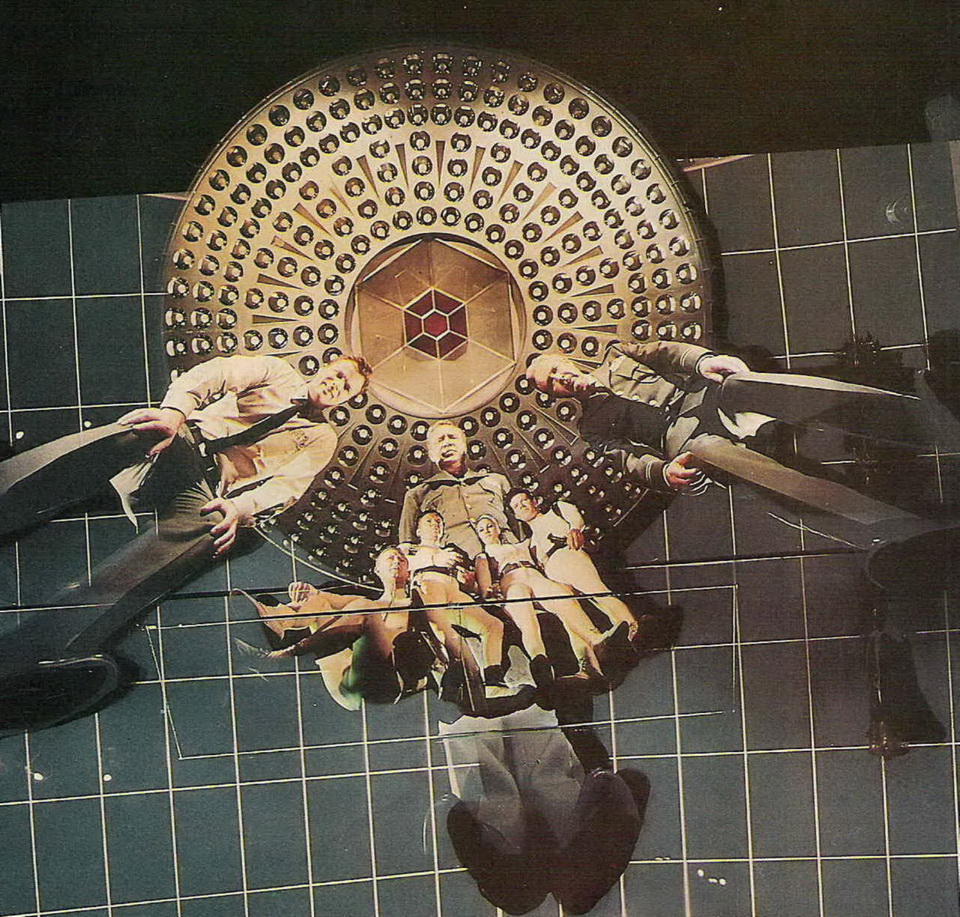
This well-regarded genre film escorts the audience inside the HQ of the CMDF (Combined Miniature Deterrent Forces), an American military-intelligence agency that has developed the ability to shrink down to microscopic levels everything from people and equipment to large-scale vehicles. The problem with this technique is that the miniaturization process becomes unstable after a mere sixty minutes, and all shrunken persons or objects then return to normal size.

Only one scientist -- a Soviet named Jan Benes -- knows the answer to this riddle. Unfortunately, he's been badly wounded during his defection to the West. An inoperable brain injury threatens his life and all of his advanced knowledge. 

CMDF doctors quickly realize that the only way to clear a large blood clot from the scientist's brain is to arrange a "little trip." Specifically, a nuclear submarine named Proteus (model U91035) and a team of medical personnel are to be miniaturized and injected into the dying man's blood-stream. The strategy is to travel by artery to the brain clot, slice open the dangerous occlusion with experimental laser beam, and wait for removal at the base of the neck. 


And all this must occur in just sixty minutes.

The mission doesn't quite turn out that way. Security agent Grant (Stephen Boyd), neuro-surgeon Dr. Duval (Arthur Kennedy), his beautiful assistant Cora Peterson (Raquel Welch), sub Captain Owens (William Redfield) and team leader, Dr. Michaels (Donald Pleasence) encounter an array of unexpected and wild dangers on their fantastic voyage.

A whirlpool at an artery branch shunts the Proteus into the veins, forcing a dangerous journey directly through the human heart (which is stopped for sixty seconds to permit transit). Then, the Proteus's air supply mysteriously fails, requiring a pit-stop in the lungs, where the oxygenation process is observed and then exploited. A trip through the inner ear is equally dangerous, because any vibration inside the operating theatre could rattle the ship and crew into pieces.

Before the mission ends, the surgical laser is damaged (sabotaged?) and jury rigged, and an enemy agent is found among the crew. 

Take a look at the cast members, and then take a good guess at who the saboteur might be. 

Finally, a swarm of puffy, jelly-fish like white corpuscles attack the Proteus, crushing the marvelous high-tech sub completely. After a successful operation to remove the clot (conducted in four minutes, no less...), the mission survivors evacuate through Benes' tear ducts...just in the nick of time. Their "full reduction" reverses and they are restored to normal dimensions as the end credits roll.


I've always admired and enjoyed Fantastic Voyage, but watching it again today, it is not difficult for the objective viewer to discern some of the film's more notable shortcomings. 

All the characters are two-dimensional and deadly dull, their dialogue stiff and uninteresting. The film also wastes an inordinate amount of valuable screen time on military brass arguing amongst itself and barking orders at subordinates, who dutifully carry these technical instructions out in mission-control-style environs. 

Most troublesome, it takes the movie nearly a full thirty minutes to get to the miniaturization process and the actual impossible mission, so the movie starts out at a snail's pace. The pace does pick up, but some won't have the patience to stick with the film.

Still, I would have to say that all of these drawbacks are largely immaterial, given the movie's strengths.  The premise would have to be counted key among those. Movies often exist for the express purpose of revealing to us worlds and vistas we've never imagined or seen before. On that criteria alone, the wacky miniaturization plot of Fantastic Voyage succeeds magnificently. It's the doorway to a world of awesome visual delights and some great 1960s-era effects.

Some of the amazing and jaw-dropping sights you'll see in Fantastic Voyage include: a nuclear submarine submerging inside the choppy waters of a hypodermic needle; a roller coaster ride through that needle into human flesh; a passage through a school of globular red blood cells; a flight through a human heart; a close-up view of the oxygenation process, an exchange of gases that is one of the "miracles of the universe;" and even a rendering of a "blazing" single thought, as Benes' sparkling synapses fire all about the rocketing Proteus.

My two favorite images, however, occur late in the film. There's a terrifying moment wherein a white corpuscle descends on the dorsal dome of the Proteus, where Captain Michaels (Pleasence) has become trapped following a crash. The corpuscle crushes the glass of the dome, and proceeds to envelope Michaels' (screaming) head before our eyes. That fatal moment -- which Pleasence really sells -- has haunted me since I was a kid. Imagine being eaten, head-first, by a giant cell.


And secondly, I love the shot that finds the mission survivors swimming wildly in a single tear drop -- to them the size of a lake -- after evacuating the body through the corner of the eyeball. I remember I once owned the Fantastic Voyage comic-book too (long gone, alas...), and this image really resonated with me both in print and on screen. The kid in me has also nurtured a long fondness for that high-tech submarine, the Proteus ("quite a canoe," as one character describes it...). I always wished there had been a model kit of that ship in the 1970s.

As a dazzling visual travelogue into inner space, a journey into a contained universe all its own, Fantastic Voyage remains an involving cinematic experience. I also detect now a thematic leitmotif I missed as a kid: an early debate about intelligent design vs. evolution. Dr. Duval (the good guy...) sees the oxygenation process as a sure sign of a "Creator's" hand, while the godless communist agent, Michaels, views it as nothing more than evolution. 

As you can guess, the movie falls philosophically on the side of intelligent design. Message: do not tamper in God's domain.

So Fantastic Voyage is a nostalgic favorite that features some imaginative sets and more than a handful of grand physical effects. It also generates a fair degree of tension in the final act, especially during the hair-raising "absolute silence" scene involving the journey through the inner ear.  The film has been imitated on Doctor Who and satirized on The Simpsons, and has, in some sense, achieved pop culture immortality.

Friday, July 31, 2026

60 Years Ago Today: War of the Gargantuas (1966)


It’s no exaggeration to state that The War of the Gargantuas (1966) was a staple of my childhood TV-watching. 

The Japanese monster movie -- released in America in 1970 -- aired frequently on our local station WWOR Channel 9 in the 1970s and 1980s; sometimes on The Million Dollar Movie, if memory serves.

Rightly or wrongly, I have come to associate these viewings of The War of the Gargantuas with the Thanksgiving holiday, or more accurately, the Friday after Thanksgiving.  

So today, I decided to take a look back at the film. Until last week, I had not seen The War of the Gargantuas since a holiday in the early 1990s when I introduced the film to my wife, Kathryn. We were at my grandparents’ house in Tom’s River, N.J. for the Thanksgiving weekend, so the film may have been playing on basic cable.

The War of the Gargantuas stars Russ Tamblyn as Dr. Paul Stewart and is a sequel of sorts to Frankenstein Conquers the World (1965). In particular, the film’s Gargantuas -- brown and green -- were created from the cells of the Frankenstein Monster, which were cast into the sea in the previous film.  

And in Japanese, I believe, the creatures are referred to not as Gargantuas but as “Frankensteins.”

Directed by Ishiro Honda, with special effects from Eiji Tsubaraya, The War of the Gargantuas concerns the attempts of several scientists to save the life of the non-violent brown Gargantua, or Sanda, even while the Japanese Army plots the demise of the violent, carnivorous green Gargantua, Gaira. 

In the end, nature does away with the giant monsters instead. But the film serves as a meditation on the nature vs. nurture debate, comparing the wild, untamed Gaira with the kindly Sanda, who knew human companionship. 

Man’s violent nature is discussed as well, since the Japanese Army refuses to acknowledge the (obvious) differences between the gargantuan monsters, and goes forward with its plan to kill them both with napalm.


“Is it possible a gargantuan might exist?”

A ship at sea is attacked by a giant octopus, and later, a giant green monster or Gargantua. 

The only survivor of the incident reports the attack, and the Japanese press runs with the story, asking Professor Paul Stewart (Tamblyn) and his associate Akemi (Kumi Mizuno) if such creatures could be real. The scientists know from experience that it is possible.  Five years earlier, they cared for a gentle brown Gargantua, before it escaped from custody.

The Green Gargantua, Gaira, soon makes landfall at Tokyo Airport and does catastrophic damage there. Later, the same beast attacks the patrons at a roof-top night-club, and is repelled only by bright light.  

The Japanese Army brings in maser tanks to annihilate Gaira, but at the last minute, the injured creature is rescued by Sanda, the brown Gargantua who has been living in peace in the Japanese Alps.

Stwewart surmises that the Gargantuas are offshoots from the same unknown cells, and therefore their cells may be able to generate additional monsters.Alarmed, the Army plans to destroy Gaira and Sanda, over Stewart and Akemi’s objections...


“We were sunk by a hairy green giant.”

The War of the Gargantuas explicitly references, at one point, the Biblical story of Cain and Abel: the story of a man who murders his brother. 

That tale roils underneath The War of the Gargantuas as Sanda and Gaira  first discover one another, and eventually face off. Early in the film, Sanda saves Gaira from the Army and nurses him back to health after maser attack. But soon Sanda -- who was raised by humans -- sees that Gaira has killed and eaten a human boater.  Sanda realizes that he can no longer protect his sibling, and nor should he. They fight it out, even though Sanda is peaceful and docile.

The other set of “brothers” in the film -- mirroring this monster dynamic -- are human scientists and soldiers. The scientists, like Sanda, are peaceful and docile, hoping to investigate the crisis and save the more peaceful of the two Gargantuas.  The soldiers, by contrast (and not entirely unlike Gaira...) are bound and determined to destroy anything they deem a threat, including the innocent Sanda.  

Like the Gargantuas, scientists and soldiers possess “the same blood, the same cell structure,” and yet are incredibly different.The movie points out the hypocrisy of the Army's higher-ups. They are bound and determined to kill both Gargantuas, even without cause, even though they are acting in a murderous fashion, like Gaira. 

But brothers are supposed to be responsible for brothers, right?

In the end, the Gargantuas are put down not by each other, or by the auspices of man, but by an underwater volcanic eruption. Though spurred by a helicopter bombing, this eruption is the “other” key player in the film’s action: Mother Nature, or God, if you will.  

The Gargantuas -- as Frankenstein Monsters and creations of man -- are “unnatural” creations. Therefore, it is only proper that nature remove them. But had monster movie history been a little different, however, Sanda and Gaira would have likely returned in another film, perhaps to battle Godzilla himself. 

On my recent screening of the film, I was pleasantly surprised by the effetive and atmospheric opening of the film. Like so many Japanese monster movies, The War of the Gargantuas opens with a ship at sea during a storm, and an attack by a giant monster.  

This time, that monster is a huge, menacing octopus, and the scene is very well-shot. The punctuation of the scene is a surprise too.  Gaira dispatches the octopus so that we think he is a hero, but then Gaira proceeds to attack the ship himself.  Out of the frying pan, into the fire. 

Later, in a scene that is a little shocking to behold, we see Gaira pursuing the swimming survivors from the ship.  He plucks them out of the water and eats them. 


The scene I most remembered from the film is set at a night club, where an American singer croons “The Words Get Stuck in My Throat,” unaware that Gaira is creeping up in the background, behind her.  

The movie misses a genuine opportunity, in my opinion, because the singer doesn’t get eaten (or stuck in Gaira’s throat...). That would have been a wicked (and nasty) joke but The War of the Gargantuas is a sincere entertainment and doesn’t tread into camp, at least intentionally. Still, it's hard not to giggle at the sea captain's cry that his vessel was attacked by a hairy green giant.


On this viewing of the film, I also admired how the filmmakers set up and exploited the comparison between Gaira and Sanda.  

Gaira is a vicious, inhuman thing that has never known love or companionship. By nature, he may have the potential to love, but he has never been nurtured.  He sees human beings only as food, biting their heads off first, apparently. This is terrifying to watch, and I remember, as a kid, being scared by Gaira.  

There's a moment in the film when a fisherman looks down into the sea, and there -- below the surface -- is Gaira, just waiting to spring. That moment offers some good old fashioned nightmare fodder, and Gaira represents nature gone wild, untamed and undisciplined. 


Sanda was raised by humans, however, and therefore understands love, companionship, and even brotherhood. That latter quality, brotherhood, is the very thing that Sanda seeks with Gaira, perhaps to alleviate a lonely, or even solitary existence.  

But Gaira simply can’t change his ways at this juncture, and is no doubt confused when his brother turns against him. Sanda, clearly, wishes events had turned out differently.

What I didn’t admire so much about The War of the Gargantuas is the fact that the mid-movie battle between Gaira and the Japanese Army seems to go on forever, and therefore lose some visceral impact.  

I fully realize that many nay-sayers disliked 2014’s Godzilla because there wasn’t a lot of monster-on-monster fighting in the film. The fights were used strategically, and mostly during the climax.

The War of the Gargantuas, however, validates that restrained approach.The battles here go on for so long, without relief, that they eventually become monumentally uninteresting. 

It’s probably sacrilege to say this, but the fights could have been pruned back by a full-third, and the movie would have moved with more grace, purpose and drive. The first thirty minutes or so of The War of the Gargantuas in particular, are terrific, and the special effects (especially during the airport attack) hold up rather well.  


Once the fighting takes center stage, however, The War of the Gargantuas feels like it is stuck in neutral. Long stretches of time go by where we just seem to be watching vehicles getting positioned, and masers firing.

The War of the Gargantuas is generally very well-regarded by fans, and I can detect why. Some feel nostalgia for the film, because they grew up with it. Certainly, I'm in this camp.

Others have keyed in on, quite rightly, the human, affecting nature of these particular monsters. You don’t want the Gargantuas to kill each other or die, and yet, at the same time, that outcome feels inevitable. 

All the best monster movies make audiences care about their creatures, one way or another. You either love them, hate them, or feel sorry for them. 

On that front, The War of the Gargantuas absolutely succeeds, and all those emotions bubble to the surface. Sanda, in particular, is heart-breaking. He attempts to build a bridge to the human world (which includes brotherhood and compassion), and carry Gaira with him -- his own flesh and blood -- across it, but doesn't succeed.  

His failure, one might say, is only human.

Wednesday, December 03, 2025

60 Years Ago: The Tenth Victim (1965)


In the early 1950s, sci-fi author (and now legend...) Robert Sheckley (1928 - 2005) penned a story titled "The Seventh Victim."  

Published in Galaxy Magazine in 1953, Sheckley's tale depicted a post-World War Six future world in which an "Emotional Catharsis Board" had established a worldwide "hunt," or "game" during which mankind could satisfy his need for violence by hunting down human "victims" as a licensed, carefully regulated hunter.  

In fact, after seven successful hunts (alternating turns as hunter and victim...) a person could achieve great wealth and even join an exclusive hunter's club.  

How did such a world come about?  Well, it was believed that the Hunt (established originally by men for men) could curb the violent tendencies of a "large percentage" of men and prevent any further world wars.

The protagonist in "The Seventh Victim" is Stanton Frelaine, a New Yorker who finds himself unable to kill his  assigned victim, a young actress named Janet Patzig who, for some strange reason, does not defend herself or even hire "spotters" to help her target her would-be-murderer.  

Curious about this unusual young woman, Stanton befriends Janet and eventually falls in love with her.  Finally, Stanton confesses to Janet that he is her "hunter" but that he wants to marry -- not murder -- her.  

"You don't kill the girl you love," he  informs her...


From this description, you might guess the ending of the story.  Or maybe not.  

But, in keeping with Sheckley's literary canon, "The Seventh Victim" is a futuristic satire of sorts, an absurd tale about mankind attempting (with questionable results) to exorcise his "high degree of combativeness" through an officially sanctioned and legislated sport.

In 1965, The Seventh Victim was re-fashioned as a motion picture called The Tenth Victim that starred Marcello Mastrioanni and Ursula Andress.  

Made in Italy, The Tenth Victim is directed by Elio Petri (1929 - 1982), a former neo-realist.  As you may recall, the Italian neo-realist movement in cinema occurred immediately post-World War II, and some of its trademark stylistics include a focus on location shootingnon-professional actors in major roles and a narrative focus on poverty and difficult economic situations.

By the 1960s, however, thanks in large part to talents such as Antonioni and Fellini (who gets name-dropped in The Tenth Victim), the Italian neo-realist movement gave way to a more individual cinema that focused on internal existential angst rather than the external difficulties of life in a more-prosperous Italy.  It was a big shift, but perhaps a natural one given improving economic conditions in the country.

The Tenth Victim arises from this second movement: a more colorful, dynamic cinema, but also one that questions many aspects of modern life.  Petri was well-known as a political/social filmmaker, and in The Tenth Victim he is abundantly aware that he is forsaking the neo-realist obsession on stark reality.  In one specific scene, for instance, the film's main character, Marcello Poletti (Mastroianni) is heckled (and nearly stoned) by a cult of neo-realists who object to the hedonism and romanticism of another cult, the local "sun worshippers."  This is Petri's play statement on his sci-fi film: he knows he's forsaken his background and heritage.  But bloody hell, those neo-realists are such downers...

This all sounds like inside baseball, but you don't have to remember the details of the Italian cinema to enjoy The Tenth Victim and contextualize it in terms of dystopian science-fiction cinema.

Indeed, this forward-looking film from the 1960s has much in common with later American films on the topic, such as Death Race 2000 (1975) or The Purge (2013). In both ventures, the government gleefully administers a violent contest (the cross-country race there; the Big Hunt here) that is judged, after a fashion, a "social good," but which actually appeals to our most base and awful instincts as a species.

In terms of social commentary, The Tenth Victim also serves ably as a comment on overreaching government, on our thirst for violence, and also -- perhaps most dramatically -- the unending battle between the sexes.  

On that last front, the story by Sheckley suggests that women may be far more effective (and cold-blooded killers...) than are men. And indeed, one might detect a sexist aspect to the film since Poletti is hounded relentlessly throughout by three women: his wife Lidia, his mistress Olga (Elsa Martinelli), and his would-be terminator, Caroline Meredith (Ursula Andress).  The final moments of the film also explicitly compare marriage to "death," which is certainly a funny joke if you take it in the spirit intended.

Weighed in total, the satirical The Tenth Victim boasts a wicked sense of humor from its tour-de-force first "hunt" all the way through its surprising last shot "bang," and it eminently deserves its reputation as a 1960s cult classic.  

"I'll tell you, this year it's trendy to kill women..."


As The Tenth Victim commences, American hunter extraordinaire, Caroline Meredith (Andress) makes her ninth kill, luring her "hunter" to the Masoch Club and then -- during a striptease -- murdering him with her double-barrel brassiere gun.  

The Ming Tea Company is so impressed with Caroline that they offer her corporate sponsorship for her tenth and final kill.  

Caroline agrees to the company's terms and sets off to Rome, where she is take out her tenth victim, a hunter named Marcello Poletti (Mastroianni).   With the Ming Tea film crew in tow, Caroline decides to murder Poletti at the Temple of Venus (the Goddess of Love...) and with the Colosseum in the background. And yes indeed, this locale is symbolic.

Meanwhile, Poletti -- who has just completed his sixth hunt -- is growing twitchy about his upcoming role as victim in the seventh.  He's recently annulled his first marriage to Lidia and is being hounded by his mistress, Olga.  When a third woman, Caroline, enters his life claiming to be a TV interviewer doing a story about sexy Italian men, Poletti is immediately suspicious of her, fearing that she is his new hunter.

Caroline and Marcello orbit each other suspiciously and Poletti sets up his own product placement deal with Coca 80 to murder her.  His plan is to lure Caroline poolside at the Big Hunt Club, and then -- using a spring-loaded chair -- to eject her into the jaws of a man-eating crocodile.  At that point, Poletti would look to the camera and say "You always win with Coca 80..."

Things don't go exactly as planned, however, and Poletti ends up at the Temple of Venus, face-to-face with his would-be murderer and now lover.  Will she kill him?  Or has Poletti let himself be trapped in this fashion?

"Legalize Your Homicides"


As is the case with other movies of concurrent vintage, such as ZPG (Zero Population Growth), Westworld, THX-1138 and Zardoz, The Tenth Victim predicts a future world in which governmental efforts to help solve a problem in fact succeed only in creating a corrupt new regime and civilization.

In The Tenth Victim, a new agency called "The Department of the Big Hunt" (sanctioned by a global moral institution, "which moralized this century") has put an end to all war with the advent of this strange murderous ritual.   Loudspeakers at the Bureau constantly trumpet the wisdom of this war-ending Big Hunt. 

"To avoid the dangers of the big wars, register with the Big Hunt," crows on announcer.  "Legalize your homicides," "One enemy a day will keep the doctor away," suggest others.  

My personal favorite of these violent government platitudes suggests a unique resolution to the problem of over-population: "Why control the births when you can increase the deaths?"  

I also like the announcer's urging to "live dangerously...but within the law."  Good advice, no?
  
As director, Petri does an admirable job diagramming the absurdly violent nature of this new world order, especially during a scene set at the Bureau.  As Poletti walks down the front stairs of the building, a woman in a white dress (a victim) is shot in the back by her (male) hunter.  A police strolls by and cites the sanctioned hunter...for a parking violation.

What this scene suggests is that there is still rule of law in this future...it's just a very different sort of law.  Murder is legal in this future world...under certain circumstances.  The funny (or sad...) thing about this whole dystopic set-up is that today it doesn't seem all that far from the truth in modern, twenty-first century America. Indeed, The Purge (2013) dealt with similar issues.  Don't retreat, reload, right?

In The Tenth Victim, a hunter decries new Big Hunt regulations in Rome which prevent gun-men from opening fire in restaurants, hospitals and "nursery schools." Caroline responds proudly that such restrictions on personal freedom have not yet been approved in America, and Poletto shakes is head and notes, simply, that "America is...something."

Legalize your homicides indeed.  In this country, you can bring a gun to church if you want.  

So, If a film like Zardoz was a brilliant right-wing picture about the danger of unconventional family units (specifically the 1960s hippie communes) then The Tenth Victim is a left leaning picture about, at least partially, a world in which the NRA makes the laws.

But the really forward-thinking aspect of the film involves how Poletti ties the pervasive violence of the culture to mass media, and to business interests. Specifically, both hunters in the film gain corporate sponsorship, and both sponsors actively encourage colorful, on-camera murder.  

In a very funny scene set aboard a helicopter, Caroline and her Ming Tea TV producers scout locations for the next kill, debating studio interiors versus exterior locations.  At first, the producers want to kill Poletti near the Vatican, but the Pope doesn't approve of the Big Hunt. Then, they discount the Colosseum as "too run down."  

After the company settles on the Temple of Venus as a locale for Poletti's death, set-designers hoist up a giant sign in the background of the shot, reading "MING TEA."  

Subtle.

Then, before long, the equivalent of Solid Gold dancers (all waving prop guns around...) appear to make the murder scene even more colorful.

Watching these sequences, you can't help but think of reality television programming, of being "voted off the island," or of being "fired" from a job.  This Big Hunt (not unlike a certain Amazing Race) is all about big business.

I also found the film forward-thinking in two other instances. In one scene, an announcer declares that "The National Association of Homosexuals" has officially sanctioned the Big Hunt, suggesting a world in which gay rights are already established by law.  Again, that seems to be the direction we're heading.

And secondly, one scene dramatizes Poletti reading a comic-book from his expansive collection of  such works. The last few decades, in real life, have seen the mainstreaming of comic books in our culture, and as a critical part of modern Geek life.  The Tenth Victim gets this idea right as well.

There's even a subplot in the film about Poletti hiding his elderly parents in his home (in a secret room...) so that the State can't take them away and murder them; an idea we saw with Sarah Palin's "Death Panel" commentary a few years back.

Finally, I really got a real kick out of the moment in which Poletti flashes Caroline a small card that read simply (in three languages): "I am a victim."  

Talk about an embodiment of the victim mentality! Today, we don't actually have card-carrying victims anywhere, but so many folks play the outraged victim role to the hilt, even without the official cards. Everyone seems to have a grievance: about government, about insurance, about employers, about freedom. You name it.

"When people are in love, they make mistakes..."


Against the gun-crazy background of The Tenth Victim, director Poletti also tells a unique story about men and women.  

In the film's bravura first sequence, Caroline lures her (male) hunter to his untimely death...at a strip-club.  She strips down before him -- to a silver bikini -- and he is so taken with her physical beauty that he doesn't see his own death coming.  She shoots him with a double-barrel bra, and that's the end for him.

Later in the film, Caroline similarly manipulates Poletti.  She rouses him to jealousy when she suddenly drops him as a lover and picks a local stud to dance with and interview for her fake TV show.  Poletti falls for the ruse and ends up at the Temple of Venus, at the business end of Caroline's pistol.  He survives by his wits; but the fact of the matter is that Caroline gets him where she wants him.

When you add these sequences to those other scenes in which Poletti must balance his continued survival with the demands of his nagging wife and demanding mistress, two things become plain.  One, men are depicted in the film as being not particularly cunning, bright or capable.  And secondly, that women are...well...barracudas.   

In other words, Poletti is thoroughly out-matched throughout the film, in all corners of his personal and professional (Big Hunt) life.  This  idea is faithful to Sheckley's short story, and  might be interpreted in two ways. 

It's either anti-woman for painting them as manipulative hunters or it's even-handed because it also paints men as not-too-bright creatures who let their emotions (and urges...) get in the way of good decision-making.

The film's final scene, which finds Caroline and Poletti on a "wedding plane" bound for America explicitly compares marriage to death.  Caroline hasn't murdered her prey.  Instead, she marries him.  Either way, he is trapped, the film suggests, and the last shot: --  of a gun firing celebratory flowers into his face -- makes this fact absolutely plain.  Talk about shot-gun weddings...

Again, it's not a big stretch to view The Tenth Victim as being sexist. But on the other hand, women are often unfairly described in the media as overtly (and irrationally...) emotional, and that's not the case here.  On the contrary, in The Tenth Victim, it's the man who can't see past his emotions; and the woman who takes the upper hand through the traditionally male trade/profession of "hunting."  

So it comes down to, I suppose, how you choose to interpret the film. You could see it as either anti-woman, or anti-man, if that's your game.  But I think that -- more than anything --  this film is about the dance that men and women do; the endless circling and sizing up.  

The Tenth Victim is more a movie about the way that we fall in love and express that love than one about putting any group down.  The line of dialogue from the film -- "when people are in love, they make mistakes" -- is sort of an on-camera explanation of the characters' behavior throughout, and a sympathetic one at that.


Today, The Tenth Victim serves as a perfect 1960s companion piece to Death Race 2000 (1975), The Running Man (1987) or Gamer (2009). If you're intrigued by the idea of a future society where violence is sanctioned and even encouraged, there's much to enjoy and reflect on here. Where the movie version differs most significantly from Sheckley's literary vision is in terms of outrageous touches.  The hunt in the short story is simple: it's an intimate seduction.  But the hunts in the Petri movie are deliberately outrageous and over-the-top, thus contributing to the film's sense of fun and humor about itself and its central concept.

We've come a long way since the swinging sixties, but The Tenth Victim suggests that even in the future, our thirst for violence won't diminish.  Today, nobody wears double barreled bras and there's no Big Hunt on TV,  and yet the film seems strangely much more plausible than it did in decades past.

Sunday, September 28, 2025

60 Years Ago: Ghidrah The Three Headed Monster (1965)


Godzilla makes the dramatic shift from being a villain and enemy of the human world to a dedicated (if reluctant…) Earth defender in the rip-roaring Toho effort, Ghidrah: The Three Headed Monster (1965).  

This film also introduces the world to Godzilla’s key nemesis: the three-headed flying alien dragon known as King Ghidorah.

Ghidorah would return to battle Godzilla in many other films, including the brilliant adventure Monster Zero (1970), Godzilla vs. King Ghidorah (1991), and Godzilla: Final Wars (2004), to name just a few titles.

The enduring charm of Ghidrah: The Three Headed Monster, in large part, rests on its fanciful depiction of the monster world and, importantly, the monster viewpoint about that world. 

Specifically, in the film’s delightful and unexpected final act, humanity asks for assistance battling the berserker Ghidrah, and Godzilla and Rodan must consider their priorities. 

Are they man’s enemies, or do these beasts have a basis for cooperation with the human race?

Fortunately for mankind, Mothra is present to talk some sense into the recalcitrant Godzilla…


“These monsters are as stupid as human beings!”
A foreign princess, Selina (Akiko Wakabayashi) is presumed dead after her plane is destroyed  by assassins en route to Japan.

However, Selina soon re-appears in perfect health...but claiming to be a Martian princess. 

In this new identity, Selina warns the people of Earth of an impending crisis, a repeat of the very one that destroyed her advanced home world.

While assassins from her home-land continue to seek to assassinate Selina, the alien princess’s warnings come to pass.  As she forecasts, the fearsome pterodactyl Rodan awakens at Mount Aso, and Godzilla ascends from the sea.

Selina’s protector, Detective Shindo (Yosuke Natsuki) and psychiatrist Dr. Tsukamoto (Takashi Shimura) become convinced that Selina is acyually possessed by the spirit of an alien, and she makes a final, dire prediction.  The monster that destroyed her home planet, Mars, in a matter of months, is now on Earth.

This too comes to pass, as King Ghidrah, or Ghidorah -- a three-headed goliath -- emerges from a meteor and lays waste to Japan.

Desperate, authorities make an effort to solicit Mothra’s help on Infant Island, and the giant insect acquiesces. 

However, Mothra alone cannot defeat Ghidorah. So Mothra attempts to convince the quarrelsome Godzilla and Rodan to join forces and vanquish their common enemy, but it is not an easy sell.

When Mothra decides to go it alone, and is savagely attacked -- and ridiculed -- by malevolent Ghidorah, however, Godzilla comes to the rescue, followed by Rodan…


“Godzilla, what terrible language!”

The theme of cooperation, already given voice in Godzilla vs. The Thing (1964) is front and center in Ghidrah: The Three Headed Monster. Here, Godzilla and Rodan must stop their bickering -- with the help of a third monster, Mothra -- and defend the Earth from a threat of monumental proportions.

In terms of metaphor, it is not difficult to gaze at the film as a post-Cuban Missile Crisis, Cold War Era plea for sanity and cooperation among the argumentative powers of the world.  If we follow it through symbolically, Godzilla may here represent the U.S. (as he is the avatar of American nuclear tests), Rodan the Soviet Union, and Mothra...level-headed, practical Japan.  Only by all three “monsters” (or nations…) working together will the “alien” Ghidorah be defeated.

This theme finds voice in the brilliant finale, as Mothra, Godzilla, and Rodan share a meeting of the minds, or international monster summit of sorts.  Mothra attempts to sway them with reason and logic, but Godzilla and Rodan are too busy kicking rocks into each other’s faces, at least at first, to listen.  Eventually Mothra gets their attention, and then Godzilla and Rodan must consider their options.  

They both hate mankind, and remember, importantly, that mankind hates them.  Why should they help?


Well, as Mothra points out, we all share this Earth together, and so Godzilla and Rodan must put their hatred for man aside and do what is right for the planet.

I absolutely love the imagination and audacity of this film's climactic sequence. Mothra’s tiny princesses translate for the human audience while three monsters gurgle, growl and squeal at one another in serious conversation, determining the fate of the planet in the process.  

This sequence conveys some important information, too. The first thing is that man, in his arrogance, presumes that he controls the planet and its future. Ghidrah: The Three Headed Monster reveals him “humbled” before the monsters.  If man is to survive, and not suffer the same fate as the Martians, he will have to put his trust into beings -- monsters -- he considers enemies.

Secondly, the monsters dislike man as much as man dislikes them, apparently. More is made of this notion throughout the Godzilla franchise, actually.  In Godzilla: Final Wars, for instance, we learn that Godzilla hates man -- and can’t forgive him -- because of his misuse of the planet, and because of all the “fires” (wars?) man has started.


Third, and finally, Godzilla, we learn here, seems to possess both a grumpy attitude (and the vocabulary of a sailor…) but also a strong moral barometer.  He cusses and uses bad language when talking to Mothra, and that’s a funny moment.  But more importantly, Godzilla refuses to fight until he sees what a total bastard Ghidrah really is.  Ghidrah mocks and plays with poor Mothra and that action offends Godzilla’s sense of honor, even though Mothra has, in the past, defeated him.

Mothra is quite the smart creature too. No doubt, Mothra goes it alone intentionally, hoping that Godzilla will detect the level of the danger, and be drawn into the battle to save the planet. That seems to be precisely what happens.

Indeed, what seems to separate good monsters from bad monsters in this thoroughly enjoyable film is a sense of justice or honor. 

Mothra, Godzilla and Rodan all demonstrate the capacity not merely for growth, but for cooperation. They are able to rally to a cause greater than themselves, in other words.  

By contrast, King Ghidorah is really a berserker with no value system beyond destruction.


I suppose that the question that must be reckoned with involving Ghidrah: The Three Headed Monster involves changed premises or changed assumptions in the Godzilla franchise.  Are audiences willing to embrace Godzilla the hero, over Godzilla the avatar of nuclear destruction? 

And if so, is it a corruption of the franchise’s original idea?

Although on an artistic front, I do prefer the purity of the nuclear metaphor in Godzilla (1954), I must confess that on an emotional level, I love the idea of Godzilla as Earth’s (grumpy) defender.  I love the big green monster as a hero, and as a friend to the human race.  It may be a corruption of the original premise, but I do find Godzilla in these Showa "versus" films to be an appealing combination of innocent, tragic, and lovable.

One further quality of Ghidrah: The Three Headed Monster that may keep it from being a corruption of the original franchise intent and rather an evolution of key concepts is the example of Mars.  The alien princess reports: Centuries ago, the monster appeared in the skies of Mars. Within a month, the culture of Mars had been wiped out completely. The civilization on my planet had reached a stage of development which you people will not achieve for a long time…Today, because of the space monster, it is a dead world…dead and unpopulated.

Encoded there is a direct corollary to the warning in Godzilla (1954).  

Man has and will continue to achieve advances in terms of his technology, and his capacity for war. But if he brutalizes nature in that evolution, nature will have its revenge, and man will, in that conflict, lose. 


Ghidorah, in essence, here takes on the role of Godzilla from the first film.  He is Out-of-Whack Nature Personified: a threat that can’t be reckoned with in terms of technology or conventional war.

Ghidrah: The Three Headed Monster is such an imaginative and entertaining film not only because it features lovable and idiosyncratic monsters, but because it endows its monsters with a point of view that is not human-centric, and allows them -- in their  own destructive way -- to settles matters based on those points of view.  

To some, this approach of giving the monsters human personalities may seem silly or childish, but in a way, this creative choice perfectly expresses the childish nature of the Cold War conflict.

Are we really going to destroy the world because we can’t get along with each other? Can we stop kicking sand in each other's faces long enough to see that the planet needs our help?