Subscribe To JKM


 Posts
All Comments
Showing posts with label 2000. Show all posts
Showing posts with label 2000. Show all posts
Friday, February 26, 2016
Movie Trailer: Supernova (2000)

 award-winning creator of the web series Abnormal Fixation (2024), the audio drama Enter the House Between (2023) and author of 35 books including Horror Films FAQ (2013), Horror Films of the 1990s (2011), Horror Films of the 1980s (2007), TV Year (2007), The Rock and Roll Film Encyclopedia (2007), Mercy in Her Eyes: The Films of Mira Nair (2006),, Best in Show: The Films of Christopher Guest and Company (2004), The Unseen Force: The Films of Sam Raimi (2004), An Askew View: The Films of Kevin Smith (2002), The Encyclopedia of Superheroes on Film & Television (2004), Exploring Space:1999 (1997), An Analytical Guide to TV's Battlestar Galactica (1998), Terror Television (2001), Space:1999 - The Forsaken (2003) and Horror Films of the 1970s (2002).
Thursday, October 01, 2015
Mars on Film: Red Planet (2000)

The
years 2000 – 2001 brought movie audiences a handful of films about the (angry)
red planet, including Brian De Palma’s Mission to Mars, John Carpenter’s Ghosts
of Mars, and Antony Hoffman’s Red Planet.
Of
all those titles, Red Planet is likely the least satisfying work of art. A
big-budgeted film featuring a great cast that includes Val Kilmer, Carrie-Ann
Moss, and Terence Stamp, the film suffers from poor execution, and, finally, a
lack of coherence.
It
would be tempting to write that the movie’s heart is in the right place because
Red
Planet expresses the idea that man will survive by exploring and settling
the final frontier, by pursuing new horizons.
But
Red
Planet also boasts a contradictory anti-science message, one that
suggests faith and belief are actually the answers to solving man’s problem. It
isn’t my job -- or my place -- to tell anyone what to believe in this regard,
only to state that, thematically-speaking, it would have been better for Red
Planet to pick one idea and stick with it. Instead, the film raises a
debate about science vs. spirituality that is handled superficially at best. The
whole approach is…scattershot.
This
thematic schizophrenia would be more tolerable and easily reconciled if Red
Planet were better paced and the narrative details more compelling. I’ve
watched several Mars films of late, and Red Planet, like The
Angry Red Planet (1959) and Robinson Crusoe on Mars (1964)
boasts some scientific errors too. But
both of those (older) films knew clearly what they wanted to be about, and what
they had to say about human life and nature.
By
contrast, Red Planet is muddled and sadly anti-climactic, unable to
enunciate any clear philosophical through-line or point. Much of the film looks
great, particularly a dangerous landing on the Mars surface, but other than
that, the film possesses very few memorable virtues.

“Maybe
life is more mysterious than you think it is.”
In
the near-future, Earth can no longer sustain the rapidly-expanding human
population. Realizing that the planet will soon die, mankind sends algae to
Mars which will produce oxygen and commence the terraforming process prior to
colonization.
A
ship, Mars-1, heads to the red planet, however, when the air on the planet
begins to diminish rather than expand. The mission is captained by Commander
Kate Bowman (Carrie-Ann Moss). Others in the crew include engineer Gallagher
(Val Kilmer), scientists Chantillas (Terence Stamp) and Burchenal (Tom
Sizemore), co-pilot Santen (Benjamin Pratt) and a terraforming expert,
Pettengill (Simon Baker).
En
route to Mars, the ship is damaged, and Bowman remains on board to conduct
repairs while the others attempt a dangerous landing on the Martian rock.
After
making ground-fall, the crew finds that it is being hunted by AMEE, a military robot
who has been set to “war” mode inadvertently. Soon, the crew also learns that
their habitat -- equipped with food and oxygen -- has been mysteriously
destroyed.
With
precious little air remaining in their suits, Gallagher and the others must
solve the mystery of the algae, evade AMEE, and repair an old Russian launcher
that may be the only key to returning to orbit.

“Short
time to live. Long time to wait.”
First
things first: the makers of Red Planet should be commended for
creating a strong, and central female character Kate Bowman. This mission
commander is likely named after Dave Bowman (Keir Dullea), of the ill-fated
Discovery in Stanley Kubrick’s 2001: A Space Odyssey (1968), and Moss
is very good in the role.

It’s
no exaggeration to note that Red Planet seems to work
exponentially better whenever Bowman is on-screen making tough calls, and
fighting for her team’s survival, and the success of the mission. Bowman faces
some of the same challenges that Sandra Bullock’s character endured in last
year’s Gravity (2013), but Red Planet doesn’t saddle the
character with a trite personal tragedy to overcome, or one that contextualizes
Bowman in terms of a traditional or conventional female role, like being a Mommy
instead of being an astronaut. One of
the few things Red Planet gets right, finally, is its depiction of a
competent, resourceful commander figure.
Red
Planet
evidences a strong environmental undercurrent too. The Earth is dying and a
terraformed Mars may be the only option for survival if man is to endure into
the twenty-second century. I admire the film for noting that man will not last
forever if he remains solely on Earth -- whether for reasons of
over-population, pollution, or even an asteroid strike -- and that the logical
alternative is to seek new homes on neighboring worlds, or in deep space.
In
the film, Chantillas (Stamp) puts a fine point on human short-sightedness about
the environment. “If we fail,” he
says, “everything” (including the
works of Shakespeare and the Constitution) was for nothing.
How
true.
If
humans don’t take better care of the Earth, or make arrangements for the
future, then every great artistic achievement is lost to history, and, finally,
unimportant. And that, of course, would be a terrible tragedy.

Yet,
in the very same scene, Chantillas -- the scientist, and a character described
as “the soul” of the crew -- notes
that “science can’t answer any of the
real interesting questions.”
Since
he is a scientist, I wonder how he can make such a claim with a straight face.
Science
has brought the team to Mars.
Science
has made space travel possible.
Science
has seeded Mars with algae, which should (according to the film) make the air
breathable.
Science
has thus made it possible for man to have a second chance to escape extinction.
Without
science, I hasten to add, there would be no chance whatsoever. Believe in God or not, you simply can’t pray
your way to Mars. I don’t mean that facetiously, I mean it in practical,
real-life terms. To get to Mars you require specific things, like rocket fuel,
computers, trained astronauts, and a competent support net. All those things arrive from the auspices of
knowledge and science.
I
suppose it comes down to what, precisely, are Chantillas’s “interesting questions.”
If
by that phrase he is talking about the existence of the human soul, or of the
afterlife, he may have a point worth debating, absolutely.
But
those topics aren’t under discussion.
What
is being discussed in the film is a mission to determine why some algae on Mars
is dying, and whether or not the planet will soon be ready to sustain human
life. I don’t see how anything other than science can answer those particular
questions. Again, you can’t analyze the properties of algae (or alien “nematodes”)
through prayer or worship. You do it
with education, with science.
While
Red
Planet struggles to be profound by musing over “interesting questions”
vis-à-vis science and religion, the time would be better spent sharpening the
characters. Many suffer from a severe lack of definition. Benjamin Bratt’s
character, Santen, for example turns into a complete asshole once on the
Martian surface, and his death is depicted so poorly and so suddenly that you
wait for the rest of the film for him to re-appear. But he doesn’t.
By
the same token, Pettengill is woefully ill-defined. Why does he go nuts? Why
does he kill Bratt’s character? Why does he attack the others?
There
is no rhyme or reason for his behavior or paranoia beyond personal mental
instability, and though he is a last-minute crew addition, it certainly seems
someone would have detected, on the long journey to Mars, that he is a bit
off.
Instead,
Pettengill is just a useful -- but baffling -- cog in the screenplay, one that
must make certain things (like a murder) happen in a certain order, thus throwing
up second and third act obstacles for the landing team.
But
if you examine Pettengill’s behavior, there is no reason for him to go bonkers
when he does. Why kill the very people who are going to repair the spaceship
you need to get home? Or who will solve the mystery of the atmosphere that you need
to can breathe? The human survival
instinct would preclude Pettengill’s behavior, even if he is unhinged. Only
Gallagher can re-tool the Russian lander. Only Burchenal can understand the
mystery of Mars, etc. Kill them, and you’re
killing yourself, essentially.

Unfortunately,
much the same argument can be made regarding AMEE, the robot that conveniently gets
stuck on “war” mode and attempts to kill Gallagher and co. The robot begins
hunting and killing the crew-members, but there is no real rhyme or reason for
this plot strand, unless the movie is attempting to note that man, by creating
such technology, is actually endangering only himself.
And
again, a movie about man landing on and taming the Red Planet can’t be anti-technology
or anti-science to such a degree, can it?
There would be no hope for mankind in the film’s central scenario if he
didn’t build spaceships, terra-forming devices, or robots like AMEE.
And
again, Gallagher explicitly survives by re-purposing old (Russian) technology
and getting back into orbit. Bowman
survives by knowing how to purge a fire from the belly of Mars-1.
Science
saves them both.
Once
more, Red Planet doesn’t seem to know what point it wants to convey.
It wants to suggest that life is more mysterious than humans can reckon with
(and thus hint at profound or deeply philosophical religious truths), but
similarly tries to make the case that man must tame -- via science, knowledge,
and technology --other planets to survive.
Robinson
Crusoe on Mars
and Angry
Red Planet certainly had their share of scientific errors, but in
fairness to those films, these errors were made before much our fund of knowledge
about Mars was complete. By the time of Red
Planet’s release, we had a rover on Mars (which features in the film)
and a decent sense of the planet’s qualities.
But
Red
Planet keeps getting things wrong that we already know. For example, it
gets wrong the four letters that describe DNA sequences -- G T A and C -- and
wrongly suggests that nematodes are insects rather than worms. Errors like these may be small, but can take
one right out of the film’s reality.
Forget
the errors, and forget, even, the muddled message about science vs. religion. Red
Planet simply never works up any real sense of tension or momentum. The
final battle between AMEE and Gallagher is completely lacking in suspense, or
even a true sense of danger. Like every other aspect of the film, the denouement
just falls completely flat.
I
wanted to love Red Planet when I first saw it. I had high hopes for it. But
the film, like poor Mars-1, ultimately, is “dead
in the water.”
award-winning creator of the web series Abnormal Fixation (2024), the audio drama Enter the House Between (2023) and author of 35 books including Horror Films FAQ (2013), Horror Films of the 1990s (2011), Horror Films of the 1980s (2007), TV Year (2007), The Rock and Roll Film Encyclopedia (2007), Mercy in Her Eyes: The Films of Mira Nair (2006),, Best in Show: The Films of Christopher Guest and Company (2004), The Unseen Force: The Films of Sam Raimi (2004), An Askew View: The Films of Kevin Smith (2002), The Encyclopedia of Superheroes on Film & Television (2004), Exploring Space:1999 (1997), An Analytical Guide to TV's Battlestar Galactica (1998), Terror Television (2001), Space:1999 - The Forsaken (2003) and Horror Films of the 1970s (2002).
Thursday, June 25, 2015
Cult-Movie Review: Battle Royale (2000)

The
dystopian sub-genre in the science fiction cinema has long held a fascination --
even obsession -- with bloody games, or contests.
Remember
The
Tenth Victim (1965) about a game of murder and assassination for the jet-set?
Or
the twin demolition derby dystopian movies of 1975: Rollerball and Death
Race 2000?
In
the eighties, we had fare such as The Running Game (1987), which
mocked American TV and game shows, and this century has given us The
Hunger Games (2012), a franchise that endures even as I write
this review.
Battle
Royale (2000),
based on the novel by Koushun Takami, follows in this familiar tradition, but also stems
from a specific, Japanese cultural and historical context.
From
1996 to 1999, juvenile crime in Japan spiked. According to The
New York Times, the “fastest
growing criminal category” in Japan at that time involved minors. In one decade, the number of violent crimes
committed by juveniles doubled.
The
stories of these turn-of-the-century youth crimes were shocking to the nation,
and remain so to this day. In 1997, in
Kobe, for example, a 14-year old boy decapitated an eleven-year old boy, and
clubbed a ten year old girl to death. In
Yamaguchi during the same span, a minor strangled and killed a mother and baby.
The
reasons behind this uptick in youth crime are numerous.
Some scholars point to
a weak national economy, which offered too few jobs to young people finishing
school. We've all heard or read references to Japan's "lost decade."
Others cast a light on the social aspects of the culture, like the drop-out
rate, and the push (via “juku” or “cram”
school) to compete for academic/economic success. That intense competition -- which sometimes
saw students attending school programs from early morning to nearly midnight --
kept children from being at home with their families. The same article I quoted above observes that,
in particular, children were cut from spending time with their fathers. The absence of present, engaged fathers, was -- and remains -- a catastrophe in many places around the world, including this country.
So,
to put a fine point on it, economic success was prized more highly than family
time in the Japanese culture during this period (the same period, incidentally, that gave rise to Ringu [1998]). A whole generation, it seemed, as a result, lost faith in the future, and their place in it.
In
response the youth crime wave, new,
draconian laws were proposed to address it. For example, it was suggested that there would
be an increased detention period for juvenile offenders, and that the age in
which they could appear in criminal court would be lowered from 16 to 14.
All
of this information and history is necessary back-story, in a sense, if one hopes to make
sense of Kinji Fukasaku’s ultra-violent film, Battle Royale.
The film depicts a few-days-in-the-future
Japanese society in which children are out-of-control and violent, but where,
ultimately, the adults are responsible for the worsening situation because of the laws they
have imposed.
In
the fictional Japan of the film, specifically, a BR (Battle Royale) law (or
Millennium Education Reform Act) has been enacted. It states that troublesome
students can be removed from their school rooms and remanded to a remote
island, where they will kill each other in a contest over a three day span.
Only
the last survivor will return home. Explosive
collars make certain that this is the case, as do rotating “danger zones.”
The
lord of this deadly game is a teacher Kitano (Takeshi Kitano) who was once
stabbed by a wayward student, and now, out of spite and hatred, sentences
students to untimely, monstrous deaths.

Battle Royale follows one classroom of kids as they are taken to the island and must
compete to there, against one another, to survive.
The action on that
island is brutal, monstrous, and bracing.
However, as in many films of this type (see: The Last House on the Left [1972])
there is a pro-social meaning underlining the violence. In this case, we are asked
to reckon with the savagery and the barbarism of the students on the island...much as newspaper
readers in 1997 would encounter the savagery of the crimes I tallied above.
But then, the film goes a step further, and asks audiences to reckon with the
idea that the cure -- a crueler, less sympathetic and more violent society -- is worse than the
disease itself.
To
put the matter another way, Battle Royale reminds us that youngsters may be violent if they
lose hope, or are abandoned by society and family.
But the real monster here is that
society which made this world for them: one of no hope, no escape, and no love. It is a society whose primary lesson is be the best or you have fail. Kill or be killed. And take no prisoners in your quest to be number one.

“Nothing
is against the rules.”
At
the start of the new Millennium, Japan suffers an economic depression. There is
15 percent unemployment, ten million people out of work, and rising violence, especially among the country's youth. 800,000
students boycott the Millennium Education Reform Act, which has been crafted to
address the uptick in crime.
Each
year, under the new law, troublesome students in a random class are taken from
their school and transported to an inhospitable island. There, they will fight to the death, until
only one student remains.
This year,
class 3-B has been chosen, according to game-master Kitano.
Among
those abducted for the fight are the gentle Noriko (Aki Maeda) and a young man, Shuya
Nanahara (Tatsuya Fujiwara) whose father recently committed suicide, all but
leaving him alone in the world.
In
the course of the games, Shuya seeks to protect Noriko, and and also team-up with a
former game-winner, the mysterious Kawada (Taro Yamamoto), to survive the
extreme violence.
But
alliances are neither encouraged nor allowed here, which means that everyone is
constant danger, even from those they trust most.
And worse, some students take glee and pride
in their pursuit of murder.

“How
can you all kill each other so easily?”
Battle
Royale (2000)
succeeds on several thematic and literal fronts. In the first case, the film is a blistering action
film, one totally lacking in political correctness or decorum. Here, school age kids
commit murder and die bloodily. Innocent
youngsters, I should add, are hunted and killed without remorse. Some beg for their lives, and are killed anyway.
Again, there’s a reason for this level of unadulterated violence: it rocks us
back on our heels and shocks our sensibilities. The violence must be edgy, must push the envelope, or the movie's point doesn't transmit.
In America, this approach likely would not fly. For instance, I can recall the late movie critic Gene Siskel
giving James Cameron’s Aliens (1986) a thumbs-down review
because it often put a child (Newt) in direct danger.
Imagine what Mr. Siskel would have made of
Battle Royale, in which children kill one another viciously and graphically on
camera.
Again, however, there is a thematic point. The violence -- and the blunt, indecorous nature of the violence -- shocks the system. These are little more than children, as you can see from the photos accompanying this post.
But they are drenched in blood, surrounded by death. Witnessing this violence here, as I noted above, is akin to reading about or countenancing some of the violent youth crimes conducted 1996 - 1999. The brutal, taboo-shattering nature of the violence makes us wonder, how is this possible?
How has society gone so wrong that the youngest among us think that it is acceptable to act so violently, and without thought?


Putting
aside the in-your-face aspect of the violence it often depicts, Battle Royale is
brilliantly-staged and filmed, with the violence being timed and shot for the most
dramatic and visceral impact.
At times
the violence is so over-the-top and intense that you may be tempted to let out
a nervous giggle. It's discomforting.
And
that nervous giggle, in a sense, is the key to the film’s satirical
argument.
Specifically, Battle
Royale operates, at least on one level, as a metaphor for the pressure-cooker
that students face in Japan, with juku and relentless study. They must metaphorically slay their classmates every day to achieve success academically and economically, and this means beating everyone, even
their friends.
No alliances will get
them to first place in school, or to the best job academically. They must show no mercy, no quarter in their rise to the top. Gazing at Battle Royale’s violence,
it can be interpreted as a literal representation of Japan’s academic regime. Here there is no prize for second place. Yet
thousands of students are competing…for slot one. Felow students aren't friends. They are enemies to be dispatched.
Even
the explosive collar seems to be a comment on the rigorous academic competition
of students in Japan's schools. They may
not slay others successfully, but there’s always a risk their heads will blow-off from all
the pressure of cramming…
Much
more intriguing to me, however, is the serious (rather than satirical) social
commentary laced throughout the film’s text.
In Battle Royale, we encounter a society that fears youth violence, so what does it do?
It rewards successful violence. It breeds violence. The problem, as noted above, is an outbreak of juvenile
crime, but the Millennium Education Reform Act only ensures that students
become more adept, more skilled in their use of violence.
Consider this fact: any class can be picked, any year. So
it becomes incumbent upon a student to prepare -- cram? -- to survive in the event his or
her class is picked. After a few years, students will be cramming not in academic subjects, but in the art of dealing death. The law only encourages one to become a cold-hearted killer.

The
purpose of rehabilitation or reform in Japan is “shokuzaikan,” the insight to view your crimes in a new, empathetic
light. You must look at who you hurt, and why
your hurt them, for example. What was the impact, on a human level? On a personal one? On a societal level?
The Battle
Royale in the film doesn’t achieve that end of self-awareness or reckoning...even in the slightest. =Instead, it encourages blood-thirstiness, a
kill-or-be-killed attitude that puts self-survival and success above all
else.
In this case, the film's “bad father”
figure, Kitano embraces a system which creates additional student assassins, much
like the one who stabbed him in the first place.
Indeed, the direct result of
the battle/contest featured in the film is that he is assassinated by students who, before the games, would
not have come after him. They would not have imagined hurting, let alone murdering him.
On a broad scale, then, what Battle
Royale concerns is the
idea that tougher laws -- heartless laws -- can never make better people, only meaner,
more cut-throat ones.
The idea with criminal reform is to make the criminal pay
his or her debt to society, and then make him or her better able to return and
function normally in society.
At the end
of Battle Royale, by contrast, two students become criminals. Outside the game
experience they would never have been criminals. We last see these protagonists in
a major city, on the run, trusting no one but each other. In this case, clearly, the draconian law has backfired. It has made the law-abiding youth of Japan
unable to trust, unable to join society. They have cashed in their chips, and signed out of the culture. Permanently.

Indeed, a key line in the film states “I’ve never really trusted adults,” and that’s because, in the film;s fictitious world, the adults have
responded to a problem not by making it better, not by examining its root
causes, but by making it infinitely worse.
The laws to crack down on teen violence have only made teen violence necessary.
There is also, unusually, hope in the film.
Shuya remains an open,
hopeful character, despite all the tragedy that life has thrown at him. He knows he will be punished for making
allies with other students, and yet he seeks and honors those alliances because
he knows it is the right thing to do. Inside of isolating himself from others, he responds by reaching out. That is a real sign of strength.
I
don’t feel -- as some do -- that The Hunger Games (2012) is a straight-up rip-off of Battle Royale. But I do
believe that the popular American franchise appropriates the Japanese story’s ending, which is that the “stupid system”
is defeated, specifically, by disobeying rules about the contestants working
together, building alliance. That is a constant in both
films, but Battle Royale handles the concept better.
I applaud Battle Royale for gazing at this idea with such clarity.
Another line in the film also resonates: “If you
hate someone, then you have to live with the consequences.”
That is so true. The film's Millennium Education Reform Act came out of fear and hate, and then
built a larger culture of fear and hate, one that would swallow the next generation of Japanese youngsters.
My closing thought about Battle Royale?
To quote
a survivor of the battle to the death, “it’s
beautiful…even though it’s where everybody died.”
award-winning creator of the web series Abnormal Fixation (2024), the audio drama Enter the House Between (2023) and author of 35 books including Horror Films FAQ (2013), Horror Films of the 1990s (2011), Horror Films of the 1980s (2007), TV Year (2007), The Rock and Roll Film Encyclopedia (2007), Mercy in Her Eyes: The Films of Mira Nair (2006),, Best in Show: The Films of Christopher Guest and Company (2004), The Unseen Force: The Films of Sam Raimi (2004), An Askew View: The Films of Kevin Smith (2002), The Encyclopedia of Superheroes on Film & Television (2004), Exploring Space:1999 (1997), An Analytical Guide to TV's Battlestar Galactica (1998), Terror Television (2001), Space:1999 - The Forsaken (2003) and Horror Films of the 1970s (2002).
Movie Trailer: Battle Royale (2000)
award-winning creator of the web series Abnormal Fixation (2024), the audio drama Enter the House Between (2023) and author of 35 books including Horror Films FAQ (2013), Horror Films of the 1990s (2011), Horror Films of the 1980s (2007), TV Year (2007), The Rock and Roll Film Encyclopedia (2007), Mercy in Her Eyes: The Films of Mira Nair (2006),, Best in Show: The Films of Christopher Guest and Company (2004), The Unseen Force: The Films of Sam Raimi (2004), An Askew View: The Films of Kevin Smith (2002), The Encyclopedia of Superheroes on Film & Television (2004), Exploring Space:1999 (1997), An Analytical Guide to TV's Battlestar Galactica (1998), Terror Television (2001), Space:1999 - The Forsaken (2003) and Horror Films of the 1970s (2002).
Thursday, October 16, 2014
Movie Trailer: Red Planet (2000)
award-winning creator of the web series Abnormal Fixation (2024), the audio drama Enter the House Between (2023) and author of 35 books including Horror Films FAQ (2013), Horror Films of the 1990s (2011), Horror Films of the 1980s (2007), TV Year (2007), The Rock and Roll Film Encyclopedia (2007), Mercy in Her Eyes: The Films of Mira Nair (2006),, Best in Show: The Films of Christopher Guest and Company (2004), The Unseen Force: The Films of Sam Raimi (2004), An Askew View: The Films of Kevin Smith (2002), The Encyclopedia of Superheroes on Film & Television (2004), Exploring Space:1999 (1997), An Analytical Guide to TV's Battlestar Galactica (1998), Terror Television (2001), Space:1999 - The Forsaken (2003) and Horror Films of the 1970s (2002).
Tuesday, September 30, 2014
Cult-Movie Review: Supernova (2000)

Supernova (2000) is just the kind of genre film that -- I readily admit -- I’m inclined to enjoy. It involves a doomed space mission skirting the edge of the cosmic map. Specifically, Supernova recounts the most dangerous journey of the Medical Rescue Vehicle Nightingale as -- in response to an emergency signal -- it “jumps” to a rogue moon where a mining outpost, Titan-37, once operated.
Unfortunately,
the Nightingale’s crew learns, post-jump, that the wandering satellite is now
desperately close to a blue giant star, one destined to go supernova in
less-than-a-day.
And
that’s just the beginning of the action.The film also involves an alien
artifact -- a ninth dimensional bomb, -- and a super-strong psychopath, Troy
(Peter Facinelli) determined to keep ownership of the WMD.
Buttressed
by some solid year 2000 visual special effects, Supernova also features a
promising cast, including James Spader, Angela Bassett, Robin Tunney, Lou
Diamond Phillips, and Robert Forster.
And
yet despite such virtues, this science-fiction film never quite comes together
as powerfully as one might hope it would.
The
action and death scenes are largely run-of-the-mill affairs, less kinetic and
less effective than similar scenes you will find in pictures of this vintage
and type, like Event Horizon (1997) or Pitch Black (2000), for example.
Behind-the-scenes
turmoil on Supernova is the stuff of legend, with director Walter Hill opting
to be credited by the pseudonym “Thomas Lee.” When MGM refused to approve the
budget necessary for special effects, Hill left the production, allegedly, and
Jack Sholder was brought on to complete the film. Then, Francis Ford Coppola attempted to save
the film in the editing process.
Not
good.
Given
a history like that, Supernova is actually a bit more coherent
than one might expect. Legendary box office “bomb” or no, the film boasts a few
facets that even today hold the interest.
The
first is the deliberate aping of the Dead Calm (1989) narrative, which
was writer William Malone’s intent.
The
second quality of value is the film’s steadfast refusal to clear up the
ambiguity of the final act, and the fate that may befall Earth.
Third
and finally, Supernova provides an interesting contrast in “percentages,” in
a subplot that suggests the greatest treasure in the universe may not be
ninth-dimensional matter, but rather the human capability to connect with his
fellow man or woman, right down to the genetic level.
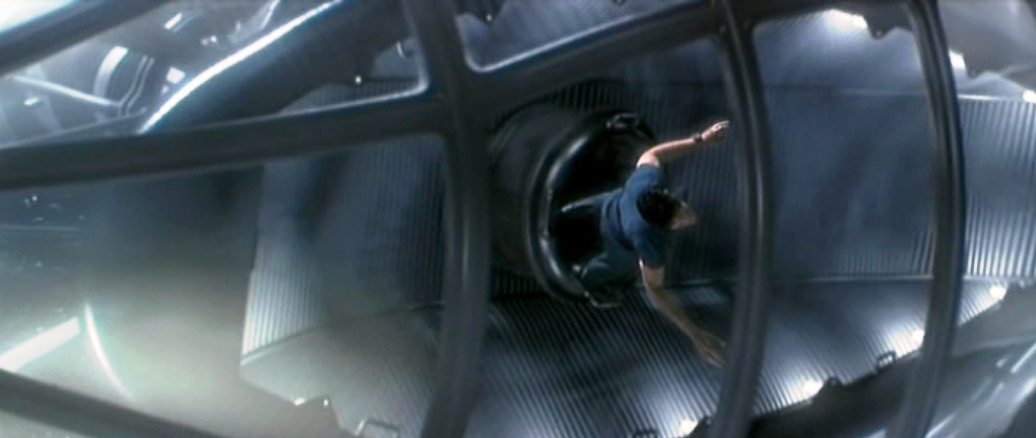
“I
like deep space…People tend to respect your privacy.”
In a few centuries, the rescue ship
Nightingale receives an emergency distress signal from Titan-37, an abandoned
mining operation on a rogue moon.
New to the ship is the co-pilot, Vanzant
(Spader), an ex-junkie who has earned the dislike of the ship’s doctor, Evers
(Bassett), in part because of her personal past with a violent junkie named
Karl Nelson.
After a dangerous jump, the ship’s
captain, Marley (Forster) is mutilated in his bio-protection chamber, and asks
to be killed. And the sender of the
distress call turns out to be the son of Karl Nelson, Troy (Facinelli).
While the ship’s crew tends to repairs from
the dimensional jump, and prepares to escape a nearby blue giant’s supernova,
the crew also learns that Troy has in his possession an unstable alien artifact…

“That
whole place is like a ghost ship.”
The
most notable aspect of Supernova’s story, perhaps, is its
dedicated repetition of the plot-points of Philip Noyce’s sea-based thriller, Dead
Calm. In that film, as you may recall, a couple played by Sam Neill and
Nicole Kidman go to sea following the death of their child, only to help out
the last survivor of a ruined vessel, played by Billy Zane. Zane’s character
turns out to be a dangerous psychopath, and he strands Neill’s character on his
useless old boat while he terrorizes Kidman’s character on the family yacht.
In
Supernova,
we also get the passenger from the ruined “other” location, in this case a
moon-based mining operation. The film also finds Spader’s lead character, Vanzant
marooned there, and fighting his way to get back to his ship, much as Neill did
in the earlier picture. Facinelli, like Zane, is a physically-fit, twitchy
psychotic who, before his reign of terror ends, has his way with a female
shipmate. Outer space, obviously, substitutes for the terrestrial high seas.
Supernova
has its problems
to be sure, but the idea behind it, of bringing Dead Calm into the
future, is not one of them. You may recognize the Dead Calm flourishes and
consider them derivative -- because they are -- but Supernova is also original enough to introduce
some new elements to the formula. In this case, it’s the presence of the ultimate
WMD, the alien artifact that elevates the film’s ending. The movie’s denouement,
which eschews our desire for closure, also leaves audiences to ponder what
might could happen in the brave new world following the finale.
There’s
also a present -- if irregularly enunciated -- through-line here about the
human race, or more accurately, human nature. Once rescued by the crew of the
Nightingale, the evil Troy/Karl tries to bring them around to his cause. He
promises them each five percent of the wealth he plans to acquire from the
alien artifact. He prizes monetary wealth, and is surprised that there are no
takers, save for Yerzy.
At
film’s end, uniquely, Vanzant and Dr. Evers are forced to share a biological
containment unit so as to survive the space jump away from the super nova. In
the process, they each swap 2.5 % of their DNA with the other. Add those figures up, and you have 5% percent,
Troy’s proposed figure for recompense.
The
notion here may be, simply, that one “treasure” may be more worthwhile or more
valuable than other. Troy promises material wealth to the crew, but at the risk
of everything, at the risk of the universe itself. By contrast, the biological transfer renders
Evers pregnant, ostensibly with Vanzant’s child.

Who
needs the magic of unstable, 9th dimensional matter, when human
matter can, likewise, “replenish” life, and in a way that is safe?
Finally,
Supernova
ends with a terrifying thought. The shock-wave from the supernova will
detonate the 9th dimensional bomb, and the ensuing shock-wave will
spread out, to all corners of the universe. It will strike Earth in fifty one
years, we are told. When it strikes, it
will either destroy the planet, or change the very nature of human life.
Supernova gives us no idea which outcome is
more likely, or what that change could be. But I’ve got to give the movie
credit for setting up an apocalypse that it never intends to depict, and asking
viewers to consider the possibilities.
Would
the shock-wave render all men and women physically powerful, but mentally
unhinged, like Troy? Or would it usher
in the very “leap in evolution” that
the mad Troy foresees? There are many ways that the movie could have ended. Troy
could have been killed. The ship could have escaped. There could have been a
final sting in the tail/tale. Instead, Supernova leaves audiences to ponder
the idea that a “wave” is coming for mankind, and that it is something he can’t
avoid. The future will be…different.

When
one couples this idea of some force changing man’s physical nature with the
moment early in the film in which Captain Marley (Robert Forster) discusses “violent animation” of the 20th
century (meaning Tom and Jerry), and calling it a “catharsis” that can, under
some circumstances, unleash “human malevolence,” the film’s theme starts to
become clearer.
Tom
and Jerry live in a world in which there are no physical limits or restraints.They
bash, bruise and bludgeon each other with that power, and do almost nothing
else. If the shock wave unshackles man from his biological restraints, will he
find a better use for that power than the animated cat and mouse, his artistic
creations, do?

A
further connection to the film’s leitmotif comes in characterization of the
ship’s computer, Sweetie. The ship’s
navigator, Benjamin (Wilson Cruz) attempts to over-write her programming when
under duress, when threatened with death by Troy.He attempts to unshackle her,
however, so she can kill. Again, there’s the notion here that without
“programming” (or biological) restraints, the universe tends to violence. Man creates Tom and Jerry and Sweetie the
Computer, and directs them both towards such that violence. What chance is there he won’t act violently
if transformed into a superman?
Supernova falters, largely, in that most
of the crew deaths seem to happen all at once, and without tremendous or even
modest distinction. Two crew members, one after the other, get ejected into
space without protection, and die there. Similarly, the battle scenes on Titan
and aboard the Nightingale seem claustrophobic and messy, but not in an
intentional or good way. The scuffles are virtually incoherent, and so some
sense of suspense is sacrificed.
There
are gaps in the storytelling too. Danika Lund is shown to be in an intense (and
apparently rewarding…) romantic relationship with Yerzy. So much so that they
are hoping to be approved as parents when they return home. They want to have a
child together. But after seeing Troy
naked (and with an apparently sizable erection), Danika makes love to him. She
does not seem to be under duress when she does so. She is not executing a strategy (as Nicole
Kidman’s character was, once more, in a similar scene in Dead Calm). Instead, we
have no understanding of why -- besides carnal lust -- she would sacrifice
everything to be with this (admittedly hot…) guy for the right fifteen minutes.

I’m not arguing that people don’t make impulsive decisions about sex all the
time, only that we don’t have a lot of insight into Danika’s character, and her
decisions. Does she feel trapped by Yerzy? Does she really not want children?
Is this her way of avoiding those responsibilities? It would be nice to have just a bit more
clarity in terms of character motivations. If we knew Danika’s reasons, we
might be able to fit them into the film’s larger puzzle or leitmotif. Sex, like violence, might be deemed the
result of our biological programming, and this aspect could have been explored
in the context of the rest of the film’s themes.
It’s
pretty clear that Supernova overcame incredible odds just to get to theaters,
and given the tumult of its production, it’s a little amazing that the film succeeds
to the degree it does. The silver-blue palette that suffuses the film gives it
a sense of visual consistency, and from time to time, the script really gets
close to expressing a meaningful thought about mankind, and what kind of creature
he is, or might become, given a giant leap forward.
It’s
no Sunshine
(2007), Pitch Black, or Event Horizon, but Supernova
occasionally shines very brightly. You
can either enjoy the flashes of ingenuity on their own terms, or curse the general darkness of the enterprise.
award-winning creator of the web series Abnormal Fixation (2024), the audio drama Enter the House Between (2023) and author of 35 books including Horror Films FAQ (2013), Horror Films of the 1990s (2011), Horror Films of the 1980s (2007), TV Year (2007), The Rock and Roll Film Encyclopedia (2007), Mercy in Her Eyes: The Films of Mira Nair (2006),, Best in Show: The Films of Christopher Guest and Company (2004), The Unseen Force: The Films of Sam Raimi (2004), An Askew View: The Films of Kevin Smith (2002), The Encyclopedia of Superheroes on Film & Television (2004), Exploring Space:1999 (1997), An Analytical Guide to TV's Battlestar Galactica (1998), Terror Television (2001), Space:1999 - The Forsaken (2003) and Horror Films of the 1970s (2002).
Movie Trailer: Supernova (2000)
award-winning creator of the web series Abnormal Fixation (2024), the audio drama Enter the House Between (2023) and author of 35 books including Horror Films FAQ (2013), Horror Films of the 1990s (2011), Horror Films of the 1980s (2007), TV Year (2007), The Rock and Roll Film Encyclopedia (2007), Mercy in Her Eyes: The Films of Mira Nair (2006),, Best in Show: The Films of Christopher Guest and Company (2004), The Unseen Force: The Films of Sam Raimi (2004), An Askew View: The Films of Kevin Smith (2002), The Encyclopedia of Superheroes on Film & Television (2004), Exploring Space:1999 (1997), An Analytical Guide to TV's Battlestar Galactica (1998), Terror Television (2001), Space:1999 - The Forsaken (2003) and Horror Films of the 1970s (2002).
Subscribe to:
Posts (Atom)

-
 Director Ridley Scott has already given the science fiction cinema two of its greatest and most cherished films: Alien (1979) and Blade...
-
 "Other Worlds lie outside our seeing; beyond the beyond; on the edge of within. The Great Pyramids: erected by the Ancient Ones as a ba...