Showing posts with label Hitchcock Binge. Show all posts

Friday, July 24, 2020

Hitchcock Binge: The Birds (1963)


Dig long and dig deep into the annals of horror cinema history, and you will likely excavate a dozen or more titles traceable directly back to Alfred Hitchcock's seminal "revenge of nature" movie, The Birds (1963). John Carpenter's The Fog (1980), about a small town overcome by a creeping mist appropriates the Marin County location; the "local color" of a small town in jeopardy, and the final siege set-piece. Or take, for example, George Romero's Night of the Living Dead (1968), another siege picture with desperate heroes barricading themselves (with hammers and nails...) inside an isolated farmhouse while the menace grows outside -- a concept nearly identical to the last act of The Birds. On and on, you can tally your catalogue. Films from Frogs (1972) to Kingdom of the Spiders (1977) to Day of the Animals (1977) to Shyamalan’s The Happening (2008) derive much of their energy, drive and central scenarios from The Birds.

This is so because the film compellingly depicts a crisis (a war with homicidal birds) but finds no empirical solution for the mystery, instead focusing the viewer's search for "answers" as it were, on the vicissitudes of human nature and the human heart. Thus, the technically accomplished film, a horror thriller of the first order, is both enticingly and alarmingly ambiguous at the same time, with no scientific or rational explanation for the birds' attack on mankind in scenic Bodega Bay. The lack of a scientific or rational explanation lends the film a powerful -- and undeniably sexual -- subtext; and that's the element of the piece to focus on. The bird attacks, one can detect upon close viewing, occur because of turbulent human emotions. Yep, it's all about the birds and the bees.


But first some reminders about the storyline. The Birds opens on a seemingly normal day in the early 1960’s with Melanie Daniels (Tippi Hedren) happening into a bird shop in scenic San Francisco. As she enters the shop, a flock of birds are seen in the distance amongst the skyscrapers: circling and cawing, but otherwise nonthreatening. This is a foreshadowing of what is to come; a "simmering" before the inevitable boiling.

Once Melanie is in the store, however, things do heat up (as we anticipate). Melanie attempts to pull a prank on a handsome man, Mitch Brenner (Rod Taylor) by pretending to be a bird shop employee. But Mitch -- who claims (critically) to be there to purchase two "love birds" -- is actually pulling a prank of his own, and soon gets the better of Melanie.

This game of cat and mouse spurs a veritable obsession in Melanie, and she soon tracks Mitch down to his home, sixty miles up the coast, in scenic Bodega Bay. a little hamlet described as a "a collection of shacks on a hillside." Her mission: to initiate a sexual relationship with Mitch, still more or less a stranger. Melanie does so under the guise of delivering him his love birds. Once in town, Melanie also meets the town's schoolteacher, Annie (Suzanne Pleshette), another woman who once shared an intimate relationship with the apparently promiscuous Mitch. There is a quick rivalry between Annie and Melanie, and some jealousy there too. Meanwhile, as Melanie grows closer to Mitch, she is looked upon with stern disapproval by Mitch's shrewish, controlling mother, Lydia (Jessica Tandy). Lydia is a cold, emotionally closed off woman, still despondent over the death of her husband years earlier.

And while all these tumultuous personal relationships shift and grow, the inexplicable suddenly occurs: birds of all varieties (sparrows, crows, gulls, etc.) launch a coordinated attack on Bodega Bay, ambushing the local school (killing Annie), dive-bombing the local diner, and laying merciless siege to Mitch's family farm house (reachable primarily by motor boat and therefore somewhat isolated).

In The Birds, Alfred Hitchcock forges fascinating connections between the film's primary love relationship and these bird attacks. In fact, he seems to suggest that the relationship is indeed the very thing manifesting the homicidal rage among our fine feathered friends. Hitchcock's visual storytelling and connections suggest -- albeit in subtle terms -- that the Mitch/Melanie coupling, their perhaps "unnatural" or "inappropriate" relationship (at least in Lydia's eyes...) is the very factor that has caused the sudden and alarming up-ending of Mother Nature, and set off the murderous birds. I find this "stealth" explanation fascinating, because instead of locating an answer inside science (which would inevitably play like techno-babble), Hitchcock finds motivation in us; in the way we relate to another; in the things, even, we keep hidden and buried away from one another.


The film's first bird attack triggers this nearly subconscious connection in a most artful way. Early in the film, Melanie takes a skiff out to Mitch's isolated farmhouse. She parks the boat, sneaks into his home (through an unlocked door...), deposits the love birds and makes good her escape. Right under Mitch's nose: he's in the yard but doesn't see Melanie approaching. There is no music at all in this sequence (as there is no music, actually, in the film), but the suspense grows almost unbearable in the lingering silence as Hitchcock deploys quick cuts, and a series of point-of-view receding zooms to depict Melanie's hasty and illicit retreat from the private property. We then see Mitch discover the intrusion, grab a pair of binoculars, look through them and -- bam -- he sees her! She's been caught!

The two lovers are thus face-to-face (over some distance) for the first time with the revelation that something romantic (something sexual...) joins them. We're so obsessed with this flirtation, with this game of cat and mouse, that we are caught totally off guard when a (huge) gull swoops into the frame -- out of nowhere -- and literally takes a plug out of Melanie's scalp. The vicious and unexpected attack causes blood to run down her forehead, and Mitch tends to her wound, but the overall impression of this bird attack is that it serves as metaphor for being dumbstruck by love (or more accurately, desire). Lust bitch-slaps you when you least expect it.

Later that night, after Annie and Melanie have shared a long discussion about their mutual and sordid histories with Mitch, a bird attacks the boarding house's front door. The target again, not surprisingly, is Melanie. The next day, the birds attack once more: this time dive-bombing a group of children (including Veronica Cartwright, playing Mitch's sister Cathy). Importantly, the attack follows a very intense, very intimate conversation between Mitch and Melanie on the hillside beyond the party. Again, the timing is crucial, as if the birds are desperate -- insanely desperate -- to stop the relationship before it progresses any further.

Later, in Lydia's presence, the birds attack once more, flying into Mitch's living room through a chimney. And it is here that the full Oedipal nature of the film exposes itself most fully. Lydia is a possessive old woman, a "clinging, possessive mother" who disapproves of Melanie and her son's lascivious interest in her. For example, Lydia complains to Mitch how Melanie was featured in the gossip columns the previous year for jumping naked into a fountain in Rome. This brazenly sexual act doesn't seem to bother the stimulated Mitch, but it certainly bothers the fearful and closed-off Lydia, a widower who fears "abandonment." So, the question becomes: is Lydia subconsciously orchestrating the bird attacks on Melanie? The first bird attack (near the cottage) could have been a general warning of "stay away." The second attack (at Annie's house) was a strike against two of Mitch's women, and the attack in the living room may have been a result of Lydia's uncontrollable rage at seeing the two lovers circle each other with such blatant and brazen sexual intent.

A later attack also supports this thesis. Lydia is sick in bed mid-way through the film (after witnessing the aftermath of a bird attack on a neighbor), and she pointedly asks Melanie to go to Annie's school to check on her daughter. Not coincidentally, when Melanie gets there, the birds launch an attack on the school. Not before she arrives. Not after her arrival. While she is there. So, was this a trap for Melanie created by Lydia's "id?" And when Melanie managed to escape it, remember, it was Annie (the secondary threat for Mitch's affections), who got offed by the birds. If you'll forgive the expression, Lydia may have been killing two birds with one stone, by sending Melanie to the school, where Annie also happened to be.

As film aficionados, we recognize that Hitchcock has toiled in overt Oedipal themes before, notably with Norman Bates in Psycho (1960). In that film, a mother's love reached from beyond the grave, in a sense, to twist her adult son into a psychotic. In The Birds, Lydia's desperate desire not to be abandoned, not to see Mitch go off with another woman, somehow precipitates the bird attacks, and lashes out at those she perceives as threats or dangers to her own emotional safety. This idea tracks throughout the film, particularly in the climax.

The film's final act finds Mitch, Lydia, Cathy (the sister) and Melanie sequestered in the boarded-up farmhouse as the birds attack in waves. Melanie, hearing a noise, separates herself from the group, and goes into an upstairs bedroom. There, in a sequence that evokes the cutting-style of the notorious Janet Leigh shower scene in Psycho, the birds relentlessly -- endlessly -- peck at Melanie. Rending and tearing her flesh and clothes. Ripping her apart. Ultimately, she is saved in the nick of time, but is badly wounded and bloodied. This sequence, the film's piece-de-resistance in terms of shock editing, essentially eliminates Melanie as a threat to Lydia, does it not? She falls into catatonia and shock for the remainder of the film (right through the end credits) and is therefore no longer a danger to Lydia's supremacy as the woman in Mitch's life. This sexually carnivorous woman has been, essentially, de-clawed and de-fanged. Or more aptly, her wings have been clipped. 

The last shots of the film thus depict Lydia accepting and nurturing Melanie (in the car), as the group attempts to escape; caring for as she would for a helpless child. With Melanie's sexuality all-but eliminated, there is no reason Lydia cannot "love" Melanie as she would a child. In some senses, this is actually a win-win because the film has defined Melanie as a person who lacked the love of a mother (the motivation, we are led to believe, for her acts of reckless sexuality). Now Lydia can play that role with her. 

Another clue about the underlying (and human-spawned) motivation for the bird attacks comes in a throwaway line of dialogue. A character comments that in the night sky, the moon is full. In mythology, the moon is often linked with a person's emotional gestalt, and here's the kicker: to their unconscious emotions. More trenchantly, in mythology the moon is closely associated with the mother, with -- according to Wikipedia -- "maternal instincts or the urge to nurture, the home, and the past." Understanding this, one might detect the hidden importance Lydia plays in this Hitchcockian narrative. Her unconscious desire to protect Mitch from a sexually carnivorous woman, to live in the past (when she was protected by an alpha male, not unlike Mitch) is cloaked just beneath the surface in the film; and one might argue, the reason why the birds go nuts.

Late in the film, a hysterical woman in a diner looks at Melanie with utter hatred and notes that she is the cause of the unnatural bird behavior. "They said when you got here, the whole thing started," she accuses Melanie. Well, she's right. Melanie's presence is the reason for the attacks, but Melanie is not causing the attacks herself. Lydia has detected her as a threat and managed to rally the birds against her. What we have in The Birds is an example of an overbearing Mother Human subconsciously directing Mother Nature to do her bidding.

Of course, this is all just a theory that happens to track with a close reading of the film, but The Birds is so admirable for the very reason that it leaves itself open to interpretation. No answers are given. Nothing is spoon-fed (unlike the newscast ending of The Happening; or even the talky coda of Psycho, for that matter). The film is littered with clues about the birds and the reasons for their attack, but as an audience, we are asked to interpret; to speculate; to add our own intellect to that of a master filmmaker. There are many reasons why The Birds is a horror classic, from the beautiful choreography of the bird attacks (including one utterly amazing bird's eye view of Bodega Bay as a coordinated assault is launched from the sky) to the surprising wit of the screenplay. But as with all great horror cinema, the real (and lasting) value of this film rests in what it has to say about us; about humanity and human nature.

An old Asian proverb goes: "a bird does not sing because it has an answer. It sings because it has a song." The angry, maddening song of the feathered ones in The Birds is written by the insecure id of frightened Lydia; but perhaps more importantly, it is one composed beautifully and artistically by that horror maestro for the ages, Mr. Hitchcock.

Wednesday, July 22, 2020

Hitchcock Binge: Psycho (1960)


Based on Robert Bloch’s 1959 novel, Alfred Hitchcock’s Psycho (1960) remains a turning point in the horror cinema for a number of significant reasons, but first and foremost because it knowingly and brazenly flouts the decorum of its age.  

Psycho features not only nudity, extreme violence, and the early death of a beloved protagonist played by Janet Leigh, it also happens to feature, on-screen, views of…a toilet.  


Today, all that -- especially the bit about a toilet -- doesn’t seem like much to get worked up about. 

But when the film premiered, Psycho unsettled audiences because its explicit failure to conform to conventional, Hollywood standards meant that all bets were off, and that, likewise, audiences could see and experience anything.  

Accordingly, Psycho’s audiences felt endangered. The narrow parameters of Hollywood decorum and standards of acceptability had sheltered them in previous movie-going experiences, and by deliberately treading outside of those parameters, Psycho suddenly possessed the capacity to shock on a new, previously unplumbed level.

Every now and then on Amazon.com or some horror site, you’ll read a review by someone very young who goes back to watch Psycho and just doesn’t get why it is important, or so revered. This viewpoint arises because Psycho, like all films, must be considered and examined in its historical context.  And some folks forget that fact.

Before Psycho, no one had seen anything like it.  

Since, Psycho, filmmakers have been using the same playbook for over fifty years.  

Some films and filmmakers have surpassed it, too, to be certain (Tobe Hooper and The Texas Chainsaw Massacre [1974], Brian De Palma and Sisters [1973], perhaps), but in its day Psycho shattered formula and blazed a new path. 

Yet the mere fact that other filmmakers have so often imitated the film's approach to its material doesn’t take anything away from what Psycho accomplished in the first place.

What makes Psycho truly great, even today is the manner in which Hitchcock meaningfully connects the film’s form and content. The narrative is shocking and unconventional, the imagery is shocking and unconventional, and, in fact, Psycho’s very structure is unconventional too. 

Virtually every decision Hitchcock makes as a filmmaker here -- save for the very last one (to restore order) -- thus creates and nurtures anxiety in viewers.

With its blunt looks at an unmarried couple having a sexual liaison, a brutal murder, and even a flushing toilet, Hitchcock -- frame-by-frame, shot-by-shot -- makes audiences feel that they crossing threshold after threshold. 

As the taboos fall away, so does any sense of confidence or certainty about what the filmmaker may show us. Psycho continues to impress today because of Hitchcock's virtuoso technique, but also because it moves with a kind of diabolical, elegant purpose.

And that purpose is, simply, to shoot down your defenses one at a time and, in the final revelation of Mrs. Bates' secret, leave you breathless and shocked.


“We’re all in our private traps.”

In Psycho, beautiful Marion Crane (Janet Leigh) wants very much to marry her boyfriend, divorcee Sam Loomis (John Gavin), but monetary concerns keeps him from committing to her.  

One day, at work, Marion is tasked with taking $40,000 dollars to the bank, but in a moment of desperation, she decides to steal the cash and flee town.

Marion escapes from Phoenix, AZ and even switches cars to avoid detection, looking forward to surprising Sam in his home-town, Fairvale.  

After a long drive, however, Marion decides to call it a day. She spends the night at the Bates Motel, a small, out-of-the-way establishment that stands in the shadow of a giant, dilapidated Gothic mansion.  

The motel is run by young, lanky Norman Bates (Anthony Perkins), a lonely man who apparently lives with his old, invalid mother.

When Marion shares a meal with Norman, she learns about his mother’s brutal treatment of him, and realizes how Norman has become trapped at the motel, and in an unhappy life. Marion vows not to trap herself, and decides to go home, return the stolen money, and face the consequences of her actions.

Resolved to set her life right, Marion decides to take a hot shower…


“This is the first place that looks like it’s trying to hide from the world.”

There’s a feeling, watching Psycho (1960), of viewing the world outside typical Hollywood parameters. 

Hitchcock fosters this feeling from the film’s earliest shots. After a pan across the city of Phoenix, and arriving, finally, at a cracked hotel window, Hitchcock’s camera sneaks in through that narrow portal, exploiting the opening to reveal two attractive – unmarried -- young people (Marion and Sam) after an afternoon of love-making.  

It’s as though, from the very start, Hitchcock not only pries open a literal window, but the metaphorical window of Hollywood standards and practices.


Hitchcock's other choices in vetting this adaption of Bloch’s novel are just as startling. First, he unsettles the audience by fracturing the role of the protagonist.The audience's focal point of identification in most Hollywood thrillers is one person: a man or woman who follows the predictable arc of increased learning and ascending knowledge as the three acts progress satisfyingly to a conclusion. 

The arc of "learning" on the part of the movie audience, presented through the experiences of the lead character, is usually a straight line traveling up and up, until, by the movie's denouement, the character and the viewer reach an apex, or zenith.  Apotheosis has occurred. Audiences have learned everything they need to know to understand the film's narrative, theme, and message.

But in Psycho, the protagonist role is unconventionally splintered into three or even four characters: Marion Crane (Janet Leigh), Arbogast (Martin Balsam), Lila Crane (Vera Miles) and Sam Loomis (John Gavin). 

Learning still occurs over the course of the film’s plot, and the audience still attains that final plateau of knowledge through a psychologist's detailed and clinical "explanation" of Norman Bates' psychosis.  

Yet importantly, the process of learning is fractured and jumbled by the three acts and the changing point of audience identification. Each protagonist dominates center stage, very roughly, in one particular act.  

Marion does so in the first. 

Arbogast assumes that role in the second. 

And finally Lila and Sam become the point of identification and the hub of learning in the final act. We especially fear for Lila and Sam’s safety because we have seen, in gory detail, what has become of Marion and Arbogast, our two earlier leads.

Since Psycho revolves around schizophrenia -- around a splintering of a single mind into more than one individual -- the film's very structure actually reflects this state of existence not only in its villain, Norman/Mother, but in the variety and differentiation of its protagonists.  

In some sense, it's as though Hitchock is trying to impress this schizophrenic state upon us, the audience. We are asked to meet, accept, follow, root and then grieve for one protagonist after the other.

In simple terms, then, Hitchcock punishes the audience -- and ruthlessly unsettles it -- for emotionally investing in the characters. 

First, Hitchcock makes the audience fall in love with adorable and sexy Marion Crane through her ongoing interior monologue during an extended road trip. This soliloquy of sorts regards the theft of 40,000 dollars, and what the acquisition of the money and the perpetrating of a crime could mean for her life personally, professionally, and legally. Marion berates herself and mocks herself in these passages, like we all do when we talk to ourselves.


The device of the interior monologue, in conjunction with the preponderance of gorgeous close-ups during these moments in the car, actually accentuates the feeling of connection to the character and her plight. 

And of course, that forging of a close emotional connection is intentional. Hitchcock wants audiences heavily invested in Marion's imagination, her potential, her crime; the very things that make her human and therefore sympathetic. In other words, the director sucks us in with a likable character and her crisis.

And then, Hitchcock rips Marion, the star of the movie, away from the audience in the notorious shower scene. 

We watch helplessly as all our expectations and hopes for Marion -- namely that she will return the money, seek a life with Sam, and escape her personal purgatory or trap -- run down the tub drain with her spilled blood.  


Suddenly, everything the audience has taken for granted as "important" in Psycho, including Marion's dilemma regarding stolen cash is now rendered, categorically, unimportant. 

The result? The audience is rudderless.  Vulnerable.  

The only thing left to cling to, again, is that stolen cash, and the hope that another human being, perhaps sweet, harmless Norman, will find it and use it to escape from his trap, from his Mother.

The movie goes on, and the audience still feels lost without Marion. Thus it soon seizes on laconic, world-weary Arbogast as the focal point of identification. 

Yeah, he's the guy who's going to get Norman's Mother and set things right, for the memory of Marion.  He's got the chops.  He's got the professional background.  No one's going to pull the wool over his eyes. 


And then Hitchcock violates traditional narrative structure and decorum again.  He pulls the exact same trick a second time.  

He kills Arbogast before our eyes in another visually dazzling murder scene, set this time upon a staircase. And for a second time, the audience loses the focal point of identification.

Finally, identification transfers to Sam and Lila, but by this point -- on a first viewing of Psycho, anyway -- the audience is surely thinking "fool me once, shame on you; fool me twice, shame on me," and therefore reluctant to embrace this couple, not out of loyalty to the dead; but out of the fear that, for a third time, Evil will triumph.  

Is there another reason it is difficult to warm to Lila and Sam?  Absolutely

They begin to seriously question and threaten Norman Bates, but at this point in the proceedings, the audience is still invested in him and his escape from the motel, and from his twisted, overbearing Mom. Viewers don't want to see Norman railroaded for what they believe his mother did.  They think Sam and Lila are barking up the wrong tree.

The unconventional presentation of the protagonists and antagonists in Psycho is all part of Hitchcock's masterful manipulation, his gleeful manner of misdirecting attention and subverting expectations. Yet he doesn't merely subvert by way of conveying story points; he does it via the actual narrative structure; by exploding movie conventions. 

The "Janet Leigh" trick as I sometimes call it, isn't the only trail-blazing, convention-shattering aspect of Psycho.  It's harder to appreciate this second factor given the direction of our culture since Psycho, but Hitchcock further shatters Hollywood decorum by revealing to the audience shocking imagery it had not often, if ever, seen depicted before. Things like an afternoon, pre-marital assignation in a cheap hotel room between Sam and Marionor, simply, a toilet being flushed.

And then there’s the notorious shower scene.


Arriving in 1960, Psycho broke a critical rule/taboo in film history. It showed a vulnerable person virtually nude in the bathroom and then depicted that character brutally murdered in nothing less than a murderous frenzy.   

Many film critics and Hitchcock scholars have written expertly and at length about the staging and cutting of the Psycho shower scene, but the important thing to remember is how it plays

It is a visualization of frenzy, rage, and madness at close-up range. The helter-skelter pace of the shock editing and the very closeness -- intimacy? -- of many shots transmits the inescapable impression of a trapped animal being murdered in a blinding, fury-filled rage.  

Before Psycho, no one had ever seen anything like this. Violence, close-up, with adroit film technique embodying psychosis and powerful anger. And we weren't seeing a bad guy or some random character being killed.  Rather, a woman whom we had, as viewers, fallen in love with. To dispatch Marion when she is vulnerable, when she has so many reasons to live, and to do it in such indecorous, nay un-chivalrous, fashion, is...bracing to say the least.  It's a literal shock to the system.

The presentation of Norman Bates (Anthony Perkins) represents another shattering of tradition too.  Hollywood often lives by the edict that what is beautiful must also be good. And young Anthony Perkins, like Janet Leigh, is certainly beautiful. He is innocent, boyish, graceful, handsome and charming.  Simultaneously, he is a brutal murderer when "possessed" by Mother Bates. The film asks us to countenance competing visions of Norman, that he can be both innocent and guilty; a good boy and a very naughty boy at the same time. 


In large part, Hitchcock was able to get away with this complexity involving the characters, and particularly with Norman, because of the burgeoning popularity of pop psychology in the American culture of the 1950s and 1960s. Horror films such as The Bad Seed (1956) began to ask very pointed questions about human "monsters," thereby exploring the eternal nature vs. nurture debate. To a very large extent, that's the terrain as well of Psycho.  Norman is a good boy, perhaps, by nature. But a very bad boy via nurture, by his mother's parenting. Nurture is stamped over nature, in his case, and the result is psychosis.

This focus on human psychology represents an important turning point in horror history: a period wherein supernatural and fantasy can be subtracted from the genre formula and the human being can take his -- rightful? – role as the pre-eminent "Monster" in the cinema, thus paving the way for a slew of slashers and serial killers. 

Indeed, this is the point in horror history where many "monster" horror movie fans cut bait: preferring their monsters as more fantastical creations like vampires, Gill Men, or the Mummy.


Here, in Psycho, Dracula’s castle still lurks large in the frame, in the form of the Gothic Bates House, but the monster lurking inside is purely of man’s nature, not of the supernatural

Despite its brilliance and trailblazing, Psycho end with nod to decorum and tradition. Hitchcock closes the film with a restoration of the sense of order. 

Norman is captured, processed, categorized, diagnosed and understood. A psychiatrist, played by Simon Oakland, explains everything. In this way, an audience might leave a showing of the film knowing that it need not be afraid in real life. The good guys still come out on top; the dangerous bad guy is punished, or at least apprehended. 


In the years following Psycho, directors like Tobe Hooper and Brian De Palma would go even further than Psycho to break established movie decorum. Hooper denied the audience (and Chainsaw's characters) the act of learning in toto; and in Sisters, De Palma did not bother to re-establish order, instead leaving the film's heroine a confused amnesiac.

But those bold, innovative steps in the genre could not have been broached had Hitchcock not re-written the rules of the game first, with Psycho.   

If you ask yourself why the 1998 remake of Psycho failed, the answer rests not just with re-casting.  It is not only because of color photography. It is not, even, because of Hitchcock's absence in the director's chair. These are all factors, of course. But that notable failure occurred because that remake failed to re-structure its narrative and format in a pioneering fashion; in a way that would have actually honored Hitchcock and the spirit of the original film. 

Thirty years after Hitchcock fooled everyone, nobody was going to be taken in by exactly the same bag of tricks  Chainsaw and Sisters are more valid remakes of Psycho, in the sense that they pursue the same aims, the shattering of standing conventions and decorum.

Despite over a half-century of imitators, Psycho is still a standard-bearer for the genre because of its historical context.  Also, on a recent re-watch, I felt too that the film had something very valuable to share with audiences about human nature. It’s sometime easy not to look at the film’s actual story, because Psycho’s form is so exemplary.

Yet pay close attention, and one starts to see how Psycho is the story of how the things we do to achieve happiness don’t actually bring us happiness. 

In Psycho, we see that people will steal, fuck, and commit murder in attempts to find happiness.  Instead, invariably, they find “traps” of their own making, not freedom, or satisfaction.  Marion created a shit-storm for herself by stealing forty-thousand dollars. But she did it because she wanted to be with Sam…and he needed money. 


And Norman is so desperate to feel happy again that he has resurrected his “mother” as a hectoring, violent shrew. He has re-imagined her as a jealous lunatic, and now once he has her back, he can’t get rid of her. She has taken over a part of his very mind.


Again, there seems to a corollary visual to go with this idea.  Marion finds a point of clarity on the road. She drives through the rain, through a storm, and comes out the other side. After the deluge, she should be cleansed, free. 

But the place she ends up is the Bates Motel: a location not where she will turn her life around, but die violently. The message seems to be that the plans we make are the very thing that lead us to destruction. 

Or, to put it in proverbial terms, Man proposes and God disposes.

Today, we all know the stylistic twists and turns that make Psycho such a classic horror film, but one need re-watch again it to remember clearly the feelings it engenders. We feel real loss when Marion is killed and Norman, despite his insanity, is a little boy lost who holds our sympathy. Their “private traps” are terrifying ones, but also ones that, surprisingly, still affect us on an emotional level fifty years later.

Tuesday, July 21, 2020

Hitchcock Binge: Strangers on a Train (1951)


Lives and deaths "crisscross" in master-of-suspense Alfred Hitchcock's taut Strangers on a Train (1951), a classic black-and-white thriller that unfolds like an extended tennis match between evenly matched and opposite contenders.

On one side of the court, we have Guy Haines (Farley Granger), a likable if deadly-serious up-and-coming tennis star. He's unhappily married, and his cheating wife, Miriam (Kasey Rogers) is pregnant with another man's child. Guy wants a divorce so he can escape Miriam, as well as his unhappy life in small-town Metcalf; but also so he can be with his beautiful Washington D.C. girlfriend, Anne Morton (Ruth Roman). She's a Senator's eldest daughter, and Guy wants a career in politics.

On the other side of the court, we have Guy's nemesis, Bruno Anthony (Robert Walker), a flamboyant playboy-type who "sometimes goes too far" in his obsessions (according to his dithering, clueless mother.) Bruno dreams of murdering his overbearing, disapproving father, a wealthy local aristocrat. Anthony is everything Guy is not: frivolous, un-serious, and deeply, deeply unstable. He's also brash, and seemingly unafraid of legal or social consequences for his actions. Life (and death) seems like nothing but a game to Bruno.


The "court" on which these diametrically opposed strangers first meet is, as the film's title announces, a train. To set up the ensuing "match" between these players, Hitchcock determinedly cuts (after views of "crisscrossing" railroad tracks), to opposing shots of the players' feet heading in clashing directions. In fact, it is their feet that make the inaugural contact between the two men, a would-be Larry Craig moment with homo-erotic undertones. The somewhat antiquated British term "cottaging" concerns foot signals among gay or bisexual men indicating sexual desire (often in public places like train stations), so Hitchcock's choice to focus on feet touching in public on a train as mode of initial contact between Guy and Anthony is significant and provocative.

After their feet collide in a train passenger car, Bruno strikes up a probing, flirtatious conversation with Guy. "I have a theory. You should do everything before you die," he says. 

Then - aware of Guy's problem with Miriam from the newspaper gossip pages - Bruno offers his theory of the perfect murder. It comes down to this simple plan: two fellows -- with no connection -- meet and swap something...intimate. No, not fluids, but rather murders. It is specifically, as Bruno describes the strategy, a "crisscross." Bruno will murder Miriam for Guy, thus leaving no trail back to Guy for the police to follow. And Guy will murder Anthony's father, doing the same for him. This makes sense because, as Anthony points out, it's always "the motive" that trips up a murderer. In this case, there is no motive.

Weirded out by this overly friendly stranger, Guy excuses himself from Bruno's presence, but Bruno manages to pocket Guy's engraved lighter, which reads: "From A to G." (Meaning from Anne to Guy). As many critics have also pointed out, this inscription might also mean, sub-textually, from Anthony to Guy, another indicator of the under-the-surface, homosexual relationship between the men. Also branded on the cigarette lighter is a significant image: two tennis racquets are "criss-crossed." Just like the lives of these two players.

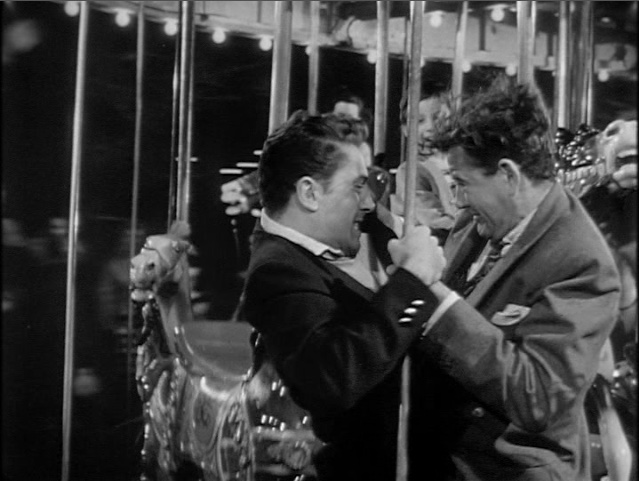
Bruno then takes it upon himself, without any encouragement from Guy whatsoever, to go forward with his plan; to kill Miriam. Bruno hops a train to Metcalf, and stalks Miriam at a local amusement park. In one clever scene, Bruno boards a boat called "Pluto" and pilots it through the tunnel of love, following Miriam out to an isolated island with her two-would-be-suitors/lovers. The name of the boat, Pluto, is significant since in Roman lore, Pluto was the god of the underworld, one technically associated with the grave or with death. The name of his boat thus associates Bruno with the act of murder. Similarly, the Pluto of myth was a son of the child-eating Saturn/Cronus, a character who symbolizes a domineering father. Again, this is a perfect connection to Bruno, since he desires to purge himself of his father. Like mythic Pluto, Bruno is a vengeful son.


Throughout the scene at the carnival, leading up to the violent strangulation of Miriam, the sexual imagery crafted by Hitchcock proves quite potent. The "loose" Miriam immediately sends non-verbal signals to Bruno that she wants to have sex with him. She seductively licks an ice cream cone, her eyes never leaving Bruno's. In return, he reveals his strength and prowess, wielding a hammer to pound a weight all the way to the top of a marker tower (a clear phallic symbol). Then, in a wickedly edited series of shots equaling foreplay, Hitchcock's camera equates the riding of horses on a merry-go-round with the riding act of intercourse. Bruno, atop one horse, is leaning forward aggressively, in the superior or dominant position. In the very next shot, Miriam (who is shot slightly from behind), seems to be presenting or receiving. These two shots -- in combination -- indicate the desire Miriam and Bruno apparently share.

Finally, as Bruno strangles Miriam, we watch the murder through one lens of Miriam's fallen glasses. Why just one?

Because Strangers on a Train is a story vetted through two perspectives, two worldviews, two lenses. Guy's and Bruno's. Here, in the case of the choking death of Miriam, we are seeing exclusively through Bruno's eyes. It's a view (or vision...) that also comes to haunt him, as he equates eye-glasses with the murderous act he conducted in lover's lane.


Bruno soon ends up at Guy's house in Arlington, and tells him what he's done. Throughout the scene, Guy and Bruno are both positioned (physically) behind the bars of a gate, a visual cue to the possibly consequences of their relationship (prison bars), and an indicator that Guy has become trapped by his "chance" encounter on the train with Bruno. He cannot simply report Bruno to the police for Miriam's murder, because Bruno promises he will name Guy as a co-conspirator. Finally, Bruno gives Guy an ultimatum: kill Bruno's father, or face the consequences. In this section of the film, with Bruno stalking Guy, Hitchcock utilizes another great visual touch that lends new meaning to the tale.

Bruno, in essence, becomes an immovable object. And as we see, an immovable object holds all the power (just like Bruno does). Watch how Bruno is carefully positioned in the frame of several shots. He is absolutely still, unmoving, like a statue. In one extreme long shot, we see Bruno standing silently on the steps of a Federal-style building (between pillars), just watching Guy...from an extreme distance. He is a menace at a distance; a storm-cloud on the horizon. Threatening...

In another shot, Bruno is positioned amongst a large audience watching a tennis match. Everyone in the audience is following the match, except Bruno...who is looking right at Guy. Making eye contact. The "heads" of the audience members ping-pong back and forth comically (left to right; left to right;) avidly tracking the back-and-forth of the tennis match, but Guy is totally and completely still. By keeping Bruno immobile, centered, Hitchcock visually expresses the notion that he is strong, unaffected by what is around him; a singular force to be reckoned with.

And that's exactly the right approach to take, because it is indeed Bruno who now holds all the power in the relationship with Guy. One word from Bruno and Guy is "outed." Fingered. Guy, like Bruno will be labeled a deviant, a criminal. And again, it doesn't take much to understand the sexual or social subtext here. How Guy wants to keep his "relationship" with Bruno a secret, in terms of 1950's social mores and culture.

In the climactic portion of the film, Bruno realizes that Guy will never "follow through" with their relationship (!) and complete the crisscross, killing his father. So, Bruno decides to drop Guy's monogrammed lighter at the scene of the crime (the lover's lane where he killed Miriam) to implicate him. As Bruno hops a train to Metcalf, Hitchcock cuts to an increasingly tense, increasingly fast-cut tennis match between Guy and an opponent. Guy wants to finish off his competitor quickly so he can get to Metcalf and stop Bruno, but there are reverses, surprises and delays.

The entire scene becomes an exercise in generating suspense. Hitchcock perfectly deploys the art of cross-cutting here, and there is one brilliant moment - a surprise - that finds Bruno accidentally dropping the lighter down a grate under a sidewalk. Almost immediately after this stunning accident, the film cuts back to Guy and we hear the words "game, set, match." We think it's over. Fate has intervened on Guy's behalf. But then there's another reverse...a physical feat from Bruno as impressive in dexterity as Guy's tennis. And it's here - watching the ball go from Guy's court to Bruno's and back - that you fully realize how Hitchcock has structured the entire film as a visual tennis match, a fierce competition in which Guy and Bruno hurl the initiative back and forth at one another. 

From the tennis match and cross-cutting to the stirring denouement of the film (culminating with an exploding merry-go-round) you will find yourself riveted, unable to look away, unable to disengage or even truly intellectualize what you are seeing. This scene serves as a remarkable example of Hitchcock's oft-noted capacity to play the audience like a piano. The characters have gone from crisscross to deadly, fast-moving circle (as represented by the runaway merry-go-round, spinning in fast motion). That too seems appropriate. At this point the dance between Guy and Bruno (a battle of opposites; a battle of lovers; a battle of doppelgangers, a battle of reflections) is so intricate, so complex, that it can't be untangled. So the two men spin and spin, locked in combat, until the spinning itself can't be sustained either and there's a massive...er...explosion.

Strangers on a Train more than lives up to its reputation as a compelling thriller. Robert Walker is the stand-out in the cast here, portraying an early screen stalker who diabolically straddles the line of charming-obnoxious-creepy without missing a beat. Yet -- as is universally the case when Hitchcock is involved -- the director is the real star of the picture. Hitchcock has cleverly taken the story of two strangers "criss-crossing" and transformed it into something much deeper; and much more disturbing. Murder is the game Anthony plays, one suspects, when he'd rather be playing...something else. After his last bluff, the lighter with those letters on it slips out of Bruno's clutched hand, finally, and the contest of wills is over.

From Anthony to Guy. Game. Set. Match.

40 Years Ago: Howard the Duck (1986)

In 1986, the comic-book adaptation  Howard the Duck  -- executive-produced by George Lucas -- landed in movie theaters with a splat.   The f...