Subscribe To JKM


 Posts
All Comments
Posts
All Comments
Showing posts with label 2012. Show all posts
Showing posts with label 2012. Show all posts
Friday, February 24, 2017
Movie Trailer: Sinister (2012)

 award-winning creator of the web series Abnormal Fixation (2024), the audio drama Enter the House Between (2023) and author of 35 books including Horror Films FAQ (2013), Horror Films of the 1990s (2011), Horror Films of the 1980s (2007), TV Year (2007), The Rock and Roll Film Encyclopedia (2007), Mercy in Her Eyes: The Films of Mira Nair (2006),, Best in Show: The Films of Christopher Guest and Company (2004), The Unseen Force: The Films of Sam Raimi (2004), An Askew View: The Films of Kevin Smith (2002), The Encyclopedia of Superheroes on Film & Television (2004), Exploring Space:1999 (1997), An Analytical Guide to TV's Battlestar Galactica (1998), Terror Television (2001), Space:1999 - The Forsaken (2003) and Horror Films of the 1970s (2002).
Friday, February 12, 2016
Movie Trailer: Muirhouse (2012)
award-winning creator of the web series Abnormal Fixation (2024), the audio drama Enter the House Between (2023) and author of 35 books including Horror Films FAQ (2013), Horror Films of the 1990s (2011), Horror Films of the 1980s (2007), TV Year (2007), The Rock and Roll Film Encyclopedia (2007), Mercy in Her Eyes: The Films of Mira Nair (2006),, Best in Show: The Films of Christopher Guest and Company (2004), The Unseen Force: The Films of Sam Raimi (2004), An Askew View: The Films of Kevin Smith (2002), The Encyclopedia of Superheroes on Film & Television (2004), Exploring Space:1999 (1997), An Analytical Guide to TV's Battlestar Galactica (1998), Terror Television (2001), Space:1999 - The Forsaken (2003) and Horror Films of the 1970s (2002).
Thursday, February 11, 2016
Cult-TV Flashback: Hemlock Grove (2012 - 2015)

Earlier
this week, a reader here on the blog asked me for my thoughts about Netflix’s Hemlock
Grove (2012 – 2013), the Eli Roth-produced horror TV series based on Brian
McGreevy’s novel.
I
have watched the first half-dozen episodes of the first season twice, so my
knowledge is based on those episodes and my double viewings of them.
My
conclusion at this juncture is that the series is somewhat inconsistent in tone
and approach.
Sometimes
it is well-acted; sometimes not.
Sometimes
Hemlock
Grove is fascinating and visually-daring…even crazy.
And
sometimes Hemlock Grove qualifies, actually, as droning and tedious.
There
were times I had a hard time staying tuned to the action on-screen, which is why I watched the episodes
twice.
At
this juncture, I cannot report accurately whether this sense of muddled inconsistency or
uneven-ness recurs later in the series’ run… only that the episodes I saw
vacillated wildly between curious strangeness and tiresome cliché.
I
will readily admit that perhaps I didn’t watch enough episodes to find the series' “vibe”
resonant, or to fall in love with the characters. The central mystery is pursued
with such haphazard, variable, irregularity that it did not hook me, either.
Again,
this is my critical evaluation based on what I viewed. The aforementioned blog reader made n interesting case for the
program’s virtues, and two pod-cast hosts that I know and respect greatly lauded the
series to me as well.
I
made the mistake of dismissing The Vampire Diaries (2009 - ) after
the pilot episode, some years back, and don’t wish to make the same error here.
All
I can write is that based on my admittedly-limited viewing of the first season, Hemlock
Grove proved more uneven than enticing.

Hemlock
Grove is the
tale of two young men in a Pennsylvania town: a 17-year old gypsy werewolf,
Peter Rumancek (Landon Liboiron), and Roman Godfrey (Bill Skarsgard), an “upir” or vampire.
They become uneasy
friends and soon work together to solve a mystery: a series of vicious animal-attack style
murders in Hemlock Grove.
The
series, which ran for three seasons, is a
soap opera in its structure and narrative development, and also concerns a
young woman, Letha (Penelope Mitchell) who believes she has been impregnated by
an angel. Others fear she may have been raped.

Meanwhile,
there’s a deeper background to the story as well.
Roman’s sister, Shelley (Nicole Boivin) is a
deformed young woman and outcast. And Roman’s mother, Olivia Godfrey (Famke
Janssen) is having an affair with her former brother-in-law, Norman Godfrey
(Dougray Scott), who works at the mysterious Godfrey Institute of Medicine.
Meanwhile,
Peter’s mother, Lynda (Lili Taylor) also seems to possess some secrets, as well
as a healthy dislike for Olivia.

What
I admire most about Hemlock Grove is the series’ setting.
The
town itself has become a zombie, or undead.
The
rust belt location once thrived as the home of a successful steel mill. But
once the economy took a down-turn, industry and manufacturing died, thus
leaving the town’s denizens stumbling on futilely, trying to figure out where they
belong and how they can live.
The
new “industry” in town, --which hovers on the cutting edge of bio-medicine/and
bio-abomination “science run amok" -- has replaced the rust belt soul of the town
with something, then, that the citizens fear and dread.
There
are a few shots in Hemlock Grove which reflect this new reality.
We see the apricot,
autumnal nature of the town and its lush landscape, but then this strange,
white, high-tech ominous tower occludes the sky-line. It’s like a cyborg growth or blot
on the town’s natural horizon.

The
“feel” of Hemlock Grove, based on my viewing so far, is part-Twin
Peaks (1990-1991), part film-noir.
The episodes I watched seem to embody
the notion, oft-seen in noirs that though you may be done with the past, but
the past is not done with you.
The older, established generation here -- represented
by characters played by Janssen, Scott, and Taylor -- seems dissolute, corrupt, and trying
desperately to overcome old secrets and old hatreds.
The
past, in some sense, is the “real” monster portrayed in the series.
The
younger generation, though embodied literally by vampires and werewolves, seems
like Hemlock Grove’s best hope for a better future.
The
friendship between Peter and Roman is intriguing, and it doesn’t progress
predictably, which is a quality I appreciated very much.
Roman, for example, learns that Peter is a werewolf,
and asks to watch him transform.
Peter
-- for reasons not entirely known even to himself -- agrees.There’s a certain
homo-erotic tension in the relationship overall, but certainly in that moment
of transformation, featured in episode 2, “The Angel.” There’s an electric
feeling of discovery between the two characters, and it isn’t exactly platonic.
Instead,
Roman watches, wide-eyed, as Peter strips down nude, and the transformation
occurs.
Then, in a perfect example of how Hemlock Grove shifts tones radically
moment to moment, the werewolf Peter devours his own cast-off human flesh right
on camera. The series is erotic one moment, and visceral Grand Guignol the next.

That equation probably sounds like it could be terrific, but the pace and plotting are so damn languid.
Individual moments are spiky and weird and
memorable, but overall the series feels like it is on David Lynch-styled cruise
control or automatic pilot, only without benefit of Lynch’s guiding intellect or strange sense of humor. The series even flirts with his trademark "dream sense," but again, it feels applied haphazardly.
Hemlock
Grove is definitely of the Wolf Lake (2002),
Twilight (2008 – 2011), Vampire Diaries (2009 - ), Teen
Wolf (2011 - ) monster school or genre, but it also attempts to
distinguish itself from that competition through its off-kilter
sensibilities.
Two
things result from the series’ off-kilter nature, I reckon.
One,
Hemlock Grove doesn’t feel teeny-bopperish, as one might legitimately fear, considering the milieu. The show is many things, but the vampires aren’t
glittery, and the werewolves aren’t mere boy toys.
The
other result is that Hemlock Grove feels off-putting and
impenetrable at times -- at least as far as I got into the continuity. I found this approach distancing.
Hemlock Grove ended after three seasons of about a dozen episodes per year, and my understanding is that those who stuck with it really enjoyed it.
That's as it should be.
For me, the episodes that I watched had some great promise, some amazing scenes, and a hell of a lot of weirdness for, apparently, weirdness sake.
Hemlock Grove?
Not your average destination spot, but a little too bizarre and sleepy for my tastes.
award-winning creator of the web series Abnormal Fixation (2024), the audio drama Enter the House Between (2023) and author of 35 books including Horror Films FAQ (2013), Horror Films of the 1990s (2011), Horror Films of the 1980s (2007), TV Year (2007), The Rock and Roll Film Encyclopedia (2007), Mercy in Her Eyes: The Films of Mira Nair (2006),, Best in Show: The Films of Christopher Guest and Company (2004), The Unseen Force: The Films of Sam Raimi (2004), An Askew View: The Films of Kevin Smith (2002), The Encyclopedia of Superheroes on Film & Television (2004), Exploring Space:1999 (1997), An Analytical Guide to TV's Battlestar Galactica (1998), Terror Television (2001), Space:1999 - The Forsaken (2003) and Horror Films of the 1970s (2002).
Friday, August 07, 2015
Beach Week: Movie Trailer: Shark Night (2012)
award-winning creator of the web series Abnormal Fixation (2024), the audio drama Enter the House Between (2023) and author of 35 books including Horror Films FAQ (2013), Horror Films of the 1990s (2011), Horror Films of the 1980s (2007), TV Year (2007), The Rock and Roll Film Encyclopedia (2007), Mercy in Her Eyes: The Films of Mira Nair (2006),, Best in Show: The Films of Christopher Guest and Company (2004), The Unseen Force: The Films of Sam Raimi (2004), An Askew View: The Films of Kevin Smith (2002), The Encyclopedia of Superheroes on Film & Television (2004), Exploring Space:1999 (1997), An Analytical Guide to TV's Battlestar Galactica (1998), Terror Television (2001), Space:1999 - The Forsaken (2003) and Horror Films of the 1970s (2002).
Friday, March 06, 2015
Movie Trailer: REC 3: Genesis (2012)
award-winning creator of the web series Abnormal Fixation (2024), the audio drama Enter the House Between (2023) and author of 35 books including Horror Films FAQ (2013), Horror Films of the 1990s (2011), Horror Films of the 1980s (2007), TV Year (2007), The Rock and Roll Film Encyclopedia (2007), Mercy in Her Eyes: The Films of Mira Nair (2006),, Best in Show: The Films of Christopher Guest and Company (2004), The Unseen Force: The Films of Sam Raimi (2004), An Askew View: The Films of Kevin Smith (2002), The Encyclopedia of Superheroes on Film & Television (2004), Exploring Space:1999 (1997), An Analytical Guide to TV's Battlestar Galactica (1998), Terror Television (2001), Space:1999 - The Forsaken (2003) and Horror Films of the 1970s (2002).
Friday, September 26, 2014
From the Archive: Dredd (2012)

The great age of science fiction
movie dystopias occurred from the 1970s to the early 1980s. During that span -- from roughly 1971 to 1981
-- audiences witnessed dystopias involving over-population (Z.P.G.
[1972], Soylent Green 1973]), hippie communes (Zardoz [1973]) fascist computer
control (Logan’s Run [1976]), and even rampant crime (Escape
from New York [1981]).
John Wagner and Carlos Ezquerra’s
future cop, Judge Dredd, arose from
that historical period. The character
first appeared in the British comic-book anthology 2000 AD in the year
1977. In the comic-book universe, the fearsome,
always-helmeted Dredd patrolled the mean streets of Mega City One on his law-master
motorcycle, carrying his lawgiver pistol.
He was a policeman, judge, jury and -- if need be -- executioner.
The dystopian milieu of Dredd was
first adapted to film in 1995, with Sylvester Stallone in the lead role. But Judge
Dredd was poorly received in large part because it watered down the
hardcore nature of Dredd’s dystopia.
In the Stallone film, Dredd often
removed his helmet, took time to romance a fellow judge, and had a comedic
sidekick played by Rob Schneider. The
film seemed more concerned with fanciful, stereotypically “future” touches and
comic relief than with the creation of a
real sense of place. Instead of a
legitimately artistic vision, the 1995 film had the word “blockbuster” written
all over it. And there’s nothing more
depressing than a film that homogenizes its source material in the hopes of
being commercial…and then fails in that endeavor.
The same criticism could never accurately
be applied to the compact, concise, and visually-dazzling Dredd (2012), the recent cinematic
adaptation of the same comic-book material.
This new version of the
comic-book material is a breath of fresh air in a movie culture that eschews purity
of vision in hopes of satisfying the widest possible demographic coalition. The film’s script is spare, satirical, and
relentlessly sharp. Furthermore, Dredd
is unburdened by unnecessary settings, characters, or plot points, making it --
brilliantly -- all of a unified (dystopian) piece. The film thus represents a perfect
introduction to Dredd’s unpleasant world, one where small touches -- like a homeless man holding a sign that
reads “will debase self for credits”-- add
up to a lot.
.
By avoiding that pitfall as well
as the temptation to go for blockbuster scope and ameliorating,
politically-correct touches, Dredd emerges as not only one of the
best science fiction films of recent vintage, but one of the best action films
since The Matrix, or going back even further, since the original Die
Hard (1988).

“Only one thing fighting for
order in the chaos…”
In a harrowing future world, much of the United States’ east
coast, from Boston to Washington D.C. is a vast metropolis called
Mega-City-One. Eight hundred million
citizens live there, and 17,000 crimes are committed per day. Unemployment is at
96% and vast skyscrapers now house entire, self-contained slums of over
two-hundred levels.
A cadre of highly-trained Judges enforces order in the unruly
city, though even though they can only respond to 6% of the crimes that occur.
On the very day that Judge Dredd (Karl Urban) is supposed to
train an inexperienced rookie judge, a mutant telepath named Anderson (Olivia
Thirlby), he discovers just how outnumbered the judges really are. He and Anderson answer a seemingly routine call
at the Peach Trees Slum, and learn that the drug-lord, Ma-Ma (Lena Headey)
rules it with an iron fist. In fact, she has just skinned and murdered a
group of rivals.
Before the Judges can take a suspect back to headquarters who
can finger Ma-Ma as the main producer of the illegal narcotic “slo-mo” in Mega
City One, she locks down the entire slum, and announces over the loudspeaker
that the two judges are to be executed.
Any residents who help or hide the law enforcement officers will be
killed themselves.
Trapped in a hostile, self-contained city, Dredd, Anderson,
and their reluctant witness make their way skywards, towards Ma-Ma’s
headquarters, but not before encountering floor-after-floor of deadly
resistance…

“It's a fucking meat
grinder. People go in one end, and meat comes out the other. All we do is turn
the handle.”
Dredd is an extremely violent and
bloody film. And yet that depiction of violence absolutely rings true with the dystopian
world the film portrays. This is the
world Wayne La Pierre apparently thinks we live in today, right now, rife with
gang violence everywhere, and the police under constant siege.
It’s a vision the more
reality-based among us would more commonly associate with the early eighties
and films such as Fort Apache: The Bronx (1981) or Carpenter’s Escape
from New York (1981).
Nonetheless, the world of Dredd is still believable to us
today in part because of sporadic mentions of high unemployment. This is a problem which still threatens to
derail our economy, especially when paired with the dire and looming threat of
austerity.
In terms of its intense action, the
film unexpectedly lands on a legitimate method to accommodate slow-motion, 3-D photography in its
visual tapestry, an accomplishment roughly akin to the genesis of bullet-time as
a side-effect of the virtual world in The Matrix (1999).
Only here, much of the action is
rendered in glorious, beautiful, rainbow-colored slow-motion because of a
narcotic called “slo-mo,” which slows time for the percipient to 1/100th
of its normal speed. Several crucial
action sequences are filmed while gunfighters are under the sway of this drug,
and the visualizations of these extended moments are incredible. They are beyond incredible. They are
jaw-dropping.
Such a creative visual conceit by
itself would mark Dredd as dynamically original action film. But the movie also succeeds because of its
stoic, nearly ascetic artistic values.
The film quickly settles down into one setting and a central conflict,
and doesn’t leave that arena, even though the temptation was no doubt to “world
build” on a colossal scale.
But the problem with traveling
around and even outside the city, however, is that the sense of overwhelming urban
blight, and thus dystopia, is lost. The existential
problem for those unlucky souls who inhabit this world is that they can’t escape the cycle of economic ruin
and crime. So to have Dredd flying
off to locales far and wide (as he did in the 1995 film) would spoil the atmosphere
of doom and hopelessness. Dredd
works so splendidly because the judge finds himself locked down in a
claustrophobic trap, one where he must fight just to survive, let alone to execute
the law.
Although the violence in Dredd
is particularly bracing, it is also depicted in such a way as to be -- dare I say it? -- beautiful.
In part, this aesthetic works
very well because the film projects a hopeless future. The only way to experience pleasure for the
poor and unemployed is to use “slo mo.” The drug permits one to mentally check out,
and view the world as a kind of lumbering, slow-motion tapestry. In this way, life is revealed as a
slowly-shifting work of art, one with cascading light, frisson-able atmospherics
and other tactile pleasures.
Nihilistically then, life can
only be appreciated in a world that is not “convulsing,
choking and breaking under its own weight,” to quote the film’s dialogue. Dredd’s drug-of-choice makes the
visualization of the action revolutionary, but it also does something else too. It reveals much about the culture that created
it.
Ma-Ma’s death scene is the most
egregious example of this aesthetic of violence. Dredd gives the crime boss a snoot-ful of
slo-mo and pushes her off a high ledge. She will fall to her death down a trench of 200 levels, and the moments
before her death will be extended dramatically because of the drug.
Is this a kind of mercy?
Or is it a brand of
punishment?
Does slowed down time augment and
extend Ma-ma’s terror at the oncoming death, or does it lengthen the last few,
precious moments of her life on this mortal coil?
Although I don’t view Dredd as
the merciful type, I would argue that the visuals raise the question. Ma-ma’s falling body seems to fall first
through a shattered snow globe of sorts, with glittering debris all around, and
then, she passes through a kind of color rainbow and atmospheric rain cloud. Implicitly, she gets to experience one lost
moment of beautiful life before hard, cruel reality re-asserts itself….violently.
Maybe that is punishment: the knowledge that she could have done things differently,
and experienced life’s beauty for many more years had she not been so terrible
and murderous.
In whatever way one chooses to
parse this climactic sequence, it is visually dazzling, and a reminder that
even in the most unpleasant situations, life is still the best game in town.


Most of the violence in the film
also involves the restoration of order
in an out-of-control setting, and from a certain perspective, that too can be a
beautiful thing, or at least a relief. The moment of Ma-ma’s death expresses the
effect of the drug, of but also the liberation of Peach Trees at Dredd’s
hand. It is a sustained, gorgeous,
visual catharsis. .
Sometimes it is useful to discuss
a movie in terms of other movies, and indeed, that’s the case here. Dredd features the Training Day (2001)
scenario of an experienced cop showing a rookie the ropes. It also features the
“hostile city” scenario of Black Hawk Down (2001), wherein
American soldiers fought a whole metropolis rising up to kill them in Mogadishu,
with precious few safe harbors. And in
keeping with the dystopia comparison the contained “future” city of Logan’s
Run (1976) is not all that different from the Peach Trees slum.
The remarkable thing about Dredd
is th smooth, uncluttered manner in which it silently assimilates all those cinematic
references into a dynamic and surprising new narrative. If Training Day was about a first day
on the job, and a corrupt cop, Dredd concerns instead, a policeman
who, no matter the situation, won’t abandon his principles. Black Hawk Down was about a foreign
policy failure and its blow-back on America, but Dredd concerns a
terminal, ubiquitous economic failure
and the internal blow-back resulting from that problem. Even the glittering shopping mall
city-of-the-future from Logan’s Run (1976) is reflected or
overturned in the blighted commercial landscape of the Peach Trees Ghetto.
Paradoxically, Dredd
is both a dazzling movie, and a grounded one. It is dazzling in its visual imagination and
audacity, yet grounded in the way it adheres to the rules of its grim, future
world. There is little sentimentality in
the film, and yet the burgeoning friendship between Dredd and Anderson
nonetheless transmits beautifully.
After the Stallone version of the
same material, I was “dreading” this re-boot, but director Peter Travis has given
us a new classic, and one that I wager we’ll be discussing for years to
come. A sequel would be great, but it
isn’t, strictly-speaking, necessary. We now have the definitive Judge Dredd
movie.
award-winning creator of the web series Abnormal Fixation (2024), the audio drama Enter the House Between (2023) and author of 35 books including Horror Films FAQ (2013), Horror Films of the 1990s (2011), Horror Films of the 1980s (2007), TV Year (2007), The Rock and Roll Film Encyclopedia (2007), Mercy in Her Eyes: The Films of Mira Nair (2006),, Best in Show: The Films of Christopher Guest and Company (2004), The Unseen Force: The Films of Sam Raimi (2004), An Askew View: The Films of Kevin Smith (2002), The Encyclopedia of Superheroes on Film & Television (2004), Exploring Space:1999 (1997), An Analytical Guide to TV's Battlestar Galactica (1998), Terror Television (2001), Space:1999 - The Forsaken (2003) and Horror Films of the 1970s (2002).
Thursday, September 18, 2014
Movie Trailer: Cloud Atlas (201)
award-winning creator of the web series Abnormal Fixation (2024), the audio drama Enter the House Between (2023) and author of 35 books including Horror Films FAQ (2013), Horror Films of the 1990s (2011), Horror Films of the 1980s (2007), TV Year (2007), The Rock and Roll Film Encyclopedia (2007), Mercy in Her Eyes: The Films of Mira Nair (2006),, Best in Show: The Films of Christopher Guest and Company (2004), The Unseen Force: The Films of Sam Raimi (2004), An Askew View: The Films of Kevin Smith (2002), The Encyclopedia of Superheroes on Film & Television (2004), Exploring Space:1999 (1997), An Analytical Guide to TV's Battlestar Galactica (1998), Terror Television (2001), Space:1999 - The Forsaken (2003) and Horror Films of the 1970s (2002).
Thursday, March 27, 2014
Cult-Movie Review: The Hunger Games (2012)

I’m a long-time admirer of Dystopian Cinema -- movies about morally, culturally, and economically bankrupt “future worlds” -- and thus I was very much looking forward to The Hunger Games.
Directed by Gary Ross from Suzanne Collin’s best-selling novel of the same name, the epic film involves a teenage girl who becomes a contestant in a life-or-death (televised) spectacle in a decadent future society
That brief description conjures memories of many other dystopian films. There’s
a strong under-current in the genre involving blood-sports as “bread and circuses” attractions for beleaguered,
oppressed citizens of “future states.”
We saw similar gladiatorial games in Death Race 2000 (1975), Rollerball (1975), and The Running Man (1987) to name only a few.
We saw similar gladiatorial games in Death Race 2000 (1975), Rollerball (1975), and The Running Man (1987) to name only a few.
Mad
Max: Beyond Thunderdome
(1985) and The Blood of Heroes (1989) also feature material of a similar
nature, showcasing worlds where life-and-death “games” are the law, and, not
coincidentally, the only avenue by which to achieve independence from the
corrupt state.
The
Hunger Games
develops its tale of the futuristic blood sport by comparing the games not to
the world of professional TV sports (like Rollerball) or TV game shows (like The
Running Man), but to a more timely topic: reality television show competitions.
Not
unlike American Idol (2001 - ) or Dancing with the Stars (2005 - ), the story’s violent annual “Hunger Games” make a celebrity of a resourceful contestant, while other, perhaps-equally resourceful youngsters also vie for the
crown and fleeting fame. And not unlike Survivor
(2000 - ) alliances are forged during game play, presumably to be broken as
contestant attrition sets in.
Meanwhile, producers and other behind-the-scenes players keep changing
the rules to make the show a bigger “hit,” and one more appealing to the audience at home.
The
Hunger Games
combines its apropos commentary on reality TV contests with some very vague political
commentary. I’ve seen the film described
in print as a both a metaphor for the Occupy Wall Street Movement, and as a
right-wing anti-government screed.
The
phrase I just used -- “very vague” --
in fact, captures much of what’s amiss with The Hunger Games. Although the film is undeniably buttressed by a
forceful lead performance from Jennifer Lawrence and a welcome lack, overall, of
sensationalism, the film’s future world never quite seems believable or genuine. Instead, it comes off as half-baked.
Too
many factors here -- too many ideas –
are left purposefully vague, and therefore the film is neither the searing
satire of our modern culture that it could be, nor the heroic poem that some critics
view it as.
In other words, the filmmakers often back away from the "core" of the material, and don't play it for all it is worth. This movie should be about America in 2012, about the qualities we ask of our our "stars," and the ways we broach fame. Instead, The Hunger Games is about none of those things, at least not in a fashion that is cerebral or intriguing.
In other words, the filmmakers often back away from the "core" of the material, and don't play it for all it is worth. This movie should be about America in 2012, about the qualities we ask of our our "stars," and the ways we broach fame. Instead, The Hunger Games is about none of those things, at least not in a fashion that is cerebral or intriguing.
“This
is the time to show them everything.”

In the oppressive future state of Panem, the insurrectionists living in twelve poverty-stricken districts are required every year to give up two “tributes” -- a male and female each between the ages of twelve and eighteen -- to participate in a life or death contest called The Hunger Games.
In
District 12, resourceful Katniss Everdeen (Lawrence) volunteers to be a tribute
for the 74th Annual Games after her innocent young sister, Primrose
(Willow Shields) is selected on the day of the Reaping. She takes her sister’s place, and steels
herself for battle.
Katniss
joins Peeta Mellark (Josh Hutcherson), a boy in District 12 who harbors a crush
on her, for the journey to the Capitol City. Soon they meet their mentor for the games, one-time
winner Hayitch Abernathy (Woody Harrelson), as well as image advisors Effie
Trinket (Elizabeth Banks) and Cinna (Lenny Kravitz).
Before the games commence, Katniss and Peeta train with their fellow contestants, learning their strengths and weaknesses in the process. They are also introduced on TV by the Hunger Games host Caesar Flickerman (Stanley Tucci). Katniss makes a splash with viewers, and Peeta admits on-air that he is in love with her.
When
the bloody games start, Katniss must determine how to stay alive, and how to
treat Peeta, who is sometimes a friend and sometimes a foe, apparently. Meanwhile, President Snow (Donald Sutherland)
grows suspicious of Katniss and fears she could upset the Capitol’s grip on the
districts…
“They
just want a good show. That’s all they
want.”

I have not read Suzanne Collins’ young adult novel, The Hunger Games (2008), or any of its follow-ups so I cannot, alas, comment meaningfully on whether or not this 2012 film represents an adequate or faithful adaptation of the literary material.
I
can only study the film as a movie-going experience and as a complete visual and
thematic work of art. Therefore, my observations in this review will focus on those
aspects rather than judge fidelity to the literary source material.
In
brief, I found the film’s two primary strengths to be its sense of earnestness
and the central performance by Jennifer Lawrence.
The Hunger Games never feels gimmicky, slick, or sensational,
and Lawrence projects fortitude, sincerity, and intelligence as the film’s
protagonist. When the movie succeeds,
it’s because Lawrence is riveting and even magnetic as Katniss Everdeen, and
because the filmmakers generally take the subject matter seriously. On the surface, it all seems very impressive, if overly straight-forward.
When
The
Hunger Games fails, I assess, it’s largely because the
dynamics of the dystopian world seem unnecessarily vague or inconsistent.
We
see this sort of “muddle” throughout the film, and therefore it is difficult
for The Hunger Games to speak meaningfully or even directly to its audience regarding theme or meaning.
For instance: politics. The film is either an Occupy
Wall Street film, about the rich 1% lording it over the poor 99 percent, or it
is a film about the fear of over-reaching, outwardly benevolent but really malevolent government.
The Hunger Games attempts to straddle
the line between those red state/blue state viewpoints, but only ends up with a wide stance, if you get the reference.
In other words, the audiences can’t judge the film’s perspective or viewpoint on the world. Is it the rich elite who made the world a hell? Or overreaching government? In the end, it all just comes across as kind of, well, simple-minded. What we are left with is that evil government is evil, decadent people are decadent, and good citizens are good. That's as deep as it gets. The film is smart enough to tap the Zeitgeist, but it can't commit to a specific aspect of that Zeitgeist.
In other words, the audiences can’t judge the film’s perspective or viewpoint on the world. Is it the rich elite who made the world a hell? Or overreaching government? In the end, it all just comes across as kind of, well, simple-minded. What we are left with is that evil government is evil, decadent people are decadent, and good citizens are good. That's as deep as it gets. The film is smart enough to tap the Zeitgeist, but it can't commit to a specific aspect of that Zeitgeist.
We
see the same problem recur with Katniss and Peeta.
Do they actually love each other, or is it all a show for the
cameras, just like on The Bachelor or Joe Millionaire?
In the end, both Peeta and Katniss play up the
star-crossed lovers angle to survive the games, but is the show of affection ever heartfelt or authentic? Well, The Hunger Games will get back to you on that, coming soon in a theater near you!
In other words, the film reserves the exploration of that important idea for the sequel. Yet it is necessary to have some answer here, or the movie offers a woefully incomplete emotional experience. As it stands, we just don’t know why Peeta and Katniss behave as they do here, now. Peeta doesn’t bring up his love of Katniss
until he is on live TV, for example, which suggests to me it’s a gimmick to help him stay
alive. Katniss realizes that the love affair is, similarly, a way to get ahead.
Yet, by the same token, Peeta hunts down Katniss during the games with a group of others, which is hardly the act of a soul mate. And then, if he does authentically love her, why doesn't he murder in cold blood the other contestants (staking out the tree where she is hiding), while they sleep?
Yet, by the same token, Peeta hunts down Katniss during the games with a group of others, which is hardly the act of a soul mate. And then, if he does authentically love her, why doesn't he murder in cold blood the other contestants (staking out the tree where she is hiding), while they sleep?
But
the point is that the movie just...doesn’t...commit.
It doesn’t commit, I submit, because if it did we, as viewers, would be forced to reckon with how we feel about Peeta and Katniss based on the fact that they agree
to a mutually beneficial lie. If they aren't pretending, and really do have feelings for each other, then they aren't so bad, so shallow. The movie tries to play it both ways but just seems, again, muddled.
The Hunger Games could have commented meaningfully (and perhaps mercilessly) here on how reality stars will do and say anything on camera to achieve their fifteen minutes of fame -- Bristol Palin, j'accuse -- but this point is barely touched upon in the film.
Why set up a satire of reality TV and then drop it without comment?
Why set up a satire of reality TV and then drop it without comment?
There’s
a similar problem with the violence in the film. Katniss lands in an immensely competitive, immensely violent game,
and yet she survives almost entirely by being in the right place at the right time, and
by unexpectedly getting help at the very last instant. She
actually kills, by my count, only three of her twenty-three opponents. And of those, she
only kills one directly.
One blonde villain dies when Katniss cuts a beehive from a tree branch, and the competitor is stung to death. Katniss wasn't attempting to kill, however. She was crafting a distraction so she could escape.
The second kill is sort
of a mercy killing, sparing a villain from painful death by huge, slobbering wild-dog monsters.
Katniss actually only murders
one person in cold blood. She shoots Rue’s (Amandla Stenberg’s) killer in a
fit of rage and adrenaline.
Laughably, even the masters of the game keep changing the rules so Katniss doesn't have to kill Peeta to survive the game. Convenient, no?
Because Katniss never must make the choice to kill someone like Rue -- an innocent little kid -- the movie never addresses the central question of violence and its morality.
Laughably, even the masters of the game keep changing the rules so Katniss doesn't have to kill Peeta to survive the game. Convenient, no?
Because Katniss never must make the choice to kill someone like Rue -- an innocent little kid -- the movie never addresses the central question of violence and its morality.
Again,
I see this development as a failure on the part of the film (and I would assume the book too…) to
really commit to its central idea . If Katniss wants to
survive the games, she has essentially two options:
team-build with the other players and commence an insurrection against the games, or kill her
opponents outright. She does neither, at least
not in any organized or deep sense. Instead, Katniss hides for the first part of the games, teams-up with Rue for a while, and then
manages to endure alone while the others fight.
Once more,
the hard questions are totally avoided.
Is it right to kill another human being for your own survival?
For the survival of your family?
The Hunger Games features children killing children on screen -- something I’ve rarely if ever seen in a horror movie, for example -- but makes absolutely no commentary on the morality underlying these killings. This way, we can continue to gaze at Katniss as a hero, I suppose. She's more of an innocent bystander than an active participant in the violence.
Is it right to kill another human being for your own survival?
For the survival of your family?
The Hunger Games features children killing children on screen -- something I’ve rarely if ever seen in a horror movie, for example -- but makes absolutely no commentary on the morality underlying these killings. This way, we can continue to gaze at Katniss as a hero, I suppose. She's more of an innocent bystander than an active participant in the violence.
How do I feel about this?
In two words: cop out.
In two words: cop out.
For
all of Jennifer Lawrence’s skill in bringing the character of Katniss to the
screen, I find that she succeeds without much help from the non-commital script. Katniss is given no meaningful character arc whatsoever in The Hunger Games.
She starts our resilient, independent and capable, is judged an "11" by the games
keepers (meaning resilient, independent and capable, in other words), and then
emerges the winner of the Hunger Games (with Peeta) by being -- wait for it -- resilient,
independent and capable. The character
has no learning curve in the film. Katniss is in the end as she was in the beginning.
Other
aspects of the plot are also deliberately vague. The Capitol apparently possesses miracle medicine and -- unbelievably -- Star Trek-type technology which can seems to turn energy into matter and “beam”
hostile dog-things into the fighting arena.
Where
did this high-technology come from in a post-war dystopian universe where resources are limited?
Why does the Capitol need supplies from the districts if it can create matter out of energy, or even just teleport real matter?
Such
amazing technological capabilities are never directly addressed in the film, and thus
the universe of The Hunger Games doesn’t quite feel real. It certainly isn't very believable. I
submit it would have been much better to see dog-handlers releasing the
slavering beasts from cages at the rim of the arena rather than featuring this
unexplained and inconsistent technological achievement.
For
instance, if the gamesters of the Capitol can create animals, generate fires
and so forth from energy, they can certainly create a CGI Katniss and get her to do what
they want her do. They could have killed the
real one, and then had the CGI one act badly, reflecting poorly on her
reputation and mitigating her capacity to be a martyr. Problem solved!
Indeed, this one technological touch ruins a
lot of the legitimacy of the action in The Hunger Games. Katniss might lay low enough for a while to last for much of the game, but there' s no way she could beat a state apparatus armed with Starfleet-era medicine, genetic engineering capabilities, and the equivalent of replicators. That's a bridge too far.
Also, and I'm certain this has been said before, there is not a single contestant in the games -- not one -- who looks remotely hungry, or starving. The whole idea underlying this culture is that the Districts live in abject poverty, scrambling for resources and food. And yet everyone looks well-fed, not emaciated. Some of the contestants, in fact, look like body-builders. In the real world, we've all seen, alas, how hunger twists young, developing bodies. It doesn't look anything like what is presented in The Hunger Games, or more aptly, The Well-Fed Games.
It's a fact, isn't it, that muscle-mass comes from eating right and vigorous exercise? How are these poor District-ers eating so well, getting so much protein, and working out so frequently under the yoke of The Evil Government?
Either the movie should have cast more appropriately, or the actors and actresses should have fasted a bit before principal photography began. But if those changes had occurred, The Hunger Games wouldn't be able to show off hot young nubile bodies, and that, finally, is what gets the Twilight crowd into the theater, isn't it?
It's a fact, isn't it, that muscle-mass comes from eating right and vigorous exercise? How are these poor District-ers eating so well, getting so much protein, and working out so frequently under the yoke of The Evil Government?
Either the movie should have cast more appropriately, or the actors and actresses should have fasted a bit before principal photography began. But if those changes had occurred, The Hunger Games wouldn't be able to show off hot young nubile bodies, and that, finally, is what gets the Twilight crowd into the theater, isn't it?
 |
| Does she look hungry? |
 |
| Does he? |
 |
| How about him? |
 |
| Does he look like he's starving to you? |
 | |
| What about these folks? Skinny, undernourished kids living off the land? |
Dystopia can't be built in a day. For audiences to believe in a corrupt future world, they must understand why it works or why it doesn't. It needs to be internally-consistent and well-thought out.
We also must understand how the filmmaker's feel about that world, and where that world went wrong. What was the human quality that transformed paradise into hell?
The Hunger Games doesn't provide much by way of answers to any of these questions. It eschews social commentary and satire in the very era when we see fame whores on every network station in prime time every night of the week. And furthermore it suggests -- in an abundantly bogus fashion -- that a person can survive a tournament to the death without committing almost any violence at all.
In terms of dystopian films, this one wouldn't likely survive the first round with Rollerball or Death Race 2000. The Hunger Games looks terrific and is fronted by the very appealing Lawrence, but the film doesn't hold up under the slightest intellectual scrutiny.
In terms of dystopian films, this one wouldn't likely survive the first round with Rollerball or Death Race 2000. The Hunger Games looks terrific and is fronted by the very appealing Lawrence, but the film doesn't hold up under the slightest intellectual scrutiny.
award-winning creator of the web series Abnormal Fixation (2024), the audio drama Enter the House Between (2023) and author of 35 books including Horror Films FAQ (2013), Horror Films of the 1990s (2011), Horror Films of the 1980s (2007), TV Year (2007), The Rock and Roll Film Encyclopedia (2007), Mercy in Her Eyes: The Films of Mira Nair (2006),, Best in Show: The Films of Christopher Guest and Company (2004), The Unseen Force: The Films of Sam Raimi (2004), An Askew View: The Films of Kevin Smith (2002), The Encyclopedia of Superheroes on Film & Television (2004), Exploring Space:1999 (1997), An Analytical Guide to TV's Battlestar Galactica (1998), Terror Television (2001), Space:1999 - The Forsaken (2003) and Horror Films of the 1970s (2002).
Thursday, March 06, 2014
Movie Trailer: Grave Encounters 2 (2012)
award-winning creator of the web series Abnormal Fixation (2024), the audio drama Enter the House Between (2023) and author of 35 books including Horror Films FAQ (2013), Horror Films of the 1990s (2011), Horror Films of the 1980s (2007), TV Year (2007), The Rock and Roll Film Encyclopedia (2007), Mercy in Her Eyes: The Films of Mira Nair (2006),, Best in Show: The Films of Christopher Guest and Company (2004), The Unseen Force: The Films of Sam Raimi (2004), An Askew View: The Films of Kevin Smith (2002), The Encyclopedia of Superheroes on Film & Television (2004), Exploring Space:1999 (1997), An Analytical Guide to TV's Battlestar Galactica (1998), Terror Television (2001), Space:1999 - The Forsaken (2003) and Horror Films of the 1970s (2002).
Thursday, February 06, 2014
Movie Trailer: V/H/S (2012)
award-winning creator of the web series Abnormal Fixation (2024), the audio drama Enter the House Between (2023) and author of 35 books including Horror Films FAQ (2013), Horror Films of the 1990s (2011), Horror Films of the 1980s (2007), TV Year (2007), The Rock and Roll Film Encyclopedia (2007), Mercy in Her Eyes: The Films of Mira Nair (2006),, Best in Show: The Films of Christopher Guest and Company (2004), The Unseen Force: The Films of Sam Raimi (2004), An Askew View: The Films of Kevin Smith (2002), The Encyclopedia of Superheroes on Film & Television (2004), Exploring Space:1999 (1997), An Analytical Guide to TV's Battlestar Galactica (1998), Terror Television (2001), Space:1999 - The Forsaken (2003) and Horror Films of the 1970s (2002).
Tuesday, September 03, 2013
Cult-Movie Review: Cloud Atlas (2012)

All boundaries are
conventions waiting to be transcended. One may transcend any convention, if
only can first conceive of doing so.”
-
Cloud Atlas (2012)

The
2012 Wachowski/Tom Tykwer science fiction film Cloud Atlas is a sprawling, three
hour epic, and a dedicated adaptation of David Mitchell’s award-winning novel
of the same name, first published in 2004. The novel tells six stories (or a sextet, if
you prefer), set in six different time periods, ranging from centuries ago to
centuries in the future.
It
is necessary to describe these six stories briefly, so you have a full sense of
them, before I continue to review the film.

“We
cross and re-cross our old paths like figure-skaters.”
First,
there’s “The Pacific Journal of Adam
Ewing,” set in the South Pacific in 1849. Adam Ewing (Jim Sturgess) is the
son-in-law of a slave-trader (Hugo Weaving).
Adam falls grievously ill on his return home to England, but is deliberately
made sicker by a con-man, Dr. Goose (Tom Hanks), who wishes to steal his
wealth. Fortunately, Adam has befriended
a black slave and stowaway on the ship, one who is grateful for Adam’s
kindnesses, and comes to watch over him.
The
second story, “Letters from Frobisher”
is set in 1936 Scotland, and involves a brilliant young musician, Frobisher
(Ben Whislaw) who creates a sextet called the Cloud Atlas while mentoring with
one of the world’s greatest composers, Vyvian Ayrs (Jim Broadbent). When Ayrs
recognizes his talent, however, he uses Frobisher’s homosexuality to extort him
and imprisons the young man in his home until he hands over the Cloud Atlas. Frobisher’s lover, Rufus Sixsmith (James
D’Arcy) tries to save Frobisher, but fate rips them apart.
The
third tale, “Half-Lives: The First Luisa
Rey Mystery” is set in San Francisco in 1973, and features a dedicated
reporter, Luisa (Halle Berry) who learns a dangerous secret about a nuclear
plant that will soon go into operation.
She attempts to report the truth, but the head of the plant, Lloyd Hooks
(Hugh Grant) orders her assassinated.
The
fourth tale is “The Ghastly Ordeal of
Timothy Cavendish.” Set in London in 2012, this tale finds a fly-by-night
book agent Cavendish (Broadbent) unexpectedly incarcerated at a diabolical
nursing home. With the other exploited
old folks in the home, Cavendish engineers an escape from custody, and sells
the movie rights to his story.
The
fifth story, “An Orison of Somni-451”
is set in New Seoul in 2144 AD, as old Seoul succumbs to the ravages of global
warming. There, a female “fabricant,” Somni-451 (Doona Bae) regularly endures
slavery and exploitation but nonetheless honors the First Catechism: “Honor They Consumer.” Soon, she experiences an awakening about the
fabricants’ plight, and the connections between human beings. She conveys these thoughts to the world at
large after being rescued by the people’s union. Through this orison or prayer on viral video,
Somni, in later generations is worshiped as a prophet.
In
Cloud
Atlas’s sixth and final story, set in the post-apocalyptic Hawaii of
2346 AD, a grizzled old storyteller, Zachry (Hanks) recounts by campfire the
tale of how his tribe ended up in a new home, starting a new life. His story involves a gang of fearsome
cannibals called the Kona (led by Hugh Grant in terrifying war-paint…) and his fateful
decision to help a “prescient,” Meronym (Berry) on a long and dangerous trek to
a mountain summit. There, she believes,
an answer regarding mankind’s future may exist.
But Zachry’s got a devil on his back, one insistent on causing Meronym’s
mission to fail…

“Fear, belief, love…phenomena that determined the course of
our lives. These forces begin long before we are born and continue after we
perish…”
The
movie version of Cloud Atlas adapts all six stories highlighted in the book, but
takes the unusual step of doing so -- as
the descriptions above indicate -- with the same eight or ten actors
appearing in all segments, namely Tom Hanks, Halle Berry, Jim Broadbent, Hugh
Grant, Susan Sarandon, Hugo Weaving, Doona Bae, Ben Whishaw, Jim D’Arcy, and
Jim Sturgess.
Now,
just to be crystal clear, these actors are not
playing the same character in each story; but rather entirely different
individuals, a fact made abundantly plain by the creative and jaw-dropping
make-up effects featured on-screen.
So
Halle Berry plays both a black woman of the year 2346 and a white, Jewish woman
of the year 1936.
Likewise,
Tom Hanks plays a murderous English thug for the story set in 2012, a movie
star in the year 2144 AD, and the post-apocalyptic story-teller, Zachry, in the
post-apocalyptic finale.
The
question regarding this particular approach is: why?
Why
vet these six very different stories in such a way that the same repertory actors
perform all the parts?
The
answer ultimately comes down to the film’s application of Buddhist philosophy,
or what the dialogue terms “Eternal
Recurrence.”
Buddhists
will immediately recognize this concept as something akin to the Samsara, which
Wikipedia describes thusly: “
“…Samsara is
defined as the continual repetitive
cycle of birth and death that arises from ordinary beings' grasping and
fixating on a self and experiences. Specifically, samsara refers to the process
of cycling through one rebirth after another within the six realms of
existence, where each realm can
be understood as a physical realm or a psychological state characterized by a
particular type of suffering. Samsara arises out of avidya (ignorance) and is characterized by dukkha (suffering, anxiety, dis-satisfaction). In the Buddhist view,
liberation from samsara is possible by following the Buddhist path.”
You may notice something important encoded in that
definition above. The Samsara is said to
have six realms of existence, and Cloud
Atlas likewise consists of six story-lines set in six time periods.
Thus the movie’s epic tapestry serves as a deliberate re-creation of the Samsara,
and the actors each portray multiple individuals or characters. But the argument could be made, I suppose
that they are playing…only one soul moving
through the six realms, from past to future (and in one fascinating case of
prescience, future to past…).
This fact means that the Tom Hanks character in
the first, third and sixth story are different people/individuals but are
perhaps the same soul, experiencing avidya and dukkha in a different state of existence,
or level of the Samsara.
Another way to describe Cloud Atlas’s thematic
conceit: each main character in the film is re-born into one of the six realms
and based on his “kindnesses” or “crimes” writes his soul’s very future going
forward.
Again, what’s the benefit of structuring the
story this way? Well, the directors are more
easily able to examine the ripple effects of moral or immoral decision-making
over a long period of time or history, for one thing.
For instance, the soul portrayed by Jim Broadbent
in the tale set in 1936 Scotland does something terrible to another person and
his soul eventually suffers for it. Specifically,
Vyvian Ayrs, a famous composer, imprisons Frobisher -- a young man of great talent -- in an attempt to steal his
work.
But then, in the 2012 story, “The Ghastly Ordeal of Timothy Cavendish,”
the same soul (for which actor Broadbent is the visual avatar) receives his
karmic comeuppance: Cavendish is imprisoned in a nursing home of the
damned.
His soul’s evil acts in 1936 were paid forward to
the next realm of the Samsara and thus the next iteration of his soul, Timothy,
suffers grievously. And the manner of
the punishment is equal to the crime.
The soul goes from victimizer to victim, from jailer to jailed.
 |
| In one life: a jailer and exploiter. |
 |
| In the next life: jailed and exploited. |
Similarly, the soul symbolized by Hugh Grant undergoes
his karmic comeuppance across two stories and two epochs. As Lloyd Hooks, a nuclear plant manager in
1973, this soul willfully plans to murder thousands of people in a meltdown…all
because he is being paid by the oil industry to sow mistrust of nuclear
power.
By the time this corrupt soul reaches 2346
Hawaii, however, he is a half savage beast and a cannibal, the Kona Chief. His actions in life have made his journey
through the Samsara all the more horrible.
By his sixth go-round he has not evolved or transcended, but actually
devolved into something barely human, something very nearly animal.
 |
| In one life a killer by proxy. |
 |
| In the next, a killer by hand...and teeth. |
To fully understand and appreciate Cloud
Atlas it is necessary to understand the Buddhist underpinnings, the
concept of Samsara (or “eternal
recurrence” in the film’s lingo), and even karma. The viewer must realize he or she is
witnessing the march of souls from 1849 to 2346 and that each stop or each
story along the way is an opportunity for those souls to deliver kindnesses to
others and evolve to the next step, or deliver a crime, and continue in a realm
of suffering going forward.
As you are no doubt tired of reading here on the
blog, my highest aesthetic or critical criterion is that form must echo content in film, and that visuals must reflect the
story.
Cloud Atlas is so brilliant and
worthwhile a science fiction initiative, I submit, because it asks us -- through its casting and re-casting of the
same actors as souls in various incarnations -- to understand one possible
aspect or force of universal, constant human existence.
Perhaps the there is no sphere of the afterlife
at all. Perhaps our souls ride the wheel
of the Samsara, hopefully achieving wisdom as that wheel turns. And what we do here, now, affects where our
soul lands when we return to this plane of existence.
Had different actors played all the important
parts in Cloud Atlas, viewers would have no visual signifiers by which to
recognize the same soul in different stories and different eras, and therefore
we’d be unable to track their moral progress on the Samsara, in the “eternal recurrence” of human life.
The film thus suggests, by casting the same actor
as different individuals over a long span of time, that our lives stretch
beyond this moment of now. They go on. The flesh is mortal, but the soul is not. We keep repeating the same mistakes,
surrounded by the same souls, until we learn to change our behaviors, or until
we reach the outcome we desire and need.
None of this philosophy would be evident,
however, without Cloud Atlas’s complex structure. The film reflexively notes its own complexity
in an early voice-over narration by Cavendish (Broadbent): “While my extensive experience as an editor
has led me to disdain for flashbacks and flash forwards and all such tricksy
gimmicks, I believe that if you, dear reader, can extend your patience for just
a moment, you will find that there is a method to this tale of madness.”
That line of dialogue -- that explicit request for patience and understanding -- is at the
heart of Cloud Atlas’s ambitious strategy to chart the full human
experience. Since “we’re all connected,” the film requires the audience to engage with
its creative strategy. This task of
engagement and attention is richly rewarded however. Audiences that meet the film half-way will
feel part of a process of discovery…and then experience joy and awe as that
discovery unfolds, and layer after layer of meaning blossoms.

“I knew someone who had a birthmark similar to
that…”
Much of the challenge and joy that arises from an
engaged viewing of Cloud Atlas involves noting and cataloging the little touches
or grace notes that connect souls from one story (or level of the Samsara) to
the next.
For instance, a comet-shaped birth mark appears
on one character in each of the six tales, and then the film ends with a
shooting star -- a comet of sorts --
as its valedictory composition. Is this
comet-shaped birth mark ticking off the levels of the Samsara, ending with a
valediction in the cosmos, in Eternity itself?
Is it a signifier of the same soul, moving through various levels of the
Samsara? Again, the film opens itself to
various stimulating and challenging interpretations.
Similarly, a jeweled button that appears in “The Pacific Journal of Patrick Ewing”
re-appears again and again throughout history (or the future), owned by
different individuals.
And all six levels of
the Samsara are connected by a work of art featured prominently in the previous level of existence.
Frobisher in Story #2 reads Ewing’s diary from
Story #1
Luisa Rey in Story #3 listens to Frobisher’s
musical composition, Cloud Atlas, from Story #2, and so on.
Not only does music play a crucial role in the
film, but a movie version of Cavendish’s tale appears in the fifth story, and a
viral video from the fifth story plays a role in the sixth and final vignette.
In toto, therefore, Cloud Atlas seems to note
that art -- whether literature, music,
film, or even a web video -- is the
thing ties humans together on the Samsara from one life or level to the
next.
In other words,
our art is as immortal as we are, and it carries our stories and histories
into the unbound future.
We can learn from that art if we heed it, and we
ignore it at our own peril. This notion of art outliving individuals and
proving of great value to future generations is transmitted beautifully in a
line of dialogue: “My life extends far
beyond the limits of me.”
That extension of life may be in the soul itself,
or it may be in the thoughts transcribed in a book, or the musical notes of a
composition. It may be in a movie that speaks to the future, though it was made
in the past.

What is an ocean but a multitude of drops?
The interconnections between the six stories in the
film stretch even further. In all six tales featured in Cloud Atlas, a crime is
committed based on craven selfishness and thirst for power. This selfishness or power-thirst is tellingly
described in at least three different stories as being part and parcel of “The Natural Order.”
Consider:
The Natural Order permits for the slave-trader,
Haskell, to do his exploitative work.
The Natural Order permits for the murder of
whistle-blowers and the furtherance of avaricious corporate goals in 1973 San
Francisco.
The Natural Order allows the State to abuse and
cannibalize its Fabricants in New Seoul, and so forth (a fact foretold,
uniquely, by a joke about Soylent Green [1973] in the previous
story, set in 2012).
Virtually every conflict in every story featured
in Cloud
Atlas lands a pair of soul-mates up against proponents of some Natural
Order. And the Natural Order always
seems to possess the superior hand.
As Haskell, the slave trader notes in the first
story: “There
is a natural order to this world, and those who try to upend it do not fare
well. This movement will never survive; if you join them, you and your entire
family will be shunned. At best, you will exist a pariah to be spat at and
beaten-at worst, to be lynched or crucified. And for what? For what? No matter
what you do it will never amount to anything more than a single drop in a
limitless ocean.”
This plot-line represents the film’s embedded social critique of “Natural
Order” and the so-called “Natural Order’s” vehicle on this mortal coil: anarcho-capitalism for lack of a better
term.
An out-of-control and merciless capitalist buys
and sells human flesh in “The Pacific
Journal of Adam Ewing.”
The importance of status -- or “reputation” -- in
a capitalist class-system is what drives blackmail and exploitation in “Letters from Frobisher.”
The desire to control energy resources (at the
height of the Energy Crisis in 1973, no less) is what drives Lloyd Hooks to
contemplate the murder of thousands of innocent people in “Half-Lives…”
Timothy Cavenish ends up at the nursing home
while running away from a $60,000 dollar debt in “Ordeal.”
The economic system of New Seoul mass produces
people to be slaves to hedonist “consumers,”
and then cannibalizes those man-made people when they can no longer work, in “An Orison of Sonmi-451.”
And finally, the battle to control food and other
resources dominates the final story, with the Kona Clan operating as the
ultimate corporate raiders/cannibals.
More than once in the film, we hear the mantra of
Natural Order spoken aloud, and with hungry salaciousness: “The weak are meat, and the strong must eat.’
The point to all this is simply that when the
goal of humanity is to control power or own supreme wealth rather than better
oneself (and find true love…), crimes are born instead of kindnesses…and
karma’s a bitch.
In at least three of the stories (“Letters from
Frobisher,” “Half-Lives” and “Orison…”) the meeting of souls together in true
love is brutally curtailed by the forces of the so-called “Natural Order.” In other stories, however (Ewing’s, Cavendish’s
and Zachry’s), true love is victorious over the Natural Order because
kindnesses, not crimes, carry the day.
 |
| Soul-mates threatened by the "natural order." |
 |
| The same soul-mates, in another place and time. |
The answer to the question posed by one character
in the film – “why do we keep making the
same mistakes?” – is simply that Natural Order, aligned with the levers of power,
often seizes the day over the better angels of man’s nature. But it’s a constant battle, and for that
reason, our souls “cross and re-cross our
own/old paths,” trying to achieve justice…and happiness.
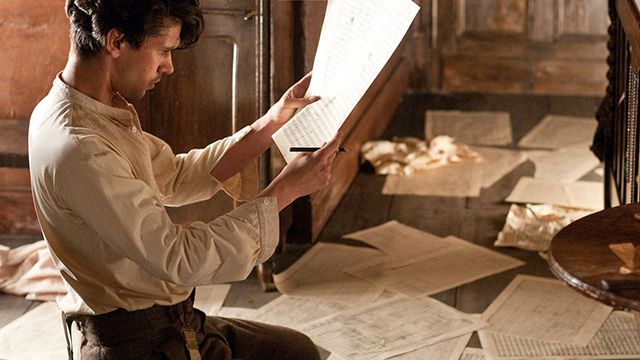
“This world spins from the same unseen forces that twist
our hearts…”
In the second story, Frobisher composes “The
Cloud Atlas,” a sextet, and from this work the film derives its title and its
structure.
But today, I gaze at a science fiction film of
such scope, ambition, and convention-shattering that I can’t help but think of
“cloud” computing too. With cloud
computing, a program can run on multiple computers at the same time, networked
together.
That technological term therefore seems like a
good analogy for our “interconnected” souls.
We’re all here on this planet together, right now, and according to Cloud
Atlas “the gulf between us”
is but an “illusion.” In how we treat each other, we create a map
-- or atlas -- a network of bonds, of
loves and hates, stretching outward and into the future, and reverberating
through the very corridors of existence.
In the end, like Frobisher suggests, perhaps we
all become, art or music.
And if that is the case, wouldn’t you rather your
eternal song be one of harmony, not dissonance?
award-winning creator of the web series Abnormal Fixation (2024), the audio drama Enter the House Between (2023) and author of 35 books including Horror Films FAQ (2013), Horror Films of the 1990s (2011), Horror Films of the 1980s (2007), TV Year (2007), The Rock and Roll Film Encyclopedia (2007), Mercy in Her Eyes: The Films of Mira Nair (2006),, Best in Show: The Films of Christopher Guest and Company (2004), The Unseen Force: The Films of Sam Raimi (2004), An Askew View: The Films of Kevin Smith (2002), The Encyclopedia of Superheroes on Film & Television (2004), Exploring Space:1999 (1997), An Analytical Guide to TV's Battlestar Galactica (1998), Terror Television (2001), Space:1999 - The Forsaken (2003) and Horror Films of the 1970s (2002).
Subscribe to:
Posts (Atom)

-
 It is an indisputable fact that fan service and good drama don’t always go hand-in-hand in the cinema. In fact, sometimes these factors div...
 -
 It is quite difficult to believe, but in 2024, Ridley Scott’s Alien (1979) turns 45 years old. Perhaps the most amazing thing about Alie...