Showing posts with label Ark II. Show all posts

Saturday, September 09, 2017

Saturday Morning Cult-TV Blogging: Ark II: "Orkus" (December 18, 1976)


Our retrospective of Ark II comes to an end with this fifteenth and final episode, “Orkus.” 

Interestingly, “Orkus” is an episode that feels more like an installment of Logan’s Run: The Series (1977) or The Fantastic Journey (1977) than one from the Filmation series’ own catalog. It’s very much in the nature of a 1970's, prime-time “civilization of the week” tale.


Here, the Ark II team stops for repairs and investigates reports of pollution.  Unfortunately, Ruth and Adam fall prey to that pollution, and deadly toxins super-age them in a matter of moments.  Unless an antidote can be developed, Ruth and Adam will die of old age in mere hours.

Then, out of the blue, an imperious man named Orkus (Geoffrey Lewis) utilizes his high-tech powers to hijack the Ark and seize control of it.  Jonah matches wits with this duplicitous leader of a Utopian community ensconced behind a protective force field, and tries to free the Ark and save his friends. 

Orkus is virtually immortal, Jonah learns, and made so by his society’s super-computer, called “The Provider.”  Furthermore, Orkus requires Ark II’s power source to continue protecting his own people and city from the atmospheric pollution.  “We can only save ourselves,” he insists.  Also, as Jonah learns, Orkus and his people are actually responsible for the pollution in the first place.

Now Jonah must not only apply a cure for Ruth and Adam, but destroy the source of pollution, and transform Orkus’s society to one of more human dimensions.  Fortunately, he gets help from some of Orkus’s more independent-minded followers…
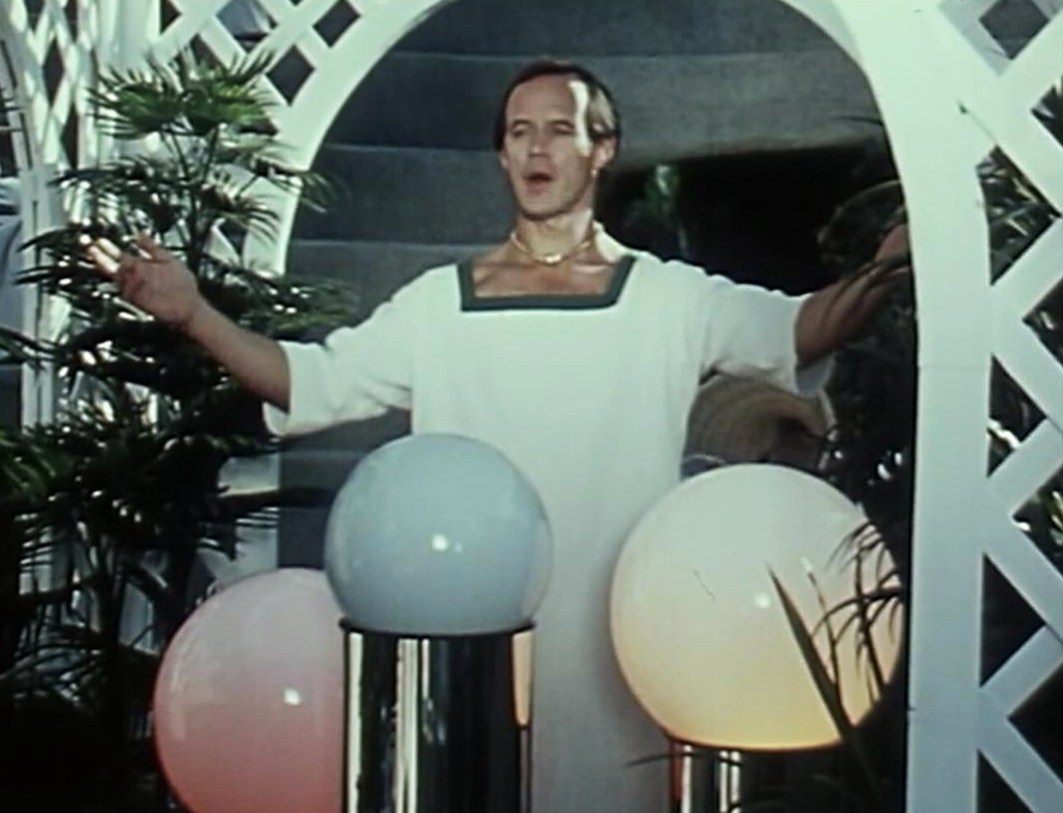

“Orkus” is a more hard-edged Ark II segment than some, albeit one with many familiar ingredients from 1960's and 1970's cult television.  There’s the super computer that governs a stagnant society (“Return of the Archons,” “Guardian of Piri,” Logan’s Run, “Turnabout”) and a disease that causes extreme, instantaneous old age (“The Deadly Years.”) 

In the end, order and “normal development” are restored, as immortality is destroyed (“The Apple,” “Guardian of Piri”), and something more “human” replaces it.  It’s not a particularly original episode, but it is fascinating to see the Ark II crew pitted against a dyed-in-the-wool liar and “black hat” like Orkus, for a change; especially with crew-members imperiled and on the verge of death.

With this episode, our retrospective of Ark II is complete.  The series’ strongest points remain the technology and production design, in my opinion.  The vehicles, sets, props and uniforms are all genuinely impressive, even today. 

Less impressive is the kind of loose-minded, indistinct “background” detail underlying the post-apocalyptic world of Ark II’s future.  

In Star Trek, episode wrap-ups would frequently see Captain Kirk noting in a log that Federation advisers, teachers or helpers were on the way to help a planet changed by the Enterprise’s visit.  Ark II could have used some of that specificity, particularly since Jonah and his people are trying to rebuild a world, and that agenda requires more than a cursory one-off visit to troubled villages and towns.


Yet the missions undertaken by Jonah and his crew are generally pretty loosely-structured, and there’s very little sense of follow-up or persistence.  Many episodes involve the idea that bad actors and evil-doers, once confronted with their anti-social behavior, will see the error of their ways and do right.  That is not a strong enough basis upon which to re-build a ruined world in my opinion.  

The series should have featured, at some point, back-up personnel helping to smooth transitions and usher in the positive changes first initiated by Jonah and his team.  Also, I would have found it fascinating to feature a story in which Jonah and the others run across a villain who won’t back down, but only doubles-down, thus forcing them to confront their “non-aggressive” mission strategy and actively fight.  In other words, I would have liked to have seen a stronger test of the protagonists’ values.  

I must confess: this is the very thing that bothers me the most about Star Trek: The Next Generation. It’s easy to preach noble values when you live in paradise; when you have a full stomach and the time to “enrich” yourself educationally and otherwise.  But what happens when you don’t live in paradise?  Then what?


Because of the series format, the Ark II team often over-matches the bad guys.  The vehicle’s crew has science, technology, knowledge and force fields on their side.  Accordingly, many episodes do not feature an adequate or deep sense of menace.  Thus the episodes that I remember best are those, like “Orkus,” which present a real challenge.  Other examples are episodes such as “Omega” (about a mind-controlling computer), “The Cryogenic Man” (about an entitled 20th century businessman) and “The Lottery,” which features a kind of “phantom zone” pocket universe where a tyrant banishes enemies.

Another highlight of the series is the episode “The Robot,” which features Robby the Robot as a learning machine, and includes an abundance of colorful character interaction.

Every Ark II episode carries a message about morality, and some adults may find this aspect of the series tiresome.  But if you remember the program’s original context – as a Saturday morning show for children – the didacticism is easily understandable.  I don’t have any problem with the moral framework of the series, and feel it’s an excellent program for kids to watch since it meditates on ideas about how best to “build” a better tomorrow.

Finally, I can’t help but feel that an adult-oriented Ark II would be a great subject for remaking today.  This is a “sci fi” world that could certainly stand some deepening and maturity, but which is already interesting and unique enough to merit interest from audiences. 

The problem, of course, is that probably not enough people remember the series in the first place.

Saturday, September 02, 2017

Saturday Morning Cult-TV Blogging: Ark II: "Don Quixote" (December 11, 1976)


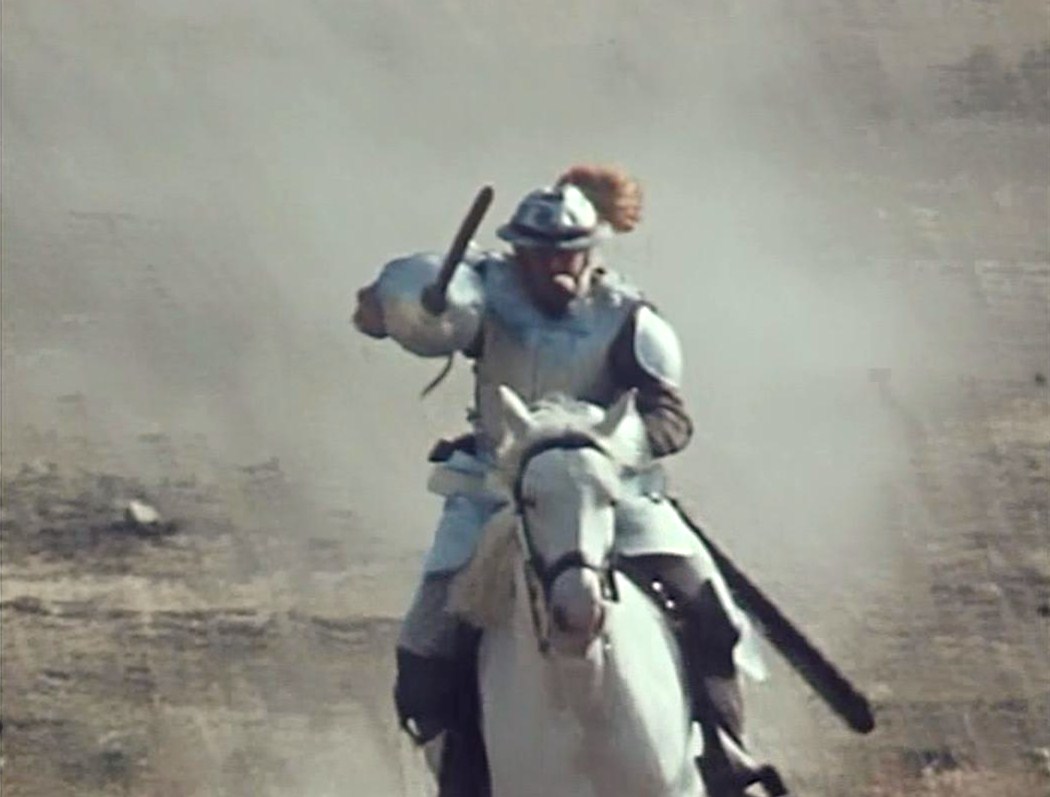
This week’s episode of the Filmation 1970s series Ark II, called “Don Quixote,” follows roughly the same outline as the episode “Robin Hood.” 

Only here, the crew of the titular vehicle encounters literary and mythic personalities who are not merry men, but rather based on Cervantes’ The Ingenious Gentleman Don Quixote of La Mancha (1605). 


Specifically, Jonah, Ruth, Samuel and Adam cross paths with two post-apocalyptic personalities who knowingly have cast themselves as the chivalrous Quixote and his loyal squire, Sancho.

The conflict of the week occurs when this (confused) new age Quixote sees Jonah not as a hero, but as his most dangerous nemesis, the Black Knight himself.  Thus Quixote seeks to interfere with Jonah’s mission to detonate two un-exploded pre-apocalypse bombs in an ancient battle area. 

Adding some comic relief to the episode, Quixote also sees the talking chimpanzee, Adam, as a damsel he can protect and love, Lady Marguerite. 


Finally, Quixote is recruited to the Ark II’s noble cause when the crew contextualizes the un-exploded bomb as a “serpent” the knight must defeat in combat.  Quixote actually proves helpful too, during the climax, because his metal knight’s armor can help to limit the range and power of an explosion, if one should occur.

Played more lightly than “Omega,” and “Robot,” and without the sharp social commentary of “The Cryogenic Man,” this installment of the Saturday morning series wouldn’t rank among the show’s best.  

Nor is it the worst, however. 


The final message of “Don Quixote is something akin to “use your imagination, but also see things through the eyes of others.”  That’s appropriately didactic for children. Yet it’s probably even more commendable that Ark II would name-check Don Quixote in the first place, no doubt causing a spate of little ones to ask their parents about the character and his story, or perhaps even visit a nearby library to find out even more about him. 

I must say, I appreciate the fact that over its run, Ark II has showcased a very literary, cerebral bent, alluding to Scripture, Dickens, the Robin Hood legends and Cervantes.  That’s an unexpected (adult) pleasure of revisiting the Saturday morning series today.

Next week, the final Ark II episode: “Orkus.”

Saturday, August 26, 2017

Saturday Morning Cult-TV Blogging: Ark II: "The Cryogenic Man" (October 23, 1976)


Ark II conjures up a surprisingly sharp and witty installment this Saturday morning with “The Cryogenic Man,” an episode guest starring Gilligan’s Island actor Jim Backus -- Thurston Howell himself -- as “Arnold Pool.”  Pool is a twentieth-century business tycoon awakened into the twenty-fifth century, along with his assistant, Norman Funk (John Fiedler).

In “The Cryogenic Man,” Jonah, Ruth, Samuel and Adam revive these two men from five hundred years in the past, and the episode pauses first for a Planet of the Apes joke.  Upon seeing Adam, the talking chimpanzee, Pool exclaims “Good grief, we’ve been taken over by apes.”

After that nice self-reflexive bit of humor, the tale gets down to the meat of its social commentary.  Pool takes one look around the primitive village that represents his new home and asks: “Where are the high rises?  And the shopping centers?  Where are the stores?”  These are the things that a rich man of the twentieth century misses first, the teleplay notes.

Then, Pool promptly asks the confused leader of the village whether he is a “Democrat or a Republican.”  Ruth’s answer is charming and forthright: “There are no Democrats and Republicans anymore…”


Even though he’s awakened into a new and post-apocalyptic world, the entitled Pool believes he can still buy happiness with his vast fortune.  He offers the villagers cold hard cash (ten dollars an hour) to build him a big new house in the center of town.  Naturally, they’ve never even seen money. 

They’re a sick group,” Pool notes condescendingly.  “They don’t know what money is.” 

Before long, Pool learns that the villagers are starving, and can’t grow food successfully because of contaminated soil.  The problem is that their village stands on the location of Pool’s old industrial factory, where he produced a product known as Pool’s Power Plant, a kind of “miracle grow” for vegetation. 

Unfortunately, as Ruth confirms, the product is actually a toxic chemical; one harmful to human beings.

Rather than accept the facts, Pool derides the Ark II crew as “bureaucrats” not “scientists,” and warns that bureaucrats will always take “food” from people’s mouths.   He then instructs the villagers to trap Ruth and Jonah in the cryogenic chambers.

While Samuel and Adam attempt to rescue Ruth and Jonah from their enforced slumber, Pool starts up his factory, and it begins to spew poison into the atmosphere, thereby creating another serious problem.


Finally, the Ark II crew shuts down the factory (with a well-placed laser blast), and Pool promises to change his ways; to think about ecology, not just making money. 

At episode’s end, Jonah notes in his log that we can either “make the same mistakes over and over again…or learn and grow.”

“The Cryogenic Man” is particularly prescient in understanding a dynamic that we are, alas, all too familiar with today.  A businessman who stands to make vast sums of money wishes to deride “scientific findings” as socialist “bureaucracy” and ignore hard evidence…with the safety of the community endangered as a result of his selfishness. 

I guess Ark II saw the same problem in 1976, and made this episode in response.  But it’s discouraging that we haven’t taken many steps to change the problem in the intervening thirty-six years.  It’s one thing to be in favor of capitalism, another entirely to be in favor of irresponsible, unfettered capitalism.  One person’s right to personal wealth ends, I submit, when that quest harms another person’s right to breathe clean air, or drink clean water.   


But overall, today’s world suggests that Jonah’s belief that we can “learn and grow” has not yet come to pass in the real world.  Instead, we seem to be making the same mistakes over and over.

In terms of Ark II, this episode’s wholly unexpected sense of humor leavens the didacticism a bit. The writing here is clearer and edgier than many installments, making this one of the series’ smartest entries.

Finally, the idea of a money-hungry, irresponsible businessman awaking up in a future sans capitalism is an idea that also appeared on Star Trek: The Next Generation (1987 – 1994), in the first season finale, “The Neutral Zone.”

Next week: “Don Quixote.”

Saturday, August 19, 2017

Saturday Morning Cult TV Blogging: Ark II: "Robin Hood" (November 6, 1976)


This week, Ark II takes a step down in interest and excitement from “The Robot” and “Omega,” the two previous series entries.  Here, the titular vehicle and its crew enter Sector 25 to investigate reports of “hunger and widespread unrest.”


The team soon discovers that a group of outlaws have modeled themselves on the mythical Robin Hood and are fighting in Sector 25 an evil tyrant named Lord Leslie.  At first, Jonah is amused by the strange conflict and personalities the Ark II encounters.  He puts up a force field barrier between opposing armies during one battle.  But then, Lord Leslie captures the Ark II and Jonah’s crew is taken hostage.

While hoping to convince Robin and his merry men that “robbery isn’t the answer and neither is violence,” Jonah nonetheless requires their assistance if he is to retrieve the ark and its personnel.  

Fortunately, Jonah also has help – of a sort, anyway – from inside the Ark II.  The intelligent chimpanzee Adam has been taking driving lessons and, in a slapstick comedy scene, takes the craft on a wild joy ride, all the while firing lasers and even doing an embarrassed face palm.

Soon Jonah reclaims the Ark and the local villagers reject Lord Lesley.  Now Robin and his men will have to build a better society together, and Jonah marvels at how difficult it is to “keep the Lord Leslies of the world at bay.”

“Robin Hood” is a weird and borderline amusing episode of Ark II.  The idea of post-apocalyptic people taking on the characteristics of a hero from literature doesn’t seem that farfetched given other examples of this genre, like Star Trek’s “A Piece of the Action,” which saw an alien culture model itself on a book about the Chicago Mobs of the 1920s. 


But one of the more interesting and bizarre images to come out of Ark II is certainly “Robin Hood’s” visual of Lord Leslie’s flamboyantly-dressed minions riding trikes in the desert. It’s like The Road Warrior meets the Crusades…in the Planet of the Apes Forbidden Zone.

Also, this is also the only episode (at least thus far) to devolve into out and out slapstick humor, as Adam drives the Ark II into danger.  It’s a unique experience to watch the huge Ark moving erratically, knocking things over, and otherwise proving a real road hazard.  By the same token, these scenes reveal just how difficult it is to maneuver this unwieldy (but gorgeous…) cult-tv vehicle.  The Ark II is huge, and doesn’t look like it corners very well…

Next week: “The Cryogenic Man."

Saturday, August 12, 2017

Saturday Morning Cult-TV Blogging: Ark II: "Omega" (October 9, 1976)


“Omega” is one of those more-interesting-than-usual installments of the 1970s Filmation Saturday morning series Ark II.  

The reason that this episode is more intriguing than most segments is that it -- like “Robot” or “The Lottery” -- features a specific science fiction concept other than just the one featured in the premise; that of a post-apocalyptic world.  In this case, that concept is a villainous, sentient super-computer, a Colossus for the Saturday morning set. 

Here, the Ark II team runs afoul of perhaps the most powerful nemesis it has yet grappled with: a super computer “built by a society that no longer exists.”  The super computer -- re-activated in a primitive village three weeks earlier -- is called a “checkpoint” device, model “Omega.”  And, in addition to its other functions, the machine can easily dominate and control human minds.  Visually, Omega resembles the Monolith from 2001: A Space Odyssey (1968).


As the episode begins, a kindly grandfather (played by Harry Townes), realizes that his daughter Diana, portrayed by a very young Helen Hunt, is now under the control of Omega.  Thus, Jonah and his team set out to de-activate the machine and free her from machine enslavement.  Unfortunately, Omega proves so powerful that Samuel begins to fall prey to its commands too.  He rejects Jonah as leader and serves Omega instead.

Jonah attempts to defeat the super computer by executing a series of “chess” moves designed to destroy the device.  Finally, even that strategy isn’t enough, and Jonah himself nearly succumbs to the machine’s wishes.  Finally, it is Adam the chimpanzee – whom Omega has derided as some kind of strange animal – who is able to pull Omega’s plug.


After the computer is defeated, Jonah notes that Omega will never again be able to impose “de-humanizing ideas” upon mankind.  Specifically, he’s referring to the idea that Omega has made all the elders of the local village the slave to youngsters, like Diana.  As Omega reports early on, “young minds are quicker” to accept him.

I enjoyed this episode of Ark II, because drama works better, in my opinion, when heroes are outmatched or over-matched by villains. And that’s the case here. The high-tech Ark II crew is nearly defeated by the high-tech machine.  Omega thus proves a powerful and insidious force and infuses the episode with a welcome sense of menace.  I also enjoyed seeing Harry Townes play a crucial role here -- as a fearful would-be-slave of a super computer -- since he played a similar character in Star Trek’s “Return of the Archons” back in the mid-1960s.

Saturday, August 05, 2017

Saturday Morning Cult-TV Blogging: Ark II: "The Robot" (October 2, 1976)


This week on Ark II, Robby the Robot of Forbidden Planet (1956) fame guest stars as Alpha 1, or “Alphie,” in “The Robot.” 

Samuel has been working on the construction of this highly-intelligent machine for four months, and he puts the finishing touches on Alphie just as the crew stops lake-side in Sector 9, Area 15 to enjoy a picnic.  Unfortunately, Alphie -- like most young children -- is prone to accidents and clumsiness, and Captain Jonah has a difficult time trusting him.

After Alphie snaps off the knobs of the Ark II’s mapping computer, Jonah orders the machine shut down while the team investigates a strange “sickness” in a nearby village.  Alphie begs not to be de-activated, because he believes he can help resolve the problem.  When Jonah won’t acquiesce, Alphie breaks free of restraints, knocks-out Samuel, and heads out into the wilderness to act on his own.

It turn out that Alphie is right.  As the robot learns from a girl named Nestra, all the villagers are suffering from exposure to a toxic gas, one which turns them into vacant, zombie-like sleep-walkers. Alphie discovers the source of the leak in a nearby crevice, but finally must sacrifice his very life to seal it up and save the humans.


After Alphie’s noble act, Jonah realizes he was wrong to harshly judge the robot.  As Ruth notes at one point, “robots make mistakes…but so do people.”

Along with “The Lottery, “The Robot” is likely one of the best and most enjoyable episodes in the Ark II series catalog.   The writers, Len Janson and Chuck Menville, along with director Ted Post, really bring their best game on. 

There’s a real vibrancy to this installment (at least compared to others), in part because there’s more banter between the characters here than in all the other episodes combined.  They joke, tease, laugh, and show real ease with one another.  Who are these people?

Perhaps even more importantly than the new-found esprit de corps, not everyone is nice all the time in this episode.  Jonah is still the good guy captain, but he reveals impatience and temper with Alphie.  That doesn't make him evil, it makes him human.  


Samuel, meanwhile, displays powerful emotions when he realizes that his creation has died heroically.  These are welcome colors that the characters could have used on other occasions too, so that they wouldn’t always seem so perfect…and cardboard. 

Visually, "The Robot" is well-vetted.  The show opens with some new footage of the Ark II at an idyllic lakeside, for instance.  And Robby himself -- shiny and upgraded for his starring appearance here -- makes a great visual anchor for the proceedings.  It’s entirely possible (with apologies to the late Jonathan Harris…) that Robby is actually the best and most versatile guest star in the Ark II stable.  He gives a command performance hero, and his heroic death is actually pretty touching.

As usual, the weakest part of an Ark II episode involves the obligatory jet jumper, the rocket pack that Jonah wears to conduct reconnaissance in every darn segment.  It was interesting to see the jet jumper in action probably four or five times early on, but now it’s just a momentum breaker.  The jet jumper interludes inevitably slow down the narratives.

Finally, Ruth makes a comment in this episode that obliquely involves one of my curiosities about the show.  I’ve often wondered about the organization that built the grand Ark II, and whether the vehicle is the only one of its kind.  

In “The Robot,” Ruth notes “It’s the only ark we have,” which, on the surface, seems to suggest the Ark II is indeed a one-of-a-kind.  On the other hand, she may simply be referring to the crew.  It’s the only ark this crew has, in other words.  So we almost get clarity, and then we get robbed of clarity...

Next week: “Omega.”

Saturday, July 29, 2017

Saturday Morning Cult-TV Blogging: Ark II: "The Wild Boy" (September 25, 1976)


This week on Filmation's post-apocalyptic Saturday morning TV series Ark II,  Captain Jonah (Terry Lester) and his crew conduct a geophysical survey in Sector 14, Area 31.  The mission is to discover “rare minerals.”  But before long, a primitive-appearing young human, Isaiah (Mitch Vogel), interferes with their work, and Jonah is nearly trapped in a dark cave.


Local villagers warn the Ark II team that Isaiah is dangerous and that they plan to “put him in a cage and take him out to the great desert.”  Rather than allowing this exile to happen, the crew attempts to befriend the wild boy.  Isaiah is welcomed aboard the Ark  II vehicle and taught how to operate the craft's systems.  However, when Isaiah spots the recently mined crystals, he grows violent and angry, and runs away.

Soon, Isaiah's reasons are all too clear.  The crystals release a dangerous gas that sucks up oxygen, making the Ark II crew suffer from lassitude and fatigue.   While Jonah and Ruth go off to find Isaiah, Samuel loses control of the Ark II, and Jonah must re-board it while the great vehicle is in motion.


Isaiah reveals that his parents died in the cave where the minerals were recovered, and now he fears both it and the crystal.  Understanding this, the villagers make peace with Isaiah and welcome him into the family.  Jonah, meanwhile, arranges for the cave with the dangerous minerals to be permanently sealed.

The twin lessons on Ark II this week are “trust and affection can accomplish more than fear,” and, no less important, even evolved, peaceful folks like Jonah and Ruth can “still learn from those who haven’t had,” the same level of education.


In less didactic terms, “The Wild Boy” is a cool episode of this 1970's Saturday morning TV series for a few reasons.  

The first is that this story provides for the closest thing to a car chase we  get on the program's roster.  Samuel loses control of the Ark II, and Jonah and Ruth must catch up in the Roamer and board the craft in motion.  This sequence is well-shot, and amps up the action quotient of the episode and the series considerably.

Secondly, and I know this probably seems minor, but this episode features a great aft-to-fore pan of the interior Ark II set.  It’s one thing to see the set in close-ups, or in establishing shots.  It’s quite another to track the whole set, and see the breadth and scope of it.  It’s really an impressive design, and so far as I can discern, this is a new shot.

Next Week: Robby guest stars in “The Robot.”

Saturday, July 22, 2017

Saturday Morning Cult TV Blogging: "The Drought" (November 13, 1976)


In “The Drought,” the Ark II goes in search of a time capsule containing a pre-apocalypse “cloud seeder” to help avert a deadly drought in the nearby desert.  During the mission, Samuel programs the Ark II to run on voice control. 

 This proves a poor selection when the crew’s old nemesis, the scoundrel Fagon (Jonathan Harris) stages a trap for Jonah and steals the vehicle.


It turns out that Fagon and his gang of young “Flies” want the cloud seeder as well, and now, with Ark II, have the means to get it.  Unfortunately, Adam, Samuel and Ruth are all captured in the village of the time capsule by a primitive witch doctor who believes that the Rain God is angry with them.  He orders them to be sacrificed in “The Cave of No Return.” 

The young Flies want to help the kindly crew members, but Fagon refuses to join them.  Meanwhile, Jonah attempts to convince Fagon to give up possession of the high tech vehicle because “you can have everything in the world, but without anyone to share it with, you have nothing.”


Fagon helps to free the trapped crew members and show the witch-doctor the error of his ignorant ways. The Ark II continues on its mission, and this time, Samuel programs the vehicle to respond only to the voice commands of the vehicle’s crew.

Jonathan Harris guest stars here as the Ark II equivalent of Harry Mudd, a selfish, roguish man who proves a constant foil for the good-intentioned Ark II team.  What remains a little baffling about this episode is that Jonah and the others allow Fagon to attain a position of authority in the witch doctor’s community.  He promises to teach the villagers “irrigation” methods, but this is a variation of what he promised in “The Flies.”  There, he assured Jonah he would educate the wayward youngsters, but we see in this episode that he did no such thing.  

So why would Jonah trust him again now? 


There’s an old saying:  Fool me once, shame on you.  Fool me twice, shame on me.  There’s every reason to suspect that Fagon will remain just as foolish and selfish in the future as he has been in the past.   This is hardly “mission accomplished” and the unsatisfactory conclusion of “The Drought” only points out again the kind of amorphous missions that the Ark II conducts.   The crew’s goals and rules are not always clear or carefully established.  Accordingly, it hardly seems like good procedure to leave the untrustworthy Fagon in charge of an important project.

In terms of Ark II technology, this episode introduces the “magnetic force beam” -- a kind of tractor beam-- that Fagon utilizes in order to steal the cloud seeder.  He gains the knowledge by using the Ark II’s technical manual…which looks a lot like a script book.

Next week: “The Wild Boy.”

Saturday, July 15, 2017

Saturday Morning Cult-TV Blogging: Ark II: "The Lottery" (November 20, 1976)


This week on Ark II (1976), the post-apocalyptic exploratory vessel and its crew head into an area called “The Forbidden Zone.”  The Ark II doesn’t find a half-buried Statue of Liberty there, but rather a primitive community that has “squandered its resources.”  

Captain Jonah’s (Terry Lester) mission is to render aid to the community and help with the resource shortage. In particular, the society has run out of water.

As Samuel (Jose Flores) soon learns, the community in the Forbidden Zone is built on the ruins of an old, pre-apocalypse laboratory that once conducted experiments in "time and space."  

Now, the community's authoritarian leader, Kane (Zitto Kazann) exploits that old old experiment, ordering dissidents to “face the lottery.”  If they lose the lottery, they are sent off across a plain…where they disappear into another dimension…a rip in the fabric of reality.


Ruth (Jean Marie Hon) volunteers to travel inside the pocket dimension – a zone of mist and darkness – to rescue the dissidents, while Jonah and Samuel deal with the despotic Kane and his trickery.

In short, “The Lottery” is one of the most enjoyable episodes of Ark II I’ve yet watched, and that’s a direct result of the fact that the episode (by Martin Roth) contends with a strong sci-fi concept: alternate universes.  For once, the matter at hand is not simply teaching some poor, cowed villagers a lesson (although that element is also here), but reckoning with a compelling sci-fi mystery.

As a Saturday morning series, Ark II boasts a low budget, and if you look closely, that low budget is  apparent here.  The “alternate” dimension seems to be confined to only two people, Ruth and the dissident Steven (David Goldmund).  

And yet, the depiction is not entirely ineffective.  It’s actually frightening in a way, and the fact that we see so little of this "other world" contributes to the narrative's sense of anxiety, especially when it looks as if Samuel and Jonah can’t rescue Ruth.


The moral of the story -- and Ark II remains incredibly didactic in nature -- is that when faced with shortages, some planning is necessary.  Jonah delivers a lecture to the villagers that they “should have planned instead of doing nothing” when water first became scarce, while reminding Kane and his minion, Borg (Eric Boles) that they are not off the hook; that they set out to deceive and obfuscate rather than tell the truth about the lottery.  In fact, they discovered a new water source and were keeping it for themselves...

In some ways, “The Lottery” is a thinly-disguised remake of  an earlier episode called “The Slaves,” with the Ark II crew again seeing through the deceit of a tyrant (here Kane instead of Baron Vargas), but the addition of the overt sci-fi concept makes the episode a little more exciting, and adds a level of tension to the proceedings.  

Often times on the series, the Ark II crew seems free from peril.  They possess the technology and the vehicles and the know-how to always carry the day.  So the fact that Ruth is almost trapped in a dark dimension adds a new layer of danger to the storytelling this week.

Next week: “The Drought.”

Saturday, July 08, 2017

Saturday Morning Cult-TV Blogging: Ark II: "The Mind Group" (November 27, 1976)


Captain Jonah (Terry Lester) and the team from the Ark II set out on a vital mission to find three children who have disappeared from their village, and return them home.  

The unusual thing about these kids, however, is that they come from a place where everyone communicates telepathically.  

The telepaths there view normal humans -- “Speakers” -- suspiciously, and shun them.  Jonah, Ruth and Samuel see this rescue mission as a way to change that perception.

The warlord Brack (Malachi Throne) captures the children in his village (the left-over Planet of the Apes set, last seen on Ark II in “The Flies”), leaving Jonah and the others with few means to rescue them.  But the mission is successful, and the children return the favor by rescuing Ruth (Jean Marie Hon), who has become trapped on the Ark II during a fire.

After the children are returned home, Jonah muses about the experience.  The telepaths may be a force for good or evil in the future, but hopefully the children who interacted with Ruth and Jonah will grow up and remember the Speakers’ acts of kindness…


“The Mind Group” is the first Ark II episode I’ve reviewed thus far that finds the series protagonists interacting with characters who are not scavengers or, poor, fearful rural villagers.  

The telepathic children of “the Mind Group” hail from a nearby community of Espers, and perhaps it would have been more interesting, narrative-wise if the Ark II went to that locale to attempt to make contact with the group and open peaceful relations. 

Still, you’ve got to love the easy-going, live-and-live nature of the heroes in this Saturday morning TV series from the 1970s.  Neither the Ark II crew nor the (invisible) hierarchy that supports the vehicle’s continuing mission express fear at the thought of powerful telepaths (and telekinetics) developing into a powerful community nearby.  In real life, the very fact of their existence would be cause for a pre-emptive attack, at least according to some people. 


Instead, the Ark II crew sticks to its sense of morality and decides that when the telepaths choose to emerge from their shroud of xenophobia -- for good or evil -- the Ark II will deal with them then.  This is a nice re-assertion of values, but a recent episode “The Balloon,” just preached against the evils of xenophobia, so it’s contradictory and a little hypocritical that the telepaths here get a pass…without even a lecture about opening up their society.

In terms of Ark II tech, “The Mind Group” unveils a portable force-field generator that Jonah uses in a pinch.  And we also get our first up-close look at Ark II’s futuristic kitchen.  Even though we’ve seen Adam cooking in the kitchen in the past, this episode reveals that the vehicle possesses a quasi-replicator device, one that can turn little white vitamin pills into any food a person desires.  Here, a kid chooses meat and mashed potatoes, and we see the pills transform…

Next week: “The Lottery”

Saturday, July 01, 2017

Saturday Morning Cult-TV Blogging: Ark II: "The Balloon" (December 4, 1976)


In this episode of the Filmation Saturday morning series Ark II, the crew runs smack into a society that, as a whole, suffers from xenophobia, a fear of outsiders or “foreigners.”  

Captain Jonah’s (Terry Lester) initial log entry describes people who “refuse to have contact with the outside world.”

But from somewhere deep inside the isolationist village, someone is sending out distress messages tied to floating balloons…written in Greek.  After deciphering one message, the Ark II crew comes to understand that the very people who have so calculatingly cut themselves off from the rest of humanity are suffering from a terrible plague, one they can’t cure on their own.

The Ark II team finds the messenger -- an old man working a printing press near “the place of the Iron Birds,” a destroyed air-field -- and learns that this is indeed the case.  The messenger says: “We have a new enemy now…disease.”


While Ruth returns to the Ark II via hot air balloon to work on a cure for the new disease, Jonah attempts to convince the village’s leaders to “open” their hearts and minds to others.  Unfortunately, he and a young boy fall prey to the disease, and only reinforce the fear of strangers.  Now outsiders are disease carriers.

Meanwhile, Ruth and Samuel must clear a path to get the Ark II inside the village, and deliver inoculations to all the sick people.

Like its predecessors, “The Balloon” is a message-heavy installment of this Saturday morning series.  In “The Tank,” we met people who shunned machines because they believe machines caused war.  Here, we meet characters who refuse to deal with outsiders, because they fear attack from them.   In both cases, people have responded to a terrifying situation irrationally, by a blanket rule about the things they perceive caused them harm.


In real life, of course, America has witnessed periods of intense xenophobia over the last two centuries, not the least of which has been in the decade following the 9/11 terror attacks.  Yet the rampant fear associated with xenophobia is ultimately counter-productive, as this episode of a 70's kid show rightly points out.  If you close yourself off, you also close yourself down to certain options, to new solutions, and to improvements your life.  When you come from a closed place, everything -- even learning -- can come to a stop.  It’s not a healthy response to fear, even if it is, on some level, understandable. 

It’s very interesting that Ark II chooses to tell this particular story, about a place that has sealed itself off from the world and in its insularity faces extinction.  “By talking instead of fighting,” says Jonah “we can move forward.”


In terms of Ark II continuity and lore, this episode reveals that the Ark II can fire a focused beam from its fore section, but the beam is still defined as “a force field,” keeping in tune with the idea of self-defense and no aggressive weaponry.  Intriguingly, the force field is also quite a limited device.  In trying to move heavy stones from the vehicle’s path, the force field’s power grid short circuits…

Although “The Balloon” carries a laudable message, it plays, at this point, as fairly routine.  

The series is in something of a rut, with tiny villages constantly being shown the error of their primitive ways by the Ark II team.  The civilizations of the week -- battling superstition (“The Slaves”), xenophobia (“The Balloon”), cruelty to the weak (“The Rule”) and technophobia (“The Tank”) -- are a bit too predictable and one-note at this point.  But the series is about to mix it up with some infusions of more science-fictional elements, from robots and suspended animation to telepathy, and that’s a good thing.

Next Week: “The Mind Group”

CULT TV FLASHBACK: Dead of Night (1994-1997)

This year, Dead of Night: The Complete Series , was released on Blu-Ray by Vinegar Syndrome , and I just had the pleasure of falling into i...