Showing posts with label Beauty and the Beast. Show all posts

Friday, March 17, 2017

Guest Post: Beauty and the Beast (2017)


Remaking a Classic: The Good, The Bad and The Beastly, Part II, Beauty And The Beast

By Jonas Schwartz

The 1991 animated musical Beauty and The Beast is beloved.  Audiences and critics went insane for the animation that perfectly mimicked the thrill of epic live-action cinematography, an engaging story and Broadway caliber songs by Alan Menken and Howard Ashman. 

It was the first animated film to ever get a best picture Oscar nomination and spun off into a highly successful (at least financially) Broadway production. After scoring with a slew of live-action versions of Disney classics (The Jungle Book, Cinderella, Alice on Wonderland), the studio has returned to this tale as old as time. Surprisingly, many of the elements are arresting, with casting, script, acting and design all in top form. There is only one facet that fails and for a musical, it's a gigantic issue.


Following the framework set up by Linda Woolverton in the '91 film, Belle (Emma Watson) trades her life for her father’s (Kevin Kline) when he accidentally wanders into a cursed castle and is taken prisoner by a beast (Dan Stevens).

She remains in her father's place and though the castle is a haunted gothic monstrosity, Belle finds the beauty in the palace and even the beauty in her misunderstood, hostile captor. With the help of several inanimate servants, like a candelabra (Ewan McGregor), a clock (Ian McKellen), a teapot (Emma Thompson) and a dresser (Audra McDonald), she turns this hell into a home. Back in town, a blowhard with an ego bigger than Disneyland (Luke Evans) expects Belle to be his wife, whether she chooses him or not.
  
The cast is impeccable. Watson and Stevens make charming lovers. The love blossoming between them is affectionate and grounded. Instead of playing to the rafters, Evans is appropriately villainous but in more subtle ways. Gad makes a hilarious sidekick who functions as a fully-realized character with feelings (not just those of passion for Gaston as reported recently in the news) and a conscience. McGregor shows off a Broadway caliber voice as he had in Moulin Rouge. Kline is more fatherly than the original incarnations. Maurice is still a bit eccentric, but his kindness, ingenuity and tenderness with Belle shines through.


The script by Stephen Chbosky and Evan Spiliotopoulos perfectly transforms a cartoon into a live-action film. Some of the more buffoonish characters are more realistic and empathetic than their clownish versions. The dialogue sounds fresh and funny. The script does bring up some layers that could have enhanced the story if handled better, but wind up slowing down the film.

In this film, Belle has inherited her father's passion for inventing, as can be found in an early scene where she creates a washing machine. But never does that kernel of an idea sprout throughout the film. It's completely forgotten. There's also a revelation towards the end between Maurice and Belle wherein she finally understands why they left their past life in Paris. Yet, never before in the film had Belle given any indication of resenting her father, so it's unclear why she's suddenly forgiving him. She was never standoffish or even a bit concerned about her father's motives at any time earlier.


Director Bill Condon has assembled a Candyland of visuals. The costumes are luscious (the introduction to Belle's iconic dress is a dazzling moment); the sets are magnificent. Everything looks worthy of the original sumptuous ink and painted designs. The original movie was an homage to the Broadway musical genre with every song representing a component of the classic musical structure. Condon plays on that concept by echoing famous musicals of the past: Belle glides on a grassy hill just like Maria in The Sound of Music; during "Be Our Guest," when Lumière (McGregor) says the word cabaret, John Kander's famous vamp can be heard; in the same song, Lumière dances in the water as tribute to Gene Kelly.

The score is where things turn problematic. Most of the popular songs have returned, but the score sadly misses "Human Again" (a song that was cut from the original film but was returned in later releases and the Broadway musical). The new songs, like "Evermore" for the Beast and "How Does A Moment Last Forever" for Maurice, lack the style and nuances of the original score. Anthony Van Laast's choreography is unimaginative.

The biggest issue, one that is inexcusable in a musical, is the sound mixing is way off. The orchestra overwhelms the singers so that all the lyrics are unintelligible. My spouse performed in various international productions of the show for over three years and even he could not decipher what the actors sang. For a musical, that is a cardinal sin, and could have been an easy fix. 

Turning the cherished animated film Beauty and The Beast into a live-action replica was a risky venture and one that Bill Condon, for the most part, excelled. With a bit of editing and more adept sound mixing, this could have been a classic. Here's wishing for a future director's cut.

Jonas Schwartz is a voting member of the Los Angeles Drama Critics, and the West Coast Critic for TheaterMania. Check out his “Jonas at the Movies” reviews at Maryland Nightlife.


Sunday, July 20, 2014

Cult-TV Flashback: Beauty and the Beast (1987 - 1990): "Once Upon a Time in New York"


Twenty-five years ago, all the way back in 1987, a fairy tale came to vivid life on our television sets. This was the year that Star Trek returned (The Next Generation), but it was also the year that the story of "Beauty and the Beast" was re-imagined for prime-time television on CBS. The series ran for three years and drew good ratings for a time. More to the point, it earned a great deal of fan devotion.  Today, it has even been remade on the CW, at least after a fashion.

Today, watching the pilot episode of the original, one can determine clearly why the series was so beloved. Beauty and the Beast is indeed a fairy tale, a very specific form of "escapism."

Accordingly the series opens with a meaningful conjunction of fantasy and reality. The opening legend reads: "Once upon a time," the classic first line of all great fairy tales, and then adds for good measure "...in the city of New York," thus making viewers aware this will be a modern story, in other words, a fairy tale with a unique twist.

In 1987 (as today...) we desperately needed good, moral fairy tales like the one this series provided. Urban crime rates were at their highest in recorded American history and the "greed is good decade" had taken its toll on the country and the economy. At the top of the social ladder were the yuppies -- young upwardly mobile professionals -- vying for stock options and corner offices, and at the bottom of the heap were President Reagan's forgotten Americans, the homeless whom publicly he deemed "homeless by choice." Their ranks swelled in the 1980s. By the millions. This was also the time of Gordon Gekko, or in real life, Ivan Boesky. It was an era when criminals made millions on Wall Street, and when violent wildings occurred in Central Park.

And, it must be pointed out, Beauty and the Beast came to television just when racism -- and racial tension -- was again becoming major national news. There was the Howard Beach incident of December 20, 1986 and the Tawana Brawley incident of November 28, 1987, to name but two such attention-grabbing headlines. But the issue was clear: the racial divide had not been healed in America. And what is "racism" if not the "fear of the other," the person who is "different" from one's self?

Beauty and The Beast successful addresses and incorporates all these facets of American culture in the late 1980s, and so today practically reads as a time capsule of the epoch.  So imagine if you will, one Friday night in 1987. When - without warning or preamble - a fantasy world appears on your television set, a classic fairy tale made modern and relevant.

In this first episode by Ron Koslow (and directed by the brilliant Richard Franklin, of Psycho 2 fame), the ugly "above" world of New York, that of corporations and yuppies, is revealed (literally...) to be a nightmare for lead character Catherine Chandler (Linda Hamilton).

She's stuck with a smarmy business-man fiance, Tom (Ray Wise), working a thankless job as a corporate lawyer, and wondering what her life is really all about.

After an argument with Tom, Catherine leaves a party early one night and runs smack into the realities of street crime. She's abducted by several thugs, taken to a van...and cut with a knife. Her face scarred, she's dumped in a park and left to die...bleeding.

Later, when she re-imagines this crime as a dream phantasm, Catherine sees Tom and his circle of friends mocking her. Her co-workers do so as well. They have no sympathy for the victim of a violent crime, and instead mock her. Why? Well, because she's scarred, and in 1980s America (the U.S.A. of aerobics and Perfect [1985]) the one thing you can't be if you hope to be successful...is ugly.

Near death that terrible night, Catherine is miraculously rescued by an unusual stranger. On this strange, fog-shrouded evening, a colossal, shadowy figure named Vincent rescues her and brings her to his subterranean home, to the world underneath or The World Below. He brings her to the world where the poor and disenfranchised live...unnoticed....forgotten. But Vincent's world, beneath the city and beneath the subways, is not one of sadness, desolation or hopelessness.


On the contrary, as he establishes to Catherine quite early in the show, "You're safe here." In this underworld, he claims "no one can hurt you."  This is quite different from the street crime above, and the white-collar crime of Tom's world. Catherine feels safe there, and begins a friendship with Vincent, who reads to her passages from Great Expectations while her wounds heal.

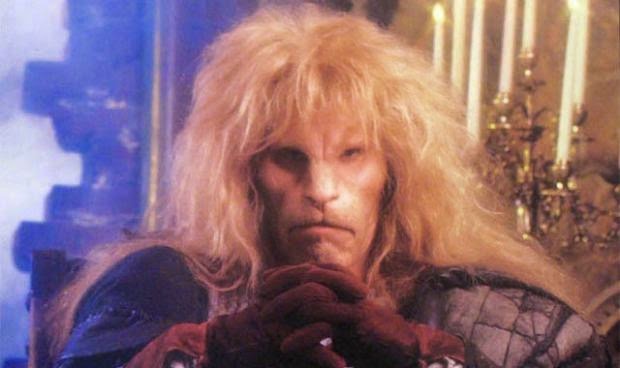
You probably know the rest of the story. Vincent (Ron Perlman) is a survivor too, a strange, hulking lion-man. And he develops a bond with Catherine, an empathic one. So that even once she's healed and returned to the world above (now re-born with purpose as a crusading district attorney...), he is still "bonded" to her.

That synopsis may sound cheesy in a society obsessed with grim, gritty reality in its entertainment, but this is a fantasy after all, and a lovely one at that. Vincent makes for a classic hero, not just physically powerful, but also gentle, intellectual and highly moral. And Catherine, of course, is strong and resourceful.  They make a perfect fantasy (and TV couple).

But what makes Beauty and the Beast such a wonderful and rewarding viewing experience, even today, isn't just the romance, it's the very world the TV series so carefully forges. Like Star Trek, this is a highly moral universe, one about people who work hard to do the right thing and take care of each other even when it isn't easy to do that. The World Below is a fantasy utopia, in a sense, but Beauty and the Beast crafts a world, like that of the 23rd or 24th Century that viewers can feel good about escaping to.

With admiration, I noted while watching how Koslow's screenplay for the pilot creates the character of Vincent and how Perlman interprets it. He's a man of deep feelings, with a deep-seated sense of right and wrong. Unlike many heroes of our cynical time, when Vincent commits violence, it's clear he feels shame. Here, we see it in a close-up of his eyes after he's killed a thug trying to hurt Catherine. For him, violence isn't something to be relished.


No, it's part of his dark side; not the good side that his father (Roy Dotrice) says boasts "the soul of a doctor." 

I also appreciate how Vincent sees New York, or "the world above." It's a world of "frightened people," he says, where his face -- a different face -- reflects the "aloneness" of others. This is great fairy tale stuff, and almost explicitly a comment on racism. Vincent hides in the shadows, lives in darkness, not because he is ugly (he isn't...), but merely because he is different. And differences -- in this world -- are to be feared.

Although now twenty-five years old, Beauty and the Beast, especially in this pilot is dominated by great production values and filled with wondrous sets. There are long spiral staircases leading down, down into the golden-bronze underworld. There are libraries stacked with books, cut from solid rock. In one iconic shot composed entirely for its visual poetry and dynamism, Catherine is depicted walking away from Vincent -- in silhouette -- into a blue ray of light.

Also, there's a brilliantly crafted moment in the middle of the show wherein Vincent begins to describe the fairy tale world beneath the city, "where the people care for one another." Instead of focusing on a close-up of the character, or of Catherine, for that matter, director Franklin chooses instead to pan across Vincent's room...a place of books and trinkets and statuary. We "see" the world he is describing as he describes it. Many moments in this pilot feel equally cinematic.  I don’t want to diss the remake, but it plainly doesn’t feature this kind of timeless feel.

The writing here is also good...and often downright poetic. There will be those cynics who can't stomach the genuine sense of romance on display here, the slightly purple prose, or the syrupy music. Yet Beauty and the Beast isn't just a fairy tale, it's a romance...a love story. So, if you ask me, the violins are perfectly appropriate, and even welcome. And I believe the series writers' were correct to make Vincent speak in a manner of almost Shakespearean classicism and greatness.


The purpose of a program like this is indeed "wish fulfillment," the idea that we can step into a tunnel and walk into a utopian world below the streets, Vincent's world. It would not be appealing or interesting if everyone there spoke in the exact same manner as those of the "above" world.  We need plenty of distinctions between the World Above and the World Below, and Vincent’s language is one of them.

The romance between Catherine and Vincent is timeless, tragic and touching, and therefore their mode of expression must be grand, rarefied and poetic. We've seen sparks fly on television before (the banter of Moonlighting, the back and forth of The X-Files), but rarely before (and rarely since...) has a love story been vetted for the masses with such an august sense of style, and such an authentic heartbeat.

There's a literary feeling to the writing here that is also surprising. The dialogue feels like it would be better read in a book then actually spoken by actors. But, by the same token, it's highly individual and original. Some people really won't like it, or may term it over-the-top and corny. But hey, I can appreciate a show that wears its heart on its sleeve.

Today, Beauty and the Beast feels remarkably un-cynical, and pulses with an open, romantic heart.

Outré Intro: Beauty and the Beast (1987 - 1990)


The romantic Beauty and the Beast (1987 - 1990) ran on CBS for three years, and drew a strong fan following. The series starred Ron Perlman as Vincent, the titular "beast" and Linda Hamilton as Catherine, the "Beauty."  I have always enjoyed the series tremendously as a modern day fairy tale and romance, a kind of spiritual predecessor to such programming as Grimm or Once Upon a Time.

The series' introductory montage captures beautifully the fairy tale aspects of the series. The montage is separated into two parts, essentially.  

Vincent (Perlman) narrates "The World Above," the first part which concerns Catherine's life in NYC, a place where "the beautiful rule."  

The second part of the montage is narrated by Catherine (Hamilton) and involved "The World Below," Vincent's "secret place...far below the city streets" where tunnel folk like Vincent are "safe from hate."

What I enjoy especially about this set-up is that each character discusses the world that he/she is separated from, not his or her own.

We begin with the Big Apple, an urban wonderland (as opposed to The Equalizer's urban jungle...).  

As night falls, we see the lights of the city twinkling like stars, and get the series title card: Beauty and the Beast.


Then, Vincent's narration tells us that his urban wonderland is a place where the "powerful rule," and as if for evidence, we see images of rich people -- in tuxedos, no less -- getting into a limo. 

The visual implication is that this is a place not merely for the powerful, but for the ultra-wealthy.  It is their immoral playground.  They exist in ignorance of the other world (The World Below) but also in ignorance that there is any place where people are poor, or starving, or suffering.  Instead, they are shuttled from one party to the next.


Coming up next in the montage, we get a Juliet on her balcony moment, so-to-speak.  Vincent speaks on the soundtrack about the first time he saw Catherine.  "From the moment I saw her, she captured my heart," he reveals, and the images depict beautiful Catherine stepping out onto the balcony, looking down below (by inference, at Vincent's world.).

Notice that in virtually all these shots, including the ones that introduce series star Linda Hamilton, there seems to be a sadness or wistfulness about Catherine.  It is as if something is missing from her life, and again, by inference that seems to be the friendship and kinship she feels towards Vincent.


In the next sequence of the series' introductory montage, Catherine crosses a busy metropolitan street, and the camera pans down to a vent or grate on the ground.  We go down through it, and get our first look at the World Below.


Notice the color-shift as we move to the World Below. The stairwell is lit by a warm, apricot light, a golden hue that strongly contrasts with the harsh silver of the grate/vent in the previous image.


As Catherine discusses Vincent's world, we get several views of its landscape.  As opposed to rich people partying and celebrating in decadence, we see stacks of books, suggesting learning, and views of humble living quarters.


Then -- again in stark opposition to the leisure of the rich we witnessed earlier -- we see Vincent offering a helping hand to Catherine, pulling her toward him.  The visual suggestion is thus that this is a world where people help one another, touch one another, and connect with one another.  


Finally, a few shadowy views of Vincent himself.  

At this juncture, he appears more a Shakespearean hero than a "beast."   This appearance suggest Vincent's heart.  He is a scholar and a gentle-creature, but one who can -- as his face suggests -- be roused to righteous anger.


Finally, the last shots of the montage reveal Catherine walking into the world of Vincent, the World Below, and appearing within a beam of light, almost a Heavenly light.  

Is is as though she finds salvation here, in this more meaningful, less-materialistic World Below.  And in a time when Yuppie values dominated the culture, such pointed imagery was meaningful.  A woman who moves in the "beautiful" world finds meaning not with the wealthy or powerful, but with the disenfranchised who read books, take care of one another, and form a genuine community.


Below, you can see the lovely montage in action.  The romantic theme music is by Mark Isham.


Friday, April 04, 2014

Cloned from a Mutual Zygote: Vincent/Joshua Edition