Posts
Posts


In
“The Return,” the final episode of V: The Series (1984 -1985), the
Leader declares a truce on Earth, demanding that all Visitor warriors and sky-fighters
withdraw.
The Leader also communicates
telepathically with Elizabeth (Jennifer Cooke), and wishes to rendezvous with
her on the L.A. Mothership, over Kyle’s objections.
With
peace at hand, Mike (Marc Singer), Julie (Faye Grant), Willie (Robert Englund),
Kyle (Jeff Yagher) and Elizabeth board the Mothership, where they are greeted
on friendly terms by Lydia (June Chadwick) and Philip (Frank Ashmore).
In fact, Philip challenges Mike to a friendly
duel with (de-activated) nuclear swords. Diana sabotages the contest, however, and Mike is nearly killed.


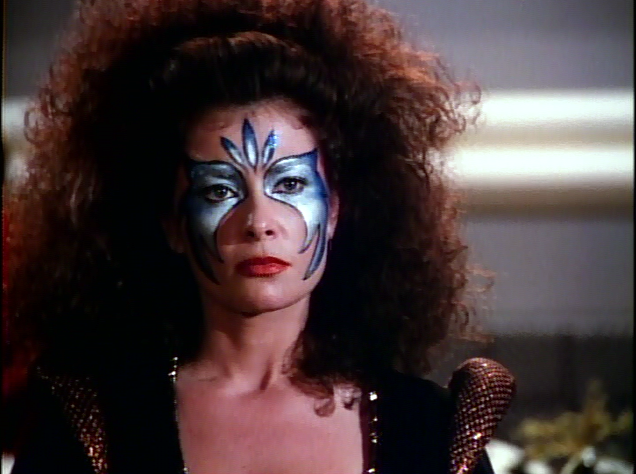
Diana
(Jane Badler), who fears that she will lose command if peace is at hand, also conspires to destroy the
Leader’s shuttle and makes the assassination attempt look like a plot by the
Resistance. The plan fails, and Diana is exposed. Desperate, she attempts to vaporize the Earth using the mothership’s fusion reactors.
Then Elizabeth, with psychic help from the Leader, manages to save the day, harnessing the ship's technology with the power of her mind. Diana is captured and held for trial with her
cohort, Lt. James (Judson Scott) while Elizabeth prepares to go off with the
Leader.
Kyle stows away on her shuttle, unwilling
to give up Elizabeth.
Diana,
meanwhile, reports that a bomb has been planted on the Leader’s shuttle…


Even
at its very worst, V: The Series always had brass balls.
The program killed off regular cast members
willy-nilly, featured kinky sexual innuendo at virtually every turn, and then
gave us this episode -- “The Return" -- a gonzo cliff-hanger conclusion, as its final
installment. Almost thirty years later, the cliffhanger still hasn't been resolved, alas.
I
still recall seeing “The Return” in prime-time in 1985 and finding the tension unbearable, especially during the climactic pull-back up, up, up and away from the mothership
deck, and from the Resistance fighters.
Nothing was resolved, and disaster loomed. Elizabeth
was gone. Kyle had disappeared. And
Diana was still scheming to break the peace....violently. When the end credits rolled, I think my heart was in my throat.
I must say, I’m especially sad a second season never materialized
because June Chadwick informed me in an interview some time back that the first several episodes
of Season Two would have seen Lydia pursuing Diana on an alien world for her
crimes against the Visitors. I would have loved to see those episodes.

So
“The Return” has momentum, and guts, too. It goes for broke, and there's an energy in the air that was missing from some of the last few episodes. Everyone gets it together for one last hurrah.
Looking back, I half suspect that the plan was to kill Elizabeth and Kyle (along with
the Leader) and start fresh with some new characters the following season, if the series got renewed. I know that Julie’s death was in the
offing. If so, that would only have left
Jane Badler, June Chadwick and Marc Singer returning.
Despite
the pacey, go-for-broke nature of “The Return,” the episode does raise a few intriguing questions, especially in regards to the depiction of the Leader. Although we never see the Leader during this installment, we hear his
booming voice frequently, and see that his shuttle is awash in unearthly light. It’s as though he’s more God than man, or
rather lizard. He can communicate
telepathically (which other Visitors can’t), can control his technology
remotely (which, again other Visitors can’t,) and seems very concerned with
peace (which his people don't).
So he's an anomaly.

Of
course, none of this information about the Leader in "The Return" jibes with the information Martin (Frank Ashmore) told Mike in the
first mini-series back in 1983. There, Martin described the Leader as a kind of charismatic madman who seized power in a time
of turmoil and upheaval. He was a war-mongering fascist dictator
(think Hitler), and not some benevolent “Father” of the Visitor race.
And
indeed, it makes no sense for The Leader to wage war against the Earth in the
first place if he is such a peace-loving person (or force, as the case might
be).
Also, we know from series history
that the Leader was Diana’s lover for a time. It’s
hard to picture the serene-voiced, light-encrusted “Leader” imagery of “The
Return” in those circumstances. Diana would eat him for breakfast.
The
episode’s other weak point, perhaps, is another lame subplot involving Willie. Here he
meets an old flame Irma who wants to pick up where they left off. This subplot hardly seems worthy of a season
finale or series finale, and the time would have been better spent with either Diana --who is told by Philip that her “voice will no longer be heard” -- or with Kyle and
Elizabeth, whose relationship hits a crossroads as Elizabeth “evolves.”

I
grew up with V: The Series, and I loved it as a fifteen year old kid. Today,
I appreciate it primarily for the performances, especially those of Jane Badler, June Chadwick, and Faye Grant. I believe it is undeniable
that all three of these actors would have been even better served with the original “It
Can’t Happen Here” idea of the series. The show could have been a drama about the Visitors inserting themselves into our lives here on Earth, finding collaborators and allies, as well as making enemies. I don't believe the hard "action" approach of the series suits V very well. The premise is too smart to get reduced cleanly to car chases and fisticuffs.
Actually,
even the Open City format that opened the series and lasted for a dozen
episodes or so would have worked just fine, if some of the writing was just a little stronger. But the re-vamp at V’s midpoint just kills the
series, at least in terms of its heroes.
The Resistance loses all semblance of reality, and so the action heavily
tilts towards the Mothership, where Badler and Chadwick reign, stealing scene
after scene. I find these scenes immensely enjoyable and a saving grace, but again, there's a sense of imbalance overall.
A
summer break would have well-served the series. Everyone could have rested,
stories could have been honed, and better ideas (and perhaps) characters
explored. Brandon Tartikoff once reported
that canceling V was a tremendous mistake, and I agree with him in the sense
that the series had a charismatic cast, a great premise, and, a vast array
of expensive sets and costumes. If the writers had
learned to play better to those strengths, a second season might have been a
vast improvement over the first.
It is too bad we never got to find out.