
 Posts
Posts


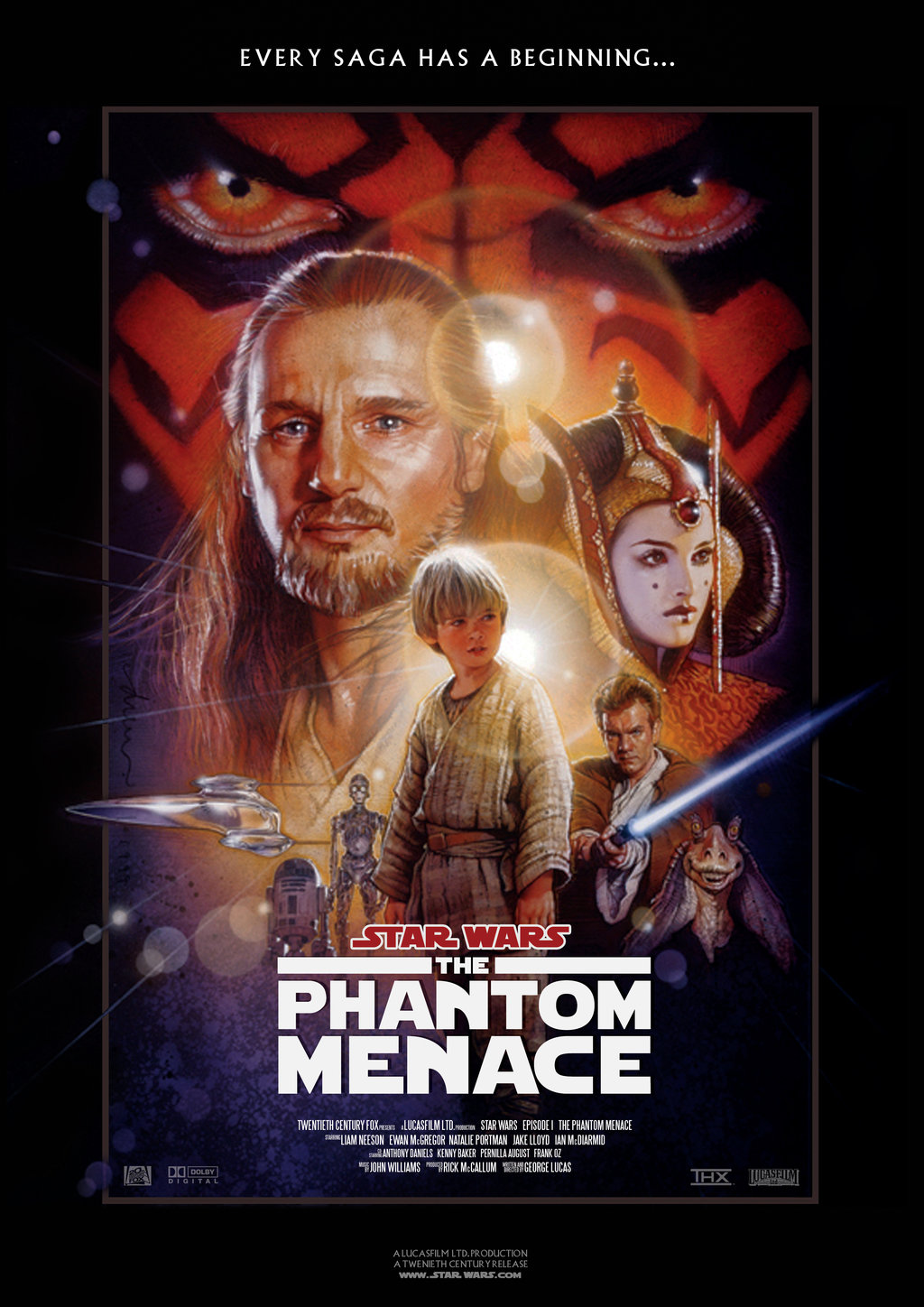
The Phantom Menace (1999) is the Star Wars film that many fans -- and
certainly those writing on the Internet -- love to hate.
The reasons for that
hate are right there on the film’s surface. Many of these critics and fans don’t
like the humor or wacky hijinks of Jar Jar Binks, for instance.
They might also complain
about the mundane nature of the film’s overarching conflict (a “dispute” about
taxing trade routes), and many also dislike the performance of sunny-faced Jake
Lloyd as a pre-pubescent Anakin Skywalker.
Then again, there’s
another complaint written about and spoken of frequently. Many fans and critics
simply dislike what they feel is the over-green-screened, CGI look of this
first in the prequel trilogy.
I can sympathize and
fully get behind some of those arguments. Some aspects of the movie don’t come
off as successfully as I would have preferred.
And yet, across the
years I have grown to appreciate The Phantom Menace more than I once
did. To quote a Skywalker, I believe there is still good in it.
Why have I moved to this
stance so fully over the last fifteen years, when my initial gut response was,
admittedly, grievous disappointment?
Perhaps because the hostility
towards the film (and indeed, its creator) has been so harsh, I have been
motivated to go back and really examine the film, and my feelings about it.
My work as a critic,
here on the blog or in books, is not to mirror conventional wisdom. It is not
to glom on to popular opinion. It is not
to make snarky comments that seek to mock an artist’s attempt to share his or
her vision with the world. It is, only, to study a film and determine if an
intellectual case for its artistry can be forged.
A decade-and-a-half
after its release, I believe I can make a case for the artistic coherence (and
indeed, beauty, in spots) of The Phantom Menace.
First, the entire film
-- rather unlike the other Star Wars entries -- features a
remarkable, under-the-surface leitmotif that pulls all of the disparate aspects
of the narrative together.
What is that leitmotif?
Symbiont circles.
Virtually every key relationship
is defined in the film by the concept of symbiont circles. For the purposes of
the saga, the idea of a symbiont circle is that people -- and their fates -- are
connected. Those connections aren’t always seen. Sometimes they are merely
hinted at. Sometimes they are detected, but unclear. But they are present
nonetheless.
The film’s discussion of
symbiont circles allows George Lucas to go beyond the “Light Side” and “Dark
Side” dichotomy of the original trilogy, and tread into more nuanced, gray
material. For instance, the symbiont circle leitmotif reveals that the Jedi are
not paragons of virtue, but arrogant, and occasionally haughty individuals.
This is an appropriate
development for an artist returning to his work a generation later; looking to
deepen and broaden it in ways that are commensurate with his experience.
Beyond that leitmotif of
symbiont circles, The Phantom Menace succeeds on a visual basis. The film’s art
direction and production design convey the underlying elements of the narrative,
which clearly concerns the rise of fascism and fall of a free, enlightened
society.
Every film critic has as
his or her shtick I suppose you could conclude; a benchmark by which to rate a
movie a success or failure. As regular readers here are aware, I approach films
by looking for the ways that visuals do or do not reflect/augment the thematic
content. If a film can match
visualization with theme, I count it artistically sound. If a movie can better
make its point with its pictures than its words, it has succeeded in using the
art form to its fullest.
On that basis, I find The
Phantom Menace flawed, and yet, finally, artistically sound.

“There’s always a bigger
fish.”
I have never quite
understood why so many fans harp on the fact that -- on the surface -- The
Phantom Menace is about a minor dispute over taxation.
That mundane “challenge”
for the Republic is, of course, a stalking horse, for the film’s titular “Phantom
Menace,” a puppet master called Darth Sidious who is utilizes the appearance of
“business as usual” -- the routine, the bureaucratic, the corrupt -- to achieve
something truly radical. That’s actually what a “Phantom Menace” is: something
that isn’t obvious; but rather amorphous…at least at first. Obi Wan begins to sense this truth when he
opens himself up to the Force. He senses something “elusive.”
And that “elusive”
threat brings me to the film’s central notion of symbiont circles. If there’s
always a “bigger fish,” as Qui Gon
Jinn (Liam Neeson) informs us early in the film, then the tax dispute is definitively
and intentionally “the small fish,” the concrete menace, the challenge that
appears before the Jedi’s eyes, but doesn’t reveal the whole truth. Obi Wan, in
his comment on something “elusive” almost detects that “bigger fish,” it seems.
Here, a mystery figure
is manipulating seemingly mundane disputes between Republic members to achieve
a radical or revolutionary end. This Dark Lord of the Sith realizes precisely how
the pieces of the Republic interact with one another. He is cognizant of that
symbiotic circle, you might conclude. He realizes how he can make one piece of
it act in a certain way (an illegal blockade by the Trade Federation), and how
another member will respond to that action (Naboo’s resistance).
His end goal, as is abundantly clear by film’s end, is to create a desire in the Republic for a regime change; to unseat Chancellor Valorum. So Palpatine/Sidious manipulates the symbiotic nature of Republic trade and economic relationships, for lack of a better term, to create war between members, weaken leadership, and see himself installed as chancellor.
His end goal, as is abundantly clear by film’s end, is to create a desire in the Republic for a regime change; to unseat Chancellor Valorum. So Palpatine/Sidious manipulates the symbiotic nature of Republic trade and economic relationships, for lack of a better term, to create war between members, weaken leadership, and see himself installed as chancellor.
There is actually very
little talk of taxes or trade routes in the film, though you wouldn’t know that
from the Internet criticism leveled at it. What we see mostly is an illegal
orbital blockade of Naboo, and attempts to penetrate or end that blockade. That
situation, rather than being staid, provides for plenty of action.
The same idea of
symbiont circles plays out on Naboo’s surface. Obi Wan Kenobi (Ewan McGregor)
warns Boss Nass, leader of the Gungans, that what occurs to the humanoids of the planet -- invasion,
namely -- will also happen to the Gungans.

Why? They share the same planet; the same
reality. They are linked.
Amidala recognizes this
symbiont circle herself, in the film’s conclusion. Her successful battle tactic
is predicated on the idea of the Gungans and humanoids joining forces to stop
the invasion.They work together, in symbiosis, rather than failing to recognize
their connection to one another.
And Padme is quite a
leader too. She recognizes she doesn’t “rule” her people. She is one with them,
part of another symbiont circle. “I will sign no treaty,” she declares. “My fate will be the same as my people’s.”
Just as the Gungans will
share the same fate as her people.
It’s all connected.
The small fish/big fish
comparison fits in quietly elegantly with the idea of the symbiont circle. We
all live in inter-connected environments, wherein our actions impact
others.
Take for example Anakin,
a slave on Tatooine. The Republic has explicitly outlawed slavery and yet,
again, facts are facts: Anakin is a slave on Tatooine. Qui Gon reports, almost as an aside that he
hasn’t come to Tatooine to free the slaves. The Republic/Jedi are therefore -- quite
unlike Padme or even Jar Jar -- unable to detect the symbiont circle of which
they are a part.
And the cost of their
failure to honor the dignity and basic human rights of Anakin and his mother is
their own eventual destruction. Anakin ultimately destroys them and what they
stand for. Significantly, even slaves like Anakin and Shmi, who live by the edict
that the biggest problem in the universe is that “people don’t help each other,” see how it is right to help
others. For some reason -- either corruption,
bureaucracy, avarice, or arrogance -- the Jedi nor the Republic Council can see
this truth. They love in opulent, literal
ivory towers.
Instead of actually helping
those who need them, the Jedi don’t show anything but contempt and arrogance
towards some of those with whom they share the universe. “Why do
I get the feeling that we’ve picked up another pathetic life form?” Obi Wan
asks at one point. That is precisely the wrong perspective for someone who
lectures others on the idea of being aware of and valuing inter-connection.
The question: what does
this idea of symbiont circles buy George Lucas and Star Wars?
Quite simply, it reveals
that the Republic and its defenders have fallen from their high moral ideals,
and are vulnerable to the Sith because of it.
The Jedi are arrogant, and can’t see “the bigger” fish operating behind
the scenes because of their inadequate sight. The Republic, likewise, is so
bureaucratic and caught up in red tape that its leaders cannot free slaves,
help an imperiled senate member (Naboo) or even get out of congressional gridlock.
We know from the
Original Trilogy that the Republic must fall and give rise to the Empire. The Phantom Menace makes a kind of
double or mirror case regarding that fall. Darth Sidious is aware of symbiont
circles and manipulates them to his ends, destroying the Republic. His mirror
reflection -- the Jedi and the Republic -- are not tending to their symbiont
circles and have therefore failed not just institutionally, but morally.
So Lucas has shown us,
with his concept of symbiont circles, how and why a free society falls…when it
loses touch with its own plainly stated and voiced values. Obi Wan and Qui Gon
are both quick to talk about inter-connection with the Gungans, but the Gungans
(raising their “grand army,”), Padme, and Anakin who actually tend to those
relationships. While the Jedi Council holds back because the Jedi can’t fight a
war for Naboo, Padme, Anakin and Jar-Jar actually fight that war.
This is where Lucas has
broadened and deepened his myth since the 1970s and 1980s. Listening to Obi Wan
Kenobi talk to Luke in Star Wars, one
might conclude that the “good” Jedi were defeated by the “evil” Emperor and his
sidekick Darth Vader. What The Phantom Menace reveals is that
the story is not that simple.
The Jedi and the
Republic played roles in their own downfall. The Dark Side was there, ready to
exploit those faults but, but those faults existed. The Golden Age was not so
golden after all.

“Your focus determines your future.”
The
Phantom Menace is set a long time
ago in a galaxy far, far away. But it is actually a film about life here on
Earth in the early twentieth century, particularly the so-called “Inter-Bellum”
or “Inter-War” period between 1918 and 1939.
This was a gilded age of
Art-Deco-styled architecture and design, and apparent peace and prosperity in
America. Yet if you remember from history what came next, economic ruin was on
the horizon, racism still thrived, and the “phantom menace” of Fascism and
tyranny lurked in the shadows.
Through
carefully-crafted, beautifully-rendered imagery, The Phantom Menace recreates
this very Inter-Bellum age, but on other planets, and in another
time.
We’re all familiar with
the lived-in look of Star Wars (1977) where the universe is
kind of…junked. But by important contrast, The Phantom
Menace is set at the apex or zenith of the Galactic Republic, an
epoch of riches and wonders, a span when even the finned, chrome spaceships
reflect the glory of an advanced civilization at its pinnacle.
And yet, of course, as
the discussion of symbiont circles reveals, it is not a perfect Republic, is
it? Slavery still thrives in far corners of the galaxy, and even the
noble Jedi Knights turn a blind eye towards this corrupt institution. And
on the rise is wily Senator Palpatine (Ian McDiarmid), a man who will deceive
the unsuspected advanced society to achieve a completely despotic, totalitarian
state.
In short, The
Phantom Menace’s story is a perfect metaphor for the lead-up to
World War II and the global fight against fascism in Europe. Accordingly,
the rich imagery in the film explicitly recalls this battle of
civilizations. Consider just for a moment the scenes set on the planet
Naboo, a kind of quasi-European state in another solar system.
At least twice in the
film, we spy a building in the capital city of Naboo that resembles the Arc De
Triomphe (or Arc of Triumph) in France.
In 1940, Nazi troops
invaded Paris, and marched the pavement of the Champs-Elysees as a sign of
strength and domination. In 1944, the Allies liberated the nation from
Hitler’s troops, and on this occasion there was a parade of victory and freedom
at the Arc de Triomphe.
The Phantom Menace features two similar moments at an Arc-like structure, once
at the commencement of the Droid Army/Trade Federation occupation and then
again after their expulsion, during a celebration or parade. If you gaze
closely at the imagery, it’s impossible to deny the significance of these visual allusions or comparisons.


If Naboo represents a
foreign nation endangered by the outer space equivalent of an Axis power, then
Coruscant clearly represents New York City of the same age...a popping hub of
culture, diversity, and freedom.
As you may recall,
Coruscant is a planet-wide metropolis, a city beyond all others. This
urban city-scape stretches to the horizon, and nearly right to the cusp of
space itself. In appearance and style, Coruscant conforms perfectly to
the Italian architectural style of “Futurism” popular during the 1930s.
In fact, the Futuristic
aesthetic -- an always-growing city upon a city upon a city –
was in some corners considered a coded critique of Fascism, and that’s an idea
visually reflected by the depiction of the Republic’s capital.
And yet, by the same
token, Futurism is seen as stylistically compatible with Art Deco, a school of
design often considered “purely
decorative." It therefore represents the art of a people
very satisfied with the social status quo. The form is important for
itself (for aesthetics), not for the social message behind it. This description
not only describes Coruscant aptly, but her satisfied people. They don’t
perceive the “phantom menace” in their midst, nor the threat to their very
liberty. They're too busy enjoying a time of peace and prosperity.


So this is Lucas’s
selected thematic terrain: a metaphor in a galaxy far, far away comparing the
last epoch of the Republic to the Inter-Bellum period on Earth. In Star
Wars, in 1977, Lucas used visual movie allusions (war films and
Kurasawa’s canon, with some Flash Gordon thrown in for good measure) to create
a pastiche. Twenty-two years later, Lucas is still using allusions, but
historical ones, and ones from schools of art. His approach, again, is more developed, more
nuanced.
But then Lucas stretches
his comparisons even a step further in The Phantom Menace and connects that
period in Earth history and in the Star Wars universe
to the period in which the film was actually made, the 1990s.
The
Phantom Menace was released at the end
of the Roaring Nineties, a period of genuine peace and prosperity in the U.S.,
and a time – we now know – before the gathering storm of the
War on Terror.
Lucas was downright prophetic
in describing how American politics would soon change to face a grave and gathering
threat. In Lucas's vision, Supreme Chancellor Valorum (Terence Stamp)
-- a name which features the same number of letters as Clinton --
would see his leadership and plans for governance stamped out by pervasive
accusations of “scandal” from his political enemies and the enemies of
progress.
Accordingly, Valorum is
impeached by the bureaucratic Senate when a vote of no-confidence is held. That's
what happened to Clinton too. We were all focused intently on his scandals, and
the very public investigation of those scandals while overseas, terror grew in
secret...


And, of course -- as
I’ve written before -- one important though subordinate villain's name
in this film is Nute Gunray. Nute = Newt (Gingrich), the
leader of the Republican opposition during Clinton’s Presidency. And
Gunray = Ray Gun = Reagan. So a villain here is Newt Reagan,
essentially.
You needn't agree with
Lucas’s viewpoint or political slant to acknowledge that such an undercurrent
is present in The Phantom Menace. And I'm not arguing that Lucas is
either right or wrong in his statement, either.
I'm merely
noting the existence of the pointed social critique.
As further evidence in
support of this sub-text, I would note that the social commentary in Phantom
Menace as I've spelled it out in this essay is consistent with
Anakin’s 2005 Bush-esque declaration in Revenge of the Sith that
“Either you’re with me, or you’re my enemy.”
These data points
suggest that Lucas understands the sweep of history.That empires age, become
corrupt, and are challenged. That periods of peace and prosperity do not go on
eternally, unchallenged.
Regarding the film's
other lush visuals, The Phantom Menace shows us a Tatooine that is not unlike
Humphrey Bogart's Casablanca, a meeting place and
trading square for different alien races with varied motivations; where a
criminal underbelly operates. But more
to the point, I believe that the Pod Race is a direct allusion to William Wyler's Ben Hur (1959),
and in particular, the central set-piece: a chariot race.
Here,
Lucas has co-opted the spectacular imagery of a well-attended race, but colored
it with a technological sheen, to update a classic Hollywood movie moment (a
call-back to his Star Wars approach).
And notice too that both movies are overtly religious in nature, and involve
slavery, or more aptly, a former slave who rises to a place of remarkable power.
As I noted in my introduction, an important critical requirement for any film is that form must in some fashion reflect content. Imagery should buttress, reflect, or augment our understanding of the story presented. A good film can’t merely carry deeper meaning around on a character’s tongue…or else the movie becomes radio with pictures. And yet surprisingly few films these days effectively manage this (necessary) feat; to truly deploy visuals in a manner that makes pictures convey thematic meaning.
The
Phantom Menace succeeds admirably
in this particular aspect of its tapestry. The images convey important
thematic information about the film’s narrative, and how we should interpret
that narrative. In other words, the visuals reinforce the comparison the
director wants to make, the point he wishes to transmit.
At the very least, I
believe that George Lucas embarked on a complex and ambitious visual aesthetic
in this first prequel. He makes the images of his fictional world connect
to a time of apparent peace and prosperity (but phantom danger) in our past,
and then makes modern audiences understand that we were at a similar juncture
in the 1990s. Were our eyes open to the "Phantom Menace" back
then, or were we turned inward, mired in accusations of scandal and corruption?
If you consider the
decade 2001 - 2010, I think you'll have your answer.
Here’s another apparent ding
against the film. Many character designs, voices, and characteristics
in The Phantom Menace appear, in fact, based on racist
stereotypes that existed and flourished in the Inter-War period.
Watto the money-grubbing
Toydarian with his hook-nose appears to be an amalgamation of the offensive “money
mad” Jewish stereotype of the Inter-Bellum period.

The Trade Federation
representatives like the Viceroy speak pigeon English and have – literally –
slants in their eyes. They thus serve as the embodiment of negative stereotypes
about the Japanese.

And finally, the much
hated Jar-Jar Binks with his Stepin Fetchit, “Feet-Don’t-Fail-Me-Now” routine
is alarmingly representative of the prevailing caricatures of black men in the
media of the same, between-wars age.
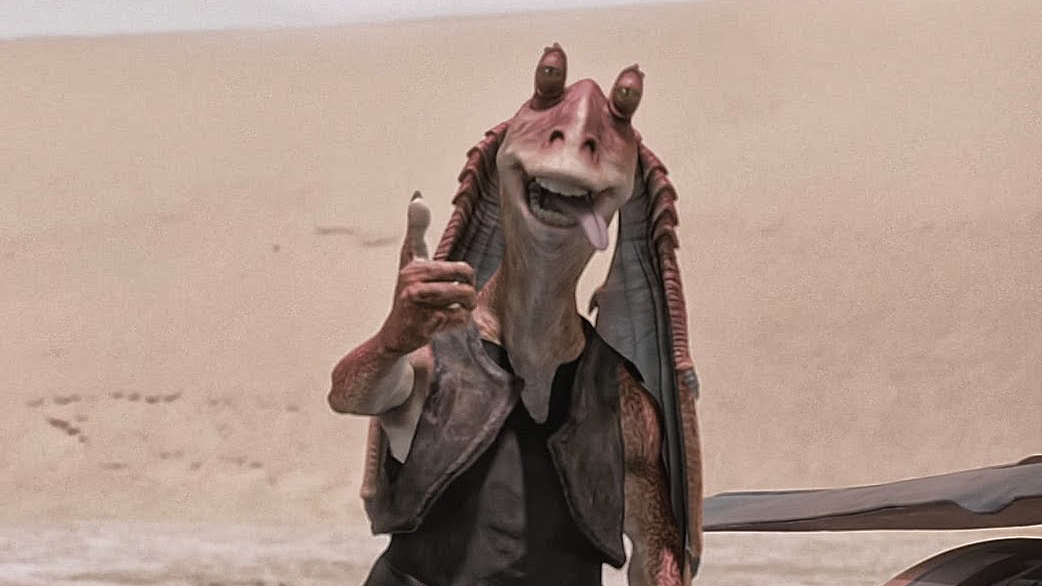
While it’s true that
these characters hark back explicitly to that specific period on Earth and
thus sub-textually remind viewers of that time, that historical
allusion may not validate their inclusion in the film.
What could?
Well, I would very much
prefer to believe that Lucas’s depiction of such “ethnic” characters in The
Phantom Menace points out, again, that The Galactic Republic is
not really the Utopian paradise of equality that many believe it is.
Not only is slavery
present in some corners, but certain “pathetic”
life forms (to quote Obi-Wan directly) are looked down upon, explicitly…even
by the Jedi.
So we’re right back to
the symbiont circle, aren’t we? Gazing
at the Trade Federation as literal “slant eyes” or writing off Jar-Jar because
of his apparent dopey-ness. Trying to
run a Jedi-Mind trick on the money-grubbing Watto. The message here may very
well be that prejudice is inside all of us, and it blinds us to the
inter-connection of our environment, to the symbiont circle. Jar-Jar, at least in terms of the action,
pretty much saves the day, doesn’t he?
And so does a slave. Those beings
who appear to be silly stereotypes, both to us and the Jedi, turn out to have
unrecognized value.
Perhaps the Republic
falls because there’s that level of hypocrisy and arrogance there, a looking
down its collective nose at species like Gungans or Toydarians. All the
Republic and Jedi see, essentially, is the equivalent of “skin color,” not the
true value of these individuals and their people. Pathetic life-forms? What kind of hero would use such words to
describe another being?
So is Star
Wars Episode I: The Phantom Menace the film I hoped it would be,
on the eve of its release?
Not exactly.
The film is poorly paced,
and Jar-Jar's biggest problem is not that he's an annoying boob, but rather
that the CGI artists who created him feel, for some reason, that they must show
off, making him catapult and dive like a cartoon superhero when he should move
a lot more...subtly.
Were he bound more
directly to forces such as gravity, he might have seemed more acceptable.
I should note, in fairness, that my reservations about Jar-Jar are
generational. They are shared by the OT’ers. I conducted an informal poll in my carpool
last week, before writing this review, about Jar-Jar. With nine years old, he came in as the third
best Star
Wars character ever. Number one was R2-D2, number 2 was Yoda, number 3
was Jar-Jar, number 4 was Chewbacca, and number 5 was General Grievous. Han Solo didn’t place with the nine year old set, even in the top ten.
Who are 46 year olds -- who found Star Wars at age 7 or so -- to argue with a nine year old that
his impression of Star Wars is the wrong one? Isn't one joy of Star Wars supposed to be that it sparks the imagination of children. It looks like with Jar-Jar, George Lucas accomplished that for the second generation, even if the first generation holds its nose.
On the other hand, as my review of Return of the Jedi pointed out, the franchise's overt appeal to childhood set legitimately started there, with all the burping aliens and Ewoks. That's a bit of a shift from Star Wars and The Empire Strikes Back, but not one you can blame The Phantom Menace for instigating. At this point, it's a fait accompli. Selling toys and bringing in the kids is a marketing strategy.
On the other hand, as my review of Return of the Jedi pointed out, the franchise's overt appeal to childhood set legitimately started there, with all the burping aliens and Ewoks. That's a bit of a shift from Star Wars and The Empire Strikes Back, but not one you can blame The Phantom Menace for instigating. At this point, it's a fait accompli. Selling toys and bringing in the kids is a marketing strategy.
On the plus side, I'd
argue that the final light saber duel against Darth Maul is the greatest and
most impressive such battle in the franchise, and that Liam Neeson projects
enormous dignity and grace throughout the film as Qui-Gon Jinn. Overall, I'd
say he's the most likable Jedi Knight in the saga (so far).
But that is all just icing
on the cake. In The Phantom Menace, George
Lucas made a film about a galaxy far, far away, but that galaxy was succumbing to
the same hatreds and fears that we saw early in the 20th century
(and which rear their ugly heads again, even now, in political discourse). The
film’s visuals tell us that fact, and even the nature of the aliens remind us
of why it is valuable not to speak in Nativist, arrogant, racist terms. To do
so is not honoring the connections we share in our symbiotic circle. To do so is
to betray the force.
Obviously, I can change
no hater’s mind.
At this juncture, I don’t
care to try, and I don’t feel I need to. So I will close with this thought: “your focus determines your future.”
If you focus on the
1919-1939 Inter-Bellum type visuals of The Phantom Menace, and keep your
eye on the leitmotif about symbiont circles, the future reputation of this film
need not be consumed by hate.
Because we know hate
leads to the Dark Side, right?


