Showing posts with label Frank Spotnitz. Show all posts

Thursday, January 29, 2015

Cult-TV Review: The Man in the High Castle (2015)


(Here there be spoilers...proceed at your own risk.)

The Man in the High Castle (2015) is a new and impressive pilot from X-Files writer Frank Spotnitz and director Ridley Scott. It is being featured as part of Amazon's second annual pilot season.

The filmmakers have worked with great skill and artistry to adapt the Hugo Award-winning 1962 novel by Philip K. Dick to a visual format. Dick’s story has been termed an “alternate history” science fiction story, meaning it ponders what might happen had history gone differently.  

In this case, the Axis Power won World War II, and have since carved up America. Imperial Japan now controls the West Coast, and Nazi Germany controls the East Coast, with a “neutral zone” in the mid-west separating fiefdoms.  

The series is set in 1962, some dozen or so years after the end of the war.


The Man in the High Castle pilot focuses primarily on two characters, one living in Japanese San Francisco, the other in Nazi-run New York, as they make separate, unplanned pilgrimages to Canon City, in the Neutral Zone. 

Making the journey from the west is Julianna Crain (Alexa Davalos).  

Making it from the east is Joe Blake (Luke Kleintank). 

Independently of each other as well, each character carries notable contraband: a film reel titled “The Grasshopper Lies Heavy,” which showcases documentary footage of the West -- FDR, and Winston Churchill -- winning World War II for the Allies.  

Since this did not happen, apparently, in Joe and Julianna’s particular reality, that means that the world -- reality itself -- is false in some way not yet understood.

The pilot episode commences in terrifying fashion, as images of American sovereignty and power are overcome by the relentless march of the Axis Powers.  

Scored to a morose, creepy version of “Edelweiss,” from The Sound of Music (1959), the introductory montage is unforgettable.  The funereal tone makes viewers aware that they have entered a world without freedom and liberty, where the face of Lady Liberty has fallen under a shroud of darkness. It’s an effective and ominous note to start out on, and the opening montage is quite powerful.

From there, the narrative moves crisply and cleanly o introduce this “brave new world” of the 1960s.  Rock Hudson and June Allyson are still making movies for Hollywood, but America is not the same country any more. 

Joe Blake seeks to join the Resistance movement in New York, while Julianna sees her sister Trudy gunned down in cold blood by the Japanese regime for her role in the resistance. Both characters take up the same odyssey from opposite sides of the country, and by pilot’s end, meet one another.  

And, of course, there’s a final twist that will leave you gasping.


The pilot also contends with the specter of a new Cold War. 

Hitler is aged and dying in this alternate reality, and his would-be successors (Goebbels, Himmler, and Rommel) are scrambling for power. This means trouble for Japan, because many in the Nazi hierarchy believe that the U.S. should not have been partitioned. Instead, it should have been taken for Germany. Accordingly, nuclear weapons stand ready to bomb the Japanese island as well as San Francisco.  It’s possible that the world will plunge into an all-out war…again. 

Some characters in the drama believe that they can use the I-Ching, an ancient divination text, to determine what shape the future will take.

In the original novel by Dick, The Grasshopper Lies Heavy was a book, not a film, but I liked this update and change because TV is a visual art-form, and the existence of a documentary film establishes better than words on a page would that the world featured in the series could be false, or perhaps, merely one world in a massive multi-verse. 

If a series should develop, the exact nature and origin of this book will no doubt be a major plot line.  How did get to this universe?  Is this universe real?  Is it a game?  A simulation?  A parallel reality? 

A clever and intelligent writer like Spotnitz can spin the narrative in any tricky direction, hinting at multiple possibilities, and keeping us on our toes for many seasons. Certainly, the pilot episode is well-crafted, particularly in its attention to small details.


For example, there’s one scene of utter horror that occurs while Joe is on the road. He stops his truck, and speaks to a police-man. 

Ash suddenly falls from the sky like snow. 

Joe is perplexed, and the policeman reports that a hospital is nearby. And Tuesday is the day of the week that said hospital burns cripples, the terminally ill, and other “drags on the state.” 

Blake is eating a sandwich when this revelation occurs. Watch him closely as he regards his meal. His unguarded response (or lack of one) is a clue about his character's nature. But this little throwaway moment captures the terror and inhumanity of the Axis Powers more powerfully than could a scene involving Nazi soldiers and large scale combat. We understand immediately how this America is different from ours.  

Here, death panels are really…and burning every Tuesday.

The Man in the High Castle introduces a number of good concepts that could well serve a long-term series, including the belief that “fate is fluid” and that “destiny is in the hands of man.”  It would be incredibly intriguing to see this idea play out, across a Japanese/Nazi Cold War, and across a dedicated resistance movement.  

Already, The Man in The High Castle is extraordinary, imaginative television, dominated by strong performances, crisp writing and surprisingly good production values. On that last front, there’s a shot of Nazi Time Square here that will make your jaw drop.  


Let's hope this one makes the cut.  I'm still in mourning over Amazon's treatment of The After. Let's hope it doesn't make the same mistake twice. The Man in the High Castle could very well be the Game of Thrones for the alternate reality sub-genre...if Amazon doesn't kill it in the cradle, that is.

Thursday, September 05, 2013

The X-Files 20th Anniversary Blogging: "Leonard Betts" (October 27, 1997)


Many episodes of The X-Files (1993 - 2002) depict human-appearing genetic mutants who, in order to survive, must prey on the rest of us.  

These mutant predators operate in secret and are usually, though not always, hostile in the manner by which they garner their sustenance. Victor Eugene Tooms (of “Squeeze” and “Tooms”) devours the livers of victims, and stalks his prey like animals.  Mr. Incanto of “2Shy” lures unsuspecting plus-sized women to their doom -- playing on their lack of self-confidence and vulnerability-- to drink and digest their body fat and thereby nourish himself.

The series' fourth season entry “Leonard Betts” is indeed another genetic mutant story in this pattern, but there are two important distinctions or twists in this tale written by Vince Gilligan, Frank Spotnitz, and John Shiban.

The first is the less-than-malevolent nature of Mr. Betts, played by Paul McCrane. Unlike Tooms or Incanto, he is the most reluctant of mutant "eaters," and also perhaps the most “surgical” or skilled.  Betts doesn’t want to kill anyone, but he does want to survive.  There is an element of sympathy and sadness in the way he approaches his victims.  Also, as a paramedic, he is no berseker. 

The second and perhaps more important point regarding “Leonard Betts” is that it presents -- for the first and last time, I believe (and if memory serves…) -- a kind of Unified Theory of Genetic Mutants on The X-Files.   In other words, it contextualizes the mutants that Mulder and Scully frequently encounter in a way that could apply to the whole phenomenon.

Specifically, the episode brings up the topic of “punctuated equilibrium.”  

Mulder discusses this theory with Scully, and it’s an authentic hypothesis in evolutionary biology.  Punctuated equilibrium suggests that most species exhibit small or inconsequential change for most of their duration on this Earth, dwelling in a brand of biological stasis.  

But when significant evolutionary change does come, the theory of punctuated equilibrium suggests it will include rapid, radical events of cladogenesis, a process by which one new species branches away from the main or established one. 

Given this particular definition, it’s fascinating to consider the mutants of episodes like “Tooms,” “The Host,” “2Shy,” “Hungry” and “Leonard Betts” as representatives of cladogenesis, a sudden rapid branching-off from mankind.   Are they representatives, actually, of several new species?

Exploring the idea more deeply, the implicit question becomes: why is cladogenesis occurring now?  Why is it appearing so frequently in the 1990s America of Mulder and Scully?  What we are truly discussing here is a second X-Files Mythology, one that ties together the so-called “Monster of the Week” stories.

I would propose that the sudden and apparent increase in genetic mutants as seen in The X-Files may be a product of technological man’s impact on the environment at the turn of the 20th century...on an industrial scale. Although this explanation can’t necessarily apply to Tooms -- who is over a hundred years old -- we do know from episodes like “The Host” and “Leonard Betts” that radiation, and human/biological waste are two factors that have some involvement.

That’s just speculation, of course, but one wonderful quality about re-visiting The X-Files is that engaged viewers begin to see under-the-surface, perhaps even unintended connections between apparently-unrelated installments.

Outside a unified theory of The X-Files mutants, “Leonard Betts” is a successful episode of the Chris Carter series because it proceeds with humor and joviality and because it turns those commendable qualities on their head for a stunning, jaw-dropping finale that concerns a main character, Scully.  

Mulder’s humorous quips disarm the viewers, and Leonard Betts’ humanity lends the episode a softer side than seen in some mutant stories...and then the episode delivers a devastating gut-punch.  Suddenly what seemed very unreal is very real indeed.  A monster that couldn't possibly be real points out the existence of a very real disease in a beloved character.

In true The X-Files fashion, “Leonard Betts” thus impresses for the way it both adheres to series tradition and meaningfully diverges from it.
                                                        
                                 
Leonard Betts -- a gifted paramedic who can seemingly diagnosis cancer by eye -- is decapitated in a catastrophic ambulance accident in Pittsburgh.  But on the same night as his apparent demise, Leonard’s headless body disappears from the morgue…

Scully (Gillian Anderson) and Mulder (David Duchovny) investigate Leonard’s death and explore the strange hypothesis that Betts is somehow still alive, and that he can regenerate parts of his body…even his cranium.

The agents also gather evidence that suggests Betts is riddled with cancer, and that somehow this sickness aids in the regeneration process.  Betts’ cancerous form also explains the nature of his gift.  He can pinpoint cancer in others because he must consume cancer to survive.

Scully is surprised and devastated when she becomes Betts’ intended next meal…

                            
In terms of The X-Files series catalog, I have referred at least twice before to the series focus on the un-excavated “sausage-making” of modern society.  

On at least two notable occasions, The X-Files shone a light on that sausage-making in ways that make us, the audience, feel intensely uncomfortable.  Two of the best episodes of the series, “The Host” and “Our Town” tackle this notion. 

In the former case, the issue pinpointed is: where does our bodily waste go after we flush it down the toilet?  What happens to it?  

The second (examined in “Our Town”) is equally disturbing: what goes into our food preparation at meat plants across the country?  What are the chickens we eat at home fed as they are grown?  And what is in that feed?


“Leonard Betts” follows up this idea by escorting viewers to a place far more gruesome and disturbing than a hospital morgue.  

Here, Mulder and Scully go diving into a large tank of biological refuse or waste.  They sift through discarded body parts, and again, this is something we just don’t generally talk or think about as a society...let alone on television in the 1990s.  Essentially, this is a place where the human body becomes…garbage.  The disgusting exploration of cast-off body parts is leavened somewhat by Mulder’s persistent sense of humor, but the fact is, this is another aspect of modernity we live in ignorant bliss about.

The episode also features one of the most disturbing scenes on The X-Files since “Home.”  Scully prepares to perform an autopsy on Betts’ decapitated head and she experiences an “unusual degree of post-mortem galvanic response.”  

In other word, the jaw distends, and the eyes open as Scully's scalple nears.  

There is still, apparently, life in that severed head.  Scully is so shaken by this idea that she must cease her efforts.  

I really, really don’t blame her.  Some of the terror here emerges from our sense of imagination about what could have come next.  What if Scully had started cutting?  What reaction would she have caused?  Would the head have...screamed?


But if we enter “Leonard Betts” feeling disturbed about the “sausage making” inside a modern hospital, or sensing intimations of a unified theory regarding the series’ genetic mutants, we leave the segment with heavy-hearts, with a renewed sense of our connected humanity.  

For all his murdering ways, Betts' doesn’t desire to be a killer.  He wants what we want…to continue living.  But for some reason, nature has made him a freak who must kill to live.  Betts is a reluctant monster, and thus we can feel sympathy for him.

Most importantly, “Leonard Betts” culminates with the stomach-turning revelation that Scully has cancer.  The episode is exceptionally clever in the way it reaches this destination.  Betts -- a cancer eater -- wordlessly goes after Scully as his next victim, and so the implication is clear.  If she is in his victim pool then she must have cancer.

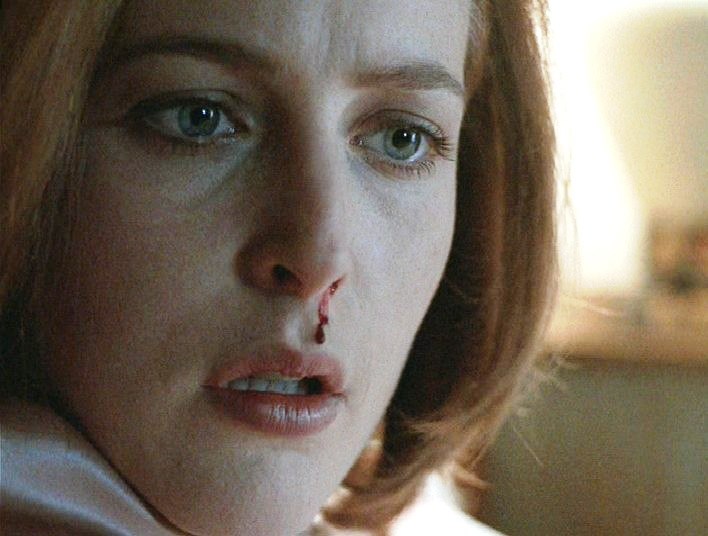
And cancer can be a death sentence, not only because of Betts presence, but because of the disease itself.  So our hero – Scully – is sick.  Really sick. In fact, the cancer must be somewhat far along because she experiences a nose-bleed soon after learning the truth.

Not a good sign.

I remember the first time I watched “Leonard Betts.”  I felt unexpectedly rattled by the ending because the story had demonstrated a great deal of humor (such as Mulder’s “Siskel or Ebert?” quip while going through severed thumbs…), and I was unprepared for the gravity of the cancer revelation.  Even more so, standalone stories in The X-Files don’t often feature life-altering character moments.  Those tend to be reserved for the Myth-Arc tales.

So the revelation of Scully’s illness is doubly shocking because of its placement. 

 I can't help but be reminded of Alfred Hitchcock’s stated desire to play the audience like a piano.

“Leonard Betts” is one of those episodes of The X-Files that plays the audience like a piano.

In two weeks: “Never Again.”  Next week on the blog, a celebration of The X-Files' 20th anniversary!

30 Years Ago: Chris Carter's Millennium (October 25, 1996)

Frank Black (Lance Henriksen), his wife, Catherine (Meghan Gallagher) and their daughter, Jordan (Brittany Tiplady) move into a beautiful ye...