Showing posts with label The Films of 1972. Show all posts

Thursday, January 14, 2016

The Films of 1972: The Poseidon Adventure


Based on Paul Gallico’s 1969 novel of the same name, Irwin Allen’s The Poseidon Adventure (1972) is one of those disaster movies from the seventies that even today proves nearly impossible to resist.  

It’s not just human curiosity that makes this film appealing, with audiences inevitably wondering how, in the same situation, they might fare.

On the contrary, there’s actually a strong spiritual component at work in this thriller directed by Ronald Neame.

Indeed, the movie offers a full-throated, abundantly muscular version of Christian faith that many viewers will find appealing now, in 2016, and must have proven highly appealing at the time of the film's original release, in the aftermath of Time Magazine’s “Is God Dead?” cover story.

The filmmakers knew what they were onto, I believe, and so the film’s promotional materials read, pointedly. “Hell, Upside Down!”


That tag-line very nicely sums up the movie’s thematic through-line. 

Specifically, a widely-disdained man-of god -- a Moses or Jesus figure -- played by Gene Hackman leads a group of would-be survivors through an industrial Hell on Earth: the capsized ocean-liner S.S. Poseidon. 

The path to safety and indeed, salvation, is veritably Dante-sque in its grueling, horrific dimensions, consisting of floods, fires, and other challenges for the faithful to overcome. Again and again, Reverend Scott’s tenets of faith are asserted, challenged, and vindicated as he rallies the spirits and courage of his wayward flock.

This approach is quite different, for certain, from the specifics of the novel.

In the literary version of this tale, Scott possesses some rough edges, and takes his own life. Additionally, the character played by Pamela Sue Martin in the film is, in the book, raped by a fellow survivor. The filmmakers have removed this controversial material so that Scott and his “flock” are easier to identify with and root for, perhaps.

And that’s the thing worth lauding about The Poseidon Adventure (1972). 

In the final analysis, it doesn’t matter how much Ernest Borgnine over-acts, or if the special effects have aged poorly (and mostly, they haven’t).  

Despite any such superficial drawbacks, the film enthralls the viewer because we desire to see the characters live up to their leader’s words. We hope to see them take responsibility for their own lives; for their own survival. 

When they do so, their victory is not merely one of physical endurance. It is one of spiritual strength.
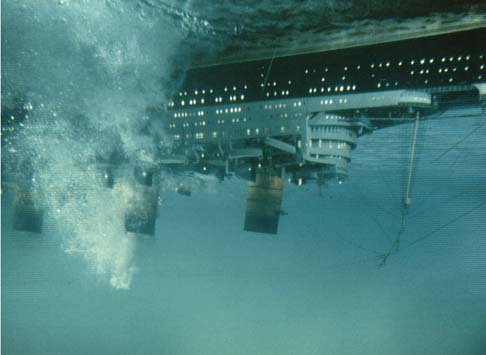


“Resolve to fight for yourself and others.”

At sea, the ocean liner S.S. Poseidon is struck by a tsunami, and it cap-sizes. The captain (Leslie Nielsen) and bridge officers are killed instantly, leaving survivors of the disaster to fend for themselves.

In the ship’s main hall, a ballroom where a New Year’s Eve party was in full swing, the Reverend Scott (Gene Hackman) attempts to convince the others that they must leave the hall and head for the upside-down vessel’s aft propeller section. There the metal hull is at its thinnest, and rescue is therefore possible.

Many don’t heed his message, but some do. 

Climbing a Christmas tree and escaping the ballroom with the reverend are a young woman, Susan Shelby (Pamela Sue Martin) and her little brother, Robin (Eric Shea), and an older Jewish couple, the Rosens (Shelley Winters, Jack Albertson). 

Also going with Scott’s group are an argumentative police officer, Rogo (Ernest Borgnine) and his wife, Linda (Stella Stevens), as well as a single man, Mr. Martin (Red Bttons) and a traumatized singer, Nonnie (Carol Lynley).

The group escapes the hall just as water floods it, killing those who stayed behind. 

But the survivors can’t look back, and must soon navigate a passageway called “Broadway,” a kitchen riddled with fire, a submerged compartment, and the obstacles of a burning engine room.


“Nobody’s gonna help us except ourselves.”

Early in The Poseidon Adventure, Gene Hackman’s outsider reverend (who is bound for exile in the third world for his non-dogmatic views of Christianity) delivers a powerful sermon on the ship's deck.  

He declares that God cares about humanity, but sees humanity on a different scale than we can understand. God is looking at man over the generations, over a huge span of time, and can’t worry about each one of us, says Scott.

Instead, Scott informs his flock -- and the audience -- when we “pray to God” we should “pray to that part of God within” all of us. 

God wants winners, not quitters,” he says. Scott then suggests that his listeners “resolve to fight” for themselves and "for others."


Scott’s philosophy comes in handy during the crisis, but on a much more significant level, also informs the rest of the film.  It is not actually in Scripture that “God helps those who help themselves,” but The Poseidon Adventure puts forward that philosophy, on steroids, as a guide-post for the faithful in harrowing and uncertain times.

Again, one must consider historical and cultural context when thinking about a film’s meaning. In the early 1970s, the pop culture was agonizing over the issue of God and faith. The 1966 Time Magazine with the “Is God Dead?” cover appeared in Rosemary’s Baby (1968), for example. 

The Poseidon Adventure’s response to such questioning, is, essentially, to say, stop being a crybaby about God and go pull your own weight. 

God’s got other things to do besides saving your scared ass. He made you in his image, so find that part of God inside you...and survive.  Quit being a victim.

Now, I am not advocating any viewpoint or belief system here (least of all regarding belief in God), merely noting that The Poseidon Adventure reflects its time, and accordingly puts forward a philosophy or way of commenting on that epoch.

Think about that time just a little more: December, 1972. American pillars like faith in government were beginning to fall, in part because of the Watergate Scandal. The first convictions in that crime came just weeks after The Poseidon Adventure’s theatrical release. 

Also, America was sharply divided by issues such as the Vietnam War, which it appeared to be losing...badly. The old ways of seeing and living just weren’t working anymore. In short, We all seemed to be trapped on a capsized ship, one that was sinking fast.  

The Poseidon Adventure’s answer  to that dilemma was simple but ultimately empowering on a personal level: When things are falling apart, look to yourself. Summon the best part of yourself to respond.

In the film, Scott’s superior in the Church, also on the Poseidon, laments that Scott “speaks only for the strong,” but I think he’s off-base in that assertion. I believe that the message of Scott’s sermon is that we all  carry the spark of the divine within us, and can access it when we try.  We are all strong, and we must summon that strength if we wish to survive. Again, I’m not advocating for or against anything, including religious belief, merely noting what I saw and heard consistently expressed in this movie.

The entire film can be read, at least metaphorically, as a religious journey. Scott states his philosophy, and some follow it...while others (to their detriment) don't. 

He leads them out of the hall or ballroom, specifically by climbing up a Christmas tree. Certainly, that is a symbolically-important choice.  In 2004, for example Pope John Paul noted that the Christmas tree exalts “the value of life” and related it to Scripture, and the tree of life in Genesis 2:9.  

Note that a key aspect of Scott’s philosophy, as repeated, in hushed tones throughout The Poseidon Adventure is that “life matters very much.”  Life, specifically, involves climbing that Christmas tree and escaping the hall. It is literally a tree of life for those who choose to see it as such.


Moreover, the Christmas tree in the film is topped by a star of sorts, if memory serves, and symbolically speaking, such a Christmas star is supposed to represent the one viewed by the Three Wise Men at the time of Jesus’s birth. Likewise in the film, above and beyond the star is, literally, salvation: an escape from the hell of the bowels of the ship.

Scott’s belief system, that “nobody’s going to save us except ourselves,” is transmitted to the others, including Belle Rosen (Winters). She gives up her life fighting to survive. Had she not chosen to swim into a submerged compartment, Scott would have died then and there, pinned under a sheet of metal, and the others would not have escaped the ship.  Belle Rosen -- whose name means beautiful flower -- "blooms" as a person, and puts into practice the belief of her spiritual leader.  She fights for "others," like her husband, Manny. She has resolved to fight for them, no matter the cost.


Next, of course, in this spiritual reading of the film, we must consider Scott himself. He is either a Moses figure, leading the survivors out of Hell to a promised land, or a Christ figure.  

I tend to prefer the Christ analogy, because -- spoiler alert -- he dies living his principles.  

Above the burning ruins of Poseidon’s Engine Room -- literally a lake of fire in spots -- Scott gives up his life so that others might live. He dies, essentially, for our sins, as Jesus did. Burning steam is being voided into the chamber, and Scott hangs precariously from the valve to close it, and make the way passable.

Although we don’t explicitly get a traditional crucifixion pose here, it is important to note that visually, Scott hangs isolated before the others, dying before their eyes, as he makes his sacrifice.

He dies living out his philosophy, fighting every inch of the way to survive, to fight not just for himself, but “for others.”


The Poseidon Adventure's final scene is particularly Dante-sque, as it sees the survivors escape the Hell of the Engine Room and step out onto the surface, into sunlight and safety.  This moment represents a catharsis, a cleansing. True, it’s not Easter Sunday when these individuals escape (like it was for Dante and Virgil in The Divine Comedy), but it is a day of renewal and re-birth nonetheless: New Year’s Day.

As readers are aware, I admire tremendously those movies that work on two tracks of meaning simultaneously. 

One can absolutely enjoy The Poseidon Adventure as a straight-up disaster film with some remarkable stunts.


But one can also view the film as a statement of philosophy; as a meaningful comment on spirituality and what it means at this particular junction in history.  Although the film is often criticized for over-acting and some cheesy dialogue, it also manages to craft some beautiful and unforgettable compositions.

For instance, there’s the moment early in The Poseidon Adventure when the hall is flooded, and those without faith in Scott's leadership panic and drown. There is nothing Scott can do to help them once the sea rushes in. 

Downcast, he closes the doors to the hall -- which the doomed will never reach -- his visage disappearing into shadow and darkness. The others have been locked out of Heaven, in a sense, because of their inability to believe in Scott’s philosophy of muscular faith. Visually, this shot  makes us understand how Scott must “close the doors” on those who can’t help themselves, and continue his trek for freedom (and the salvation it brings).


Another moment that lingers in the memory involves Mrs. Rogo’s death. She’s a former prostitute and a crass sort of gal.  She dies just moments before salvation, by falling into the lake of fire. 

This occurs, I believe, because she never came to believe in Scott’s dogma of looking out for herself and others.  She only got to the first part of that equation. In one especially ugly moment, she comments on Mrs. Rosen’s “fat ass,” and getting stuck behind it.  

Her punishment for abandoning her fellow survivors is death by fire. It’s true Mrs. Rosen dies too, but she dies at a moment of courage and nobility, saving others instead of deriding them. I suppose the important question involves how one meets his or her fate, right?

On the surface, The Poseidon Adventure is about a disaster at sea, of course, and those who do and don’t survive that disaster.  That’s to be expected.  

The rewarding quality about this film is that it talks about survival not merely as an end, but, finally, a statement of philosophy and faith. 

There are a lot of good disaster movies out there, but I don't know of many that are as coherent and consistent as The Poseidon Adventure is in terms of messaging and symbolism.

Hell, Upside Down,” is the challenge you face, and if you desire to escape it, you have to do it standing on your own two feet.  

Movie Trailer: The Poseidon Adventure (1972)

Friday, March 20, 2015

From the Archive: Z.P.G. (Zero Population Growth) (1972)


In 1968, author Paul R. Erlich had an unexpected best seller with a book entitled The Population Bomb.  It sold over two million copies and yet was vociferously derided by the forces of the extreme right and the extreme left in America. 

In short, Erlich's book suggested that if birth-rate trends continued unabated, over-population would cause mass starvation and country-wide die-outs in the 1970s and 1980s. 

Since we survived those years and decades without any such famine or mass-deaths, it is tempting to gaze at The Population Bomb today as just another end-of-the-word scenario that didn't come to pass. At the time of publication, critics widely termed The Population Bomb "alarmist" for what they termed the author's wild "predictions."

But jokes, political agendas, and critiques aside, The Population Bomb remains an initiative that contains at least some kernel of currency in our world today; the idea of Earth's "finite capacity to sustain human civilization," as the author himself put it in a defense entitled The Population Bomb Revisited, available in The Electronic Journal of Sustainable Development. 

In terms of film theory, if we recall the axiom that movies universally mirror their social-political contexts, then The Population Bomb is certainly a major "bugaboo" and influencing factor in the late 1960s and early 1970s genre cinema. This period -- pre-Star Wars (1977) --  was a highly inventive one for filmmakers, who veritably obsessed on dystopian futures and apocalyptic scenarios. 

Aside from the brilliant Planet of the Apes films (1968-1973), the social commentary of  John Boorman's Zardoz (1974), and the satirical Death Race 2000 (1975) there were several major films of this epoch that explicitly broached the topic of overpopulation and suggested (mostly horrible...) ways to "sustain human civilization" in the event of planetary disaster. 

Among these  notable efforts were George Lucas's visually-dynamic THX-1138 (1971), the macabre Soylent Green (1973), the colorful and action-packed Logan's Run (1976) and the subject of today's review, ZPG: Zero Population Growth (1972).

In some ways, ZPG was just as casually dismissed by critics of the day as had been The Population Bomb.  

The New York Times' Vincent Canby wrote disparagingly of the film that it was "a sometimes funny (unintentionally), untimely meditation on the earth's over-population problems, set in some future smog-bound England where the World Deliberation Council has decreed that for 30 years there shall be no babies born. Women mad for motherhood who refuse to be content with mechanical dolls programmed to say "Mummy, I love you Mummy," take to giving birth in cellars and stealing each other's offspring."

Even in science fiction circles today, ZPG is rarely discussed or debated, despite the fact that it is an intriguing and rather forward-looking sci-fi film. A grave atmosphere of despair hangs over the entire picture, and the film by director Michael Campus paints an unforgettable portrait of a totalitarian society that controls every aspect of the citizenry's day-to-day life. 

Most importantly, however, ZPG is worthwhile for the main questions it zeroes in on. What sacrifice is too great to save the planet? And secondly, should one generation be the one to carry that enormous burden?


"We conquered cancer and then heart disease...and for what?"


A hovering government craft announces the Zero Birth Edict; and forecasts Blade Runner's (1982) megapolis. 
Set in an unspecified future, ZPG begins as "The Society" and the "World Deliberation Council" announce over a smog-filled metropolis the inception of the "Zero Birth Edict."  For thirty years, no women will be allowed to bear children. Women already pregnant are to be registered with "The Department of State Security."

If, during this thirty year ban on child bearing, a woman does become pregnant, she has two options.  She can report to an "Ab Lab" (an Abortion Lab), or have a home abortion courtesy of a new bathroom appliance apparently installed in all houses.


At home abortion appliance, in close-up.
In the latter case, the pregnant woman need only press her swollen uterus against a kind of belt-like radiation device (glowing red) and hit the "abort" button.

If, however, a woman should choose to go to term and is discovered, she and her husband (and the child too...) are captured, then suffocated inside transparent, mobile tents, in full view of the disapproving community-at-large. 

Those citizens who report such "criminals" are rewarded with bonus food rations. In the world of ZPG, child-bearing is "the gravest crime" imaginable.

Alas, the "Zero Birth Edict" is only the latest indignity that this unfortunate culture must suffer.  The surfeit of smog in the atmosphere has rendered the air largely unbreathable, and outside, all citizens must wear face masks, or make occasional stops at air stations strategically located throughout the city.

And overpopulation also means long lines to visit the local museum. The wait to get in -- for an hour, no less -- is four years, according to the dialogue. At the museum, you can also see extinct species like cats and dogs...stuffed, and featured in action-poses in dioramas

Another grim scene reveals a restaurant overflowing with patrons. Diners-in-waiting stand everywhere, surrounding seated diners, looking forever over their shoulders as the lucky ones eat first.

Despite the difficulties of this future, many companies have discovered a way to make a profit in such dark times. 

 The "MetroMart" is a TV-based department store-- that forecasts the Internet and online stores -- and makes a killing selling artificial Christmas trees and other rarities. And then there's "Babyland," a store where mechanical dolls are sold to men and women who long to be parents.  

The store's motto: "You come to us as a man and a woman, you leave as a family."

One of the best and most horrifying scenes in the film involves Babyland, and the desperation of prospective parents as they meekly accept plastic automatons as their "children."   These child dolls -- who make whirring, mechanical sounds when they turn to look at you -- are the stuff of nightmares. They walk, they talk, they demand attention, and their eyes are as dead as you can imagine.

The heart and soul of ZPG involves a young couple, Russ McNeil (Oliver Reed) and Carol McNeil (Geraldine Chaplin), who break the Zero Birth Edict and decide to conceive a child. They do so, I hasten to add, without really thinking out the consequences for their baby. Because of the Society's law on children, Carol must give birth in an old civil defense bunker. And worse than that, the child can never -- in his entire lifetime -- leave the bunker, for fear of discovery.

Russ and Carol's world has gotten very, very small.
The birth scene in ZPG is crafted artistically, if also in grim fashion.  It is a natural birth, since no doctors can be present. The director, Campus, charts the delivery entirely by focusing on the silhouettes moving over the bunker's stone wall.  It's like a weird cave birth from man's prehistory, a strange futuristic book-end to a long-forgotten and humble beginning. 

There's also a terrific shot in the film of Russ and Carol (pictured above) -- looking defeated -- inside that civil defense bunker. Their world is now tiny; they are visually, metaphorically and literally trapped, even as they seek to escape The Society's Zero Birth Edict.

After the baby is born, the infant develops a fever, and Russ and Carol's neighbors, George (Don Gordon) and Edna (Diane Cilento) discover what the McNeil's are hiding. Now these also-desperate, would-be parents want to "share" the baby, and their demands on Russ and Carol just grow and grow.  

This passage of ZPG is a truly horrifying look at human nature. George and Edna resort to blackmail. They let Russ and Carol know that they could report them to The Society at a moment's notice, if the parents don't cave to their demands. This is ugly but also strangely believable behavior.

Refusing to give up or share their child, Russ and Carol make a last ditch effort to escape their neighbors and the rules of The Society...

"It is as it is..."
 Bonnie is ready to greet her new parents at "Babyland." 
There's not a single action-sequence or consequential effects sequence in ZPG, save for establishing shots of the city and the overhead vehicles that patrol it and catch law-breakers. Yet this 1972 film is fully engaging because of Carol, the character played by Geraldine Chaplin. She is desperate to be a mother, but her society has determined that no woman in her generation will be permitted to play that role. 

There are no do-overs in life. We all get one shot on this mortal coil, and yet Carol -- for the sake of the planet -- is asked to give up her child-rearing years; her only shot. She is in her late twenties, perhaps, so will be too old in thirty years, to become a mother. The joy of being a parent is thus something forbidden; never for her to experience. This situation raises all kinds of moral questions.

Does the good of "The Society" and the need for the human race to endure outweigh the personal dreams and aspiration of one woman, or one man, for that matter?  

And secondly, why is it so hard for Carol to share her joy -- her baby -- with one other couple, once she has staked out her position of defiance?  

Make no mistake, the movie lands firmly on Carol's side: she is right to reject the inhuman State that dominates her life; but there's another side too, that the movie subtly hints at.

Carol (Chaplin) and Russ (Reed) conceive a child.
Perhaps what it all comes down to is that Carol and Russ are just regular married folks, even in this crazy, Orwellian future. They want to live free, as they wish, and want to experience what we all do, particularly parenthood.They aren't fantasy heroes, or larger-than-life icons. They're just regular folk. 

They make some big mistakes in the movie, but that fact only makes them all the more human, and therefore touching.  There are times during the film you will grow infuriated with Carol and Russ for their decisions -- and for their lack of planning -- but you also understand their deep desire to be a family.


I wrote above that ZPG is a forward-looking film, and in several ways, it predicts the future world of Blade Runner (1982).  For instance, the opening scenes of the film involve a slow, hovering craft that makes governmental announcements to the populace far below. In Blade Runner, it was a blimp advertising "off world opportunity" but the image in ZPG is very much a primitive version of the one in Scott's (superior and more accomplished) film.


"This is called a gas pump..."
In terms of our society today, well, we've already seen some of strange things come to pass in the last decade, and ZPG is prophetic.

The idea of citizens turning in and spying on fellow citizens in ZPG is oddly reminiscent of the Bush Administration's proposal for "TIPS" the so-called "Terrorism Information and Prevention System" of 2002. It was designed to help "every American become active in the homeland security effort," much in the same way that the Society uses informants to report violators in the film.

On the opposite side of the spectrum, there are scenes in ZPG during which citizens are indoctrinated by movies that describe how poorly previous generations selected their diets and portion sizes.  In other words, "The Society" of the film tells people exactly what to eat and how much to eat. And, of course, there are those on the right side of the political spectrum who feel that the current Obama Administration has taken the first steps down that same road.

So there's ample fodder here to read the film both as a critique of both right wing excess (particularly in the depiction of the companyies profiting off of the misery of Zero Birth Edict) and left wing excess, namely in the depiction of a Nanny State gone berserk.

But beyond questions of left and right, and of today and yesterday, ZPG is fascinating because of the questions it raises about community vs. the individual.  What would you give up to save the planet?  

Would you surrender your right to become a parent? 

Furthermore, what would you give up for the pursuit of your liberty in general? And if you pursued that liberty, what if you risked the very future in the process?

I can't declare that ZPG is always smart or knowing about the answers to these questions, only that it raises them in a fascinating and frequently terrifying way. Most of all, I'd describe the movie as haunting.  

Late in the film, there is a montage of Carol, Russ, George and Edna playing with the "illegal" child. The images are joyous: the realization of a dream, of an aspiration.  But the montage is scored with sinister, nay diabolical music that grows more and more unsettling as the sequence reaches its crescendo.

In microcosm, this scene gets at the problem of our human condition (and human contradictions).  We want our species to survive, but we also want the freedom to live life our way. Carol and Russ want a baby, period; they don't think about the future. There is no sense of balance, of weighing immediate gratification versus long-term stability. I mean, what kind of life will that baby have in this world, especially if other parents make the same choice as Carol and Russ?

Then the world would end; the planet couldn't sustain everyone. And yes, that would mean an end to the corrupt, Big Brother-esque Society, but also an end to love, and to all future generations of children.

I also appreciate how the film adopts the perspective of the future in several important, satirical scenes set at a museum.  On display in one such sequence is a 1971 gas tank and automobile, utilized as an object lesson for how the 20th century culture used up resources without any thought to the future. A later scene terms industrial leaders "inept" and even "criminal" for fostering the destruction of our environment, and the wholesale extinction of so many species.   

If a future like this does come to pass, it will be us -- the Boomers, the X'ers, etc. -- who are under such a microscope; who are judged for the way we live today. Right now, I'm not certain the future will judge us so kindly, but as always, I hope there's time to reverse that judgment.

Not an easy or simple movie to parse; ZPG is an underrated science fiction gem, and one well worth seeking out.  But don't go in expecting action and special effects.  Here, it's all about the concept and the characters, and a grim vision of the future that I hope is as erroneous as The Population Bomb's was in 1968.

40 Years Ago: Howard the Duck (1986)

In 1986, the comic-book adaptation  Howard the Duck  -- executive-produced by George Lucas -- landed in movie theaters with a splat.   The f...