Showing posts with label 1976. Show all posts

Saturday, February 24, 2018

Saturday Morning Cult-TV Blogging: Monster Squad: "Queen Bee" (September 11, 1976)


Monster Squad (1976 - 1977) -- not to be confused with the late 1980's movie, The Monster Squad (1987) -- is a one-season Saturday morning series developed by Stanley Ralph Ross, one of the key writers of the Adam West Batman (1966 – 1969) series.

Like Batman, Monster Squad’s style is high-camp, meaning that all the heroes face their various crises with melodramatic solemnity, a solemnity that plays to adults as funny but kids as serious. 

Also like Batman, Monster Squad is famous for its rogue’s gallery of celebrity villains.  Some of the actors who wore crazy get-ups and twirled their metaphorical mustaches on the program included Julie Newmar as “Ultra Witch” and Jonathan Harris as “the Astrologer.”

Briefly stated, the premise of Monster Squad is that a young and hopelessly earnest criminologist, Walter (Fred Grandy) has developed a fantastically advanced crime computer at the Chamber of Horrors exhibit in the basement of Fred’s Wax Museum. This large-scale computer can rise out of a sarcophagus platform when in operation, and features a “secret government” channel and radio transmitter.

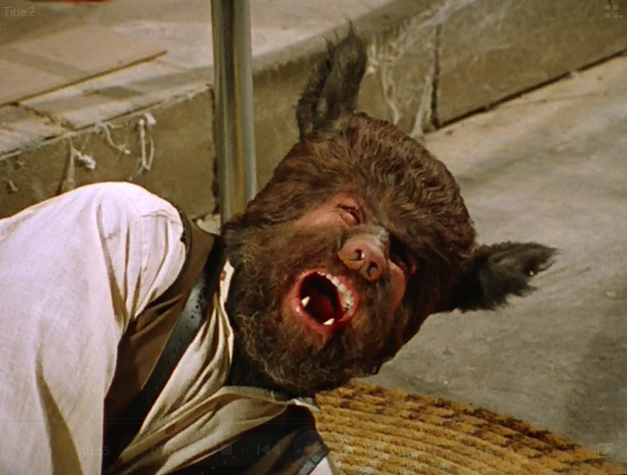
One day however, the “oscillating vibrations” of Walter’s crime computer awaken three of the museum’s figures, Dracula (Henry Polic II), the Frankenstein Monster (Michael Lane) and The Wolfman (Buck Kartalian). These figures are apparently the real deal, resurrected, and not merely wax representations of them.  However, it is never explained why the wax museum was housing the bodies of such dangerous monsters.


Regardless of their precise nature, these three “monsters” from history wish to atone for their sins by solving crimes with Walter, and thereby making reparations to society.

With Walt operating out of the Chamber of Horrors, Dracula, The Wolfman and The Frankenstein Monster are thus frequently dispatched -- in a black 1970s van -- to combat evil-doers around the city.


The first episode of Monster Squad, “Queen Bee” -- which aired on NBC the morning of September 11, 1976 -- stars Alice Ghostley as the insect matriarch, the aforementioned Queen Bee. As the episode commences, she has ordered her bee minions around the world to attack unsuspecting humans.  This “unexplained rash of bee stings” is noticed by Walt, who captures a bee and attempts to interrogate it with the Crime Computer.

One will notice here that the Crime Computer has a slot designed and labeled for insect analysis. This makes one wonder how often evil bugs show up in town…


After a time, Walt frees the bee, and Dracula tracks it in bat-form to Queen Bee’s headquarters. There, he and his monster must stop the Queen Bee’s plans before the United Nations can surrender the world to her.

The 1970's represents the great era of “killer bee” entertainment, from the movies Invasion of the Bee Girls (1973) and The Swarm (1978) to TV series such as The Starlost (1973-1974) which featured an episode about giant bees called “The Beehive.” 


In terms of “Queen Bee,” the Monster Squad episode reports about the South American killer bee briefly, but otherwise conjures up little in terms of fact.  Instead, the installment features about a hundred bad “bee” puns for Ghostley and her buzzing minions. 

“I bee-seech you,” says one character.  “Bee-ware your fate,” says another.

After a while, we also get “bee-lieve me,” “bee-guiling,” “bee-wildering,” “bee-headed,” “bee-trothal,” “bee-tray” and other variations on the theme.  One non -“bee” joke is Queen Bee’s comment that one of her minions always “bumbles.”

As you can probably guess, this approach grows tiring after a while, though it anticipates the approach to Mr. Freeze in Batman and Robin (1997).  

The episode -- like all Monster Squad episodes -- plays as particularly arched, and not overly amusing. Everyone is in on the joke, but the joke isn’t as amusing as it is on Batman, and this Saturday morning series also lacks the resources, and hence production values of that camp classic.  For instance, here Dracula is put in a vat of honey, and the vat is a tiny little barrel.


Viewers who were kids in the 1970's may be most interested here to see a Mego toy re-painted and used as a prop in “Queen Bee.”  Ghostley’s “bee” communicator is actually a Star Trek walkie-talkie from the age, but painted gold.  The prop -- with a different paint job -- recurs as Walt’s crime computer remote control in the next episode, “Mr. Mephisto.”


Although Monster Squad doesn’t hold up particularly well-today, I remember that I absolutely loved it as a seven year old, and that I wished and hoped for action figures, playsets and other toys featuring these lovable and familiar monsters. There was, as memory services, a board game available at one time.

As bad as some of these episodes are, the opening theme song and introductory montage still provide me a nice kick of nostalgia…


Next week: “Mr. Mephisto.”

Thursday, December 21, 2017

Cult-TV Blogging: Star Maidens: "The Enemy"


In the final episode of Star Maidens (1976), Fulvia (Judy Geeson) and her captives -- Adam (Pierre Brice) and Shem (Gareth Thomas) -- prepare to return to Medusa for the hostage exchange.  

At the same time, Dr. Rudy Schmidt (Christian Quadflieg) and Liz (Lisa Harrow) are being ferried back to Earth by Octavia (Christiane Kruger).

The exchange does not go off quite as planned, however, because of a malevolent third party. The Medusans remember -- from their ancient history in Proxima Centauri -- the presence of alien predators who “fed” on them. Now, a deadly spaceship from that force has arrived in Earth’s solar system, ready to once more interfere in Medusan affairs.

The alien ship attacks, attempting to seize the Medusan shuttles, but Adam and Rudy, on separate ships, launch a counter-attack, something the Medusan females are not willing to do. The counter-attack is successful, and Earth and Medusa have their first triumph together.


“The Enemy” is a fascinating episode of Star Maidens, and a segment that makes one wish for further episodes. Although the episode’s final statement on the war of the sexes is not so strong (which I will talk about below), “The Enemy” nonetheless sets the scene for a larger tapestry, had the second season been produced.

Here, the ancient enemy of Medusa arrives in a menacing-looking spaceship, depicted with a miniature that would have felt right at home in Space: 1999 (1975-1977). We never actually see the enemy. But from their merciless voices, we know that the enemies are all male. We see their uniforms, rotund bodies, and gloved hands, but never their faces.


We are told -- via exposition -- that the Medusans, in their original solar system “were preyed upon” by these aliens.  Apparently, these forces have been searching for Medusa for centuries.  And now the enemy has found both its quarry, and Earth. It would indeed have been fascinating to see how this dynamic altered the series in a second season, but alas it was never to be.

In terms of our final statement about men and women, there is finally no ambiguity about where Star Maidens stands. Adam and Rudy take command of their respective Medusan crafts, and fight back against the aliens. 

Several times, Octavia and Fulvia complain that they don’t know how to fight. So the men, who apparently do, must step up to save the day.  

In light of what we have already seen on the series, including Medusan weaponry and security forces, this plot element doesn’t make much sense. Octavia is a hard-nosed, brutal fighter, and head of Medusan Security. It seems highly unlikely that she would “choke” in battle, especially after detecting that her enemies are males.  Her primary prejudice, as we have seen close up, is that men are weak, inefficient creatures who cannot protect themselves. Hence women must protect them.  That through-line is lost in this final episode.


In terms of science, Star Maidens gets into a little trouble here. “The Enemy” continually confuses the term galaxy with solar system, noting that the bad guys have been chasing Medusa from galaxy to galaxy.  In the 1970’s, these terms were used interchangeably in many series, including in Battlestar Galactica (1978).

As this is the final episode of Star Maidens, I do want to reflect on the series as a whole. In brief: I rather enjoyed it, even if I can make the argument that the series did not always know where it was headed, or what its point about the war of the sexes really was. 


I love the production design from Keith Wilson, and the miniature effects as well.  Some stories, namely “Hideout” and “The End of Time” are really fascinating, and suggest that the makers of the series aimed for more than “high camp.”

And “high camp” is what critics have determined the series is. I can see why, based on some early episodes, but Star Maidens is worth a second-look, if only to better understand science fiction on TV in the 1970’s.
Thursday, December 07, 2017

Cult-TV Blogging: Star Maidens: "Creatures of the Mind" (1976)


In “Creatures of the Mind,” we return to Medusa for a hard sci-fi story. In particular, a Medusan officer working in the Archive of the Department of Historical Records, is confronted with an old computer that has developed sentience, and wishes to feed on the energy of living beings.

Octavia (Christiane Kruger) assigns Liz (Lisa Harrow) to continue the job in the Archives when the officer descends into catatonia. Liz asks Rudy (Christian Quadflieg) to help, and together they confront the strange living machine.

The dangerous computers nearly take control of Liz, but Rudy saves the day, and actually gets a compliment from Octavia about his performance during the crisis.


Although this is a good, creepy, genre tale, “Creatures of the Mind” doesn’t exactly feel tailor-made for Star Maidens (1976), a series about the war between the sexes.  Instead, it feels very much aligned with many Star Trek (1966-1969) or Space: 1999 (1975-1977) stories involving sentient, mad, tyrannical computers. 

Here the Museum of Medusan History houses just such a danger.


It’s true that Octavia and Rudy must put their differences aside to defeat the danger, making this an example of the “My Enemy, My Ally” story, as well as one about the sexes getting along.  

Still, this story on Medusa doesn’t reveal much about the culture (as “End of Time” did) or expose some flaw in the way the society works (as was the case in “What Have They Done to the Rain?”)  Instead, the story just features a sci-fi standard: the evil, advanced computer.

What the story lacks in customization, perhaps, it makes up for in style. The prologue, with creepy female voices taunting a security officer, is quite unnerving.  The Archive is dark, foreboding, and dangerous, and there is the feel of this as some kind of demonic possession horror story. Only in this case, it is a computer, not a devil that wishes to possess the living.


The budgetary limits of the series are apparent, at least in one regard in “Creatures of the Mind.” Octavia is the Chief of Security for the entire planet, and yet she and Rudy work to save Liz...just the two of them. You’d think she had more scientists and soldiers she could rally to the cause.

Of course, the presence of additional characters would not only be expensive, it would take away from the particularly intimate nature of this horror: creepy computer voices in the dark, promising friendship, but delivering something malevolent and monstrous.


Next week, the final episode of Star Maidens: “The Enemy.”

Thursday, November 30, 2017

Cult-TV Blogging: Star Maidens: "Hideout" (1976)


In “Hideout,” Star Maidens (1976) takes us back to Earth for the first time in a few episodes.  Adam (Pierre Brice) and Shem (Gareth Thomas) are still on the run from Fulvia (Judy Geeson), and Earth’s police hunt them down.

Adam and Shem hide in an apartment complex, but Adam is captured by authorities. This leaves Shem to befriend a lonely woman, Rose (Corny Collins), who has just suffered a break up with her boyfriend.  Shem heals Rose, providing an example of what a loving, supportive man can be like.  

Rose, in turn, hides Shem from the authorities, demonstrating her love and affection for him.

When Rose is nearly killed by going down a waterfall at a local park, Shem risks exposure to save her life. The police capture him and bring him to the angry Fulvia. But Shem and Rose have shared something beautiful, despite the relationship’s outcome.


I was set, at the start of “Hideout” to slag the episode as a champion time-waster, a return to the early slapstick car chases and “run around” shows at the start of the season. But, as “Hideout” went on and the narrative developed, I began to see how it might function as one of the best episodes, actually, of Star Maidens.

Overall, this cult series functions by showing us mirror dysfunctional images. We see a human male and female from Earth try to contend with Medusa’s matriarchy, in some episodes, specifically those featuring Liz and Rudy.  And then we see a Medusan woman and man, Fulvia and Adam, deal with Earth’s patriarchy in the episodes set here, on our planet.


Both worlds and both situations are imperfect. In fact, both are highly imperfect. “Hideout” therefore functions as this little grace note, this little “carve out,” if you will, of what a strong male/female relationship could look like, on either planet.  

In particular, Shem treats Rose with respect, loyalty and love. He helps her endure during the times she is weak, and he helps her to be strong. Rose responds in kind, housing Shem, trusting Shem, and choosing to help him when she could simply turn him in to the authorities. They develop a perfect symbiosis. 


If you look at the relationship, it is clearly one of give and take, not of set-in-stone matriarchy or patriarchy. Shem and Rose independently take the lead in the relationship when there is a void to be filled; but they do so to heal and fill the deficits of their opposite number. The Shem/Rose relationship is perhaps the only positive male/female relationship we witness in the entirety of Star Maidens.

This fact makes “Hideout” of great significance. There is so much political, sex role maneuvering in the series, between Fulvia and Adam, even on Medusa between Rudy and Octavia. There is absolutely none of that here. This story is simply about two people attempting to be together in a world that is out to destroy them, and their love.

This story features almost no science fiction trappings, but it doesn’t matter. “Hideout” is the episode about the fact that men and women can get along. In a series about the war between the sexes, the commentary it offers is vital.

Next week: “Creatures of the Mind.”

Thursday, November 09, 2017

Cult-TV Blogging: Star Maidens: "The End of Time" (1976)


In “The End of Time,” Octavia (Christiane Kruger) returns to Medusa with Professor Evans (Derek Farr), so he can help negotiate a hostage swap. Once Fulvia and Adam return to Medusa, Liz (Lisa Harrow) and Rudy Schmidt (Christian Quadflieg) can return to Terra.

Unfortunately, something strange has happened on Medusa. All the women have vanished, the men are tranquilized, asleep in their dormitories, and the vast city is abandoned.  The only other people awake and in the metropolis are Liz and Rudy, who are trying to determine what has occurred.

And what has occurred?  

Apparently, “The End of Time.”  As Liz, Evans and Rudy learn, the Medusan people mark time by the life and death of their presidents. Time (symbolically stops for the culture when a president dies, and it does not resume until a new president is selected.  President Clara (Dawn Addams) appears to be dead.

Worse, since Liz was awake during her death, she is accused of being a presidential assassin and exiled to the inhospitable surface of Medusa.

Upon closer inspection of Clara, however, Evans realizes she is not dead, only the victim of a bacteriological infection, a condition that the Medusans have no familiarity with, because they long ago conquered disease. He suggests antibiotics.

When Clara recovers, time is allowed to resume in the city, and Rudy rescues Liz from the surface. Evans returns home, having failed his hostage mission, but having saved a life.


“The End of Time” is another very intriguing episode of Star Maidens (1976), since much is learned about Medusa, and its customs and history. 

For instance, it is reported, at one point that men are put to sleep during the death of a President (the so-called period known as “The End of Time”) so that they do not launch an uprising or attempt to gain control of the planet. Apparently, at one point in Medusan history, a man did lead the planet, and was an unmitigated disaster as a leader.  The technology to tranquilize men is called a “hypnomat.”

We also learn, of course, about “The End of Time” ritual, the stopping of all life on the planet, since a president has died. Time only resumes, in the eyes of Medusa, when a new matriarch rises. Without leadership, without control, Medusa itself seems to die, or at least hibernate.  I wonder how this would work if the planet were at war, or in crisis.


There are two other observations worth making at this juncture (episode ten of thirteen). The first is that the writers absolutely seem to prefer dealing with the “Medusa” story, rather than the “Earth” story, where Fulvia and Adam are suspiciously circling another.  The series boasts a schizophrenic feel because the Medusa stories are presented as straight-up science fiction tales in a futuristic setting, whereas the Earth story is campy, romantic, and at times, blisteringly caustic.  

The last two stories set on Medusa (“The End of Time” and “What Have They Done with the Rain?”) feature strong, mysterious science fiction elements, and social commentary too. “What Have They Done with the Rain?” is about the way that human beings and destroy the environment, and turn a blind eye to the cause of inimical changes. 


“The End of Time” commences as an “Empty City”-type story (think: Star Trek’s “Mark of Gideon” or Space:1999’s “One Moment of Humanity”) but then evolves into a meditation on the idea that sometimes an advanced civilization cannot deal with a “primitive” problem, like a bodily infection. The Medusans so long ago conquered illness, that even the creepy robot doctor is not able to diagnose Clara’s “death.”


The point I am making here is that Star Maidens has a reputation, among those who have seen it, as a “campy” 1970’s science fiction series. That description is apt, but only for the Fulvia/Adam episodes set on Earth.  The episodes on Medusa grapple, ambitiously -- and seriously -- with genre concepts, tropes, and commentary.

The second point I’m going to make here involves the thematic underpinnings of the series. As was the case in last week’s story, this tale focuses on the idea that the women of Medusa can’t help themselves. 

In “What Have They Done with the Rain?” Rudy -- a man – saved the planet from its own environmental short-sightedness. In “The End of Time,” a different man -- Professor Evans -- saves the women of the planet by proving that President Clara is sick, but not dead, and that, therefore, Liz is not an assassin.

When you boil it down, the idea in both stories is that only men can lead, or come up with answers, and that the matriarchy of Medusa would be doomed without them.  

This very concept betrays the thematic thrust established early in the series, that Earth and Medusa are mirror images of one another, and that both are locked in nonsensical prejudices about which gender is superior.  

At this juncture, it’s clear that the series seems to suggest men are better capable of leading, or at least solving problems. We have yet to see a story in which the Earth is doomed, because of the short-sighted behavior we have seen in these two episodes, and only a Medusan woman can save it.


Next up on Star Maidens: a return to Earth in “Hideout.”

Thursday, November 02, 2017

Cult-TV Blogging: Star Maidens: "What Have They Done To The Rain?" (1976)


In “What Have They Done to the Rain?,” the ninth episode of Star Maidens (1976), Dr. Rudy Schmidt (Christian Quadflieg) -- a human, male prisoner on Medusa -- is working surface detail on the planet when he notes a dangerous chemical change occurring there. His men are endangered, and a Medusan supervisor sentry slips into the mud, and is destroyed.

Rudy warns Medusa’s president, Clara (Dawn Addams) that something deadly is occurring on the planet, and Medusa’s “Destiny” computer makes the same dire prediction, but can’t compute the reasons why. The computer observes that the “entire planet is under threat.”

Rudy and Liz (Lisa Harrow) conduct their own investigation -- over Octavia’s (Christiane Kruger) objections about a man contributing to the planet’s knowledge-base -- and find that structural areas of the city are collapsing. Toxic waste dumped on the surface of Medusa by the government have created chemical deposits that are eating through the crust of the planet…which is now starting to split. The rain, in conjunction with Medusa’s artificially-produced atmosphere, are accelerating the process of splitting the “shell” of the planet.

With mud-slides occurring regularly, Rudy warns that the Medusans must de-activate their current, dangerous atmospheric processor, and go back to an older model. Octavia refuses to believe it, but President Addams, seeing the wisdom of Rudy’s warning, agrees to make the change.


Once more, we are back on Medusa for an episode of Star Maidens, which means the focus is not on satire and male/female romantic relationships/power dynamics, but on sci-fi storytelling.  In “What Have They Done to the Rain?” Rudy asks a question that might be asked of our people, here on Earth: “Are you going to let your prejudices affect your lives?”

To wit: The vast majority of scientists here on Earth, in 2017, believe that humans are contributing to catastrophic climate change in a significant way, but some lawmakers and citizens refuse to believe the facts, because they disagree with the politics of the scientists, or because the facts conflict with their religious biases.  Or maybe, they economically benefit from not changing, from not adjusting to the facts.

But facts are facts, even if they come from someone who disagrees with you. Notice the title here, which is prophetic: What Have They Done..."  The "They" in question covers the government of Medusa, which is damaging the planet, without thought to the consequences.

So in this episode, facts are facts too, even if they come from a man (a lower class citizen in the matriarchy of Star Maidens). President Clara is, fortunately, able to allow reason to overcome her built in prejudice against men. Octavia, by contrast, is not able to do so. She can’t even believe that a man may have the knowledge to save her planet, because men are inherently inferior in her eyes.


As Rudy suggests in the episode’s coda, he wins a “triumph” for men, by proving his science accurate to the President and governing council of Medusa. But beyond that, he also proves that science and facts are superior to self-aggrandizing mythology and the forces of inertia or the status quo. He is assisted in this effort by Liz, whose position as a woman on Medusa allows her to pick her own team for the investigation. She promptly picks Rudy, giving him a platform to address the problem, and have a voice in its solution.

In some ways, “What Have They Done to the Rain?” is very reminiscent of Space: 1999 (1975-1977).


First, the episode makes extensive use of sound effects heard on the Gerry and Sylvia Anderson series, especially those heard in “Dragon’s Domain” and “Collision Course.”  If you are a fan of 1999, this heavy use of familiar sound effects can be very distracting.

Secondly, the story concerns a man (or woman…)-made problem -- toxins and pollution in the atmosphere -- and predicts disaster of the citizens of a planet do not change their short-sighted ways. In “Breakaway,” the 1999 premiere, Commander Koenig (Martin Landau) learns that the waste disposal area on the Moon, housing Earth’s atomic waste, is dangerous and unstable. 

Those in power, such as Commissioner Simmonds (the late Roy Dotrice) refuse to accept the truth. Koenig attempts to resolve the problem, but fails, and a cataclysm occurs.  In this episode of Star Maidens, at least, Rudy helps the Medusans avoid this environmental disaster.

The only downside to this Medusa-focused episode is that a pattern is emerging. Rudy keeps proving the female population and government wrong, and that subtly suggests the series viewpoint.  It seems the makers of the series are implying that women are unfit or unsuitable to lead or govern. The next episode, "The End of Time," follows on in this pattern.


Next week: "The End of Time."

Friday, October 27, 2017

The Thing-a-Thon: Doctor Who: "The Seeds of Doom" (1976)


In Antarctica Camp 3, several scientists -- Moberly (Michael McStay), Winlett (John Gleeson), and Stevenson (Hubert Rees) -- excavate from the ice a mysterious vegetable pod.

Found at a layer that indicates it is more than 20,000 years old, this vegetable pod becomes of interest to the World Ecology Bureau in London. 

The Bureau contacts UNIT, and sends the Doctor (Tom Baker), and Sarah Jane (Elisabeth Sladen) to Antarctica to investigate it.

The Doctor determines the pod originated not on Earth, but a distant planet, and orders the scientists to keep it well-guarded until his arrival. His orders are disobeyed, however, and one of the scientists is attacked by the pod and assimilated it by it. The pod is actually a malevolent alien life-form called a Krynoid.

A “galactic weed,” the Krynoid travels the universe dispersing seeds to habitable planets, and then destroying all animal life there. Now it is a race against time: can the Doctor stop the Krynoid from spreading before it takes over all plant life on Earth?

A millionaire and plant-lover named Harrison Chase (Tony Beckley), is secretly working against the Time Lord to help an adult Krynoid germinate and rule our world.


The thirteenth season of classic Doctor Who (1963-1989) culminated with “The Seeds of Doom,” a serial from Robert Banks Stewart that is clearly inspired both by John Campbell’s “Who Goes There?” and the 1951 film, The Thing.  The (excellent) narrative re-purposes settings and characters from the history of The Thing productions and literary works.

As is the case in both “Who Goes There” and The Thing, an alien life-form that is buried in the ice (whether at Antarctica, or the North Pole, like the Hawks/Nyby film), is unearthed here, revealing an alien menace. 


Similarly, the Krynoid is plant or vegetable-based life in “The Seeds of Doom,” and as you may recall, the Thing (James Arness) in the fifties film is characterized as an “intellectual carrot” made of vegetable matter.

Mind boggling…

It’s intriguing how “The Seeds of Doom” adopts different aspects of The Thing’s narrative across the decades. From the novella, we get here the idea of an evil contaminating our life form and altering the shape of a human being, which is then able to infect others similarly.  And, the larger threat is of a new and inimical life-form taking over the Earth, eliminating the human race in the process.  In the case of this Doctor Who tale, the Krynoid escapes Antarctica, and gets to Great Britain, where things get out of hand quickly.

From the 1950's film, primarily, “The Seeds of Doom” takes the aforementioned nature of the monster (vegetable rather than animal), and the idea of a possibly-mad ally helping it along.  In the movie, Dr. Carrington (Robert Cornthwaite) -- whether from lack of sleep, bad judgement, or poor character -- attempts to propagate a “Thing” garden at the base, and preserve the “wise” being (despite its readily obvious violent qualities). Here, Harrison Chase, an eccentric millionaire, chooses intelligent plant life over his own species, and plays, essentially, the same role in the drama. He is the turncoat to his own species, deluded about what role he would play in the “New Order.”


“The Seeds of Doom” has always been one of my favorite Doctor Who serials of the Tom Baker era. The first sections, set in Antarctica are claustrophobic and terrifying, and the nature of the Krynoid threat is well-established.  For a low-budget show, some of the effects still manage to be creepy and disgusting.


Meanwhile, the last chapters of the serial -- with an adult Krynoid towering over Chase’s mansion, and harnessing the power the Earth’s vegetation -- plays like some gonzo (and thoroughly enjoyable) kaiju movie.


One other element worthy of discussion here involves the presence of the Doctor, the protagonist. In other versions of The Thing, characters such as McReady/MacReady, Kate Lloyd, or Pat Hendry have to play “catch-up” to understand the situation and the nature of the threat the Earth faces.

In “The Seeds of Doom,” the Doctor -- with all of his knowledge of time, space, and alien life-forms -- has an advantage they didn’t. He knows all about the nemesis he must contend with, and is ready for battle, almost from the beginning.

Thursday, October 19, 2017

Cult-TV Blogging: Star Maidens: "The Perfect Couple" (1976)


While Liz (Lisa Harrow) and Rudi (Christian Quadflieg) must re-think their escape plans on Medusa, Adam (Pierre Brice) and Fulvia (Judy Geeson) begin to acknowledge their feelings for one another on Earth.

Fulvia has been lecturing about life on Medusa to the Grand Council of Women, a militant feminist group. These women are “encouraged” to learn that Medusan women used reason to convince men that women should rule their planet. Those who didn’t listen to reason contended, however, with "discipline.”

Meanwhile, it is announced that Earth has but two weeks to send back Adam, or there will be a diplomatic incident with Medusa. Adam realizes that if he reconciles with Fulvia, there is a possibility that Octavia would allow them to remain on Earth…and live together.  This could be his only chance to live free from Medusa.

Accordingly, Adam and Fulvia decide to move into the suburbs together, and share blissful domestic existence together. 

Adam will stay at home and tend to the house, and Fulvia will have a career working for the British government.  This living arrangement collapses, however, after Fulvia becomes jealous of Adam’s interactions with a British housewife.

Meanwhile, the group of militant feminists steal two of Fulvia’s advanced Medusan weapons, and set about launching an insurrection against the men of Earth.


“The Perfect Couple” may be the silliest episode of Star Maidens (1976) thus far. Here, Adam and Fulvia decide to play house in a suburban community, but find that the normal “gendered” roles of 20th century Earth don’t seem to suit them. 

The episode features a funny, unconventional montage of their life together, playing house. We see Fulvia working in a garden, and Adam mowing the lawn (via Medusan remote control), for example.


In the episode’s most ridiculous moment, Adam and Fulvia attempt to explore the Earth custom of “going to the pub,” with predictable fish-out-of-water results. Fulvia attempts to tell a dirty joke.

The sub-plot of the week involves militant feminists in Britain, who steal advanced weaponry from Fulvia and launch an ill-fated insurrection.  

At first, I thought the episode really treated these characters shabbily, as stereotypes and two-dimensional characters.  As such, it seemed the episode was mocking feminism, and, in doing so, equality itself.  

And then I remembered the previous episode “The Trial.”  In that story, Rudi joins a rebel group on Medusa; one similarly attempting to over-turn a sexist order.


So what we have in “The Perfect Couple” is a mirror-image of that tale, with feminists of the seventies representing the rebels of Earth. 

What are we to understand from these mirror plot-lines? I suppose only that both systems are flawed, and that there are those on each planet fighting against what is perceived, culturally, as the “natural order."

The men, as you may recall, were vexed, because they did not have backbone. They could not disobey the women of Medusa. The women, in this episode, are defeated by their incompetent handling of the alien weaponry.

Neither rebel group is held up as a worthwhile solution to the planetary war of the sexes.


Of course, it’s strange and insulting in “The Perfect Couple” that Shem (Gareth Thomas) continues to refer to the advanced weapons themselves as female.  “These are female weapons!” He exclaims “They can be temperamental.”

Cuz men are never temperamental, right?

The line is played straight, but it is difficult to discern intent and tone here. Is the intent to mock such “gendered” labels? Or is doubling down on such labels?

I can’t say that I know the answer for certain, only that “The Perfect Couple,” while often ridiculous, is certainly the most provocative episode of the series so far. It dares to show the audience that Medusa isn’t the only sexist society in the universe.


Next week: “What Have They Done to the Rain?”

CULT TV FLASHBACK: Dead of Night (1994-1997)

This year, Dead of Night: The Complete Series , was released on Blu-Ray by Vinegar Syndrome , and I just had the pleasure of falling into i...