Showing posts with label The Top Five. Show all posts

Thursday, October 25, 2012

The Top Five: James Bond Cars


In only a few short weeks, the newest James Bond movie, Skyfall (2012) will premiere in theaters nationwide.  I’ll be reviewing this brand new Daniel Craig, 007 film here on the blog on Tuesday, November 12th. 

But in the meantime, I’ve been celebrating the James Bond franchise’s 50th anniversary with several “Top Five” entries that survey various facets of the films, from villains to “Bond Girls,” to favorite title songs.

Today, I’m offering up selections for my personal “Top Five” Bond cars. 

Now normally I’m not exactly a big “car” guy.  That might change, however, if cars on the market today were to come equipped with ejector seats, lasers, tire spikes, and the like.

Also, my definition of a “Top Five” Bond car may differ radically from the norm.  For me, it’s not so much how hot the car looks that matters.  We expect a Bond car to boast nice lines, after all. 

Rather, my top five cars have been chosen because of how they are utilized in a particular film’s narrative. 

In other words, I’m looking at how the cars fit in, overall, with story, theme, and action. 

After all, doesn’t it get boring and highly selective to choose between an Audi 200 Avant and an Audi 200 Quattro, for example?

All that established, let’s get started.

5. AMC Hornet. The Man with The Golden Gun. 

Okay, I’m biased about this selection.  Myfirst car in high school was a used AMC 1973 Hornet.  So on a purely personal level I have tremendous affection for this less-than-stylish Bond car. 

Plus, in real life, the AMC Hornet was the only vehicle in the world that could make the film’s bridge jump successfully.  It wasn’t a Porsche.  It wasn’t a Lotus.  It wasn’t an Audi or an Aston Martin. 

Nope, it was a Hornet!  The car deserves some credit for performing an otherwise impossible stunt, which is why it makes the list.

4. Citroen 2CV. For Your Eyes Only (1981).

Another non-traditional choice, I readily admit, and it comes from my absolute favorite Roger Moore era Bond film.  This movie followed Moonraker in series continuity, and to one extent or another, For Your Eyes Only was all about “re-grounding” the 007 mythos after the space adventuring of the previous film (not to mention the slapstick shtick of Jaws…).   

Early in the film, Bond is on the run with lovely Melina Havelock (Carole Bouquet) when a bunch of goons bash the window on his expensive, tech-heavy Lotus Esprit.  The car’s self-destruct mechanism promptly activates, leaving Bond and Melina to a little yellow Citroen.  What follows is one of the best and most inventive car chases in the 007 mythos as Bond uses the Citroen’s unexpected advantages -- a small size, extreme maneuverability and even durability -- against his numerous opponents.

3 Bentley 4.5 Litre. Never Say Never Again (1983). 

Again, I must assume this is an unlikely choice for many Bond fans.  The Bentley in Never Say Never Again isn’t utilized in a car chase, and it features no gadgets whatsoever.  In fact, we see it only briefly as Bond drives to a health clinic.   

But this 1930s-era car still looks great and that’s the point.  Age doesn’t matter.  This was a metaphor, of course, for the return of Sean Connery in the role of a lifetime after a departure of more than a decade.  Connery was older, yes, and his hair was thinning.  But as Bond, he could still get the job done with panache.   “They don’t make them like they used to,” says a valet as Bond drives up in his Bentley.  “She’s still in pretty good shape,” Bond replies.  

And the same thing goes for Mr. Connery.

2. Lotus Esprit S1. The Spy Who Loved Me (1977). 

This car was to kids of the Moore Era of the 1970s what the Aston Martin DB5 was to kids in the 1960s Connery Era.  It was a fabulously “cool” car in appearance, but also one given a fantasy sheen in terms of its unusual capabilities. 

In this case, of course, the Lotus Esprit could double as a compact submarine, and was literally a transforming car.   Heavily- armed, and deadly on land or at sea, the Lotus Esprit is one of Bond’s all-time best cars.  The only point against the Lotus is that it is responsible for the death of Caroline Munro’s character, Naomi.

1. Aston Martin DB5. Goldfinger (1964) and Thunderball (1965).

This is likely the one car on the list that isn’t a surprise, I assume, since it has been termed “The most famous car in the world.” 

Today, we all recognize the silver Aston Martin DB5 is crucial part of the Goldfinger -- and Bond -- mystique.  That third 007 film is nearly perfect in so many regards, and introduced so many of the “core” elements of the series, from the slightly cheeky (but spectacular…) pre-title sequence to the soldier villain with the weird personal characteristics (Odd Job).   The Aston Martin is part of that equation.  It’s every kid’s dream car: stylish, fast and kitted-up with ejector seat, rear water tanks, rotating license plate, tire spikes, bullet-proof shield and more. 

In one way or another, this Bond car inspired every one that came after it.  If we dream about owning a Bond car, I readily admit a Citroen or a Hornet doesn’t cut the mustard.  But the Aston Martin DB5 likely tops every fan’s dream list.

Thursday, October 18, 2012

The Top Five: James Bond Villain HQs


The Bond films are renowned for their memorable and unique villains.  These villains are often characters with weird physical quirks (like Dr. No’s mechanical hands), and they employ weird and fearsome minions (like Jaws, Oddjob and Nick Nack).  

But no matter how strange the villains or their soldier goons, you have to give it to them for one area of success: they have really great bases of operation.

Since 1962 and Dr. No’s base on Crab Key, the Bond villains have made their homes in some of the strangest and most picturesque locations imaginable.  These headquarters have been underground, in the sky, and even in outer space. 

Without further ado, here are top my five favorite villain headquarters.

5. Whittaker’s House, The Living Daylights (1987). 

The military poseur, Brad Whittaker (Joe Don Baker) – a pretty clear corollary for Oliver North -- owns a gorgeous home in Tangier.  But it’s not just any home, it’s a veritable museum dedicated to war, and the history of war.  The entrance hall features a row of statues that physically resemble Whittaker, but wear the garb and uniforms from various historical conflicts. 

Then there’s Whittaker’s play room, where he has on display several dioramas with miniature soldiers.  Here, he obsessively replays famous battles.   Beneath these displays, Whittaker can open and shut slim automatic drawers (with a handy remote control) filled with state-of-the-art weaponry and ammo.  The film’s climax finds Bond trapped in Whittaker’s diabolical play room, battling (live) antique cannons and 21st century “machine” pistols at the same time.  Although this villain’s HQ is not as vast or as intricate as many in the Bond canon, I have a soft spot for it because I too am a collector (of sci-fi toys, not war toys…), and so I enjoy seeing how Whittaker’s personality is expressed in terms of his “man cave” or surroundings.

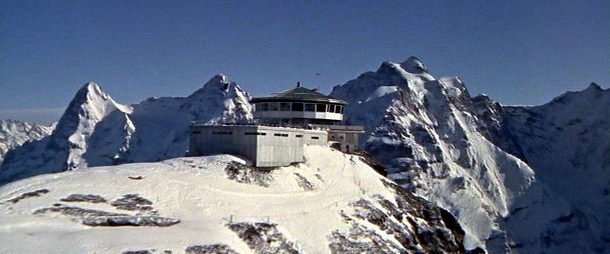
4. Piz Gloria in On Her Majesty’s Secret Service (1969). 

Ernst Stavro Blofeld (Telly Savalas) has lived in some great headquarters over the years (in Thunderball, You Only Live Twice, and Diamonds are Forever, to name a few of the films), but Piz Gloria, a mountaintop “allergy clinic” feels like a nice winter vacation home for the psychopath, maniac, and leader in exile of SPECTRE.  

The headquarters at Piz Gloria is inaccessible except by helicopter (and dangerous mountain climbing…), and boasts a suite of rooms much like a modern hotel. There’s also a gorgeous, multi-windowed “Alpine Room” for taking in the sunset or sunrise.   Beneath the attractive exterior, Blofeld maintains a laboratory for generating bio-weapons. 

Another perk: Save Piz Gloria comes fully equipped with the most gorgeous international beauties you could imagine, including Catherine Schell (Space: 1999).  One of the great Bond action scenes also occurs on the exterior of this mountaintop hideaway, as 007 (George Lazenby) slides across a sheet of ice, mowing down SPECTRE soldiers with his machine.

3. Atlantis in The Spy Who Loved Me (1977).

This is the headquarters of Stromberg (Curt Jurgen), and a vast complex that can survive underwater (in case of nuclear war), but also rise to the surface occasionally.  Atlantis is to be the castle of a new, underwater fiefdom when its new lord and master Stromberg brings about the destruction of the world.

In terms of design, the tripod-style base is quite imposing.  In fact, it seems to be created entirely for fearsome effect, like a weird metal sea bug or something.  Any future underwater colonies or domes would stand in its shadow, with Stromberg and his monstrous headquarters looming over them. 
Inside Atlantis, meanwhile, Stromberg enjoys a lush office with aquarium windows on all side. Just watch out for the elevator, though: a trap door leads right down to the shark tank.

2. Drax’s Space Station in Moonraker (1979). 

As I’m sure other critics have noted many times, Moonraker is approximately the same movie as The Spy Who Loved Me.  Just substitute Drax (Michael Lonsdale) for Stromberg and an orbiting space station for Atlantis, and voila, instant Bond spectacular. 

In this case, Drax has manned his impressive space station with perfect men and women, “models” who will re-colonize the Earth after he de-populates it using a deadly toxin.  The space station is the most inaccessible of all Bond villain headquarters because it is perched in space, but also capable of defending itself from attack. 

Like Stromberg’s Atlantis, the station was designed to dominate a new breed of man.  The young Adams and Eves on Earth would conceivably look to the sky above and know that their “master” (A God?”) is watching over them…for good or ill.  The space station is a great design, reminiscent of Gerry Anderson’s work, and it’s a shame to see it get blown up at film’s end.

1.Blofeld’s Volcano headquarters in You Only Live Twice (1967).

This base is the prototype or trend setter for all future Bond films.  In You Only Live Twice, Blofeld (Donald Pleasence) operates out of a vast subterranean base inside a dormant volcano in Japan.  The outer walls are impregnable, and entrance can only be gained to the post via a sliding door that resembles a mountain lake.

The interior of this base, replete with monorails, command deck, and a rocket launch station, dwarfs just about any set in the Bond canon.   It’s an amazing creation, and yet one that seems wholly believable, if spectacular.  Blofeld even has a nice piranha pool (and collapsible walkway) leading to his roomy office.


You Only Live Twice is the 007 movie that really established SPECTRE as a world menace capable of interfering with the Eastern and Western super-powers in a big way.  The interior set reflects the grandeur of Blofeld’s vision…and evil.

Friday, October 05, 2012

The Top Five: James Bond Double-Entendres


A double-entendre is a risqué or ironic comment, designed to be taken two ways, or to boast a double meaning.  And as we know from fifty years of Bond films, nobody excels at cheeky double-entendres more than Agent 007.

These double-entendres are a matter of subjective taste, no doubt, but below are my choices for the top five double-entendres in the Bond canon.  

You’ll notice that none come from the more serious-minded Dalton or Craig Bonds, or even the early Connery installments. 

5. “Just a slight stiffness coming on.” On Her Majesty’s Secret Service (1969). 

Here, Bond (George Lazenby) masquerades as the effete, bookish Sir Hillary (or “Hilly”) at Blofeld’s mountaintop headquarters on Piz Gloria.  

In the Alpine Room, one of Blofeld’s luscious patients surreptitiously writes her room number in lipstick on Bond’s leg (beneath his kilt).  Bond is jolted, and Irma Bunt, Blofeld’s assistant, asks if anything is wrong.  His response concerns the altitude, I suppose you could say.

4. “I believe he’s attempting re-entry, sir.” Moonraker (1979).

This raunchy double-entendre is actually spoken by Q (Desmond Llewelyn), not Bond, and likely without knowledge of the raunchy double meaning.  

The joke appears at the end of the film, as Mission Control captures an image of Bond (Roger Moore) and Dr. Holly Goodhead (Lois Chiles) making love aboard a space shuttle in flight, returning to Earth.   The same year as Moonraker premiered, there was also a re-entry sex joke in Buck Rogers in the 25th Century. 

3. “No sense going off half-cocked.” Live and Let Die (1973).

Roger Moore’s first Bond film featured this unforgettable and bawdy joke.  In the film, Bond has just made love to the virgin Solitaire (Jane Seymour) and instructed her in a series of “Lover’s Lessons.”  

Solitaire asks if there is time for a review of Lover’s Lesson Two -- *ahem* -- and Bond replies with this classic (if crude...) witticism.


2. “I thought Christmas only comes once a year.”  The World is Not Enough (1999).

This is The World is Not Enough’s closing line/joke, and as I remember it drew a tremendous and spontaneous roar of approval/laughter from the audience I saw the film with.   

Here, Bond beds Dr. Christmas Jones (Denise Richards) and makes a really bad joke about her name and the holiday season.  It’s kind of a cheap laugh, yet, but I can’t deny that it works perfectly as a capper for the film, or has the desired effect. 

1.”Named after your father, perhaps.” Diamonds are Forever (1971).

This double-entendre is Bond’s classic rejoinder when introduced to a lovely lass named Plenty O’Toole (Lana Wood) in Sean Connery’s swan song, Diamonds are Forever (1971).   

This one always makes me laugh, and reminds me how the double-entendres that work best in the Bond series are crude and naughty, but colorfully and imaginatively crude and naughty.

Monday, October 01, 2012

The Top Five; James Bond Fight Sequences


The Bond films are known for spectacular stunts, gorgeous women, ingenious gadgets, memorable bad guys and inventive (if mad) plans to take over the world.   But they are also known for their dazzling, brutal fight sequences.

At some point in every Bond film, the story comes down to Bond against one opponent, with only fists, feet -- and whatever targets of opportunity are available -- making the difference between life and death.

By my reckoning a great fight scene is one with inventive targets of opportunity (Bond using what’s on hand to defeat the bad guy), a great setting, a sense of suspense, and a feeling of exhilaration.  That last bit -- the exhilaration – is meted largely by how the fight is filmed and edited.

My top five selections are.

5.  On Her Majesty’s Secret Service (1969), Beach Fight, Pre-Title Sequence.

Here the new Bond (George Lazenby) attempts to rescue a beautiful damsel in distress, Tracy (Diana Rigg) but is intercepted by Draco’s hulking goons.  Bond is held at gunpoint when he seizes a target of opportunity (an oar on a beached row boat), and leaps into action.  Bond and a goon then duke it out in the roaring surf, with crashing waves all around.  The tide serves to accelerate the pace of the fight.

This beach battles boasts the distinction of not only being suspenseful, but beautifully rendered in terms of imagery.  Silver moonlight makes the ocean shine brightly in this scene, while Bond and his nemesis appear as circling black silhouettes.  The editing is fast-paced, but the camera occasionally steps back far enough to establish a sense of geography, and in these infrequent establishing shots, a large, very-sharp hook is visible in the foreground, a visual indicator of the life and death nature of the battle.

This fight is essentially George Lazenby and director Peter Hunt’s audition film, and they both pass it with flying colors.

4. Diamonds are Forever (1971), Elevator Fight.

This Bond entry is at the low-end of the totem pole, in terms of my affection.  It’s a sort of fat, bloated, listless film. 

But early in Diamonds are Forever, Bond goes up against Peter Franks (Joe Robinson), a jewel smuggler.  The two men fight in an extremely tight setting: a cramped elevator.  The setting is so tight, in fact, that almost each time a character pulls back to deliver a punch, an elbow shatters glass on the elevator windows. 

Because this fight arena is so small, in fact, the two men are constantly being thrown into the elevator control switch, making the car stop and start its ascent towards Tiffany Case’s (Jill St. John) apartment, another wild card in the fight. 

The fight features broken light bulbs, shattered panes, and more.  At one point, Franks picks up a shard of jagged glass and attempts to stab Bond with it, one of those all-important “targets of opportunity” I mentioned above.

This fight is very different from the one I describe above in On Her Majesty’s Secret Service.  There isn’t a lot of quick cutting, and not a lot of camera position shifts either.  Instead, it’s just Sean Connery and Joe Robinson (and their stuntmen, no doubt), pounding brutally on one another, sometimes for long stretches.  

This is one of the meanest grudge matches in the long-lived series, an absolutely life-or-death struggle.

3. Thunderball (1965). Pre-Title Sequence: Bond vs. Count Bouvar.

Setting and context play a crucial part in making this Thunderball fight scene so memorable.  Bond attends a funeral, but then rather suddenly breaks movie decorum when he meets the grieving widow in a large, royal-seeming sitting room.  What does he do??  He punches her in the face.

The moment is quite shocking, but we soon realize Bond has tagged his opponent (really legendary Bond stuntman Bob Simmons) as Colonel Jacques Bouvar of SPECTRE.

The two men then fight in a contest that -- visually speaking -- is edited to within an inch of its life.  The cuts are sharp, the movements sudden, and targets of opportunity are everywhere.  Before the fight is done, a table, a grandfather clock, a chair, a large bureau, hanging tapestries and other pieces of furniture all thrown into the mix, and in rapid-fire succession. 

The fight’s final punctuation is great too: Bond’s nemesis ends face first in a fireplace, and then Bond chokes him to death with a poker that Bouvar had previously yielded as a weapon. Yikes!

Later Bond films often imitated this particular fighting style (I’m thinking of the glass factory fight in Moonraker [1979], in particular) because it is not just a man-against-man contest, but a two-person demolition derby or wrecking crew.

2. Goldfinger (1964): Fort Knox Fight: 007 vs. Odd Job.

It’s probably fair to term Goldfinger the “gold standard” in terms of Bond films, if you’ll pardon the pun.   It very much sets the tone of the film series in a variety of ways, from the tongue-in-cheek pre-title sequence, to the pop title tune.  The final confrontation between Goldfinger and Bond in Fort Knox is no exception.  

Here we have a fantastical or out-of-this-world type setting (with gold bricks stacked on all sides), the colorful and physically powerful soldier villain, Odd Job, and a bomb ticking down to destruction to generate suspense.

That bomb plays a critical role in the action too. Unlike in the other fight scenes tagged in this list, no music accompanies the grudge match between Bond and Oddjob.  Instead, we hear only the persistent hum of that atomic bomb.  It reminds us constantly of the stakes, which is a good thing.  We know that the game isn’t simply stopping Odd Job, but defusing the bomb before it explodes.

Finally, this fight culminates with a great target of opportunity.  Outmatched and outfought by Oddjob, Bond targets a loose electrical cable, and electrifies a wall where Odd Job’s metal-rim has lodged, thus killing his opponent.  If you can’t out-fight your enemy, out-think him…

1. From Russia with Love (1963): Train Fight: Bond vs. Red Grant.

From the opening moments of From Russia with Love, the film establishes Red Grant (Robert Shaw) as the man who has been trained to kill James Bond.  This is his reason for being. 

When Bond and Grant thus meet for their vicious fight in a train car, it is the battle between two men whose capacities for lethality the audience knows quite well.  We’ve seen Bond in action several times by now, and know he can handle himself in a fight.  But we’ve seen Grant in action too, with his watch-garrot…killing a Bond double and others.   This fight is as much about characters as it is about thrills. 

Who has the edge?  The killer instinct? Grant has prepared for this fight for some time.  Bond, on the other hand, must rely on his wits and instincts.  He doesn’t know his enemy the way Grant knows him.

The actual fight is not only fast-paced, and brilliantly-edited, but buttressed by the fact that there appear to be no stunt doubles.  It really looks like Connery and Shaw are slugging it out, and vying for superiority, and the sense of authenticity is incredibly powerful. 

This fight feels frighteningly and painfully real, and though we are conditioned to expect that the hero always wins, there’s still a sense of uncertainty too; a sense that Bond has met his match.   It’s the greatest Bond fight ever, in one of the best films in the series.

Monday, September 24, 2012

The Top Five: James Bond Femme-Fatales


A femme fatale is literally a “deadly woman.” 

And the James Bond films have, for nearly fifty years, given audiences many fine examples of this cinematic breed. 

In fact, villains in the Bond films tend to come in three categories: General Villain, Soldier Villain and Femme Fatale.  Sometimes these categories overlap, and sometimes they don’t.  But the femme fatale -- the dangerous and seductive woman -- is a critical element of the James Bond movie mystique.

The James Bond femme fatale is usually ravishingly beautiful, of course, but perhaps more important than that quality, she is also incredibly, well, lusty.  Whether or not this is a sexist stereotype left over from the 1960s, I’ll leave you to decide. 

Regardless, in keeping with recent “Top Five” posts on James Bond, today I make my selections for the top five Femme Fatales in James Bond movie history.   

5. May Day (A View to A Kill [1985])

Grace Jones portrayed May Day, bodyguard to and operative for Max Zorin (Christopher Walken) in Roger Moore’s last outing as Bond, A View to A Kill (1985). Dangerous, powerful, and physically intimidating, May Day not only is good in a fight, but makes a terrifying leap from the top of the Eiffel Tower (with parachute) following her assassination of an informant. 

May Day is seen in the film fighting both Zorin and Bond, and, finally, bedding Bond (while they are still enemies).  It’s for this particular scene (the bedding of 007) that May Day primarily makes this top-five list. 

It’s a bit of a surprising (and funny…) moment, actually. Bond leans in for the romantic kiss, and May Day violently pushes him over and down, and then assumes the dominant position atop him. 

This moment serves as a good reminder that -- mid 1980s -- this wasn’t the 1960s or 1970s anymore in terms of a woman’s traditional role, even a femme fatale’s, in the Bond flicks.  I like that May Day takes the fight to Bond where he is comfortable, and then asserts her superiority over him in bed. 

4. Elektra King (The World is Not Enough [1999])

Sophie Marceau plays the delectable but deadly in Elektra in Pierce Brosnan’s third Bond film, The World is Not Enough.  Like all the femme fatales, Elektra is gorgeous, of course, but Elektra is memorable because she pretends to be vulnerable, thus exploiting 007’s penchant for protecting beautiful women. 

In truth, Elektra is allied with the evil Renard (Robert Carlyle), and using Bond for her own devious purposes.  A puppet-master combining elements of the femme-fatale and the General Villain, Elektra makes for a powerful threat to Bond.

Even today, in the era of Daniel Craig, it’s still a bracing -- and deadly serious -- moment, when Bond kills Elektra.

3. Fiona Volpe (Thunderball [1965])

I try not to make these lists a commentary on my personal taste in women, but sometimes that’s difficult.  I must confess that I find Luciana Paluzzi really irresistible in Thunderball, and, in fact, a far more intriguing villain than Adolfo Celi’s bland Emilio Largo. 

In Thunderball, Paluzzi plays a SPECTRE agent named Fiona Volpe, an operative who isn’t afraid to use either lethal force or her feminine wiles to get the job done effectively.  Alas, Volpe lives by the sword and so must die by the sword too.  In one of the Bond franchise’s greatest scenes, Volpe and Bond dance together at the Kiss Kiss Club while Volpe’s assassins circle in for the kill.  Bond detects the ambush, and spins Volpe into position -- as a human shield -- right as the lethal bullet is fired.  That’s the end for sexy Volpe, but this motorcycle-riding, sexy villainess lives on in the memory. 

Paluzzi’s performance -- and indeed her charismatic screen presence --  may just be my favorite quality of Thunderball, which I generally don’t enjoy as much as many other Bond aficionados do.

2. Xenia Onatopp (Goldeneye [1995])

There’s not much I can say about a femme-fatale named On-a-top who squeezes her male enemies to death with her killer thighs, and virtually orgasms while conducting a machine gun massacre.  Yikes!

Famke Janssen is absolutely a marvel in this iconic role, and her scenes sizzle with danger, and also, not incidentally, a high-degree of humor.  By this time in the Bond mythos -- the mid-1990s -- we were all in on-the-joke, so-to-speak, and so when Janssen goes “big,” it’s not a campy misstep but a brilliant calculation.

From her wickedly funny name to her unusually physical assassination techniques, Onatopp may actually be Overthetop, but who cares?  Janssen brings a lot of sex appeal and fun to the first Bond film in six years, and remains a favorite to this day for good reason.

1. Fatima Blush (Never Say Never Again [1983])

Whenever someone claims that Never Say Never Again isn’t a great Bond film, I just instruct them to look at the caliber of the villains in the film, namely Klaus Maria Brandauer as Largo and Barbara Carrera as his mad femme fatale, Fatima Blush.  

Both characters are extraordinary well-drawn, and bring the movie to life with a sense of anarchic energy.  Barbara Carrera makes Fatima Blush almost schizophrenic in her extreme good cop/bad cop routine with Jack Petachi, and then reveals inordinate, mad delight when Largo gives her the order to kill Bond. 

But it’s her death scene that really distinguishes Fatima Blush, in my book.  Bond (Sean Connery) knowingly plays on her oversized ego, and she demands that he leave behind a note (with his corpse…) stating that sex with Fatima was the best he ever had. 

This demands leads, of course, to Bond using a secret gadget – a pen gun – against Blush.  I wrote about this dynamic some in my review of Licence to Kill, vis-à-vis Sanchez, but the best Bond characters are the ones who possess psychological foibles…ones that Bond can manipulate or exploit. It’s ever so much more interesting to see Bond hoist villains (or femme fatales) by their own petard rather than just haul out a gadget or fire a gun.  Here, we get a combination of the two approaches. 

 Fatima Blush is such a charismatic character and important player in the film that it never quite seems the same after she’s been dispatched.  Blush is the best Bond femme fatale of all-time in my book, and Never Say Never Again’s great source of renewable energy.

Monday, September 17, 2012

The Top Five: James Bond Villains


As famous as Agent 007 remains after four decades at the movies, many of his nemeses remain equally well-known.  

Typically, Bond films don’t work very well if the villains don’t measure up; if they don’t present the audience some electric jolt suggesting that Bond -- and the world itself -- might truly be in danger.  

We have long since come to expect that Bond will drive fast cars, romance beautiful women, and defeat monstrous enemies, but we also must believe at least a little during the course of the movie that the outcome is in doubt.  The best villains help us suspend that disbelief.

There’s no magic formula for a Bond villain, either.  Some are young, physically-agile Bond “opposites” (as in From Russia with Love or Goldeneye) while others are brilliant schemers (like Goldfinger of Blofeld.) Over the years, we’ve also met genetically-engineered freaks like Zorin (Christopher Walken), drug-dealers like Sanchez (Robert Davi), and even rabid devotees to a political cause, like Rosa Klebb (Lotte Lenya).

I’m going to write-up a separate list for Villain Henchman soon, so this list focuses on the mastermind or general villains, not the soldiers-types.

5.Ernst Stavro Blofeld in You Only Live Twice (1967)

I’m a long-time admirer of the late Donald Pleasence and his many great performances.  He was -- rather famously -- in a bad movie or two (Pumaman, Warriors of the Lost World) during his time.  But Pleasence also made a hell of a villain in films such as Fantastic Voyage and You Only Live Twice.  

Here, the actor appears as Bond’s ultimate enemy, Blofeld, head of SPECTRE.  Scarred and bald, this Blofeld combines physical ugliness – someone once compared his skull and scars to a “cracked egg” – with an absolute sense of contempt for anyone other than himself.  

The Bond films had a number of very capable actors play Blofeld over the years (Telly Savalas, Max Von Sydow and Charle Gray, namely), but I have always felt that Pleasence was tops at  playing a master manipulator, a man of tremendous intellect and cunning, but  one divorced from the human race in terms of compassion and decency.  There's a madness in Blofeld's eyes in this film that makes you think he may just succeed in his plans to start World War III.  I wish Pleasence had reprised the role in On Her Majesty's Secret Service and Diamonds are Forever.  As the films stand now, there's no sense that we're looking at the same man battling Bond in three different adventures.

4.Maximillian Largo, Never Say Never Again (1983)

Is it heresy to include Never Say Never Again on an “official” James Bond top five list? 

Perhaps so, but Klaus Maria Brandauer nonetheless created one of the most memorable characters ever to menace 007 on the silver screen.  His version of Largo is playful, witty…and an absolute ego-maniac.

Temperamental and jealous as well as brilliant and rich, this Largo is a rather atypical villain in his three-dimensionality.  Bond (Sean Connery) gets a good read on the character’s competitive nature and makes a play for his girl, Domino (Basinger) and his money (in a video game of global “Domination”), all while trying to track down two missing atomic bombs.  Meanwhile, Brandauer imbues Largo with tremendous individuality, from the moment when he delicately blows a kiss on his wounded hands (after losing to Bond at the video game which delivers electric jolts), to the moment he swaps spit with a recalcitrant Domino. 

You can’t exactly state that Brandauer plays the role lightly, but certainly the actor has given considerable thought to Largo’s world view, from his weird sense of humor to his casual (class/wealth based?) dismissal of Bond as a kind of lowly plebian.  Never Say Never Again isn’t heralded widely as a great Bond film, which I believe is something of a mistake.  The casting of Brandauer (as Largo) and Carrera (as Fatima Blush) gives the film a major boost of strange, anarchic, dangerous energy. 

3. Dr. Julius No in Dr. No (1962)

Joseph Wise portrays Dr. No in the Bond film of the same name, the very first Bond film in the canon, in fact.  As the first of the “bad guys,” Wiseman makes a tremendous impact.  

Physically powerful and endowed with destructive, crushing metal hands (because of an accident), he also boasts a cruel, cool intellect.  As No, Wiseman set the tone for many of the future Bond villains by memorably terming our hero a “stupid police man.”   

Brilliant, brutal and condescending, Dr. No is the first in line to challenge 007, and that prominent positioning alone makes him special.  But  there is more to the character than that too.  There’s the sense in Wiseman’s Dr. No of supreme authority and power, backed up by technological know-how, and that Bond may be outmatched in terms of both brain and brawn.

2. Franz Sanchez (Robert Davi) in Licence to Kill (1989)

Timothy Dalton’s James Bond went up against Davi’s diabolical, physically-intimidating drug lord, Sanchez in Licence to Kill (1989).  

Although I remember vividly at the time of the film's release that some critics were disappointed to see Bond battling a drug baron in South America, I believe  that the character worked brilliantly not only because of Davi’s fearsome, intense (method) portrayal, but because the character boasts a psychological frailty.  

For Sanchez, everything comes down to loyalty.  I love Licence to Kill because when you get right down it, the film is all about Bond manipulating and exploiting Sanchez’s feelings about those under his command, playing on his insecurity about loyalty.  Even Sanchez's death -- brought on by the question “don’t you want to know why?” -- is a reflection of this relentless campaign of psychological manipulation.  Sanchez is a brutal guy, for certain, but he remains a great Bond villain because of the character’s flawed, human nature.  If Sanchez had not been so concerned with loyalty, he would not have fallen.  There’s something almost Shakespearean or tragic about the character.

1. Auric Goldfinger in Goldfinger (1964)

Well, this is a huge surprise, right? 

I think everyone knew this selection was coming.  But Goldfinger is surely the ultimate James Bond villain, one oft-imitated but never quite duplicated. 


A genius, a mad-man, an ego-maniac, and more, Auric Goldfinger, like Sanchez, can be discussed in terms of one key quality: an obsessive love of gold. 


Goldfinger is single-minded in his pursuit of gold, and he lets nothing stop him.  In part, Goldfinger is so memorable because he doesn’t engage much with Bond directly, not when there's Operation Grand Slam to plan, anyway.  Hence his famous retort: “No Mr. Bond, I expect you to die,” or another good quip: “Choose your next witticism carefully, Mr. Bond. It may be your last."  


Goldfinger is so single-minded that he can’t quite see that Bond is clever enough to be his undoing and not just a nuisance.  I also love the fact that film defines Goldfinger as, essentially, a cheat.  He obeys no rules in his quest to control the world's supply of gold, and that kind of obsession/lawlessness makes for a very powerful opponent indeed.

60 Years Ago: Star Trek:"The Naked Time" (September 29, 1966)

Stardate 1704.2: The  U.S.S. Enterprise  (NCC-1701) orbits distant Psi 2000, an ancient world on the verge of breaking up. The crew's mi...