Showing posts with label Cult-TV Theme Watch. Show all posts

Monday, June 18, 2018

Cult-TV Theme Watch: Dinosaurs


In my experience, every little boy and girl goes through a "dinosaur stage" between the ages of 5 and 10 -- a time when these extinct creatures play a crucial role in their developing imagination.  This is so, probably, for many reasons. 

 For one, there are so many different varieties of dinosaurs to learn about -- with various qualities -- that they seem like prehistoric Pokemon.  You can spend weeks and months learning about the different types of dinosaurs and their behaviors.  

Secondly, it's amazing for both children and adults to contemplate the idea that these giant creatures once roamed our Earth....long before we did.  In that sense, they are "real" in a way that dragons, perhaps, are not.  

Similarly, the death and extinction of the dinosaurs so long ago is a potent lesson to students of all ages.  

Nothing lasts forever.  Everything has its time.  Even monsters that seem as mighty and powerful as these "terrible lizards."

But cult-TV history, in many ways, has been the time of the dinosaurs. They have appeared again and again, over the decades, to inspire and entertain audiences, and remind us both of the distant past and fears about future, and the extinction of man.


A dinosaur was seen from a fly-over point-of-view, early on in TV history, in The Twilight Zone's 1961 story "Odyssey of Flight 33." There, a modern airliner slipped through a time warp, and cruised over the New York area only to be confronted with visions of dinosaurs.   

On the same series, an episode called "It's a Good Life," about a wicked boy (Bill Mumy) with extreme mental powers and abilities, featured a clip of dinosaurs. Specifically, the boy would only allow the adults of his town to watch TV if they watched his self-created program...one which concerned dinosaurs endlessly battling it out.

Dinosaurs have appeared on episodes of Doctor Who -- old (1963 - 1989) and new (2005 - present)  -- for over forty years.  The Third Doctor (Jon Pertwee) battled them in a serial titled "Invasion of the Dinosaurs," while the Eleventh Doctor (Matt Smith) had to rescue many of these reptiles in "Dinosaurs on a Spaceship."  

Recently, the era of the Twelfth Doctor (Peter Capaldi) was inaugurated with a view of a T-Rex in Victorian London, in "Deep Breath."


Given the affinity children have for dinosaurs, it is appropriate that Saturday morning television has often focused on them too.

In 1974, both the live-action Land of the Lost (1974 - 1977) and the animated series Valley of the Dinosaurs premiered, offering children the opportunity to see modern families contend with these prehistoric beasts.  

Indeed, if you gaze at the Jurassic Park films, they resurrect a key aspect of both Land of the Lost and Valley of the Dinosaurs: children play a key role in the dino-centric stories.  Both the films and these TV shows are about families bonding, while running from giant-sized dino-threats.


Advances in special effects technology in the last decade have resulted in -- surprise -- more dinosaurs on television.  Series such as Primeval (2007-2011) and Terra Nova (2011) both featured these extinct animals on a regular basis. 

In the case of the former, gateways or portal from prehistoric times were opening into modern-day London, bringing dinos with them.  In the latter case, future man traveled back in time to colonize the prehistoric past.


Basically, you can find dinosaurs in a variety of cult-TV programs, of any sub-genre.  

There was a sitcom about a blue-collar family of them called Dinosaurs (1991 - 1994).  The X-Files (1993 - 2002) featured an episode titled "Quagmire" about a Loch-Ness-like dinosaur called Big Blue living in a Southern lake in the United States.  The crew of the U.S.S. Voyager encountered a race of evolved dinosaurs in the third season Star Trek: Voyager (1995 - 2001) episode "Distant Origin," and so on.

Dinosaurs are extinct today, but the love for these "monsters" goes on in our popular entertainment, as the release of Jurassic World: Fallen Kingdom (2018) this Friday abundantly proves.

Monday, December 04, 2017

Cult-TV Theme Watch: Cake


Yesterday, December 3rd, was my forty-eighth birthday, so it seems appropriate to focus this Cult-TV Theme Watch to cake, and preferably birthday cake. 

A cake is a concoction of soft food made from a mixture of eggs, sugar, flour and other ingredients. A cake is baked, and sometimes decorate, if for a special event (like a birthday).

Cakes have appeared frequently in cult-TV history.

In one of the last episodes of Rod’s Serling’s The Twilight Zone (1959-1964), for instance, a huge, delicious-looking cake is served at Aunt T’s, a fantasy cabin in the woods where hopeless and forgotten children find the equivalent of parental love, in “The Bewitchin’ Pool.”


In Buck Rogers in the 25h Century (1979-1981), the astronaut from the 20th century, but awakened in the 25th century (Gil Gerard), gets a surprise party and a birthday cake with a lot of candles on it, given his age, in the episode “Happy Birthday, Buck.”

Alf gets confused in an episode of ALF (1984-1988) and pours cold water on his birthday cake candles, so as not to start a fire.

A cake of a most unusual variety appears in the seventh season Star Trek: The Next Generation (1987-1994) episode “Phantasms.” There, Lt. Cmdr Data (Brent Spiner) has a dream in which he carves up a cake that is molded in the shape of Counselor Troi’s (Marina Sirtis) torso and head. It is a “peptides” cake.


It’s not exactly a cake, but Scully (Gillian Anderson) gets a happy birthday cupcake from Mulder (David Duchovny) in The X-Files episode “Tempus Fugit.”


A birthday cake is the order of the day for Jordan Black’s (Brittany Tiplady) seventh birthday in the third season Millennium (1996-1999) episode, “Seven in One.”

Finally, Liv Moore (Rose McIver) gets a birthday cake in the iZombie (2015 - ) episode, “Real Dead Housewife of Seattle.”

Monday, November 27, 2017

Cult-TV Theme Watch: The Cabin in the Woods


As the 2012 meta-horror movie Cabin in the Woods reminds us, there is no greater -- or more isolated -- locale for terror than, well, a cabin in the woods.

One of the greatest horror films ever made, The Evil Dead (1983), charted that particular territory brilliantly, but the subject of this blog post involves TV series that utilize the location.


The isolated cabin in the woods is the central battlefield, for example, in the classic The Twilight Zone (1959-1964) episode, “The Invaders,” which involves a lonely woman (Agnes Moorehead) attacked by tiny, malevolent beings. These monstrous invaders turn out to be human astronauts.

A memorable episode of Ghost Story/Circle of Fear (1972-1973) called “Doorway to Death” involves two children taking a mystical doorway from a haunted city apartment in San Francisco to a wintry landscape. There, in the woods -- at a cabin, naturally -- a killer is seen chopping wood with an axe. The doorway is literally, a portal to death.


One of the greatest The X-Files (1993-2002) episodes of its first season, “Darkness Falls,” finds Agent Scully (Gillian Anderson) and Agent Mulder (David Duchovny) trapped in a cabin in the woods in the Pacific Northwest as flesh-eating, prehistoric insects attack. The bugs emerge at night, but are repelled by light. In a suspenseful scene, Mulder and Scully must depend on a single, dangling light bulb, and a faulty generator, to keep them alive.

In Chris Carter’s Millennium (1996-1999), the leader of the Millennium Group played by R.G. Armstrong is seen to be living in a remote cabin in the woods in the early second season episode, “Beware of the Dog.” Frank Black (Lance Henriksen) is sent by the Group to encounter him.


A cabin in the woods has also been a sanctuary, on more than one occasion, for the living, during the zombie apocalypse in AMC’s original series, The Walking Dead (2010 -- ), and of course, Ash vs. The Evil Dead (2015 - ) has revisited the notorious cabin in the woods where all the horror of Sam Raimi’s Deadites first began.

Monday, November 20, 2017

Cult-TV Theme Watch: Thumbs-Up


The “thumbs up” sign is a gesture of approval or satisfaction, at least in the United States of America. In some other countries and regions, however, the thumbs up is actually an insulting expressin, a gesture we reserve, here, for the middle finger. This is true in some areas of South America, Iran, Afghanistan, and Italy, for instance.

In cult-TV history, however, the thumbs-up sign has often been a funny sign of assent and agreement, but the gesture is also a trademark of two particular historic programs, in particular.

Happy Days (1974-1984), a nostalgic program about the 1950’s, introduced the character of the Fonz -- or Fonzie (Henry Winkler) -- who was the coolest person in existence. The Fonz wore a leather jacket, drove a motorcycle, jumped a shark, and indicated approval with his ubiquitous thumbs-up gesture. The Fonz became such a pop culture icon that his “thumbs up” image was seen on T-shirts, trading cards and other collectibles.


The other TV series to make frequent use of the “thumbs up” gesture, of course, is At the Movies (1982-86), which featured film critics Gene Siskel and Roger Ebert giving their (often dueling) opinions of current movie releases.


A thumb’s up sign was also seen in the opening credits, each week, of Mystery Science Theater 3000 (1989 – 1999) during the Joel Robinson (Joel Hodgson) era. Joel appeared in his red-jump suit and hard-hat, “cleaning up the place” (Gizmonic Institute), and giving his assent to the camera with the thumbs-up.

Monday, November 06, 2017

Cult-TV Theme Watch: CEOs


A CEO is the chief executive officer of a corporation, the top manager responsible for the direction and administration of the organization.

Since the 1980, CEOs have played an important role in cult-TV programming, usually as villains, or at least morally-suspect individuals.


Back in 1985, Nathan Bates (Lane Smith), the CEO of Science Frontiers, negotiated an “Open City” policy in Los Angeles for Visitor and humans, in V: The Series (1985). 

His plan was to exploit Visitor technology, but also to control inter-species violence in the city.  A side-effect was that he was the most powerful man in the city of Angels. Bates was killed off half-way through the series run, alas, and the Open City fell.

In 1990, Alexander Alucard (Geordi Johnon) was a tycoon and CEO of his own company in the syndicated series, Dracula: The Series

Like Bates before him, Alucard -- A Gordon Gekko-type character – seemed fascinated with the development and acquisition of technology (including supernatural technology) that could help him maintain his power.


In the various incarnations of the Superman legend -- Lois and Clark: The New Adventures of Superman (1993 – 1997) and Smallville (2001 – 2011) -- audiences have met CEOs from the Luthor Family.  In the former series it is Lex (John Shea) himself. In the former, we meet LuthorCorp CEO Lionel Luthor (John Glover), and his replacement, Lex (Michael Rosenbaum).


In Veronica Mars (2004 – 2006), Jake Kane (Kyle Secor) is the CEO of Kane Software, in Neptune, CA. His daughter Lily is murdered, and throughout the first season the tycoon is a central suspect in the crime.


In Fringe (2008 – 2013), William Bell (Leonard Nimoy) is the legendary CEO of Massive Dynamic, and described as one of the nation’s most “inspiring” corporate leaders.

There are precious few CEOs in the Star Trek franchise, because capitalism is a thing of the past, mostly by the 24th century.  


Still, Star Trek: Voyager’s (1995 – 2001) third season two-parter, “Future’s End” featured a 20th century CEO, Henry Starling (Ed Begley Jr.).  The character had stolen a 29th century time ship, and was planning to illicitly gain access to more future-tech.

Monday, October 16, 2017

Cult-TV Theme Watch: The Blue and the Grey


The American Civil War divided this nation like no other conflict, and yet divides it, in many significant ways. The conflict between the North and South, the blue and the grey, is a turning point in our history, and in many ways, a turning point in its cultural frissons.

The American Civil War has appeared again and again in our entertainment, in our shared cult-TV canon.

In Rod Serling’s The Twilight Zone (1959-1963), an episode called “The Passersby” commented on this conflict.


The haunting story is set during an “incident on a dirt road during the month of April, the year 1865.”
A crippled Confederate sergeant (James Gregory) limps to the home of Lavinia Godwin (Joanne Linville), who awaits (in vain) the return of her husband, also a soldier. Together, they watch as Union and Confederate soldiers walk the lonely road, heading to some unknown destination beyond.

The episode’s kicker is that the last man on the road is Abraham Lincoln -- said in the closing narration to be the final victim of the Civil War. 

But if we have learned anything in the America of today, 2017, it is that there are still victims of the Civil War living in our culture right now. They are the ones who mistake hate for heritage. They are the ones who still deal with the inequities of an immoral slave trade that divided families, destroyed wealth, and fostered poverty and resentment.  It turns out The Twilight Zone was too optimistic in its approach. One hundred and fifty something years later, Americans are still walking down this Civil War road of grievous wounds and divisions.


Other TV series have also featured the civil war.  Sid and Marty Krofft’s Saturday morning TV series Land of the Lost (1974-1977) is about a pocket universe where people, of all eras, become trapped, unable to escape The episodes “Downstream” (and its oblique sequel, “Medusa”) contend with one such person, a Civil War soldier…and his beloved cannon.  This veteran, Jefferson Davis Collies (Walker Edmiston) helps the Marshalls in the first season, and is discovered to be one of Medusa’s statues in the third season.


Star Trek: Voyager (1995-2001) featured a Civil War themed tale called “The Q and the Grey,” about a civil war inside the Q Continuum, during its third season. The Q exist on a different realm of reality all together, one that humans can’t perceive as it is.  Therefore, their cosmic civil war is depicted, for Janeway’s crew, as the American Civil War.  The episode ends with Tuvok and other crew members picking a side and donning uniforms of the era to fight in this war.

The X-Files (1993-2002) also featured a Civil War-themed episode called “The Field Where I Died.” This story involves reincarnation, and Mulder’s (David Duchovny) discovery that he has a “soul mate” in each life, including in a previous life in the Civil War. That soul-mate, is, unfortunately, a cult-member fated to die in the present. 


Both modern vampire series -- True Blood (2008 – 2014), and The Vampire Diaries (2009 – 2016) -- position their long-lived heroic vampires, whether Bill Compton (Stephen Moyer) or Damon Salvatore (Ian Somerhalder), as veterans of the Civil War. 

Throughout both series, flashback scenes are featured set during this time period, in which the characters, not yet vampires, but must contend with their choices in the life-and-death struggle of the era. In the final season of The Vampire Diaries, for instance, Damon is sent to a personal Hell where he must relive, again and again, a mission during the Civil War that ended with the slaughter of an innocent family.

Monday, October 09, 2017

Cult-TV Theme Watch: Wax Figures


A wax sculpture is a figure resembling the original model, only created in wax, and displayed, usually at a museum or other attraction.

Wax figures have been avatars for horror in film and television going back more than fifty years. In this case, however, I am looking at “cult-TV” wax-figures.


A creepy episode of Rod Serling’s The Twilight Zone (1959-1964), “The New Exhibits” (1963) concerns a man, Senescu (Martin Balsam) who worked the “murderer’s row” exhibit in a wax museum, Ferguson’s, where duplicates of Jack the Ripper and other notorious human monsters were on display. 

When the museum was going to be torn down, Senescu decided to bring the figures to his home. This was, as you may guess, a decision he came to regret.

A wax figure turned up in the unlikely place of the final frontier, in Star Trek’s (1966-1969) “Shore Leave.”  There, on an amusement park planet, a black knight killed Dr. McCoy (De Forest Kelley), and when his helmet was lifted, the knight was revealed to be an apparently lifeless wax-figure.


The 1976 Saturday morning TV series, The Monster Squad (not to be confused with the eighties movie) had a premise based on a wax museum and wax figures.  

There, in the museum, wax figures of Dracula, the Wolf Man, and the Frankenstein Monster came to life, and solved crimes. Their home base was the wax museum. But intriguingly, the series was not about the classic monsters resurrected in the 1970’s, but about their wax sculptures brought to life.

The wax figure or museum trope survives to this day.


In 2009, “Fallen Idols,” an episode of Supernatural (2005 - ) revisited the cliché, and also connected back to the (not-well-received) remake of House of Wax (2005).  That film starred Supernatural star Jared Palecki and Paris Hilton, and they were reunited in “Fallen Idols.”  Here, the Winchesters encountered figures of Lincoln, Gandhi, and aforementioned Hilton.


In the second and last season of Penny Dreadful (2015-2016),  Oscar Putney creates a waxworks museum (as competition for Madame Tussaud’s), and is a recurring character. He makes the mistake of hiring the Frankenstein Monster to work at his attraction.

Monday, October 02, 2017

Cult-TV Theme Watch: Split Screens


A split screen is a composite shot, or rather, two shots projected/edited simultaneously into the same frame. This time-honored technique of the “split screen” has been used often in cult-TV history so that characters can meet themselves.

And by meet “themselves,” I mean encounter a doppelganger, twin, or self from an alternate, future, or past chronology.


Split screen shots were used extensively in the early first season Star Trek (1966-1969) episode, “What Are Little Girls Made Of.”

There, Captain Kirk (William Shatner) encountered an android duplicate of himself. Although stunt doubles were also utilized, the illusion of “two” Captain Kirks was ultimately sold through the use of split-screen effects, so William Shatner could be seen acting…next to himself.

By the time of Star Trek: The Next Generation (1987-1994), the split-screen shots were less obvious, or at least less quickly noticeable, and incorporated more movement within the frame to hide the illusion.  In episodes such as “Datalore” and “Time Squared,” Enterprise crew-members interacted with themselves, walking down corridors, sharing turbo-lifts, and so forth.


The mirror universe episodes of Deep Space Nine (1993-1999) also featured split-screens for the scenes in which Kira Nerys (Nana Visitor) met her mirror double, the lascivious Intendant.

A series such as Beyond Westworld (1980) was actually constructed on the premise of android duplicates replacing their human doubles, so split-screen photography was bound to play a significant role. In episodes such as “Brother’s Keeper” (which saw Connie Sellecca’s character face an android double), split-screen shots were crucial to the verisimilitude of the series’ very formula.


The same idea appeared in cult-TV far more recently, in Ringer (2011-2012), a series which saw a woman played by Sarah Michelle Gellar impersonate her wealthy sister in Manhattan. Although the two sisters did not meet often, when they did, split screens were deployed. One such meeting scene set the opposing sisters against a wall of mirrors so that we were seeing not just split screen imagery, but an infinite regression of reflections.

The old staple of the “evil twin” could not have been visualized, in classic cult-TV without the split-screen technique.  Just two examples: we have seen it in use in Man from Atlantis (1978) in “Shoot Out at Land’s Ends,” and in Knight Rider’s (1982-1986) “Goliath,” which introduced the world to Michael Knight’s doppelganger and evil twin, Garth Knight (also played by series star David Hasselhoff).


Monday, September 25, 2017

Cult-TV Theme Watch: Dungeons


A dungeon is a subterranean jail cell, and is sometimes referred to as a keep or stronghold. Often times, one will find this underground prison in a medieval castle.

In science fiction or cult-TV history, however, dungeons might be found all over the universe, and across all different time periods as well.

One of the most unforgettable TV dungeons appears in a Twilight Zone (1959-1964) episode titled "The Howling Man."  


In this haunting tale, a traveler in Europe happens upon an old monastery, and stays the night there when he falls ill. During the dark, lonely hours of night, the visitor hears a strange howling emanating from the dungeon. There, a stranger is locked up...begging to be released.  The stranger, however, is a sinister sort, and his continued presence in this dungeon is a necessity if the human race is to prosper and know peace.


Although set in the 23rd century, Star Trek (1966-1969) features many dungeons out there, on the final frontier. In the first season story, "The Return of the Archons," for instance, hooded Lawgivers (the servants of a "God" known as Landru) throw Kirk's landing party in a dungeon to wait until they become assimilated into "The Body."

In a second season story, "Catspaw," Kirk, Spock and McCoy end up chained in a dungeon, in a witch's castle, on a distant world. It is guarded, of course, by a giant black cat (in keeping with the Halloween-styled imagery).


The Space:1999 (1975-1977) story "Journey to Where" ends in a dungeon. A time travel mistake sends Commander Koenig, Dr. Russell and Captain Alan Carter back to Earth, but during the battle of Bannockburn in the 1310's. The Alphans are captured, held in a dungeon, and nearly burned alive before Maya discerns a method of returning them to the errant moon.

A dungeon of sorts is featured in The X-Files (1993-2002) episode "Alone," which sees Doggett (Robert Patrick) in pursuit of a murderous lizard-man. He discovers that the lizard man's victims end up in a subterranean tunnel -- or dungeon -- to be eaten alive.


Of course, Game of Thrones (2011 - ) features dungeons on a semi-regular basis, whether to house dragons, or the bones of Stark kin, and ancestors.

Monday, August 28, 2017

Cult-TV Theme Watch: My Enemy, My Ally


What does it mean when I write about “my enemy, my ally?

Two committed enemies are forced to work together to extract themselves from a difficult, life-threatening spot despite their extreme differences.

You may have seen this dramatic idea played out, large scale -- human pilot against alien Drac -- in Wolfgang Peterson's epic film, Enemy Mine (1985). But a similar tale has also been a staple of sci-fi TV programs across the decades.

This "My Enemy/My Ally" narrative conceit proved especially popular during the 1970’s and 1980’s. Perhaps it was a coded reflection of the Global Cold War between the U.S. and the Soviet Union, a conflict that separated the world into two intractable sides, and ideologies.

Since many cult TV programs are geared explicitly towards the idea of imagining and presenting a better, more positive future -- pointing towards the evolution and growth of our species -- this explanation certainly makes abundant sense.

Episodes of the "My Enemy/My Ally" variety often suggest that -- once thrown together into a life-threatening scenario -- enemies can find a common bond if only they leave their pre-existing, hostile, cultural beliefs behind.

The notion is that understanding and trust are seeds that can grow inside people over time, and even blossom into peaceful co-existence, tolerance and hopefully, real friendship. In the era of mutually assured destruction, it was powerful for sci-fi television to suggest that -- just by being thrown together into a common danger with our mortal enemies -- we could prevent nuclear annihilation.

By personally knowing our enemy, we could make a better choice...for the planet.

Gazing back across the decades, you can see several examples of this My Enemy/My Ally story template.

For instance, in the year 1970, an episode of the jingoistic (but utterly brilliant...) Gerry Anderson series U.F.O. saw S.H.A.D.O. astronaut Paul Foster and an alien pilot work together to survive on the desolate lunar surface following a battle, in the installment called "Survival." Different ideologies/different agenda, but a mutual, positive purpose outside the political confines of a larger war-between-the-planets.


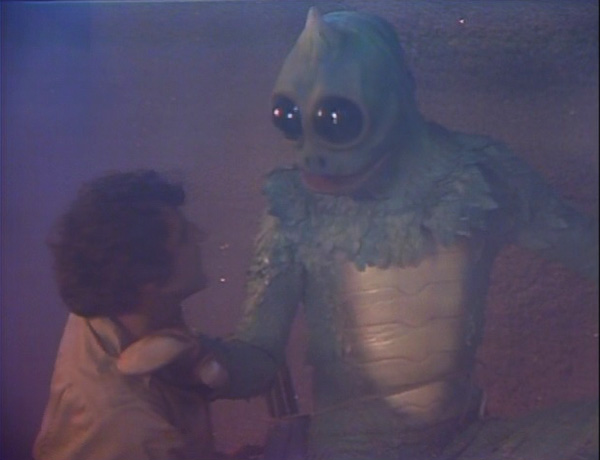
Then, in 1974, a first season episode of the Krofft Saturday morning TV series Land of the Lost found a Sleestak named S'latch and human protagonist Rick Marshall (Spencer Milligan) trapped in a deep, smoky pit inside the Lost City.


Again, these two opposing individuals had to learn to trust, and to work together, to escape...before the Sleestak God made them lunch. When S'latch was wounded during an escape attempt, Rick Marshall rescued the Sleestak from the pit, and earned the creature's loyalty and friendship.


The same year saw an intelligent simian of future Earth, General Urko (Mark Lenard) team up with a human astronaut from the past, Peter Burke (James Naughton) in the Planet of the Apes series episode “The Trap.


Likewise, in "The Return of Starbuck," an episode of Galactica: 1980 from May of '80, Lt. Starbuck (Dirk Benedict) and a Cylon enemy crash-landed on a barren planet after (another) pitched space battle. A lonely Starbuck re-programmed "Cy" to become an ally, and they kept each other company for a time...until Cy gave his life to save his human friend from further Cylon troops.

As late as November of 1989, Star Trek: The Next Generation took a stab at this "My Enemy/My Ally"-fashioned narrative.


In "The Enemy," Engineer Geordi La Forge (LeVar Burton) became trapped on an inhospitable world, Galorndon Core, with only a zealous Romulan soldier for company. The sub-plot of two enemies finding understanding on the isolated planet was artfully balanced against a story of Worf refusing to give aid to an injured, dying Romulan aboard the Enterprise. On the surface: enemies helping one another, their mutual existences threatened. On the Enterprise (and inside the "culture war" between the Federation and the Romulans...), one man/Klingon just couldn't let go of the hate-filled past.

But on the planet, hate was forgotten, at least briefly.

40 Years Ago: Howard the Duck (1986)

In 1986, the comic-book adaptation  Howard the Duck  -- executive-produced by George Lucas -- landed in movie theaters with a splat.   The f...