Showing posts with label Dan Curtis. Show all posts

Thursday, September 28, 2017

Cult TV-Movie Review: Dan Curtis's Dracula (1974)


In 1897, Jonathan Harker (Murray Brown) travels to Hungary, and meets with his client, Count Dracula (Jack Palance), at the count’s castle in the Carpathians. 

After entering the estate freely -- of his “own will” -- Harker attempts to secure property in England for his host: dilapidated Carfax Abbey.

Meanwhile, Dracula shows a suspicious interest in Harker’s photograph of his fiancĂ©, Mina Murray (Penelope Horner), and her friend, Lucy (Fiona Lewis).

The undead Dracula unlooses his three vampire brides on Harker, and leaves for England. 

Five weeks later, there are reports in Whitby, England of the arrival of a ghost ship, the Demeter, and its dead crew.  Soon, Lucy falls ill, the victim of some apparent mystery illness.

In truth, Dracula is draining Lucy’s blood, a little each night. A brilliant scientist, Van Helsing (Nigel Davenport) arrives to help, and evidence leads him to the conclusion that a vampire is responsible for her suffering. 


This Dan Curtis TV-movie from 1974 is not the most notable production of Bram Stoker’s novel, Dracula, perhaps, but it certainly earns points for a grim atmosphere of seriousness in its depiction of the famous “preternatural being,” and his campaign of terror in Victorian England.

The tele-film starts out as an uber-faithful adaptation of Stoker’s work, beginning with the Harker interlude, but as it goes on, it becomes less and less faithful to the source material. This is a result, perhaps, of budgetary or time restraints. 

For instance, Renfield is absent from this version entirely. Lucy’s three suitors are not present either, replaced by the character named Arthur (Sion Ward) instead.

And yet surprisingly -- since this was broadcast on network television -- the film doesn’t shy away from the sexual implication of the story. 

There is a scene here, for example, of Lucy dropping to her knees before a standing Dracula, which, when coupled with the disrobing of her bandaged neck, suggests wanton, sensual abandon.

The film's photography, by Oswald Morris, is quite powerful, and director Curtis shows a facility with film grammar when it comes to establishing Dracula's frightful power.


But any production of Dracula rises and falls on its depiction of the titular character.

Here Jack Palance plays the count squinty-eyed and labored,  an approach which suggests that Dracula is often in terrible physical pain, perhaps from his yearning for blood; or perhaps because of his yearning for companionship.  


Even Dracula’s death feels highly personal here. We (the audience) are on the receiving end of the wooden stake, looking right into Van Helsing’s eyes as the death blow is delivered. From this perspective, it’s as though we are being murdered.


The story, adapted by Richard Matheson, dispenses with some of Stoker’s more nightmarish (but expensive) imagery such as the blue rings of fire on the path to Dracula’s castle, or the dark count scaling the tower walls of his home.

The teleplay also invents a “human” motivation for Dracula’s campaign of terror, his invasion of England. In this case, Lucy is a dead ringer for the vampire’s long lost wife, whom he misses desperately. Intriguingly, this subplot (though changed to Mina...) is also included in Coppola’s 1992 Bram Stoker’s Dracula, though it is not a facet of Stoker’s original work in any way, shape, or form..

The epistolary structure of the novel is also missing here, but the core of Stoker’s work -- the “new” technology and science of the Victorian era (such as hypnosis…) of England vs the old world magic and romanticism of Dracula’s world -- remains largely intact. 

Van Helsing is portrayed as a particularly pragmatic sort of scientist, noting that he accepts “what is,” whether science agrees with the idea or not. The underlying notion is of a world of mysteries that mankind is conquering, one at a time. Advances in science, philosophy and technology are making that happen, so that the Draculas of the world are becoming fewer, or less dangerous.


It’s also illuminating, I hope, to note that there seems to be no appetite here for some of Stoker’s over-exposed dialogue (“creatures of the night….”). Instead the focus is on a very physically-intimidating Dracula. This Dracula doesn’t rely on transformations into mist or wolves -- again, too expensive -- but instead throws people out of windows and engages physically with his nemeses.


Dan Curtis’s Dracula is generally high-regarded among critics and fans of the vampire, and it’s easy to see why this is the case.


The tele-film is much more faithful to the source material than many of the 1930’s or 1950’s films were, and the Dan Curtis production seems grounded in a way that other dramatizations do not.  Today, the film feels a bit restricted by its origin and nature as a TV-movie, but still impresses, on more than one occasion. On paper, Palance doesn't seem a good choice for the title role, but he is able to project the power, anger, and tragedy of the count in a way that is worth remembering. 


Thursday, April 06, 2017

Cult-TV Movie Review: The Norliss Tapes (1973)


Author David Norliss (Roy Thinnes) mysteriously warns his publisher that he can’t finish his new book debunking the supernatural, and that all the extensive work for the text has been recorded on a series of cassette tapes.

When David then disappears, his agent and lawyer investigate, and his agent, Sanford Evans (Don Porter), listens to the tapes in his apartment.

The tapes reveal a bizarre and frightening story. Specifically Norliss was approached by a beautiful widow, Ellen Cort (Angie Dickinson), who reported something strange -- and possibly supernatural -- on her isolated estate. 

Specifically, Ellen saw the ambulatory corpse of her late husband, James Cort (Nick Dimitri), murder their German shepherd in the dead man’s art studio. He also attacked her. She shot him at point blank range, but there is no sign of the body.

Investigating further, David learns that James, a sculptor, went to the grave wearing an Egyptian scarab “Orisis” ring, an occult object which is reputed to render its wearer immortal.

Meanwhile, a young woman driving on a lonely roads near the Cort Estate late at night is attacked by a stranger, and drained of blood. The local sheriff, Tom Hartley (Claude Akins) refuses to reveal information about the condition of her corpse.

Soon another strange event occurs. The dead sculptor’s work is continued in a macabre new piece: a life-size clay creation of the demon, Sagaroth.

David fears that Ellen is in danger as James, a zombie, breathes life into the monstrous figure. 

Sargoth, David realizes, is made of clay, but the clay is filled with human blood!

As David learns with horror, Ellen’s sister, Marsha (Michele Carey) is also in danger, as is Mademoiselle Jeckiel (Vonetta McGee), the person who sold Cort the scarab ring...


The 1970’s saw the airing of many psychic/occult investigator TV movies. The most famous, and perhaps most-well-loved of all, of course, is The Night Stalker (1972), starring Darren McGavin as journalist Carl Kolchak. 

But Kolchak was not the only occult/or psychic investigator of the bunch. The TV-movies of the disco decade also gave us Alex Dreier in Sweet, Sweet Rachel (1971), and Leonard Nimoy in Baffled! (1973), to name just two others.

One of the most memorable of such psychic/occult investigator TV-movies, however, is The Norliss Tapes, starring Roy Thinnes. In this case, the occult investigator, David Norliss, is an author, and a skeptic, and his discovery of the supernatural is a surprise to him. Like Kolchak, Norliss is a man of words, and one who works alone to uncover the truth.

Norliss’s first (and thus far only…) adventure is vetted very much in the style of a classical film noir. Like films of that type, this Dan Curtis film involves the equivalent of a private detective, a lovely widow, and a mystery. 

In this case, the mystery involves what happened to the widow’s husband. Suffice it to say, James Cort made a corrupt deal for immortality, one that could bring great evil into the world.  As David investigates, he also “interviews,” essentially, members of the victim pool, and tangles with the local, corrupt authorities (here represented by Claude Akins’ sheriff).  

In the end, there is no meaningful resolution; society can’t help restore order because society itself is corrupt. And the endangered character flee rather than remain in clear-and-present danger (not unlike the denouement we get in the tech noir, Blade Runner [1982])


The Norliss Tapes' dialogue and voice-over narration are also effective in a pulpy way, and loads of fun to boot. At one point, Ellen colorfully notes “every time the house creaked, my skin crawled.”  

And Thinne’s laconic, laid-back delivery of the voice over narration perfect for such purple lines as “no one talks to anybody about the condition of the deceased.

Intriguingly this San Francisco-based noir ends without any real explanation or resolution. Norliss and Ellen -- apparently still jeopardized by Sagaroth -- disappear without a trace.  They have either escaped, or been done away with.

And, finally, those who care what happened to the duo are left with just one option: to sift through the author’s cassette collection listening to additional “tales” of the supernatural.

Did Sagaroth exact vengeance upon them? Or did the Ellen and Norliss flee the supernatural? The movie comes to an abrupt (and somewhat unsatisfying) halt, failing to provide the audience the necessary answers. It is a bit disconcerting for a movie (TV or theatrical) to end with no closure regarding its protagonists, but I suppose the idea here is that The Norliss Tapes -- a backdoor pilot -- would go to series, and viewers would thus have the opportunity to listen to future and further stories.  

Apparently, there were a lot of case studies of the supernatural on those Norliss tapes...


As I've noted, the noir elements of The Norliss Tapes grant it some life and energy, but the depiction of the antagonist: a zombie, helps even more in that regard. James Cort is a yellow-eyed, ash-gray-skinned menace who moves (and attacks) with unexpected, blazing speed. 

The make-up holds up today, and the film’s best (and scariest) moment occurs when Ellen pulls a window shade up in the art studio, and the zombie is right there, at the pane, peering in at her.  It’s a great (close-up) jolt that adds immeasurably to the terror of the piece.


The zombie is rarely hidden from view throughout the telefilm, but often seen in full-sight instead. Some might consider this front-and-center approach a visual mistake, but the scenes with the zombie actually remain pretty effective, because of his speed and gruesome undead look.  

There is one scene here in which Norliss and Ellen attempt to flee the family estate in the rain, and the zombie attacks their car.  He rips a car door off, and then proceeds to brush off all physical damage, as Norliss attempts to run him down. The scene is relentless, and exciting.

The weakest aspect of The Norliss Tapes is, perhaps, the writing for the main character. Norliss is supposed to be a thoughtful skeptic who debunks the supernatural, but here never gets even a single word of dialogue about his belief system. The audience is told at the start of the film that Norliss is writing a book debunking the supernatural, but that’s the last thing we ever find out about Norliss’s skepticism.

Why is he a skeptic? What does he believe? What is his world-view? It might have been nice to see more of Norliss in the debunking role before seeing him embrace the supernatural world so thoroughly.

Even with an open-ended finale and no real background on Norliss or his beliefs, The Norliss Tapes is overall well-shot and engaging, and most importantly, scary.

I would love it if some relative of Norliss, in 2017, found David’s tapes in an attic, long forgotten, and started listening to them again, for a brand new TV series.  

Wednesday, February 11, 2015

Cult-TV Review: Dark Shadows (Episode 212)


In Dark Shadows episode 212, Barnabas Collins (Jonathan Frid) -- a vampire -- returns for the first time in centuries to his home, Collinwood Mansion.  He meets Mrs. Stoddard, and tells her that his “roots” are there, and, “perhaps,” his “destiny" as well.

Stoddard is thrilled to meet a relative, a cousin from England, and welcomes Barnabas with open arms. He is grateful for her hospitality, meets Victoria Winters (Alexandra Moltke) and then goes to look at the grounds.  


Barnabas travels up to the old house on the hill, and there meets young David Collins (David Henesy), who tells Barnabas that the house is occupied by many ghosts. A portrait of Josette has eyes that seem to follow visitors and “the picture glows” even as the air around it “smells like jasmine.”

Barnabas seems to understood, and David recognizes that he is “sad,” and that he seems to “haunt” the rooms of the house, rather than merely walk through them…''


Jonathan Frid in the role of Barnabas Collins connected to a youthful generation in America on Dark Shadows (1966 - 1971), and it is easy to see why.  

Barnabas is both monster and man, a creature that inhabits the night and is haunted by his own behavior and choices.  Frid once described the character as being in “terrible agony” and noted that Barnabas was not unlike a heroin addict, driven to madness by a thirst beyond his ability to sate. He is a tragic figure, and in many ways, the first tragic TV vampire. 

That club later took on new members including Nick Knight, Angel, and Bill Compton.  They all owe something to Barnabas, and to Frid's portrayal of the noble monster.


This episode of the series introduces Barnabas as a primary driving force of the Dan Curtis afternoon soap opera. Almost immediately, Frid takes command of his environs, and the series transitions. The sets at Collinwood -- the mansion and so forth -- now seem truly to belong to Barnabas, an outsider and a man with secrets, 

Barnabas is also a man of regal bearing, and dignity…when he can maintain it, but given to flights of rage and anger. Somehow, Frid makes it all play as coherent.

There is very much the possibility that Frid would succumb to some of the more florid dialogue he is given  here, but instead, in this episode at least, the language assists him craft a character quickly. Barnabas seems all the more formal and mysterious, seeing visions of a world that no longer exists.

Frid has good focus too. At one point in the episode, the actor playing David badly flubs a line about oceans and sunsets, and Frid doesn’t react, nor miss a beat. His focus is laser-like.

The tragedy of Barnabas Collins begins to come to the forefront in this episode too. He states it well, describing how he turned into a creature that "even his father loathed."  But this episode of Dark Shadows is also important because Barnabas makes a choice that affects everyone at Collinwood.  He chooses to fight for what he wants, and what he feels he deserves.  He is going to return to the life he never had…but should have.

Shot in just one or two locations, and lasting only a half-hour, this Dark Shadows episode, moves faster than the other two I watched in recent weeks, and coheres because of Frid’s considerable gravitational pull.  He pulls the other actors -- and the audience too -- right into his performance.

Trading Cards of the Week: Dark Shadows


Model Kits of the Week: Dark Shadows


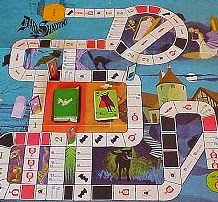
Board Game of the Week: Dark Shadows (Milton Bradley)


Theme Song of the Week: Dark Shadows (1966 - 1971)

Sunday, February 08, 2015

Cult-TV Review: Dark Shadows (1966 - 1971)


When the afternoon soap opera Dark Shadows (1966 – 1971) premiered on ABC TV on June 27, 1966, it was fashioned by creator Dan Curtis as a Gothic Romance (capital “r”) firmly in the tradition of a story like Jane Eyre, or Alfred Hitchcock’s Rebecca (1940).

The series initially concerned a governess, one Victoria Winters (Alexandra Moltke) as she came to the mansion of a secretive but powerful family in Maine, the Collins.


But almost a year later -- in April of 1967 -- everything changed for Dark Shadows.

A new character named Barnabas Collins -- played by Jonathan Frid -- appeared on the series for the first time in episode number 210.  Unlike the other characters in Collinsport, Maine, he was a hundreds-of-years old vampire, a monster.

A door was opened. And once cracked, it could not be closed.

Almost immediately, Dark Shadows’ ratings skyrocketed, and before long the sleepy Northeastern town would be populated by ghosts like Angelique, werewolves, zombies, and even a Dr. Jekyll/Mr. Hyde-styled character. 

Thanks to the inventive conceit of “parallel time,” some episodes of the soap also were set in earlier centuries, in the 1790s, and told of Barnabas’s origin as a vampire, the victim of a witch’s curse. Many cast members played different characters in the past, as well as their familiar characters in the present.


By 1970, Dark Shadows was attracting daily audiences of more than fifteen million viewers, and the production was receiving five thousand fan cards and letters a week. Barnabas, the vampire and outsider, became a beloved character to a young generation countenancing the Vietnam War, sexual revolution, and the Civil Rights Movement.

As the late Frid once noted, youngsters at this time sought a “new morality” and found that cause in common with Barnabas, who was “confused, lost, screwed up, and searching for something.”

A legitimate pop culture phenomenon, Dark Shadows has spawned two mediocre feature films (House of Dark Shadows [1970]; Night of Dark Shadows [1971]), a TV remake in 1991, and the 2012 Tim Burton re-boot starring Johnny Depp.  A Gold Key comic-book was also produced in the 1970s, and twenty-five years after its debut, MPI Home Video sold more than 600,000 Dark Shadows videotapes. Throughout the nineties, the series aired daily (from 11:00 am to noon) on the old Sci-Fi Channel.

The series ran for over 1,200 half-hour episodes, which represents some kind of crazy record.

Today, Dark Shadows remains utterly charming, even though it was produced on a low-budget. The series was shot as live every week day for five years and so actors regularly flub lines, cues are missed, microphones dip into the frame, and the sets look fake, and small. 

Add to that, the pacing is slow and story-lines are dragged on endlessly (a staple of the TV soap opera format, especially in those days…).

And yet the series has…something. It possesses some quality that makes it more intriguing than its individual parts. There is a crazy, almost mad inspiration to some narratives, and Jonathan Frid is a powerful presence and anchor as Barnabas. The end result is a series that seems to giving its no-budget all to entertain. It’s a little bit like William Hartnell Doctor Who (1963 – 1989) in that regard; made on the cheap, but with one embarrassment of riches, in the all-important category of imagination.

Episodes 210 and 211, aired in 1967, and concern the awakening of Barnabas in the 20th century. At Collinswood, the home of the Collins family, a shady character named Willy Loomis (John Karlen) has been asked to leave by matriarch Elizabeth Collins (Joan Bennett). 

But he has been studying the family’s history and believes that a secret tomb nearby may house expensive jewels belonging the long-dead Naomi Collins.

He breaks into the tomb, and as episode 210 ends, discovers a secret chamber, and a coffin within.  The coffin is chained shut.

Willie snaps the chains, and a hand emerges from the coffin to choke him. Barnabas is back!


Episode 211 picks up right there, as Willie disappears and the denizens of Collinwood Mansion wonder if he has left for good.  Instead of being confronted with a departure, however, they are confronted with an unexpected arrival.  A cousin from England, Barnabas has decided to visit.

We don’t see Barnabas’s face in full until he stands next to the historic portrait of Collins’ in the mansion’s entrance-way. It is at that point that the audience understands the two individuals are one in the same.

Penned by Art Wallace and directed by Lela Smith, the first two episodes of the Barnabas era feature very little of Barnabas himself. 

Instead, both stories consist mostly of atmospheric build-up, leading to his return. The pace is incredibly slow, and not much happens.  And yet the production manages to stage some creepily effective shots in stark black-and-white.  The aforementioned composition of Barnabas by his painting is certainly bracing, and in episode 210, there’s also remarkable view of Willie pushing into the Barnabas tomb, his flashlight falling on impenetrable darkness. He opens a door into a nightmare, and the director chooses exactly the right shot to suggest that truth.

Jonathan Frid was always great – dignified and sincere -- as Barnabas, but we don’t get the full impact of his performance until episode 212, in which he grabs the spot-light, and holds it for nearly a half-hour.


I have watched many episodes of Dark Shadows over the years (as well as all of the Ben Cross remake series), but it has always been a true wish of mine to watch all of them; to follow the entire run and get immersed fully in the lore.  I doubt that can happen because I am an author, a teacher, a father, a husband, and a blogger, and I don’t have six-hundred hours to devote to this particular series.  But in my heart, I would like nothing more than to go back, and follow the steps of this classic vampire soap from story to story, moment to moment. 

Experiencing Dark Shadows again, in its black-and-white, atmospheric glory is, to quote the series a little like “coming from one world to [visit] another.”

Monday, October 13, 2014

Ask JKM: The Three Most Important Voices in Horror Television History?


I have been saving this particular “Ask JKM a Question” for the Halloween season for a while, since early summer, if memory serves.  A reader named Jacob writes:

“I read and liked your book Terror Television and I want to ask a question. Who do you think are the three most important creative voices in horror television history and why?  I suspect I know at least one answer, but I would like to read your thoughts about why."


Jacob, first of all, thank you for supporting my work in print. That means a lot to me. And I’m glad you enjoyed Terror Television. I had a great time writing it (all the way back in 1998-1999…).

And secondly, that’s a terrific question.  In terms of quantity and quality, I keep coming up with three names that seem the most significant.

They are (in chronological order):


Rod Serling

Although The Twilight Zone (1959 – 1964) is not strictly a horror series, a significant number of its stories qualify as such, both in terms of subject matter and in presentation. In its stark, crisp black-and-white, The Twilight Zone absolutely set the standard for horror storytelling in a TV format, featuring well-written stories and ones of authentic terror. 

Serling himself wrote (or adapted to television), many of the most horrific tales, from “The Hitch-Hiker” to “The After Hours” (the one about living mannequins in a department store), to “Eye of the Beholder.”  Outside of his own contributions, the series gave the medium pop culture touchstones like Richard Donner’s “Nightmare at 20,000 Feet,” “Living Doll,” the episode about Talky Tiny, and “Come Wander with Me,” about a sinister folk song.

After The Twilight Zone, Serling’s Night Gallery (1969 – 1973) was a straight-up horror series, the first of its kind in color. Although Serling frequently complained about the Jack Laird-produced series, it still holds up well today, and a number of Serling’s stories were produced, including two directed by a young Steven Spielberg, “Eyes” and “Make Me Laugh.” 

Between The Twilight Zone and Night Gallery, we have eight years and over a hundred anthology stories, many in the horror genre, that bear Serling’s distinctive stamp. Serling proved, I believe, that horror on television can be both scary and socially conscious (“Eye of the Beholder,” and “The Monsters are Due on Maple Street,” to name just two), and his work, through first run and syndication, impacted -- and continues to impact -- a world-wide audience.


Dan Curtis

This talent was a writer, producer and director. And at a crucial time in horror television history -- the 1970s -- he proved both prolific and canny in his work. 

Curtis created the ABC series Dark Shadows (1966 – 1971) which aired every weekday afternoon on network television, and coupled monsters such as the vampire or werewolf with the elements of the afternoon soap-opera. The series’ ostensible villain, Barnabas Collins (Jonathan Frid), was both a vampire and an outsider, and became a kind of hero of the counter-culture times (much in the same way that Mr. Spock did.)  If you look at the tortured or angsty vampires of later years (Nick Knight, Angel, the Salvatore Bros.), they all have a clear antecedent in Barnabas.

Beyond Dark Shadows, Curtis produced and directed some of the decade’s greatest and most well-loved TV movies, often teaming with screenwriter and legend Richard Matheson in the process. He served as producer on the original Kolchak TV-movie (a ratings blockbuster), The Night Stalker (1972), and directed its follow-up The Night Strangler (1973). 

Dan Curtis also directed Trilogy of Terror (1975), the TV adaptation of Dracula (1973), and other efforts from roughly the same period (The Norliss Tapes [1973], Scream of the Wolf [1974]) Curse of the Black Widow [1977]).  


It’s amazing to think about, but at the same time the horror genre was experiencing a renaissance in theaters in the 1970s (thanks to Spielberg, Carpenter, Hooper, Friedkin and Craven), Curtis was almost single-handedly accomplishing the same feat with his made-for-television work.


Chris Carter

Like Rod Serling and Dan Curtis, this writer/director/producer created a vast body of genre work that practically defines a decade, in this case, the nineties. Chris Carter wrote more than sixty episodes of his series, The X-Files, including some of the all-time scariest, including “The Host” (with the Fluke Man), and "The List."

And much like Serling, Carter then created a second TV series of high-quality, and rival popularity, Millennium (1996 – 1999), and again, its bread-and-butter was horror.  The X-Files and Millennium have been copied approximately a dozen times at this juncture, with J.J. Abrams’ derivative Fringe even using the tag “fight for the future” (a riff on X-File’s “fight the future”), as the latest example.  Now Carter is poised to bring us a new horror series for our time, The After (2014).

Carter not only excelled at creating horror “monster of the week” stories, but introduced serialized horror stories to television as well, and that format has succeeded to this day with the likes of The Walking Dead.  Put very simply, we would probably not have, today, Fringe, Nowhere Man, Dark Skies, American Gothic, Strange World, Buffy the Vampire Slayer, Angel, Brimstone, Freaky-Links, The Others, Prey, and Sleepwalkers -- to name just a few -- if Chris Carter’s The X-Files had not proven that horror can succeed on network television.

Also, Chris Carter's re-invented classic monsters with new twists, in a time in which horror movies were unpopular, and searching for relevance (the early nineties). Basically, every famous monster you can imagine was re-invented on one of his series. You've got vampires ("Bad Blood,") the invisible man ("Unrequited"), the evil doll ("Chinga"), the werewolf ("Shapes"), the Golem ("Kaddish"), the succubus ("Avatar") and so on. While horror had a recession at the box office, Carter's creations made the genre boom at home.


This list would probably not be complete without a mention of Alfred Hitchcock, who presided over Alfred Hitchcock Presents (1955 - 1966) and The Alfred Hitchcock Hour (1962 - 1965). Both of those series, however, tend to focus on drama that we more closely associate with thrillers than with "pure" horror.  But episodes in both catalogs feature moments of high suspense and tension, for certain. Additionally, Hitchcock's work on those TV series gave rise to one of the most important horror films of all time, 1960's Psycho.

Other important voices in horror television include Richard Matheson, whose work was adapted, as noted, to a number of series, including The Twilight Zone and Ghost Story/Circle of Fear. Similarly, Glen Morgan and James Wong have been important voices for twenty years, writing for The X-Files, Millennium, and The Others.Separately, they have worked on American Horror Story and Intruders.  

Don't forget to send me your questions at Muirbusiness@yahoo.com

40 Years Ago: Howard the Duck (1986)

In 1986, the comic-book adaptation  Howard the Duck  -- executive-produced by George Lucas -- landed in movie theaters with a splat.   The f...