Showing posts with label 1970's. Show all posts

Tuesday, January 22, 2019

Gerry Anderson's UFO: "Identified"


In 1970 (and in America, in 1971), Gerry and Sylvia Anderson presented 26 riveting hour-long live-action episodes of sci-fi television: UFO.

Set in the far-flung, future year of 1980, this beloved cult series involves a multi-national organization, SHADO (Supreme Headquarters Alien Defense Organisation), and its attempts to stop malicious alien incursions on planet Earth.

A splendid example of speculative realism, the series imagines -- again, from  an inception date of the 1969 or so --  a future in which the swinging sixties never ends, so much so that well-established, mature military officers, in 1980, wear radical/punk hair-cuts, and the latest Nehru jacket fashions. 

Modern viewers may find this "futuristic" affectation amusing today, since producers did not imagine the pendulum swing back to conservative fashion and politics in the 1980's, but the series is nonetheless consistent and meticulous in its portrayal of a world in which the swinging 60's becomes the even more swinging 70's and 80's (in terms of fashion, race relation, sexual politics, etc.).

This view of a "progressive" future is coupled with a world in which technological advances explode with great rapidity. Again, however, that explosion is vetted through the context of the Nixon Era. UFO rightly imagines a world in which the computer is ubiquitous, but not the fact that a revolution in "miniaturization" contributes to that ubiquity. So the series is dominated by wall-sized computer panels, with reel-to-reel tapes, and blinking lights.


What remains most intriguing, however, about UFO, may just be its ahead-of-its-time character-touches. The series lead, brilliant portrayed by Ed Bishop, is Commander Ed Straker. He is a driven, workaholic, divorcee. To fight the aliens on Earth, he literally gives up everything and every person in his lie. This does not seem odd to us today, in a world in which the divorce rate has skyrocketed, and technology means that we are never "off" from our jobs. But in 1970, Straker was a new -- and tragic -- brand of hero.

The world of UFO supports the nature of this particular hero. Like the Anderson series that followed it, Space:1999 (1975-1977), UFO imagines a universe of limited resources. During the program's two-dozen or so installments, Straker is constantly at war to get funds for SHADO, since bureaucrats control the purse strings.

Similarly, the aliens themselves, as we learn in the first segment, "Identified," are desperate. While Straker attempts to "harvest" the funds, resources, man-power, and technology to combat his enemy, the enemy is coming to Earth to actually, physically harvest our body parts, to overcome sterility and possible extinction.  This whole idea seems more timely today than it did nearly forty years ago.


"Identified" commences in 1970, as a young Ed Straker, an American Air Force officer barely survives a UFO attack.

Elsewhere, at the same time, a group of British youngsters spy a crashed UFO in the woods, and photograph it. One of the youngsters, however, a girl, is apparently killed, and her body taken by the aliens.


Ten years later, Straker is ensconced as the commander of SHADO, which possesses a base of operations at a movie studio. And the long-ago victim's brother, Carlin, is now an officer in the organization. The various installations of SHADO -- including an orbital satellite, SID, an advanced moonbase, and a submarine/jet combination, Skydiver -- monitor a UFO entering Earth's orbit.

The UFO is shot down by Skydiver, and the alien pilot is recovered from the water. Straker wants to know where the alien is from, who the aliens are, and why they have come to Earth. A medical examination of the pilot provides some troubling answers. The body possesses the organs of Peter Carlin's long-ago dead sister, meaning that the aliens are harvesting humans for transplant surgeries. Straker has the unpleasant task of telling Carlin what finally became of his sister.

"Identified" is a fascinating entrance to the world of UFO, because it accomplishes three tasks in one hour.

First, it introduces the world to the series single-minded lead, Straker. We get a strong sense of the man's mettle, right out the gate. He is serious, dedicated, single-minded, and edgy. He is also, incredibly lonely, and therefore sad.


Secondly, "Identified" introduces the viewer to the many diverse facets of SHADO.  SID is a great and detailed miniature, though Skydiver One does not hold up as well today, perhaps because it is very difficult to get water "right" on miniature sets.

The most fascinating aspect of SHADO's operation, however, is Moonbase. This installation, a precursor to Alpha, is commanded by a woman, Lt. Gay Ellis (Gabrielle Drake), and most of the lead officers are also women. That's a great move for gender equality in terms of the series' imaginings.  On the other hand, these capable, intelligent women also wear form-fitting breakaway space suits, and Lt. Ellis strips-down in one scene. Also, and for no apparent reason, all the women on the Moon wear purple wigs. Stylish and memorable, yes. Practical? I don't see how.


The introduction of the aliens in "Identified" is also fascinating. After an autopsy at HA, Straker speculates about the alien nature and purpose in a riveting, well-acted and written sequence. These extraterrestrial beings are intelligent and highly advanced, but "doomed to extinction" and "driven by circumstance" to take the abundant Earth's resources. Straker realizes the desperation of his enemy, and how it makes them exceedingly dangerous.


Follow-up episodes of UFO focus on alien gambits to acquire more human bodies, or disable SHADO defenses. Other tales, like "A Question of Priorities" and "Confetti-Check A-OK," contend with Straker's personal sacrifices as commander of Earth's last line of defense.

The second episode in the series, "Exposed" adds the final piece of the program's jigsaw puzzle, a young, "action" hero (and dashing lady's man) in the form of Paul Foster (Michael Billington). Foster is a memorable character, but UFO, the series, is all about Straker, a man of iron will and discipline, and a great tragic hero. He makes the series unforgettable, right alongside some of the more mind-bending tales (such as "Timelash,"or "The Long Sleep.")

Saturday, August 11, 2018

Saturday Morning Cult-TV Blogging: Sigmund and the Sea Monsters: "Make Room for Big Daddy"


When they break Big Daddy's shell-o-vision set, Blurp and Slurp decide to run away and move in with Sigmund, who has just been given an old TV set for his club house residence.

When Sigmund's brothers take over the club-house, they play the TV much too loud, earning the ire of the nosy neighbor, old Miss Ettles (Margaret Hamilton). 

In attempt to get rid of Slurp and Blurp, Johnny (Johnny Whitaker) and Scott (Scott Kolden) leave a not for Big Daddy about where to find his sons.  Big Daddy runs the monsters off, but then decides he wants to live in the clubhouse, himself.

Johnny tape records the voice of Sweet Mama, finally, to scare off Big Daddy. 

But more problems arise: Miss Ettles has called the sheriff over the noise from the TV in the clubhouse.


"Make Room for Big Daddy" is a fun episode of Sigmund and the Sea Monsters that, much like other episodes, features the sea monster family more prominently than it does Sigmund. It is clear that the Sea Monsters have become the most popular, and most utilized characters on the series. Here, they set up residence in the Club House to enjoy the television.

Margaret Hamilton guest stars in this episode, and her final scene in the episode sees her coming face to face with Sigmund screaming in terror. Of course, Hamilton is best known for playing a monster, herself. She portrayed the Wicked Witch in The Wizard of Oz (1939).

Otherwise, this story continues the series gag of featuring monster-related TV programs and films. Big Daddy wants to watch a movie called The Godzilla-Father (The Godfather [1972]), and a TV show called The Cod Squad.

Next week: "It's Your Move."

Saturday, August 04, 2018

Saturday Morning Cult-TV Blogging: Sigmund and the Sea Monsters: "Sweet Mama Redecorates"


Things go awry in the Sea Monster family cave when Sweet Mama demands new furniture to spruce the place up, and Big Daddy does not want to pay for replacements. The brothers come up with the idea to steal the furniture from Johnny and Scott's house instead.

The monsters swap Zelda's furniture with their rock furniture, causing a crisis for the human family. Sheriff Bevins is called in to stop the burglaries, but is unable to do so.

Meanwhile, back at the cave, Sweet Mama decides she does not like Zelda's furniture after all, and wants all new rock furniture. A frustrated (and cheap) Big Daddy thus issues the boys an ultimatum. If they pay him 100 clams (the price for new furniture), he will return Zelda's belongings.


"Sweet Mama Redecorates" is a fun episode of this classic Sid and Marty Krofft live-action series though, for the most part, it sidelines the titular character. Sigmund is hardly in this segment at all.  Instead, the focus is largely on the Sea Monsters, and Zelda and Sheriff Bevins have bigger than normal roles as well.

Sigmund's scene sees him expressing sadness at the thieving and bad behavior of his family. "I'd like to resign from the sea monsters, and become a porpoise," he declares.

Otherwise, the episode features some mildly humorous moments, including Zelda's description of the sea monster furniture as "early American rock pile."  

The Sea Monster TV show of the week is a soap opera called "As the Werewolf Turns." And another funny moment sees the monsters trying to figure out what an ironing board is. Big Daddy mistakes it for a bed.

Next week: "Make Room for Big Daddy."

Saturday, July 28, 2018

Saturday Morning Cult-TV Blogging: Sigmund and the Sea Monsters (1973-1975): "The Curfew Shall Ring Tonight"


In “The Curfew Shall Ring Tonight,” Sigmund nearly gets caught by Zelda (Mary Wickes) while eating a sandwich in the kitchen. When the sea monster makes his escape, he also breaks her favorite salad bowl.  Now he must raise enough money to fix it, with the boys’ help.

Meanwhile, at the cave, Water Confright, the Sea Monster news anchor creature, announces on the shellovision that there is a curfew ordered for all local monsters. At the same time, in the human world, a curfew is announced by the sheriff because of “teenage trouble” in the area.

Now the boys and Sigmund must sneak out of the house by night, and go down to the monster cave to acquire Sigmund’s savings of fifty clams, to repair the broken salad bowl.


This episode of Sigmund and the Sea Monsters (1973-1975), at least, doesn’t borrow a plot from The Bugaloos.  Not much more can be said for “The Curfew Shall Ring Tonight” except that Sigmund’s clumsiness again precipitates a misadventure (“Oh, I did it again!” is quickly becoming the titular character’s refrain.). And said misadventure, inevitably takes him, and his human friends, down to the sea caves at Dead Man’s Point for an encounter with the hapless monster family.

There are no new monster suit this weeks, only the some humorous new monster names to chew over. I mentioned Water Confright (Walter Cronkite) above, but we also learn that the monster sheriff of Dead Man’s Point is Sheriff Shrock.

Perhaps the most interesting thing about this episode, and the series overall, is the mirror premising. What happens in the human world is almost always reflected in the tale by what is happening in the monster world. The value of this mirror premising, if it isn’t apparent, is that we see how family fears, and problems, even loves and losses, are all the same, regardless of species differences. Some families may consist of “monsters” to the eye, but be totally recognizable in terms of human foibles and phobias. In a weird way, this is a 1970’s affirmation of diversity. Sigmund’s family may consist of monsters, but they have feelings too, right?

Another truly intriguing aspect of this episode.  The episode seems to be a variation on a poem from 1867, Rose Hartwick Thorpe's "Curfew Must Not Ring Tonight."  That's a remarkably obscure literary reference to be included in a Saturday morning series about sea monsters!

Next week: “Sweet Mama Redecorates.”

Saturday, July 14, 2018

Saturday Morning Cult-TV Blogging: Sigmund and the Sea Monsters: "Monster Rock Festival" (1973)


In "Monster Rock Festival," Sigmund listens regularly to a popular radio show and decides to participate in a new contest to win prize money. The sea monster writes and performs his own song for the show, as "Swinging Sigmund," and to his surprise, wins the contest.

This victory creates two problems for Sigmund, Johnny (Johnny Whittaker) and Scott (Scott Kolden). 

The first problem is that the radio disc jockey wants to meet Sigmund in person, so he can record him singing his song live.  Of course, if the D.J. meets him, that would reveal Sigmund's identity as a sea monster.

Secondly, Sigmund's villainous family wants in on the action, and decides to put on its own (bad) musical show.


This episode of Sigmund and the Sea Monsters (1973 - 1975) feels like a call-back -- or perhaps a left-over teleplay -- from an earlier Sid and Marty Krofft live-action Saturday morning series: The Bugaloos (1970 - 1972).  

As you may recall (hopefully from my blog posts), that cult-TV program involved teenage rock singer/insect people living peacefully in "Tranquility Forest," and facing constant jealousy from Benita Bizarre (Martha Raye). Benita wanted to be a musical star, but didn't have the chops to succeed. Most episodes involved her stealing the songs or talents of the Bugaloos so she could become famous.

In "Monster Rock Festival," the same dynamic exists. Sigmund writes and performs a song that wins a contest, and faces jealousy from the villains of this series: his family.  In fact, this story was actually the plot of The Bugaloos episode "Our Home is Our Hassle," in which the firefly Sparky (Billy Barty) won a radio song-contest sponsored by the Tranquility Forest D.J., Peter Platter.

So if this story feels familiar, there's a good reason. Still, at least this week's plot is a little different from the repetitive Sigmund and the Sea Monsters fare of late, even if it seems ported in from another show.

Next week: "Ghoul School Days."

Thursday, January 25, 2018

Cult-TV Blogging: The Immortal: "Legacy" (October 15, 1970)


Ben Richards (Christopher George) is shot in the shoulder while being pursued by Fletcher’s men in the desert.  He is assisted by a kindly woman, Annie Williams (Susan Howard), a teacher who has been helping a local Mexican boy, Luis (Manuel Padilla). The boy’s grandfather is sick, dying of Typhoid Fever.

Richards, Annie, and Luis head to a remote camp in the mountains, to hide there and tend to Luis’s grandpa. The camp -- the site of an old mine -- is run by a charismatic but dangerous fugitive named Ramos (Mario Alcalde), who refuses to let Richards leave the site to seek help for the old man.

After the old man dies, Richards confronts Ramos, and Annie seeks to adopt Luis. Ramos would rather turn Richards in, than contend with him. Ultimately, he has a change of heart and proves himself a good man.


 “The Legacy” is the episode of The Immortal (1970-1971) -- the fourth after the pilot movie -- that signals the program’s long slide into mediocrity and formulaic storytelling. This episode is the canary in the coal-mine, in other words. In keeping with the (now tired) man-on-the-run format, the series once again finds Richards romancing a beautiful woman, in this case the lovely and kind, Annie. 

The problem is that for the series to follow up with another romantic relationship following Ben’s relationship with Dr. Koster (Rosemary Forsyth) in last week’s (superior) episode, both stories are cheapened.  His connection with Dr. Koster feels a lot less special.

So is Ben Richards just going to love ’em and leave ’em, every darn week?  No woman is more special to him than the last?  As James McLean and I talked about in our podcast about this Fugitive formula, this “different woman in every port” approach may be actually a kind of fantasy for the male viewers.

I should hasten, Annie is a lot like Anne Koster. She is a do-gooder who finds herself instantly attracted to a stranger who is, clearly, keeping secrets.  Yet she automatically trusts him. I think it would have been great if, at some point, the series explained that Ben Richards’ special blood also makes him irresistible to the opposite sex.  Women just throw themselves at his feet.

This episode is also the most dated (thus far) of The Immortal episodes. For example, I understand that Ben is a test driver, but seconds after meeting Annie, he starts driving her pick-up truck.  He does so with a brusque: “Get in. I’ll drive.”  She goes along, asking no questions.  Importantly, Ben doesn’t tell her that he is a test-car driver. He just orders her into her own vehicle, and tells her that he’s in the driver’s seat.  Welcome to the unspoken, unquestioned white male dominance of the 1970’s. If there’s a man and a woman going somewhere, and it’s the woman’s car, the man is still going to drive it. Even if he’s just been shot in the shoulder.

The treatment of the Mexican criminals is slightly better, to one’s relief. Ramos is an interesting, dimensional character in some important ways. He knows that he is a criminal, and that all he will ever be is a criminal. It is too late for him to change. He never had an opportunity to be anything but a criminal. Despite this, he wants something better for young Luis.  He can see that for Luis, a better life is within reach.

And, Ramos is aware of the racial dynamics here too, with Richards carrying the “great white burden,” teaching Luis the so-called “right way” to live. He sarcastically refers to Richards as “The great Anglo-American hero.”  He’s not far wrong, and it’s good that the episode acknowledges this fact.  The episode’s solution to Luis’s situation and future is adoption by Annie. To the show’s credit, it never feels as though this is the answer because she is white, but rather because she truly loves Luis.  She cares deeply for the boy. Since his grandpa is dead, he has no one else.


“The Legacy” is a pretty pedestrian episode of The Immortal. There are still some strong episodes coming up (namely “Man on a Punched Card” and especially “The Queen’s Gambit,”) but one can’t help but feel that the series is losing its battle with a formulaic premise.  The gravity of that premise is pulling down the fine performances, and the action, and making the stories feel less immediate, less individual, even.


Next week: “The Rainbow Butcher.”

Saturday, January 13, 2018

Saturday Morning Cult-TV Blogging: Far Out Space Nuts: "Secrets of the Hexagon" (November 6, 1975)


In “Secrets of the Hexagon,” the space nuts’ lander is broken once more, and Junior (Bob Denver) feels useless because he can’t do anything to help. The lander is out of fuel.

A strange alien named Flam, however, soon appears near Junior, and makes a trade: a useless hexagon device for the lander. Junior accidentally agrees, and must explain to Barney (Chuck McCann) how he has traded away their only ticket back home, to Earth.

Soon, however, the space nuts learn how to operate the Hexagon. It is actually a talking key that leads them to a mysterious lost city, and the strange duplication device housed there.  If Barney and Junior can just reclaim their lander, they can duplicate all the fuel they need to return home.

Unfortunately, Flam stole the hexagon device from two hostile aliens, who wish to reacquire it.


Another week, another ridiculous episode of Sid and Marty Krofft’s 1975 live-action romp, Far Out Space Nuts. “Secrets of the Hexagon” features alien beings who look like humanoid moles, a lost city, and a blooper that reveals just how low-budget the production must have been.

In that blooper, we see Barney and Junior driving their rover vehicle in a circle over the landscape. The camera moves just a little to one side, and the capsule, or lunar lander, is visible behind them. At this point in the story, however, Flam has taken the lander -- it has de-materialized -- and they are going off to the lost city in an effort to recover it. The lunar lander mock-up is moved from its normal position…by about three feet, and just by moving the camera a tiny bit, it is still visible. The sound-stage where the episode was shot must have been tiny!

As usual, the strangeness of the series is evident in this episode. In the lost city, Barney and Junior happen across a cosmic barbershop and pretend to be barbers, so they can put on patches of hair, and masquerade as the space mole people. Miraculously, the gambit works.  But a barbershop on an alien planet? Why do the mole people even stop to get their hair cut in the first place, in a city they know to be abandoned? When they are looking for their missing technology!  ("Oh let's stop here, I need a trim.")

The alien villain of the week is named “Flam” (as in the word “flim flam,), but forget that term, which means confidence game, or swindle.

These old episodes aren’t “flim flam,” but they sure seem to have been made on a wing and a prayer.  

Next week: “Captain Torque, Space Pirate.”


Saturday, January 06, 2018

Saturday Morning Cult-TV Blogging: Far Out Space Nuts: "Dangerous Game" (October 30, 1975)


In “Dangerous Game” a furry alien and an alien female, Solanna, embark on a new hunt, seeking fresh prey. They come upon Barney (Chuck McCann) and Junior (Bob Denver’s) in their lunar lander, and settle on the duo.

The lander sets down in a spaceship grave yard, and the duo learns they have been trapped there “for the games.”

If victorious in this deadly context, they can be returned to Earth.

The duo attempts to escape from the games, and the hunters never waged on prey as stupid as the far out space nuts…


“Dangerous Game” is another sci-fi TV variation of the famous cult-TV standard: The Most Dangerous Game. In stories of this type (or trope) -- seen on Space:1999, The Incredible Hulk, Logan’s Run, Deep Space Nine and other programs -- the series’ protagonists must escape from deadly, technologically advanced hunters.

Here, the alien hunters are particularly distinctive, at least in terms of their visualization. The female, Solanna, possesses a face of glitter, and long, pointed side-burns, much like Space: 1999’s Maya (Catherine Schell). And the male, Lycos, looks very much like a silver-haired Wookie, from the Star Wars universe.

Another trope, the space-graveyard, or “Sargasso Sea,” also gets a work-out in this episode of the Sid and Marty Krofft live-action series. Long-abandoned space-ships (miniatures) are seen on an alien surface.

Some other weird touches: When being threatened by the hunters, the space nuts encounter a weird space distortion, a vortex of some type. To determine what it is Junior and Barney consult their Encyclopedia of Space Disasters. This isn’t likely a tome that America’s space program could have developed, given its knowledge at the time of the space nuts’ accident.

That said, the lander’s passage through the space vortex allows for a ridiculous scene of (chroma-key) weightlessness with the two main actors.

The episode culminates with pie-throwing and other shtick, and then Barney teaching the alien “Space wolves” about poker, though the rules sound more like Star Trek’s Fizzbin.


Next week: “Secrets of the Hexagon.”

Saturday Morning Cult-TV Blogging: Challenge of the Super Friends: "The Final Challenge (November 25, 1978)


In “The Final Challenge,” a space warp sucks the Super Friends and the Legion of Doom into a strange unknown universe. There, Vartu -- the “peaceful” leader of this realm -- wants to put an end to the constant and endless battling that characterizes life on Earth. 

To that end, he arranges a series of deadly challenges for the super-powered foes. These include a labyrinth of death, a lake of terror, a mission to scale an erupting volcano, and a battle with a two-headed serpent.

Ultimately, the Super Friends prove victorious, which means that the members of the Legion of Doom are to be destroyed, dropped into acid.  

The Super Friends realize, however, that even the villains of the Legion of Doom deserve a fair trial.


“The Final Challenge” is another sci-fi TV version of Fredric Brown’s story, “Arena.”  That story, about warring races brought to fight (by aliens) in a place of personal combat, has been adapted by name not only to Star Trek, but to series including The Outer Limits (“Fun and Games”), Space: 1999 (“The Rules of Luton”), Blake’s 7 (“Duel”), Buck Rogers in the 25th Century (“Buck’s Duel to the Death”), and Star Trek: The Next Generation (“The Last Outpost).

Here, the leader of an alternate dimension, Vartu, is tired of the strife created in the conflict between the Hall of Justice and the Legion of Doom, and so arranges a contest which will settle the battle for power once and for all.  


These challenges, intriguingly, are not all won by the heroes. For instance, Black Manta defeats Aquaman, who becomes trapped inside a giant clam. Scarecrow, likewise, defeats Apache Chief, in his particular contest.  This is a nice touch which suggests that the Super Friends are not all-powerful, and do not always win.

The original story, “Arena” ended with one alien race -- the losers in the personal combat -- being destroyed (as promised), but TV often changes this outcome. In Star Trek’s “Arena,” for instance, Captain Kirk demonstrates mercy for the Gorn, and impresses the Metrons with his behavior. A similar outcome is depicted here. The Super Friends reject the rules of the contest, and save their mortal enemies.

Intriguingly, another sci-fi TV cliché also gets a work out in “The Final Challenge.”  Specifically, the “my enemy/my ally” trope is present, which sees protagonists and villains cooperating to reach a mutually beneficial end.  Here, the Super Friends and Legion of Doom members not captured and forced to compete by Vartu work together to find their missing friends. Naturally, the Legion of Doom proves untrustworthy.


Some other intriguing notes regarding this episode include the fact that “The Final Challenge” commences with what I call a “Star Wars shot,” a view of a  large ship passing in front of the screen. 

Also, this installment  continues the general nuttiness of the series’ dialogue, which often suggests that the heroes and villains are all-powerful and all-knowing . Here, someone actually says “let’s search the universes parallel to ours!

That sounds easy, just a quick scan of a couple -- or dozen? -- UNIVERSES…


Next week: “Fairy Tale of Doom.”

Saturday, December 30, 2017

Saturday Morning Cult-TV Blogging: Challenge of the Super Friends: "Conquerors of the Future" (November 18, 1975)


In “Conquerors of the Future,” the Legion of Doom becomes the Legion of Good, vexing the Super Friends. The evil villains perform a number of good deeds, but then execute a trap for our heroes from the Hall of Justice.

Specifically, the Legion travels 10,000 years into the future, and helps an evil barbarian called the “Barlocks” overtake the last vestiges of humanity.  But the Super Friends also travel forward in time, and read from a history book about the Legion of Doom’s plot. Thus, they are able to travel back in time to stop it.


“The Barlocks” of “Conquerors of the Future” are clearly an homage to (or rip-off of, depending on how generous you are) of the Morlocks, the malevolent future race in H.G. Well’s The Time Machine.  In fact, this whole episode is a variation on that oft-told story, with time travelers finding humanity on its last legs, endangered by predators, in a distant future.

This derivative nature seems to be par for the course in this run of Challenge of the Super Friends episodes. A previous episode (“Revenge of Gorilla City”) was a Planet of the Apes (1968) knock-off, and “Swamp of the Living Dead” had Romero-esque overtones (age appropriate, of course.)


Beyond the derivative story, “Conquerors of the Future” features a drawback that many episodes of this series share. The writers have the lead characters announce -- exhaustively -- what they are doing, even as they are doing it. When Superman attacks a mutant spider, for instance, the character intones” My super-strength will stop this futuristic spider!”

Yes, Superman, we can see that!

I can only guess that the constant reinforcement through dialogue of plainly visible and apparent action on screen is a result of this series’ nature as a Saturday morning series. I suppose that children sometimes were looking down at their Cheerios, and not up at the screen, and needed to be filled in on the action. 

But boy, does this approach add to the lameness quotient of the series today.


Next week: “The Final Challenge.”

Saturday, December 23, 2017

Saturday Morning Cult-TV Blogging: Challenge of the Super Friends: "Swamp of the Living Dead" (November 11, 1978)


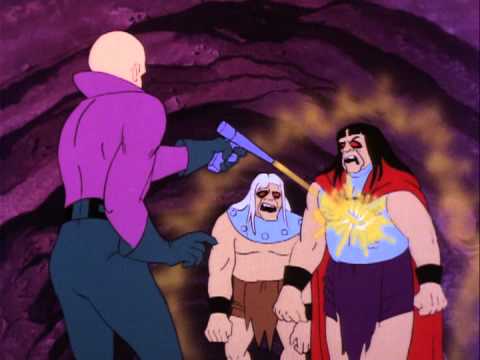
In “Swamp of the Living Dead,” an episode of Hanna-Barbera’s Challenge of the Super Friends (1978), the Legion of Doom negotiates with an old witch in a swamp to possess the greatest powers of all time. A dark force, an Evil Being, promises the Legion of Doom it will comply, but wants the Super Friends in return.

The Legion of Doom sets out to capture and destroy the Super Friends one-at-a-time, setting “super traps” for the heroes.

Before long, the heroes are captured in tubes under the swamp, and gassed into suspended animation.  

While the heroes suffer this “strange fate in the depths of the fathomless bog,” the Legion of Doom inherit from their benefactor -- “The Evil One Who Haunts the Night” -- the ability to raise an army of the living dead.

The Legion of Doom and the zombie army attack the Federal Plutonium Plant, but no one should ever count out the Super Friends.


Challenge of the Super Friends delves into George A. Romero territory in “Swamp of the Living Dead” after, in its previous installment, visiting the Planet of the Apes (Gorilla City!).

In “Swamp of the Living Dead,” the Legion of Doom seeks power from a dark force that happens to inhabit a local swamp.  Why or how this creature -- a kind of floating head -- has come to exist is never explained. The Legion of Doom, however delivers to it the Super Friends, starting with Hawkman, and then Batman and Robin.  The Dynamic Duo end up running the Batmobile into the swamp, and Robin exclaims, “Holy Reckless Driving, Batman!”


The funniest thing about this episode is that the Legion of Doom has never, ever -- in the entire history of the show -- been able to successfully restrain or stop the heroes from the Hall of Justice for any significant duration of time.

But when the dark swamp entity demands the superheroes as a price, the Legion of the Doom promptly captures them all. Maye they should have just quit while they were ahead.

In addition to his reckless driving comment, Roin gets in a quasi-reference to Kolchak at one point: “Holy Night Stalker!”

Next week: "Conquerors of the Future."

Thursday, December 21, 2017

Cult-TV Blogging: Star Maidens: "The Enemy"


In the final episode of Star Maidens (1976), Fulvia (Judy Geeson) and her captives -- Adam (Pierre Brice) and Shem (Gareth Thomas) -- prepare to return to Medusa for the hostage exchange.  

At the same time, Dr. Rudy Schmidt (Christian Quadflieg) and Liz (Lisa Harrow) are being ferried back to Earth by Octavia (Christiane Kruger).

The exchange does not go off quite as planned, however, because of a malevolent third party. The Medusans remember -- from their ancient history in Proxima Centauri -- the presence of alien predators who “fed” on them. Now, a deadly spaceship from that force has arrived in Earth’s solar system, ready to once more interfere in Medusan affairs.

The alien ship attacks, attempting to seize the Medusan shuttles, but Adam and Rudy, on separate ships, launch a counter-attack, something the Medusan females are not willing to do. The counter-attack is successful, and Earth and Medusa have their first triumph together.


“The Enemy” is a fascinating episode of Star Maidens, and a segment that makes one wish for further episodes. Although the episode’s final statement on the war of the sexes is not so strong (which I will talk about below), “The Enemy” nonetheless sets the scene for a larger tapestry, had the second season been produced.

Here, the ancient enemy of Medusa arrives in a menacing-looking spaceship, depicted with a miniature that would have felt right at home in Space: 1999 (1975-1977). We never actually see the enemy. But from their merciless voices, we know that the enemies are all male. We see their uniforms, rotund bodies, and gloved hands, but never their faces.


We are told -- via exposition -- that the Medusans, in their original solar system “were preyed upon” by these aliens.  Apparently, these forces have been searching for Medusa for centuries.  And now the enemy has found both its quarry, and Earth. It would indeed have been fascinating to see how this dynamic altered the series in a second season, but alas it was never to be.

In terms of our final statement about men and women, there is finally no ambiguity about where Star Maidens stands. Adam and Rudy take command of their respective Medusan crafts, and fight back against the aliens. 

Several times, Octavia and Fulvia complain that they don’t know how to fight. So the men, who apparently do, must step up to save the day.  

In light of what we have already seen on the series, including Medusan weaponry and security forces, this plot element doesn’t make much sense. Octavia is a hard-nosed, brutal fighter, and head of Medusan Security. It seems highly unlikely that she would “choke” in battle, especially after detecting that her enemies are males.  Her primary prejudice, as we have seen close up, is that men are weak, inefficient creatures who cannot protect themselves. Hence women must protect them.  That through-line is lost in this final episode.


In terms of science, Star Maidens gets into a little trouble here. “The Enemy” continually confuses the term galaxy with solar system, noting that the bad guys have been chasing Medusa from galaxy to galaxy.  In the 1970’s, these terms were used interchangeably in many series, including in Battlestar Galactica (1978).

As this is the final episode of Star Maidens, I do want to reflect on the series as a whole. In brief: I rather enjoyed it, even if I can make the argument that the series did not always know where it was headed, or what its point about the war of the sexes really was. 


I love the production design from Keith Wilson, and the miniature effects as well.  Some stories, namely “Hideout” and “The End of Time” are really fascinating, and suggest that the makers of the series aimed for more than “high camp.”

And “high camp” is what critics have determined the series is. I can see why, based on some early episodes, but Star Maidens is worth a second-look, if only to better understand science fiction on TV in the 1970’s.

Saturday, December 16, 2017

Saturday Morning Cult-TV Blogging: Far Out Space Nuts: "The Three Spacekateers" (October 9, 1975)


In “The Three Spacekateers,” two alien beings arrive on the planet surface where Barney (Chuck McCann), Junior (Bob Denver) and Honk (Patty Mahoney) are repairing their lunar lander. After meticulously cleaning a faulty Electric Guidance System, Junior manages to get dust in it and damage all Barney's work.

Angry, Barney calls Junior “useless” and Junior runs away, feeling sorry for himself. The next morning, he sees the landing of the alien saucer. These aliens (called Sporians) mistake him from their mission leader, “Junio.”

Junio is supposed to help them capture their female ruler from evil aliens call the Troyax.  Now, they are stuck with Junior, who arranges to invade the Troyax fortress, and distract the evil aliens with a magic show. Barney and Honk help out.

But the real Junio has also arrived on the planet…


It’s a case of comedic mistaken identity this week on Sid and Marty Krofft’s Far Out Space Nuts (1975), as the bumbling Junior is mistaken for an elite trainer of soldiers, the gold-skinned alien Junio. 

Much of the humor in the episode arises from the fact that Junior keeps getting things right, though always completely by accident. For instance, he accidentally leads the aliens to the mountain that houses the enemy fortress. Then, when he arrives there, here accidentally discovers the “ant-gravity” rocks that can carry the team to the summit of the same mountain. He’s a bumbling idiot, but this week, a lucky bumbling idiot.

The evil Troyax this week look like the Gill Man from the classic movie, The Creature from the Black Lagoon (1954), though with some of the fish-elements lessened a bit. They may have been commercial masks from the time, only modified for use here.


In terms of special effects, this episode features many shots of the alien flying saucer flying over the land-scape, and some chroma-key shots to integrate the two Klingon-like aliens into the shot with them. At one point, the footage doesn’t quite match up, as the two humanoids seem to grow inordinately in size.

Finally, the mistaken identity concept breathes new life into an episode with a familiar plot line: Junior and Barney restoring a (female) royal to her throne. One wonders why so many female leaders are being dethroned in this universe, and why only the galaxy’s two worst bumblers can help them get their power  back.


Next week: Flight of the Pippets”

CULT TV FLASHBACK: Dead of Night (1994-1997)

This year, Dead of Night: The Complete Series , was released on Blu-Ray by Vinegar Syndrome , and I just had the pleasure of falling into i...