
 Posts
Posts


In
the season premiere of Lost in Space (1965-1968), season
two, a reckless miner from another world, Nerim (Strother Martin), searches for the valuable
substance “Cosmonium” on Priplanus.
Unfortunately,
Nerim’s lack of attention to safety begins a catastrophic chain reaction. All
of his blasting in the planet’s interior has caused an irreversible problem. In just twelve-to-fifteen hours, the planet
will explode.
The
Robinsons work desperately against the clock, making final preparations to lift
off and leave their home.
Dr.
Smith (Jonathan Harris), unfortunately, has different plans.
He wants to possess Nerim’s valuable
Cosmonium, and gambles for it in a card game with the miner, using a crucial thruster
unit from the Jupiter 2 as collateral.
The thruster is lost to Nerim, and he
promptly flees the doomed world, leaving the Robinson family behind.
As
the planet nears total destruction, the Cosmonium causes a statue of Dr. Smith
to come to malevolent life, and other perils threaten the family too.
Finally,
the Jupiter 2 leaves Priplanus with all hands aboard, just as the world is
destroyed.
But now the ship is on a collision course with a red dwarf!


The
first thing to note about Lost in Space season two, perhaps,
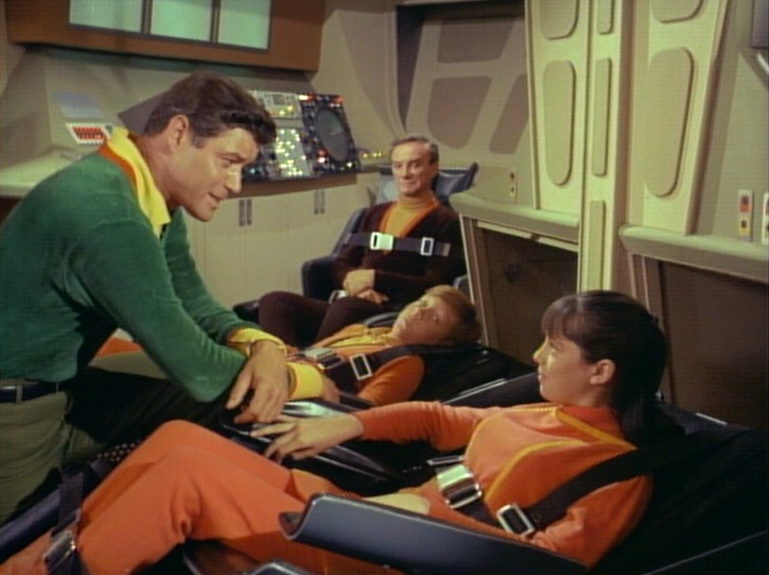
is that the series looks fantastic in color.
More than ever, the series resembles a lushly-colored, vividly illustrated and highly-imaginative fantasy comic strip. The Chariot, the rocket pack, and the Jupiter 2 exteriors
and interiors all look fantastic outside of the first year’s black-and-white
photography. The Robinsons' clothing is kind of garish in color, but also visually striking.


But
beyond the shock of the new -- of seeing Lost in Space in color after 29
episodes in b&w -- there’s simply not much to commend this premiere episode, “Blast
Off into Space.”
Indeed,
all the creative problems that came to hobble the series late in the first year (in the
run between “The Challenge” and “Lost Civilization,” in particular) return in
force to impact the storytelling here.
First and foremost of these problems is
the pervasive earth-centric thinking.
In “Blast
Off into Space,” for example, we meet Nerim the miner.
But he is presented here like a late 19th century miner (of the
Old West) rather than as an alien or futuristic miner.
He is accompanied by a mule, uses a pick-axe,
and wears and Old West wardrobe. He is a creature of the past, not of the space age, or of an alien culture. There is no imagination, in other words, in his depiction.

Once
more, the question is, simply, how did the equivalent of a 19th
century Earth miner arise as a citizen of another planet?
And how come he can travel from planet to
planet, but the Robinsons can’t? To our
eyes, they’re all human beings. So why
doesn’t Nerim help the Robinsons, or allow them to join the galactic culture?
Secondly,
“Blast Off into Space” is predicated almost entirely on the idea of Dr. Smith
getting into trouble, and acting badly.
Again.
He gambles away a critical thruster unit.
He creates a statue of himself that comes to life when
he accidentally spills Cosmonium on it.
He
tries to partner up with Nerim, leaving the Robinsons behind to their fate.
By now, we expect Smith to be greedy, cowardly and
buffoonish, but it is tiresome that Smith’s behavior is always the entrance
point into the narrative, the thing which creates stories. It would be much more interesting, from a dramatic stand-point, to have the Robinsons discover the planet's instability.


Thirdly,
“Blast Off into Space” has little regard for series history.
The Jupiter 2 escapes from doomed Priplanus,
but there is no mention of the fact that thousands of aliens in a subterranean
world (including a child princess…) will die when the planet crumbles.
In “The Lost Civilization,” we met the princess
and saw her soldiers frozen in suspended animation tubes. We met her major domo (Royal Dano).
No notation is given here about any of them, but if
Priplanus dies…they all die, right?
It
would have been great to have Will exclaim “The Princess!” at one point, just
to remind us that Priplanus was populated by humanoids other than the
Robinsons.
What
“Blast Off into Space” adds to the Lost in Space creative equation, perhaps, is
a kind of frenetic approach to action. The episode never settles down or lingers in one place, or with one plot-line for long. Between the action and special effects pyrotechnics, the episode is stunning in the visual sense.


For example, we get a
weird anti-gravity chute in a mine, an attack by a creepy monster, a search (by
John Robinson) of the planet in the air, and a last-minute escape by the
Jupiter 2, and other set-pieces. These moments don’t all gel together, but the surfeit of action means that the episode is, at
least, never dull.
The
story ends with promise, with the Robinsons unshackled from planet-bound
adventures, and free to roam space.
But I have an unhappy suspicion that this
will turn out to be more potential unfulfilled.
Next
up (in two weeks): “Wild Adventure.”


