Showing posts with label Space 1999. Show all posts

Monday, September 08, 2025

Attention All Sections Alpha: Space:1999 Turns 50!


Approximately fifty years ago, in September of 1975 -- shortly before I turned six -- I sat down in front of a color TV, turned on WPIX New York, and a TV show blew my mind.

Seriously.

I was watching a new science fiction series, called Space:1999, and, no exaggeration, it changed my life. It was a series that I not only loved as a child, a teenager, and as an adult, but as a writer, it transformed my career. 

My very first book was a non-fiction book guide to the series. My first magazine sale was a retrospective of the series.  And in 2002 and 2014, I wrote officially licensed novels or new adventures in the 1999 universe, representing my first fiction sale. 

My love of the series introduced me to a creative mentor, friend and collaborator in the late, great script-writer Johnny Byrne, and I have made so many new friends and talented colleagues because of Space:1999.  Musicians. Writers. Model-makers. Filmakers. Podcast and video-makers.

But in the beginning was the series itself.

Here was a program that felt different from Star Trek (1966-1969) and Lost in Space (1965-1968), and at least to me, it seemed incredibly real; incredibly possible.  

Say what you will, but Space:1999 was my sci-fi show, for my era, in the 1970s.

Half a century later, with the year 1999 far behind us, Space:1999 still feels that way to me, and this week, I'll be celebrating the series as it celebrates this milestone and anniversary.

I always say that the year 1999 need not be an expiration date, and that this Gerry and Sylvia Anderson series from the disco decade still has much to share with audiences about ourselves, about humanity.  

Those people who compile internet list insisting that its age makes the series unwatchable? Let's just say they suffer a paucity of imagination, understanding of context, and lack of appreciation for the tenets of filmmaking.
 
As I see it, Space: 1999 was constructed upon the following six creative pillars and philosophical underpinnings.  

These half-a-dozen ideas represent the identity of the original 1970s program, and keep it vibrant after all these years and decades. 


1. Technology is a double-edged sword. 


While technology permits for the Alphans to sustain themselves on the moon (and in deep space), and the wonderfully versatile Eagles permit for landings on planets that could represent a new home, technology is not a cure-all in the Space: 1999 universe.  

On the contrary, technological solutions to problems (like atomic waste on the moon), cause the "Breakaway" catastrophe in the first place.  

And in episodes such as "Space Brain" and "The Troubled Spirit," technological solutions to crises are often proven to be flawed.

A nuclear charge-carrying Eagle (mysteriously) can't return to Alpha when it is on a collision course with a cosmic intelligence in the former episode, and in the latter episode, a scientific "exorcism" of a ghost is the very thing that creates a haunting on the lunar base in the first instance.

In large part, this conceit of technology as a double-edged sword is what distinguishes the Space: 1999 universe from the Star Trek universe.  In Star Trek, "Technology Unchained" has made the Federation a paradise. Without the need to worry about survival issues like hunger and poverty, man has turned, particularly in the 24th century, towards "enriching" himself, not his pocketbook.   

Writing in Science Digest all the way back in 1975, editor Arielle Emmett wrote that Space: 1999 concerned the "downfall of technological man."  That's the template,  "Earthbound" is a perfect example of this idea well-executed. It showcases the glorious potential and horrors of advanced suspended animation in a most chilling fashion.

As we are developing new technologies, new medicines, new weapons and new media at a prodigious rate right now, this facet of the original series remains timely. 

Do our tools make us more human, or less human?  Do our tools connect us or isolate us?  Do we control our machines, or do they control us?

2.  Outer Space is Terrifying and Mysterious.  It isn't a Cosmic United Nations.

Many popular "outer space" franchises, from Star Trek to Farscape to Andromeda  have featured recurring alien villains.  We all know their names: the Klingons, the Peacekeepers, the Nietzscheans, the Ferengi, the Borg and so on.  Communication is possible with all these species, and the galaxy is like a cosmic U.N., with different countries separated by the vast cosmic ocean of outer space. You can radio back to headquarters (Earth) via a sub-space radio, and there is no time dilation at all.

Not so in Space: 1999, the original series. 

There, outer space was a realm of mystery and terror and awe.  I'm reminded of Taylor's lyrical description of deep space in Planet of the Apes: "Time bends. Space is...boundless. It squashes a man's ego. I feel lonely."  

Those sentences perfectly describe the established Space: 1999 aesthetic.  

Another way of putting it, the original Star Trek had a rule for prospective writers that they should not get lost in "the bigness of it all" in terms of outer space.  

In Space: 1999, the bigness of it all is the very point of the drama. 

It's important to remember that on Space: 1999 the errant moon was moving through alien star systems, on an unplanned course, never to return, so there were not recurring enemies to battle.  This makes it more challenging, I suppose, in terms of drama: you don't have a regular villain to fall back on.  But the idea was also rewarding, each episode offered new horizons.  Space: 1999 wasn't pinned to an increasingly complex alien-based continuity where you had to say, "but a Ferengi would never do that!"

There was a logical reason for this approach in terms of the structure of Space: 1999. The Alphans had few resources and fewer weapons on their cosmic odyssey. Thus they were never in a position to combat a continuing enemy like the Borg or the Klingons.  

Indeed, Moonbase Alpha might -- with luck and ingenuity -- survive one engagement with a militant alien empire, but it would never have survived if the Sidons, the Dorcons or other villains had kept hammering at it, week after week. The base was too fragile for that, its life support systems too precarious, its defenses too "primitive."  

Again, this goes right back to the late Martin Landau's (correct) assertion back in the 1970s that Space: 1999 was less "macho" than Star Trek.  Star Trek was about peaceful contact with aliens in a universe of plenty, but also about gunboat diplomacy. The Enterprise had phaser banks to make certain the crew was safe, and the Federation was protected. By contrast, Space: 1999 was about a Darwinian universe where survival was the overriding issue, and this was distinctly a battle for limited resources.

We saw many aliens in Space: 1999 who attempted to steal the Alphan resources ("The Beta Cloud" and "Bringers of Wonder" to name two episodes), and the series obsessed on matters of survival. One character, in an episode called "Dorzak" said that the battle for survival "makes monsters of us all." Yet another episode, "The  Exiles" saw characters debating survival explicitly.  

Is it more important that you simply survive, or how you choose to survive?"

Johnny Byrne's "Mission of the Darians" looked at a disaster on an alien spaceship where the crew turned to cannibalism because there was no uncontaminated food remaining. The series hero, John Koenig was asked if he would have turned to the same grisly solution if that crisis had occurred on Alpha. 

Rather pointedly, he didn't answer.

3. Mankind in Space: 1999 is technologically and psychologically unprepared for the mysteries of deep space, and when he countenances those mysteries, it is his human nature which will either hand him defeat, or bring him to victory. The scientists and astronauts of Moonbase Alpha were not examples of evolved, idealized, romanticized mankind, but us -- contemporary man -- in space, replete with all our flaws, emotions, paranoia, fears and hopes. 

Frequently in Space: 1999, a mistake by the Alphans was the very thing that led into the adventure of the week.  They tampered in alien justice in "End of Eternity." They investigated and opened up orbiting cryo-chambers in "The Exiles."  

Humans are curious, and that can be a strength, but it can also be a weakness.

The story "Collision Course" depicted beautifully how man is psychologically and technologically unprepared for life in space.  An alien from an advanced race, Arra (Margaret Leighton), informs Commander Koenig that he must permit the moon to collide with her colossal world. In this case, she claims, it will trigger some kind of evolutionary metamorphosis, but that Alpha will survive the event.  That's a lot to "believe in," but Koenig discovers that he trusts Arra.  He's made a human judgment about her.

Back on Alpha, however, his team can't get on board with this idea of letting the collision occur and it goes around Koenig's authority to attempt to avoid disaster with mines deployed in space.  

What is the superior value in this instance? Trust in science? Or trust in a person?  Do we depend on what we know, or what we feel?

I'm not drawing any universal conclusions regarding that idea, but Space: 1999 meditated on the notion that in deep space, the "laws" of the universe might not be exactly exist as we understand them now, from our perch on Earth.  Instead, man is going to be asked to take -- now and again -- a "leap of faith."  

Some men and women will be equipped to do so, some will not. This creates tension amongst the Alphans.

Now, Space: 1999 has been accused of being anti-science, and this is so because the series suggests that:

a.) technology is not always the answer, and... 

b.) that the laws of science as we understand them in the here-and -now may not apply, exactly, in the far corners of space and time. In Space: 1999, man must puzzle his way through answers, based not on techno-babble, but on a combination of technology, psychology, philosophy and even spiritualism.  

4. The Alphans are the new kids on the block, literally.  I once compared the original universe in Space: 1999 to a classroom. It's a crucible from which the Alphans -- having escaped from a dying, politically-destructive Earth -- learn about themselves and their role in space.  

You'll notice that in no episode of Space: 1999 do the Alphans encounter a race that is less advanced than they were, at least in terms of technology (unless you count 13th century Earth in "Journey to Where," or the Alphans themselves, as cavemen, in "Full Circle.")

Instead, the Alphans universally countenanced super-advanced aliens that believe they have life "licked," so-to-speak, and are apparently far more advanced. But these aliens, almost universally have lost  or sacrificed some important aspect of humanity.  

The Zennites of "Missing Link" have emphasized science over emotion, and have forgotten how to feel.  

The Sidons of "Voyager's Return" champion their  legalisms over moral solutions to their problems, thus embracing vengeance under the auspices of "law."  

The aliens of "War Games" have created a world with no fear...and yet they fear the presence of the Alphans on their world.  Planet of the Hypocrites.

In "Guardian of Piri," the Alphans discover an extinct race, the Pirians, that gave up physical labor and "work" and destroyed themselves through lassitude and luxury.

Again and again, the Alphans gaze at alien worlds in the series, and find that while some of those societies possess glorious aspects, they also showcase an absence of something important; the very things the Alphans cherish most in themselves, as human beings.  

Space:1999's late story editor, Johnny Byrne always told me that the Alphans would be successful, ultimately, in their space quest, and they would achieve success by accepting their limitations and potential as a species. Their humanity -- warts and all -- is their greatest gift. 

5. Horror Mythology. If you look across the catalog of Space: 1999 episodes, you begin to detect that many episodes actually had more in common with the original The Outer Limits than Star Trek. This is because the horror genre -- particularly the Gothic -- played a considerable role in Space: 1999. Various episodes resurrected and updated famous horror tropes.  

I've written about this in length in a post here.  

In short, Space: 1999 in 1975 and 1976 gave us outer space, high-tech variations of  The Premature Burial ("Earthbound), the Siren ("Guardian of Piri"), the Midas Touch ("Force of Life,") the Midwich Cuckoos ("Alpha Child"), Dr. Jekyll and Mr. Hyde ("Full Circle), Faust ("End of Eternity"), Ghosts ("The Troubled Spirit"), St. George vs. The Dragon ("Dragon's Domain"), The Picture of Dorian Gray ("The Exiles") and even the zombie ("All That Glisters.")  

You'll notice that some of these tales arise from ancient mythology (the siren, the Midas Touch, namely), and others come from more recent mythology, 19th and early 20th century literature.  

Johnny Byrne once informed me that his idea for "Another Time, Another Place" came from a mythology built around a church in Ireland.

He told me: "One hundred yards up the road from the house where I grew up was this little church with a fantastic reputation.  We heard that if you walked around the church sun-wise (clockwise) three times, you'd meet yourself coming out.  That kind of legend was the core of "Another Time, Another Place."  Our mythology is filled with situations in which a person stumbles into a mist and then emerges 300 years later or some such thing. So I constructed a story around the experience of my upbringing."


6. Mind-blowing Visual Distinction. In terms of visualization, Space: 1999 was a series that took ambitious, even crazy risks on a regular basis, and was never afraid to fail.  

There were occasional visual failures (the soap suds of "Space Brain," one of my favorite episodes), of course, but also radically new environments featured on the series.  

Who can forget the bizarre but mind-blowing surface of planet Piri in "Guardian of Piri?"  

We saw, in Space: 1999 worlds of soft fabrics glowing mists and hard-edged nightmares ("Missing Link,"), diamond-like, jeweled mirrors ("Seed of Destruction"), vast computer/man interfaces ("War Games," "The Infernal Machine"), an anti-matter world of crimson skies ("Matter of Life and Death"), an underground alcove of spheroid "bouncing" probes ("AB Chrysalis"), and much more.  

In some sense, Space: 1999 was really about allowing the imagination to run wild -- with very little control or barrier terms of scientific rationalization or explanationFarscape was truly brilliant in this regard as well, showing us colorful worlds of tremendous ingenuity and visual invention.

these are my thoughts on what Space: 1999  as we celebrate its fiftieth birthday. These are the values I see played out, across the catalog of 48 episodes.  These are the reasons I enjoy the series after a half-century.  

Other fans have other reasons, I should hasten to add.  I'm not trying to speak for anyone else, or for any agenda. This is just my interpretation of a work of art that inspired me (and, incidentally, began my writing career).

Tuesday, May 06, 2025

Space 1999 This Episode - The Infernal Machine


I had the great pleasure of being a guest on the Space:1999 "This Episode" podcast to discuss the Year One episode "The Infernal Machine" with co-hosts Roy and Warren.  

We spent a little over 90 minutes really digging in, so I hope you enjoy it!


Sunday, September 13, 2015

Breakaway Day 2015: Space:1999 Year Two Introduction


After its first season, big changes were in the offing for Gerry Anderson's space epic, Space:1999 (1975 - 1977). 

Fred Freiberger, late of Star Trek's third season, came aboard the series as producer, and ushered in a regime of dramatic re-vamps and re-thinks. To this day, those changes remain the source of great controversy. 

Most importantly, Year Two of Space:1999 was to offer an enhanced sense of pace and "humanity." Action and color were thus the order of the day, and those two qualities are the ones most dramatically reflected in the season's introductory montage, featured for this installment of  Outré Intro.

As the montage commences, we see two brightly-colored planets looming in space, moving towards us, even while a cluster of stars is visible in the frame's lower quadrant. 

Notably, the alien worlds are bright and colorful in contrasting ways, blue and pink. The color enhances their strange-ness, but also suggests the visual dynamism that Freiberger sought in the re-tooled series. The white-on-white trademark minimalism of Year One was to be a thing of the past.


Next, a space age "teletype" spells out the premise of Space:1999, beginning with the location of a planetary disaster.  

We see an Eagle fly over Moonbase Alpha, and then we learn of the catastrophic specifics of the disaster. 

A "massive nuclear explosion" has occurred, the moon is "torn out of Earth's orbit" and the natural satellite is "hurled into outer space."

Note that all these images -- accompanied by Derek Wadsworth's (1939 - 2008) exciting, driving new theme -- expressly feature movement.  We see an  Eagle fly towards the camera. We see a bundling of colorful, expanding explosions. aAd then we see the Moon moving from its orbit, into what appears to be a coruscating space warp or vortex.

All these images suggest motion, and accelerating action. Similarly, the brevity of the teletype "message" suggests not only an emergency transmission, perhaps from Alpha itself, regarding the catastrophe, but the new season's intended sense of crisp clarity.


The camera keeps moving in the next image.

We pan quickly across a row of high-tech computers, and the words "RED ALERT" (in all caps) flash dynamically, super-imposed over the space age equipment. This image again stresses movement (the camera pan), color (the flashing words), and the sense of adventurous urgency.

The impressions is that we are in the midst of an emergency, with no time to stop, and excitement is building.


Next, we meet our cast, and once more, they are introduced in action-packed poses.  

Martin Landau, playing Commander Koenig, spins around in his seat in Command Center, whirls around, stands-up, and fires his laser. 

Secondly, we meet Dr. Helena Russell (Barbara Bain), walking urgently through a Moonbase corridor, after leaving the Life Support Unit.

If you contrast these views of the lead actors with their Year One montage "static" poses, the difference in approaches is all the more apparent.  The Year Two meme, once more, is action and color.

These qualities are further high-lighted with the title card that practically lunges onto the screen, right to left. 

This is (the new) Space:1999.


The next order of business for the montage is adding a new and unusual character, Maya the metamorph. 

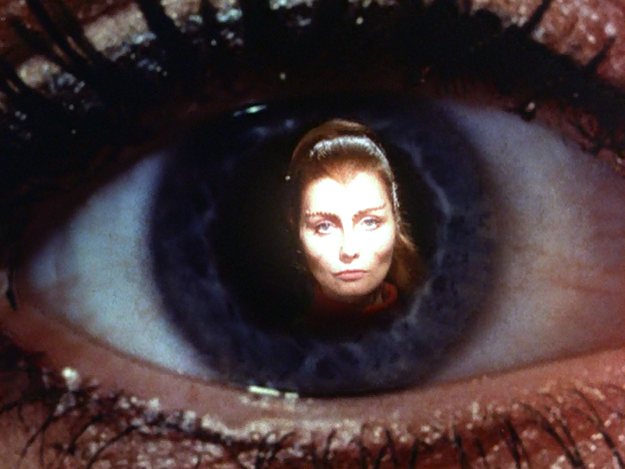
We move in on Maya's eyeball, and see the different animals she can turn into, including a dog, a bird and a tiger. 

Next we see Maya in her humanoid form, and get the title card introducing Catherine Schell.

These images, while rapid-fire and action-packed, are there primarily to convey crucial information about Maya so that her nature and capabilities can be understood before the audience even begins to watch an episode.  

This part of the intro thus sells a character concept. Incidentally, it was the concept of Maya -- a shape-shifter -- that got the series renewed for a second year.


Finally, we get Gerry Anderson's title card, next to a shoot of a slowly-spinning moon, home base for the series.  After all the action, all the movement and all the color, we close with a view of sanctuary, safety, and, essentially family.  The moon is home.


Although I like and enjoy Year Two (and especially Catherine Schell's portrayal of Maya) very much, I have always preferred the more philosophical, more thoughtful Year One of Space: 1999.  

Yet even with that bias in mind, it is indeed impressive how adeptly (and quickly...) this Year Two introductory montage "sells" the series in its new format.  

The exciting music, the colorful visuals, and the near-constant motion -- as well as the surreal ingenuity of the Maya "eyeball" imagery -- really express the nature of Space: 1999 Year Two well. The montage says, in essence, space just got a whole lot more exciting, and dynamic.

Impressively, the montage manages to present the mood, the set-up, and the new character of Maya in just under 45 seconds.  Love or hate Year Two, the imagery is effective.

It would be great to see this intro restored in high definition, on Blu-Ray, and we haven't long to wait!


Wednesday, September 09, 2015

Breakaway Day 2015: Space:1999 Annuals


Breakaway Day 2015: Space:1999: "Guardian of Piri"


In “Guardian of Piri,” Earth’s traveling Moon encounters a new and strange world, which Victor Bergman (Barry Morse) mysteriously designates “Piri” during a command conference.

Unfortunately, every attempt to gather more information about Piri seems to go awry, and Computer provides a steady stream of inaccurate or confusing information about it. When an Eagle mission to the planet is believed lost, its crew assumed dead, Alan Carter (Nick Tate) is furious, blaming the tragedy on Computer because the pilots believed what “the lousy computer told them to believe.”

Before long, Alpha’s computer begins to make catastrophic errors regarding the base’s internal operation too. Professor Bergman faints after Computer recalibrates the oxygen in the base’s air-supply, without heed.  Later, another Alphan, Sarah Graham, dies when Computer stops a blood-transfusion in mid-operation.

Commander Koenig (Martin Landau) believes that David Kano (Clifton Jones), head of Computer Section can help determine why the machine has gone “haywire.”  Several years earlier, David undertook a dangerous experiment to link computer memory with the human brain, and now he and Koenig believe this link-up might help pinpoint the problem. Instead a force spirits Kano away from Alpha when link-up is made.

Koenig travels to Piri in an Eagle, and sees that the Eagle pilots and Kano have become mindless drones on the strange planetary surface. He encounters a beautiful woman (Catherine Schell), who identifies herself as the Servant of the Guardian of Piri, and reports that her purpose is to take “transient, imperfect” human life and render it “perfect.”  She also reports that the Guardian has stopped time, because absolute perfection is eternal.

Koenig objects, noting that the Pirian Way is not the human way. But back on Alpha, Dr. Helena Russell (Barbara Bain) and the others are already preparing for Operation Exodus, and a permanent re-settlement on the planet…


In blunt terms, “Guardian of Piri” is a story about the ways that technology and automation can be dehumanizing influences. 

Space: 1999 writer Johnny Byrne told me during an interview that the Gerry and Sylvia Anderson series grapples explicitly with the notion that technology is a double or two-edged sword. Technology gives us something, but also takes away something else. Johnny was talking, specifically, about “Matter of Life and Death” when we had this discussion, but he could have been discussing Christopher Penfold’s visually dynamic and thematically resonant “Guardian of Piri” as well.

“Guardian of Piri” has fascinating origins in Greek Myth. In Homer’s The Odyssey, Odysseus was desperately attempting to return home to Ithaca following the Trojan War, but along the way encountered the sirens. 

These inhuman beings had a tantalizing call, one both irresistible and sexual in nature. Odysseus had himself tied to the mast by his crew so he could hear the song, but not heed the call. That’s how powerful the siren song proved to be.


In “Guardian of Piri,” the Guardian and its servant are created very much in the fashion of the mythical sirens, drawing the Alphans and even Computer to the planet surface.Yet importantly, in this case their song is not overtly sexual (though the episode’s final act features strong sexual overtones...), but rather technological in nature. Specifically, Piri promises a paradise in which machines will tend to every human need, and humans will be left to their leisure. Even the day-to-day matters of “sustenance” will not interfere with human pleasure, as Helena asserts at one juncture. 

What makes all that pleasure possible is the toil and custodianship of the Guardian.

Uniquely, “Guardian of Piri” suggests a continuum in term of dependence on technology (specifically machines or computers).  The Alphans represent an early but still dangerous point on that particularly graph.  

They “believe what the lousy computer” tells them to believe, and thus nearly lose an Eagle crew.  

Similarly Koenig notes that there are simply not enough personnel to run the base on manual control.  The Alphans are overseers of their technology, but they cannot regulate every function on Moonbase Alpha. Sarah Graham dies because her blood transfusion -- considered a routine computer-controlled process --went unobserved by human eyes.  “I am not a computer,” Dr. Mathias (Anton Phillips) declares angrily, and his suggestion is that Medical Section is unmanageable without Computer’s custodianship of it. 

Koenig starts to suspect that this dependence on Computer, while necessary, is having ill-effects. “That computer seems to be telling us exactly what we want to hear,” he observes correctly.  Indeed it is, because the computer has heard the song of Piri and is now in thrall to the siren...the Guardian.

The Pirians meanwhile, stand at a later point on the same continuum, or more aptly, its end point. 

The Servant explains to Koenig how the Pirians were people of “great skill” and how they built machines to run everything. Then they constructed the Guardian to oversee their machines to save them “from decision.”  

The (ostensibly humanoid) Pirians thus abandoned every responsibility they had, even those pesky matters of day-to-day sustenance, in favor of pleasure. But a people that didn’t build anything, didn’t exert themselves, and couldn’t be bothered, even, to feed themselves became...apathetic. In the end, as Koenig realizes, they died.  They could not thrive in a computer’s idea of paradise.

Late in the story, Koenig stumble on the antidote to this mind-numbing apathy: pain. He punches a monitor in Main Mission and cuts his hand. The Servant offers to heal it for him but he objects: Leave me with my pain. It reminds me I’m human.” Then he descends to Piri and puts Helena through shock treatment to rouse her from her trance of apathy.  The message seems to be that some amount of suffering, or pain (the opposite of pleasure) is necessary if human civilization is to thrive.


One of the most fascinating aspects of “Guardian of Piri” involves the episode’s ending. By destroying the “moment of perfection” created by the Guardian, the Alphans actually restore natural (rather than machine life) to the planet’s surface. They were brought there, essentially, to die in a computer's vision of perfect bliss.  Instead, they upended the machine’s vision and imposed a sense of order more in keeping with human biology. Too bad, as Koenig says, that they didn’t stay.   

As I noted in my book, Exploring Space:1999, several episodes of the series involve the Alphans acting as catalysts, bringing new life or resurrecting dead life on alien worlds. In addition to their catalyzing actions in "Guardian of Piri," the Alphans help Arra to evolve in "Collision Course," and bring the seeds of life to Arkadia in "Testament of Arkadia," 

Beyond the plot line, which suggests a futuristic siren call and a computerized version of paradise, “Guardian of Piri” thrives on its amazing and uncanny visuals.  


In all of science fiction television history, there has never been another world that looks like Piri.  It is unique. The planet’s surface is a strange, technological forest atop a rocky plateau. In the forest, the trees seem to be wrapped in wires bundles instead of organic vines, and instead of leaves, there are giant mechanical white bulbs everywhere. his set was built in miniature and in live-action proportions, and remains, as noted above, absolutely singular in appearance.  

As one Alphan notes, the planet is a “weirdy.”  But an unforgettable weirdy.

This episode always reminds me why I admire Space: 1999 to such a degree.  Its visual presentation is downright stunning, and often incredibly original. Spectacular is probably the right word. And this episode gives us the spectacular Catherine Schell as well, strolling among the strange wiry trees of Piri, suggesting a distant world both alluring…and utterly alien.

Saturday, February 22, 2014

Now Available: Space:1999: The Whispering Sea (2014)


My new book, the officially-licensed Space:1999 novel The Whispering Sea (Powys; 2014), is now available.  You can purchase it at this link. 

The book is my first venture into the Year Two series continuity, and serves as a "bridge" between the episodes "The Metamorph" and "The Exiles." The story explains how the shape-shifting Psychon, Maya (Catherine Schell), went from being a refugee and alien on Moonbase Alpha, to its resident science officer.

Seriously, this book was so much fun to write, and if you're a Space:1999 fan, I hope first that you purchase it, and second that you enjoy the hell out of it.

Monday, September 16, 2013

Television and Cinema Verities #86


"I never thought of Maya as a role model, perhaps because in my life I have never been held back from doing something just because I am a woman.  I'm thrilled that she is seen by many as a role model, but I did not intend it that way.  Perhaps because Maya was an alien, she was allowed to do more than 'human' women were at the time."

- Catherine Schell discusses Maya as role model, in an interview in my book, Exploring Space:1999 (1997), page 92.

Friday, August 30, 2013

Back to Frank Black Interviews Barbara Bain


I just want to direct all Mission: Impossible, Space:1999 and Millennium fans to the latest podcast from the good folks at Back to Frank Black.  James McLean and Troy Foreman have conducted a brilliant,  wide-ranging hour+ interview with three-time Emmy Award winner Barbara Bain.

The interview discusses Ms. Bain's impressive career in detail, but also -- delightfully -- reveals her great sense of humor.  She is an absolute pleasure to listen to, and fans of Cinnamon Carter and Dr. Helena Russell should definitely check this out.  As a Space 1999-admirer, I loved listening to Ms. Bain's reminiscences of London, Bray Studios, Main Mission, and the Great Strike in the 1970s.

The link is here

Wednesday, July 17, 2013

Lunch Box of the Week: Space:1999


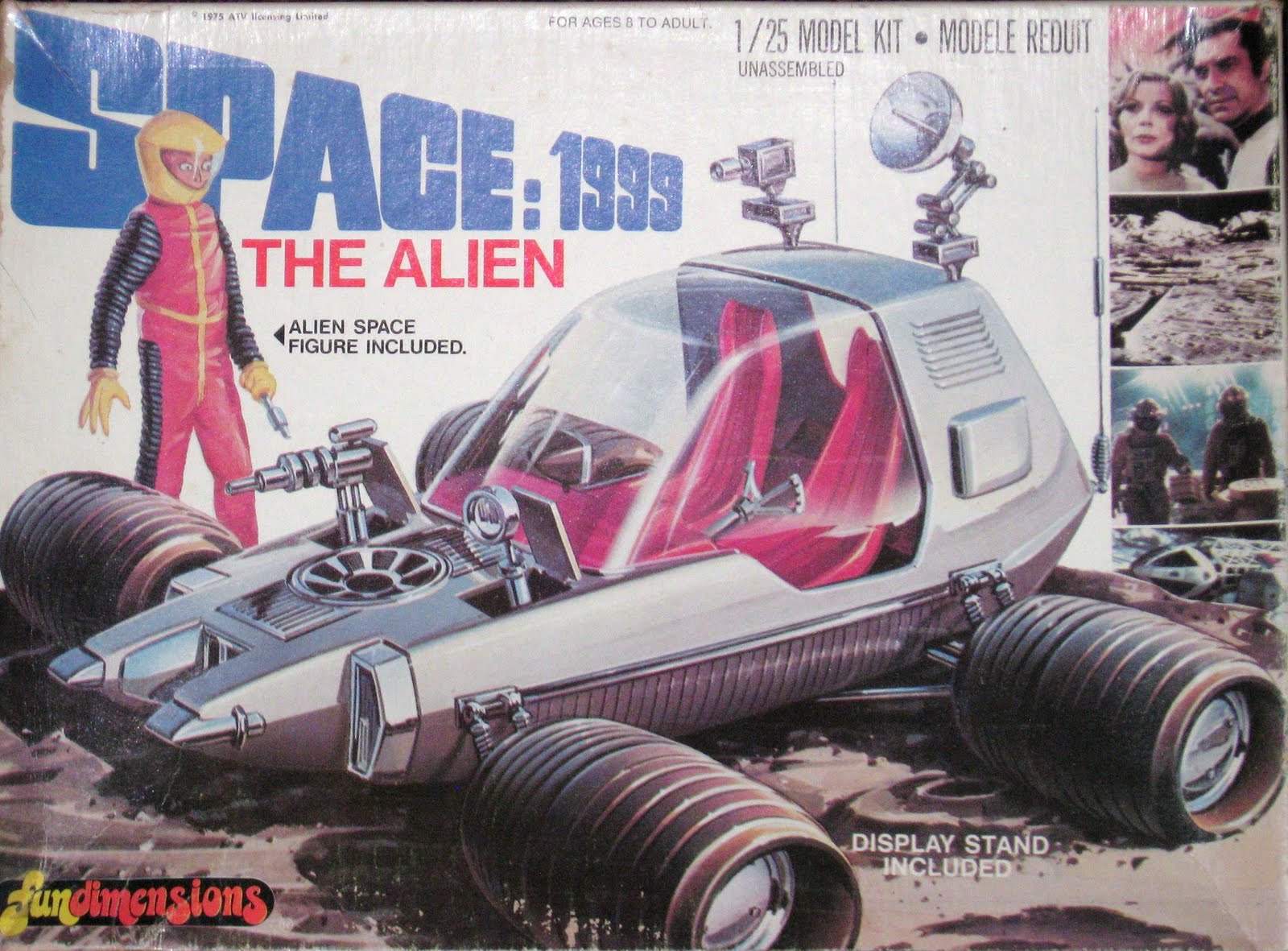
Model Kits of the Week: Space:1999 Edition


Wednesday, April 03, 2013

Collectible of the Week: Space:1999 Flying Eagle (VertiBird/Mattel; 1976)


The year 1976 brought a number of great toys related to the Gerry and Sylvia Anderson outer space series, Space: 1999 (1975 - 1977).  One of the rarest and most valuable of such toys is the Space:1999 Flying Eagle or "VertiBird."'

Like many VertiBird toys (and there were also editions for Battlestar Galactica [1978], and -- apparently -- Megaforce [1982]), the Flying Eagle toy consists of a central column and a small control panel that controls speed and altitude.  Hanging from the top of the central column is a long arm which holds up a craft, in this case an Eagle (with a propeller on the dorsal spine).  By adjusting the controls, you could fly your Eagle Transporter in a circle, take-off, and land.

On the box, the legend reads: "Space Age flying fun indoors and out."  And the advertisements promised a "compact operational version of TV's Space:1999 vehicle...You pilot tight maneuvers, sky-lift a moon buggy," etc.

The Space:1999 Flying Eagle came with a light mast, capsule, moon buggy, plus labels.  I had the toy and I can also attest that it came with a Kaldorian space ship from the episode "Earthbound" (guest-starring Christopher Lee).  The Light mast is a show-accurate representation of a lighting tower seen inside Moonbase Alpha's Eagle hanger.  You can see the photos of my Flying Eagle accouterments below.


Alas, these are that I still have left of the toy.  

The central column and Eagle itself are long gone.  As a child of about ten, I think, I attempted to do surgery on the Eagle Transporter by removing it from the arm, and breaking off the propeller.  I wanted it to look more accurate, I guess, as a spaceship.  As you might guess, the operation was not a success.  Today, the Flying Eagle buggy and Kaldorian ship dock at my Cardboard Amsco Moonbase Alpha Play Set.

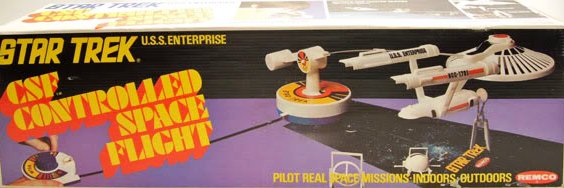
Similarly, I also distinctly remember getting for one Christmas a Star Trek-styled VertiBird knock-off.  In this case, it was called "CSF" or Controlled Space Flight (from Remco).  There, you could control the flight of the U.S.S. Enterprise, and the unsightly propeller was lodged in the underside of the saucer section.


Wednesday, February 06, 2013

Pop Art: (Toy) Eagle Edition


40 Years Ago: Howard the Duck (1986)

In 1986, the comic-book adaptation  Howard the Duck  -- executive-produced by George Lucas -- landed in movie theaters with a splat.   The f...