Showing posts with label Space: 1999. Show all posts

Saturday, February 28, 2026

50 Years Ago on WPIX: Space:1999 "Earthbound"


In “Earthbound,” Commissioner Simmonds (Roy Dotrice) complains in a Command Conference about the Alphans’ direction for the future.  

He wants to know why there has been no discussion -- and no concrete plans – for a return to Earth.  

Commander Koenig (Martin Landau) counters that a return to Earth is impossible and that the Alphans are, rightly, focusing on two primary goals: survival, and a new place to call home.

Simmonds is not placated.

Before long, Alpha detects a powered object -- an alien spaceship – approaching the moon.  

Rather than going into orbit, however, it crashes on the lunar surface.  Aboard an Eagle, Koenig, Professor Victor Bergman (Barry Morse) and Dr. Helena Russell (Barbara Bain) investigate the vehicle.  They force entry, and find several humanoid aliens in suspended animation in transparent sleep cubicles.

The Alphans inadvertently kill one of the aliens when they tamper with a sleep cubicle, an act which awakes the others, including Captain Zantor (Christopher Lee).  

Zantor shows no malice regarding the accident, and introduces his people, the Kaldorians.  They are the last survivors of a world that has grown sterile, and they are traveling to Earth where they hope to be welcomed as friends. 

Their journey, they report, will take seventy five years.

With one of their number dead, Zantor offers the vacant slot on his ship to an Alphan of the Commander's choosing.  Accordingly, Dr. Russell begins to study the suspended animation process while Koenig instructs Computer to pick one Alphan to return home to Earth. 

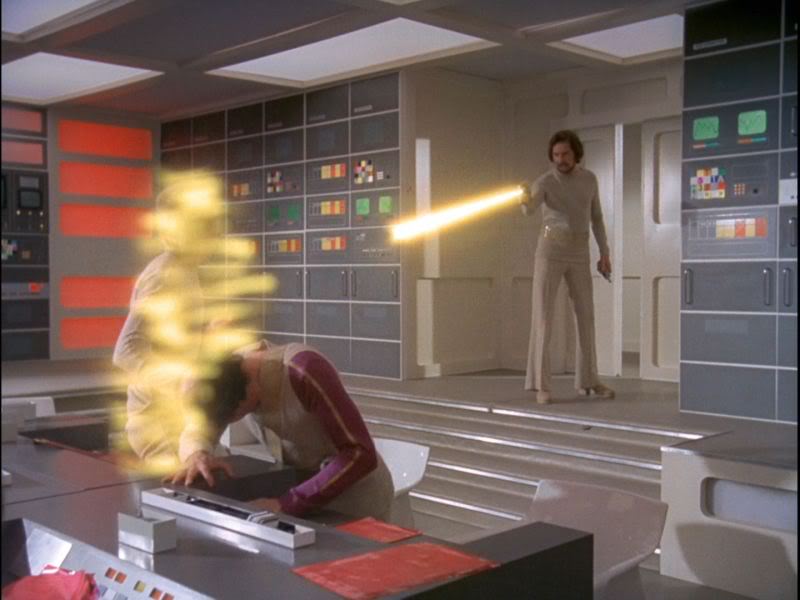
Simmonds wants Koenig to choose him, but Koenig refuses, noting that the choice must be objective. Simmonds refuses to accept that answer. He attacks Alpha’s power station and holds the base captive. 

Koenig realizes he has no choice but to let Simmonds return to Earth with the Kaldorians. 

But Simmonds has not allowed Zantor time to prepare a proper physiological matrix for him, meaning that the suspended animation process does not work correctly.  Simmonds learns this the hard way very soon into the 75 year journey.


One aspect of Space: 1999 (1975 – 1977) that I resolutely admire is the fact that many stories often re-purpose famous literary horror devices or narratives. There’s a valid thematic reason for this, too. The series’ heroes, the Alphans, are not prepared psychologically or technologically for a deep space journey.  They don’t understand the nature of the galaxy; they are not experienced. Outer space is not a place, necessarily for brotherhood among aliens.  It is a realm of mystery.

Accordingly, the Alphans often encounter beings and phenomena that we would term terrifying. 

Not always, of course. Some stories deal with wonder or awe, the other side of the equation.  

But a good number of stories, especially in Year One, contend with horror-based ideas, like the monster in “Dragon’s Domain,” a man with the Midas Touch (“Force of Life,”) ghosts (“The Troubled Spirit”), and even sadism and torture (“End of Eternity”).

“Earthbound,” a very strong early entry in the canon functions on a similar principle.

In particular, it pivots off a key element in Edgar Allen Poe’s (1809-1849) short story: The Premature Burial (1844).  In Poe’s time, a pervasive cultural fear, in fact, was being buried alive. Poe's tale involved a character obsessed -- wracked with fear, in fact -- regarding this fate. He took many steps to prevent such an outcome, and yet (it appeared, anyway...) that it was all for naught.


Intriguingly, “Earthbound,” takes that fear of being buried alive – of being trapped, unable to escape, in a casket -- and updates it for the space age. 

Here, Commissioner Simmonds fails to take the necessary precautions before entering a suspended animation chamber, and awakens only a short-time in on a seventy-five year flight.  All the other people on the ship -- Zantor and the Kaldorians -- are sound asleep and therefore oblivious to his desperate cries for help.  

And because the cubicle is transparent, we are able to watch Simmonds’ panic grow and grow, as he repeatedly throws himself against the unbreakable walls of the sleep cubicle  Finally he is left screaming, defeated, with no way to escape his premature burial.

Surrounding this climactic set-piece, “Earthbound” features some of the sharpest, and in a way, cruelest plotting in the entire series.  

Koenig orders the Computer to pick one name among the Alphans; one person who the base can reasonably spare if it is to continue to function.  Since Simmonds is not really a member of the base personnel, he is the natural choice to go. 

But Simmonds refuses to let “chance” (or, presumably, a machine) dictate his fate, and takes steps to assure that he goes home.  

Alas, the irregular manner of his methods -- blackmail, hostages, gunpoint diplomacy, etc. -- assure that he will not be adequately prepared for the voyage.  He does not trust Zantor, and doesn’t give him time to prepare a  biological matrix.  So he will go home…but he will never, in fact, see home.

At the end of the episode, the other shoe drops. 

Helena asks Koenig who Computer ultimately chose to return to Earth.  In one of the series’ greatest, most chill-inducing codas, Alpha's commander answers.  With one word.

“Simmonds.”

Landau’s delivery is great here. It is deadpan and straight-forward, imbued not with too much or too little emotion. It’s a simple declaration, and Landau's delivery allows the viewer take in the information for him or herself; to realize the full ramifications without spoon-feeding or hand-wringing.

In short, “Earthbound” represents Space: 1999 at the top of its game. 

Outside of the horror trope re-purposed for the near future, and the chilling, Twilight Zone-worthy twist or denouement, we also get examples of the Alphans at their best here. The Kaldorians are treated as friends and allies, not as monsters or enemies.  

A common criticism of the series is that the Alphans are always “menaced” by advanced aliens. Clearly, that’s not the case in “Earthbound.” If anything, the Alphans here are menaced by human nature; by Simmond’s selfishness and cut-throat determination. As Paul Morrow (Prentis Hancock) trenchantly notes at one point, the Alphans are better off without Simmonds.

And yet, as bad as Simmonds is, the Alphans clearly don’t wish for him to endure the horrible fate of being prematurely buried. Accordingly, the episode presents a three-dimensional depiction of the Alphans.  They know how flawed Simmonds is, and yet, as fellow human beings, they can still empathize with his predicament, and grim fate.


 “Earthbound” is notable, too, for the performance by the iconic Christopher Lee. Here, he is not Dracula, or even a villain with a golden gun. On Space: 1999, by contrast, he plays a regal and reasonable alien, a being who doesn’t permit the passions of the moment to alter his beliefs or actions. Lee is quite imposing as Zantor, especially in his first scenes, wherein we don’t yet know what he will do, or who he is.  

But Lee remains a fascinating presence right through his last appearance in the episode in part because he keeps the character’s motivations opaque. 

In the last scene, for example, Zantor could help Simmonds by telling him he needs to prepare a matrix. Instead, he behaves according to Simmonds demands...and keeps his mouth shut.  He makes a choice not to help a man he considers “diseased.”  

Is this murder, or merely an adherence to the logic of the moment?  

It is very likely that even if Zantor warned Simmonds about the necessity of a matrix, Simmonds wouldn’t believe him.  Hence, the same fate would result.  

But I love how ambiguous the moment is, in terms of Zantor's decision-making and feelings. He is "alien" in a true sense, I guess, and that's an intriguing touch.

The episode features some other welcome visual touches too, The Kaldorians arrive on Alpha bearing a gift: ceremonial gold eggs belonging to a life-form called a “libra bird.” Eggs, of course, represent fertility and re-birth.  And the Kaldorians are seeking their re-birth on Earth. In a way, they have already been reborn on Alpha, awaking from the deep slumber that has characterized their journey.

I should also note that I enjoy “Earthbound” because it remembers the basic premise of the series; that the Alphans are, essentially, us in space. They are men of the 21st century, with our flaws and foibles, not romanticized figures of perfection and “evolved” natures.

Here the Alphans accidentally kill a Kaldorian while attempting to open a sleep bay. It is a mistake, of course, but a bad one. Yet when you put human nature together with the unknown, such things may happen, even if the humans -- Koenig, Bergman and Helena -- have the best of intentions. 

If Zantor represents an alien mind-set, Space:1999 again presents us a look at fallible human nature too.

Sunday, February 22, 2026

50 Years Ago on WPIX: Space:1999 "The Full Circle"


The reconnaissance team on Eagle 6 has not reported back from the forested planet of Retha. 

Commander Koenig (Martin Landau) orders Paul Morrow (Prentis Hancock) to retrieve the craft by remote control.  When the ship is explored at Moonbase Alpha, a primitive cave-man is discovered dead in the passenger module. He is the ship's only occupant.

Koenig orders a full-scale rescue mission to the planet, unaware that a mysterious mist found on the planet surface is actually a time warp of sorts.  

When the Alphans step through the fog, they are re-made as primitive cave-people. As a primitive man, Koenig becomes Cave Chief, while Helena Russell becomes the tribal healer, and the Chief’s consort.

Unaware of what has happened to her fellow Alphans, data analyst Sandra Benes (Zienia Merton) encounters several cave people, who capture her and bring her back to the cave.  There, a primitive hunter (Oliver Cotton) and the Cave Chief battle for ownership of the beautiful and strange female in their midst.

On Alpha, Dr. Mathias (Anton Phillips) solves the alien riddle during an autopsy.  The caveman in the Eagle has caps on his teeth.  

He is one of the Alphans, not an inhabitant of Retha…


“The Full Circle” is likely not one of the better-regarded episodes of Space: 1999’s (1975-1977) Year One.  And yet, it is an episode that I like very much, and for two key reasons.  

First, the episode is set mostly in natural, real environs, and that fact gives the story a remarkable boost in terms of visuals and excitement.  The planet Retha is a combination of Black Park and Pinewood Studios back-lot exterior locations, and the contrast between sterile, technological Moonbase Alpha and such natural, wild locales is remarkable.

You could not recreate the “primordial” look and feel of Retha on an interior sound-stage, using papier mache rocks, nor, truthfully, by using a familiar So Cal location.  

To American eyes, therefore, “The Full Circle” looks genuinely like a journey to the prehistoric era, to a wild, untamed world. Director Bob Kellett’s camera-work is also remarkable, especially during the pursuit of Sandra by the cave-man Alphans.


Secondly, the episode’s thematic framework works very successfully. Specifically, "The Full Circle" ponders the (unchanging?) nature of humanity. It compares turn-of-the-millennium, space-age Alphans to Stone Age counterparts, and finds few meaningful differences.  

To wit: Sandra Benes (Zienia Merton) nearly bludgeons Commander Koenig (as cave man) to death with a rock. And Alan Carter (Nick Tate) literally goes “cave-man,” vengeful and hungry for blood when he worries that Sandra has been injured. These are the acts of rational, modern human beings?

As the episode’s coda suggests, the narrative is really about basic human emotions, about human instincts.  Sandra still acts by fight-or-flight dictates, for example, and this means that she is not far removed, in terms of nature, from the Cave Chief who -- in a manner very unlike Commander Koenig -- desires her.

As Koenig notes “it was only us there,” and the point is made. 

In 40,000 years, according to the episode’s timeline, man has not really evolved beyond savagery, beyond jealousy, rage, and other primitive emotions.  Those things still drive us, sometimes to survival, sometimes to disaster.


One scene suggests the similarities visually.  

At around the half-way point of the episode, we meet Alan, Victor and Kano huddled around a camp-fire, getting ready to turn in for the night. 

In the very next scene, we see the interior of the tribe’s cave, where a camp-fire is also at the center of the population, at the center of civilization.  The costumes have changed -- from Rudi Gernreich 1999 chic to primitive furs -- but man has not. He still needs fire. He still huddles with his fellow humans in the dark.  And he still doesn’t understand all the mysteries of nature, and the universe.


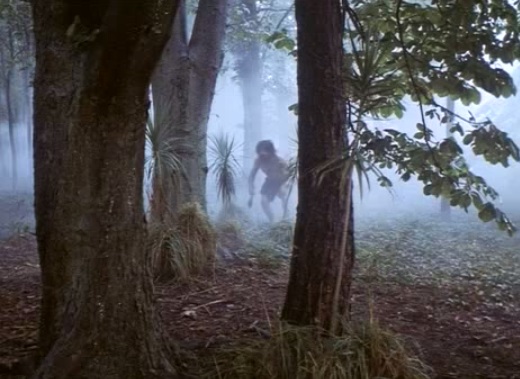
Where “The Full Circle” vexes some critics and viewers, I suppose, is in the story mechanism that makes the comparison between primitive man and space age man possible.  Here, a swirling mist is a time warp that changes Koenig, Helena and other Alphans from civilized to primitive. Even their clothes change with them.


The time warp mist is a solid device for making the story’s point, but leaves a lot of questions unanswered.  

How do the Alphan’s change costumes in the mist?  How does the time warp achieve that end? Does all the mist on the planet act in this fashion, or only in this one spot?  Is the time warp naturally occurring, a function of “nature” on Retha, or is it something that was designed by unseen inhabitants?

Personally, it doesn’t bother me that Space: 1999 fails to address such questions. I prefer to speculate, and have always felt that the time warp is some device or entity left behind the planet’s inhabitants.  

Perhaps they created it because they foresaw the end of their race, and wanted to go back to the beginning...get a second chance. Or perhaps they left it behind on Retha to preserve the planet’s natural, unspoiled nature. Any visitors would lose the capacity to alter the planet’s climate or terrain if reverted to primitive form. 

In the end, the details don’t really matter a whole lot, and it is what “The Full Circle” states about human nature that is valuable, and memorable. When you combine that statement with the beautiful location work, the episode emerges as one that is less disposable, and far more intriguing. Barry Gray's score is also one of his most unusual contributions, and underlines the action brilliantly.

Also, as is the case in many Year One stories (and “Earthbound’s” coda is an example), “The Full Circle” gains interest and suspense from a twist in the tale.  

It is learned, late in the story, that the cave-man in Eagle 6 is actually an Alphan. Specifically, he has caps on his teeth.  This information changes the whole nature of the story on the first watch.  Before this reveal, it is a natural assumption that the Alphans have encountered a world of primitive man.  

In fact, as Mathias's discovery suggests, they have encountered only themselves at a different stage of development.  

That twist is a surprising one, and like the device of the misty time-warp, makes the final point about humanity’s unchanging nature, all the more powerful.

Thursday, September 10, 2015

Breakaway Day 2015: Space:1999: "The Full Circle" (1975)


The reconnaissance team on Eagle 6 has not reported back from the forested planet of Retha. 

Commander Koenig (Martin Landau) orders Paul Morrow (Prentis Hancock) to retrieve the craft by remote control.  When the ship is explored at Moonbase Alpha, a primitive cave-man is discovered dead in the passenger module. He is the ship's only occupant.

Koenig orders a full-scale rescue mission to the planet, unaware that a mysterious mist found on the planet surface is actually a time warp of sorts.  

When the Alphans step through the fog, they are re-made as primitive cave-people. As a primitive man, Koenig becomes Cave Chief, while Helena Russell becomes the tribal healer, and the Chief’s consort.

Unaware of what has happened to her fellow Alphans, data analyst Sandra Benes (Zienia Merton) encounters several cave people, who capture her and bring her back to the cave.  There, a primitive hunter (Oliver Cotton) and the Cave Chief battle for ownership of the beautiful and strange female in their midst.

On Alpha, Dr. Mathias (Anton Phillips) solves the alien riddle during an autopsy.  The caveman in the Eagle has caps on his teeth.  

He is one of the Alphans, not an inhabitant of Retha…


“The Full Circle” is likely not one of the better-regarded episodes of Space: 1999’s (1975-1977) Year One.  And yet, it is an episode that I like very much, and for two key reasons. 

First, the episode is set mostly in natural, real environs, and that fact gives the story a remarkable boost in terms of visuals and excitement.  The planet Retha is a combination of Black Park and Pinewood Studios back-lot exterior locations, and the contrast between sterile, technological Moonbase Alpha and such natural, wild locales is remarkable.

You could not recreate the “primordial” look and feel of Retha on an interior sound-stage, using papier mache rocks, nor, truthfully, by using a familiar So Cal location.  

To American eyes, therefore, “The Full Circle” looks genuinely like a journey to the prehistoric era, to a wild, untamed world.  Director Bob Kellett’s camera-work is also remarkable, especially during the pursuit of Sandra by the cave-man Alphans.


Secondly, the episode’s thematic framework works very successfully. Specifically, "The Full Circle" ponders the (unchanging?) nature of humanity. It compares turn-of-the-millennium, space-age Alphans to Stone Age counterparts, and finds few meaningful differences.  

To wit: Sandra Benes (Zienia Merton) nearly bludgeons Commander Koenig (as cave man) to death with a rock.  And Alan Carter (Nick Tate) literally goes “cave-man,” vengeful and hungry for blood when he worries that Sandra has been injured. These are the acts of rational, modern human beings?

As the episode’s coda suggests, the narrative is really about basic human emotions, about human instincts.  Sandra still acts by fight-or-flight dictates, for example, and this means that she is not far removed, in terms of nature, from the Cave Chief who -- in a manner very unlike Commander Koenig -- desires her.

As Koenig notes “it was only us there,” and the point is made. In 40,000 years, according to the episode’s timeline, man has not really evolved beyond savagery, beyond jealousy, rage, and other primitive emotions.  Those things still drive us, sometimes to survival, sometimes to disaster.


One scene suggests the similarities visually.  

At around the half-way point of the episode, we meet Alan, Victor and Kano huddled around a camp-fire, getting ready to turn in for the night. 

In the very next scene, we see the interior of the tribe’s cave, where a camp-fire is also at the center of the population, at the center of civilization.  The costumes have changed -- from Rudi Gernreich 1999 chic to primitive furs -- but man has not.  He still needs fire. He still huddles with his fellow humans in the dark.  And he still doesn’t understand all the mysteries of nature, and the universe.


Where “The Full Circle” vexes some critics and viewers, I suppose, is in the story mechanism that makes the comparison between primitive man and space age man possible.  Here, a swirling mist is a time warp that changes Koenig, Helena and other Alphans from civilized to primitive. Even their clothes change with them.


The time warp mist is a solid device for making the story’s point, but leaves a lot of questions unanswered.  

How do the Alphan’s change costumes in the mist?  How does the time warp achieve that end? Does all the mist on the planet act in this fashion, or only in this one spot?  Is the time warp naturally occurring, a function of “nature” on Retha, or is it something that was designed by unseen inhabitants?

Personally, it doesn’t bother me that Space: 1999 fails to address such questions. I prefer to speculate, and have always felt that the time warp is some device or entity left behind the planet’s inhabitants.  

Perhaps they created it because they foresaw the end of their race, and wanted to go back to the beginning...get a second chance. Or perhaps they left it behind on Retha to preserve the planet’s natural, unspoiled nature.  Any visitors would lose the capacity to alter the planet’s climate or terrain if reverted to primitive form.

In the end, the details don’t really matter a whole lot, and it is what “The Full Circle” states about human nature that is valuable, and memorable.  When you combine that statement with the beautiful location work, the episode emerges as one that is less disposable, and far more intriguing.  Barry Gray's score is also one of his most unusual contributions, and underlines the action brilliantly.

Also, as is the case in many Year One stories (and “Earthbound’s” coda is an example), “The Full Circle” gains interest and suspense from a twist in the tale.  

It is learned, late in the story, that the cave-man in Eagle 6 is actually an Alphan.  Specifically, he has caps on his teeth.  This information changes the whole nature of the story on the first watch.  Before this reveal, it is a natural assumption that the Alphans have encountered a world of primitive man.  

In fact, as Mathias's discovery suggests, they have encountered only themselves at a different stage of development.  That twist is a surprising one, and like the device of the misty time-warp, makes the final point about humanity’s unchanging nature, all the more powerful.

Wednesday, September 09, 2015

Breakaway Day 2015: Happy 40th Anniversary to Space:1999 (1975 - 1977)


Every year on the blog, I celebrate Breakaway Day: the occasion (September 13), in Space: 1999 (1975-1977) lore that the Moon -- and the inhabitants of Moonbase Alpha -- are blasted out of Earth’s orbit.

But this is a special year. 

Space: 1999 turns forty this year, which is hard for me to believe, let alone accept.

Of course, one might look at the year “1999” in the series title, and then consider the age of the production, and wonder why Space: 1999 is worth celebrating. 


The answer is simple: 1999 is not an expiration date because the ideas, human and genre-oriented, explored in Space: 1999 continue to hold currency in our culture.

Indeed, many episodes have more social currency today than they did in 1975. The series visuals, in terms of production design and special effects, continue to hold up remarkably well, but the ideas have never, in my opinion, looked better, or carried more value.


So to celebrate Space: 1999’s special Breakaway Day this year, I’ll be starting today, on September 9th, and going right through September 13th

September 9th, actually, is an important day in series lore too.  It is the day that Commander Koenig (Martin Landau) assumes command of Moonbase Alpha.

Today through the 13th then, I’ll be posting new episode reviews (“Earthbound, “The Full Circle,” “The Metamorph”), showcasing new collectibles, and also re-posting Space: 1999 articles from years past. 

I hope you enjoy the show, and I hope you join me wishing Space: 1999 a happy fortieth anniversary.

Friday, September 12, 2014

Breakaway Day 2014: Visualizing Space: 1999


"Space: 1999" had a style, a feel, a look of its own." - Martin Landau (Lee Goldberg. Starlog: "Martin Landau Space-Age Hero." July 1986, page 45).

"...Space:1999 is like Star Trek shot full of methedrine.  It is the most flashy, gorgeous sci-fi trip ever to appear on TV.  Watching it each week is very close to being under the influence of a consciousness altering drug. - Benjamin Stein. The Wall Street Journal: "Sailing Along on a Moon-Base Way."


Though TV reviewers were often quick to criticize the storylines on Gerry and Sylvia Anderson's Space: 1999, most nonetheless agreed that the visualizations of this classic series were unimpeachable. 

For example, TV/Radio columnist Charlie Hanna termed the sci-fi program a "visual feast," and The New York Times critic John J. O'Connor noted that the "visual lavishness is apparent from the dazzling array of electronic gadgets and hardware to the "moon city" costumes designed by Rudi Gerneich."

I can add my own testimony to this effusive praise.  When I initially watched Space:1999 back in 1975, I was certain that this was indeed what the future would look like.  It just seemed right and appropriate that by the year 1999 we'd all be able to communicate across mini-tv screens thanks to devices such as the useful commlock.  And, of course, furniture and interior decoration would be immaculate, minimalist, and stream-lined by the eve of the 21st century, right?

Okay. It didn't quite turn out that way, but you can't convince me that it shouldn't have turned out that way. The sets  for Space: 1999 were created by production designer Keith Wilson, and the exterior miniatures by special effects director Brian Johnson. In both cases, these gentlemen did extraordinary work.  In short, they accomplished three critical things:


First, they created believable technology with one foot in the future and one in the present. 

In Space:1999, for instance, you'll see control rooms, nuclear generating plants, and high-tech medical units, but at the same time, you can note characters reading books, adjusting thermostats in their crew quarters, and even tanning themselves in a solarium ("Force of Life.") 

In practice, this is quite an extraordinary combination.  Despite the clean, minimal lines of Moonbase Alpha construction, crew quarters boast a sense of individuality and recognizable humanity ("Matter of Life and Death."), Areas of heavy use such as laboratories, as seen in "Breakaway" and "Voyager's Return," are cluttered and over-crowded.  In other words -- despite the immaculate white conception of Moonbase Alpha -- man will be man, even in the future. He will use the "space" on the Moon in just the way he does here on Earth; and that way isn't always clean and austere...or even neat.  Victor Bergman's laboratory is another example of this design approach.


Secondly, the designers of Space:1999 didn't skimp on a sense of scope.

This means that the vistas and views of Moonbase Alpha appeared more legitimately cinematic and impressive than virtually any other sci-fi series sets in history up to 1978 including Star Trek, wherein the Enterprise bridge famously did not include a ceiling.  

The control center of Moonbase Alpha, Main Mission, is a perfect example of this aesthetic.  It is a vast, two-story affair replete with a ledge and observation area, as well as a kind of mission control pit where analysts toil on a regular basis.  Attached to Main Mission -- with a wall as a huge sliding door -- is the Commander's office.  For privacy, Commander Koenig can shut the door to Main Mission.  In cases of emergency, he can open the door, and his desk overlooks the Big Screen and his workers.   

What must be noted about this is that both Main Mission and the Commander's office are vast.   The two (joined) sets present the appearance of a real life, sprawling complex.

Scope is sometimes achieved other ways on the series as well.  Miniatures do the trick to convey passage on the useful Travel Tube, and in rare instances, Space:1999 joins live-action footage with rear-projection footage of Eagles and their hangar bay.  Again, there's a powerful aura of a fully-operational Moonbase here.


Third, and equally important, the amazing technology and design of Alpha and the Eagles were merely the starting point of this adventure.

Week after week, our impressive views of Earth's high-tech turn-of-the-century moonbase were one-upped, essentially, by mind-blowing alien landscapes and worlds,  as featured in episodes such as "Guardian of Piri," "Missing Link," "War Games," "The Last Enemy" and so on. 

After many of those trippy adventures, the high-tech environs of Moonbase Alpha felt not like a dazzling vision of a future age, but rather like "home," even fostering a sense of security. By creating alien worlds of such blazing distinction and originality, the makers of Space:1999 actually made their "future" Earth technology seem all the more believable (and desirable).

It would be impossible to write this post without commenting just a little on the Eagle, one of the most beloved spaceship designs of cult-televisions. These craft are perfectly in keeping with Moonbase Alpha: as remarkable embodiment of "near future" technology. No flying saucers or stream-lined nacelles in this world.  Rather, the utilitarian Eagles consist of interconnected modules, retro-rockets, landing pads and nose-cones.  All these facets are recognizable as dramatic extrapolations from the then-current Apollo program.  Again, Space:1999 had one foot in the future, and one in the present.

This is how Brian Johnson described the creation of the Eagles, in an interview with me almost a decade ago (on the advent of Space:1999's release on DVD):

"I was in my "modular" design mode in those days. I reasoned that it made sense to make Pods that were interchangeable. The command pod could serve as a lifeboat, Eagles could be "chained" together, etc...My basic ideas came from looking at dragonflies and insects of all sorts. I copied nature to some degree - I think it made the Eagle believable."

Believability, scope, and then imagination. These are the sturdy foundations of Space:1999's set and model designs.   Below is a brief gallery showcasing Moonbase Alpha as it appeared in Year One.  Finally, I should add that these sets, models and designs look even more remarkable on Blu Ray.

Looking up to the Commander's office.


Minimalism meets clutter: a fully functioning machine laboratory.

A Room with a view.  Note the globe of Earth cast in gray and black to match the rest of the set.


Clock, communicator and more: The comm-post.


Against a backdrop of stars: a repair-man with a tool kit.

Remote control flying an Eagle.

The well-lit travel tube interior track.

The Solarium

Behind our heroes, a hanger bay filled with Eagles.

An Eagle spacecraft, with special module (from "Breakaway.")

Moonbase Alpha

Breakaway Day 2014: Space:1999 "Guardian of Piri"


In “Guardian of Piri,” Earth’s traveling Moon encounters a new and strange world, which Victor Bergman (Barry Morse) mysteriously designates “Piri” during a command conference.

Unfortunately, every attempt to gather more information about Piri seems to go awry, and Computer provides a steady stream of inaccurate or confusing information about it. When an Eagle mission to the planet is believed lost, its crew assumed dead, Alan Carter (Nick Tate) is furious, blaming the tragedy on Computer because the pilots believed what “the lousy computer told them to believe.”

Before long, Alpha’s computer begins to make catastrophic errors regarding the base’s internal operation too. Professor Bergman faints after Computer recalibrates the oxygen in the base’s air-supply, without heed.  Later, another Alphan, Sarah Graham, dies when Computer stops a blood-transfusion in mid-operation.

Commander Koenig (Martin Landau) believes that David Kano (Clifton Jones), head of Computer Section can help determine why the machine has gone “haywire.”  Several years earlier, David undertook a dangerous experiment to link computer memory with the human brain, and now he and Koenig believe this link-up might help pinpoint the problem. Instead a force spirits Kano away from Alpha when link-up is made.

Koenig travels to Piri in an Eagle, and sees that the Eagle pilots and Kano have become mindless drones on the strange planetary surface. He encounters a beautiful woman (Catherine Schell), who identifies herself as the Servant of the Guardian of Piri, and reports that her purpose is to take “transient, imperfect” human life and render it “perfect.”  She also reports that the Guardian has stopped time, because absolute perfection is eternal.

Koenig objects, noting that the Pirian Way is not the human way. But back on Alpha, Dr. Helena Russell (Barbara Bain) and the others are already preparing for Operation Exodus, and a permanent re-settlement on the planet…


In blunt terms, “Guardian of Piri” is a story about the ways that technology and automation can be dehumanizing influences. 

Space: 1999 writer Johnny Byrne told me during an interview that the Gerry and Sylvia Anderson series grapples explicitly with the notion that technology is a double or two-edged sword. Technology gives us something, but also takes away something else. Johnny was talking, specifically, about “Matter of Life and Death” when we had this discussion, but he could have been discussing Christopher Penfold’s visually dynamic and thematically resonant “Guardian of Piri” as well.

“Guardian of Piri” has fascinating origins in Greek Myth. In Homer’s The Odyssey, Odysseus was desperately attempting to return home to Ithaca following the Trojan War, but along the way encountered the sirens. 

These inhuman beings had a tantalizing call, one both irresistible and sexual in nature. Odysseus had himself tied to the mast by his crew so he could hear the song, but not heed the call. That’s how powerful the siren song proved to be.


In “Guardian of Piri,” the Guardian and its servant are created very much in the fashion of the mythical sirens, drawing the Alphans and even Computer to the planet surface.Yet importantly, in this case their song is not overtly sexual (though the episode’s final act features strong sexual overtones...), but rather technological in nature. Specifically, Piri promises a paradise in which machines will tend to every human need, and humans will be left to their leisure. Even the day-to-day matters of “sustenance” will not interfere with human pleasure, as Helena asserts at one juncture. 

What makes all that pleasure possible is the toil and custodianship of the Guardian.

Uniquely, “Guardian of Piri” suggests a continuum in term of dependence on technology (specifically machines or computers).  The Alphans represent an early but still dangerous point on that particularly graph.  

They “believe what the lousy computer” tells them to believe, and thus nearly lose an Eagle crew.  

Similarly Koenig notes that there are simply not enough personnel to run the base on manual control.  The Alphans are overseers of their technology, but they cannot regulate every function on Moonbase Alpha. Sarah Graham dies because her blood transfusion -- considered a routine computer-controlled process --went unobserved by human eyes.  “I am not a computer,” Dr. Mathias (Anton Phillips) declares angrily, and his suggestion is that Medical Section is unmanageable without Computer’s custodianship of it. 

Koenig starts to suspect that this dependence on Computer, while necessary, is having ill-effects. “That computer seems to be telling us exactly what we want to hear,” he observes correctly.  Indeed it is, because the computer has heard the song of Piri and is now in thrall to the siren...the Guardian.

The Pirians meanwhile, stand at a later point on the same continuum, or more aptly, its end point. 

The Servant explains to Koenig how the Pirians were people of “great skill” and how they built machines to run everything. Then they constructed the Guardian to oversee their machines to save them “from decision.”  

The (ostensibly humanoid) Pirians thus abandoned every responsibility they had, even those pesky matters of day-to-day sustenance, in favor of pleasure. But a people that didn’t build anything, didn’t exert themselves, and couldn’t be bothered, even, to feed themselves became...apathetic. In the end, as Koenig realizes, they died.  They could not thrive in a computer’s idea of paradise.

Late in the story, Koenig stumble on the antidote to this mind-numbing apathy: pain. He punches a monitor in Main Mission and cuts his hand. The Servant offers to heal it for him but he objects: Leave me with my pain. It reminds me I’m human.” Then he descends to Piri and puts Helena through shock treatment to rouse her from her trance of apathy.  The message seems to be that some amount of suffering, or pain (the opposite of pleasure) is necessary if human civilization is to thrive.


One of the most fascinating aspects of “Guardian of Piri” involves the episode’s ending. By destroying the “moment of perfection” created by the Guardian, the Alphans actually restore natural (rather than machine life) to the planet’s surface. They were brought there, essentially, to die in a computer's vision of perfect bliss.  Instead, they upended the machine’s vision and imposed a sense of order more in keeping with human biology. Too bad, as Koenig says, that they didn’t stay.   

As I noted in my book, Exploring Space:1999, several episodes of the series involve the Alphans acting as catalysts, bringing new life or resurrecting dead life on alien worlds. In addition to their catalyzing actions in "Guardian of Piri," the Alphans help Arra to evolve in "Collision Course," and bring the seeds of life to Arkadia in "Testament of Arkadia," 

Beyond the plot line, which suggests a futuristic siren call and a computerized version of paradise, “Guardian of Piri” thrives on its amazing and uncanny visuals.  


In all of science fiction television history, there has never been another world that looks like Piri.  It is unique. The planet’s surface is a strange, technological forest atop a rocky plateau. In the forest, the trees seem to be wrapped in wires bundles instead of organic vines, and instead of leaves, there are giant mechanical white bulbs everywhere. his set was built in miniature and in live-action proportions, and remains, as noted above, absolutely singular in appearance.  

As one Alphan notes, the planet is a “weirdy.”  But an unforgettable weirdy.

This episode always reminds me why I admire Space: 1999 to such a degree.  Its visual presentation is downright stunning, and often incredibly original. Spectacular is probably the right word. And this episode gives us the spectacular Catherine Schell as well, strolling among the strange wiry trees of Piri, suggesting a distant world both alluring…and utterly alien.