Showing posts with label The Terminator. Show all posts

Friday, November 01, 2019

Terminator: Genisys (2015)


First things first: Genisys (2015) is not the worst film to carry the franchise name Terminator.

That (dis)honor still goes to 2009’s Salvation, and by some distance too.  

But one shouldn’t celebrate much about this sequel, either, for Genisys abundantly lacks the visceral impact of the first two Terminator films (helmed by James Cameron) and the ambition/courage of Rise of the Machines (2003) which -- love it or hate it -- at least attempted to move the franchise in a new direction, beyond Judgement Day and into the Future War. That movie did more than inch John Connor toward his destiny, and showed audiences that his fate had not been changed, just delayed.

Terminator Genisys, by contrast, is yet another “we’ve got to stop Judgment Day before it happens” movie, much like the 1991 sequel.  But it undertakes that familiar quest without Cameron’s skill or acuity in terms of humanity, action, and even humor. 

It’s intriguing to note those places where Genisys falls down on the job.  

It isn’t necessarily in the twisty-turning narrative, which features a grab-bag of great ideas, even if half-realized. 

Rather, it is in the unexceptional execution.  

The entire film moves by at the same clip or pace -- a steady heart-beat -- and there is no real quickening or slowing of its pulse. Without any hills or valleys to accentuate the action, Genisys indeed feels relentless, but never exciting, nor particularly thrilling. There isn’t a single action scene here that feels distinctive, memorable, or like a meaningful addition to the franchise.  

Instead, this movie is an entertainment machine on autopilot.

In concept, Genisys is actually a “side-quel” to the original films, meaning that it takes place in an alternate but connected reality (think: J.J. Abrams’ Star Trek [2009]).  

But where that side-quel by-and-large got the characters and joie de vivre right, Terminator Genisys misses most of its marks, and falls flat. The re-cast actors -- Emilia Clarke as Sarah Connor and Jai Courtney as Kyle Reese -- aren’t bad in those familiar roles, but there is no force or momentum behind their performances, thanks to Alan Taylor’s listless, generic direction.


Arnold Schwarzenegger does his able best to carry the movie, but the supposedly humorous call-backs to T2, with his cyborg character practicing a smile, are generally dreadful, and largely unfunny.  

Even the emotional connection between his aging cyborg character, named Pops, and young Sarah Connor doesn’t feel as powerful as it should.


So this Terminator is, like its namesake, an infiltration unit of sorts.  It arrives in our theaters looking and sounding like the other films in the franchise, but underneath the exterior, it’s a stealth machine, all grinding gears and motors and calculated surfaces, but no soul.

In other words, Genisys is a crushing disappointment. Not because it’s authentically terrible (like Salvation), but because it can’t hold a candle to the other Terminator flicks.


“We’re here to stop the end of the world.”

In 2029, at the end of the war with the machines, resistance leader John Connor (Jason Clarke) must send soldier Kyle Reese (Jai Courtney) back to 1984 to protect his mother, young Sarah Connor (Emilia Clarke) from a Terminator, a relentless cyborg built for infiltration.

But as he steps into the time field, Reese sees John attacked by a stranger (Matt Smith), and as he travels through time, accesses a different time-line’s worth of memories. 

In this time-line, Judgment Day did not occur in 1997, but in 2017.  And Skynet is a Trojan Horse in a new app from Cyberdyne, called Genisys.

In 1984 Reese is rescued from a T-1000 by Sarah Connor, who has been raised since age nine by a Terminator she calls Pops (Arnold Schwarzenegger). 

Now, Reese, Connor and Pops must get to 2017, prevent the rise of Genisys, and battle its protector: John Connor, who has been reborn as a “phase-matter” Terminator.


“You’re nothing but a relic.”

Although many critics have complained about it, I believe the Terminator Genisys story actually possess a great deal of potential.  

A new time incursion, basically, has scrambled the official (and familiar) time-line, shuffling all the old familiar cards, and giving the audience a new hand, so-to-speak, to play. 

Characters who were once heroes are now villains.  Characters who were once protectors are now in need of protection, and so on.  It’s an explosion, basically of the 1984 and 1991 films, with a high unpredictability factor involved.


Some of the early scenes in the film -- particularly those that recreate Kyle’s landing in 1984 -- are a lot of fun for the fashion that they play on our familiarity with Cameron’s original film.  Some of the shots used in these sequences are identical to Cameron’s, but the precise characters details have changed in ways that are surprising.  

Now Kyle arrives in an alleyway only to be pursued by a T-1000, not a Los Angeles cop. Now Sarah says to him, Kyle's own immortal line: "Come with me if you want to live."  Now Kyle is the one who must play catch-up about the past, not Sarah.

But Terminator Genisys is so keen on playing up its (admittedly smart...) twists and turns that, at times, it doesn’t settle down enough and pursue a single good idea.

For example, here are two good -- even great -- ideas in the film, and neither is touched on for more than two minutes.

First, in the course of the action, the aging Pops (who possesses aging human tissue around his robotic shell…) injures his hand, and can’t get it to function exactly right.  

We see his hand shake as he loads bullets into a clip, and he attempts to right the error. And for  a moment, the film is actually about something: the ravages of age.  

An old injury has given Pops the equivalent of arthritis in that hand, and he must “adapt” so that it isn’t a weakness in combat.


The movie desperately wants the audience to love Pops, and feel his bond with Sarah. Indeed, much of the film's climax depends on us being moved by that father-daughter relationship.

One way to enhance that aspect of the characters' relationship would have been to feature three or four occasions when Pops' programming/body starts to fail, and he must use ingenuity, rather than brute strength, to stop his machine opponents.  

Had those moments occurred, we would have felt invested in Pops in a deeper way.  He would have had some flaw he was fighting against, namely rapid obsolescence.  Since many of us have been watching The Terminator films since 1984, that flaw would have reflected our own lives.  We too are aging.

But instead, the movie gives the idea of an aging, slowing-down Terminator precisely one scene, and then has Pops jumping into propeller blades, smashing into windshields and committing other dangerous (and circuit damaging…) behavior without harm or commentary.


The opportunity here would have been to depict how a Terminator -- an infiltration machine -- grapples with completion of its mission while being, essentially “old."

Instead, it’s just a great idea, tossed up momentarily, and then largely dispensed with.

Secondly, Skynet is played to great effect in the film by none other than Matt Smith…here billed as Matthew Smith.  

At one point, prior to his upload to the Cloud, Skynet notes that humans only give lip service to peace, and are committed, actually, to violence.  Now consider, Skynet is essentially an infant here, and so his meeting with Sarah and Kyle represents the A.I.'s first encounter with our species.

Now, imagine if -- all along -- it was this very experience – meeting Connor and Reese on their crusade of destruction -- that made Skynet murderous in the first place.  What if Skynet had no intention of launching a nuclear war, come upload, except for the fact that humans tried, on his birthday, to kill him in the crib?

Such a scenario would represent a surprising twist on the entire franchise.  Sarah and Kyle would be responsible for Judgment Day, not Skynet, who is simply defending himself. 

Again, this movie (barely) gives this idea lip-service, and Skynet’s comments about humanity is meant only as general, villainous disdain for our breed. But it could have been so much more.  The whole story -- the whole franchise story -- could have been about how, in a way, mankind’s downfall occurs because of aggressive efforts to avert that downfall.  

Terminator Genisys possesses a lot of great ideas, barely enunciated (like John Connor’s destiny, post-war…) but shunts them all asides for action scenes that have approximately zero impact.  

We get an extended battle on the Golden Gate Bridge, for instance, but it feels like a pale imitation of a confrontation in Rise of the Planet of the Apes (2011). And a night-time helicopter chase around San Francisco seems so gravity free that it could be happening inside a cartoon.

Basically, the action scenes in the film lack not only any kind of punch, but any significant grounding in reality. As a result, it feels like every character in the film must be a terminator.  Kyle and Sarah keep surviving incident after incident with just mere scratches. At one point, they are hit -- naked, mind you -- by a speeding car on the freeway, and just need some stitches.  Similarly, the T-1000 (Lee Byun-hun) is dispatched with surprising ease, especially given how difficult Robert Patrick’s model was to kill in T2.

Overall the action is underwhelming, and the lack of real-world results for those involved in the chaos only worsens that problem. 

For a movie about the way our choices impact our future, Terminator Genisys boasts surprisingly little impact.

Long story short: Alan Taylor had hundreds of millions of dollars and 2015 era special effects technology at his disposal to make a good Terminator movie, and yet his new model possesses only a fraction of the thrills -- let alone emotional engagement -- of James Cameron’s low-budget 1984 film. 

That film accomplished so much more, and with so much less.

At one point in Terminator: Genisys, Sarah Connor hugs Pops, and he resists the emotional overture.  “It is a meaningless gesture. Why do you hold onto something you must let go?”


He may be right, at least in terms of this aging franchise. Let's see if Dark Fate changes that equation.

Thursday, October 31, 2019

Terminator: Salvation (2009)


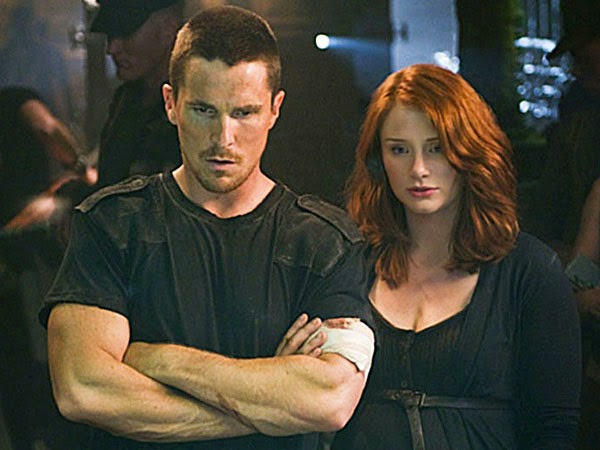
In Terminator: Salvation (2009), John Connor (Christian Bale) commands a resistance unit against the advancing forces of the A.I., Skynet, in 2018, a full fifteen years after Judgment Day.  

Connor learns that Skynet is planning to kill off high-profile targets, including Kyle Reese (Anton Yelchin) which could not only change the outcome of the conflict, but eliminate John from existence all together.  

While he tries to convince his military superior (Michael Ironside) of the situation, a mystery man, Marcus Wright (Sam Worthingon) also shows up, creating a quandary for Connor.

Can Connor trust Marcus Wright, and if so, can he use him to help rescue many captive, including Reese, from Skynet's grasp?


In light of McG's underwhelming Terminator: Salvation  the third film in the Terminator cycle, Rise of the Machine, now looks like an absolute masterpiece.

To cut to the chase, the fourth film is a colossal disappointment, a flat-line thriller that never raises the heartbeat, never engages the heart, and never, for a moment, crafts a world or characters that we can believe in. It substitutes loud explosions for thrills and inserts off-the-shelf platitudes about the "human heart" for genuine character development.

Most disturbingly, John Connor (previously played by Edward Furlong and Nick Stahl) has been transformed from quirky, ingenious individualist into a buff, strong-but-silent, dunder-headed action hero willing to leap before looking into any danger, small or large. The character's inaugural scene in Terminator: Salvation makes this trait a literal truth.

Now an infantryman of the year 2018, Connor (Christian Bale) -- without a second look -- dives into a vast subterranean machine complex attached to nothing but a tether. Connor can apparently defy the laws of gravity since he literally stops on a dime in mid-air -- without injuring his back or neck -- to light a torch. Then, amusingly, at the end of the sequence, we see Connor grunting and straining to climb out of the underground installation.

Free-falling and stopping his downward momentum in an instant? No problem.

But pulling himself up out of a hole? Tough work...


In the same vein, a later scene depicts Connor jumping out of an airborne helicopter into a turbulent ocean at the foot of a massive tidal wave in order to reach his chain-of-command on a submarine. We must wonder if he has become a machine himself because Connor's physical abilities would make Superman blush.

On set tantrums aside, the once-brilliant Christian Bale (think American Psycho [2000]...) has managed to appear less versatile and less emotionally-involved with each successive genre film role he's tackled, and Terminator: Salvation continues that unfortunate trend towards monosyllabic monotone. John Connor, the boy who grew up trained by his mother to be a warrior but who consciously and explicitly selected a different, unconventional path (even forbidding his pet terminator from killing humans...) has been transformed, disappointingly, into a gun-carrying, thick-necked, well-muscled commando who boasts a single tactical advantage: knowledge of the future.

And whether you believe this guy is a "false prophet" or "the key to salvation," would you -- as his military commander -- deploy him in the field where he could easily be killed; thus giving the enemy (Skynet) a substantial propaganda victory?


Terminator: Salvation is filled with violations of story logic just like that example.For instance, John Connor's wife, Kate (now played by a glazed-looking Bryce Dallas Howard...) must have stayed at a Holiday Inn Express between the events of Terminator 3 and Terminator: Salvation because the former veterinarian is now performing successful human heart transplant surgery.

In the field.

In a post-apocalyptic environment.


While I believe that Kate could indeed become an accomplished field medic in the fifteen year span between Terminator 3 and Terminator: Salvation, I don't believe the technology or education would be available to her in a post-nuclear world to learn the skills of heart transplant surgery. It's just moronic; Terminator: Salvation's final, lame gambit and reach for a "gimmick."

In broad terms, Terminator: Salvation's world does not much seem to resemble the horrifying future we caught glimpses of in the first three Terminator films.In Cameron's first film, the post-apocalyptic future was a world of perpetual night, darkness and gloom. Mankind barely survived, living atop mountainous layers of ash and debris (and human corpses...), in an unending nuclear winter. Terminators prowled and stalked by night, obliterating all resistance with dazzling, destructive lasers. 


A wicked joke in the original Terminator found a group of dirty, cold humans huddled around a TV set in an underground bunker. The light from the TV reflected on their sad, devastated faces, but as the camera swiveled around, we quickly registered that the set wasn't operational; that it was an elaborate fireplace.

Yet in Terminator: Salvation, the world around devastated Los Angeles is sun-lit, temperate, and mostly pretty safe. The resistance conveniently equips itself with Sony Vaio computer interface devices (product placement alert!), and fields military jets, helicopters, jeeps and submarines. The resistance also seems to have no problem remaining equipped with guns and ammo.  Even nuclear detonations are outrun with little concern or fuss.  Just another day on the front...

Even more baffling is the fact that all the humans in the film appear relatively healthy and well-fed. You'd think that acquiring uncontaminated food and water might be a full-time job after a worldwide nuclear winter, but Connor is buff, and Moon Bloodgood is certainly...fit, as a Resistance fighter pilot. Nobody mentions radiation or radiation poisoning in the film, either.  


I know that McG once expressed in an interview the idea that this is a "different" future than the one depicted in the 1984 and 1991 films because Judgment Day occurred differently in T3. But we still actually saw the nukes launch in that film, criss-crossing the country and the globe. We saw mushroom clouds too. No matter how you cut it, the planet should be deep in a nuclear winter at this juncture, and technology scarce.

Sadly, this is  also the first Terminator film in which the action scenes have failed to thrill. One particular action set-piece is a real disaster: the night-time pursuit of Marcus Wright (Sam Worthington) after his escape from the resistance headquarters. 


At the time of this chase, Connor is already struggling with his understanding of Wright, and has even come to sense that the man may be more than he seems...a possible ally. And yet Connor sends out attack helicopters, jeeps and soldiers to blow the guy away anyway...to napalm him back into the Stone Age. It's an unmotivated action sequence, especially since Connor -- after sending in the cavalry -- makes a deal with Wright anyway. This whole sequence succeeds only in slowing down the film's march towards the climax. Like much of the film, the scene makes no narrative sense.

I can only guess why, but Terminator: Salvation -- action scenes included -- is oddly lethargic and listless. It's clear now, if it wasn't before, that Arnold Schwarzenegger's presence in the previous films made some of the clunkier moments in the franchise bearable with his over-sized charisma and tongue-in-cheek sense of humor. Devoid of Arnie's catalyzing presence, Salvation is dull and mechanical. A CGI Arnold shows up late in the proceedings and is fun, if pretty darn phony-looking.

There are some nice touches here, no doubt. I enjoyed hearing Linda Hamilton's voice on the Sarah Connor cassettes. I also thought it was cool that, while going rogue, Connor listens to Guns N Roses (his soundtrack of choice in Terminator 2). 


If only there was more of that rebellious spirit left in this Connor. 

And finally, the late Anton Yelchin is equally impressive as Kyle Reese, even if given relatively little to do in this story.  I wish he had more screen-time.

The flat, heartless, disappointing Terminator: Salvation reminds me of Skynet's diagnosis of Marcus Wright late in the film:

"The human condition no longer applies to you."


This is a generic blockbuster, start-to-finish, an expensively-composed "hit"-making engine dressed up in a cover of human skin.  Under the skin, however, this is junk, and the first flat-out bad Terminator movie.

Tuesday, October 29, 2019

Terminator 2: Judgment Day (1991)


"The unknown future rolls toward us. I face it, for the first time, with a sense of hope. Because if a machine, a Terminator, can learn the value of human life, maybe we can too."

- Sarah Connor (Linda Hamilton), in Terminator 2: Judgment Day.


While never quite the lean, ruthless thrill machine that its blockbuster 1984 predecessor was, Terminator 2: Judgment Day boasts other delights and virtues.  For one thing, it continues  the story of the frequently imperiled Connors with stirring intensity and amazing pyrotechnics and stunts.

And -- perhaps more significantly -- it provides the genre one of its most amazing and influential villains: Robert Patrick as the T-1000, a shape-shifting, CGI-morphing leviathan.


I still vividly recall seeing this film theatrically in 1991 and being blown away not just by Patrick’s steady, focused performance, but also by the elaborate and confident special effects presentation of the character.

Patrick carries his strength not merely in his narrow, athletic form (a far cry from the bulging, super-muscular Schwarzenegger) but in his predatory, all-seeing eyes, which showcase enormous power and drive.

If Robert Patrick were not completely convincing in his role, this movie wouldn’t work, plain and simple. But he’s up to the task, and thus creates a classic villain. A true testament to his powerful presence is the fact that throughout the film, Arnold truly seems imperiled and outclassed by his enemy. Given Arnold's size and weight advantage over Patrick, that's an astounding accomplishment.

In terms of mechanics, the T-1000 was created through the twin techniques of morphing and warping.  Morphing is described as the "seamless transition" between two images or shapes, and generally uses points in common (like the shape of a nose, or a mouth...) as the basis for the transition. 


In the early 1990s, these visual fx techniques became the de rigueur effects in genre films, appearing in such efforts as Star Trek VI: The Undiscovered Country (1991) and Sleepwalkers (1992). Although morphing can apparently be traced all the way back to the 1980s and ILM work in The Golden Child (1986) and Willow (1987), Terminator 2: Judgment Day represents, perhaps, the finest and most meticulous utilization of the pioneering technique, again placing Cameron at the vanguard of technical achievement.

Comparing The Terminator to Terminator 2, one can see that the sequel -- while still a serious film obsessed with fate and man's self-destructive tendencies -- is remarkably less bleak in tone. As the quotation at the top of this review indicates, a sense of " hope" permeates the sequel. 

Notably, Cameron also mines the Terminator character (Arnold's, I mean) for laughs. The T-800 is the proverbial fish-out-of-water, unable to understand key aspects of the human equation, including how to smile, or why human beings cry. This set-up fits in very well with Cameron's career-long obsession with the outsider; the person unfamiliar with a world/class system who steps in and attempts to navigate it, all while simultaneously pointing out its deficits. The outsider can be social gadfly or observer, and reveal a new perspective about the film's dominant coalition (Ripley as the non-marine/non-Company exec in Aliens; Jack a Dawson lower-class passenger on the Titanic, etc.).

Although much of the  material involving Arnold's new Terminator character is indeed very amusing, particularly the actor's gloriously deadpan delivery of modern colloquialisms ("No Problemo," "Hasta la vista..."), some of this fish-out-of-water material feels very much like left-overs from Star Trek: The Next Generation. 

It's not so evident today, but at the time of Terminator 2's release, I was shocked at just how much the Terminator's journey towards humanity appears to mirror and reflect Lt. Data's (Brent Spiner) odyssey on that TV series, which ran from 1987 - 1994. It's a very intriguing dynamic: Gene Roddenberry acknowledged that Data's spiritual parents were Questor (from The Questor Tapes) and Bishop in Cameron's Aliens (1986). Here, turnabout is fair play and Data is certainly a spiritual predecessor to the T-101, only one assuredly less prone to bloody violence. 

Yet, interestingly, Star Trek: The Next Generation never rigorously established a thematic motivation behind Data's obsession with the human race, and becoming "human."  Audiences were left to infer that the character felt this ongoing fascination because his creator was human, or because he served with humans in Starfleet. Data wanted to more like those he was "with," in other words, a fact which raises the question: would he feel the same way for Klingons if they had built and/or found him? 

By contrast, in Terminator 2: Judgment Day, the T-800's "learning" mechanism (his method of becoming more human) is utilized by Cameron with laser-like precision to transmit a very specific thematic point:  If a Terminator can "learn" the value of human life, than there's hope for us conflicted, self-destructive humans in that regard too.

And once more, this lesson fits in with the film's real life historical context: 1991 was the year of the first Gulf War, the first televised war which saw the deployment of  precision or "surgical strikes" on enemy targets.

Underneath the impressive Defense Department briefings on the War -- replete with stunning camera imagery of bombs striking targets -- the truth was evident. Our automated weapons had made a quantum leap forward in accuracy and destructive power since the Vietnam War Era. The Terminator (and SkyNet too) thus did not seem so far out of reach, given the (automated) tech we saw deployed in Desert Storm. Today, we are even further down that road with our automated Predator drones and the like.

In terms of theme and vision, Terminator 2 also appears obsessed with the idea of forging a positive future for the planet Earth. Not necessarily for this generation, perhaps, but certainly for the children of the 1990s. John Connor (Edward Furlong) is only ten years old in this film (which makes it set in 1994), and he very much becomes the focus of two distinctive parental figures: Sarah Connor, and the T-101. Accordingly, Cameron frequently showcases images of children in the film, either fighting with toy guns, or seen at a playground that becomes -- terrifyingly -- the setting for a nuclear holocaust.

Ultimately more complex, if less driving and focused than The TerminatorT2 also derives significant energy from audience expectations; playing ably on our preconceived beliefs about the series.

And again, Cameron was on the vanguard of a movement in cinema here. The 1990s represented the era of the great self-reflexive genre movie, from efforts such as John Carpenter's In The Mouth of Madness to Wes Craven's New Nightmare and the popular Scream saga. Part of this Terminator sequel's appeal rests strongly in the creative fashion that it re-shuffles the cards of the Terminator deck to present new outcomes, and new twists and turns. The film gently mocks the franchise and the cultural obsession with "political correctness," transforming the Terminator into a "kinder, gentler" model who only shoots out kneecaps.

"It's not everyday you find out that you're responsible for 3 billion deaths."


Facing defeat and destruction in the 21st century, SkyNet sends another Terminator into the past to destroy resistance leader John Connor.

This time, however, the attacking machine is even more advanced than before: a T-1000 (Robert Patrick) made of "poly-mimetic" alloy and a machine that can assume the shape of any human being it physically "samples."

Fortunately, General John Connor manages to send a protector for his younger self through the time displacement equipment too, in this instance a re-programmed T-800 (Arnold Schwarzenegger).

The T-800 is programmed not only to defend Connor from the T-1000, but to obey the ten year old's (Furlong) every command.  This quality comes in handy when the T-1000 attempts to "acquire" Sarah Connor (Linda Hamilton), now incarcerated at the Pescadero mental hospital, and John orders the T-800 to mount a rescue operation.

After John, Sarah and the T-800 flee the sanitarium, they must make a decision about how they intend to stop "Judgment Day," the occasion in August of 1997 when a self-aware SkyNet precipitates a nuclear war.  Key to Sarah and John's decision-making process is Miles Dyson (Joe Morton), the man working at CyberDyne Systems who develops SkyNet in the first place.

Sarah attempts to kill Dyson in cold blood to prevent the dark future from coming to fruition, but John and the Terminator stop her and propose a different course.  They will destroy all of Dyson's working, including the prototype chips (left over from the 1984 Terminator).

The mission is successful, but Dyson dies in the attempt.  Finally, the T-1000 re-acquires the Connors, and the T-800 must put his life on the line to stop an opponent of far greater strength and abilities.  At stake is the future of the human race itself.

I know now why you cry. But it's something I can never do.


Although overly-long and somewhat heavy-handed at times, Terminator 2 still works nimbly as a self-reflexive thriller that dances a veritable ballet on the audience’s knowledge of the first film.

For instance, as in the first film, this sequel opens with two men appearing from the apocalyptic future. One is thin and lean, and very human-looking. The other is the pumped-up juggernaut Arnold Schwarzenegger.

Because of the earlier film, viewers are conditioned to expect Schwarzenegger as villain again, and look for the Michael Biehn-ish Robert Patrick to be a sympathetic hero. Of course, the opposite is true instead.  Our pre-conceived beliefs are used against us.

Secondly, Terminator 2 takes the unlikely but clever step of transforming Linda Hamilton’s character, Sarah Connor, into a Terminator herself. I’m not referring merely to her amped-up physique, either, but rather her very life philosophy.

Here, Sarah sets out to murder a man named Miles Dyson (Joe Morton) before he can complete SkyNet, the system that ultimately destroys mankind and births the terminators. In essence then, Sarah is adopting the approach of the machines she hates so much; killing a person BEFORE that person actually commits a crime. Just as SkyNet sent back a Terminator in 1984 to murder Sarah before she gave birth to John, so does Sarah endeavor to kill Dyson before he gives birth, in a very real sense, to SkyNet.

The implication of this approach, of course, is that Sarah -- in preparing for the future -- has sacrificed the very thing worth fighting for, her humanity itself.

Terminator 2 very much concerns Sarah's loss of humanity, and her opportunity to re-discover it, in large parts due to her son, John. As the movie begins, Sarah is lost and overcome with pain about the future that awaits mankind. But John ultimately teaches Sarah that it is okay to hope again, that the future is "not set," and that there is "no fate but what we make."

This sequel to The Terminator is also fascinating for the manner in which it incorporates the dominant social critique that “these films” (meaning the films of Schwarzenegger and Cameron, I suppose) are “too violent.”

In Terminator 2, young John makes Schwarzennegger’s emotionless machine promise not to kill any more humans, and the compromised Terminator spends the remainder of the film shooting up cops’ knee caps. This is quite funny, and it’s deliberately on point with what was happening in the culture of the nineties. In other words, it's inventive, unconventional and politically-correct all at the same time.  It's not the eighties anymore, and Arnold has, in a sense, been domesticated. At least a little...

Like so many horror films of the 1990s, Terminator 2 also concern the American family and the modern changes in the shape of the American family. Sarah Connor comes to the conclusion that instead of providing her boy, John, a flesh-and-blood, human father figure, the Terminator played by Arnold is the sanest answer in an insane world. The Terminator won’t grow old, won’t leave, and will never hurt John. He will always be there for the boy, she realizes, and in vetting this idea, the movie states something important about men and machines.

When more and more American families were drifting towards divorce in the 1990s or outsourcing child care to nannies and day-cares, it’s not that odd that a woman should wish for the “ultimate nanny” – an unstoppable robot – to protect her son. This also fits with the crisis in masculinity played out in films of the era, including Brian De Palma's Raising Cain (1992). Men of the 1990s were supposed to be sensitive and masculine, strong and sympathetic, peaceful and -- in a single instant -- relentless protectors of the family unit.  Arnie's character dispenses with such contradictory input and sticks to his programming.  He has no conflict about what he should be, even if others impose on him their own set of rules. Still, he manages to get the job done.


Although it spends relatively little time in the post-apocalyptic future compared to The TerminatorT2 is nonetheless haunted by the specter of nuclear war, another familiar Cameron obsession. In this case,  no less than five views of a playground are featured in the film. The playground is seen at peace (before the war, in Sarah's dream), in flames (during the war), and ruined (after the war), behind the prowling, murderous Terminators. 

The pervasive playground imagery reminds viewers again and again what is at stake if humans take the unfortunate and unnecessary step of rendering this planet virtually uninhabitable: the innocent will suffer.

Children do not boast ideologies or political parties, and do not care about issues like nationalism. They are collateral damage in any such  bloody conflict, and the prominent placement of the playground -- the domain of the child -- throughout the film makes this point abundantly plain.

At one point in the film, the T-800 also gazes upon two children fighting with toy guns and notes that it is in our nature to destroy ourselves. The idea seems to be that as children grow and develop, these tendencies towards competition and aggression emerge fully, and move off the proverbial playground into matters of politics and international confrontation. That may be the root of our problem.

It's interesting and also telling that Cameron has the T-800 make this observation about man in relation to children, and then later has Sarah Connor voice the conceit that males only know how to destroy, rather than to create life. This seems a little like the pot calling the kettle black given Sarah's hardcore actions in the film, and yet one can't really deny the truth of the observation, either. Women have simply not been afforded the reins of power as frequently as have men, historically-speaking, so guilt must fall upon the male of the species more heavily for our legacy of war and destruction. It's an unpleasant truth, but a truth nonetheless.

But yet again, that sense of hope sneaks into the movie.  John Connor -- a male child -- proves able to curb the killing instincts of Sarah Connor and the T-800 here, paving the way for what ostensibly should be a positive future. In almost all genre films, children represent the opportunity for a better future or better tomorrow, and T2: Judgment Day adheres to that trend. It is possible to change, to correct our course, but sometimes it isn't this generation, but the next that sees that potential.

I'll now state the obvious in regards to the film: The action sequences here are truly exceptional. The film’s first major set-piece, involving a truck, a motor-bike and a motorcycle in motion, is a high-point, featuring stunning stunts and seamless cutting.

The finale, in a factory and lead works also proves highly dynamic, with the T-1000’s death scene seeming like an homage to Carpenter’s The Thing

But of course -- as we know from Cameron's other films -- the magic of the director's films occurs not just in the staging of the action, but in Cameron's capacity to make the action stirring.  He makes the action affect us on an immersing, emotional level.  Here, we have characters we truly come to care about (Sarah, John and the T-800) and so we feel heavily invested in the narrative's outcome.  I'm not ashamed to admit it, but when the T-800 sacrifices himself in the lead works, I always get a bit misty-eyed.   

For John, he is losing a father and a best friend. And the T-800 has finally learned what it means to be human, and in doing so come to the conclusion that self-sacrifice is necessary. It's a great, even inspirational ending, if one sadly marred by the cheesy "thumbs up" gesture that accompanies the beloved character's demise.  

T2 is a bigger film than its immediate predecessor, and more ambitious in many ways. It isn't however, quite as hungry, quite as lean as the 1984 original. There's a sense here that the movie knows it is a blockbuster, and doesn't have to deliver on quite the same visceral level. Still a great film, of course, but these days I prefer, at least slightly, the first entry in the franchise.

Tuesday, July 21, 2015

Cult-Movie Review: Terminator Genisys (2015)


(Watch out for spoilers!)

First things first: Genisys (2015) is not the worst film to carry the franchise name Terminator.

That (dis)honor still goes to 2009’s Salvation, and by some distance too. 

But one shouldn’t celebrate much about this sequel, either, for Genisys abundantly lacks the visceral impact of the first two Terminator films (helmed by James Cameron) and the ambition/courage of Rise of the Machines (2003) which -- love it or hate it -- at least attempted to move the franchise in a new direction, beyond Judgement Day and into the Future War. That movie did more than inch John Connor toward his destiny, and showed audiences that his fate had not been changed, just delayed.

Terminator Genisys, by contrast, is yet another “we’ve got to stop Judgment Day before it happens” movie, much like the 1991 sequel.  But it undertakes that familiar quest without Cameron’s skill or acuity in terms of humanity, action, and even humor.

It’s intriguing to note those places where Genisys falls down on the job. 

It isn’t necessarily in the twisty-turning narrative, which features a grab-bag of great ideas, even if half-realized.

Rather, it is in the unexceptional execution. 

The entire film moves by at the same clip or pace -- a steady heart-beat -- and there is no real quickening or slowing of its pulse. Without any hills or valleys to accentuate the action, Genisys indeed feels relentless, but never exciting, nor particularly thrilling. There isn’t a single action scene here that feels distinctive, memorable, or like a meaningful addition to the franchise. 

Instead, this movie is an entertainment machine on autopilot.

In concept, Genisys is actually a “side-quel” to the original films, meaning that it takes place in an alternate but connected reality (think: J.J. Abrams’ Star Trek [2009]). 

But where that side-quel by-and-large got the characters and joie de vivre right, Terminator Genisys misses most of its marks, and falls flat. The re-cast actors -- Emilia Clarke as Sarah Connor and Jai Courtney as Kyle Reese -- aren’t bad in those familiar roles, but there is no force or momentum behind their performances, thanks to Alan Taylor’s listless, generic direction.


Arnold Schwarzenegger does his able best to carry the movie, but the supposedly humorous call-backs to T2, with his cyborg character practicing a smile, are generally dreadful, and largely unfunny.  

Even the emotional connection between his aging cyborg character, named Pops, and young Sarah Connor doesn’t feel as powerful as it should.


So this Terminator is, like its namesake, an infiltration unit of sorts.  It arrives in our theaters looking and sounding like the other films in the franchise, but underneath the exterior, it’s a stealth machine, all grinding gears and motors and calculated surfaces, but no soul.

In other words, Genisys is a crushing disappointment. Not because it’s authentically terrible (like Salvation), but because it can’t hold a candle to the other Terminator flicks.


“We’re here to stop the end of the world.”

In 2029, at the end of the war with the machines, resistance leader John Connor (Jason Clarke) must send soldier Kyle Reese (Jai Courtney) back to 1984 to protect his mother, young Sarah Connor (Emilia Clarke) from a Terminator, a relentless cyborg built for infiltration.

But as he steps into the time field, Reese sees John attacked by a stranger (Matt Smith), and as he travels through time, accesses a different time-line’s worth of memories. 

In this time-line, Judgment Day did not occur in 1997, but in 2017.  And Skynet is a Trojan Horse in a new app from Cyberdyne, called Genisys.

In 1984 Reese is rescued from a T-1000 by Sarah Connor, who has been raised since age nine by a Terminator she calls Pops (Arnold Schwarzenegger). 

Now, Reese, Connor and Pops must get to 2017, prevent the rise of Genisys, and battle its protector: John Connor, who has been reborn as a “phase-matter” Terminator.


“You’re nothing but a relic.”

Although many critics have complained about it, I believe the Terminator Genisys story actually possess a great deal of potential.  

A new time incursion, basically, has scrambled the official (and familiar) time-line, shuffling all the old familiar cards, and giving the audience a new hand, so-to-speak, to play. 

Characters who were once heroes are now villains.  Characters who were once protectors are now in need of protection, and so on.  It’s an explosion, basically of the 1984 and 1991 films, with a high unpredictability factor involved.


Some of the early scenes in the film -- particularly those that recreate Kyle’s landing in 1984 -- are a lot of fun for the fashion that they play on our familiarity with Cameron’s original film.  Some of the shots used in these sequences are identical to Cameron’s, but the precise characters details have changed in ways that are surprising.  

Now Kyle arrives in an alleyway only to be pursued by a T-1000, not a Los Angeles cop. Now Sarah says to him, Kyle's own immortal line: "Come with me if you want to live."  Now Kyle is the one who must play catch-up about the past, not Sarah.

But Terminator Genisys is so keen on playing up its (admittedly smart...) twists and turns that, at times, it doesn’t settle down enough and pursue a single good idea.

For example, here are two good -- even great -- ideas in the film, and neither is touched on for more than two minutes.

First, in the course of the action, the aging Pops (who possesses aging human tissue around his robotic shell…) injures his hand, and can’t get it to function exactly right.  

We see his hand shake as he loads bullets into a clip, and he attempts to right the error. And for  a moment, the film is actually about something: the ravages of age.  

An old injury has given Pops the equivalent of arthritis in that hand, and he must “adapt” so that it isn’t a weakness in combat.


The movie desperately wants the audience to love Pops, and feel his bond with Sarah. Indeed, much of the film's climax depends on us being moved by that father-daughter relationship.

One way to enhance that aspect of the characters' relationship would have been to feature three or four occasions when Pops' programming/body starts to fail, and he must use ingenuity, rather than brute strength, to stop his machine opponents.  

Had those moments occurred, we would have felt invested in Pops in a deeper way.  He would have had some flaw he was fighting against, namely rapid obsolescence.  Since many of us have been watching The Terminator films since 1984, that flaw would have reflected our own lives.  We too are aging.

But instead, the movie gives the idea of an aging, slowing-down Terminator precisely one scene, and then has Pops jumping into propeller blades, smashing into windshields and committing other dangerous (and circuit damaging…) behavior without harm or commentary.


The opportunity here would have been to depict how a Terminator -- an infiltration machine -- grapples with completion of its mission while being, essentially “old."

Instead, it’s just a great idea, tossed up momentarily, and then largely dispensed with.

Secondly, Skynet is played to great effect in the film by none other than Matt Smith…here billed as Matthew Smith.  

At one point, prior to his upload to the Cloud, Skynet notes that humans only give lip service to peace, and are committed, actually, to violence.  Now consider, Skynet is essentially an infant here, and so his meeting with Sarah and Kyle represents the A.I.'s first encounter with our species.

Now, imagine if -- all along -- it was this very experience – meeting Connor and Reese on their crusade of destruction -- that made Skynet murderous in the first place.  What if Skynet had no intention of launching a nuclear war, come upload, except for the fact that humans tried, on his birthday, to kill him in the crib?

Such a scenario would represent a surprising twist on the entire franchise.  Sarah and Kyle would be responsible for Judgment Day, not Skynet, who is simply defending himself. 

Again, this movie (barely) gives this idea lip-service, and Skynet’s comments about humanity is meant only as general, villainous disdain for our breed. But it could have been so much more.  The whole story -- the whole franchise story -- could have been about how, in a way, mankind’s downfall occurs because of aggressive efforts to avert that downfall. 

Terminator Genisys possesses a lot of great ideas, barely enunciated (like John Connor’s destiny, post-war…) but shunts them all asides for action scenes that have approximately zero impact.  

We get an extended battle on the Golden Gate Bridge, for instance, but it feels like a pale imitation of a confrontation in Rise of the Planet of the Apes (2011). And a night-time helicopter chase around San Francisco seems so gravity free that it could be happening inside a cartoon.

Basically, the action scenes in the film lack not only any kind of punch, but any significant grounding in reality. As a result, it feels like every character in the film must be a terminator.  Kyle and Sarah keep surviving incident after incident with just mere scratches. At one point, they are hit -- naked, mind you -- by a speeding car on the freeway, and just need some stitches.  Similarly, the T-1000 (Lee Byun-hun) is dispatched with surprising ease, especially given how difficult Robert Patrick’s model was to kill in T2.

Overall the action is underwhelming, and the lack of real-world results for those involved in the chaos only worsens that problem. 

For a movie about the way our choices impact our future, Terminator Genisys boasts surprisingly little impact.

Long story short: Alan Taylor had hundreds of millions of dollars and 2015 era special effects technology at his disposal to make a good Terminator movie, and yet his new model possesses only a fraction of the thrills -- let alone emotional engagement -- of James Cameron’s low-budget 1984 film. 

That film accomplished so much more, and with so much less.

At one point in Terminator: Genisys, Sarah Connor hugs Pops, and he resists the emotional overture.  “It is a meaningless gesture. Why do you hold onto something you must let go?”

He may be right, at least in terms of this aging franchise. 

If the next two films (already assigned release dates in 2017 and 2018...) aren’t a marked improvement over Genisys, they may be but a meaningless gesture.

And thus it may be time for all its fans to let The Terminator go.


CULT TV FLASHBACK: Dead of Night (1994-1997)

This year, Dead of Night: The Complete Series , was released on Blu-Ray by Vinegar Syndrome , and I just had the pleasure of falling into i...