Showing posts with label 1970's cult-tv blogging. Show all posts

Thursday, July 04, 2019

Cult-TV Blogging: Buck Rogers in the 25th Century "Vegas in Space" (October 4, 1979)


In “Vegas in Space,” Buck Rogers (Gil Gerard) is assigned by the Earth Defense Directorate and Dr. Huer (Tim O’Connor) to visit Sinoloa, a city of casinos in space run by the notorious crime lord, Velosi (Richard Lynch).

Buck is accompanied on his journey by Colonel Marla Landers (Juanin Clay), and their mission is to spring a kidnapped young woman, Felina (Ana Alicia), who is secretly the daughter of a rival crime boss, Armat (Cesar Romero).

An agreement is made: if Buck and Marla save Thelina, and the crime boss will provide information about the Draconian’s new hatchet fighters, which have proven impossible to defeat in combat.

Once at Sinoloa -- which is described by Dr. Theopolis as an “orbiting city of moral depravity” -- Buck is befriended by Tangy (Pamela Susan Shoop), a woman who is also being held captive by Velosi. She helps Buck and Marla free Felina before a sadistic expert at extracting information, Morphius (Joseph Wiseman) gets an opportunity to ply his trade.


My perception is that “Vegas in Space” is a well-liked and popular episode of Buck Rogers in the 25th Century (1979-1981), but despite this act, it has never been one of my favorite installments. It’s an early episode of the series’ first season, and the actors, writers, and directors are all still in search of a consistent tone.

This episode follows very much the kind of glib approach we see in “Awakening,” with Buck as the grinning Burt Reynolds of the future. 

Gil Gerard, in future episodes, brings depth and humanity to his most famous role, but one can see here that he is fighting against a script which features a different vision of the character. For example, just look at the scene in “Vegas in Space” in which Wilma recruits Buck for this particular mission, and he perks up at the word “gambling,” and his (lascivious) memories of (the attractive) Marla Landers. Again, this is a guy who has lost his own world, but we’re supposed to believe he just wants to gamble and bed beautiful women?  

Late in the episode, Buck is also somewhat insufferable. After his victory over hatchet fighters, he gloats to Wilma: “I told you so.”


The approach here is, also, clearly much in the pattern of Mission: Impossible (1966-1972) or the James Bond films of the era. For example, Dr. Theopolis, at the start of the episode, outfits Buck with a series of gadgets to help him escape from Sinoloa. He might as well be designated “Q.” In the final act, of course, those gadgets come in handy to escape from Sinoloa.

The episode also continues the early (and soon dropped…) conceit that no one in the 25th century can think without computer assistance. Here, the crisis of the week involves a new design of Draconian fighters. These hatchet fighters can out-maneuver human pilots. Buck wants Directorate pilots to go to manual, to counter the moves of these new crafts. Wilma doesn’t believe that this will be enough, or that her pilots can do it.

Then, on Sinoloa, no computers are allowed, so that human gamblers can lose at games such as “10 and 11” (Black Jack).  Apparently, the human mind of the future has atrophied to a terrible degree.  Buck’s dialogue spells it all out. “People’s minds have gotten flabby,” he notes.


The problem is that this “history” and characterization of 25th century man doesn’t always fit with what we see. For instance: Noah and his team of gruff veterans in “The Fighting 69th.” Don’t tell me those grizzled space dogs rely on piloting computers.  And if they didn’t, why should other human pilots?

In the end, the plot doesn’t exactly resolve, or go anywhere interesting. Buck bests a hatchet fighter during a space dogfight by relying on his instincts. So he doesn’t even need the information that was the motivating factor behind the mission to Sinoloa.

Another intriguing, but unexplored angle of this story involves the Draconians. How would Earth crime lords have top secret information about state-of-the-art Draconian spacecraft? Is there some alliance between Big Business and a foreign power threatening Earth? 

Certainly, we see this today with various corrupt politicians/business figures colluding with a foreign power, such as Russia. But “Vegas in Space” doesn’t explore the connection, or make anything dramatic of it. And the connection between the crime lords and the Draconians is never raised in the series again.


Also, it is interesting to note that there has been a change in premise since the movie/pilot. There, Earth was in ruins, New Chicago was the only city (or one of the few cities), and it was protected by a defense shield. In an episode such as this, there are orbital cities that a cosmic ports of call, like Sinoloa.  Now, with Buck as a secret agent, he needs colorful places to visit, and Sinoloa fits the bill. 

What this means, however, is that a location from the film, such as Anarchia, doesn't get explored.

“Vegas in Space” features a lot of superficial on-screen value. Consider the guest stars, for example: Cesar Romero, Richard Lynch, Joseph Wiseman, Pamela Susan Shoop, and Ana Alicia.  That’s a lot of on-screen talent for what is, essentially, a caper story. “Vegas in Space” also moves at a quick clip and features an easily comprehensible gimmick so as to appeal the widest possible audience demographic: an outer space casino.  A similar space casino had been seen in the final part of the original Battlestar Galactica pilot, "Saga of a Star World" (Carillon).


Beyond those shallow virtues, the episode isn’t really about anything.  I watch “Vegas in Space,’ and I can’t help but see a series that hasn’t yet found -- or cemented – its own identity.  This isn’t one I often choose to re-watch because there’s nothing of substance to mine, or to think about.  

I do very much like the performance of Juanin Clay, however, as Marla. It's an intriguing historical footnote that she was nearly cast as Wilma Deering, when Erin Gray was not certain she wanted to commit to the series.

Next week: "Plot to Kill a City"

Tuesday, January 22, 2019

Gerry Anderson's UFO: "Identified"


In 1970 (and in America, in 1971), Gerry and Sylvia Anderson presented 26 riveting hour-long live-action episodes of sci-fi television: UFO.

Set in the far-flung, future year of 1980, this beloved cult series involves a multi-national organization, SHADO (Supreme Headquarters Alien Defense Organisation), and its attempts to stop malicious alien incursions on planet Earth.

A splendid example of speculative realism, the series imagines -- again, from  an inception date of the 1969 or so --  a future in which the swinging sixties never ends, so much so that well-established, mature military officers, in 1980, wear radical/punk hair-cuts, and the latest Nehru jacket fashions. 

Modern viewers may find this "futuristic" affectation amusing today, since producers did not imagine the pendulum swing back to conservative fashion and politics in the 1980's, but the series is nonetheless consistent and meticulous in its portrayal of a world in which the swinging 60's becomes the even more swinging 70's and 80's (in terms of fashion, race relation, sexual politics, etc.).

This view of a "progressive" future is coupled with a world in which technological advances explode with great rapidity. Again, however, that explosion is vetted through the context of the Nixon Era. UFO rightly imagines a world in which the computer is ubiquitous, but not the fact that a revolution in "miniaturization" contributes to that ubiquity. So the series is dominated by wall-sized computer panels, with reel-to-reel tapes, and blinking lights.


What remains most intriguing, however, about UFO, may just be its ahead-of-its-time character-touches. The series lead, brilliant portrayed by Ed Bishop, is Commander Ed Straker. He is a driven, workaholic, divorcee. To fight the aliens on Earth, he literally gives up everything and every person in his lie. This does not seem odd to us today, in a world in which the divorce rate has skyrocketed, and technology means that we are never "off" from our jobs. But in 1970, Straker was a new -- and tragic -- brand of hero.

The world of UFO supports the nature of this particular hero. Like the Anderson series that followed it, Space:1999 (1975-1977), UFO imagines a universe of limited resources. During the program's two-dozen or so installments, Straker is constantly at war to get funds for SHADO, since bureaucrats control the purse strings.

Similarly, the aliens themselves, as we learn in the first segment, "Identified," are desperate. While Straker attempts to "harvest" the funds, resources, man-power, and technology to combat his enemy, the enemy is coming to Earth to actually, physically harvest our body parts, to overcome sterility and possible extinction.  This whole idea seems more timely today than it did nearly forty years ago.


"Identified" commences in 1970, as a young Ed Straker, an American Air Force officer barely survives a UFO attack.

Elsewhere, at the same time, a group of British youngsters spy a crashed UFO in the woods, and photograph it. One of the youngsters, however, a girl, is apparently killed, and her body taken by the aliens.


Ten years later, Straker is ensconced as the commander of SHADO, which possesses a base of operations at a movie studio. And the long-ago victim's brother, Carlin, is now an officer in the organization. The various installations of SHADO -- including an orbital satellite, SID, an advanced moonbase, and a submarine/jet combination, Skydiver -- monitor a UFO entering Earth's orbit.

The UFO is shot down by Skydiver, and the alien pilot is recovered from the water. Straker wants to know where the alien is from, who the aliens are, and why they have come to Earth. A medical examination of the pilot provides some troubling answers. The body possesses the organs of Peter Carlin's long-ago dead sister, meaning that the aliens are harvesting humans for transplant surgeries. Straker has the unpleasant task of telling Carlin what finally became of his sister.

"Identified" is a fascinating entrance to the world of UFO, because it accomplishes three tasks in one hour.

First, it introduces the world to the series single-minded lead, Straker. We get a strong sense of the man's mettle, right out the gate. He is serious, dedicated, single-minded, and edgy. He is also, incredibly lonely, and therefore sad.


Secondly, "Identified" introduces the viewer to the many diverse facets of SHADO.  SID is a great and detailed miniature, though Skydiver One does not hold up as well today, perhaps because it is very difficult to get water "right" on miniature sets.

The most fascinating aspect of SHADO's operation, however, is Moonbase. This installation, a precursor to Alpha, is commanded by a woman, Lt. Gay Ellis (Gabrielle Drake), and most of the lead officers are also women. That's a great move for gender equality in terms of the series' imaginings.  On the other hand, these capable, intelligent women also wear form-fitting breakaway space suits, and Lt. Ellis strips-down in one scene. Also, and for no apparent reason, all the women on the Moon wear purple wigs. Stylish and memorable, yes. Practical? I don't see how.


The introduction of the aliens in "Identified" is also fascinating. After an autopsy at HA, Straker speculates about the alien nature and purpose in a riveting, well-acted and written sequence. These extraterrestrial beings are intelligent and highly advanced, but "doomed to extinction" and "driven by circumstance" to take the abundant Earth's resources. Straker realizes the desperation of his enemy, and how it makes them exceedingly dangerous.


Follow-up episodes of UFO focus on alien gambits to acquire more human bodies, or disable SHADO defenses. Other tales, like "A Question of Priorities" and "Confetti-Check A-OK," contend with Straker's personal sacrifices as commander of Earth's last line of defense.

The second episode in the series, "Exposed" adds the final piece of the program's jigsaw puzzle, a young, "action" hero (and dashing lady's man) in the form of Paul Foster (Michael Billington). Foster is a memorable character, but UFO, the series, is all about Straker, a man of iron will and discipline, and a great tragic hero. He makes the series unforgettable, right alongside some of the more mind-bending tales (such as "Timelash,"or "The Long Sleep.")

Thursday, August 31, 2017

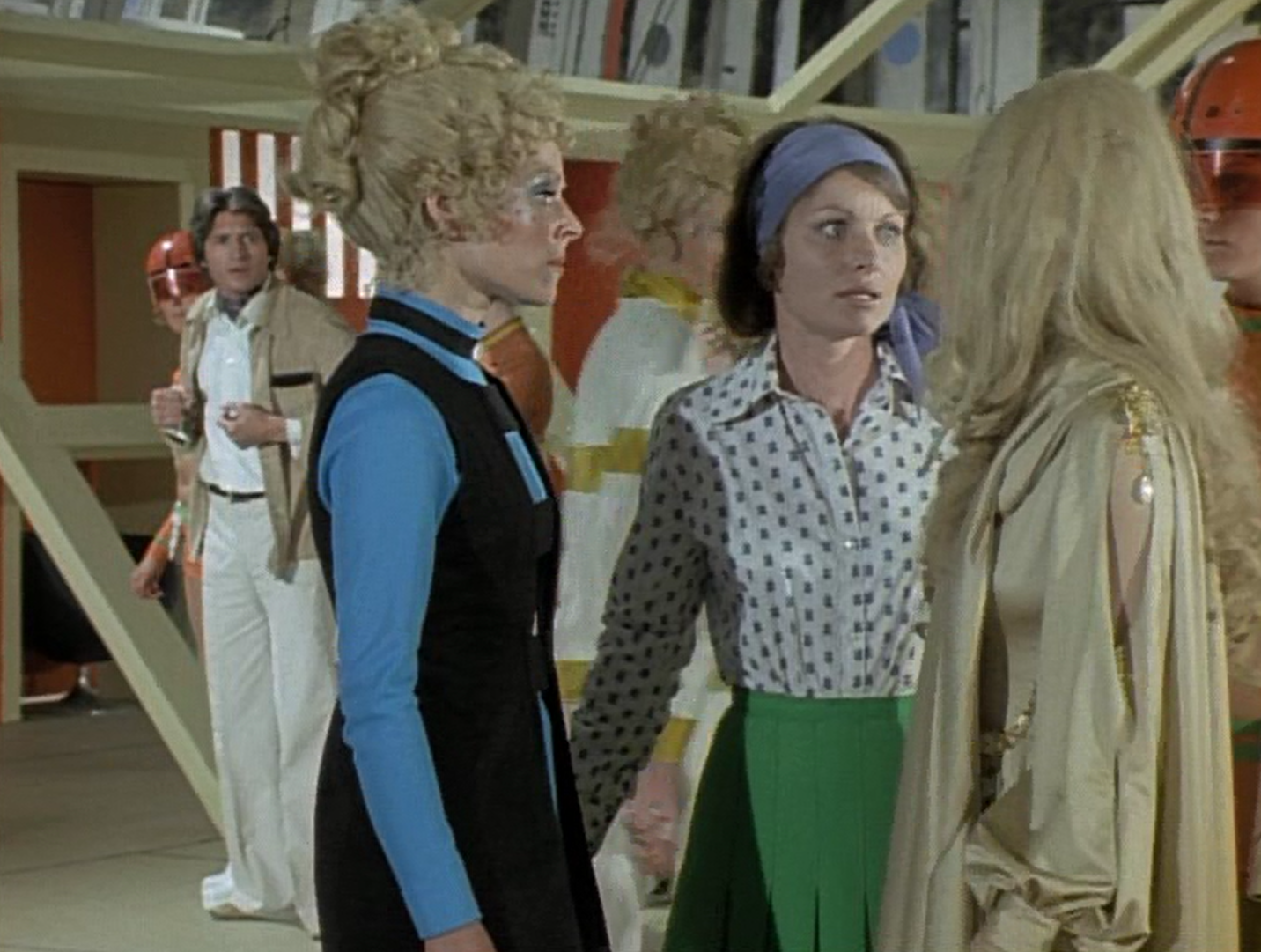
Cult-TV Blogging: Star Maidens (1976), "The Proton Storm"


This week on Star Maidens, in a script penned by John Lucarotti (who wrote several fine episodes of the original Doctor Who in the 1960’s), the Earthling Liz (Liza Harrow) and her (male) assistant Rudy are held hostage by Octavia pending the release of Shem and Adam on Earth.

Fulvia (Judy Geeson) is unhappy when a deal can't be reached with the fugitives from Medusa and Earth's Dr. Evans (Derek Farr), but Octavia terminates the mission, and decides it is time to return home.

"What can you expect of a planet ruled by men?" she asks. I love how dismissive and terse Octavia is in her dealings with our planet. And yes, I have seen men speak about women in precisely this fashion, on more than one occasion.


Held hostage, Liz and Rudy get their first (involuntary) peek at the advanced world of Medusa. Once there, the Earthlings are promptly separated and Liz is treated like royalty while Rudy is relegated to the barracks in the men's quarters.  Rudy opines that he doesn’t know how long he can take it, forced to be submissive to women overlords.

"You mustn't concern yourself over a mere male," Fulvia suggests to Liz. "To love a man is to give him power over you. And he will only abuse that." 

Again, this remark seems a perfect “crack’d mirror” example for the kind of things men tell each other about women.

Rudy discovers that the men's quarters are pretty rudimentary, and that the servants spend most of their time playing an extra-terrestrial variation of chess. They seem to do so, however, by telepathy, since the pieces move about the board without ever being touched.  The script makes nothing of this development. It isn’t even commented upon.

 "The rules are simple," explains Octavia of the chess variation -- without cracking the slightest hint of a smile -- "The Queen is never captured." 


Rudy also learns that men once ruled on Medusa, during an epoch that Fulvia refers to as the planet's Dark Ages. Back then, there was nothing "but wars, violence, and greed."

Since women took over the planet, Medusa has -- by contrast -- seen centuries of peace and social and technological progress. This is a powerful argument for female rule, given the high technology and achievements of Medusa, especially in comparison with the warring, primitive Earth of 1976 that we see in the series


While Rudy and Liz learn the ways of Medusa, on Earth Shem and Adam state their conditions for returning home. Shem wants a full pardon from Octavia and his old job as mechanic back (aim high, brother!), while Adam wants no less than equal rights and equal opportunities, a request which Octavia finds "rebellious.”

Hoping to reunite with Adam, her former domestic, on Earth, Fulvia steals the space yacht Nemesis and plots a trajectory back to Earth, but a severe proton storm is directly on her course, somewhere between "Jupiter and Uranus". The storm is raging at "destruction point," but Fulvia decides they'll just have to "ride it out.”


I probably don’t need to point it out, but Fulvia’s self-destructive behavior is that of someone who has clearly fallen in love. Fulvia can warn Liz about love all she likes. But in terms of Adam, she has clearly not taken her own advice. She loves him so much that she risks her own death to see him again.

From Earth, Shem helps Fulvia safely navigate the deadly proton storm. But when Fulvia lands on Earth, Adam still can't bring himself to forgive his mistress, and he runs off alone into the woods.  This is the first indication in the series that Adam carries affectionate feelings for Fulvia.  He is unable to deal with his emotions, and rather than confront them, he runs off like a child.

Again, this act seems to confirm the Medusan interpretation of men as children that must be cared for. And again, this is often an attitude held by the patriarchs here on Earth.  More ‘crack’d mirror’ commentary, and it’s all to the good. 


As opposed to the last episode of Star Maidens I watched ("Nightmare Cannon"), this one isn't overtly high camp, and is played rather seriously and emotionally.

I've noticed that matters always seem to pick up dramatically on Medusa, whereas most of the material occurring on Earth just seems haphazard, or poorly conceived.

For instance, why is Dr. Evans -- an egghead scientist -- negotiating with alien leaders? Wouldn't the British government like to be in on that action?  

How about the UN? Or the U.S.? 

First contact with advanced aliens seems a matter of import that would not be left to local police, or a well-meaning (but inept) astronomer.  Also, spaceships from Medusa are regularly invading the airspace of Britain now, and with no response from the air force?

Social commentary is all good, especially when it is as funny as Star Maidens makes it, but this series also needs some grounding in reality.

CULT TV FLASHBACK: Dead of Night (1994-1997)

This year, Dead of Night: The Complete Series , was released on Blu-Ray by Vinegar Syndrome , and I just had the pleasure of falling into i...