Showing posts with label time travel. Show all posts

Tuesday, March 10, 2015

The Films of 1989: Bill and Ted's Excellent Adventure


I first saw Bill and Ted’s Excellent Adventure (1989) when I was in college. In fact, I saw the film with a trio of friends, and if memory serves, my film professor at the time….who had to be dragged to the theater kicking and screaming.

At the time, I thought then that the movie was a sort of sweet, dopey take on time travel that didn’t necessarily provoke deeper thought.

And Bill and Ted’s Excellent Adventure certainly fit in with its historical context: of teenage-based science fiction comedies made in the aftermath of Back to the Future (1985).  My Science Project, Weird Science, and Real Genius all emerge from the same cultural ripple created by the Zemeckis film. 

And, in a way, Bill and Ted’s adventures also forecast the adventures of Wayne and Garth in Wayne’s World (1992) and Wayne’s World 2 (1993), at least to some extent.

Critics at the time -- including my professor -- were not amused.

Hal Hinson at The Washington Post called the film “paltry” and “undernourished.” And Variety’s staff reviewer noted that “Each [historical] encounter is so brief and utterly cliched that history has little chance to contribute anything to this pic’s two dimensions.”

On a re-watch this week, I found a few more points of interest in Bill and Ted’s Excellent Adventure.  The film’s philosophical approach to time travel is intriguing, especially as it relates to the gimmick of the telephone switchboard, only with time circuits not phone circuits.

Also, I enjoyed the film’s sense of fun about time travel, and the idea that anything you can think of can be instantly produced, assuming you remember, later in the day, to travel back in time and provide what you needed at that juncture in the past. 

This is precisely the way that Bill and Ted get out of their worst scrapes.

Probably the most significant thing to recall about Bill and Ted’s Excellent Adventure is that it is a comedy film first, a science fiction film second. Accordingly, I can’t really quibble with the success of the scenes involving Napoleon eating an ice cream sundae, or enjoying a San Dimas water slide. 

Those moments are pure silliness, and yet still garner big laughs. Napoleon is the film’s break-out character, in part, perhaps, because he is granted the luxury of the most screen time.

I prefer Bill and Ted’s Bogus Journey (1991) to this film by a wide margin, in part because it throws about a billion silly ideas at the wall to see what sticks and consequently never has a dull moment. But also because this inaugural effort doesn’t treat school (or school teachers) with much verisimilitude.

In other words, I can buy that Bill and Ted go time traveling in a TARDIS-like phone booth.

I can even buy that these two slightly dopey kids become the foundation of a future utopia. Party on dudes!

But I simply don’t believe a teacher would allow them to pass their history classed based on the final project as it appears in the movie, or even that all the world’s great figures of history and philosophy would agree to participate in it. 

Genghis Khan wasn’t known for going along to get along.

Yet, in a sense, that last joke reflects on the magical spell cast by Bill and Ted themselves. They are such amiable losers, I guess, that the future and the past bows before them without complaint.

They’re not worthy.

At least not until the sequel…


“We’re destined to flunk most egregiously.”

In San Dimas, CA, in 1988, Bill Preston, Esq. (Alex Winter) and Theodore Logan (Keanu Reeves), are in danger of flunking their final history project.  If they do fail, Ted’s father plans to ship him off to military school in Alaska.

Fortunately, a life-line arrives from seven hundred years in the future.  

A man named Rufus (George Carlin) provides the boys a time traveling phone booth that will allow them to experience history first-hand, so they can prep the greatest school project ever.

For Rufus, this is a vital matter. If Bill and Ted don’t pass this test -- and their history class too -- a future utopia in 2688 will fail to come into existence…and that is the very culture Rufus hails from.

Bill and Ted head back in time to round-up historical figures including Napoleon (Terry Camilleri), Billy the Kid (Dan Shor), Genghis Kan (Al Leong), Joan of Arc (Jane Wiedlin) and Abraham Lincoln (Robert Barron).

But will they get back to San Dimas in time to deliver their report, and can they manage to police an unruly crop of historical figures?


“Be excellent to each other.”

The undeniable magic of Bill and Ted’s Excellent Adventure arrives in the central characters’ atypical mode of expression. In particular, the boys are (unknowing) masters of the malapropism, not to mention (as Vincent Canby did…), superlatives. 

In short, Bill and Ted’s Southern California mode of expression is horrific to grammarians but hysterical to audiences. Most of the laughs in the film arise from the conjunction of their very modern Surfer-type speech with characters we remember from history books and thus deserving of a modicum, at least, of respectful discourse.

So Joan of Arc is described here by the dudes as “Noah’s wife,” and Napoleon is referred to as a “short dead dude.”  

When angered, Bill is prompted to say things like “You medieval dick weed!”

The film repeats the same joke over and over again (whereas the sequel parodies modern expression, Star Trek, views of the afterlife, Ingmar Bergman films, board games, and about a dozen other topics…).  But for most of the first film's running time, this joke about expression and vocabulary is pretty damned funny, or at least chuckle-worthy.

In terms of sci-fi concepts, the time travel angle of the film is intriguing, and unique. Most films concerning time travel don’t postulate that the present “continues” moving while time travelers are away in other epochs.  But that’s the logical conclusion to be drawn from Bill and Ted’s Excellent Adventure.  

Even while they are in other eras, the clock keeps counting-down in San Dimas towards their history project dead line. In other words, because they are of that present, they move with it, even while they are in the past.

The corridors of time themselves, are depicted visually as vast cords or cables in an old fashioned telephone switchboard. You can dial into any time period you want and make a connection to it, but the “present” keeps on trekking. 

In a sense, then, the present is a moving target. This idea is seen the prologue as well, as a Trio of future Elders/leaders check their watches and realize that a major test is coming up for Bill and Ted, the so-called "The Great Ones."  Yet of course, that test occurred, chronologically-speaking, seven hundred years earlier.


More significantly, I appreciate the film’s comic discourse on paradox.  Early in Bill and Ted's Excellent Adventure, our heroes get bogged down in one. Their band, Wyld Stallyns, needs a “triumphant video” to succeed, but it also needs “Eddie Van Halen” on guitar. 

Yet he will not join the band unless they have a triumphant video.  

And they can’t have a triumphant video without his participation.

Voila, a paradox!

This idea is reflected in the film’s last act, when Bill and Ted realize that they can -- while in the past – devise a plan to carry the day (like getting the police chief’s prison keys…) and have it happen instantaneously.  

They do so by traveling back in time, and planting those items when they are needed. 

Of course, this is a paradox too.  If the boys don’t get out of their present predicament, they can’t return to the future to execute their plan of escape.  

But they have executed their plan of escape, because the items show up when and where desired, suggesting they were successful.

This joke goes right back to the debate over which comes first, the chicken or the egg. Or in this case, Eddie Van Halen or the triumphant video.

Where Bill and Ted’s Excellent Adventure proves markedly less than enthralling are in the terrains of production design and production values. The future looks cool enough, but the visits to the past are spliced with old movie stock footage (for the Napoleon segment), familiar back-lot Western towns, and other cheap expedients. The movie looks more like a cut-rate time-travel TV series of the 1960s – 1980s (Time Tunnel, or Voyagers! maybe) than it resembles a full-fledged motion picture. 

And because so many historical figures are brought into the present of 1988, they come off as one-note jokes instead of characters, with the exception of the aforementioned Napoleon.  

Joan of Arc gets into aerobics, Sigmund Freud fondles a corn dog (sometimes a corn dog is just a corn dog…) and Beethoven plays a modern synthesizer.  None of this behavior is terribly surprising or original.

In other words, the jokes are okay, if obvious, and don’t lead into any deeper or more humorous material.  Similarly, George Carlin -- quite possibly one of the funniest human beings ever to inhabit the Earth -- is not given funny material in the movie.


In the end, Bill and Ted’s Excellent Adventure seems a meditation on the concept that there are some of us who go through life working hard, barely making it. While others, like Bill and Ted, seem to glide through life with no real obstacles or anxiety, only to find all their non-effort rewarded by history, and society at large.  

They are dopes, it is true, but harmless, good-hearted dopes. The sequel is much better, in my opinion, because it puts them up against greater odds, and against more ferocious villains (including the Devil, and De Nomolos).  They must earn their future in that film, rather than just sort or surf a wave to it, as they do -- metaphorically-speaking -- in this film.

On Thursday: Bill and Ted’s Bogus Journey.

Friday, March 23, 2012

The Films of 1982: Timerider: The Adventure of Lyle Swann

Timerider: The Adventure of Lyle Swann (1982) is a droll and perhaps even inconsequential low-budget time-travel movie from the great year of 1982.  Unlike many time travel films, however, this William Dear movie doesn't revolve around the future of humanity or some other Earth-shattering event or crisis.  

Instead, Timerider's approach is notably restrained, even low-key. 

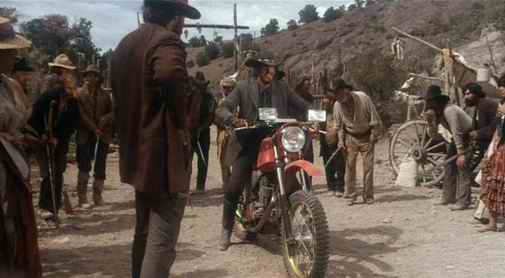
The film -- which opened theatrically in December of 1982 and later became a staple of cable television in the 1980s -- is an almost mellow "fish out of water" Western adventure involving motorcycle racer, Lyle Swann (Fred Ward), as he travels back in time to November 5, 1877, fights some nasty bandits, and beds a super-hot woman, Claire (Belinda Bauer) who turns out to be, well, the "great matriarch" of his own genetic line.   

Timerider is a minor epic at best, perhaps, yet features moments that any aficionado of low-budget cult movies is certain to enjoy and remember with affection.  The movie just kind of rolls along from one situation to the next with humor, even if the whole thing doesn't ever coalesce into being a truly "great" or classic film.

"As far as I'm concerned, this place is history..."

In Timerider, the vaguely sinister corporation "International Computel" plans its sixteenth experiment in time travel, but the first one involving a living life form.  In this case, that life form is a rhesus monkey.   

Unfortunately, Lyle Swann is racing in the Baja 1000 at the same time as these unusual time experiments in the Mexican desert are slated to occur, and is zapped into the year 1877...along with the monkey.  

Once in the past, Swann takes an unusually long time to realize that he has traveled back in time over a century, even though the unwashed locals consider the red-suited rider "El Diablo," and his motorcycle a "fire horse."  

Soon, a gorgeous female adventurer, Claire Cygne, falls for Lyle, and shelters him from a gang of bandits, led by the diabolical Reese (Peter Coyote).  Reese and his partners in crime (played by Tracey Walter and Richard Masur) are bound and determined to steal Lyle's futuristic machine for their own nefarious purposes.

When Claire is captured by the bandits, Lyle joins up with a "padre" (Ed Lauter) and two U.S. marshals to take down Reese and his gang.

"You're the strangest woman I've ever met..."

In some important dramatic sense, Timerider is a quart-low on both anxiety and ambition.  

The film boasts what we would no doubt consider a lackadaisical pace in today's hyper-accelerated media environment.  The first several minutes of Timerider simply showcase Lyle riding his motorcycle in the picturesque desert to vintage 1980s synthesizer music (courtesy of producer Michael Nesmith).

And yet despite the lack of a driving pace, there's ultimately something pretty refreshing about Timerider's laid-back attitude towards, well, everything.  

Timerider doesn't push hard in any sense, and so the movie, at times, plays as extraordinarily funny, especially in the numerous culture clash or "fish out of water" scenes.  The low-key approach means that we discover the film's sense of humor for ourselves, and Timerider feels more rewarding because of that sense of personal discovery.   

Specifically, the director, William Dear, boasts a quirky and dynamic way of dramatizing critical moments.  One composition, involving the after-effects of a bandit's unfortunate encounter with a whirring helicopter propeller, is especially memorable and amusing.  All that remains are the bad guy's (shredded) boots...

In addition, Fred Ward and Belinda Bauer share some electric romantic chemistry in the film, and each time their two characters get together (*ahem*) and stop talking about the plot, the film dramatically picks up.  The relationship between Lyle and Claire represents the heart of the film, and watching these scenes, it's a wonder to me that Bauer was never a bigger star.  It's not just that she's absolutely, drop-dead gorgeous.  It's that Bauer's screen presence conveys a fetching brand of cunning intelligence and individual strength.  

Without a doubt, Claire is the most intriguing and interesting character in Timerider, a woman who, after the Civil War, was left to fend for herself.  She had to decide whether she wanted to "use her body," or "use a gun" to survive the West.  She picked a gun, and in the course of the film, Claire demonstrates her gun-fighting skills by shooting off a bandit's nose.  

But in Bauer's capable hands, Claire is capable, sexy, smart, and more than a little mysterious, especially in her final, almost inscrutable gesture.  That action, in a sense, creates a new world (or at least, sets one in motion...).

If Claire is mysterious, strong, smart, cunning, gorgeous and supremely hot beyond all reckoning, Lyle Swann isn't as carefully presented.  Fred Ward -- in slick long hair and wearing a red jacket that make him look like Michael Jackson in the Thriller video -- is a fine actor, and does a capable job playing Swann.  However, the movie never lets Swann be as smart as he should be.  Basically, until he meets Claire, Swann is given to saying things like "What the hell is the matter with everybody?" and asking if he can use the nearest telephone.  The script plays him as dumb, clueless, and out of it.  The gun holsters, the cowboy hats, the horses, and the general lack of technology all around him never seem to sink in.  In fact, it's unclear during Timerider when precisely Swann realizes he's traveled back in time.  Claire mentions the Civil War, and Swann writes her off as "crazy."

The movie has some difficulties with plausibility too. Swann's motorcycle never runs out of gas until the end of the movie, for one thing, which doesn't make a lot of sense given all the riding he does.  And there are occasional moments of  incompetence to boot. In one close-up shot of considerable duration, for instance, you can clearly see the cameraman's reflection in Swann's motorcycle helmet.  Oops.

In terms of theme, Timerider plays lightly (and again, almost casually) with the notion of a motorcycle showing up in the Old West and shocking the hell out of folks.  The locals react in fear and horror to the noises and lights of the 20th century vehicle, and in one of the film's funnier moments (played absolutely straight, again), an old bandit dies from fright when Lyle Swann shines a flashlight upon him.  Other culture clash moments are equally amusing (and underplayed), such as the instance wherein Swann offers a U.S. marshal (Chris Mulkey) an energy bar to perk him up.

I suppose the quality that most distinguishes Timerider is the cast.  Here, we've got Fred Ward, Belinda Bauer, Ed Lauter, Chris Mulkey, Peter Coyote (E.T.), Richard Masur (John Carpenter's The Thing), Tracey Walter (Blade Runner) L.Q. Jones, and in a small role, Miguel Sandoval.  Talk about a great B-movie assortment of actors, huh?   They are all well-directed here, because every performer underplays perfectly, so that the film's sense of humor emerges naturally, rather than feeling as though it was extruded by committee decision-making.

I had planned to also write  here about the ways that Timerider is a variation on Clint Eastwood's Man with No Name films, explicitly involving a "stranger" who rides into town, battles the bad guys, metes justice, and sets things right. 

That broad story is certainly a template for this film, but Timerider perpetually and purposefully de-mythologizes the tale.  Lyle is just a "dude" on a bike, not an enigmatic hero, and he never really seems to get a good sense of what's happening around him, or even why it is happening.  I believe that this almost anti-heroic approach was intentional: a kind of deconstruction of the Western myth that reveals, perhaps, how circumstances make the man, not how a hero uses his innate qualities to achieve a positive outcome.  In other words, Timerider appears an early (but notable) inversion of the Campbell Monomyth or heroic journey.  Here, Swann may be destined for an heroic quest, but he's more like an innocent bystander on his own journey, rather than a deliberate mover and shaker.  He's a timer-ider, not a time-driver, if you get my drift.

If Timerider deliberately de-mythologizes the Western format, it does likewise for time travel movies.  Part of the common time travel aesthetic is "not changing the past" so as to "ensure the sanctity of the present."  Timerider takes the alternate point of view that instances of time travel are already factored into our existing history.  Lyle had to go back in time to bed Claire Cygne and therefore his assure his own birth.  Had he not gone back, he wouldn't exist.  To put it another way, Lyle doesn't change history by his presence.  His presence is already part of the established equation.  His journey, though seemingly accidental, is pre-destined.

The film's final revelation, that Claire is actually both Lyle's ancestor and also the mother-to-be of his child (!) is a bit weird, I'll readily admit, but it also exposes Timerider's ethos regarding time travel.  Essentially, the film is a re-iteration of the old canard about going back in time and accidentally marrying your grandmother or killing your grandfather.  Timerider plays the joke -- like just about everything else in the film -- as a long, shaggy dog story. 

Time travel fans will also note that Lyle's good luck charm -- a necklace -- represents a paradox (like Kirk's glasses in Star Trek IV: The Voyage Home).  Lyle travels back in time and Claire takes the necklace from him.  She then passes it onto her children, who pass it on to young Lyle, their descendants.  Given this "loop," where did the necklace originate?  Or rather, who made it?  Another question: why do so many time travel movies select the date of November 5th for temporal adventuring?   Timerider shares this date in common with Time After Time (1979) and Back to the Future (1985) apparently. 

I don't think that Timerider has the answer to those questions, or any other important question about time travel, frankly.  Instead, what the movie suggests is that -- through dumb luck and fate -- we sometimes ride ride right into...our destiny.  Nothing wrong with that idea, and Timerider never takes itself, or its ideas too seriously.   In fact, this genre flick from 1982 is like a nice, cool breeze blowing by you in the desert. 

Timerider: The Adventure of Lyle Swann is a pretty enjoyable - if ephemeral -- experience.


Monday, August 08, 2011

The Cult-TV Faces of: the Time Traveler


Identified by Hugh: Russell Johnson in The Twilight Zone: "Back There."


Identified by Hugh: William Hartnell is The Doctor in Doctor Who: "An Unearthly Child."


Identified by Will: Michael Ansara as Quarlo in The Outer Limits: "Soldier"


Identified by Hugh: Tony (James Darren) and Doug (Robert Colbert) in The Time Tunnel (1966).


Identified by woodchuckgod: Dr.  McCoy (De Forest Kelley) in Star Trek: "City on the Edge of Forever."


Identified by Hugh: Enik (Walker Edmiston) in Land of the Lost: "The Stranger."


Identified by Hugh: Commander Koenig (Martin Landau) in Space:1999 "Journey to Where."


Identified by Will: David Eakins (Paul Shenar) in Logan's Run: "Man out of Time."


Identified by Hugh: Phineas Bogg (John-Erik Hexum) and Jeffre (Meeno Peluce) in Voyagers!


Identified by Hugh: Patrick Stewart and Patrick Stewart in ST: TNG: "Time Squared."


Identified by Hugh: Sam Beckett (Scott Bakula) in Quantum Leap.


Identified by Hugh: Bill Preston Esq. (Evan Richards) and Theodore Logan (Christopher Kennedy) in Bill & Ted's Excellent Adventure (1992).


Identified by Hugh: Darien Lambert (Dale Midkiff) in Time Trax.


Identified by Will: Officer Jack Logan (Ted King) in Time Cop (1997).


Identified by Claudiu: Lt. Frank Parker (Jonathan La Paglia) in Seven Days.


Identified by woodchuckgod: Admiral Kathryn Janeway (Kate Mulgrew) in ST: Voyager: "Endgame."


Identified by Hugh: Eliza Dushku as Tru in Tru Calling.


Identified by Claudiu: Temporal Agent Daniels (Matt Winston): ST: Enterprise: "Storm Front." 


Identified by Claudiu: Chuck Taggart (Peter Weller) in Odyssey 5 (2002).


Identified by Will: Dan Vasser (Kevin McKidd) in Journeyman (2007)


Identified by Hugh: Sam Tyler (John Simm) in Life on Mars.


Saturday, November 15, 2008

CULT TV FLASHBACK # 63: The Time Tunnel (1966-1967)


"Two American scientists are lost in the swirling maze of past and future ages, during the first experiments on America's greatest and most secret project...the Time Tunnel..."

-opening narration to Irwin Allen's temporal opus, The Time Tunnel (1966-1967)

Love him or hate him, it's fair to state that producer Irwin Allen boasted a unique and distinctive take on science fiction television throughout the 1960s. His genre programs are undeniably kiddie-oriented, but they also reflect (in an almost reflexive, unthinking way...) a major philosophical conflict of the epoch.

In particular, Allen's adventurous cathode ray tube fantasies straddled the line between almost hysterical "technophobia" -- the fear that new inventions (like nuclear weapons or computers) would annihilate us outright, or at least put us out of work -- and, oppositely, the age's burgeoning Camelot/Kennedy-style "can do" optimism. This was, after all, the dawning of the Apollo Age; a period in which America's space program would achieve what was once believed impossible: a trip to the moon.

If you gaze across the wide array of Allen's TV programming from this age, you can detect how this unusual conflict plays out in various forms and colors. In Lost in Space (1965-1968), the future man of 1997 was able to reach the stars in advanced spaceships (such as the Jupiter 2) and build robots with human personality and individuality (like the bubble-headed booby...) but the first space flight also became hopelessly and irrevocably lost in the stars.

In Land of the Giants (1968 - 1970), the same conflict between technophobia and techno confidence was also present. In that series, man has developed (by the far-flung year of 1983...) high-tech "sub-orbital" spaceships like The Spindrift...but it still plows goes through a storm and ends up marooned on a planet of giants.


And in The Time Tunnel (1966-1967) -- which has aptly been described as "Lost in Time" -- mankind has developed the technology to conduct time travel at a top-secret facility (a huge subterranean complex in the Arizona desert...). But the behemoth, when activated, almost immediately misplaces two scientists (Dr. Doug Phillips and Dr. Tony Newman) in the corridors of time. Permanently.

On one hand: technological achievement and advancement. On the other, technological terror plus error. What these Irwin Allen speculative programs seem to tell us, I suppose, is that humans boast the intellect and skill to create amazing devices; but not the wisdom, perhaps, to adequately control them.

Of all Allen's storied sci-fi series, The Time Tunnel was perhaps the least successful on its original sortie. It aired for just a single season of 30 hour-long episodes on ABC. Broadcast from September 9, 1966 to April 7, 1967, the series involved the aforementioned scientists -- Newman (James Darren) and Phillips (Robert Colbert) -- tumbling (literally...) through various historical (and future!) time periods, a circumstance which enabled the series to frequently re-use footage and costumes from such films as Titanic (1953), The Buccaneer (1958) and Khartoum (1966).

Despite this crafty, cost-saving measure, the Time Tunnel pilot was still one of the most expensive ever produced at the time, costing a then-whopping $500,000 dollars. You can readily observe where all the considerable expense went in the pilot episode: there are some amazing matte-paintings of the Time Tunnel complex...the whole facility looks like it was outsourced to Krell construction workers. Also, the Time Tunnel control room set is vast and impressive: a testament to 1960s-style futurism. There are banks of giant computers with lots of blinking lights, and that massive, whirly-gig tunnel itself taking center stage. The visual effects are opulent too, particularly views of the lead actors somersaulting through a moving, glittering temporal vortex.

The Time Tunnel's first episode, "Rendezvous with Yesterday" (written by Harold Jack Bloom and directed by Irwin Allen), features guest star Gary Merrill as Senator Clark, a budget-obsessed politician who visits Project Tic-Toc (location of the Time Tunnel device...) in the Arizona desert. The colossal underground complex, which houses over 12,000 technicians and stretches over 800 floors, has already cost the U.S. government a whopping 7.5 billion dollars (hey, less than the monthly cost of our presence in Iraq!) This is simply unacceptable!

"Is time travel worth it?"
Senator Clark asks pointedly.

The response from Dr. Phillips is that time travel is "potentially the most valuable treasure man will ever find."

Still, the impatient senator isn't convinced that time travel is a worthwhile endeavor, and he demands a demonstration of the not-yet-operational time tunnel. Scientist Tony Newman impulsively complies and -- without permission or preparation -- jumps through the machine. The result? Lots of smoke and explosions. And then Tony lands on the HMS Titanic on April 13, 1912, just hours before the "unsinkable" liner is destined to strike an iceberg and go to a watery grave.

D'oh!

Unfortunately, the techs at Project Tic-Toc, including the lovely Dr. Ann McGregor (a woefully underutilized Lee Meriwether), can't return Tony to the present. Not even with their high-tech "location probes" or other tools. They are able, however, to visualize Tony's chronological location with a "tele screen." And, as a last resort, the technicians can also yank Tony out of one time period and into to another random one...and hope they get lucky.

It's sort of...a temporal crap shoot.

Back aboard the Titanic, Newman realizes the heart does go on, and immediately attempts to change the time line by warning the ship's captain, a regal Michael Rennie, of the impending disaster. The captain doesn't believe Newman's stories and voices a variation of a line oft-repeated on this series; something along the lines of: "you don't expect me to believe that wild story, do you?"

One might also note, at this juncture, that Tony seems to have no preparation or schooling whatsoever for the event of actual "time displacement." He's one of the key designers/inventors of the time tunnel juggernaut and yet he has no plan, no philosophy, no agenda whatsoever about dealing with the temporally-challenged natives of other time periods. Apparently on instinct, he simply warns people about the future and is immediately incarcerated or beaten-up for his trouble (another tiresome convention that is repeated throughout the series).

Now, my point here is simply this: whether or not time can actually be altered, why does Tony want to change the flow of time at all? Was the time tunnel constructed so that the American government can interfere in the past? I mean, if the captain of the Titanic had actually listened to Tony's warning and averted the nautical disaster, some several hundred additional souls would have survived the maiden voyage and thereby altered Tony's entire time-line (since he is born in 1938, after the Titanic accident).

Let me make this even more basic: what if one of those "new" Titanic survivors caused a car accident that killed Tony's Mom before she gave birth to him? See my point?

Besides wanting personally to survive the Titanic disaster (and I don't blame him for that...), what could possibly motivate Tony to reveal the details of the future to the denizens of 1912? When Doug returns to the past next, he mindlessly adopts the same plan. He even brings a newspaper from the day after the disaster to convince the Captain of Tony's veracity. I mean...jeez, what's the end game here? Saving the Titanic? Changing the course of 20th century history? Altering the time line? What?

Closely examined, the motives of the characters in this story make no sense. By my reckoning, Tony and Doug should be focused on one thing: keeping a low profile and escaping the disaster. They don't need to be sounding alarm bells, and they sure as hell don't need to commandeer the Titanic's radio room! One might expect more dispassion and weighing of variables here. Especially from two genius scientists, right?

It occurs to me while watching The Time Tunnel that the series would have been much more interesting (not to mention a bit more intelligent), if in stories like "Rendezvous with Yesterday," the heroes had to preserve the flow of time as they had already experienced it. Wouldn't it have been more interesting if Tony and Doug landed on the deck of the Titanic and realized it wasn't going to sink at all? That they had to aim it at an iceberg themselves, to ensure that their histories remained sacrosanct? I realize there would be moral questions there, but they'd still be "heroes" in the conventional TV sense, since they'd be preserving our chronology.

Oh wait, this was the premise for Voyagers (1980)...

Anyway, I'm not trying to be dismissive of The Time Tunnel. It is what it is: a product of the time period from which it arose (the 1960s), and for a very specific audience (children). It's harmless escapist fantasy, nothing more...and if you saw it as a child, I'm sure you would get a nostalgic rush watching it. That established, it's not a very smart series by today's standard (and remember, Star Trek was a smart series, and it also aired in 1966). Oh, there's definitely an occasional moment of real drama here, such as the instance in "Rendezvous with Yesterday" when Doug and Tony must inform the captain of the Titanic that he is destined to die that very night. However, for the most part, time travel mysteries and human emotions are curtailed, slighted, or outright ignored in favor of James Bondian fisticuffs and action. It's all cowboys, Indians, soldiers, spies, aliens, and disasters.

During the over-two-dozen episodes of The Time Tunnel, Tony and Doug visited the "Crack of Doom" (don't laugh...), the volcanic eruption at Krakatoa on August 27, 1883. They went to Pearl Harbor on December 6, 1941 (but didn't encounter the U.S.S. Nimitz there....) They experienced the French Revolution first hand ("Reign of Terror), averted the (first) assassination attempt on Abraham Lincoln ("The Death Trap") in 1861, witnessed D-Day ("Invasion") at Normandy, met General Custer ("Massacre"), Billy the Kid ("Billy the Kid") and...Robin Hood ("The Revenge of Robin Hood.")

Yes, before watching The Time Tunnel, I too always thought Robin Hood was a mythical hero, not a historical one, but who's counting? Another episode "One Way to the Moon," landed our wayward heroes on a rocket ship in flight, one bound for Mars...with a saboteur aboard.

As the series wore on, The Time Tunnel increasingly lapsed into empty-headed, monotonous phantasmagoria. The final episode, "Town of Terror" was set in the future year of 1978 and involved strange aliens with tin-foil faces and black capes who, for some unfathomable reason, are referred to as "androids"(!). These fishy-looking invaders -- rejects, apparently from Lost in Space -- had taken over the idyllic town of Cliffport, Maine (population 700), where they began sucking all the oxygen from the Earth. Tony and Doug landed in the town and put a stop to the plan, but not before an alien saboteur got to Project Tic-Toc and started sucking the air out of the room there too. It takes an inordinate amount of time for the brilliant project scientist, Dr. Swain -- gasping for air -- to realize the oxygen is being depleted. Whatever...

The last moments of the series are actually the most interesting, at least from a certain perspective. Following the landing in Cliffport, Doug and Phillip are shunted back in time again...to the Titanic. Now, on one hand, this return to the beginning was no doubt a lead-in to summer reruns of the first season. However, considering that there was no second season of The Time Tunnel, viewers might interpret this twist of fate to mean that our heroes were not merely stuck in time, but trapped in a loop too. Alas, we may never know...

Again, I don't want to rain on anyone's parade here -- and all sci-fi TV has its fans and adherents -- but The Time Tunnel is tough to take seriously. The lead characters - Doug and Tony - are about as cardboard as could be, not to mention the most physically fit and physically skilled "scientists" of all-time. Some of the technobabble on the series is inconsistent too. Sometimes the scientists in the tunnel control room can talkdirectly with the time travelers on a microphone, and sometimes the men can't hear them.

And you have to wonder, too, why are the time tunnel techies always rolling the dice and scrambling these unlucky guys from one time period to another? I'll tell you what...if I came from 1968 and ended up in 1978 (as Tony and Doug did in both "One Way to The Moon" and "Town of Terror"), you know what? I'd just call it a day. I'd rather live ten years in the future,than risk ending up in 1184 BC ("Revenge of the Gods"), or 1215 AD ("The Revenge of Robin Hood.")

Close enough for government work, and all.

Tuesday, September 09, 2008

CULT MOVIE REVIEW: The Time Machine (1960)

George Pal's 1960 fantasy masterpiece is the undeniable grandfather of the time travel film genre. It's also likely one of the most popular and well-known science fiction movies ever made, pre-Star Wars. You've probably seen the movie's trademark (and titular) vehicle in movies such as Gremlins (1984), and on TV programs including Carl Sagan's Cosmos (1981) and even Leonard Nimoy's version of In Search Of (1974).

Believe it or not, the time machine itself boasts a fan base. If you've never seen it, the only way I can describe it is as a Victorian-style snow sled. It basically consists of an elaborate (padded) chair, brass siding, an oval control panel and a spinning vertical dish (rear-mounted). In whatever fashion you choose to describe the time machine, it's not merely gorgeous, it's strangely believable, both as a functional device and as a "futuristic" artifact of the long gone Victorian Age.

As you probably know, the 1960 film (with Academy Award winning special effects from Gene Warren and Wah Chang) is based on socialist H.G. Wells' 1895 speculative novella The Time Machine. Both the film and the literary work focus on one man: an eccentric London inventor, in the film named George (Rod Taylor). On December 31st, 1899, this renaissance man attempts to convince his skeptical dinner guests (including Alan Young, Whit Bissell and Sebastian Cabot) that he has indeed invented a device that can travel through time. It occupies the same space, yet moves through eras. His skeptical guests don't believe George, even after an effective demonstration of a miniature model.

After his dinner guests have departed, George and his friend Philby (Young) share a philosophical discussion. "Why the pre-occupation with time?" asks Philby sincerely. George's answer is telling. He doesn't much care for his own time, an epoch when science is called on only to invent new weapons, ones that can more efficiently "de-populate" the Earth. Not entirely unlike Taylor in Planet of the Apes, George hopes that there is a better world for man "out there." Only in this case, "Out there" is not on another planet...but in another age. Philby considers the time machine dangerous and urges the destruction of the invention. A time machine, he believes may be "tempting the Laws of Providence."

After Philby departs, George retreats to his study and activates his time machine. He stops first in 1917 and meets Philby's grown son, who tells him of the first World War with Germany. A disappointed George returns to his machine and plunges further ahead in time. On the next occasion, he arrives in the early 1940s, just as German bombs level London during the Blitz. Pushing even further ahead, George travels to 1966 just as a nuclear war between the East and West breaks out. He meets an ancient Philby in this era -- a man wearing a silver radiation suit -- who urges him to take cover in a nearby bomb shelter before "the mushrooms". George leaves this era behind just as the bombs strike and travels further ahead. Further and further...

Finally, George stops his machine in the far-flung world of 802,701 AD. Wilderness appears to have reasserted itself over the ages, save for some oddly-advanced (though damaged...) structures, like a vast dome. George soon meets the denizens of this era, the androgynous and peaceful Eloi. He learns the Eloi have no government, no economy, and now laws.

Nobody in the society works, and worse -- they don't even know how to grow their own food. The Eloi can't write or read and have grown terribly incurious. George asks some questions ("the only way man learns and develops, he says, in one of the film's many great lines of dialogue) and is escorted by the lovely Weena (Yvette Mimieux) to a library of information discs. The discs (or "talking rings" as Weena calls them...) recount for George the rest of the story: The War between East and West lasted for 326 years and poisoned all the air. Mankind splintered, with some survivors moving underground into vast caverns and some stragglers remaining in the sunlight and fresh air (what little there was of it.) This is "the hopeless future," as George terms it.
In 802,701 AD George discovers something else too. Mankind is "divided" (not united) by the ultimate class warfare. The Eloi are not alone. The inhuman, cannibalistic Morlocks live underground in caverns and feed off the simple, cattle-like Eloi. The Morlocks boast advanced technology (including running water and heat....) but are brutal, domineering, exploitative. The Eloi -- far from being "free" as George first thought-- are servants herded underground (by air horn sirens...) to serve the Morlocks.

Although the movie doesn't specify it, the novel makes clear that the fat, lazy Eloi are the descendants of the leisure class; the industrial Morlocks are "blue collar" workers. In the movie, they're also blue skinned, hairy monsters with glowing eyes.

One of the elements that makes The Time Machine such a memorable film (and one that holds up so well today..) is this social commentary about the "division" of mankind into "sides." Over the ages depicted in the film (from 1917 on...), The Time Machine reveals a mankind splintered by endless wars, conflicts apparently of ideology and nationalism. The divisions of war finally become such that there is actually a physiological schism in the race: Morlocks and Eloi no longer even share the same biology. This film suggests such division is mankind's destiny, that international wars will lead only to ruin, and a collapse of the species intellectually and physically. When Wells wrote the original novella, he was well-acquainted with Darwin's work, and it's fascinating to me that Wells pondered not an evolution of the species, but rather the devolution of our kind: a pervasive moral, intellectual and physical degradation.

Another brilliant touch I mentioned above, briefly. Specifically, the Morlock "call" for the Eloi to gather at their city entrance is the same air horn or siren noise that for generations warned humans to seek underground shelter during times of attack. That particular sound was heard so frequently throughout human history that the Eloi response has become quite literally Pavlovian in nature. The horns sound, and the Eloi drop everything and mindlessly go to the Morlocks...their enemies.

In watching many time travel films over the last several weeks, I begin to detect with some clarity how different artists have manipulated the form (on film) to depict their stories, and make their dramatic points. Time After Time balanced the idealism of an earlier age with the hectic world of "today" and played like a satire on the present (or more rightly, 1979). The Final Countdown asked questions about whether it is right and proper to interfere in history. Somewhere in Time is a more intimate approach to time travel; one in which the human mind --- and the capacity to love (romantically) -- is the impetus for such odysseys.

Pal's The Time Machine boasts another style all together; and it's entirely in keeping with the literary work and interests of Wells himself (and films such as Things to Come). Specifically, the film extrapolates about the direction we're headed. The film visualizes for the audience the changes that could happen, if we don't alter our ways. The reason to travel to the future is change the now, so the film is social commentary too, but in a far more grave sense than Time After Time. Given that this film was crafted in 1960 (during the Cold War), it is understandable that the focus here would be primarily on war and the consequences. Just think, at their ages in 1960, Time Machine writer David Duncan and director George Pal had already lived through World War I, World War II, The Korean War, and the Cold War between the Soviet Union and the United States. It was THE issue vexing us in their lifetime. There wasn't much cause for optimism.

This film was remade in 2002 by Simon Wells (yes -- a relation of H.G. Wells!) , but -- in a troubling symptom of the times -- the time traveler's journey there became an entirely "personal" one; vastly undercutting the thematic underpinnings of the tale. In that unfaithful version of the material, the time traveler's beloved fiancee had died, and he simply wanted to change that bad negative outcome. Therefore, the reasons behind time traveling in the 1960 version: curiosity, hunger for change, dissatisfaction about the present, hope for the future (balanced with warnings about what it could be...) were all essentially abandoned. I think that's a grave mistake and a betrayal of the source material.

Think about it: George, the time traveler of the 1960 version, goes to the future, and sees what we have done to ourselves as a species through our constant divisions (social and military). But he doesn't give up. He doesn't cower. Instead, he fights for the human race. Ultimately, he commits himself to the world of 802,701 and sets about the hard work of building a new culture, a new civilization. The message here, right beneath the surface: Yes we can. We might fail, we might even hover on the precipice of total destruction, but we can choose to involve ourselves; to fight. And we will succeed.

Otherwise, all the future's just a...bridge to nowhere.

Friday, September 05, 2008

CULT MOVIE REVIEW: Somewhere in Time (1980)

Very often, it seems that science fiction films are designed and mounted with a hard technological edge. It's easy to detect why this is so, and I imply no criticism of that fact.

Understandably, the specific visual nature of the cinema offers the perfect opportunity to showcase state-of-the-art special effects, fancy modern vehicles, cool costumes and colorful flourishes. And the movie - a medium primarily of action and movement (hence the descriptor "moving pictures") -- also lends itself organically to physical conflict: car chases, fisticuffs, sword-fights and the like.

Yet the upshot of this fact is that it's much easier to sell a science fiction film about laser swords, superheroes, and transforming robot armies than one authentically about the mysteries of the human heart. A reliance on instrumentation (the camera) results to a large degree in a genre medium about instrumentation (batmobiles, HAL, atom bombs, etc.)

By explicit contrast, stories of the heart are always more difficult to dramatize...and downright chancy. In or out of the genre. The looming danger in crafting a truly emotional and romantic genre film is that by necessity it appeals to the emotions, not the intellect. And, well, some hearts are irrevocably...cold. Some hearts are guarded, impenetrable. And some are so stony and unresponsive that there's absolutely nothing that can be done about it.

To the cynical, mocking ear, sweet nothings and other deeply-held admissions of romantic affection -- shared between gazing and swooning lovers -- can sound alarmingly purple in perfectly-tuned stereo. These days, we love to say that such things are "campy" or "corny" if they make a direct appeal to the heart. Witness the backlash against Titanic (1997). Recall the accusing, snickering, pointed-fingers over Anakin's "sand" speech to Amidala in Attack of the Clones (2002). These days, it's so much easier to blow up romantic leads (like Maggie Gyllenhaal) than to write heartfelt romantic dialogue for them.

Why is this so? A couple reasons, I think. But when it comes down to it, it may be this: love is a deeply personal thing, isn't it? An emotion shared between two; one not easily transmitted between the masses via a technological medium. Film, after all, is homogenized, collaborative...technical. As an audience - as a mob even - we are primed to laugh, shriek and gasp. But not necessarily, to open ourselves up; to peel away our defenses.

Yet by the same token, who can truly deny that the best movies in history- like real love itself - transcend such barriers of the medium and seem...magical. How intellectual, for instance, is "chemistry" between two actors? How is that alchemical relationship quantified in scientific terms? Film records it; film registers it; film captures it. But people (the actors involved) make it happen. Sometimes between the lines.

I raise this meditation on love and film because I had the opportunity this week to screen another 1980s time travel movie (after Time After Time and The Final Countdown). Specifically, I watched Somewhere in Time (1980), the romantic film based on Richard Matheson's 1975 novel Bid Time Return.

The premise is simply that a lonely, empty man, a writer named Richard Collier (Christopher Reeve) falls in love with a photograph of a radiant, long-dead stage actress, Elise, McKenna (Jane Seymour). He becomes so consumed with her image, in fact, that he actually hypnotizes himself into time traveling from 1980 to 1912...to court her.

In other words, this film is one romantic notion constructed upon another romantic notion, constructed upon another one. For some viewers in today's caustic pop culture, perhaps this is simply too much to accept.

Some viewers maybe. But not me.

Gazing across the vast swath of time travel films, the queue is replete with efforts that boast epic, earth-shattering concerns. What if the time traveler changes our past? What if history is altered? What if one action in the past changes everything that we have come to know? Indeed, this is the beauty, opportunity and terrain of time travel films as a format.

Yet, Somewhere in Time differentiates itself from the temporal pack by brushing aside such cosmic concerns. Here we are simply drawn into another life; another world....because of love. There are no explicit conversations about paradoxes, about time machines, or about any of the time travel boilerplate we have come to expect from the sub-genre. Rather, this film asks us to ponder a love so powerful, so out of the ordinary, that it goes beyond the veil of our reality. This element imbues Somewhere in Time with some sense of the spiritual; of the longing for the impossible in our every day lives.

A lush, impossibly affecting score from John Barry serves as our constant companion on this voyage to the distant world of 1912. The setting, a picturesque Grand Hotel, is romantic in and of itself, and the time period -- the last age of innocence and simplicity before the first "technological" war (World War I) -- also evokes feelings of innocence, simplicity and lyricism. It is a world without e-mail or television. Without cell phones or other modern distractions. Against this backdrop, a man of the present and a woman of the past fall in love before our eyes. And this is where you either accept the story the film wants to vet; or you denounce it as cheesy and corny.

And of course, some romance literature and film is legitimately cheesy. But that's because it's done poorly. I don't believe that's the case with Somewhere in Time. Specifically, director Jeannot Szwarc has crafted his film with a subtle sense of visual classicism. Many of his compositions, particularly one involving the lovers, a lighthouse, the ocean and a beached rowboat, evoke real paintings from the era. For another thing, Szwarc marshals his camera in a stately, anticipatory way. Anyone who has been separated from a lover for some length of time will know what I suggest by this. Just watch the scene (and camera work) involving Collier's first "real" view of Elise in 1912. We initially catch a glimpse of her (in long shot), in the reflection of a window-pane, and then, as Collier pivots, we cut to this beautiful and stately moving shot -- over the landscape -- as an eclipsed female figure comes slowly into view, the sea behind her. The build-up is deliberate and glorious, and if you've known love, you get it. If not...you're reading the wrong review.

After this, we're into the meat of a star-crossed love story. It's well-written, but what we're ultimately left with here is a rousing soundtrack augmenting the excellent chemistry between the two leads. The late Christopher Reeve is at his goofy, innocent best. He was always wonderful (and charming) playing the fish-out-of-water, the man slightly out-of-step with his time...and such is true here. And Seymour, an ethereal, distant beauty, melts slowly and methodically, until she delivers a rousing, theatrical monologue about love that is a high point for the actress in the film and in a career. Again, if you think it's cheesy, just consider the venue (the stage) on which this soliloquy is presented. Once more, Szwarc has done something more than modesly clever: provided a 1980s audience with an old-fashioned pronouncement of love, but through the appropriate artifice of the 1912 stage. Seen in that light, everything is as it should be.

I have concentrated in this review mostly on the romantic aspects of Somewhere in Time, and yet, in a sense that focus also does the film a disservice. Dig deeply into this movie, and you will find that it is teeming with ambiguities. For instance, ask yourself, where does the gold watch come from, originally? As the film opens in 1972, an elderly Elise McKenna gives a watch to young Richard Collier. She says the words "come back to me." After Collier has obliged, and traveled back to 1912, he gives the gold watch to Elise...so she can one day again give it to him. It's a mind-bender, because the watch seems to originate...nowhere.

Ask yourself too, what is the real role of Christopher Plummer's character, Robinson? He claims to know who Collier really is; and argues that Collier will "destroy" McKenna. In a sense, that's exactly what happens: when Collier is yanked back into the present, leaving McKenna behind...her career is ruined; she's depressed and lost. So the question becomes: is Robinson a fellow time traveler (perhaps another man who has fallen in love with that photo of Elise?) or is he merely a worried theater agent, fretting about his meal ticket? To its credit, Somewhere in Time makes absolutely no comment on this debate; it lets you sift through the clues and arrive at your own conclusion.

I remember when Somewhere in Time was first released, critics seemed to have a big problem with the idea that Collier had hypnotized himself into traveling through time. But today, after having read so much about quantum physics, II wonder why it is that we so readily accept the idea that a machine could do it. But our brains can't? I mean, a time machine is always invented by the human brain, isn't it? Our mental abilities are the root creative force in both instances. But I very much like the idea here that it is the brain - the dedicated, passionate, individual human brain - that makes the leap without benefit of hardware or instrumentation.

Because if you've ever been in love, you feel like you can move mountains with your bare hands. So why not time travel too?

30 Years Ago: Chris Carter's Millennium (October 25, 1996)

Frank Black (Lance Henriksen), his wife, Catherine (Meghan Gallagher) and their daughter, Jordan (Brittany Tiplady) move into a beautiful ye...